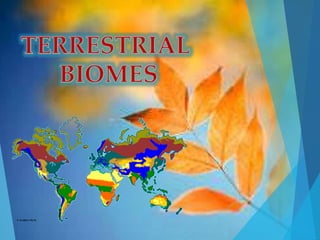
Terrestrial Biomes
Biomes are the major regional
groupings of plants and animals discernible
at a global scale.
To understand the nature of biomes one
needs to learn
 The types of animals (especially vertebrates)
characteristic of the biome
 Their typical morphological, physiological,
and/or behavioral adaptations to the
environment
 Global distribution pattern
1. Where each biome is found and
how each varies geographically
2. A given biome may be composed of
different taxa on different
continents
 The dominant, characteristic, and
unique growth forms
of the
1. vertical stratification
2. leaf shape, size, and habit
3. special adaptations
vegetation
 occupy approximately one-third
of Earth’s land area
 account for over two-thirds of
the leaf area of land plants
 contain about 70% of carbon
present in living things
 are major casualties of
deforestation, pollution, and
industrial usage
 forest biomes are classified
according to numerous
characteristics, with seasonality
being the most widely used
Location: Found near
equator…little variation in
temperatures. No distinct
seasonal changes.
Earth's most complex
land biome
TROPICAL RAIN
FOREST
Abiotic factors
high biodiversity and
biomass
both hot and moist;
ideal for bacteria and other
microorganisms; they
quickly decompose matter
on the forest floor allowing
nutrients to be recycled.
<1 cm of topsoil
About 100 in/yr of rainfall
TROPICAL RAIN
FOREST
Plant Adaptations
Sunlight is a major
limiting factor
Plants grow in layers
(canopy receives most
light)
Shallow, wide roots
since soil is so thin and
poor in nutrients
Little sun reaches the
floor
TROPICAL RAIN
FOREST
Animal
Adaptations
 Many animals are
specialists and require
special habitat
components to survive.
 Camouflage is common
 Many symbiotic
relationships
 Live in different
levels of canopy
Slender Loris
Silvery Gibbon
Wagler’s Pit Viper
 Humans strip the rainforests for
uses including logging and cattle
ranching.
 Clearing for agriculture, timber
and urban development
 Conversion of diverse forest to
tree plantations.
 Damage from off-roads vehicles.
 Pollution of forest streams
 Timber and mineral extraction
Transparent
Butterfly
Toucan
Red-eyed frog
Tanager
White Faced
Monkey
Tropical King
Snake
A. Prevention
 Protect the most diverse and endangered
areas.
 Educate settlers about sustainable
agriculture and forestry.
 Subsidize only sustainable forest use
 Certify sustainable grown timber
 Reduce Poverty
 Slow population growth
B. Restoration
 Encourage regrowth through
secondary succession
 Rehabilitate degraded areas
 Concentrate farming and ranching
in already cleared areas
Location:
 found in temperate
zone (about 480 North
latitude)
 Much of the human
population lives in this
biome
TEMPERATE
DECIDUOUS FOREST
Abiotic factors
 Well-defined seasons with a
distinct winter characterize this
forest biome
 Moderate climate and a growing
season of 140-200 days during 4-6
frost-free months distinguish
temperate forests
 Temperature varies from -30° C to
30° C.
Plant Adaptations
 Canopy
 Moderately dense
 Allows light to penetrate
 Resulting in well-developed and
richly diversified understory
vegetation and stratification of
animals
 Flora is characterized by 3-4 tree
species per square kilometer
 Trees are distinguished by broad
leaves that are lost annually
Willow
Oak
Beech
Mapple
Animal Adaptations
Animals living within this
biome must adjust to cold winters
and hot summers by hibernating,
migrating, or keeping active all
winter.
Least Weasel
Raccoon White-tailed Deer
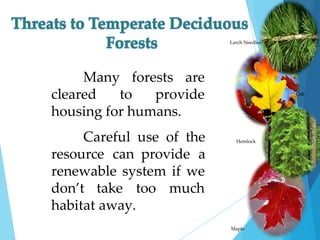
Many forests are
cleared to provide
housing for humans.
Careful use of the
resource can provide a
renewable system if we
don’t take too much
habitat away.
Larch Needles
Oak
Hemlock
Maple
Location: Found only in
Northern Hemisphere
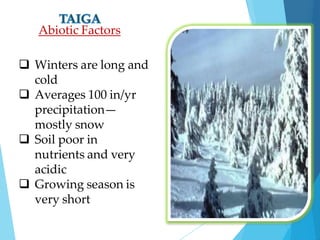
Abiotic Factors
 Winters are long and
cold
 Averages 100 in/yr
precipitation—
mostly snow
 Soil poor in
nutrients and very
acidic
 Growing season is
very short
Plant Adaptations
 Coniferous (needle-
bearing) trees are
abundant
 Roots long to anchor
trees
 Needles long, thin and
waxy
 Low sunlight and poor
soil keeps plants from
growing on forest floor
Fire Weed
Balsam Fir
Dauglas Fir
Black Spruce


Mining
operations can
irreparably
damage this
fragile
ecosystem.
Pollution left
behind can also
put animals and
plants at risk.
Moose
Great Grey Owl
Hemlock
Lynx
Characterized as lands
dominated by grasses rather
than large shrubs or trees.
Largest land animals are
present due to huge vegetation.
Grasslands are big open spaces.
There are not many bushes in
the grassland. Trees are found
only by rivers and streams.
Wheat Grass Coneflower Kangaroo Paws Tumble Weed
Always found in warm or hot
climates where the annual rainfall is
from about 50.8 to 127 cm (20-50
inches) per year
Characterized by a continuous
cover of perennial grasses, often 3 to 6
feet tall at maturity
Many plants have thorns
and sharp leaves to protect
against predation.
Reproduce during rainy
season—ensures more young survive
Whistling Thorn
Chacma Baboon
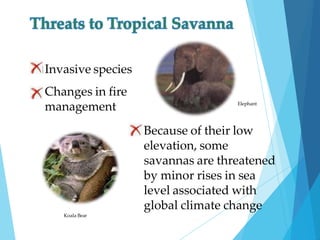
Invasive species
Changes in fire
management
 Because of their low
elevation, some
savannas are threatened
by minor rises in sea
level associated with
global climate change
Elephant
Koala Bear
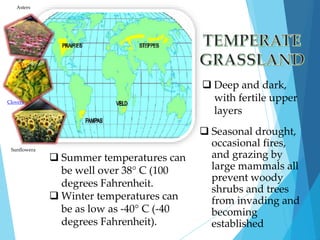
 Summer temperatures can
be well over 38° C (100
degrees Fahrenheit.
 Winter temperatures can
be as low as -40° C (-40
degrees Fahrenheit).
 Deep and dark,
with fertile upper
layers
 Seasonal drought,
occasional fires,
and grazing by
large mammals all
prevent woody
shrubs and trees
from invading and
becoming
established
Asters
Clovers
Sunflowera
Overgrazing…nomadic tribes
have started to spend more time
in one location,


Infrastructure development
(roads, buildings, etc)
Unmanaged hunting and
poaching is destroying herds of
animals
Lynx
Corsac Fox
Praire Dogs
bobcat Wild Goat
King Protea
 Coldest of all the biomes
 Comes from the Finnish
word tunturia, meaning
treeless plain
 Frost-molded landscapes
 Extremely low
temperatures
 Little precipitation
 Poor nutrients
 Average winter temperature
is -34° C (-30° F)
 Average summer
temperature is 3-12° C (37-54°
F) which enables this biome
to sustain life.
 yearly precipitation,
including melting snow, is 15
to 25 cm (6 to 10 inches)
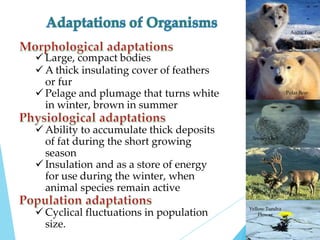
 Large, compact bodies
 A thick insulating cover of feathers
or fur
 Pelage and plumage that turns white
in winter, brown in summer
 Ability to accumulate thick deposits
of fat during the short growing
season
 Insulation and as a store of energy
for use during the winter, when
animal species remain active
 Cyclical fluctuations in population
size.
Arctic Fox
Polar Bear
Snowy Owl
Caribou
Yellow Tundra
Flower
Deserts cover about one fifth of the Earth’s surface
and occur where rainfall is less than 50 cm/year.
Most deserts occur at low latitudes
amount of
specialized
Most deserts have a considerable
specialized vegetation, as well as
vertebrate and invertebrate animals.
Abiotic Factors
 Less than 10 in./year of rain
 Little to no topsoil due to
high winds.
 Minerals not deep in soil.
 Too dry for decay
 While there are many types
of deserts, they all share one
characteristic: They are the
driest places on Earth!
Plant/Animal
Adaptations
 Spines
 Succulents
 Thick, waxy
cuticle
 Shallow, broad
roots
 Get water
from food
 Thick outer
coat
 Burrow
during day
 Large ears
 Smaller
animals
means less
surface area
BarrelCactus
Ocotillo
Sonoran Desert
Bobcate
Javelina
Armadillo Lizard
 Residential development
 Off road recreational
activities destroy habitat
for plants and animals.
Some plants are
removed by collectors,
endangering the
population.

Prickly Pear Cactus
Thorny Devil
Saguaro Cactus
Cactus Wren
http://www.ucmp.berkeley.edu/glossary/gloss5/biome/index.html
http://www.enchantedlearning.com/biomes/marsh/freshwater.sht
ml
http://mbgnet.mobot.org/
http://www.runet.edu/~swoodwar/CLASSES/GEOG235/biomes/i
ntro.html
http://archive.globe.gov/sda-
bin/wt/ghp/tg+L(en)+P(seasons/Miniinvestigation)
http://www.panda.org/about_wwf/where_we_work/ecoregions/gl
obal200/pages/home.htm
Envisci 9.pptx

Envisci 9.pptx

  • 1.
  • 2.
    Biomes are themajor regional groupings of plants and animals discernible at a global scale. To understand the nature of biomes one needs to learn  The types of animals (especially vertebrates) characteristic of the biome  Their typical morphological, physiological, and/or behavioral adaptations to the environment
  • 3.
     Global distributionpattern 1. Where each biome is found and how each varies geographically 2. A given biome may be composed of different taxa on different continents  The dominant, characteristic, and unique growth forms of the 1. vertical stratification 2. leaf shape, size, and habit 3. special adaptations vegetation
  • 6.
     occupy approximatelyone-third of Earth’s land area  account for over two-thirds of the leaf area of land plants  contain about 70% of carbon present in living things  are major casualties of deforestation, pollution, and industrial usage  forest biomes are classified according to numerous characteristics, with seasonality being the most widely used
  • 7.
    Location: Found near equator…littlevariation in temperatures. No distinct seasonal changes. Earth's most complex land biome
  • 8.
    TROPICAL RAIN FOREST Abiotic factors highbiodiversity and biomass both hot and moist; ideal for bacteria and other microorganisms; they quickly decompose matter on the forest floor allowing nutrients to be recycled. <1 cm of topsoil About 100 in/yr of rainfall
  • 9.
    TROPICAL RAIN FOREST Plant Adaptations Sunlightis a major limiting factor Plants grow in layers (canopy receives most light) Shallow, wide roots since soil is so thin and poor in nutrients Little sun reaches the floor
  • 10.
    TROPICAL RAIN FOREST Animal Adaptations  Manyanimals are specialists and require special habitat components to survive.  Camouflage is common  Many symbiotic relationships  Live in different levels of canopy Slender Loris Silvery Gibbon Wagler’s Pit Viper
  • 11.
     Humans stripthe rainforests for uses including logging and cattle ranching.  Clearing for agriculture, timber and urban development  Conversion of diverse forest to tree plantations.  Damage from off-roads vehicles.  Pollution of forest streams  Timber and mineral extraction Transparent Butterfly Toucan Red-eyed frog Tanager White Faced Monkey Tropical King Snake
  • 12.
    A. Prevention  Protectthe most diverse and endangered areas.  Educate settlers about sustainable agriculture and forestry.  Subsidize only sustainable forest use  Certify sustainable grown timber  Reduce Poverty  Slow population growth B. Restoration  Encourage regrowth through secondary succession  Rehabilitate degraded areas  Concentrate farming and ranching in already cleared areas
  • 13.
    Location:  found intemperate zone (about 480 North latitude)  Much of the human population lives in this biome TEMPERATE DECIDUOUS FOREST Abiotic factors  Well-defined seasons with a distinct winter characterize this forest biome  Moderate climate and a growing season of 140-200 days during 4-6 frost-free months distinguish temperate forests  Temperature varies from -30° C to 30° C.
  • 14.
    Plant Adaptations  Canopy Moderately dense  Allows light to penetrate  Resulting in well-developed and richly diversified understory vegetation and stratification of animals  Flora is characterized by 3-4 tree species per square kilometer  Trees are distinguished by broad leaves that are lost annually Willow Oak Beech Mapple
  • 15.
    Animal Adaptations Animals livingwithin this biome must adjust to cold winters and hot summers by hibernating, migrating, or keeping active all winter. Least Weasel Raccoon White-tailed Deer
  • 16.
    Many forests are clearedto provide housing for humans. Careful use of the resource can provide a renewable system if we don’t take too much habitat away. Larch Needles Oak Hemlock Maple
  • 17.
    Location: Found onlyin Northern Hemisphere
  • 18.
    Abiotic Factors  Wintersare long and cold  Averages 100 in/yr precipitation— mostly snow  Soil poor in nutrients and very acidic  Growing season is very short
  • 19.
    Plant Adaptations  Coniferous(needle- bearing) trees are abundant  Roots long to anchor trees  Needles long, thin and waxy  Low sunlight and poor soil keeps plants from growing on forest floor Fire Weed Balsam Fir Dauglas Fir Black Spruce
  • 20.
      Mining operations can irreparably damage this fragile ecosystem. Pollutionleft behind can also put animals and plants at risk. Moose Great Grey Owl Hemlock Lynx
  • 21.
    Characterized as lands dominatedby grasses rather than large shrubs or trees. Largest land animals are present due to huge vegetation. Grasslands are big open spaces. There are not many bushes in the grassland. Trees are found only by rivers and streams. Wheat Grass Coneflower Kangaroo Paws Tumble Weed
  • 22.
    Always found inwarm or hot climates where the annual rainfall is from about 50.8 to 127 cm (20-50 inches) per year Characterized by a continuous cover of perennial grasses, often 3 to 6 feet tall at maturity Many plants have thorns and sharp leaves to protect against predation. Reproduce during rainy season—ensures more young survive Whistling Thorn Chacma Baboon
  • 23.
    Invasive species Changes infire management  Because of their low elevation, some savannas are threatened by minor rises in sea level associated with global climate change Elephant Koala Bear
  • 24.
     Summer temperaturescan be well over 38° C (100 degrees Fahrenheit.  Winter temperatures can be as low as -40° C (-40 degrees Fahrenheit).  Deep and dark, with fertile upper layers  Seasonal drought, occasional fires, and grazing by large mammals all prevent woody shrubs and trees from invading and becoming established Asters Clovers Sunflowera
  • 25.
    Overgrazing…nomadic tribes have startedto spend more time in one location,   Infrastructure development (roads, buildings, etc) Unmanaged hunting and poaching is destroying herds of animals Lynx Corsac Fox Praire Dogs bobcat Wild Goat King Protea
  • 26.
     Coldest ofall the biomes  Comes from the Finnish word tunturia, meaning treeless plain  Frost-molded landscapes  Extremely low temperatures  Little precipitation  Poor nutrients  Average winter temperature is -34° C (-30° F)  Average summer temperature is 3-12° C (37-54° F) which enables this biome to sustain life.  yearly precipitation, including melting snow, is 15 to 25 cm (6 to 10 inches)
  • 27.
     Large, compactbodies  A thick insulating cover of feathers or fur  Pelage and plumage that turns white in winter, brown in summer  Ability to accumulate thick deposits of fat during the short growing season  Insulation and as a store of energy for use during the winter, when animal species remain active  Cyclical fluctuations in population size. Arctic Fox Polar Bear Snowy Owl Caribou Yellow Tundra Flower
  • 28.
    Deserts cover aboutone fifth of the Earth’s surface and occur where rainfall is less than 50 cm/year. Most deserts occur at low latitudes amount of specialized Most deserts have a considerable specialized vegetation, as well as vertebrate and invertebrate animals.
  • 29.
    Abiotic Factors  Lessthan 10 in./year of rain  Little to no topsoil due to high winds.  Minerals not deep in soil.  Too dry for decay  While there are many types of deserts, they all share one characteristic: They are the driest places on Earth!
  • 30.
    Plant/Animal Adaptations  Spines  Succulents Thick, waxy cuticle  Shallow, broad roots  Get water from food  Thick outer coat  Burrow during day  Large ears  Smaller animals means less surface area BarrelCactus Ocotillo Sonoran Desert Bobcate Javelina Armadillo Lizard
  • 31.
     Residential development Off road recreational activities destroy habitat for plants and animals. Some plants are removed by collectors, endangering the population.  Prickly Pear Cactus Thorny Devil Saguaro Cactus Cactus Wren
  • 32.