Landscape ecology in
Action
Book Review
By- Bhupendra Pratap Singh
(2013bpln010)
Madhavi Nikose
Author- Almo Farina
CONTENTS
• Author-Almo Farina
• The birth of Landscape Ecology
• Definition of Landscape
• The Dimension of a Landscape
• Landscapes Typologies and
Functions
• Conclusion
Author-Almo
FarinaProfessor of Ecology , Faculty of Environmental Sciences, The University of
Urbino, Campus Scientifico
Education: Doctor in Natural Sciences, Pisa University June,1974
Member of :
International Association for Ecology
International Association for Landscape Ecology
American Association for Landscape Ecology
Major research activities: Landscape ecological studies, Land
abandonment of upland areas and effects on landscape and fauna, GIS
and expert systems for wildlife management. Relationship between birds
and landscape, Landscape changes and effects on biodiversity. Theories
in landscape ecology. Cognitive landscape ecology. Eco-semiotic approach
in the study of landscape complexity.
The Birth of Landscape Ecology
Landscape ecology was coined by German geographer Carl Troll in 1939.
1st has its roots in Europe, especially in the northern part (Germany), and the
second in North America (Farina 1993).
Landscape ecology is the science of studying and improving relationships between
ecological processes in the environment and particular ecosystems.
This is done within a variety of landscape scales, development spatial patterns,
and organizational levels of research and policy.
Landscape ecology seems, today to be one branch of ecology that can strongly
contribute to the study of complexity (physical, biological and ecological).
Definition of Landscape
"The total spatial entity of human living space" (Troll 1968).
“Landscapes dealt with in their totality as physical, ecological and geographical
entities, integrating all natural and human ("caused") patterns and processes"
(Naveh 1987).
"Landscape as a heterogeneous land area composed of clusters of interacting
ecosystems is repeated in similar form throughout' (Forman & Godron 1986).
"A particular configuration of topography, vegetation cover, land use and
settlement patterns which delimits some coherence of natural and cultural
processes and activities" (Green et at 1996).
The Dimension of a Landscape
Scaling the landscape
Dimension, size and location of a landscape are determined by processes patterns
and organisms in which we hare interested in investigating, describing, managing,
and manipulating.
In conclusion, individuals, populations and communities are entities that have scalar
relationships with the landscape.
Scaling communities within the landscape
Community landscape is a real generalization because we know that species
composing a community are changing with time.
As in case of general plant (tropical forests, mountain prairies, arid grasslands, etc.)
which are stable and animal communities may be associated with climatic
conditions.
The Dimension of a Landscape
Scaling complexity
As most physical and ecological processes act at different scales and that, to better
understand phenomena it is necessary to incorporate spatial scales into an explicit
experimental and sampling project of field studies.
To better understand the local, and the regional effects of processes on biotic
realms. Commonly are four sampling scales (250-500 km (sector), 10-15 (reef), 0.5-3
km (site), 1-5 m (replicates)).
The Dimension of a Landscape
Scaling populations within the landscape
It is more simple to scale populations within a landscape because we can measure
the density of organisms in a geographical area and, following such an abundance,
understand the processes by which a species intercepts and uses resources in space
and time.
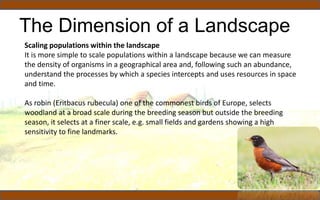
As robin (Eritbacus rubecula) one of the commonest birds of Europe, selects
woodland at a broad scale during the breeding season but outside the breeding
season, it selects at a finer scale, e.g. small fields and gardens showing a high
sensitivity to fine landmarks.
Landscapes Typologies and Functions
Many forces concur to create and model landscapes; these forces may be physical like
wind , atmospheric pressure and water acting in different states of plants , animals
and humans.
Here are some intutives examples of such landscapes:
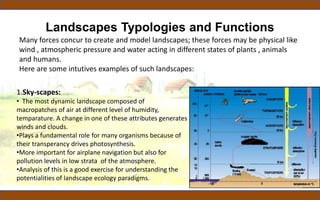
1.Sky-scapes:
• The most dynamic landscape composed of
macropatches of air at different level of humidity,
temparature. A change in one of these attributes generates
winds and clouds.
•Plays a fundamental role for many organisms because of
their transperancy drives photosynthesis.
•More important for airplane navigation but also for
pollution levels in low strata of the atmosphere.
•Analysis of this is a good exercise for understanding the
potentialities of landscape ecology paradigms.
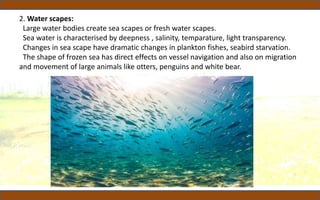
2. Water scapes:
Large water bodies create sea scapes or fresh water scapes.
Sea water is characterised by deepness , salinity, temparature, light transparency.
Changes in sea scape have dramatic changes in plankton fishes, seabird starvation.
The shape of frozen sea has direct effects on vessel navigation and also on migration
and movement of large animals like otters, penguins and white bear.
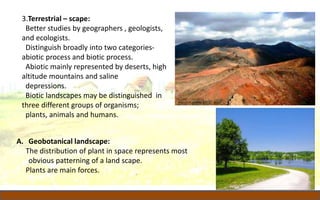
3.Terrestrial – scape:
Better studies by geographers , geologists,
and ecologists.
Distinguish broadly into two categories-
abiotic process and biotic process.
Abiotic mainly represented by deserts, high
altitude mountains and saline
depressions.
Biotic landscapes may be distinguished in
three different groups of organisms;
plants, animals and humans.
A. Geobotanical landscape:
The distribution of plant in space represents most
obvious patterning of a land scape.
Plants are main forces.
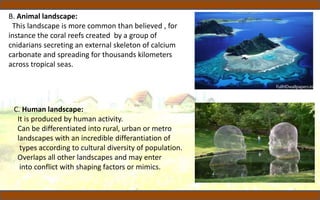
B. Animal landscape:
This landscape is more common than believed , for
instance the coral reefs created by a group of
cnidarians secreting an external skeleton of calcium
carbonate and spreading for thousands kilometers
across tropical seas.
C. Human landscape:
It is produced by human activity.
Can be differentiated into rural, urban or metro
landscapes with an incredible differantiation of
types according to cultural diversity of population.
Overlaps all other landscapes and may enter
into conflict with shaping factors or mimics.
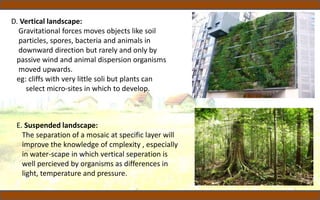
D. Vertical landscape:
Gravitational forces moves objects like soil
particles, spores, bacteria and animals in
downward direction but rarely and only by
passive wind and animal dispersion organisms
moved upwards.
eg: cliffs with very little soli but plants can
select micro-sites in which to develop.
E. Suspended landscape:
The separation of a mosaic at specific layer will
improve the knowledge of cmplexity , especially
in water-scape in which vertical seperation is
well percieved by organisms as differences in
light, temperature and pressure.
Conclusion
This book gives a detailed description about Landscape Ecology.
This book can be used by a Landscape Architect, Planner, Landscape
Geographer for a better understanding.
It describes how the evolution of Landscape Ecology takes place.
It also explains how we have to implement these concepts in real life.
From this book we have selected a few topic which helps us to have better
understanding of landscape ecology.
Thanks..

Landscape ecology (2013bpln010)

  • 1.
    Landscape ecology in Action BookReview By- Bhupendra Pratap Singh (2013bpln010) Madhavi Nikose Author- Almo Farina
  • 2.
    CONTENTS • Author-Almo Farina •The birth of Landscape Ecology • Definition of Landscape • The Dimension of a Landscape • Landscapes Typologies and Functions • Conclusion
  • 3.
    Author-Almo FarinaProfessor of Ecology, Faculty of Environmental Sciences, The University of Urbino, Campus Scientifico Education: Doctor in Natural Sciences, Pisa University June,1974 Member of : International Association for Ecology International Association for Landscape Ecology American Association for Landscape Ecology Major research activities: Landscape ecological studies, Land abandonment of upland areas and effects on landscape and fauna, GIS and expert systems for wildlife management. Relationship between birds and landscape, Landscape changes and effects on biodiversity. Theories in landscape ecology. Cognitive landscape ecology. Eco-semiotic approach in the study of landscape complexity.
  • 4.
    The Birth ofLandscape Ecology Landscape ecology was coined by German geographer Carl Troll in 1939. 1st has its roots in Europe, especially in the northern part (Germany), and the second in North America (Farina 1993). Landscape ecology is the science of studying and improving relationships between ecological processes in the environment and particular ecosystems. This is done within a variety of landscape scales, development spatial patterns, and organizational levels of research and policy. Landscape ecology seems, today to be one branch of ecology that can strongly contribute to the study of complexity (physical, biological and ecological).
  • 5.
    Definition of Landscape "Thetotal spatial entity of human living space" (Troll 1968). “Landscapes dealt with in their totality as physical, ecological and geographical entities, integrating all natural and human ("caused") patterns and processes" (Naveh 1987). "Landscape as a heterogeneous land area composed of clusters of interacting ecosystems is repeated in similar form throughout' (Forman & Godron 1986). "A particular configuration of topography, vegetation cover, land use and settlement patterns which delimits some coherence of natural and cultural processes and activities" (Green et at 1996).
  • 6.
    The Dimension ofa Landscape Scaling the landscape Dimension, size and location of a landscape are determined by processes patterns and organisms in which we hare interested in investigating, describing, managing, and manipulating. In conclusion, individuals, populations and communities are entities that have scalar relationships with the landscape. Scaling communities within the landscape Community landscape is a real generalization because we know that species composing a community are changing with time. As in case of general plant (tropical forests, mountain prairies, arid grasslands, etc.) which are stable and animal communities may be associated with climatic conditions.
  • 7.
    The Dimension ofa Landscape Scaling complexity As most physical and ecological processes act at different scales and that, to better understand phenomena it is necessary to incorporate spatial scales into an explicit experimental and sampling project of field studies. To better understand the local, and the regional effects of processes on biotic realms. Commonly are four sampling scales (250-500 km (sector), 10-15 (reef), 0.5-3 km (site), 1-5 m (replicates)).
  • 8.
    The Dimension ofa Landscape Scaling populations within the landscape It is more simple to scale populations within a landscape because we can measure the density of organisms in a geographical area and, following such an abundance, understand the processes by which a species intercepts and uses resources in space and time. As robin (Eritbacus rubecula) one of the commonest birds of Europe, selects woodland at a broad scale during the breeding season but outside the breeding season, it selects at a finer scale, e.g. small fields and gardens showing a high sensitivity to fine landmarks.
  • 9.
    Landscapes Typologies andFunctions Many forces concur to create and model landscapes; these forces may be physical like wind , atmospheric pressure and water acting in different states of plants , animals and humans. Here are some intutives examples of such landscapes: 1.Sky-scapes: • The most dynamic landscape composed of macropatches of air at different level of humidity, temparature. A change in one of these attributes generates winds and clouds. •Plays a fundamental role for many organisms because of their transperancy drives photosynthesis. •More important for airplane navigation but also for pollution levels in low strata of the atmosphere. •Analysis of this is a good exercise for understanding the potentialities of landscape ecology paradigms.
  • 10.
    2. Water scapes: Largewater bodies create sea scapes or fresh water scapes. Sea water is characterised by deepness , salinity, temparature, light transparency. Changes in sea scape have dramatic changes in plankton fishes, seabird starvation. The shape of frozen sea has direct effects on vessel navigation and also on migration and movement of large animals like otters, penguins and white bear.
  • 11.
    3.Terrestrial – scape: Betterstudies by geographers , geologists, and ecologists. Distinguish broadly into two categories- abiotic process and biotic process. Abiotic mainly represented by deserts, high altitude mountains and saline depressions. Biotic landscapes may be distinguished in three different groups of organisms; plants, animals and humans. A. Geobotanical landscape: The distribution of plant in space represents most obvious patterning of a land scape. Plants are main forces.
  • 12.
    B. Animal landscape: Thislandscape is more common than believed , for instance the coral reefs created by a group of cnidarians secreting an external skeleton of calcium carbonate and spreading for thousands kilometers across tropical seas. C. Human landscape: It is produced by human activity. Can be differentiated into rural, urban or metro landscapes with an incredible differantiation of types according to cultural diversity of population. Overlaps all other landscapes and may enter into conflict with shaping factors or mimics.
  • 13.
    D. Vertical landscape: Gravitationalforces moves objects like soil particles, spores, bacteria and animals in downward direction but rarely and only by passive wind and animal dispersion organisms moved upwards. eg: cliffs with very little soli but plants can select micro-sites in which to develop. E. Suspended landscape: The separation of a mosaic at specific layer will improve the knowledge of cmplexity , especially in water-scape in which vertical seperation is well percieved by organisms as differences in light, temperature and pressure.
  • 14.
    Conclusion This book givesa detailed description about Landscape Ecology. This book can be used by a Landscape Architect, Planner, Landscape Geographer for a better understanding. It describes how the evolution of Landscape Ecology takes place. It also explains how we have to implement these concepts in real life. From this book we have selected a few topic which helps us to have better understanding of landscape ecology.
  • 15.