GOOD MORNING!
“Always share your smile as well as your vibes
to everyone, for it is a wonderful blessing that
we can share”
•Everybody, place your right hand at
the back of your seatmate and tap it
three times while saying “Lets do
good today!” And for those who
have been tapped, smile back and
say “We can do this!”
Colored Heart as life.
•If you’re not paying attention.
•Talking with your business partners.
•Not cooperating during activities.
Anyone who caught you can take your heart.
•If you can keep your heart until the end of the class, a
reward will be given. If not, punishment awaits you.
•If you gained another hear there will be an additional
reward.
Mechanics:
•If your answer is YES, STAND
UP. And if your answer is NO,
SIT DOWN.
DOYOU LIKE
CHOCOLATE?
*Trial
DOYOU HAVE A
FRIEND?
DOYOU HAVE AN
ENEMY?
AREYOU IN A
RELATIONSHIP?
SYMBIOTIC
RELATIONSHIP
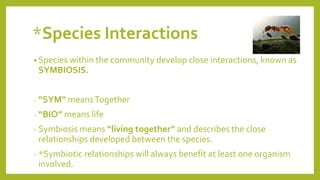
*Species Interactions
• Species within the community develop close interactions, known as
SYMBIOSIS.
- “SYM” meansTogether
- “BIO” means life
- Symbiosis means “living together” and describes the close
relationships developed between the species.
- *Symbiotic relationships will always benefit at least one organism
involved.
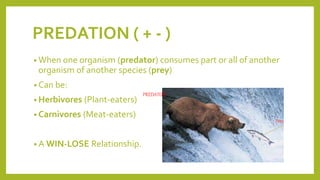
PREDATION ( + - )
• When one organism (predator) consumes part or all of another
organism of another species (prey)
• Can be:
• Herbivores (Plant-eaters)
• Carnivores (Meat-eaters)
• A WIN-LOSE Relationship.
PREDATOR
Prey
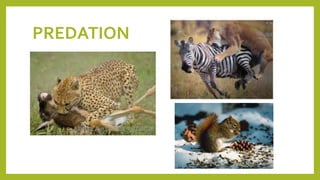
PREDATION ( + - )
• Predators .survival depend on their ability to catch prey.
Ex. Rattlesnake venom, spider web, etc.
• The prey’s survival depends on its ability to avoid being
captured.
Ex. Camouflage, mimicry, physical/chemical defenses
PREDATION
PREY DEFENSES
• Mimicry – a defense where on organism
resembles another that is dangerous or
poisonous.
There are two types:
• Batesian Mimicry
- A harmless organism closely
resembles a dangerous one.
• Mullerian Mimicry
- Two harmful organisms
resemble one another.
Hoverfly
(left) and
Wasp (right).
PREY DEFENSES
• Camouflage
- Blending in with certain aspects
of their environment
• PLANTS CAN’T HIDE OR RUN, HOW CANTHEY SURVIVE?
- Physical Defenses such as spikes, thorns and tough leaves.
- Poisonous, irritating or bad-tasting/smell
Common Baron Caterpillar
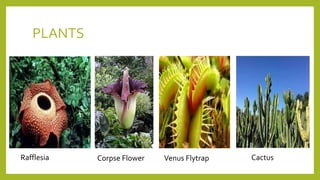
PLANTS
Rafflesia Corpse Flower Venus Flytrap Cactus
CAMOUFLAGE
Toads. Owl.
CAMOUFLAGE
Frog.
Leaf-Tailed
Gecko
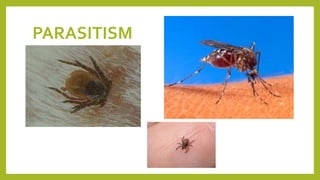
PARASITISM ( + - )
• When one organism benefits and the other organism is harmed.
• Parasite –The individual that benefits.
• Host –The individual that is harmed.
• A WIN-LOSE Relationship; sometimes
• A WIN-WIN Relationship.
PARASITISM
PARASITISM ( + - )
•Parasites are divided into two categories based on their
interaction with the host.
- ECTOPARASITES – External parasites that do not enter
the hosts body.
- ENDOPARASITES – Internal parasites and live inside
the hosts body.
ECTOPARASITES
American DogTick Flea
Leeches
ENDOPARASITE
Ascaris Hookworm Roundworm
COMPETITION
• When organisms compete with each other
for food, light, water shelter, mate or minerals.
Two major types:
- Intra-specific competition. Competition among organisms of
the same species.
- Inter-specific competition. Competition among organisms of
different species.
COMPETITION
.
Intra-Specific Competition
Two Oryx fighting over a territory. TwoYellowstone wolf.
Inter-Specific Relations
MUTUALISM ( + + )
• When both organisms are helped
in some way.
• A WIN-WIN Relationship.
.
Flower and its pollinator.
Clownfish
and sea
anemones
MUTUALISM ( + + )
.
Ant and a tree/plant. Egyptian Plover Bird and a crocodile.
COMMENSALISM ( + 0 )
• When one individual benefits and the other is unaffected
.
Pilot fish and shark.
COMMENSALISM ( + 0 )
.
Barnacles attached to
turtle’s shell.
A web between the
Giselle’s horn.
Bird nesting in a tree.
RUBRIC:
•Content – 50%
•Deliberation – 30%
•Participation - 20%
100%
APPLICATION
•List down as many as you can.
What is/are the advantage/s and
disadvantage/s of the symbiotic
relationship that is assigned in your
group.
EVALUATION
•What is Predation and Competition?
•Brief description about Parasitism.
•Difference between Commensalism and
Mutualism.
•Importance of Symbiotic Relationship.
RUBRIC:
•Content - 50% - 3 points
•Grammar- 30% - 1 point
•Cleanliness- 20% - 1 point
100% 5 points
ASSIGNMENT
•Read about Food Web and Food
Chain at your Science Book, page 17.
You can also surf the internet for
more information.

Symbiotic relationship revised.pptx

  • 1.
    GOOD MORNING! “Always shareyour smile as well as your vibes to everyone, for it is a wonderful blessing that we can share”
  • 2.
    •Everybody, place yourright hand at the back of your seatmate and tap it three times while saying “Lets do good today!” And for those who have been tapped, smile back and say “We can do this!”
  • 3.
    Colored Heart aslife. •If you’re not paying attention. •Talking with your business partners. •Not cooperating during activities. Anyone who caught you can take your heart. •If you can keep your heart until the end of the class, a reward will be given. If not, punishment awaits you. •If you gained another hear there will be an additional reward.
  • 4.
    Mechanics: •If your answeris YES, STAND UP. And if your answer is NO, SIT DOWN.
  • 5.
  • 6.
  • 7.
  • 8.
  • 9.
  • 10.
    *Species Interactions • Specieswithin the community develop close interactions, known as SYMBIOSIS. - “SYM” meansTogether - “BIO” means life - Symbiosis means “living together” and describes the close relationships developed between the species. - *Symbiotic relationships will always benefit at least one organism involved.
  • 11.
    PREDATION ( +- ) • When one organism (predator) consumes part or all of another organism of another species (prey) • Can be: • Herbivores (Plant-eaters) • Carnivores (Meat-eaters) • A WIN-LOSE Relationship. PREDATOR Prey
  • 12.
    PREDATION ( +- ) • Predators .survival depend on their ability to catch prey. Ex. Rattlesnake venom, spider web, etc. • The prey’s survival depends on its ability to avoid being captured. Ex. Camouflage, mimicry, physical/chemical defenses
  • 13.
  • 14.
    PREY DEFENSES • Mimicry– a defense where on organism resembles another that is dangerous or poisonous. There are two types: • Batesian Mimicry - A harmless organism closely resembles a dangerous one. • Mullerian Mimicry - Two harmful organisms resemble one another. Hoverfly (left) and Wasp (right).
  • 15.
    PREY DEFENSES • Camouflage -Blending in with certain aspects of their environment • PLANTS CAN’T HIDE OR RUN, HOW CANTHEY SURVIVE? - Physical Defenses such as spikes, thorns and tough leaves. - Poisonous, irritating or bad-tasting/smell Common Baron Caterpillar
  • 16.
    PLANTS Rafflesia Corpse FlowerVenus Flytrap Cactus
  • 17.
  • 18.
  • 19.
    PARASITISM ( +- ) • When one organism benefits and the other organism is harmed. • Parasite –The individual that benefits. • Host –The individual that is harmed. • A WIN-LOSE Relationship; sometimes • A WIN-WIN Relationship.
  • 20.
  • 21.
    PARASITISM ( +- ) •Parasites are divided into two categories based on their interaction with the host. - ECTOPARASITES – External parasites that do not enter the hosts body. - ENDOPARASITES – Internal parasites and live inside the hosts body.
  • 22.
  • 23.
  • 24.
    COMPETITION • When organismscompete with each other for food, light, water shelter, mate or minerals. Two major types: - Intra-specific competition. Competition among organisms of the same species. - Inter-specific competition. Competition among organisms of different species.
  • 25.
  • 26.
    Intra-Specific Competition Two Oryxfighting over a territory. TwoYellowstone wolf.
  • 27.
  • 28.
    MUTUALISM ( ++ ) • When both organisms are helped in some way. • A WIN-WIN Relationship. . Flower and its pollinator. Clownfish and sea anemones
  • 29.
    MUTUALISM ( ++ ) . Ant and a tree/plant. Egyptian Plover Bird and a crocodile.
  • 30.
    COMMENSALISM ( +0 ) • When one individual benefits and the other is unaffected . Pilot fish and shark.
  • 31.
    COMMENSALISM ( +0 ) . Barnacles attached to turtle’s shell. A web between the Giselle’s horn. Bird nesting in a tree.
  • 34.
    RUBRIC: •Content – 50% •Deliberation– 30% •Participation - 20% 100%
  • 35.
    APPLICATION •List down asmany as you can. What is/are the advantage/s and disadvantage/s of the symbiotic relationship that is assigned in your group.
  • 36.
    EVALUATION •What is Predationand Competition? •Brief description about Parasitism. •Difference between Commensalism and Mutualism. •Importance of Symbiotic Relationship.
  • 37.
    RUBRIC: •Content - 50%- 3 points •Grammar- 30% - 1 point •Cleanliness- 20% - 1 point 100% 5 points
  • 38.
    ASSIGNMENT •Read about FoodWeb and Food Chain at your Science Book, page 17. You can also surf the internet for more information.

Editor's Notes

  • #33 Motivation Presentation Discussion Generalization Application Evaluation Assignment