SYMBIOSIS
Symbiosis
• Close, long-term association between two ore more species
• “Sym” means together
• “Bio” means life
• Symbiosis means “living together”
• Relationships will always benefit at least one organism involved
• 5 types:
• Predation
• Competition
• Mutualism
• Commensalism
• Parasitism
Predation
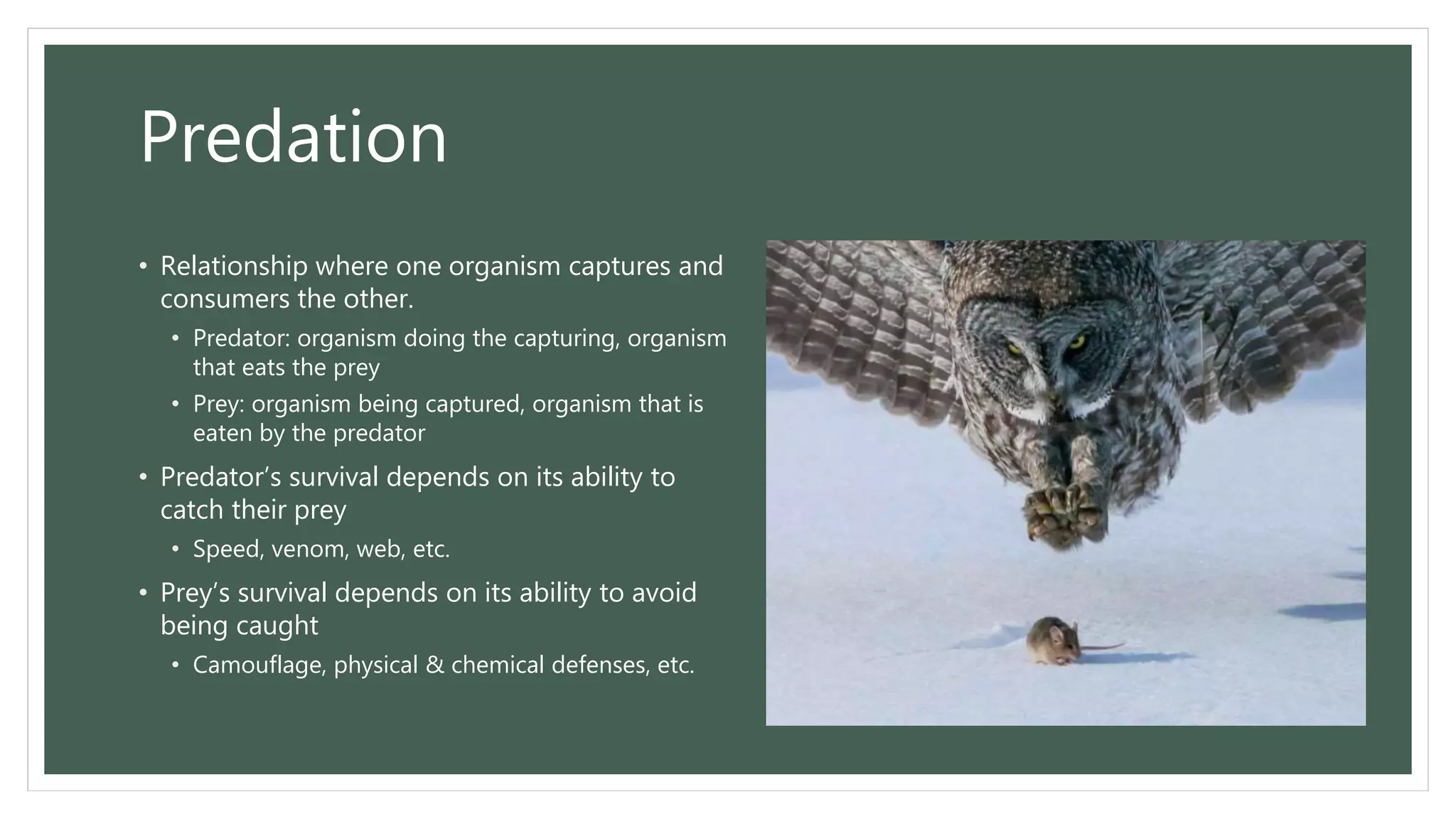
• Relationship where one organism captures and
consumers the other.
• Predator: organism doing the capturing, organism
that eats the prey
• Prey: organism being captured, organism that is
eaten by the predator
• Predator’s survival depends on its ability to
catch their prey
• Speed, venom, web, etc.
• Prey’s survival depends on its ability to avoid
being caught
• Camouflage, physical & chemical defenses, etc.
Competition
• Relationship where two or more
individuals or populations are trying to
use the same limited resources.
• Resources: Food, water, shelter, space,
sunlight
• Example: Elks competing for food from
plants.
• Elk are herbivores
• There are so many plants in their habitat
• All of the elks are competing over the same
plants for food.
Mutualism
• Symbiotic relationship where both organisms
are helped or benefit.
• Example: Flowers & Bees
• Bees get nectar to make honey from flowers.
• Bees carry pollen from flower to flower resulting in
pollination.
• Bee is benefiting by getting food.
• Flower is benefiting by being pollinated.
Commensalism
• Symbiotic relationship where one organism
benefits and the second organism is
unaffected (neither harmed or helped).
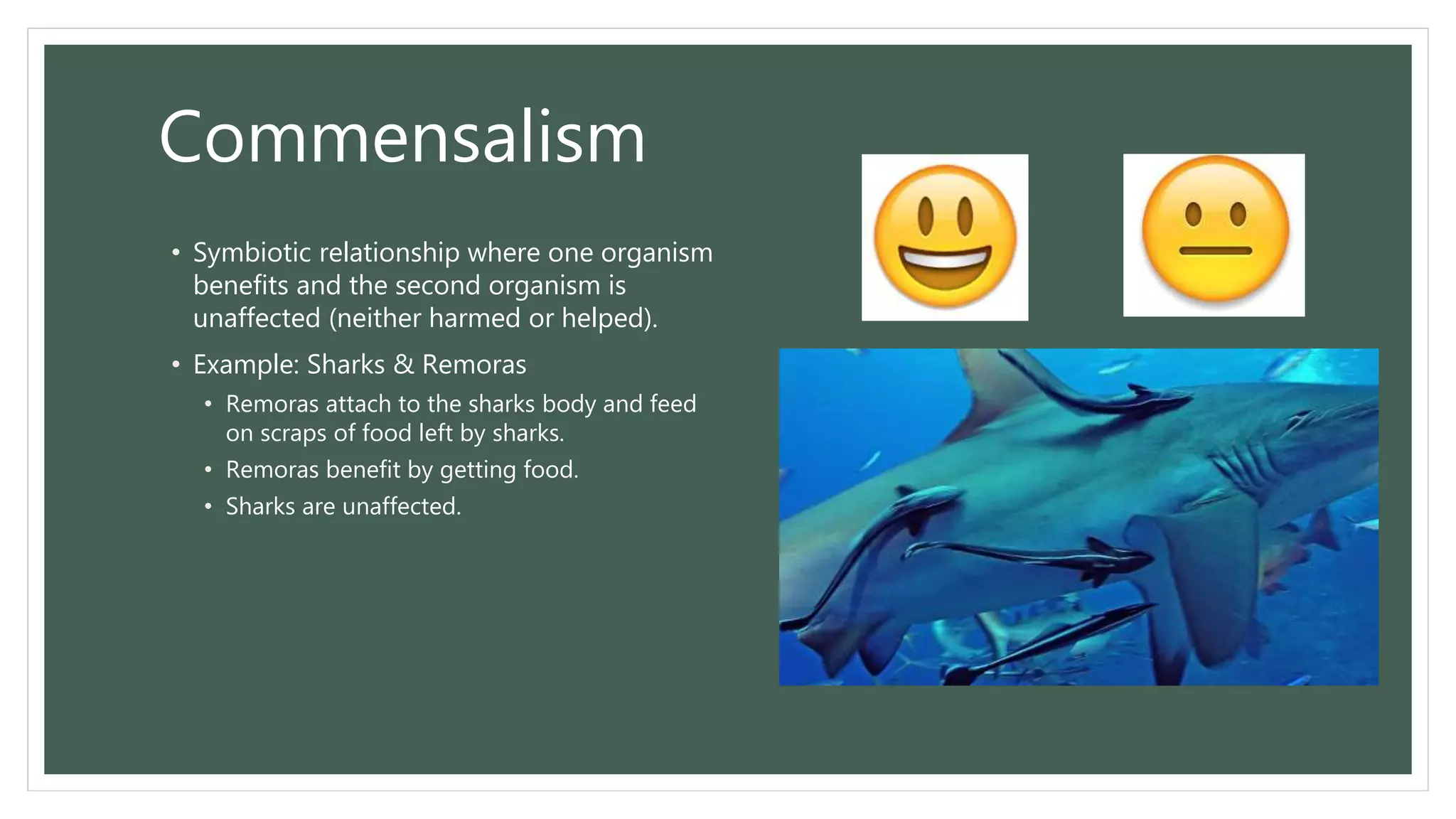
• Example: Sharks & Remoras
• Remoras attach to the sharks body and feed
on scraps of food left by sharks.
• Remoras benefit by getting food.
• Sharks are unaffected.
Parasitism
• Symbiotic relationship where one organism benefits or is
helped and the other organism is harmed.
• Parasite: organism that benefits
• Host: organism that is harmed, but not usually killed
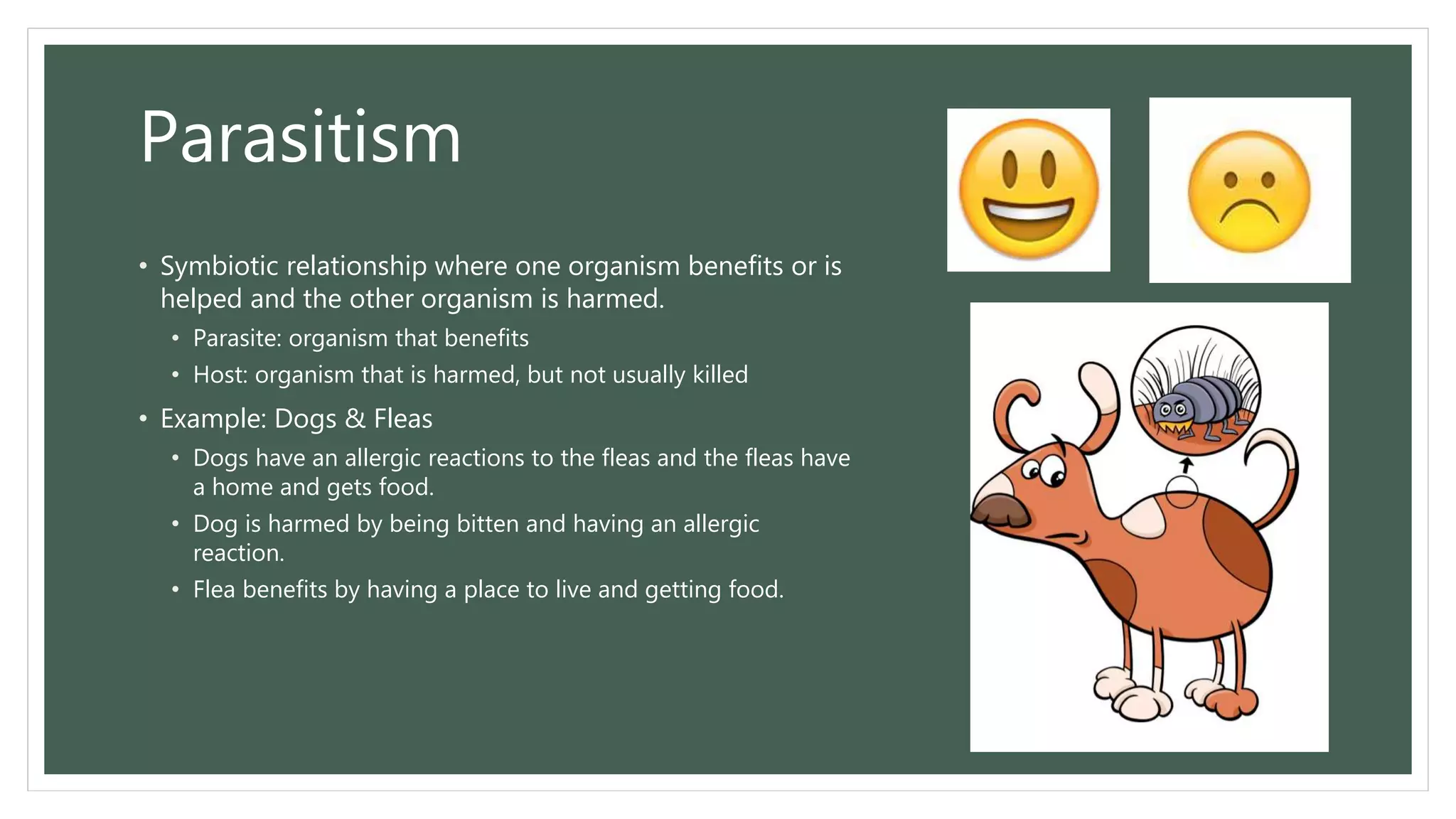
• Example: Dogs & Fleas
• Dogs have an allergic reactions to the fleas and the fleas have
a home and gets food.
• Dog is harmed by being bitten and having an allergic
reaction.
• Flea benefits by having a place to live and getting food.
Name the Relationship
• The oxpecker (a bird) lives on a rhino eating all of the bugs & parasites on the rhino.
• Mutualism
• A lion hunting an antelope.
• Predation
• Clownfish that are protected from predators by living in a sea anemone with poisonous
tentacles.
• Commensalism
• Two different penguins feeding on fish.
• Competition
• A tick attaches to a human, sucking blood and possibly transmitting Lyme disease.
• Parasitism

Symbiosis

  • 1.
  • 2.
    Symbiosis • Close, long-termassociation between two ore more species • “Sym” means together • “Bio” means life • Symbiosis means “living together” • Relationships will always benefit at least one organism involved • 5 types: • Predation • Competition • Mutualism • Commensalism • Parasitism
  • 3.
    Predation • Relationship whereone organism captures and consumers the other. • Predator: organism doing the capturing, organism that eats the prey • Prey: organism being captured, organism that is eaten by the predator • Predator’s survival depends on its ability to catch their prey • Speed, venom, web, etc. • Prey’s survival depends on its ability to avoid being caught • Camouflage, physical & chemical defenses, etc.
  • 4.
    Competition • Relationship wheretwo or more individuals or populations are trying to use the same limited resources. • Resources: Food, water, shelter, space, sunlight • Example: Elks competing for food from plants. • Elk are herbivores • There are so many plants in their habitat • All of the elks are competing over the same plants for food.
  • 5.
    Mutualism • Symbiotic relationshipwhere both organisms are helped or benefit. • Example: Flowers & Bees • Bees get nectar to make honey from flowers. • Bees carry pollen from flower to flower resulting in pollination. • Bee is benefiting by getting food. • Flower is benefiting by being pollinated.
  • 6.
    Commensalism • Symbiotic relationshipwhere one organism benefits and the second organism is unaffected (neither harmed or helped). • Example: Sharks & Remoras • Remoras attach to the sharks body and feed on scraps of food left by sharks. • Remoras benefit by getting food. • Sharks are unaffected.
  • 7.
    Parasitism • Symbiotic relationshipwhere one organism benefits or is helped and the other organism is harmed. • Parasite: organism that benefits • Host: organism that is harmed, but not usually killed • Example: Dogs & Fleas • Dogs have an allergic reactions to the fleas and the fleas have a home and gets food. • Dog is harmed by being bitten and having an allergic reaction. • Flea benefits by having a place to live and getting food.
  • 8.
    Name the Relationship •The oxpecker (a bird) lives on a rhino eating all of the bugs & parasites on the rhino. • Mutualism • A lion hunting an antelope. • Predation • Clownfish that are protected from predators by living in a sea anemone with poisonous tentacles. • Commensalism • Two different penguins feeding on fish. • Competition • A tick attaches to a human, sucking blood and possibly transmitting Lyme disease. • Parasitism