CONCEPT
•Everything in thenatural world is connected.
•Plants and animals depend on each other to
survive. This connection of living things to each
other is called biodiversity.
•These plants and animals within an area interact
with each other and with the non-living elements of
the area, such as climate, water, soil and so on.
3.
• An ecosystem,short for 'ecological system', is a
community of living and non-living things that work
together.
• An ecosystem is a community of living organisms
(plants, animals and microbes) in conjunction with the
nonliving components of their environment (things like
air, water and mineral soil), interacting as a system.
4.
ECOSYSTEM DEFINED
• Anecosystem is a community of plants, animals and
smaller organisms that live, feed, reproduce and
interact in the same area or environment.
• An ecosystem is a community of living and nonliving
things considered as a unit.
• Ecosystem is a complex set of relationships among the
living resources, habitats and residents of an area. It
includes plants, trees, animals, fishes, birds, micro-
organisms, air, water, soil and people.
5.
ECOSYSTEM DEFINED
• Anecosystem is a self regulating group of biotic
communities of species interacting with one another
and with their non-living environment exchanging
energy and matter.
• Ecosystems are dynamic interactions between plants,
animals, and microorganisms and their environment
working together as a functional unit. Ecosystems will
fail if they do not remain in balance.
6.
ECOLOGY
• Term Coinedby Earnst Haeckel in 1869.
• Derived from greek words:
OIKOS(Home)+LOGOS(Study)
• So, Ecology is the study of organisms in their natural
home interacting with their surroundings.
• Ecology is the scientific study of the relationships that
living organisms have with each other and with
their natural environment.
• Ecology is the study of ecosystems.
8.
•Habitat functions: ecosystemsprovide
habitat to wild plants and animals and thus
conserve biological and genetic diversity. It
supports different food chains and food
chains.
•Production function: production of wide
range of goods ranging from food to raw
materials.
FUNCTIONS OF ECOSYSTEM
9.
• Regulatory functions:ecosystem regulates essential ecological
processes and life support systems and renders stability.
Responsible for cycling of nutrients between biotic and abiotic
components(biogeochemical cycles). Also, it provides many
services that have direct and indirect benefits to humans (i.e.,
clean air, water and soil). Soil formation, climate regulation,
etc.
• Every ecosystem regulates and maintains itself and resists any
stresses or disturbances upto a certain limit. This is known as
cybernetic system.
FUNCTIONS OF ECOSYSTEM
10.
FUNCTIONS OF ECOSYSTEM
•Informational function: ecosystems provide an
essential 'reference function' and contribute to
the maintenance of human health by providing
opportunities for spiritual enrichment, cognitive
development, recreation and aesthetic
experience.
12.
STRUCTURE OF ECOSYSTEM
Ecosystem
Living/Biotic
Components
Producers
Consumers
Herbivores
Carnivores
Omnivores
Detritivores
Decomposers
Non-Living/
Abiotic
Components
Physical
components
Chemical
Components
13.
BIOTIC COMPONENTS OFECOSYSTEM
•Living factors of an environment
Figure 1: Three types of biotic factors in an ecosystem.
14.
•Different living organismsconstitute the biotic
components of an ecosystem.
•This refers to large life-forms such as trees or
mammals, small life-forms such as insects and algae,
and microscopic life-forms such as bacteria.
•Biotic, meaning of or related to life, are living
factors. Plants, animals, fungi and bacteria are all
biotic or living factors.
BIOTIC COMPONENTS OF ECOSYSTEM
15.
PRODUCERS
• Most importantcomponents of ecosystem.
• Producers are organisms which are able to manufacture organic
compounds from inorganic substances from their environment.
• Food is produced both for themselves and for other organisms.
• They depend directly on the abiotic component for their survival and
production of nutrients.
• Producers are also known as autotrophs (derived from Greek words:
“autos” meaning self and “trophe” meaning nourishment)
• They induce into the ecosystem, the energy required for its biological
processes.
16.
• Producers extractnutrients from soil or ocean and manufacture their own
food using photosynthesis, in the presence of carbon dioxide and
sunlight and so energy from sun powers the base of food chain.
Producers are also, thus known as primary producers.
• An exception occurs in deep-sea hydrothermal ecosystems where there is
no sunlight. Here, the primary producers manufacture food through a
process called chemosynthesis.
• Chemosynthesis is a process certain organisms use to produce energy,
akin to photosynthesis, but without the utilization of sunlight. The energy
comes from the oxidization (burning) of chemicals which seep up from
the Earth's crust.
• So, producers are either photo-autotrophs or chemo-autotrophs.
PRODUCERS
17.
Figure 2: Anautotroph mechanism of making its own food.
18.
CONSUMERS
• Consumers areorganisms that obtain nutrients by consuming other
organisms.
• These organisms are formally referred to as heterotrophs (derived
from Greek words “heteros” meaning another/ different and
“trophe” meaning nourishment.
• A heterotroph is an organism that cannot synthesize their own food
and must obtain it ready made.
• They can be herbivores, carnivores, omnivores or detritivores.
• Animals whoderive their required energy directly from
consuming the plants and plants only.
• Also known as primary consumers.
• Herbivores have special digestive systems that let them
digest all kinds of plants, including grasses.
• Eg. Rabbit, cattle, horse, sheep, insects, etc.
HERBIVORES
22.
• Animals thatfeed on other animals.
• Carnivores generally eat herbivores (secondary
consumers), but occasionally eat other carnivores also
(tertiary consumers).
• Eg: lion, tiger, cats, birds of prey, sharks, frogs, etc.
Carnivores
Predators
Scavengers
CARNIVORES
23.
PREDATORS
• A predatoris an organism that
hunts and kills other organisms
for food.
• EXAMPLES: lions, tigers, sharks,
wolves, snakes, etc.
• Scavengers eat the food that has been
killed and left behind by predators.
• EXAMPLES: vultures, racoons, hyena, etc.
• Scavengers play an important role in
the ecosystem by consuming the carcass of
of animals that have been left to
decompose. Decomposers and detritivores
complete this process, by consuming the
remains left by scavengers.
SCAVENGERS
24.
• Animals thatfeed on both plants and animals.
• Omnivores often are opportunistic, general
feeders with neither carnivore nor herbivore
specializations for acquiring or processing food, and
are capable of consuming and do consume both
animal protein and vegetation.
• Many omnivores depend on a suitable mix of animal
and plant food for long-term good health and
reproduction.
• EXAMPLES: humans, bear, etc.
OMNIVORES
25.
• They feedon dead plant and animal matter, but
perform an additional function which is to return
essential nutrients back to the ecosystem in the process.
• Detritivores actually eat organic matter.
• They are essential for recycling of nutrients: without
them dead plant material would not be returned to the
soil for new growth
• EXAMPLES: worms, millipedes, sea stars, crabs, dung
flies.
DETRITIVORES
26.
• Detritivores consumedead organic material such as
carcasses, fallen leaves, dead plants, animal droppings
and shed skins.
• Having consumed the material, the organism then
excretes or egests waste.
• This waste contains nutrients which are thus returned to
the soil, facilitating new plant growth, or made easier
for other organisms to consume. By breaking down
dead matter into smaller pieces, detritivores speed up
the process of decomposition.
DETRITIVORES
27.
DECOMPOSERS/ SAPROBES
• Theseare micro-organisms which break-down organic matter into
inorganic compounds and derive their nutrition in the process.
Decomposers break down complex compound into simpler
compounds without eating them.
• For example, fungi can grow on organic matter, such as a dead tree
trunk or a piece of bread, and breaks it down and absorbing the
nutrients without eating the wood or the bread.
• These are organisms that aid in decomposition of already dead or
dying organisms.
• Decomposers secrete enzymes to digest organic matter and then
absorb resulting molecules.
• EXAMPLES: bacteria, fungi, etc.
28.
Figure 5: Representativeimage of all the types of decomposers in the
ecosystem,
Examples., insects and worms
31.
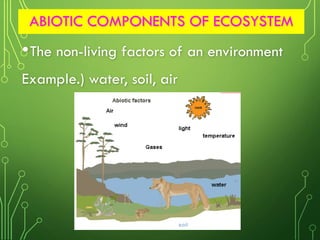
•The non-living factorsof an environment
Example.) water, soil, air
ABIOTIC COMPONENTS OF ECOSYSTEM
32.
ABIOTIC COMPONENTS OFECOSYSTEM
• The nonliving materials in an ecosystem, such as
minerals, gases, liquids and chemicals are
referred to as abiotic or non-biotic factors.
• Abiotic, meaning not alive, are nonliving factors
that affect living organisms. Environmental factors
such habitat (pond, lake, ocean, desert, mountain)
or weather such as temperature, cloud cover, rain,
snow, hurricanes, etc. are abiotic factors.
33.
•An abiotic factoris a nonliving condition or
thing, such as climate or habitat, that influences
or affects an ecosystem and the organisms in
it.
•Abiotic factors can determine which species of
organisms will survive in a given environment.
ABIOTIC COMPONENTS OF ECOSYSTEM
34.
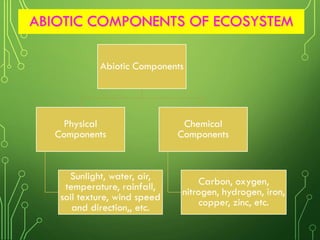
Abiotic Components
Physical
Components
Sunlight, water,air,
temperature, rainfall,
soil texture, wind speed
and direction,, etc.
Chemical
Components
Carbon, oxygen,
nitrogen, hydrogen, iron,
copper, zinc, etc.
ABIOTIC COMPONENTS OF ECOSYSTEM
35.
BIOTIC AND ABIOTIC
•Together,biotic and abiotic factors determine
the survival and growth of an organism and
the productivity of the ecosystem in which the
organism lives