Lesson 4 – Ecosystem Functions and
Ecosystem services
P.B. Dharmasena
0777 613234, 0717 613234
dharmasenapb@ymail.com , dharmasenapb@gmail.com
https://independent.academia.edu/PunchiBandageDharmasena
https://www.researchgate.net/profile/Punchi_Bandage_Dharmasena/contributions
http://www.slideshare.net/DharmasenaPb
Foundation of Environmental Management
Course code: EMGT 2114
Course Content
1.Concepts of Ecology and Environmental Biology
Ecology, Producers, Consumers, Feeding interactions, Ecological
pyramids, Ecological Interactions between organisms
2.Biogeochemical Cycles (C, N, P etc.)
• Atmosphere, Hydrosphere, Lithosphere, Biosphere
• C, N, P, S and water cycling
3.Ecosystems and Energy Flow
• Ecosystem, habitat, niche, energy roles in ecosystem, energy flow, food
chain, food web, energy pyramid
4.Ecosystem Functions and Ecosystem services
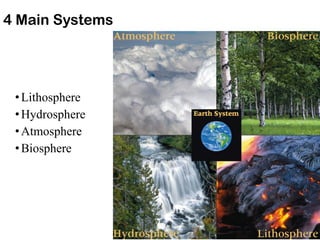
4 Main Systems
•Lithosphere
•Hydrosphere
•Atmosphere
•Biosphere
4 Main Systems
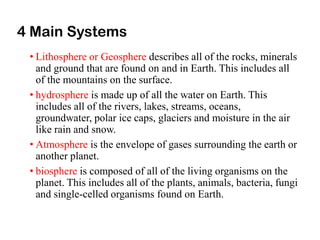
• Lithosphere or Geosphere describes all of the rocks, minerals
and ground that are found on and in Earth. This includes all
of the mountains on the surface.
• hydrosphere is made up of all the water on Earth. This
includes all of the rivers, lakes, streams, oceans,
groundwater, polar ice caps, glaciers and moisture in the air
like rain and snow.
• Atmosphere is the envelope of gases surrounding the earth or
another planet.
• biosphere is composed of all of the living organisms on the
planet. This includes all of the plants, animals, bacteria, fungi
and single-celled organisms found on Earth.
The Elements
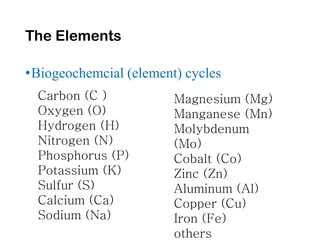
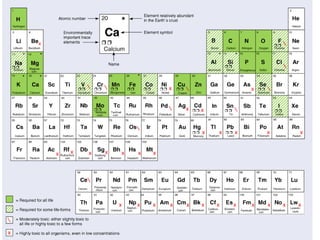
•Biogeochemcial (element) cycles
Carbon (C )
Oxygen (O)
Hydrogen (H)
Nitrogen (N)
Phosphorus (P)
Potassium (K)
Sulfur (S)
Calcium (Ca)
Sodium (Na)
Magnesium (Mg)
Manganese (Mn)
Molybdenum
(Mo)
Cobalt (Co)
Zinc (Zn)
Aluminum (Al)
Copper (Cu)
Iron (Fe)
others
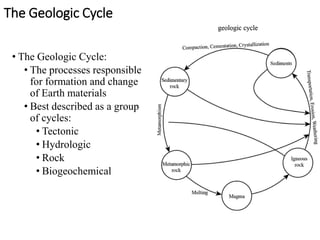
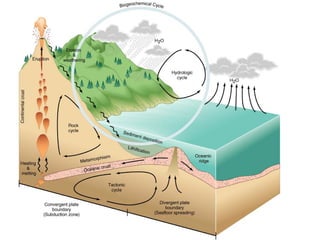
The Geologic Cycle
• The Geologic Cycle:
• The processes responsible
for formation and change
of Earth materials
• Best described as a group
of cycles:
• Tectonic
• Hydrologic
• Rock
• Biogeochemical
• Igneous Rock :
The magma in the form of a fluid is ejected from the very deep layers
of earth's mantle. This will solidify and forms the igneous rock. A
portion of molten substances will get cooled over the ground surface.
Sedimentary Rocks:
The deposits like gravel, silt, sand and clay are formed by weathering.
Then, soil are compacted and cemented under the overburden stress of
the soil. Generally, the groundwater carries the cementing agents. The
cementing material fills the pore space between the particles and forms
this type of rocks.
Metamorphic rocks:
It is the process of varying the texture and composition of rocks by heat
(without melting) and pressure. During this process, new mineral types
are formed. Examples for this category of rock are marble, gneiss,
quartzite, etc.
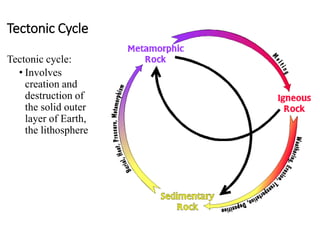
Tectonic Cycle
Tectonic cycle:
• Involves
creation and
destruction of
the solid outer
layer of Earth,
the lithosphere
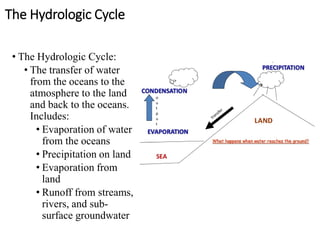
The Hydrologic Cycle
• The Hydrologic Cycle:
• The transfer of water
from the oceans to the
atmosphere to the land
and back to the oceans.
Includes:
• Evaporation of water
from the oceans
• Precipitation on land
• Evaporation from
land
• Runoff from streams,
rivers, and sub-
surface groundwater
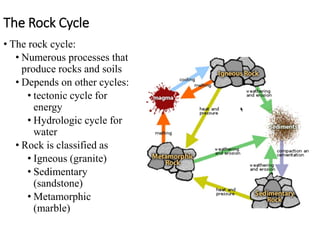
The Rock Cycle
• The rock cycle:
• Numerous processes that
produce rocks and soils
• Depends on other cycles:
• tectonic cycle for
energy
• Hydrologic cycle for
water
• Rock is classified as
• Igneous (granite)
• Sedimentary
(sandstone)
• Metamorphic
(marble)
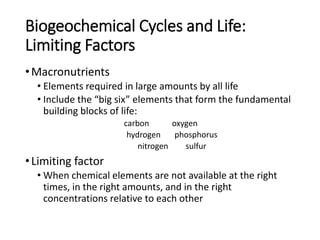
Biogeochemical Cycles and Life:
Limiting Factors
•Macronutrients
• Elements required in large amounts by all life
• Include the “big six” elements that form the fundamental
building blocks of life:
carbon oxygen
hydrogen phosphorus
nitrogen sulfur
•Limiting factor
• When chemical elements are not available at the right
times, in the right amounts, and in the right
concentrations relative to each other
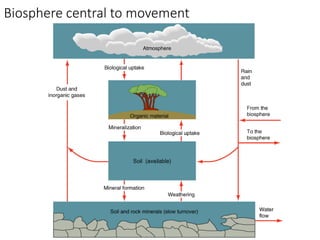
Biosphere central to movement
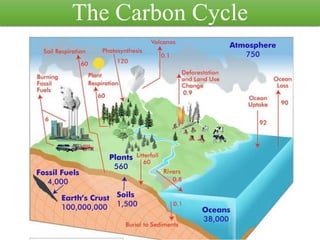
The Carbon Cycle
Basic Carbon Facts
•Key element of life
•In its reduced form as organic C comprises 45 – 50% of
the mass of all plants and animals
•Found as:
• Elemental carbon (in lithosphere)
• As organic carbon (e.g. C6H12O6)
• As inorganic carbon
• Gaseous CO2, CO
• Dissolved as HCO3, H2CO3
• Carbonite minerals as FeCO3, CO3
--, CaCO3
Vegetation
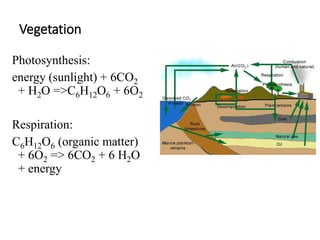
Photosynthesis:
energy (sunlight) + 6CO2
+ H2O =>C6H12O6 + 6O2
Respiration:
C6H12O6 (organic matter)
+ 6O2 => 6CO2 + 6 H2O
+ energy
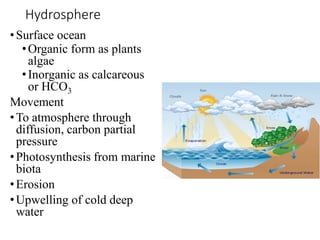
Hydrosphere
•Surface ocean
•Organic form as plants
algae
•Inorganic as calcareous
or HCO3
Movement
•To atmosphere through
diffusion, carbon partial
pressure
•Photosynthesis from marine
biota
•Erosion
•Upwelling of cold deep
water
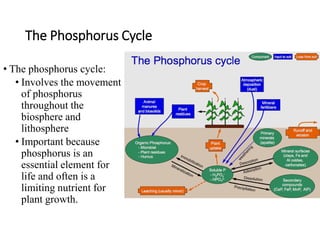
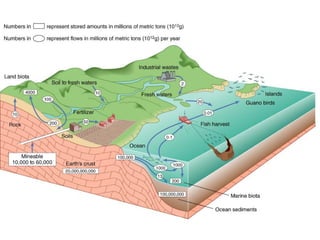
The Phosphorus Cycle
• The phosphorus cycle:
• Involves the movement
of phosphorus
throughout the
biosphere and
lithosphere
• Important because
phosphorus is an
essential element for
life and often is a
limiting nutrient for
plant growth.
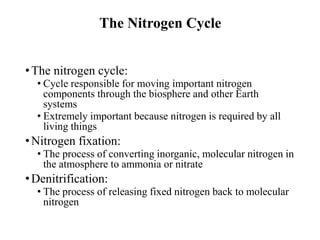
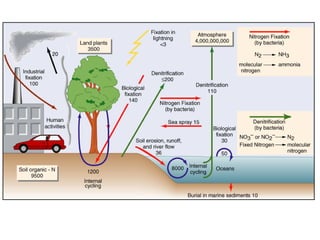
The Nitrogen Cycle
•The nitrogen cycle:
• Cycle responsible for moving important nitrogen
components through the biosphere and other Earth
systems
• Extremely important because nitrogen is required by all
living things
•Nitrogen fixation:
• The process of converting inorganic, molecular nitrogen in
the atmosphere to ammonia or nitrate
•Denitrification:
• The process of releasing fixed nitrogen back to molecular
nitrogen
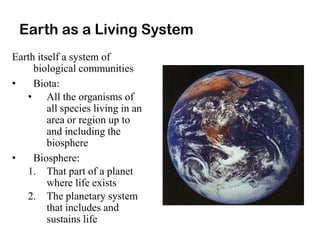
Earth as a Living System
Earth itself a system of
biological communities
• Biota:
• All the organisms of
all species living in an
area or region up to
and including the
biosphere
• Biosphere:
1. That part of a planet
where life exists
2. The planetary system
that includes and
sustains life
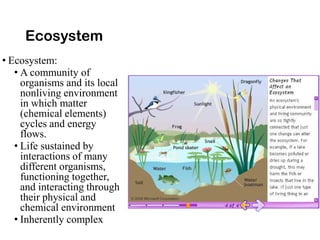
Ecosystem
• Ecosystem:
• A community of
organisms and its local
nonliving environment
in which matter
(chemical elements)
cycles and energy
flows.
• Life sustained by
interactions of many
different organisms,
functioning together,
and interacting through
their physical and
chemical environment
• Inherently complex
Basic Characteristics of Ecosystems
• Structure
• Living (Ecological Communities) – Hierarchical
interactions
• Non-living (physical/chemical environment)
• Processes
• Cycling of chemical elements – important and complex
• Inflows, recycling, no waste in nature, interactions
• Food webs
• Flow of energy
• Between tropic levels
• Change
• Evolution
• Succession
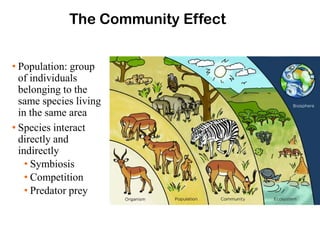
The Community Effect
• Population: group
of individuals
belonging to the
same species living
in the same area
• Species interact
directly and
indirectly
• Symbiosis
• Competition
• Predator prey
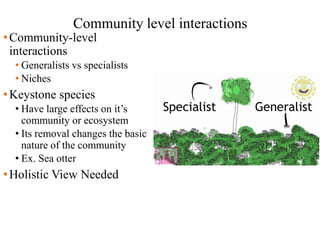
Community level interactions
•Community-level
interactions
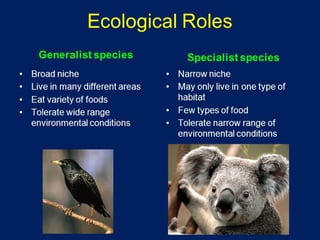
• Generalists vs specialists
• Niches
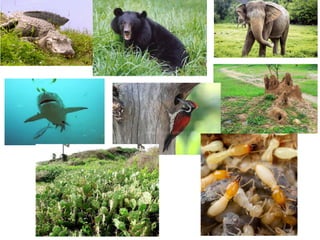
•Keystone species
• Have large effects on it’s
community or ecosystem
• Its removal changes the basic
nature of the community
• Ex. Sea otter
•Holistic View Needed
30
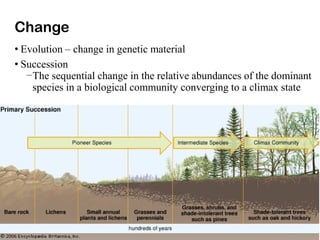
Change
• Evolution – change in genetic material
• Succession
–The sequential change in the relative abundances of the dominant
species in a biological community converging to a climax state
Change
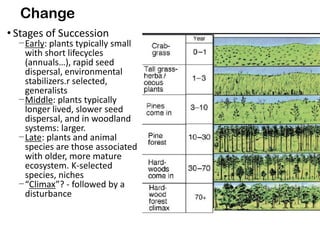
• Stages of Succession
–Early: plants typically small
with short lifecycles
(annuals…), rapid seed
dispersal, environmental
stabilizers.r selected,
generalists
–Middle: plants typically
longer lived, slower seed
dispersal, and in woodland
systems: larger.
–Late: plants and animal
species are those associated
with older, more mature
ecosystem. K-selected
species, niches
–“Climax”? - followed by a
disturbance
Resilience
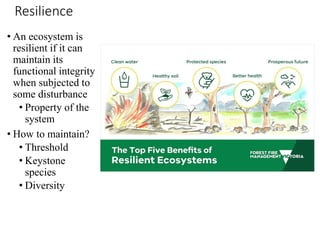
• An ecosystem is
resilient if it can
maintain its
functional integrity
when subjected to
some disturbance
• Property of the
system
• How to maintain?
• Threshold
• Keystone
species
• Diversity
Saturday, February 9, 2019 Mr G Davidson 34
Ecosystem Functions - Services
Ecosystem Functions/Services
•Ecosystem Functions/Services are the conditions
and processes through which natural ecosystems and
the species that make them up, sustain and fulfill
human life.
•Biophysical necessities for human life provided by
natural ecosystems
•Functions provide goods and services
•Currently threatened by most human activities
•Important (but new) conservation tool
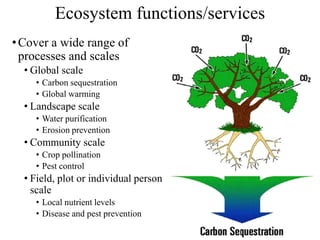
Ecosystem functions/services
•Cover a wide range of
processes and scales
• Global scale
• Carbon sequestration
• Global warming
• Landscape scale
• Water purification
• Erosion prevention
• Community scale
• Crop pollination
• Pest control
• Field, plot or individual person
scale
• Local nutrient levels
• Disease and pest prevention
Ecosystem Functions and services
• The combined activity of soil organisms results in ecosystem
functions that sustain life on the planet. Ecosystem functions
that generate benefits to society have been defined as
ecosystem services. The centrality of belowground
biodiversity to global sustainability is because soil organisms
of different types, shapes and colours are responsible for
different ecological functions…
• Complex
• Dynamic
• Interact
• Multiple within an ecosystem
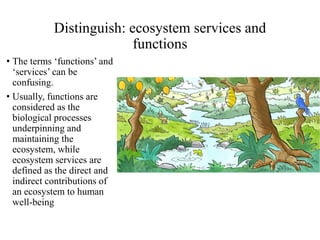
Distinguish: ecosystem services and
functions
• The terms ‘functions’ and
‘services’ can be
confusing.
• Usually, functions are
considered as the
biological processes
underpinning and
maintaining the
ecosystem, while
ecosystem services are
defined as the direct and
indirect contributions of
an ecosystem to human
well-being
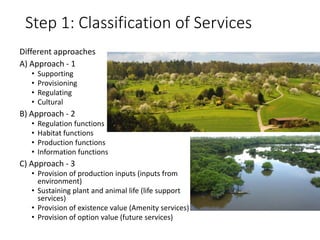
Step 1: Classification of Services
Different approaches
A) Approach - 1
• Supporting
• Provisioning
• Regulating
• Cultural
B) Approach - 2
• Regulation functions
• Habitat functions
• Production functions
• Information functions
C) Approach - 3
• Provision of production inputs (inputs from
environment)
• Sustaining plant and animal life (life support
services)
• Provision of existence value (Amenity services)
• Provision of option value (future services)
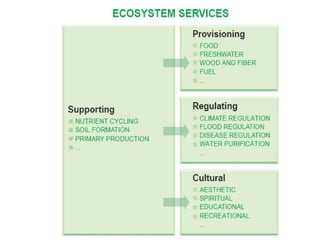
Approach – 1
1. Supporting
– Nutrient cycling
– Soil formation
– Primary
production
2. Provisioning
– Food
– Wood
– Fresh water
– Fuel
3. Regulating
• Climate regulation
• Flood prevention
• Disease prevention
• Water purification
4. Cultural
• Aesthetic
• Spiritual
• Recreational
• Educational
Approach - 2
1. Regulation functions – Maintenance of essential ecological
processes and life support systems.
• gas regulation (UVB regulation, climate, air quality)
• climate regulation (maintaining favorable climate)
• disturbance prevention (Storm prevention, flood
prevention)
• water regulation (drainage, natural irrigation)
• water supply (provision of water for consumptive use)
• soil retention (maintenance of arable land)
• soil formation (maintenance of productivity)
• nutrient regulation (maintenance of healthy soils)
• waste treatment (pollution control – detox)
• Pollination (pollination of crops)
• biological control (control of pests and diseases)
2. Habitat functions
• Refugium function (maintaining harvested species)
• Nursery function
3. Production services
• food – conversion of solar energy into edible plants and animals,
food and energy
• raw materials
• genetic resources (drugs and pharmaceuticals)
• medicinal resources (drugs and pharmaceuticals – and others)
• Ornamental resources (resources for fashion, etc)
4. Information functions
• Aesthetic value (enjoyment of scenery)
• Recreation (travel to natural ecosystems)
• Cultural and artistic information (use of nature as a motive)
• Spiritual and historic information (use for religious purpose)
• Science and education (use for schools)
Approach – 2 (contd….)
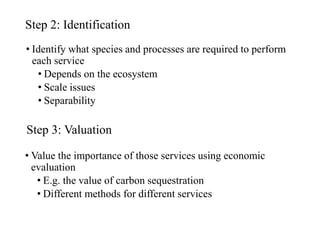
Step 2: Identification
• Identify what species and processes are required to perform
each service
• Depends on the ecosystem
• Scale issues
• Separability
Step 3: Valuation
• Value the importance of those services using economic
evaluation
• E.g. the value of carbon sequestration
• Different methods for different services
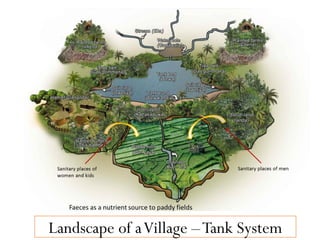
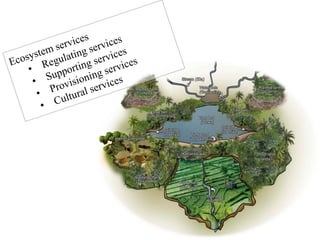
Landscape of aVillage –Tank System
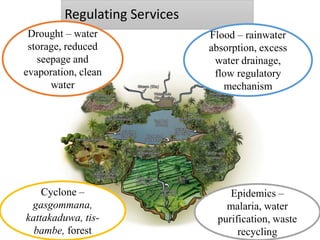
Regulating Services
Drought – water
storage, reduced
seepage and
evaporation, clean
water
Flood – rainwater
absorption, excess
water drainage,
flow regulatory
mechanism
Cyclone –
gasgommana,
kattakaduwa, tis-
bambe, forest
Epidemics –
malaria, water
purification, waste
recycling
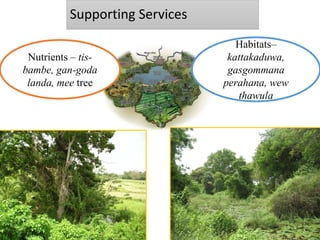
Supporting Services
Nutrients – tis-
bambe, gan-goda
landa, mee tree
Habitats–
kattakaduwa,
gasgommana
perahana, wew
thawula
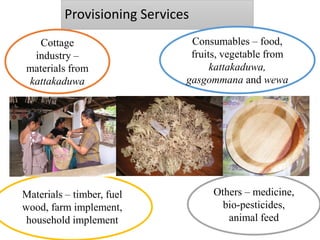
Provisioning Services
Cottage
industry –
materials from
kattakaduwa
Consumables – food,
fruits, vegetable from
kattakaduwa,
gasgommana and wewa
Materials – timber, fuel
wood, farm implement,
household implement
Others – medicine,
bio-pesticides,
animal feed
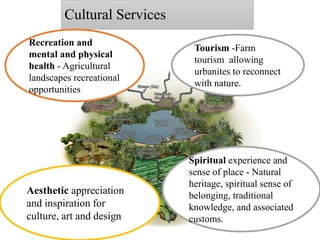
Cultural Services
Recreation and
mental and physical
health - Agricultural
landscapes recreational
opportunities
Aesthetic appreciation
and inspiration for
culture, art and design
Spiritual experience and
sense of place - Natural
heritage, spiritual sense of
belonging, traditional
knowledge, and associated
customs.
Tourism -Farm
tourism allowing
urbanites to reconnect
with nature.

Lesson 4 Ecosystem functions and ecosystem services

  • 1.
    Lesson 4 –Ecosystem Functions and Ecosystem services P.B. Dharmasena 0777 613234, 0717 613234 dharmasenapb@ymail.com , dharmasenapb@gmail.com https://independent.academia.edu/PunchiBandageDharmasena https://www.researchgate.net/profile/Punchi_Bandage_Dharmasena/contributions http://www.slideshare.net/DharmasenaPb Foundation of Environmental Management Course code: EMGT 2114
  • 2.
    Course Content 1.Concepts ofEcology and Environmental Biology Ecology, Producers, Consumers, Feeding interactions, Ecological pyramids, Ecological Interactions between organisms 2.Biogeochemical Cycles (C, N, P etc.) • Atmosphere, Hydrosphere, Lithosphere, Biosphere • C, N, P, S and water cycling 3.Ecosystems and Energy Flow • Ecosystem, habitat, niche, energy roles in ecosystem, energy flow, food chain, food web, energy pyramid 4.Ecosystem Functions and Ecosystem services
  • 3.
  • 4.
    4 Main Systems •Lithosphere or Geosphere describes all of the rocks, minerals and ground that are found on and in Earth. This includes all of the mountains on the surface. • hydrosphere is made up of all the water on Earth. This includes all of the rivers, lakes, streams, oceans, groundwater, polar ice caps, glaciers and moisture in the air like rain and snow. • Atmosphere is the envelope of gases surrounding the earth or another planet. • biosphere is composed of all of the living organisms on the planet. This includes all of the plants, animals, bacteria, fungi and single-celled organisms found on Earth.
  • 5.
    The Elements •Biogeochemcial (element)cycles Carbon (C ) Oxygen (O) Hydrogen (H) Nitrogen (N) Phosphorus (P) Potassium (K) Sulfur (S) Calcium (Ca) Sodium (Na) Magnesium (Mg) Manganese (Mn) Molybdenum (Mo) Cobalt (Co) Zinc (Zn) Aluminum (Al) Copper (Cu) Iron (Fe) others
  • 7.
    The Geologic Cycle •The Geologic Cycle: • The processes responsible for formation and change of Earth materials • Best described as a group of cycles: • Tectonic • Hydrologic • Rock • Biogeochemical
  • 8.
    • Igneous Rock: The magma in the form of a fluid is ejected from the very deep layers of earth's mantle. This will solidify and forms the igneous rock. A portion of molten substances will get cooled over the ground surface. Sedimentary Rocks: The deposits like gravel, silt, sand and clay are formed by weathering. Then, soil are compacted and cemented under the overburden stress of the soil. Generally, the groundwater carries the cementing agents. The cementing material fills the pore space between the particles and forms this type of rocks. Metamorphic rocks: It is the process of varying the texture and composition of rocks by heat (without melting) and pressure. During this process, new mineral types are formed. Examples for this category of rock are marble, gneiss, quartzite, etc.
  • 9.
    Tectonic Cycle Tectonic cycle: •Involves creation and destruction of the solid outer layer of Earth, the lithosphere
  • 10.
    The Hydrologic Cycle •The Hydrologic Cycle: • The transfer of water from the oceans to the atmosphere to the land and back to the oceans. Includes: • Evaporation of water from the oceans • Precipitation on land • Evaporation from land • Runoff from streams, rivers, and sub- surface groundwater
  • 11.
    The Rock Cycle •The rock cycle: • Numerous processes that produce rocks and soils • Depends on other cycles: • tectonic cycle for energy • Hydrologic cycle for water • Rock is classified as • Igneous (granite) • Sedimentary (sandstone) • Metamorphic (marble)
  • 12.
    Biogeochemical Cycles andLife: Limiting Factors •Macronutrients • Elements required in large amounts by all life • Include the “big six” elements that form the fundamental building blocks of life: carbon oxygen hydrogen phosphorus nitrogen sulfur •Limiting factor • When chemical elements are not available at the right times, in the right amounts, and in the right concentrations relative to each other
  • 14.
  • 15.
  • 16.
    Basic Carbon Facts •Keyelement of life •In its reduced form as organic C comprises 45 – 50% of the mass of all plants and animals •Found as: • Elemental carbon (in lithosphere) • As organic carbon (e.g. C6H12O6) • As inorganic carbon • Gaseous CO2, CO • Dissolved as HCO3, H2CO3 • Carbonite minerals as FeCO3, CO3 --, CaCO3
  • 17.
    Vegetation Photosynthesis: energy (sunlight) +6CO2 + H2O =>C6H12O6 + 6O2 Respiration: C6H12O6 (organic matter) + 6O2 => 6CO2 + 6 H2O + energy
  • 18.
    Hydrosphere •Surface ocean •Organic formas plants algae •Inorganic as calcareous or HCO3 Movement •To atmosphere through diffusion, carbon partial pressure •Photosynthesis from marine biota •Erosion •Upwelling of cold deep water
  • 20.
    The Phosphorus Cycle •The phosphorus cycle: • Involves the movement of phosphorus throughout the biosphere and lithosphere • Important because phosphorus is an essential element for life and often is a limiting nutrient for plant growth.
  • 22.
    The Nitrogen Cycle •Thenitrogen cycle: • Cycle responsible for moving important nitrogen components through the biosphere and other Earth systems • Extremely important because nitrogen is required by all living things •Nitrogen fixation: • The process of converting inorganic, molecular nitrogen in the atmosphere to ammonia or nitrate •Denitrification: • The process of releasing fixed nitrogen back to molecular nitrogen
  • 24.
    Earth as aLiving System Earth itself a system of biological communities • Biota: • All the organisms of all species living in an area or region up to and including the biosphere • Biosphere: 1. That part of a planet where life exists 2. The planetary system that includes and sustains life
  • 25.
    Ecosystem • Ecosystem: • Acommunity of organisms and its local nonliving environment in which matter (chemical elements) cycles and energy flows. • Life sustained by interactions of many different organisms, functioning together, and interacting through their physical and chemical environment • Inherently complex
  • 26.
    Basic Characteristics ofEcosystems • Structure • Living (Ecological Communities) – Hierarchical interactions • Non-living (physical/chemical environment) • Processes • Cycling of chemical elements – important and complex • Inflows, recycling, no waste in nature, interactions • Food webs • Flow of energy • Between tropic levels • Change • Evolution • Succession
  • 27.
    The Community Effect •Population: group of individuals belonging to the same species living in the same area • Species interact directly and indirectly • Symbiosis • Competition • Predator prey
  • 28.
    Community level interactions •Community-level interactions •Generalists vs specialists • Niches •Keystone species • Have large effects on it’s community or ecosystem • Its removal changes the basic nature of the community • Ex. Sea otter •Holistic View Needed
  • 30.
  • 31.
    Change • Evolution –change in genetic material • Succession –The sequential change in the relative abundances of the dominant species in a biological community converging to a climax state
  • 32.
    Change • Stages ofSuccession –Early: plants typically small with short lifecycles (annuals…), rapid seed dispersal, environmental stabilizers.r selected, generalists –Middle: plants typically longer lived, slower seed dispersal, and in woodland systems: larger. –Late: plants and animal species are those associated with older, more mature ecosystem. K-selected species, niches –“Climax”? - followed by a disturbance
  • 33.
    Resilience • An ecosystemis resilient if it can maintain its functional integrity when subjected to some disturbance • Property of the system • How to maintain? • Threshold • Keystone species • Diversity
  • 34.
    Saturday, February 9,2019 Mr G Davidson 34
  • 35.
  • 36.
    Ecosystem Functions/Services •Ecosystem Functions/Servicesare the conditions and processes through which natural ecosystems and the species that make them up, sustain and fulfill human life. •Biophysical necessities for human life provided by natural ecosystems •Functions provide goods and services •Currently threatened by most human activities •Important (but new) conservation tool
  • 37.
    Ecosystem functions/services •Cover awide range of processes and scales • Global scale • Carbon sequestration • Global warming • Landscape scale • Water purification • Erosion prevention • Community scale • Crop pollination • Pest control • Field, plot or individual person scale • Local nutrient levels • Disease and pest prevention
  • 38.
    Ecosystem Functions andservices • The combined activity of soil organisms results in ecosystem functions that sustain life on the planet. Ecosystem functions that generate benefits to society have been defined as ecosystem services. The centrality of belowground biodiversity to global sustainability is because soil organisms of different types, shapes and colours are responsible for different ecological functions… • Complex • Dynamic • Interact • Multiple within an ecosystem
  • 40.
    Distinguish: ecosystem servicesand functions • The terms ‘functions’ and ‘services’ can be confusing. • Usually, functions are considered as the biological processes underpinning and maintaining the ecosystem, while ecosystem services are defined as the direct and indirect contributions of an ecosystem to human well-being
  • 41.
    Step 1: Classificationof Services Different approaches A) Approach - 1 • Supporting • Provisioning • Regulating • Cultural B) Approach - 2 • Regulation functions • Habitat functions • Production functions • Information functions C) Approach - 3 • Provision of production inputs (inputs from environment) • Sustaining plant and animal life (life support services) • Provision of existence value (Amenity services) • Provision of option value (future services)
  • 42.
    Approach – 1 1.Supporting – Nutrient cycling – Soil formation – Primary production 2. Provisioning – Food – Wood – Fresh water – Fuel 3. Regulating • Climate regulation • Flood prevention • Disease prevention • Water purification 4. Cultural • Aesthetic • Spiritual • Recreational • Educational
  • 43.
    Approach - 2 1.Regulation functions – Maintenance of essential ecological processes and life support systems. • gas regulation (UVB regulation, climate, air quality) • climate regulation (maintaining favorable climate) • disturbance prevention (Storm prevention, flood prevention) • water regulation (drainage, natural irrigation) • water supply (provision of water for consumptive use) • soil retention (maintenance of arable land) • soil formation (maintenance of productivity) • nutrient regulation (maintenance of healthy soils) • waste treatment (pollution control – detox) • Pollination (pollination of crops) • biological control (control of pests and diseases)
  • 44.
    2. Habitat functions •Refugium function (maintaining harvested species) • Nursery function 3. Production services • food – conversion of solar energy into edible plants and animals, food and energy • raw materials • genetic resources (drugs and pharmaceuticals) • medicinal resources (drugs and pharmaceuticals – and others) • Ornamental resources (resources for fashion, etc) 4. Information functions • Aesthetic value (enjoyment of scenery) • Recreation (travel to natural ecosystems) • Cultural and artistic information (use of nature as a motive) • Spiritual and historic information (use for religious purpose) • Science and education (use for schools) Approach – 2 (contd….)
  • 45.
    Step 2: Identification •Identify what species and processes are required to perform each service • Depends on the ecosystem • Scale issues • Separability Step 3: Valuation • Value the importance of those services using economic evaluation • E.g. the value of carbon sequestration • Different methods for different services
  • 46.
    Landscape of aVillage–Tank System
  • 48.
    Regulating Services Drought –water storage, reduced seepage and evaporation, clean water Flood – rainwater absorption, excess water drainage, flow regulatory mechanism Cyclone – gasgommana, kattakaduwa, tis- bambe, forest Epidemics – malaria, water purification, waste recycling
  • 49.
    Supporting Services Nutrients –tis- bambe, gan-goda landa, mee tree Habitats– kattakaduwa, gasgommana perahana, wew thawula
  • 50.
    Provisioning Services Cottage industry – materialsfrom kattakaduwa Consumables – food, fruits, vegetable from kattakaduwa, gasgommana and wewa Materials – timber, fuel wood, farm implement, household implement Others – medicine, bio-pesticides, animal feed
  • 51.
    Cultural Services Recreation and mentaland physical health - Agricultural landscapes recreational opportunities Aesthetic appreciation and inspiration for culture, art and design Spiritual experience and sense of place - Natural heritage, spiritual sense of belonging, traditional knowledge, and associated customs. Tourism -Farm tourism allowing urbanites to reconnect with nature.