Ecology and
Human
Ecology
M.Sc. Claudia Tapia Larios
Ecology
   Is the scientific study
    of the relations that
    living organisms have
    with respect to each
    other and their
    natural environment.
   Variables of interest
    to ecologists include
    the composition,
    distribution, amount
    (biomass), number,
    and changing states
    of organisms within
    and among
    ecosystems.
Ecosystems
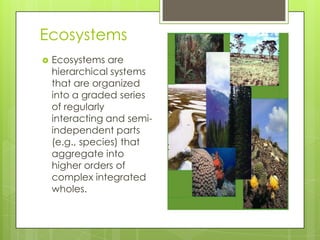
   Ecosystems are
    hierarchical systems
    that are organized
    into a graded series
    of regularly
    interacting and semi-
    independent parts
    (e.g., species) that
    aggregate into
    higher orders of
    complex integrated
    wholes.
Ecosystems
  Ecosystems create biophysical feedback
  mechanisms between living (biotic) and
  nonliving (abiotic) components of the planet.
  These feedback loops regulate and sustain
  local communities, continental climate systems,
  and global biogeochemical cycles.
Human ecology
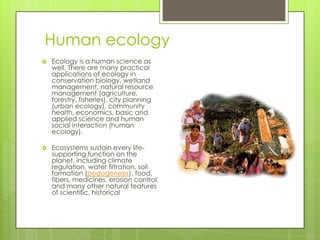
   Ecology is a human science as
    well. There are many practical
    applications of ecology in
    conservation biology, wetland
    management, natural resource
    management (agriculture,
    forestry, fisheries), city planning
    (urban ecology), community
    health, economics, basic and
    applied science and human
    social interaction (human
    ecology).

   Ecosystems sustain every life-
    supporting function on the
    planet, including climate
    regulation, water filtration, soil
    formation (pedogenesis), food,
    fibers, medicines, erosion control,
    and many other natural features
    of scientific, historical
Human ecology
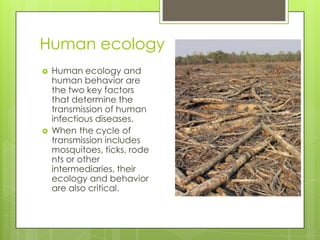
   Human ecology and
    human behavior are
    the two key factors
    that determine the
    transmission of human
    infectious diseases.
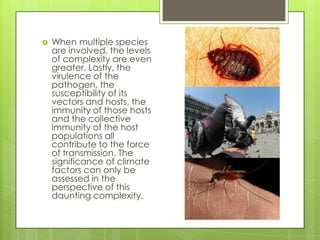
   When the cycle of
    transmission includes
    mosquitoes, ticks, rode
    nts or other
    intermediaries, their
    ecology and behavior
    are also critical.
   When multiple species
    are involved, the levels
    of complexity are even
    greater. Lastly, the
    virulence of the
    pathogen, the
    susceptibility of its
    vectors and hosts, the
    immunity of those hosts
    and the collective
    immunity of the host
    populations all
    contribute to the force
    of transmission. The
    significance of climate
    factors can only be
    assessed in the
    perspective of this
    daunting complexity.
Human ecology as a science
   Climate and weather are often invoked as the
    dominant parameters in transmission, but their
    true significance can only be assessed in the
    perspective of this daunting complexity.
    Moreover, the key parameters – temperature,
    rainfall and humidity – cannot be viewed
    independently. The effects of temperature are
    modified by humidity. The daily range of each
    may be more significant than the daily mean.
    Brief periods of atypical heat or cold can be
    more significant than long-term averages.
    Heavy storms can have a different impact than
    light prolonged rainfall. One year’s events may
    have a significant impact on subsequent years.
Climate and current distributions of disease


The distribution of many diseases coincides
with certain climate patterns, but in many
cases the reverse does not hold true. For
example, malaria disappeared
“spontaneously” from large areas of
Western Europe and North America after
the mid-1800s, precisely the period when
the current warming trend began (Reiter
2001).
SECCION DE PREGUNTAS

Ecology and human ecology

  • 1.
  • 2.
    Ecology  Is the scientific study of the relations that living organisms have with respect to each other and their natural environment.  Variables of interest to ecologists include the composition, distribution, amount (biomass), number, and changing states of organisms within and among ecosystems.
  • 3.
    Ecosystems  Ecosystems are hierarchical systems that are organized into a graded series of regularly interacting and semi- independent parts (e.g., species) that aggregate into higher orders of complex integrated wholes.
  • 4.
    Ecosystems Ecosystemscreate biophysical feedback mechanisms between living (biotic) and nonliving (abiotic) components of the planet. These feedback loops regulate and sustain local communities, continental climate systems, and global biogeochemical cycles.
  • 5.
    Human ecology  Ecology is a human science as well. There are many practical applications of ecology in conservation biology, wetland management, natural resource management (agriculture, forestry, fisheries), city planning (urban ecology), community health, economics, basic and applied science and human social interaction (human ecology).  Ecosystems sustain every life- supporting function on the planet, including climate regulation, water filtration, soil formation (pedogenesis), food, fibers, medicines, erosion control, and many other natural features of scientific, historical
  • 6.
    Human ecology  Human ecology and human behavior are the two key factors that determine the transmission of human infectious diseases.  When the cycle of transmission includes mosquitoes, ticks, rode nts or other intermediaries, their ecology and behavior are also critical.
  • 7.
    When multiple species are involved, the levels of complexity are even greater. Lastly, the virulence of the pathogen, the susceptibility of its vectors and hosts, the immunity of those hosts and the collective immunity of the host populations all contribute to the force of transmission. The significance of climate factors can only be assessed in the perspective of this daunting complexity.
  • 8.
    Human ecology asa science  Climate and weather are often invoked as the dominant parameters in transmission, but their true significance can only be assessed in the perspective of this daunting complexity. Moreover, the key parameters – temperature, rainfall and humidity – cannot be viewed independently. The effects of temperature are modified by humidity. The daily range of each may be more significant than the daily mean. Brief periods of atypical heat or cold can be more significant than long-term averages. Heavy storms can have a different impact than light prolonged rainfall. One year’s events may have a significant impact on subsequent years.
  • 9.
    Climate and currentdistributions of disease The distribution of many diseases coincides with certain climate patterns, but in many cases the reverse does not hold true. For example, malaria disappeared “spontaneously” from large areas of Western Europe and North America after the mid-1800s, precisely the period when the current warming trend began (Reiter 2001).
  • 10.