Energy & environmental
engineering (es301/401)
MODULE-II
ECOSYSTEMs
ECOSYSTEMs
CONTENT:
• Concept of an ecosystem & its types
• Structure and function of an ecosystem(Producers, consumers and
decomposers)
• Energy flow in the ecosystem (Food chains, food webs & tophic
levels)
• Ecological succession;
• Ecological pyramids;
• Introduction, types, characteristic features, structure and function of
the following ecosystem
(a.)Forest ecosystem
(b) Grassland ecosystem
(c) Desert ecosystem
(d) Aquatic ecosystems (ponds, streams, lakes, rivers,
oceans, estuaries)
Concept of an ecosystem
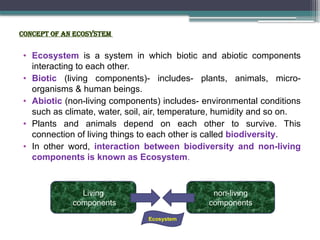
• Ecosystem is a system in which biotic and abiotic components
interacting to each other.
• Biotic (living components)- includes- plants, animals, micro-
organisms & human beings.
• Abiotic (non-living components) includes- environmental conditions
such as climate, water, soil, air, temperature, humidity and so on.
• Plants and animals depend on each other to survive. This
connection of living things to each other is called biodiversity.
• In other word, interaction between biodiversity and non-living
components is known as Ecosystem.
Living
components
non-living
components
Ecosystem
Concept of an ecosystem
• Ecosystem is defined as a community of plants, animals and
smaller organisms that live, feed, reproduce and interact with each
other in the same area or environment.
• An ecosystem is a community of living and nonliving things
considered as a unit.
• Ecosystem is a complex set of relationships among the living
resources, habitats and residents of an area. It includes plants,
trees, animals, fishes, birds, micro-organisms, air, water, soil and
people.
• An ecosystem, short for 'ecological system', is a community of living
and non-living things that work together.
• An ecosystem is a self regulating group of biotic communities
interacting with one another and with their non-living environment
by exchanging energy and matter.
• Ecosystems are dynamic ii nature.
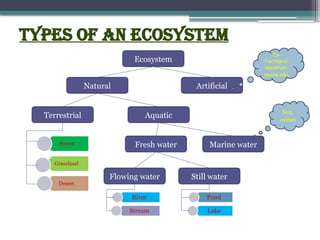
types of an ecosystem
Ecosystem
Natural Artificial
Terrestrial Aquatic
Forest
Grassland
Desert
River
Stream
Marine water
Fresh water
Still water
Flowing water
Pond
Lake
Ex-
Farmland,
aquarium,
space etc.
Sea,
ocean
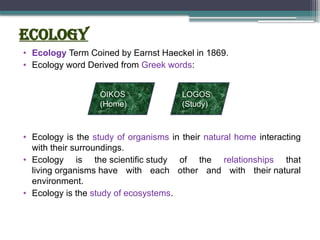
Ecology
• Ecology Term Coined by Earnst Haeckel in 1869.
• Ecology word Derived from Greek words:
• Ecology is the study of organisms in their natural home interacting
with their surroundings.
• Ecology is the scientific study of the relationships that
living organisms have with each other and with their natural
environment.
• Ecology is the study of ecosystems.
OIKOS
(Home)
LOGOS
(Study)
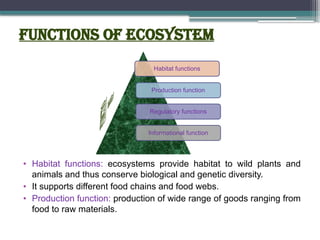
Functions of ecosystem
• Habitat functions: ecosystems provide habitat to wild plants and
animals and thus conserve biological and genetic diversity.
• It supports different food chains and food webs.
• Production function: production of wide range of goods ranging from
food to raw materials.
Habitat functions
Production function
Regulatory functions
Informational function
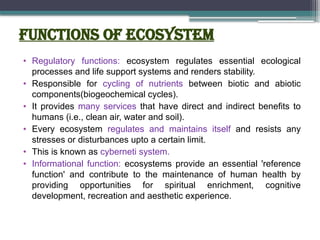
Functions of ecosystem
• Regulatory functions: ecosystem regulates essential ecological
processes and life support systems and renders stability.
• Responsible for cycling of nutrients between biotic and abiotic
components(biogeochemical cycles).
• It provides many services that have direct and indirect benefits to
humans (i.e., clean air, water and soil).
• Every ecosystem regulates and maintains itself and resists any
stresses or disturbances upto a certain limit.
• This is known as cyberneti system.
• Informational function: ecosystems provide an essential 'reference
function' and contribute to the maintenance of human health by
providing opportunities for spiritual enrichment, cognitive
development, recreation and aesthetic experience.
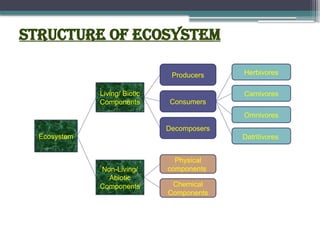
Structure of Ecosystem
Ecosystem
Living/ Biotic
Components
Non-Living/
Abiotic
Components
Producers
Consumers
Decomposers
Physical
components
Chemical
Components
Herbivores
Carnivores
Omnivores
Detritivores
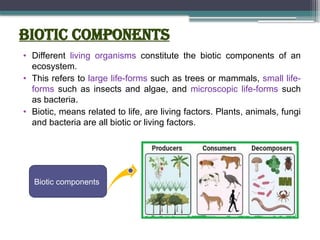
Biotic Components
• Different living organisms constitute the biotic components of an
ecosystem.
• This refers to large life-forms such as trees or mammals, small life-
forms such as insects and algae, and microscopic life-forms such
as bacteria.
• Biotic, means related to life, are living factors. Plants, animals, fungi
and bacteria are all biotic or living factors.
Biotic components
Producers
• Producers are organisms which are able to manufacture organic
compounds from inorganic substances from their environment.
• Food is produced both for themselves and for other organisms.
• They depend directly on the abiotic component for their survival and
production of nutrients.
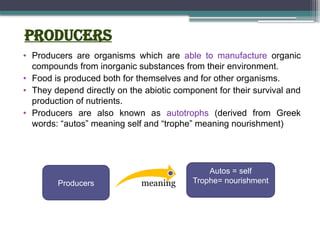
• Producers are also known as autotrophs (derived from Greek
words: “autos” meaning self and “trophe” meaning nourishment)
Autos = self
Trophe= nourishment
Producers meaning
Producers
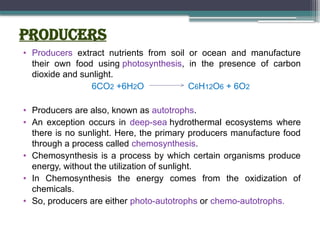
• Producers extract nutrients from soil or ocean and manufacture
their own food using photosynthesis, in the presence of carbon
dioxide and sunlight.
6CO2 +6H2O C6H12O6 + 6O2
• Producers are also, known as autotrophs.
• An exception occurs in deep-sea hydrothermal ecosystems where
there is no sunlight. Here, the primary producers manufacture food
through a process called chemosynthesis.
• Chemosynthesis is a process by which certain organisms produce
energy, without the utilization of sunlight.
• In Chemosynthesis the energy comes from the oxidization of
chemicals.
• So, producers are either photo-autotrophs or chemo-autotrophs.
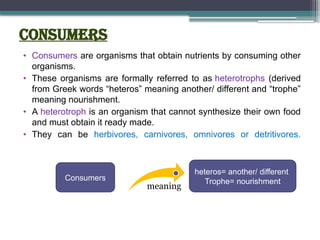
Consumers
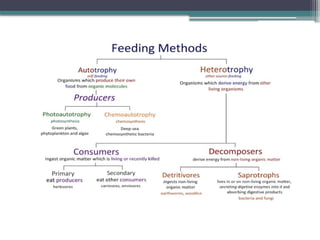
• Consumers are organisms that obtain nutrients by consuming other
organisms.
• These organisms are formally referred to as heterotrophs (derived
from Greek words “heteros” meaning another/ different and “trophe”
meaning nourishment.
• A heterotroph is an organism that cannot synthesize their own food
and must obtain it ready made.
• They can be herbivores, carnivores, omnivores or detritivores.
Consumers
heteros= another/ different
Trophe= nourishment
meaning
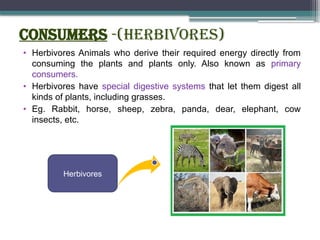
Consumers -(Herbivores)
• Herbivores Animals who derive their required energy directly from
consuming the plants and plants only. Also known as primary
consumers.
• Herbivores have special digestive systems that let them digest all
kinds of plants, including grasses.
• Eg. Rabbit, horse, sheep, zebra, panda, dear, elephant, cow
insects, etc.
Herbivores
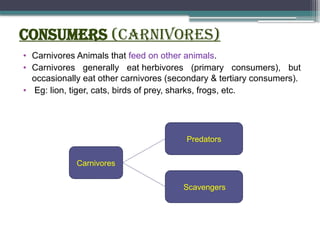
Consumers (carnivores)
• Carnivores Animals that feed on other animals.
• Carnivores generally eat herbivores (primary consumers), but
occasionally eat other carnivores (secondary & tertiary consumers).
• Eg: lion, tiger, cats, birds of prey, sharks, frogs, etc.
Carnivores
Predators
Scavengers
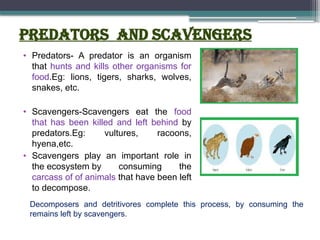
Predators and Scavengers
• Predators- A predator is an organism
that hunts and kills other organisms for
food.Eg: lions, tigers, sharks, wolves,
snakes, etc.
• Scavengers-Scavengers eat the food
that has been killed and left behind by
predators.Eg: vultures, racoons,
hyena,etc.
• Scavengers play an important role in
the ecosystem by consuming the
carcass of of animals that have been left
to decompose.
Decomposers and detritivores complete this process, by consuming the
remains left by scavengers.
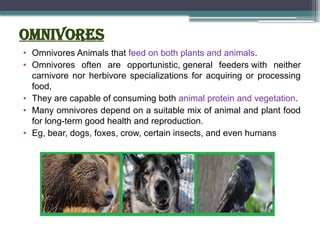
Omnivores
• Omnivores Animals that feed on both plants and animals.
• Omnivores often are opportunistic, general feeders with neither
carnivore nor herbivore specializations for acquiring or processing
food,
• They are capable of consuming both animal protein and vegetation.
• Many omnivores depend on a suitable mix of animal and plant food
for long-term good health and reproduction.
• Eg, bear, dogs, foxes, crow, certain insects, and even humans
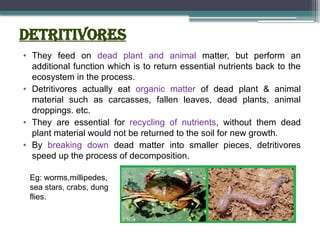
Detritivores
• They feed on dead plant and animal matter, but perform an
additional function which is to return essential nutrients back to the
ecosystem in the process.
• Detritivores actually eat organic matter of dead plant & animal
material such as carcasses, fallen leaves, dead plants, animal
droppings. etc.
• They are essential for recycling of nutrients, without them dead
plant material would not be returned to the soil for new growth.
• By breaking down dead matter into smaller pieces, detritivores
speed up the process of decomposition.
Eg: worms,millipedes,
sea stars, crabs, dung
flies.
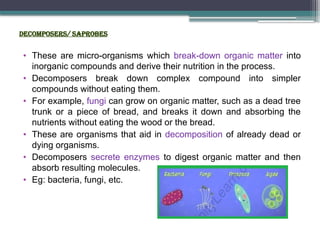
Decomposers/ Saprobes
• These are micro-organisms which break-down organic matter into
inorganic compounds and derive their nutrition in the process.
• Decomposers break down complex compound into simpler
compounds without eating them.
• For example, fungi can grow on organic matter, such as a dead tree
trunk or a piece of bread, and breaks it down and absorbing the
nutrients without eating the wood or the bread.
• These are organisms that aid in decomposition of already dead or
dying organisms.
• Decomposers secrete enzymes to digest organic matter and then
absorb resulting molecules.
• Eg: bacteria, fungi, etc.
Abiotic Components
• The nonliving materials in an ecosystem, such as minerals, gases,
liquids and chemicals are referred to as abiotic or non-biotic factors.
• Abiotic, meaning not alive, are nonliving factors that affect living
organisms.
• Environmental factors such habitat (pond, lake, ocean, desert,
mountain) are the abiotic factors.
• Weather condition such as temperature, cloud, rain, snow,
hurricanes, etc. are the abiotic factors.
• An abiotic factor is a nonliving thing, such as soil, water air etc. that
influences or affects an ecosystem and the organisms in it.
• Abiotic factors determine, which species of organisms will survive in
a given environment.
abiotic components
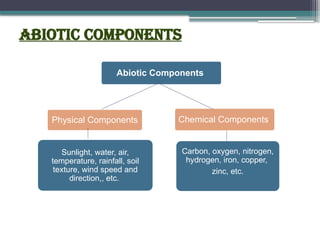
Abiotic Components
Abiotic Components
Physical Components
Sunlight, water, air,
temperature, rainfall, soil
texture, wind speed and
direction,, etc.
Chemical Components
Carbon, oxygen, nitrogen,
hydrogen, iron, copper,
zinc, etc.
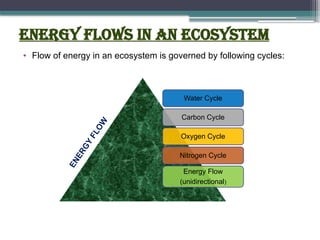
ENERGY FLOWS IN AN ECOSYSTEM
• Flow of energy in an ecosystem is governed by following cycles:
Water Cycle
Carbon Cycle
Oxygen Cycle
Nitrogen Cycle
Energy Flow
(unidirectional)
E
N
E
R
G
Y
F
L
O
W
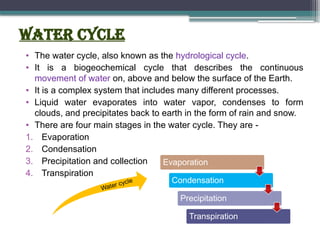
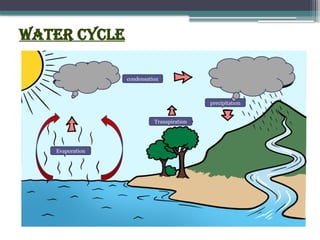
Water cycle
• The water cycle, also known as the hydrological cycle.
• It is a biogeochemical cycle that describes the continuous
movement of water on, above and below the surface of the Earth.
• It is a complex system that includes many different processes.
• Liquid water evaporates into water vapor, condenses to form
clouds, and precipitates back to earth in the form of rain and snow.
• There are four main stages in the water cycle. They are -
1. Evaporation
2. Condensation
3. Precipitation and collection
4. Transpiration
Evaporation
Condensation
Precipitation
Transpiration
Water cycle
Water cycle
condensation
precipitation
Transpiration
Evaporation
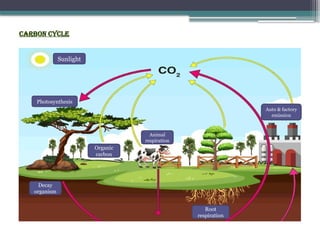
Carbon cycle
• The carbon, which occurs in organic compounds, is included in both
the abiotic and biotic parts of the ecosystem.
• Carbon is a building block of both plant and animal tissues.
• In atmosphere, carbon occurs as carbon dioxide.
• Through photosynthesis, plants form carbohydrates that contain
carbon and emit oxygen which is used by animals for respiration.
• Plants are consumed by animals for derivation of energy.
• Both plants and animals release carbon dioxide during respiration.
• Carbon is returned to soil in form of wastes from animals and plants
and in the form of dead matter when decomposed.
Carbon cycle
Carbon cycle
Sunlight
Organic
carbon
Animal
respiration
Decay
organism
Root
respiration
Photosynthesis
Auto & factory
emission
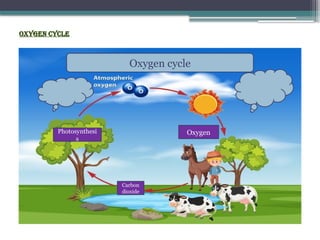
Oxygen Cycle
• Oxygen cycle refers to the movement of oxygen through the
atmosphere (air), biosphere (plants and animals) and the
lithosphere (the Earth's crust).
• The oxygen cycle demonstrates how free oxygen is made available
in each of these regions, as well as how it is used.
• The entire cycle can be summarized as, the oxygen cycle begins
with the process of photosynthesis.
• Oxygen is used up in :
1. Respiration -All organisms use oxygen for respiration.
2. Decomposing-When plants and animals die, they decompose.
3. Rusting-Called oxidation, this process causes metals to rust.
4. Combustion-Process by which fire is generated also requires
oxygen, along with heat and fuel.
Oxygen Cycle
Oxygen cycle
Oxygen
Carbon
dioxide
Oxygen
Photosynthesi
s
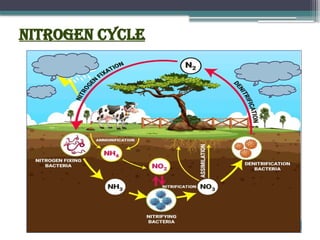
Nitrogen Cycle
• About 78% of Earth’s atmosphere is Nitrogen, in free form.
• Living things require nitrogen in compound form (not in free form), to
build proteins and other important chemicals.
• Not all the nitrogen that gets fixed is used by plants and animals.
• Some of it is returned to the atmosphere through a process called
denitrification.
• Bacterial species such as Pseudomonas and Clostridium perform
denitrification of nitrates in anaerobic conditions (absence of
oxygen).
• They use the nitrate in the place of oxygen during respiration.
• Effectively, they breathe nitrate and exhale nitrogen gas back into
the atmosphere.
Nitrogen Cycle
ENERGY flow
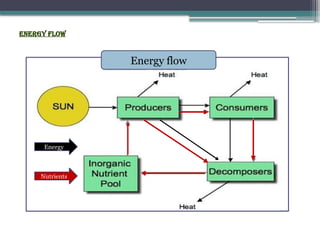
• The ultimate source of energy (for most of the ecosystems) is the
sun.
• The ultimate fate of energy in ecosystems is for it to be lost as heat.
• Energy and nutrients are passed from organism to organism
through the food chain as one organism eats another.
• Decomposers remove the last energy from the remains of
organisms.
• Inorganic nutrients are cycled, energy is not.
• Flow of energy in an ecosystem is uni-directional.
• Flow of energy in an ecosystem is governed by laws of
thermodynamics, which are:
• Energy cannot be created or destroyed (but it can be transformed
into stored energy & heat)
• Energy is lost as energy is transformed.
ENERGY flow
Energy flow
Energy
Nutrients
Integration of Cycles in Nature
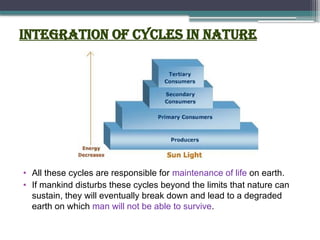
• All these cycles are responsible for maintenance of life on earth.
• If mankind disturbs these cycles beyond the limits that nature can
sustain, they will eventually break down and lead to a degraded
earth on which man will not be able to survive.
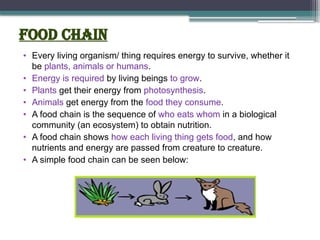
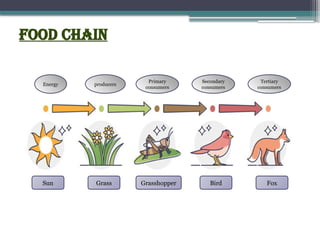
Food chain
• Every living organism/ thing requires energy to survive, whether it
be plants, animals or humans.
• Energy is required by living beings to grow.
• Plants get their energy from photosynthesis.
• Animals get energy from the food they consume.
• A food chain is the sequence of who eats whom in a biological
community (an ecosystem) to obtain nutrition.
• A food chain shows how each living thing gets food, and how
nutrients and energy are passed from creature to creature.
• A simple food chain can be seen below:
Food chain
Energy producers
Primary
consumers
Secondary
consumers
Tertiary
consumers
Sun Grass Grasshopper Bird Fox
Food chain
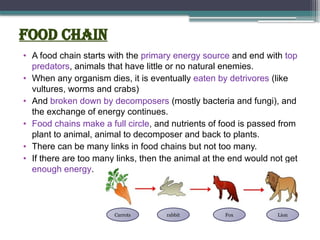
• A food chain starts with the primary energy source and end with top
predators, animals that have little or no natural enemies.
• When any organism dies, it is eventually eaten by detrivores (like
vultures, worms and crabs)
• And broken down by decomposers (mostly bacteria and fungi), and
the exchange of energy continues.
• Food chains make a full circle, and nutrients of food is passed from
plant to animal, animal to decomposer and back to plants.
• There can be many links in food chains but not too many.
• If there are too many links, then the animal at the end would not get
enough energy.
Carrots rabbit Fox Lion
Food chain
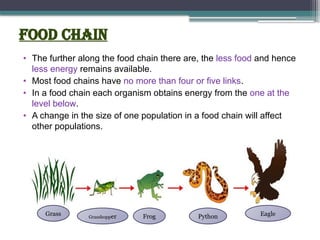
• The further along the food chain there are, the less food and hence
less energy remains available.
• Most food chains have no more than four or five links.
• In a food chain each organism obtains energy from the one at the
level below.
• A change in the size of one population in a food chain will affect
other populations.
Grass Grasshopper Frog Python Eagle
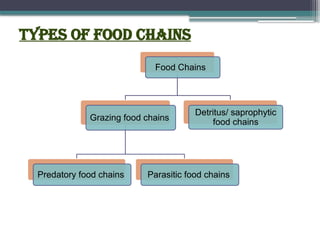
Types of food chains
Food Chains
Grazing food chains
Predatory food chains Parasitic food chains
Detritus/ saprophytic
food chains
Grazing food chains
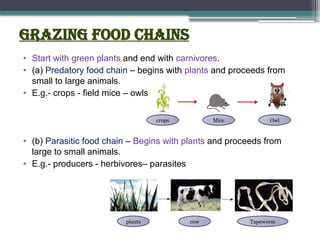
• Start with green plants and end with carnivores.
• (a) Predatory food chain – begins with plants and proceeds from
small to large animals.
• E.g.- crops - field mice – owls
• (b) Parasitic food chain – Begins with plants and proceeds from
large to small animals.
• E.g.- producers - herbivores– parasites
plants cow Tapeworm
crops Mice Owl
Detritus/ saprophytic food chains
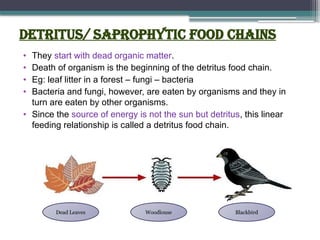
• They start with dead organic matter.
• Death of organism is the beginning of the detritus food chain.
• Eg: leaf litter in a forest – fungi – bacteria
• Bacteria and fungi, however, are eaten by organisms and they in
turn are eaten by other organisms.
• Since the source of energy is not the sun but detritus, this linear
feeding relationship is called a detritus food chain.
Dead Leaves Woodlouse Blackbird
Food Web
• In nature, food chain relationships are not isolated; rather they are
complex, because one organism may form the food source of many
organisms.
• Thus, instead of a simple linear food chain, there is a web like
structure formed by these interlinked food chains.
• Such interconnected matrix of food chains is called 'food web'.
• Food webs are indispensable in ecosystems as they allow an
organism to obtain its food from more than one type of organism of
the lower trophic level.
Food Web
Food Web
• Food chains are generally found to be interlinked and inter-woven
as a network and are known as food web.
• Food Web a system of interlocking and interdependent food chains
in a given area.
• A food web is several food chains connected together.
• A food web is many food chains linked together to show a more
accurate model of all possible feeding relationships of organisms in
an ecosystem.
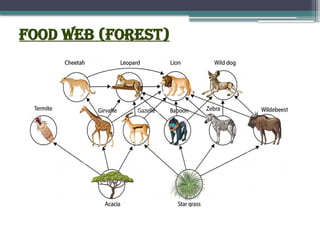
Food Web (forest)
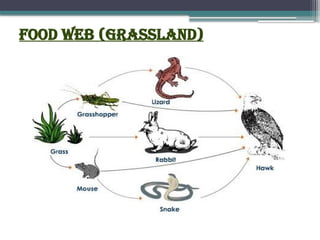
Food Web (grassland)
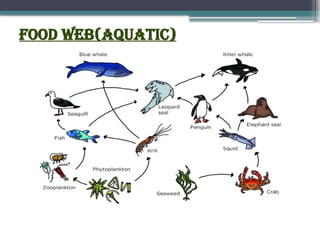
Food Web(Aquatic)
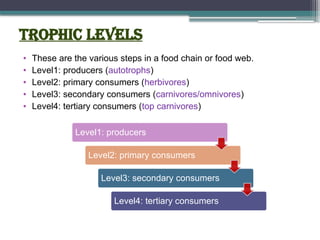
Trophic Levels
• These are the various steps in a food chain or food web.
• Level1: producers (autotrophs)
• Level2: primary consumers (herbivores)
• Level3: secondary consumers (carnivores/omnivores)
• Level4: tertiary consumers (top carnivores)
Level1: producers
Level2: primary consumers
Level3: secondary consumers
Level4: tertiary consumers
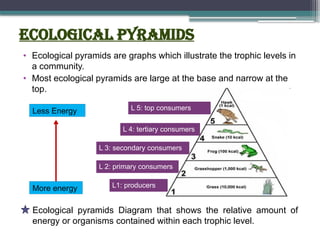
Ecological pyramids
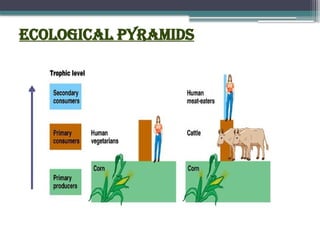
• Ecological pyramids are graphs which illustrate the trophic levels in
a community.
• Most ecological pyramids are large at the base and narrow at the
top.
L1: producers
L 2: primary consumers
L 3: secondary consumers
L 4: tertiary consumers
L 5: top consumers
More energy
Less Energy
Ecological pyramids Diagram that shows the relative amount of
energy or organisms contained within each trophic level.
Ecological pyramids
Ecological pyramids
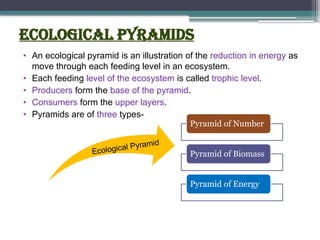
• An ecological pyramid is an illustration of the reduction in energy as
move through each feeding level in an ecosystem.
• Each feeding level of the ecosystem is called trophic level.
• Producers form the base of the pyramid.
• Consumers form the upper layers.
• Pyramids are of three types-
Ecological Pyramid
Pyramid of Number
Pyramid of Biomass
Pyramid of Energy
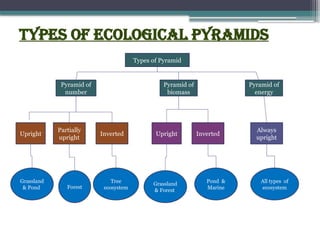
Types of Ecological pyramids
Types of Pyramid
Pyramid of
number
Pyramid of
biomass
Pyramid of
energy
Upright
Partially
upright
Inverted Upright Inverted
Always
upright
Grassland
& Pond Forest
Tree
ecosystem
Grassland
& Forest
Pond &
Marine
All types of
ecosystem
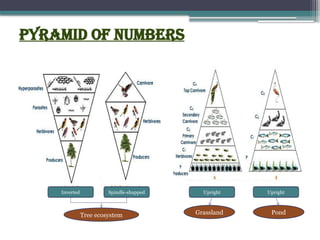
Pyramid of numbers
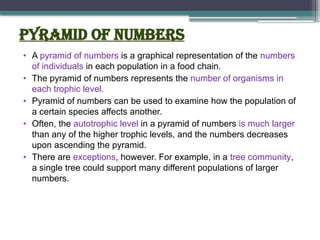
• A pyramid of numbers is a graphical representation of the numbers
of individuals in each population in a food chain.
• The pyramid of numbers represents the number of organisms in
each trophic level.
• Pyramid of numbers can be used to examine how the population of
a certain species affects another.
• Often, the autotrophic level in a pyramid of numbers is much larger
than any of the higher trophic levels, and the numbers decreases
upon ascending the pyramid.
• There are exceptions, however. For example, in a tree community,
a single tree could support many different populations of larger
numbers.
Pyramid of numbers
Inverted Spindle-shapped Upright Upright
Tree ecosystem Grassland Pond
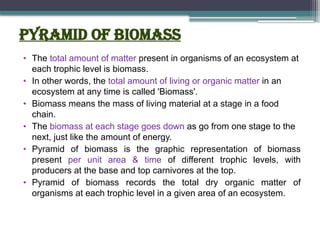
Pyramid of biomass
• The total amount of matter present in organisms of an ecosystem at
each trophic level is biomass.
• In other words, the total amount of living or organic matter in an
ecosystem at any time is called 'Biomass'.
• Biomass means the mass of living material at a stage in a food
chain.
• The biomass at each stage goes down as go from one stage to the
next, just like the amount of energy.
• Pyramid of biomass is the graphic representation of biomass
present per unit area & time of different trophic levels, with
producers at the base and top carnivores at the top.
• Pyramid of biomass records the total dry organic matter of
organisms at each trophic level in a given area of an ecosystem.
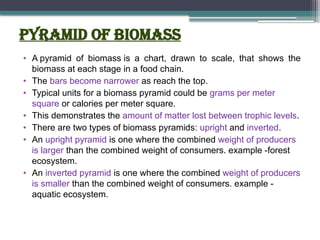
Pyramid of biomass
• A pyramid of biomass is a chart, drawn to scale, that shows the
biomass at each stage in a food chain.
• The bars become narrower as reach the top.
• Typical units for a biomass pyramid could be grams per meter
square or calories per meter square.
• This demonstrates the amount of matter lost between trophic levels.
• There are two types of biomass pyramids: upright and inverted.
• An upright pyramid is one where the combined weight of producers
is larger than the combined weight of consumers. example -forest
ecosystem.
• An inverted pyramid is one where the combined weight of producers
is smaller than the combined weight of consumers. example -
aquatic ecosystem.
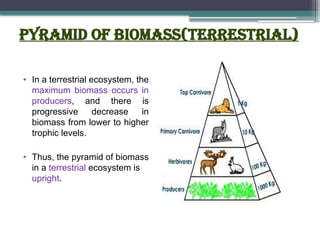
Pyramid of biomass(terrestrial)
• In a terrestrial ecosystem, the
maximum biomass occurs in
producers, and there is
progressive decrease in
biomass from lower to higher
trophic levels.
• Thus, the pyramid of biomass
in a terrestrial ecosystem is
upright.
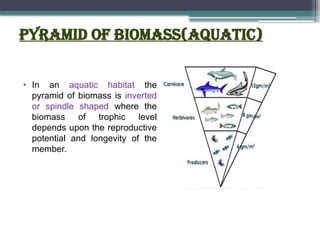
Pyramid of biomass(aquatic)
• In an aquatic habitat the
pyramid of biomass is inverted
or spindle shaped where the
biomass of trophic level
depends upon the reproductive
potential and longevity of the
member.
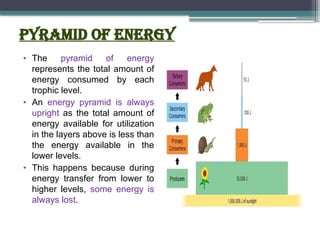
Pyramid of energy
• The pyramid of energy
represents the total amount of
energy consumed by each
trophic level.
• An energy pyramid is always
upright as the total amount of
energy available for utilization
in the layers above is less than
the energy available in the
lower levels.
• This happens because during
energy transfer from lower to
higher levels, some energy is
always lost.
Ecological succession
• Ecosystem is not static, its dynamic and changing constantly.
• Its structure and function change over time.
• These changes are in order and are capable of being predicted.
• One type of community gets totally replaced with another type of
community over a period of time and this causes several
changes.This is ecological succession.
• It is the slow and gradual process, by which ecosystems change
and develop over time.
• Ecological succession is the changing sequence of communities
that live in an ecosystem during a given time period.
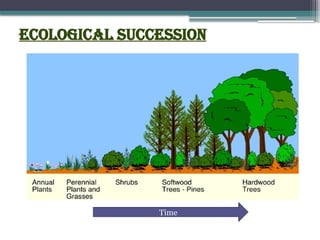
Ecological succession
Time
Ecological succession
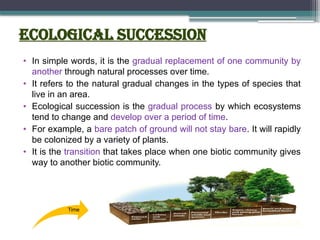
• In simple words, it is the gradual replacement of one community by
another through natural processes over time.
• It refers to the natural gradual changes in the types of species that
live in an area.
• Ecological succession is the gradual process by which ecosystems
tend to change and develop over a period of time.
• For example, a bare patch of ground will not stay bare. It will rapidly
be colonized by a variety of plants.
• It is the transition that takes place when one biotic community gives
way to another biotic community.
Time
Why succession takes place?
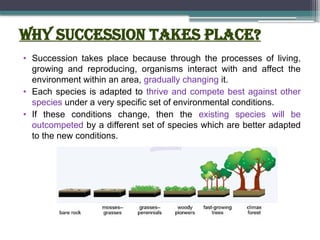
• Succession takes place because through the processes of living,
growing and reproducing, organisms interact with and affect the
environment within an area, gradually changing it.
• Each species is adapted to thrive and compete best against other
species under a very specific set of environmental conditions.
• If these conditions change, then the existing species will be
outcompeted by a different set of species which are better adapted
to the new conditions.
PIONEER ORGANISMS
• A pioneer organism is an organism that populates a region after a
natural disaster or any other event that may have caused most life in
that area to disappear.
• It is the first organism formed on the lifeless ground.
• Over time, dead material from pioneer species forms humus, and the
soil which results is colonized by other species.
• Common pioneer organisms include lichens and algae.
• A pioneer species are the species dominating a community in the first
stage of succession.
Features of Pioneer Species
High growth rate
Small size
Wide dispersal
Fast population growth
PIONEER ORGANISMS
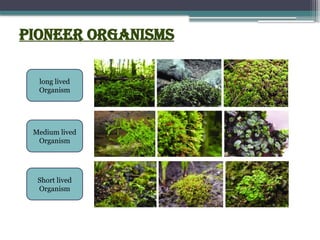
Short lived
Organism
Medium lived
Organism
long lived
Organism
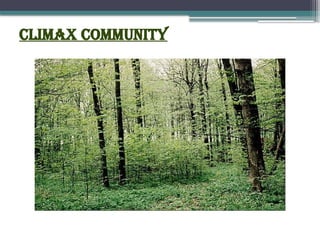
CLIMAX COMMUNITY
• An ecological community in which populations of plants or animals
remain stable and exist in balance with each other and their
environment.
• A climax community is the final stage of succession, remaining
relatively unchanged until destroyed by an event such as fire or
human interference.
• A stable, mature and final community that undergoes little or no
succession, when left undisturbed.
 Features of Climax Community
Slower growth rate
Larger size
Lower rates of dispersal
Lower rates of colonization
Longer lives
Climax Community
Stages of Ecological Succession
• Process begins with establishment of few pioneer species which get
replaced by species of increasing complexity.
• Establishment of pioneer species at a bare site causes changes in soil
structure and nutrient content, followed by changes in physical
environment.
• Existing species get replaced by new species due to changed physical
factors.
• These changes are often accompanied by introduction of animal
species into the area.
• This cyclic process ends after reaching a stabilized community called
climax community.
• At this stage ecosystem is in a state of balance, until disturbed by
external factors.
• Disturbances destroy existing climax community and then process of
succession starts anew.
Clement’s Theory of Succession
• Also known as Classical ecological theory -Published by Frederic
Clements in 1916.
• According to Clements, succession is a process involving several
phases:
 Nudation: development of a bare site, uninhabited by any
organisms, as a result of disturbances.
 Invasion/Migration: arrival of seeds, spores and other reproductive
propagules for establishment of species.
 Ecesis/ colonization: It involves establishment and initial growth of
vegetation. Dependent on soil structure. This is the stage where
pioneer species survive.
 Aggregation: Increase in the population of established species.
Clement’s Theory of Succession
 Competition: As vegetation became well established, grew, and
spread, various species began to compete for space, light and
nutrients. This also happens for animal species.
 Reaction: Environmental conditions get modified by the action of
species occupying the habitat and this triggers displacement and
replacement of one species by another.
 Stabilization: Process by which climax community gets established.
Reaction phase leads to development of a climax community, which
is mature, self-sustaining and stable. It is the final stage of
succession. Climax community continues until another disturbance
steps in.
Types of Ecological Succession
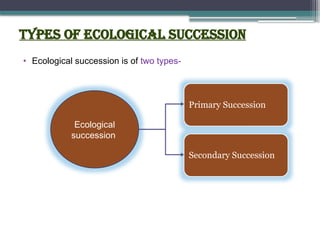
• Ecological succession is of two types-
Primary Succession
Secondary Succession
Ecological
succession
Primary Succession
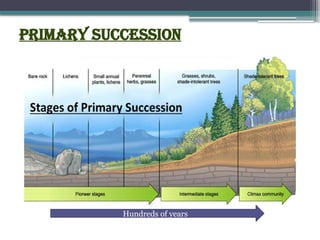
• Primary succession is the series of community changes which occur
on an entirely new habitat which has never been colonized before.
• Primary succession occurs in essentially life-less areas where no
ecosystem existed before.
• It begins on a barren surface.
• For example: on new islands created by volcanic eruptions, bare
rocks, rocks exposed by glacier retreats, etc.
• In primary succession pioneer species like lichen, algae and fungus
as well as other abiotic factors like wind and water start to
"normalize" the habitat.
• The primary succession is important in pioneering the area to create
conditions favorable for the growth of other forms of plants and
animals.
• Pedogenesis or the formation of soil is the most important process.
Primary Succession
Hundreds of years
Secondary Succession
• Secondary succession is the series of community changes which
take place on a previously colonized, but disturbed or damaged
habitat.
• For example: after felling trees in a woodland, land clearance or a
fire.
• Secondary succession begins in an area that already has soil.
 Process of secondary succession is much faster……why????
• Secondary succession is usually faster than primary succession as:
Soil is already present, so there is no need for pioneer species;
• Seeds, roots and underground vegetative organs of plants may still
survive in the soil.
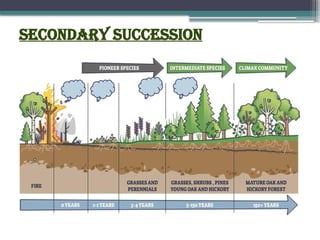
Secondary Succession
• An example of Secondary Succession by stages:
• A stable deciduous forest community
• A disturbance, such as a wild fire, destroys the forest
• The fire burns the forest to the ground
• The fire leaves behind empty, but not destroyed, soil
• Grasses and other herbaceous plants grow back first
• Small bushes and trees begin to colonize the area
• Fast growing evergreen trees develop to their fullest, while shade-
tolerant trees develop in the understory
• The short-lived and shade intolerant evergreen trees die as the
larger deciduous trees overtop them.
• The ecosystem is now back to a similar state to where it began.
ecosystems
THANK YOU

ECOSYSTEM PPT VG.On how to protect ecosystem

  • 1.
    Energy & environmental engineering(es301/401) MODULE-II ECOSYSTEMs
  • 2.
    ECOSYSTEMs CONTENT: • Concept ofan ecosystem & its types • Structure and function of an ecosystem(Producers, consumers and decomposers) • Energy flow in the ecosystem (Food chains, food webs & tophic levels) • Ecological succession; • Ecological pyramids; • Introduction, types, characteristic features, structure and function of the following ecosystem (a.)Forest ecosystem (b) Grassland ecosystem (c) Desert ecosystem (d) Aquatic ecosystems (ponds, streams, lakes, rivers, oceans, estuaries)
  • 3.
    Concept of anecosystem • Ecosystem is a system in which biotic and abiotic components interacting to each other. • Biotic (living components)- includes- plants, animals, micro- organisms & human beings. • Abiotic (non-living components) includes- environmental conditions such as climate, water, soil, air, temperature, humidity and so on. • Plants and animals depend on each other to survive. This connection of living things to each other is called biodiversity. • In other word, interaction between biodiversity and non-living components is known as Ecosystem. Living components non-living components Ecosystem
  • 4.
    Concept of anecosystem • Ecosystem is defined as a community of plants, animals and smaller organisms that live, feed, reproduce and interact with each other in the same area or environment. • An ecosystem is a community of living and nonliving things considered as a unit. • Ecosystem is a complex set of relationships among the living resources, habitats and residents of an area. It includes plants, trees, animals, fishes, birds, micro-organisms, air, water, soil and people. • An ecosystem, short for 'ecological system', is a community of living and non-living things that work together. • An ecosystem is a self regulating group of biotic communities interacting with one another and with their non-living environment by exchanging energy and matter. • Ecosystems are dynamic ii nature.
  • 5.
    types of anecosystem Ecosystem Natural Artificial Terrestrial Aquatic Forest Grassland Desert River Stream Marine water Fresh water Still water Flowing water Pond Lake Ex- Farmland, aquarium, space etc. Sea, ocean
  • 6.
    Ecology • Ecology TermCoined by Earnst Haeckel in 1869. • Ecology word Derived from Greek words: • Ecology is the study of organisms in their natural home interacting with their surroundings. • Ecology is the scientific study of the relationships that living organisms have with each other and with their natural environment. • Ecology is the study of ecosystems. OIKOS (Home) LOGOS (Study)
  • 7.
    Functions of ecosystem •Habitat functions: ecosystems provide habitat to wild plants and animals and thus conserve biological and genetic diversity. • It supports different food chains and food webs. • Production function: production of wide range of goods ranging from food to raw materials. Habitat functions Production function Regulatory functions Informational function
  • 8.
    Functions of ecosystem •Regulatory functions: ecosystem regulates essential ecological processes and life support systems and renders stability. • Responsible for cycling of nutrients between biotic and abiotic components(biogeochemical cycles). • It provides many services that have direct and indirect benefits to humans (i.e., clean air, water and soil). • Every ecosystem regulates and maintains itself and resists any stresses or disturbances upto a certain limit. • This is known as cyberneti system. • Informational function: ecosystems provide an essential 'reference function' and contribute to the maintenance of human health by providing opportunities for spiritual enrichment, cognitive development, recreation and aesthetic experience.
  • 9.
    Structure of Ecosystem Ecosystem Living/Biotic Components Non-Living/ Abiotic Components Producers Consumers Decomposers Physical components Chemical Components Herbivores Carnivores Omnivores Detritivores
  • 10.
    Biotic Components • Differentliving organisms constitute the biotic components of an ecosystem. • This refers to large life-forms such as trees or mammals, small life- forms such as insects and algae, and microscopic life-forms such as bacteria. • Biotic, means related to life, are living factors. Plants, animals, fungi and bacteria are all biotic or living factors. Biotic components
  • 11.
    Producers • Producers areorganisms which are able to manufacture organic compounds from inorganic substances from their environment. • Food is produced both for themselves and for other organisms. • They depend directly on the abiotic component for their survival and production of nutrients. • Producers are also known as autotrophs (derived from Greek words: “autos” meaning self and “trophe” meaning nourishment) Autos = self Trophe= nourishment Producers meaning
  • 12.
    Producers • Producers extractnutrients from soil or ocean and manufacture their own food using photosynthesis, in the presence of carbon dioxide and sunlight. 6CO2 +6H2O C6H12O6 + 6O2 • Producers are also, known as autotrophs. • An exception occurs in deep-sea hydrothermal ecosystems where there is no sunlight. Here, the primary producers manufacture food through a process called chemosynthesis. • Chemosynthesis is a process by which certain organisms produce energy, without the utilization of sunlight. • In Chemosynthesis the energy comes from the oxidization of chemicals. • So, producers are either photo-autotrophs or chemo-autotrophs.
  • 13.
    Consumers • Consumers areorganisms that obtain nutrients by consuming other organisms. • These organisms are formally referred to as heterotrophs (derived from Greek words “heteros” meaning another/ different and “trophe” meaning nourishment. • A heterotroph is an organism that cannot synthesize their own food and must obtain it ready made. • They can be herbivores, carnivores, omnivores or detritivores. Consumers heteros= another/ different Trophe= nourishment meaning
  • 14.
    Consumers -(Herbivores) • HerbivoresAnimals who derive their required energy directly from consuming the plants and plants only. Also known as primary consumers. • Herbivores have special digestive systems that let them digest all kinds of plants, including grasses. • Eg. Rabbit, horse, sheep, zebra, panda, dear, elephant, cow insects, etc. Herbivores
  • 15.
    Consumers (carnivores) • CarnivoresAnimals that feed on other animals. • Carnivores generally eat herbivores (primary consumers), but occasionally eat other carnivores (secondary & tertiary consumers). • Eg: lion, tiger, cats, birds of prey, sharks, frogs, etc. Carnivores Predators Scavengers
  • 16.
    Predators and Scavengers •Predators- A predator is an organism that hunts and kills other organisms for food.Eg: lions, tigers, sharks, wolves, snakes, etc. • Scavengers-Scavengers eat the food that has been killed and left behind by predators.Eg: vultures, racoons, hyena,etc. • Scavengers play an important role in the ecosystem by consuming the carcass of of animals that have been left to decompose. Decomposers and detritivores complete this process, by consuming the remains left by scavengers.
  • 17.
    Omnivores • Omnivores Animalsthat feed on both plants and animals. • Omnivores often are opportunistic, general feeders with neither carnivore nor herbivore specializations for acquiring or processing food, • They are capable of consuming both animal protein and vegetation. • Many omnivores depend on a suitable mix of animal and plant food for long-term good health and reproduction. • Eg, bear, dogs, foxes, crow, certain insects, and even humans
  • 18.
    Detritivores • They feedon dead plant and animal matter, but perform an additional function which is to return essential nutrients back to the ecosystem in the process. • Detritivores actually eat organic matter of dead plant & animal material such as carcasses, fallen leaves, dead plants, animal droppings. etc. • They are essential for recycling of nutrients, without them dead plant material would not be returned to the soil for new growth. • By breaking down dead matter into smaller pieces, detritivores speed up the process of decomposition. Eg: worms,millipedes, sea stars, crabs, dung flies.
  • 19.
    Decomposers/ Saprobes • Theseare micro-organisms which break-down organic matter into inorganic compounds and derive their nutrition in the process. • Decomposers break down complex compound into simpler compounds without eating them. • For example, fungi can grow on organic matter, such as a dead tree trunk or a piece of bread, and breaks it down and absorbing the nutrients without eating the wood or the bread. • These are organisms that aid in decomposition of already dead or dying organisms. • Decomposers secrete enzymes to digest organic matter and then absorb resulting molecules. • Eg: bacteria, fungi, etc.
  • 21.
    Abiotic Components • Thenonliving materials in an ecosystem, such as minerals, gases, liquids and chemicals are referred to as abiotic or non-biotic factors. • Abiotic, meaning not alive, are nonliving factors that affect living organisms. • Environmental factors such habitat (pond, lake, ocean, desert, mountain) are the abiotic factors. • Weather condition such as temperature, cloud, rain, snow, hurricanes, etc. are the abiotic factors. • An abiotic factor is a nonliving thing, such as soil, water air etc. that influences or affects an ecosystem and the organisms in it. • Abiotic factors determine, which species of organisms will survive in a given environment. abiotic components
  • 22.
    Abiotic Components Abiotic Components PhysicalComponents Sunlight, water, air, temperature, rainfall, soil texture, wind speed and direction,, etc. Chemical Components Carbon, oxygen, nitrogen, hydrogen, iron, copper, zinc, etc.
  • 23.
    ENERGY FLOWS INAN ECOSYSTEM • Flow of energy in an ecosystem is governed by following cycles: Water Cycle Carbon Cycle Oxygen Cycle Nitrogen Cycle Energy Flow (unidirectional) E N E R G Y F L O W
  • 24.
    Water cycle • Thewater cycle, also known as the hydrological cycle. • It is a biogeochemical cycle that describes the continuous movement of water on, above and below the surface of the Earth. • It is a complex system that includes many different processes. • Liquid water evaporates into water vapor, condenses to form clouds, and precipitates back to earth in the form of rain and snow. • There are four main stages in the water cycle. They are - 1. Evaporation 2. Condensation 3. Precipitation and collection 4. Transpiration Evaporation Condensation Precipitation Transpiration Water cycle
  • 25.
  • 26.
    Carbon cycle • Thecarbon, which occurs in organic compounds, is included in both the abiotic and biotic parts of the ecosystem. • Carbon is a building block of both plant and animal tissues. • In atmosphere, carbon occurs as carbon dioxide. • Through photosynthesis, plants form carbohydrates that contain carbon and emit oxygen which is used by animals for respiration. • Plants are consumed by animals for derivation of energy. • Both plants and animals release carbon dioxide during respiration. • Carbon is returned to soil in form of wastes from animals and plants and in the form of dead matter when decomposed. Carbon cycle
  • 27.
  • 28.
    Oxygen Cycle • Oxygencycle refers to the movement of oxygen through the atmosphere (air), biosphere (plants and animals) and the lithosphere (the Earth's crust). • The oxygen cycle demonstrates how free oxygen is made available in each of these regions, as well as how it is used. • The entire cycle can be summarized as, the oxygen cycle begins with the process of photosynthesis. • Oxygen is used up in : 1. Respiration -All organisms use oxygen for respiration. 2. Decomposing-When plants and animals die, they decompose. 3. Rusting-Called oxidation, this process causes metals to rust. 4. Combustion-Process by which fire is generated also requires oxygen, along with heat and fuel.
  • 29.
  • 30.
    Nitrogen Cycle • About78% of Earth’s atmosphere is Nitrogen, in free form. • Living things require nitrogen in compound form (not in free form), to build proteins and other important chemicals. • Not all the nitrogen that gets fixed is used by plants and animals. • Some of it is returned to the atmosphere through a process called denitrification. • Bacterial species such as Pseudomonas and Clostridium perform denitrification of nitrates in anaerobic conditions (absence of oxygen). • They use the nitrate in the place of oxygen during respiration. • Effectively, they breathe nitrate and exhale nitrogen gas back into the atmosphere.
  • 31.
  • 32.
    ENERGY flow • Theultimate source of energy (for most of the ecosystems) is the sun. • The ultimate fate of energy in ecosystems is for it to be lost as heat. • Energy and nutrients are passed from organism to organism through the food chain as one organism eats another. • Decomposers remove the last energy from the remains of organisms. • Inorganic nutrients are cycled, energy is not. • Flow of energy in an ecosystem is uni-directional. • Flow of energy in an ecosystem is governed by laws of thermodynamics, which are: • Energy cannot be created or destroyed (but it can be transformed into stored energy & heat) • Energy is lost as energy is transformed.
  • 33.
  • 34.
    Integration of Cyclesin Nature • All these cycles are responsible for maintenance of life on earth. • If mankind disturbs these cycles beyond the limits that nature can sustain, they will eventually break down and lead to a degraded earth on which man will not be able to survive.
  • 35.
    Food chain • Everyliving organism/ thing requires energy to survive, whether it be plants, animals or humans. • Energy is required by living beings to grow. • Plants get their energy from photosynthesis. • Animals get energy from the food they consume. • A food chain is the sequence of who eats whom in a biological community (an ecosystem) to obtain nutrition. • A food chain shows how each living thing gets food, and how nutrients and energy are passed from creature to creature. • A simple food chain can be seen below:
  • 36.
  • 37.
    Food chain • Afood chain starts with the primary energy source and end with top predators, animals that have little or no natural enemies. • When any organism dies, it is eventually eaten by detrivores (like vultures, worms and crabs) • And broken down by decomposers (mostly bacteria and fungi), and the exchange of energy continues. • Food chains make a full circle, and nutrients of food is passed from plant to animal, animal to decomposer and back to plants. • There can be many links in food chains but not too many. • If there are too many links, then the animal at the end would not get enough energy. Carrots rabbit Fox Lion
  • 38.
    Food chain • Thefurther along the food chain there are, the less food and hence less energy remains available. • Most food chains have no more than four or five links. • In a food chain each organism obtains energy from the one at the level below. • A change in the size of one population in a food chain will affect other populations. Grass Grasshopper Frog Python Eagle
  • 39.
    Types of foodchains Food Chains Grazing food chains Predatory food chains Parasitic food chains Detritus/ saprophytic food chains
  • 40.
    Grazing food chains •Start with green plants and end with carnivores. • (a) Predatory food chain – begins with plants and proceeds from small to large animals. • E.g.- crops - field mice – owls • (b) Parasitic food chain – Begins with plants and proceeds from large to small animals. • E.g.- producers - herbivores– parasites plants cow Tapeworm crops Mice Owl
  • 41.
    Detritus/ saprophytic foodchains • They start with dead organic matter. • Death of organism is the beginning of the detritus food chain. • Eg: leaf litter in a forest – fungi – bacteria • Bacteria and fungi, however, are eaten by organisms and they in turn are eaten by other organisms. • Since the source of energy is not the sun but detritus, this linear feeding relationship is called a detritus food chain. Dead Leaves Woodlouse Blackbird
  • 42.
    Food Web • Innature, food chain relationships are not isolated; rather they are complex, because one organism may form the food source of many organisms. • Thus, instead of a simple linear food chain, there is a web like structure formed by these interlinked food chains. • Such interconnected matrix of food chains is called 'food web'. • Food webs are indispensable in ecosystems as they allow an organism to obtain its food from more than one type of organism of the lower trophic level. Food Web
  • 43.
    Food Web • Foodchains are generally found to be interlinked and inter-woven as a network and are known as food web. • Food Web a system of interlocking and interdependent food chains in a given area. • A food web is several food chains connected together. • A food web is many food chains linked together to show a more accurate model of all possible feeding relationships of organisms in an ecosystem.
  • 44.
  • 45.
  • 46.
  • 47.
    Trophic Levels • Theseare the various steps in a food chain or food web. • Level1: producers (autotrophs) • Level2: primary consumers (herbivores) • Level3: secondary consumers (carnivores/omnivores) • Level4: tertiary consumers (top carnivores) Level1: producers Level2: primary consumers Level3: secondary consumers Level4: tertiary consumers
  • 48.
    Ecological pyramids • Ecologicalpyramids are graphs which illustrate the trophic levels in a community. • Most ecological pyramids are large at the base and narrow at the top. L1: producers L 2: primary consumers L 3: secondary consumers L 4: tertiary consumers L 5: top consumers More energy Less Energy Ecological pyramids Diagram that shows the relative amount of energy or organisms contained within each trophic level.
  • 49.
  • 50.
    Ecological pyramids • Anecological pyramid is an illustration of the reduction in energy as move through each feeding level in an ecosystem. • Each feeding level of the ecosystem is called trophic level. • Producers form the base of the pyramid. • Consumers form the upper layers. • Pyramids are of three types- Ecological Pyramid Pyramid of Number Pyramid of Biomass Pyramid of Energy
  • 51.
    Types of Ecologicalpyramids Types of Pyramid Pyramid of number Pyramid of biomass Pyramid of energy Upright Partially upright Inverted Upright Inverted Always upright Grassland & Pond Forest Tree ecosystem Grassland & Forest Pond & Marine All types of ecosystem
  • 52.
    Pyramid of numbers •A pyramid of numbers is a graphical representation of the numbers of individuals in each population in a food chain. • The pyramid of numbers represents the number of organisms in each trophic level. • Pyramid of numbers can be used to examine how the population of a certain species affects another. • Often, the autotrophic level in a pyramid of numbers is much larger than any of the higher trophic levels, and the numbers decreases upon ascending the pyramid. • There are exceptions, however. For example, in a tree community, a single tree could support many different populations of larger numbers.
  • 53.
    Pyramid of numbers InvertedSpindle-shapped Upright Upright Tree ecosystem Grassland Pond
  • 54.
    Pyramid of biomass •The total amount of matter present in organisms of an ecosystem at each trophic level is biomass. • In other words, the total amount of living or organic matter in an ecosystem at any time is called 'Biomass'. • Biomass means the mass of living material at a stage in a food chain. • The biomass at each stage goes down as go from one stage to the next, just like the amount of energy. • Pyramid of biomass is the graphic representation of biomass present per unit area & time of different trophic levels, with producers at the base and top carnivores at the top. • Pyramid of biomass records the total dry organic matter of organisms at each trophic level in a given area of an ecosystem.
  • 55.
    Pyramid of biomass •A pyramid of biomass is a chart, drawn to scale, that shows the biomass at each stage in a food chain. • The bars become narrower as reach the top. • Typical units for a biomass pyramid could be grams per meter square or calories per meter square. • This demonstrates the amount of matter lost between trophic levels. • There are two types of biomass pyramids: upright and inverted. • An upright pyramid is one where the combined weight of producers is larger than the combined weight of consumers. example -forest ecosystem. • An inverted pyramid is one where the combined weight of producers is smaller than the combined weight of consumers. example - aquatic ecosystem.
  • 56.
    Pyramid of biomass(terrestrial) •In a terrestrial ecosystem, the maximum biomass occurs in producers, and there is progressive decrease in biomass from lower to higher trophic levels. • Thus, the pyramid of biomass in a terrestrial ecosystem is upright.
  • 57.
    Pyramid of biomass(aquatic) •In an aquatic habitat the pyramid of biomass is inverted or spindle shaped where the biomass of trophic level depends upon the reproductive potential and longevity of the member.
  • 58.
    Pyramid of energy •The pyramid of energy represents the total amount of energy consumed by each trophic level. • An energy pyramid is always upright as the total amount of energy available for utilization in the layers above is less than the energy available in the lower levels. • This happens because during energy transfer from lower to higher levels, some energy is always lost.
  • 59.
    Ecological succession • Ecosystemis not static, its dynamic and changing constantly. • Its structure and function change over time. • These changes are in order and are capable of being predicted. • One type of community gets totally replaced with another type of community over a period of time and this causes several changes.This is ecological succession. • It is the slow and gradual process, by which ecosystems change and develop over time. • Ecological succession is the changing sequence of communities that live in an ecosystem during a given time period. Ecological succession
  • 60.
  • 61.
    Ecological succession • Insimple words, it is the gradual replacement of one community by another through natural processes over time. • It refers to the natural gradual changes in the types of species that live in an area. • Ecological succession is the gradual process by which ecosystems tend to change and develop over a period of time. • For example, a bare patch of ground will not stay bare. It will rapidly be colonized by a variety of plants. • It is the transition that takes place when one biotic community gives way to another biotic community. Time
  • 62.
    Why succession takesplace? • Succession takes place because through the processes of living, growing and reproducing, organisms interact with and affect the environment within an area, gradually changing it. • Each species is adapted to thrive and compete best against other species under a very specific set of environmental conditions. • If these conditions change, then the existing species will be outcompeted by a different set of species which are better adapted to the new conditions.
  • 63.
    PIONEER ORGANISMS • Apioneer organism is an organism that populates a region after a natural disaster or any other event that may have caused most life in that area to disappear. • It is the first organism formed on the lifeless ground. • Over time, dead material from pioneer species forms humus, and the soil which results is colonized by other species. • Common pioneer organisms include lichens and algae. • A pioneer species are the species dominating a community in the first stage of succession. Features of Pioneer Species High growth rate Small size Wide dispersal Fast population growth
  • 64.
    PIONEER ORGANISMS Short lived Organism Mediumlived Organism long lived Organism
  • 65.
    CLIMAX COMMUNITY • Anecological community in which populations of plants or animals remain stable and exist in balance with each other and their environment. • A climax community is the final stage of succession, remaining relatively unchanged until destroyed by an event such as fire or human interference. • A stable, mature and final community that undergoes little or no succession, when left undisturbed.  Features of Climax Community Slower growth rate Larger size Lower rates of dispersal Lower rates of colonization Longer lives
  • 66.
  • 67.
    Stages of EcologicalSuccession • Process begins with establishment of few pioneer species which get replaced by species of increasing complexity. • Establishment of pioneer species at a bare site causes changes in soil structure and nutrient content, followed by changes in physical environment. • Existing species get replaced by new species due to changed physical factors. • These changes are often accompanied by introduction of animal species into the area. • This cyclic process ends after reaching a stabilized community called climax community. • At this stage ecosystem is in a state of balance, until disturbed by external factors. • Disturbances destroy existing climax community and then process of succession starts anew.
  • 68.
    Clement’s Theory ofSuccession • Also known as Classical ecological theory -Published by Frederic Clements in 1916. • According to Clements, succession is a process involving several phases:  Nudation: development of a bare site, uninhabited by any organisms, as a result of disturbances.  Invasion/Migration: arrival of seeds, spores and other reproductive propagules for establishment of species.  Ecesis/ colonization: It involves establishment and initial growth of vegetation. Dependent on soil structure. This is the stage where pioneer species survive.  Aggregation: Increase in the population of established species.
  • 69.
    Clement’s Theory ofSuccession  Competition: As vegetation became well established, grew, and spread, various species began to compete for space, light and nutrients. This also happens for animal species.  Reaction: Environmental conditions get modified by the action of species occupying the habitat and this triggers displacement and replacement of one species by another.  Stabilization: Process by which climax community gets established. Reaction phase leads to development of a climax community, which is mature, self-sustaining and stable. It is the final stage of succession. Climax community continues until another disturbance steps in.
  • 70.
    Types of EcologicalSuccession • Ecological succession is of two types- Primary Succession Secondary Succession Ecological succession
  • 71.
    Primary Succession • Primarysuccession is the series of community changes which occur on an entirely new habitat which has never been colonized before. • Primary succession occurs in essentially life-less areas where no ecosystem existed before. • It begins on a barren surface. • For example: on new islands created by volcanic eruptions, bare rocks, rocks exposed by glacier retreats, etc. • In primary succession pioneer species like lichen, algae and fungus as well as other abiotic factors like wind and water start to "normalize" the habitat. • The primary succession is important in pioneering the area to create conditions favorable for the growth of other forms of plants and animals. • Pedogenesis or the formation of soil is the most important process.
  • 72.
  • 73.
    Secondary Succession • Secondarysuccession is the series of community changes which take place on a previously colonized, but disturbed or damaged habitat. • For example: after felling trees in a woodland, land clearance or a fire. • Secondary succession begins in an area that already has soil.  Process of secondary succession is much faster……why???? • Secondary succession is usually faster than primary succession as: Soil is already present, so there is no need for pioneer species; • Seeds, roots and underground vegetative organs of plants may still survive in the soil.
  • 74.
  • 75.
    Secondary Succession • Anexample of Secondary Succession by stages: • A stable deciduous forest community • A disturbance, such as a wild fire, destroys the forest • The fire burns the forest to the ground • The fire leaves behind empty, but not destroyed, soil • Grasses and other herbaceous plants grow back first • Small bushes and trees begin to colonize the area • Fast growing evergreen trees develop to their fullest, while shade- tolerant trees develop in the understory • The short-lived and shade intolerant evergreen trees die as the larger deciduous trees overtop them. • The ecosystem is now back to a similar state to where it began.
  • 76.