INTRODUCTION TO ENVIRONMENT,
ECOLOGY & ECOSYSTEM
Prepared By:- Dasani Yash R (Assi. Prof.)
Civil Engineering Department, DRVRGCET
◉ The word “Environment” is derived from the French word
“Environner” that means to encircle or surround.
◉ All the biological and non-biological things surrounding an
organism are thus included in environment.
◉ Environment can be defined as:
External surroundings and conditions which directly or
indirectly affects the living organism.
◉ It can also be defined as:
Environment is sum total of water, air, land,
interrelationship among themselves and also with human
beings, other living organisms and property.
ENVIRONMENT
Biotic Abiotic
Made up all living
organisms(plant,
animals and
microorganisms)
including their
reaction,
interactions and
interrelated
actions.
All physical
factor like
temperature,
humidity,
water, soil,
minerals,
gases etc.
◉ Any constitutes of the environment which directly
or indirectly affects the growth and development of
an organisms is called environmental or ecological factor.
◉ E.g. climatic factor, biotic factor, edhapic (related to
soil) factors
ENVIRONMENTAL FACTORS
◉ The word ecology is derived from two greek words
“oikos” meaning house, habitation or place of living and
“logos” meanings ‘study‘.
◉ Ecology is the study of interrelationship between living
organisms and their physical and biological environment.
◉ Physical environment includes light and heat or solar
radiation, moisture, wind, oxygen, carbon dioxide,
nutrients is in soil, water and atmosphere.
◉ The biological environment includes organisms of all kind
as well as plants and animals.
ECOLOGY
◉ Ecosystem is made up of two words “eco” and “system”.
Eco means environment and system means an interacting
and interdependent complex.
Definition of Ecosystem
1. The organisms of any community besides interacting
among themselves, always have functional relationship
with the environment. The structural and functional
system of communities and environment is called
ecological system.
2. It is a community of interdependent organisms together
with the environment.
3. Any unit that includes all of the organisms in a given area
interacting with the physical environment, so that a flow
of energy leads to clearly defined trophic structure, biotic
diversity and material cycles within the system.
ECOSYSTEM
◉ Environmental science is the study of earth, air, water,
living organisms and the man with his impact on
environment.
◉ It is highly multidisciplinary integrating disciplines of
physical, chemical and biological sciences, geology,
mathematics, sociology etc.
◉ Branches of biology like Botany, zoology, Microbiology,
Genetics, Biochemistry helps in understanding the biotic
components and their interactions.
ENVIRONMENTAL SCIENCE
◉ Basics concept of physics, chemistry, Geology,
Atmospheric science, oceanography help us to understand
the physical and chemical structure of the biotic
components and energy transfer and it’s flow.
◉ Mathematics, statics and computer sciences serve as
effective tools in environment modeling and management.
◉ Sociology and Economics helps us to understand socio-
economics aspects associated with various developmental
activities.
◉ Environmental studies is therefore a multi disciplinary
subject where different aspects are dealt with holistic
approach
1. Ecology and biodiversity.
2. Environment pollution and control.
3. Social issues in relation to development and
environment.
4. Human population and environment
◉ Environmental studies can highly specialized also which
may concentrate or more technical aspects like
Environmental science, Environmental engineering,
environmental management etc.
and
CONSERVATION
◉ Environment belongs to all and in this important for all.
Whatever be the occupation or age of a person, he or she
will be affected by environment by his or her deeds. Thus,
the environment is one subject that actually global in
nature.
◉ Environment studies is also very important science it deals
with the most basic or routine issues like safe and clean
drinking water, hygienic living conditions, clean and fresh
air, fertile land, healthy food and development that is
sustainable.
◉ Environment studies helps to solve biggest environmental
problems like acid rain, global warming, ozone depletion
and resources depletion.
◉ It is the study of factors influencing ecosystems, mental
and physical health, living and working conditions and
pollution.
◉ It has very important role to play in dealing with the global
and local issues of environment.
◉ It is important in developing awareness about the
consequences and the challenges which arise due to man
handling the environment.
◉ It also help in improving the attitude towards environment
and in understanding the environment in a better way.
◉ It also improves the skills pretaining to conservation of
resources and maintaining ecological balance and
sustainable development
ENVIROMENTAL EDUCATION
◉ To increase awareness and sensitivity to total
environment.
◉ To increase the knowledge of environment.
◉ To improve attitude towards environment.
◉ To provide motivation for environmental protection.
◉ To increase participation and to develop a sense of
responsibility and urgency regarding environmental
problems and to ensure appropriate actions to solve the
problems.
OBJECTIVE ENVIROMENTAL EDUCATION
◉ It consider environment in totality
◉ Itis nota short learning process but it requires a holistic
approach as it is multidisciplinary in nature.
◉ Environmental hazards are controllable and every citizen
has a moral obligation and towards this.
◉ Education can be given to all section of societies
◉ Promote the value and necessity of cooperation at
personal, local and national level in the prevention of
environmental problems and solution for it.
◉ Help learner to discover the systems and causes of
environmental problems.
◉ Concerns of environment are concerns of several
agencies and everybody should work together.
PRINCIPLES ENVIROMENTAL EDUCATION
Environment can be divided in to 4 parts
1. Atmosphere
2. Hydrosphere
3. Lithosphere
4. Biosphere
COMPONENTS OF ENVIROMENT
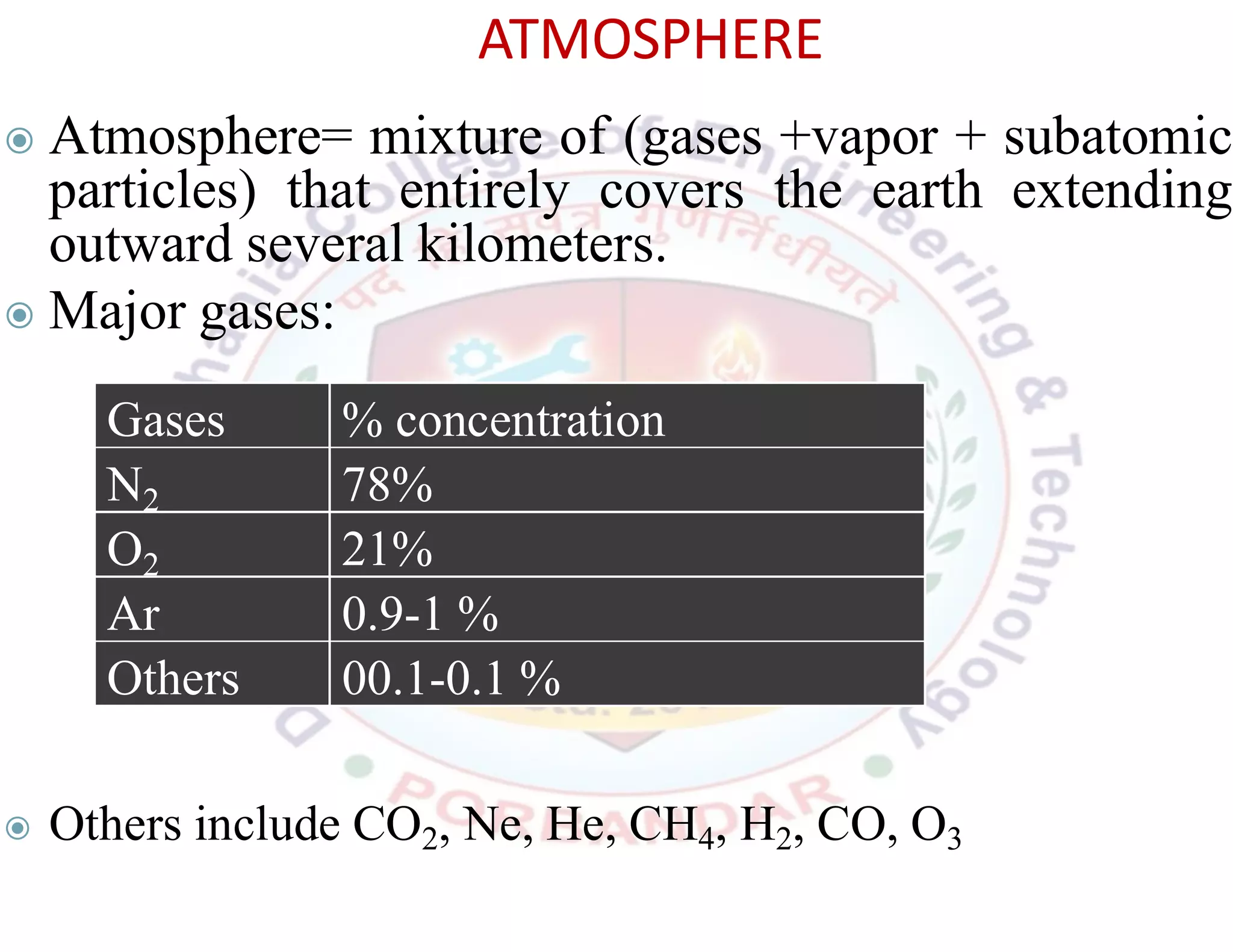
◉ Atmosphere= mixture of (gases +vapor + subatomic
particles) that entirely covers the earth extending
outward several kilometers.
◉ Major gases:
◉ Others include CO2, Ne, He, CH4, H2, CO, O3
Gases % concentration
N2 78%
O2 21%
Ar 0.9-1 %
Others 00.1-0.1 %
ATMOSPHERE
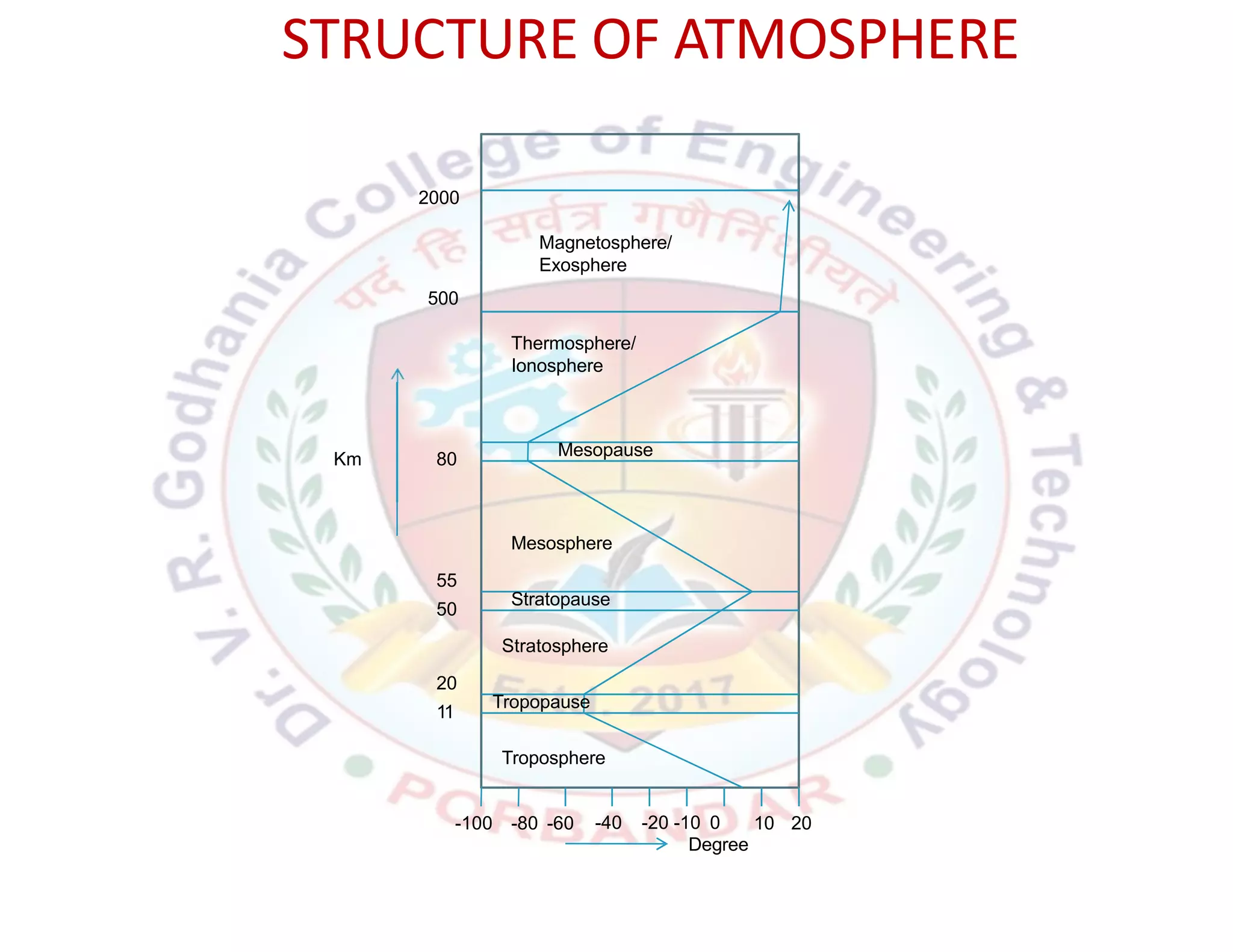
2000
Magnetosphere/
Exosphere
500
Thermosphere/
Ionosphere
80
Mesopause
Km
55
50
Stratopause
Mesosphere
20
11
Tropopause
Stratosphere
-100 -80 -60 10 20
Troposphere
-40 -20 -10 0
Degree
STRUCTURE OF ATMOSPHERE
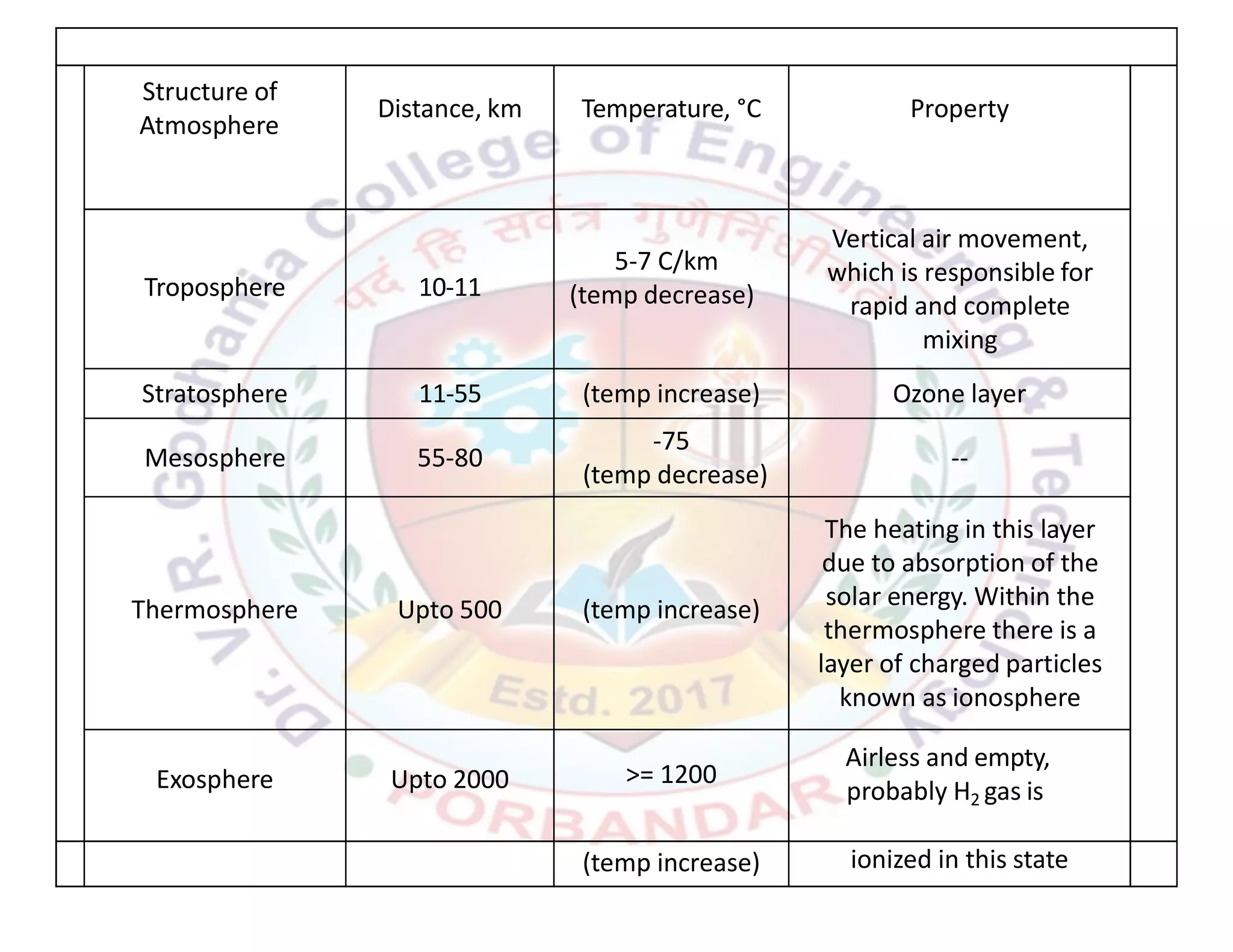
Structure of
Atmosphere
Distance, km Temperature, °C Property
Troposphere 10-11
5-7 C/km
(temp decrease)
Vertical air movement,
which is responsible for
rapid and complete
mixing
Stratosphere 11-55 (temp increase) Ozone layer
Mesosphere 55-80
-75
(temp decrease)
--
Thermosphere Upto 500 (temp increase)
The heating in this layer
due to absorption of the
solar energy. Within the
thermosphere there is a
layer of charged particles
known as ionosphere
Exosphere Upto 2000 >= 1200
Airless and empty,
probably H2 gas is
(temp increase) ionized in this state
◉ Water environment.
◉ 70% of earth is covered water.
◉ Water: Sea Ocean, lake, River, glaciers.
◉ It is estimates 1360 million cubic km of water.
◉ Out of this 97 % Ocean and sea, 2% in glaciers and
icecaps, 1% fresh water
HYDROSPHERE
◉ The outer soil crust of the earth is lithosphere
◉ The living organisms, plant, and vegetation are supported
by the lithosphere.
◉ It also contains resources like minerals, organic as well as
inorganic matter and to some extend of air and water.
◉ It plays an important role as it not only produces food for
human beings and animals, but also the decomposition of
organic wastes is carried out by a host of microorganisms
in the soil.
LITHOSPHERE
◉ Thin outer crust.
◉ Includes living organism and their environment.
◉ It extends from the lowest sea bed level to about 24 km of
the atmosphere.
◉ Biosphere= Lithosphere +Hydrosphere+ atmosphere
◉ The life supporting resources are also available from
biosphere.
◉ The wasteproducts in gases, liquids and solids waste forms
are discharged into biosphere.
◉ Though the sustaining and assimilative capacity of the
biosphere is tremendous but it is not infinite.
◉ The system is in operation for millions of years but now it
is showing stress, primarily due to impact of human upon
environment.
BIOSPHERE
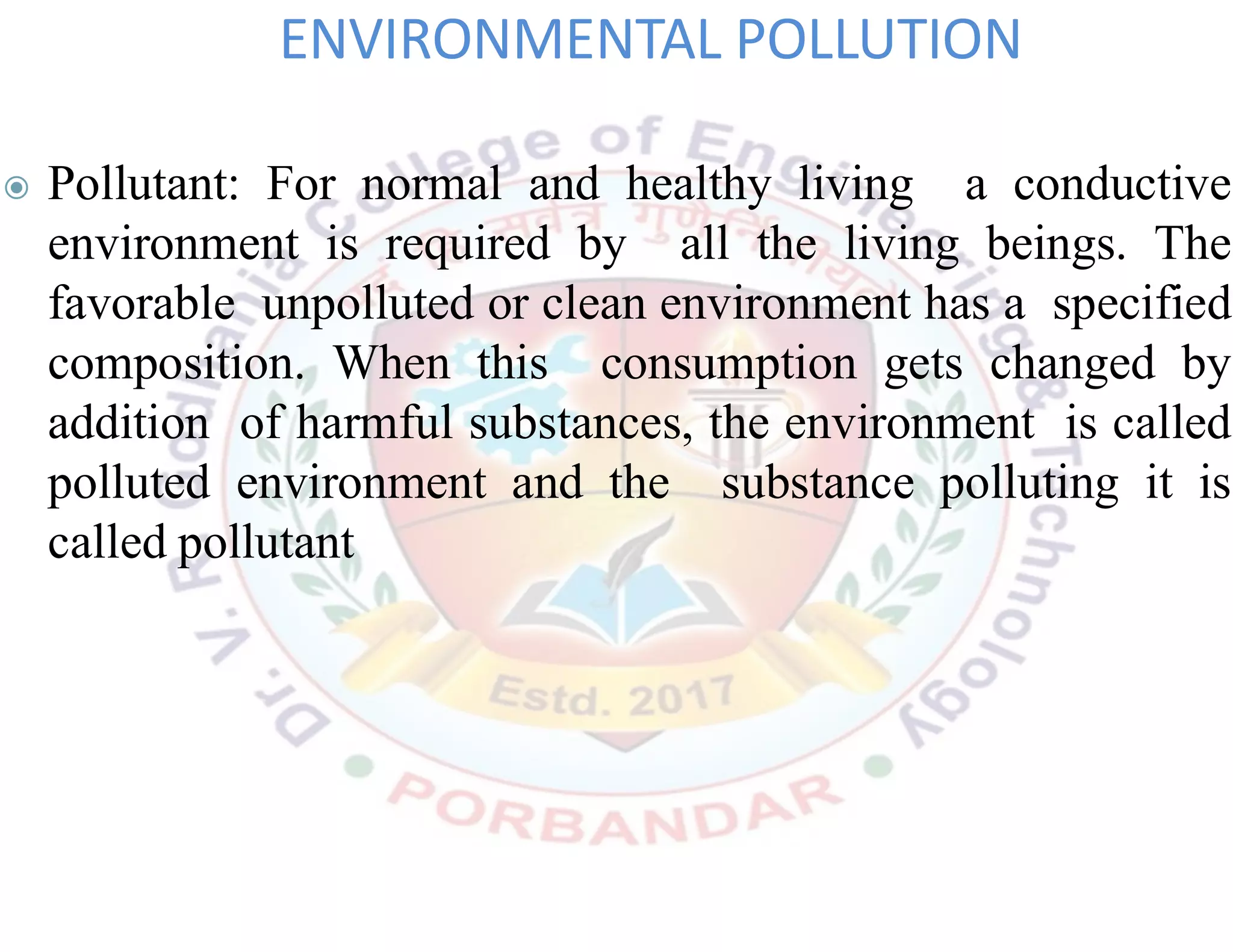
◉ Pollutant: For normal and healthy living a conductive
environment is required by all the living beings. The
favorable unpolluted or clean environment has a specified
composition. When this consumption gets changed by
addition of harmful substances, the environment is called
polluted environment and the substance polluting it is
called pollutant
ENVIRONMENTAL POLLUTION
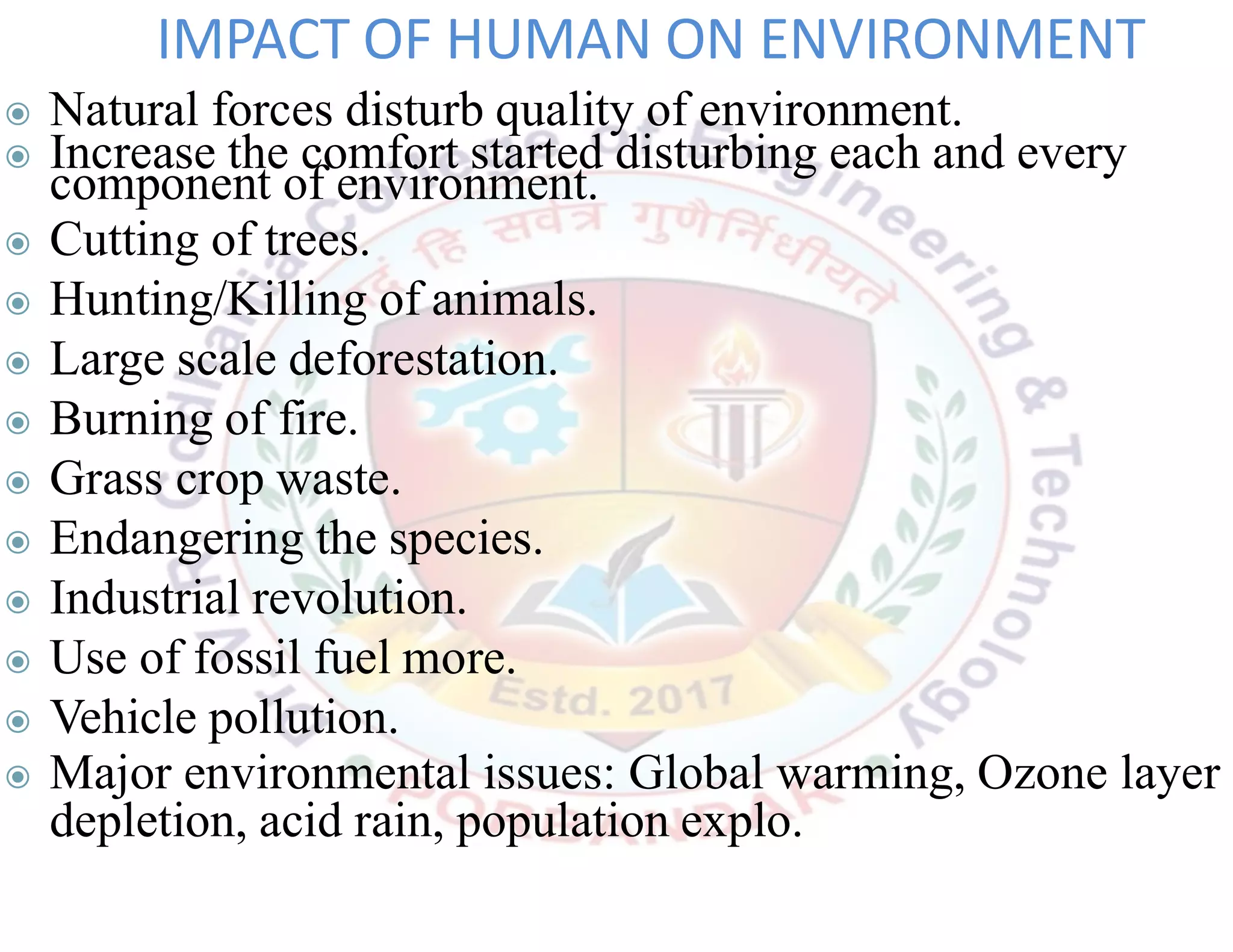
◉ Environmental Pollution: Any undesirable changes in the
physical, chemical or biological characteristics of any
components of the environment(air, water, soil) which can
cause harmful effects on various forms of life or property.
The various types of pollutants are:
1. Air Pollution
2. Water Pollution
3. Noise Pollution
4. Land Pollution
5. Thermal Pollution
Atmosphere
Biosphere
Lithosphere
Hydrosphere
INTERACTION BETWEEN DIFFERENT
COMPONENTS OF ENVIRONMENT
◉ Circle indicate sphere and curved arrow indicates the flow
path of matter.
◉ There is closed, dynamic, inseparable, organic coupling or
interrelationship among environment components.
◉ If one components changes, other component respond.
◉ Every sphere has two way linkages to every other sphere
including itself.
◉ Some arrow show transfer within a given components from
one location indicating movement of the substance from
one physical location to another without leaving the
sphere.
◉ Since the matter cannot be destroyed or created, the major
objective is to find the location and chemical form of the
substance at any given time
◉ Atmosphere – transport component to receptor – storage
capacity small – great capacity for spatially
redistributing matter.
◉ Hydrosphere- classified 2 sub component
It Convey to rivers system which collects the substances
within the watershed and delivers then to second
subcomponent to ocean
◉ Lithosphere: solid shell of inorganic materials on the
surface of the earth.
It composed soil particles + under laying rocks downs to
the depth of 50 km
◉ Biosphere: thin shell of organic matter +comprising all
living beings – It is sum total of Hydrosphere +
Lithosphere+ atmosphere
◉ Natural forces disturb quality of environment.
◉ Increase the comfort started disturbing each and every
component of environment.
◉ Cutting of trees.
◉ Hunting/Killing of animals.
◉ Large scale deforestation.
◉ Burning of fire.
◉ Grass crop waste.
◉ Endangering the species.
◉ Industrial revolution.
◉ Use of fossil fuel more.
◉ Vehicle pollution.
◉ Major environmental issues: Global warming, Ozone layer
depletion, acid rain, population explo.
IMPACT OF HUMAN ON ENVIRONMENT
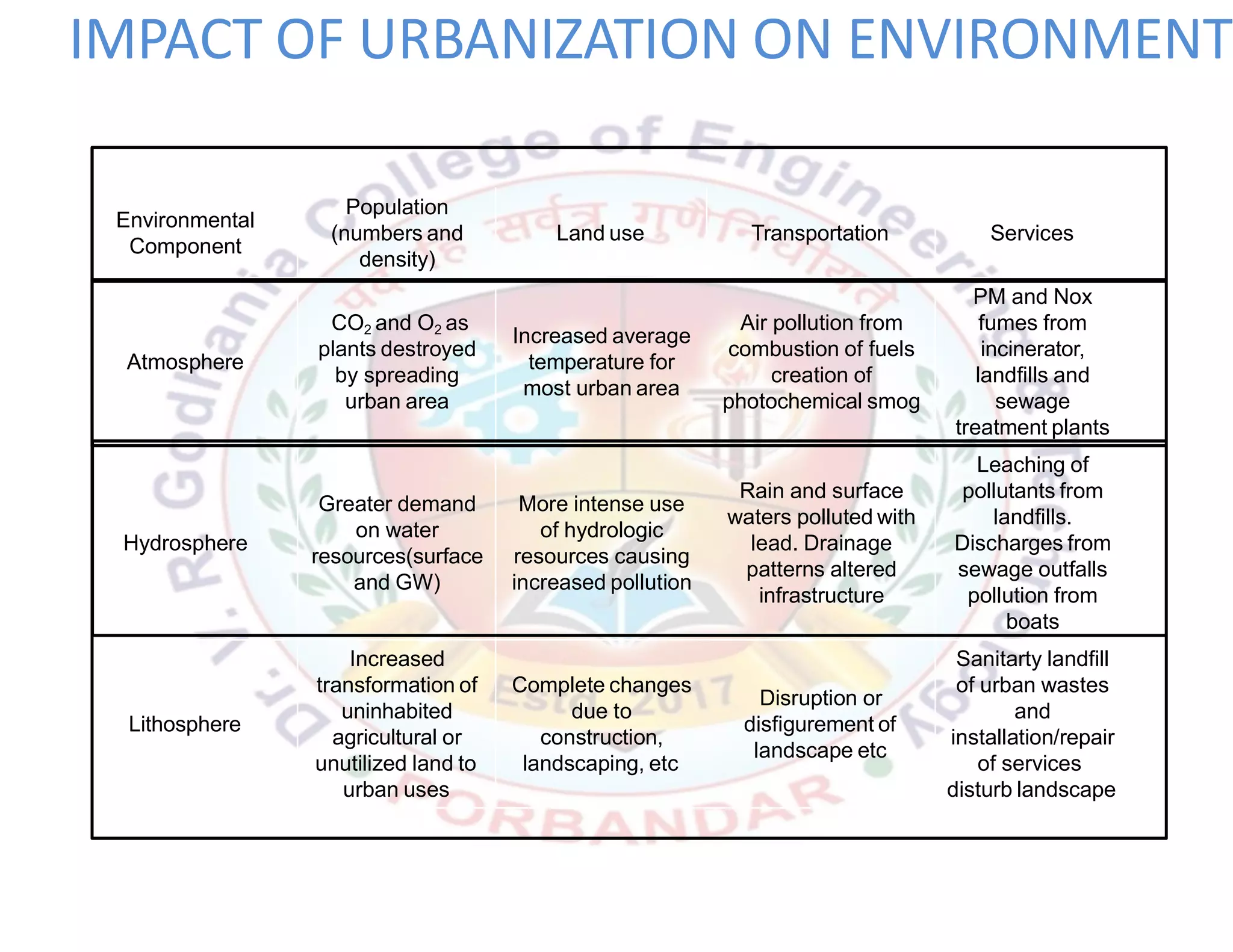
Environmental
Component
Land use Transportation Services
Population
(numbers and
density)
Atmosphere
CO2 and O2 as
plants destroyed
by spreading
urban area
Increased average
temperature for
most urban area
Air pollution from
combustion of fuels
creation of
photochemical smog
PM and Nox
fumes from
incinerator,
landfills and
sewage
treatment plants
Hydrosphere
Greater demand
on water
resources(surface
and GW)
More intense use
of hydrologic
resources causing
increased pollution
Rain and surface
waters polluted with
lead. Drainage
patterns altered
infrastructure
Leaching of
pollutants from
landfills.
Discharges from
sewage outfalls
pollution from
boats
Lithosphere
Disruption or
disfigurement of
Increased
transformation of
uninhabited
agricultural or
unutilized land to
urban uses
Complete changes
due to
construction,
landscaping, etc
landscape etc
Sanitarty landfill
of urban wastes
and
installation/repair
of services
disturb landscape
IMPACT OF URBANIZATION ON ENVIRONMENT
Environmental degradation: “The overall lowering of
environmental qualities due to damaged caused by both
natural events and human activities in the basic structure of
the environment at local, regional and global levels adversely
affecting all living organisms including man”.
Reason :
◉ Increase of population growth
◉ Rapid deforestation
◉ Industrialization
◉ Unplanned urbanization
◉ Nuclear explotion
◉ Releasing toxic gases from atmosphere
◉ Power plants
ENVIRONMENTAL DEGRADATION
Impact can be calculate by following equation
I = P* A* T
Where,
I= Impact
P= Population size
T= Degradation pollution caused per unit of resources used
A=Per capita consumption of resources
In developing countries Ps or P3 i.e. population, poverty and
pollution are key factor for rapid environmental urbanization
which cause high rate degradation
Effects:
◉ Destruction of environment stability and ecology balance
◉ Natural activity like forest fire. Deforestation, earthquake,
floods, volcanic eruption.
◉ SD is the need of present with compromising the need of
future generation,
◉ In other words, ever generation should leave air, water and
soil as pure and unpolluted as possible. Although it is a
difficult thing, it can be achieved through proper
environmental management.
◉ To meet basic requirement with increase of population,
industrialization is must, but it results in pollution,
environmental degradation and causes ecology unbalance.
◉ As the same time industrialization create job oppurtunity,
rises the standard of living and solve unemployment
problem.
◉ So require balance between environment and development
simultaneously, to achive goal SD is only answer.
SUSTIANABLE DEVELOPMENT
◉ SD can be done if following consept are taken care of:
◉ Control of pollution
◉ Reduction of excessive use of resources
◉ Resource conservation
◉ Use renewable energy sources
◉ Recycling and reuse of material for waste minimization
◉ Use cleaner fuel and technology
◉ Concentrating more on social and economic development
of the community
◉ Development of good mass transport facility to reduce
pollution
◉ By using effective management tool like Environmental
management system like ISO 14001, Environment Impact
assessment (EIA) etc
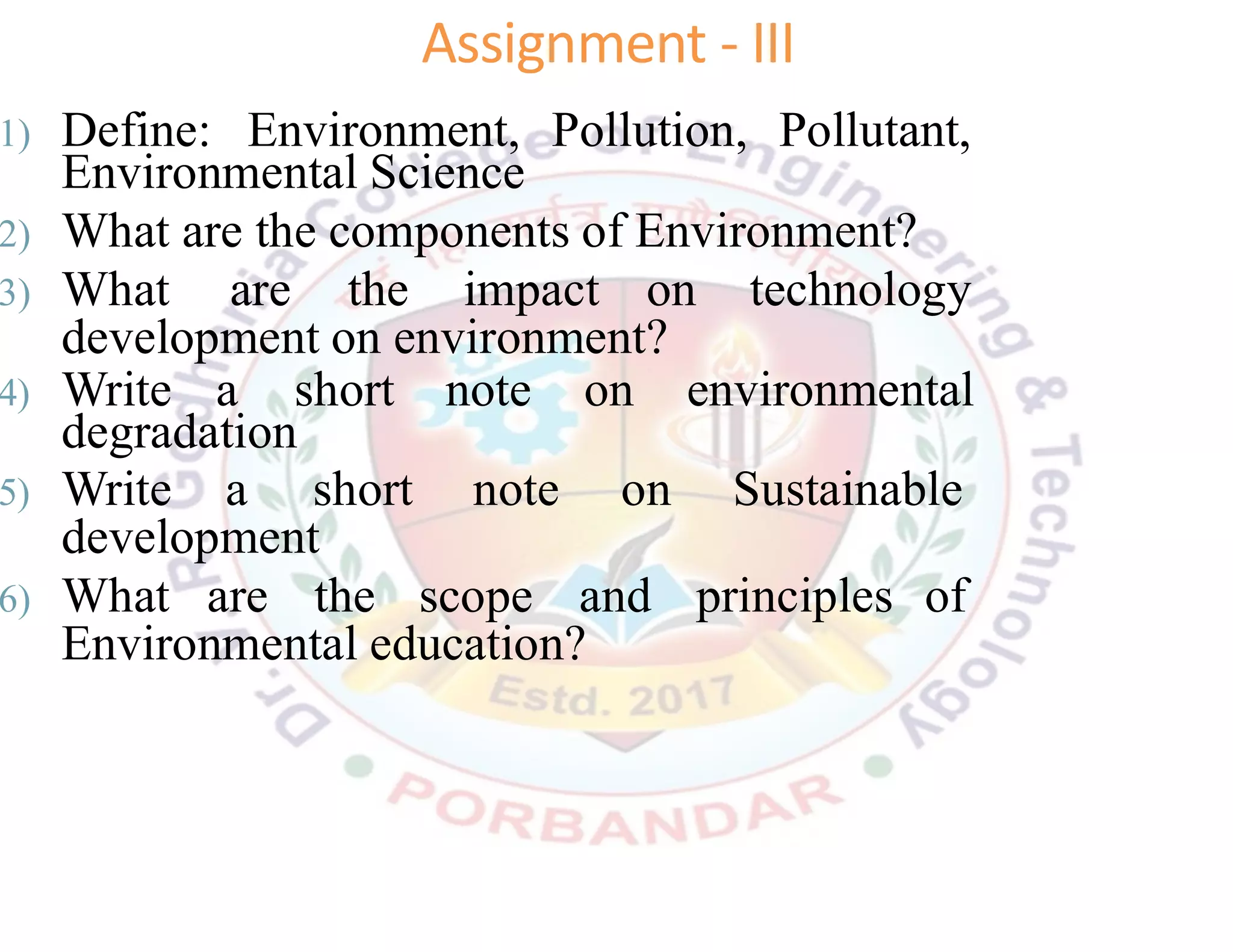
1) Define: Environment, Pollution, Pollutant,
Environmental Science
2) What are the components of Environment?
3) What are the impact on technology
development on environment?
4) Write a short note on environmental
degradation
5) Write a short note on Sustainable
development
6) What are the scope and principles of
Environmental education?
Assignment - III
Es ch.1 INTRODUCTION TO ENVIRONMENT, ECOLOGY & ECOSYSTEM

Es ch.1 INTRODUCTION TO ENVIRONMENT, ECOLOGY & ECOSYSTEM

  • 1.
    INTRODUCTION TO ENVIRONMENT, ECOLOGY& ECOSYSTEM Prepared By:- Dasani Yash R (Assi. Prof.) Civil Engineering Department, DRVRGCET
  • 2.
    ◉ The word“Environment” is derived from the French word “Environner” that means to encircle or surround. ◉ All the biological and non-biological things surrounding an organism are thus included in environment. ◉ Environment can be defined as: External surroundings and conditions which directly or indirectly affects the living organism. ◉ It can also be defined as: Environment is sum total of water, air, land, interrelationship among themselves and also with human beings, other living organisms and property. ENVIRONMENT
  • 3.
    Biotic Abiotic Made upall living organisms(plant, animals and microorganisms) including their reaction, interactions and interrelated actions. All physical factor like temperature, humidity, water, soil, minerals, gases etc.
  • 4.
    ◉ Any constitutesof the environment which directly or indirectly affects the growth and development of an organisms is called environmental or ecological factor. ◉ E.g. climatic factor, biotic factor, edhapic (related to soil) factors ENVIRONMENTAL FACTORS
  • 5.
    ◉ The wordecology is derived from two greek words “oikos” meaning house, habitation or place of living and “logos” meanings ‘study‘. ◉ Ecology is the study of interrelationship between living organisms and their physical and biological environment. ◉ Physical environment includes light and heat or solar radiation, moisture, wind, oxygen, carbon dioxide, nutrients is in soil, water and atmosphere. ◉ The biological environment includes organisms of all kind as well as plants and animals. ECOLOGY
  • 6.
    ◉ Ecosystem ismade up of two words “eco” and “system”. Eco means environment and system means an interacting and interdependent complex. Definition of Ecosystem 1. The organisms of any community besides interacting among themselves, always have functional relationship with the environment. The structural and functional system of communities and environment is called ecological system. 2. It is a community of interdependent organisms together with the environment. 3. Any unit that includes all of the organisms in a given area interacting with the physical environment, so that a flow of energy leads to clearly defined trophic structure, biotic diversity and material cycles within the system. ECOSYSTEM
  • 7.
    ◉ Environmental scienceis the study of earth, air, water, living organisms and the man with his impact on environment. ◉ It is highly multidisciplinary integrating disciplines of physical, chemical and biological sciences, geology, mathematics, sociology etc. ◉ Branches of biology like Botany, zoology, Microbiology, Genetics, Biochemistry helps in understanding the biotic components and their interactions. ENVIRONMENTAL SCIENCE
  • 8.
    ◉ Basics conceptof physics, chemistry, Geology, Atmospheric science, oceanography help us to understand the physical and chemical structure of the biotic components and energy transfer and it’s flow. ◉ Mathematics, statics and computer sciences serve as effective tools in environment modeling and management. ◉ Sociology and Economics helps us to understand socio- economics aspects associated with various developmental activities. ◉ Environmental studies is therefore a multi disciplinary subject where different aspects are dealt with holistic approach
  • 9.
    1. Ecology andbiodiversity. 2. Environment pollution and control. 3. Social issues in relation to development and environment. 4. Human population and environment ◉ Environmental studies can highly specialized also which may concentrate or more technical aspects like Environmental science, Environmental engineering, environmental management etc. and CONSERVATION
  • 10.
    ◉ Environment belongsto all and in this important for all. Whatever be the occupation or age of a person, he or she will be affected by environment by his or her deeds. Thus, the environment is one subject that actually global in nature. ◉ Environment studies is also very important science it deals with the most basic or routine issues like safe and clean drinking water, hygienic living conditions, clean and fresh air, fertile land, healthy food and development that is sustainable. ◉ Environment studies helps to solve biggest environmental problems like acid rain, global warming, ozone depletion and resources depletion.
  • 11.
    ◉ It isthe study of factors influencing ecosystems, mental and physical health, living and working conditions and pollution. ◉ It has very important role to play in dealing with the global and local issues of environment. ◉ It is important in developing awareness about the consequences and the challenges which arise due to man handling the environment. ◉ It also help in improving the attitude towards environment and in understanding the environment in a better way. ◉ It also improves the skills pretaining to conservation of resources and maintaining ecological balance and sustainable development ENVIROMENTAL EDUCATION
  • 12.
    ◉ To increaseawareness and sensitivity to total environment. ◉ To increase the knowledge of environment. ◉ To improve attitude towards environment. ◉ To provide motivation for environmental protection. ◉ To increase participation and to develop a sense of responsibility and urgency regarding environmental problems and to ensure appropriate actions to solve the problems. OBJECTIVE ENVIROMENTAL EDUCATION
  • 13.
    ◉ It considerenvironment in totality ◉ Itis nota short learning process but it requires a holistic approach as it is multidisciplinary in nature. ◉ Environmental hazards are controllable and every citizen has a moral obligation and towards this. ◉ Education can be given to all section of societies ◉ Promote the value and necessity of cooperation at personal, local and national level in the prevention of environmental problems and solution for it. ◉ Help learner to discover the systems and causes of environmental problems. ◉ Concerns of environment are concerns of several agencies and everybody should work together. PRINCIPLES ENVIROMENTAL EDUCATION
  • 14.
    Environment can bedivided in to 4 parts 1. Atmosphere 2. Hydrosphere 3. Lithosphere 4. Biosphere COMPONENTS OF ENVIROMENT
  • 15.
    ◉ Atmosphere= mixtureof (gases +vapor + subatomic particles) that entirely covers the earth extending outward several kilometers. ◉ Major gases: ◉ Others include CO2, Ne, He, CH4, H2, CO, O3 Gases % concentration N2 78% O2 21% Ar 0.9-1 % Others 00.1-0.1 % ATMOSPHERE
  • 16.
  • 17.
    Structure of Atmosphere Distance, kmTemperature, °C Property Troposphere 10-11 5-7 C/km (temp decrease) Vertical air movement, which is responsible for rapid and complete mixing Stratosphere 11-55 (temp increase) Ozone layer Mesosphere 55-80 -75 (temp decrease) -- Thermosphere Upto 500 (temp increase) The heating in this layer due to absorption of the solar energy. Within the thermosphere there is a layer of charged particles known as ionosphere Exosphere Upto 2000 >= 1200 Airless and empty, probably H2 gas is (temp increase) ionized in this state
  • 18.
    ◉ Water environment. ◉70% of earth is covered water. ◉ Water: Sea Ocean, lake, River, glaciers. ◉ It is estimates 1360 million cubic km of water. ◉ Out of this 97 % Ocean and sea, 2% in glaciers and icecaps, 1% fresh water HYDROSPHERE
  • 19.
    ◉ The outersoil crust of the earth is lithosphere ◉ The living organisms, plant, and vegetation are supported by the lithosphere. ◉ It also contains resources like minerals, organic as well as inorganic matter and to some extend of air and water. ◉ It plays an important role as it not only produces food for human beings and animals, but also the decomposition of organic wastes is carried out by a host of microorganisms in the soil. LITHOSPHERE
  • 20.
    ◉ Thin outercrust. ◉ Includes living organism and their environment. ◉ It extends from the lowest sea bed level to about 24 km of the atmosphere. ◉ Biosphere= Lithosphere +Hydrosphere+ atmosphere ◉ The life supporting resources are also available from biosphere. ◉ The wasteproducts in gases, liquids and solids waste forms are discharged into biosphere. ◉ Though the sustaining and assimilative capacity of the biosphere is tremendous but it is not infinite. ◉ The system is in operation for millions of years but now it is showing stress, primarily due to impact of human upon environment. BIOSPHERE
  • 21.
    ◉ Pollutant: Fornormal and healthy living a conductive environment is required by all the living beings. The favorable unpolluted or clean environment has a specified composition. When this consumption gets changed by addition of harmful substances, the environment is called polluted environment and the substance polluting it is called pollutant ENVIRONMENTAL POLLUTION
  • 22.
    ◉ Environmental Pollution:Any undesirable changes in the physical, chemical or biological characteristics of any components of the environment(air, water, soil) which can cause harmful effects on various forms of life or property. The various types of pollutants are: 1. Air Pollution 2. Water Pollution 3. Noise Pollution 4. Land Pollution 5. Thermal Pollution
  • 23.
  • 24.
    ◉ Circle indicatesphere and curved arrow indicates the flow path of matter. ◉ There is closed, dynamic, inseparable, organic coupling or interrelationship among environment components. ◉ If one components changes, other component respond. ◉ Every sphere has two way linkages to every other sphere including itself. ◉ Some arrow show transfer within a given components from one location indicating movement of the substance from one physical location to another without leaving the sphere. ◉ Since the matter cannot be destroyed or created, the major objective is to find the location and chemical form of the substance at any given time
  • 25.
    ◉ Atmosphere –transport component to receptor – storage capacity small – great capacity for spatially redistributing matter. ◉ Hydrosphere- classified 2 sub component It Convey to rivers system which collects the substances within the watershed and delivers then to second subcomponent to ocean ◉ Lithosphere: solid shell of inorganic materials on the surface of the earth. It composed soil particles + under laying rocks downs to the depth of 50 km ◉ Biosphere: thin shell of organic matter +comprising all living beings – It is sum total of Hydrosphere + Lithosphere+ atmosphere
  • 26.
    ◉ Natural forcesdisturb quality of environment. ◉ Increase the comfort started disturbing each and every component of environment. ◉ Cutting of trees. ◉ Hunting/Killing of animals. ◉ Large scale deforestation. ◉ Burning of fire. ◉ Grass crop waste. ◉ Endangering the species. ◉ Industrial revolution. ◉ Use of fossil fuel more. ◉ Vehicle pollution. ◉ Major environmental issues: Global warming, Ozone layer depletion, acid rain, population explo. IMPACT OF HUMAN ON ENVIRONMENT
  • 27.
    Environmental Component Land use TransportationServices Population (numbers and density) Atmosphere CO2 and O2 as plants destroyed by spreading urban area Increased average temperature for most urban area Air pollution from combustion of fuels creation of photochemical smog PM and Nox fumes from incinerator, landfills and sewage treatment plants Hydrosphere Greater demand on water resources(surface and GW) More intense use of hydrologic resources causing increased pollution Rain and surface waters polluted with lead. Drainage patterns altered infrastructure Leaching of pollutants from landfills. Discharges from sewage outfalls pollution from boats Lithosphere Disruption or disfigurement of Increased transformation of uninhabited agricultural or unutilized land to urban uses Complete changes due to construction, landscaping, etc landscape etc Sanitarty landfill of urban wastes and installation/repair of services disturb landscape IMPACT OF URBANIZATION ON ENVIRONMENT
  • 28.
    Environmental degradation: “Theoverall lowering of environmental qualities due to damaged caused by both natural events and human activities in the basic structure of the environment at local, regional and global levels adversely affecting all living organisms including man”. Reason : ◉ Increase of population growth ◉ Rapid deforestation ◉ Industrialization ◉ Unplanned urbanization ◉ Nuclear explotion ◉ Releasing toxic gases from atmosphere ◉ Power plants ENVIRONMENTAL DEGRADATION
  • 29.
    Impact can becalculate by following equation I = P* A* T Where, I= Impact P= Population size T= Degradation pollution caused per unit of resources used A=Per capita consumption of resources In developing countries Ps or P3 i.e. population, poverty and pollution are key factor for rapid environmental urbanization which cause high rate degradation Effects: ◉ Destruction of environment stability and ecology balance ◉ Natural activity like forest fire. Deforestation, earthquake, floods, volcanic eruption.
  • 30.
    ◉ SD isthe need of present with compromising the need of future generation, ◉ In other words, ever generation should leave air, water and soil as pure and unpolluted as possible. Although it is a difficult thing, it can be achieved through proper environmental management. ◉ To meet basic requirement with increase of population, industrialization is must, but it results in pollution, environmental degradation and causes ecology unbalance. ◉ As the same time industrialization create job oppurtunity, rises the standard of living and solve unemployment problem. ◉ So require balance between environment and development simultaneously, to achive goal SD is only answer. SUSTIANABLE DEVELOPMENT
  • 31.
    ◉ SD canbe done if following consept are taken care of: ◉ Control of pollution ◉ Reduction of excessive use of resources ◉ Resource conservation ◉ Use renewable energy sources ◉ Recycling and reuse of material for waste minimization ◉ Use cleaner fuel and technology ◉ Concentrating more on social and economic development of the community ◉ Development of good mass transport facility to reduce pollution ◉ By using effective management tool like Environmental management system like ISO 14001, Environment Impact assessment (EIA) etc
  • 32.
    1) Define: Environment,Pollution, Pollutant, Environmental Science 2) What are the components of Environment? 3) What are the impact on technology development on environment? 4) Write a short note on environmental degradation 5) Write a short note on Sustainable development 6) What are the scope and principles of Environmental education? Assignment - III