Echocardiography in IHD
Rishi kashyap
90
The Role of Echocardiography in the
Diagnosis of Ischemic Heart
Disease
Evaluation of Myocardial Wall
Motion Abnormalities
Localization of Infarction
Contd…
Assessment of Infarct Size
Right Ventricular Infarction
Detection of Complications of Myocardial
Infarction
Evaluation of Myocardial Wall
Motion Abnormalities
Two-Dimensional (2D) Echocardiography provides a
rapid evaluation of regional systolic function. In each
imaging plane, the left ventricle (LV) is divided into
several segments, with each segment being scored a
numerical value to signify the degree of contraction.
Contd…
A normal LV has a wall motion score
index of 1, and the index increases as
wall motion abnormalities increase in
severity.
Localization of Infarction
For the differentiation of normal from infarcted
myocardium-Wall Thickening is preferred to wall
motion.
The absence of wall motion abnormality or wall
thinning rules out a clinically significant infarction
Assessment of Infarct Size
Right Ventricular Infarction
• The characteristic echocardiographic features
of RV dysfunction in the setting of an RV
infarction are increased right atrial pressure,
begetting an interatrial septum shift toward
the left atrium (LA), and dilation of the inferior
vena cava with decreased (or lack of)
inspiratory collapsibility, which correlates
perfectly with the clinical status and
prognosis.
Detection of Complications of
Myocardial Infarction
• Ventricular Free Wall Rupture
• Pseudoaneurysm Formation
• Ventricular Septal Rupture
• Acute Mitral Regurgitation Secondary to
Papillary Muscle Rupture
• Pericardial Effusion and Tamponade
• Infarct Expansion and True Aneurysm
Formation
Contd…
• Post-Infarction Pericarditis
• Acute Dynamic Left Ventricular Outflow Tract
Obstruction
• Ischemic Mitral Regurgitation
Stress Echocardiography
• Stress Echocardiography enhances our
interpretation of the Exercise Stress Test and
has been utilized for the evaluation of the
functional importance of coronary artery
disease and for risk stratification in patients
with known or suspected coronary disease.
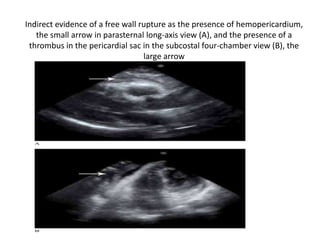
Indirect evidence of a free wall rupture as the presence of hemopericardium,
the small arrow in parasternal long-axis view (A), and the presence of a
thrombus in the pericardial sac in the subcostal four-chamber view (B), the
large arrow
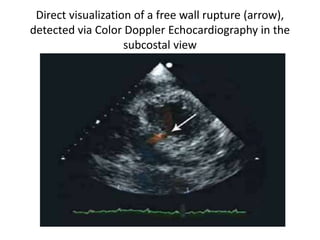
Direct visualization of a free wall rupture (arrow),
detected via Color Doppler Echocardiography in the
subcostal view
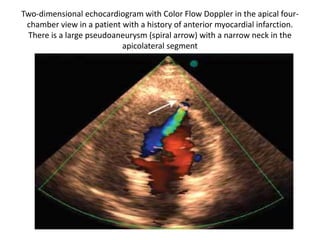
Two-dimensional echocardiogram with Color Flow Doppler in the apical four-
chamber view in a patient with a history of anterior myocardial infarction.
There is a large pseudoaneurysm (spiral arrow) with a narrow neck in the
apicolateral segment
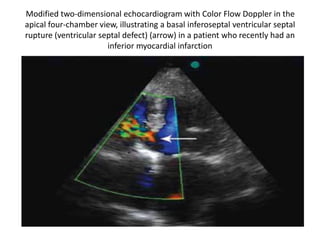
Modified two-dimensional echocardiogram with Color Flow Doppler in the
apical four-chamber view, illustrating a basal inferoseptal ventricular septal
rupture (ventricular septal defect) (arrow) in a patient who recently had an
inferior myocardial infarction
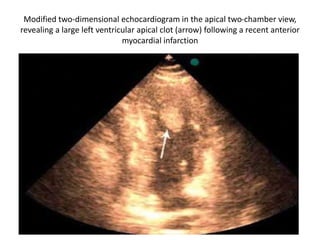
Modified two-dimensional echocardiogram in the apical two-chamber view,
revealing a large left ventricular apical clot (arrow) following a recent anterior
myocardial infarction
Conclusion
• Echocardiography is an accurate tool for the
evaluation of patients with known or
suspected coronary artery disease. Every
patient should be evaluated clinically for
pretest probability of coronary artery disease
and risk of future cardiac events.
Thank You

Echo in IHD

  • 1.
  • 2.
    The Role ofEchocardiography in the Diagnosis of Ischemic Heart Disease Evaluation of Myocardial Wall Motion Abnormalities Localization of Infarction
  • 3.
    Contd… Assessment of InfarctSize Right Ventricular Infarction Detection of Complications of Myocardial Infarction
  • 4.
    Evaluation of MyocardialWall Motion Abnormalities Two-Dimensional (2D) Echocardiography provides a rapid evaluation of regional systolic function. In each imaging plane, the left ventricle (LV) is divided into several segments, with each segment being scored a numerical value to signify the degree of contraction.
  • 5.
    Contd… A normal LVhas a wall motion score index of 1, and the index increases as wall motion abnormalities increase in severity.
  • 6.
    Localization of Infarction Forthe differentiation of normal from infarcted myocardium-Wall Thickening is preferred to wall motion. The absence of wall motion abnormality or wall thinning rules out a clinically significant infarction
  • 7.
  • 8.
    Right Ventricular Infarction •The characteristic echocardiographic features of RV dysfunction in the setting of an RV infarction are increased right atrial pressure, begetting an interatrial septum shift toward the left atrium (LA), and dilation of the inferior vena cava with decreased (or lack of) inspiratory collapsibility, which correlates perfectly with the clinical status and prognosis.
  • 9.
    Detection of Complicationsof Myocardial Infarction • Ventricular Free Wall Rupture • Pseudoaneurysm Formation • Ventricular Septal Rupture • Acute Mitral Regurgitation Secondary to Papillary Muscle Rupture • Pericardial Effusion and Tamponade • Infarct Expansion and True Aneurysm Formation
  • 10.
    Contd… • Post-Infarction Pericarditis •Acute Dynamic Left Ventricular Outflow Tract Obstruction • Ischemic Mitral Regurgitation
  • 11.
    Stress Echocardiography • StressEchocardiography enhances our interpretation of the Exercise Stress Test and has been utilized for the evaluation of the functional importance of coronary artery disease and for risk stratification in patients with known or suspected coronary disease.
  • 12.
    Indirect evidence ofa free wall rupture as the presence of hemopericardium, the small arrow in parasternal long-axis view (A), and the presence of a thrombus in the pericardial sac in the subcostal four-chamber view (B), the large arrow
  • 13.
    Direct visualization ofa free wall rupture (arrow), detected via Color Doppler Echocardiography in the subcostal view
  • 14.
    Two-dimensional echocardiogram withColor Flow Doppler in the apical four- chamber view in a patient with a history of anterior myocardial infarction. There is a large pseudoaneurysm (spiral arrow) with a narrow neck in the apicolateral segment
  • 15.
    Modified two-dimensional echocardiogramwith Color Flow Doppler in the apical four-chamber view, illustrating a basal inferoseptal ventricular septal rupture (ventricular septal defect) (arrow) in a patient who recently had an inferior myocardial infarction
  • 16.
    Modified two-dimensional echocardiogramin the apical two-chamber view, revealing a large left ventricular apical clot (arrow) following a recent anterior myocardial infarction
  • 17.
    Conclusion • Echocardiography isan accurate tool for the evaluation of patients with known or suspected coronary artery disease. Every patient should be evaluated clinically for pretest probability of coronary artery disease and risk of future cardiac events.
  • 18.