Assessment of diastolic dysfunction and
anesthetic considerations in diastolic
dysfunction
By: Dr.Gopan. G Date: 19-01-2015
Moderator: Dr. Satyen Parida
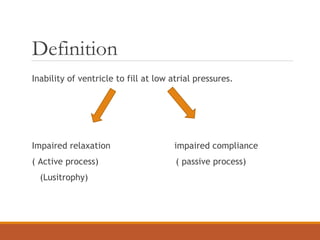
Definition
Inability of ventricle to fill at low atrial pressures.
Impaired relaxation impaired compliance
( Active process) ( passive process)
(Lusitrophy)
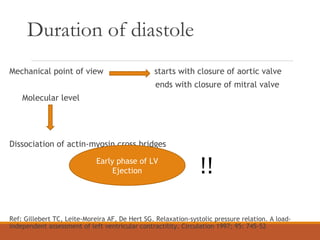
Duration of diastole
Mechanical point of view starts with closure of aortic valve
ends with closure of mitral valve
Molecular level
Dissociation of actin-myosin cross bridges
Ref: Gillebert TC, Leite-Moreira AF, De Hert SG. Relaxation-systolic pressure relation. A load-
independent assessment of left ventricular contractility. Circulation 1997; 95: 745–52
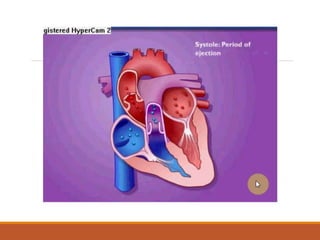
Early phase of LV
Ejection
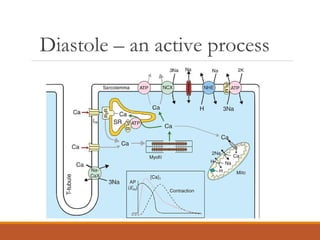
Diastole – an active process
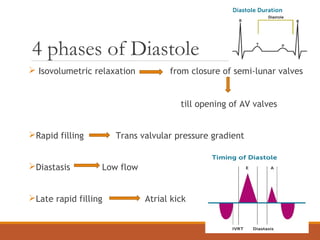
4 phases of Diastole
 Isovolumetric relaxation from closure of semi-lunar valves
till opening of AV valves
Rapid filling Trans valvular pressure gradient
Diastasis Low flow
Late rapid filling Atrial kick
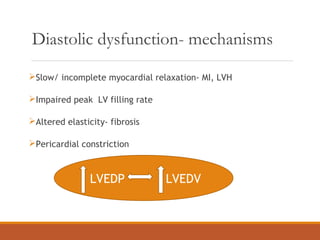
Diastolic dysfunction- mechanisms
Slow/ incomplete myocardial relaxation- MI, LVH
Impaired peak LV filling rate
Altered elasticity- fibrosis
Pericardial constriction
LVEDP LVEDV
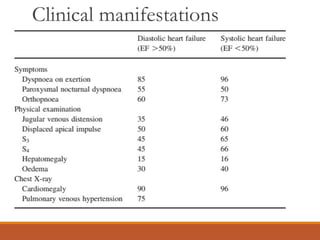
Clinical manifestations
Diagnosis
 Gold standard Direct measurement of LV pressure & volume.
Micromanometer & conduction catheters.
 Echocardiography
ECHO
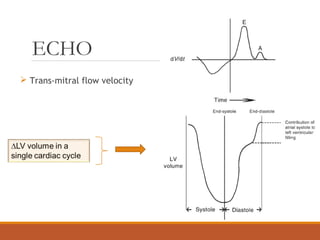
 Trans-mitral flow velocity
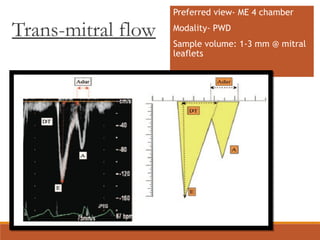
Trans-mitral flow
Preferred view- ME 4 chamber
Modality- PWD
Sample volume: 1-3 mm @ mitral
leaflets
Trans-mitral flow
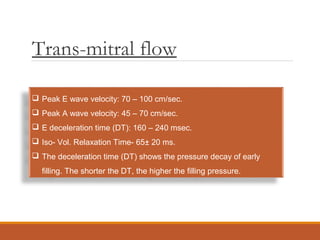
 Peak E wave velocity: 70 – 100 cm/sec.
 Peak A wave velocity: 45 – 70 cm/sec.
 E deceleration time (DT): 160 – 240 msec.
 Iso- Vol. Relaxation Time- 65± 20 ms.
 The deceleration time (DT) shows the pressure decay of early
filling. The shorter the DT, the higher the filling pressure.
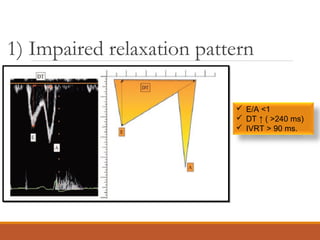
1) Impaired relaxation pattern
 E/A <1
 DT ↑ ( >240 ms)
 IVRT > 90 ms.
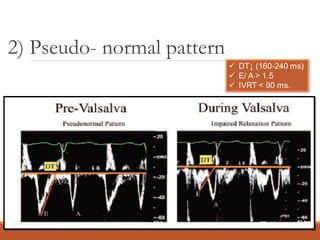
2) Pseudo- normal pattern
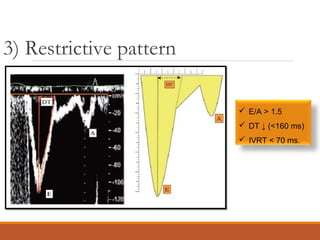
3) Restrictive pattern
 E/A > 1.5
 DT ↓ (<160 ms)
 IVRT < 70 ms.
Trans-mitral flow
Limitations
Affected by age, rate, rhythm, loading conditions, LV systolic function,
Atrial function & mitral valve disease.
Cannot be used in isolation to predict Diastolic dysfunction
Limitations
Affected by age, rate, rhythm, loading conditions, LV systolic function,
Atrial function & mitral valve disease.
Cannot be used in isolation to predict Diastolic dysfunction
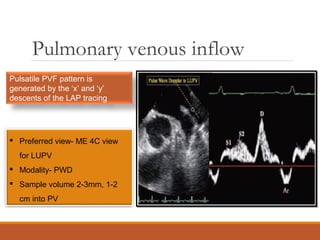
Pulmonary venous inflow
 Preferred view- ME 4C view
for LUPV
 Modality- PWD
 Sample volume 2-3mm, 1-2
cm into PV
Pulsatile PVF pattern is
generated by the ‘x’ and ‘y’
descents of the LAP tracing
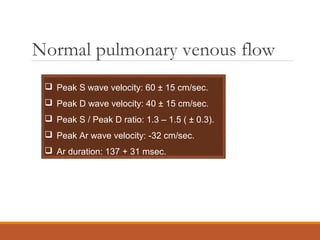
Normal pulmonary venous flow
 Peak S wave velocity: 60 ± 15 cm/sec.
 Peak D wave velocity: 40 ± 15 cm/sec.
 Peak S / Peak D ratio: 1.3 – 1.5 ( ± 0.3).
 Peak Ar wave velocity: -32 cm/sec.
 Ar duration: 137 + 31 msec.
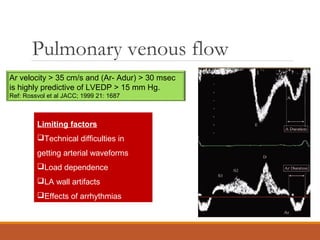
Pulmonary venous flow
Limiting factors
Technical difficulties in
getting arterial waveforms
Load dependence
LA wall artifacts
Effects of arrhythmias
Ar velocity > 35 cm/s and (Ar- Adur) > 30 msec
is highly predictive of LVEDP > 15 mm Hg.
Ref: Rossvol et al JACC; 1999 21: 1687
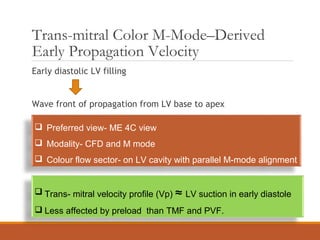
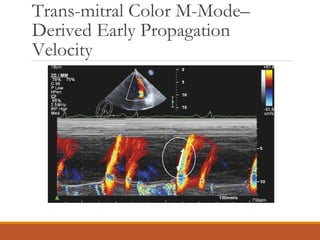
Trans-mitral Color M-Mode–Derived
Early Propagation Velocity
Early diastolic LV filling
Wave front of propagation from LV base to apex
 Preferred view- ME 4C view
 Modality- CFD and M mode
 Colour flow sector- on LV cavity with parallel M-mode alignment
 Trans- mitral velocity profile (Vp) ≈ LV suction in early diastole
 Less affected by preload than TMF and PVF.
Trans-mitral Color M-Mode–
Derived Early Propagation
Velocity
Trans-mitral Color M-Mode–
Derived Early Propagation
Velocity
 Method described by Garcia et al., in which the slope of the first aliasing
velocity (the outermost velocity) is measured, is considered the most
reliable and reproducible method.
 A Vp value of <0.50 m/s is consistent with impaired relaxation.
Trans-mitral Color M-Mode–
Derived Early Propagation
Velocity
Limitations
may not be possible to measure Vp because the slope of flow
propagation is sometimes curvilinear and does not “travel” a
sufficient distance (<4 cm) into the LV cavity or is difficult to
appreciate.
merely diagnoses the presence of abnormal relaxation, and not
necessarily its severity.
Doppler Tissue Imaging
 Measures tissue velocities and motion.
 Preferred view- ME 4C
 Modality- PWD optimized for tissue motion
 Sample volume- 5- 10 mm within 1 cm of mitral leaflet insertion
Doppler Tissue
Imaging
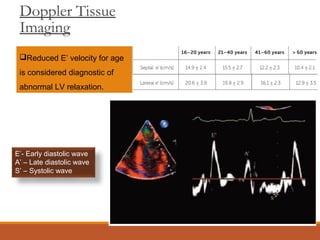
Reduced E’ velocity for age
is considered diagnostic of
abnormal LV relaxation.
E’- Early diastolic wave
A’ – Late diastolic wave
S’ – Systolic wave
Doppler Tissue Imaging
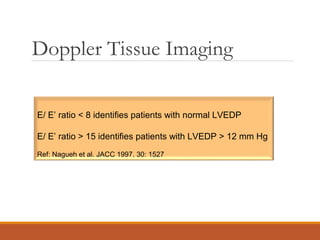
E/ E’ ratio < 8 identifies patients with normal LVEDP
E/ E’ ratio > 15 identifies patients with LVEDP > 12 mm Hg
Ref: Nagueh et al. JACC 1997. 30: 1527
Doppler Tissue Imaging
 Average E’ velocity may not accurately represent global LV
diastolic function in the presence of basal lateral and septal
wall motion abnormalities.
 E’ wave represents only the relaxation (early) phase of
diastole and does not provide any information about LV
compliance.
Prognosis
 Diastolic dysfunction develops early in most cardiac diseases.
 Clinical studies have shown the association of short mitral
DT with heart-failure and death.
 Pulmonary venous velocities was less frequently examined
but were still predictive of clinical events.
 Several studies have shown that E/E´ is highly predictive of
adverse events. It is the most reproducible echocardiographic
parameters to estimate PCWP and is the preferred
prognostic parameter in many cardiac conditions.
Anesthetic considerations
in diastolic dysfunction
Effect of inhalational anaesthetics
on diastolic function
Halothane and sevoflurane do not cause prolongation of the
IVRT.
In preexisting diastolic dysfunction, sevoflurane causes a slight
improvement in early LV relaxation assessed with E’ velocity.
Isoflurane did not exacerbate preexistent diastolic dysfunction
and had no lusitropic effects.
Effect of IV anaesthetics on diastolic
function
Propofol prolongs the IVRT in patients with no history of cardiac
disease, but does not cause worsening of preexisting diastolic
dysfunction.
Barbiturates and ketamine exert similar effects by inhibition of
sarcolemmal transport of calcium ions.
The impact of etomidate on LV diastolic function has not been
studied
Anaesthetic considerations
 Detailed Pre-operative evaluation
 Assessment of functional status & exercise tolerance
 Optimizing the patient
Perioperative drugs
Diuretics
Beta blockers, calcium channel blockers
ACEI & ARBs
Statins
Antiplatlets
Monitoring - Major surgeries
Standard monitoring tools
Invasive arterial pressures
Monitoring volume status is important
Central venous pressures or Pulmonary artery catheter or TEE
GA or Regional
 No definite recommendation either way
 Epidural vs. spinal ?
Epidural wins
General anesthesia
 Good induction practices
 Consideration for age
 Titrate to effect
Hpoxia, hypercarbia worsens PHT
General anesthesia
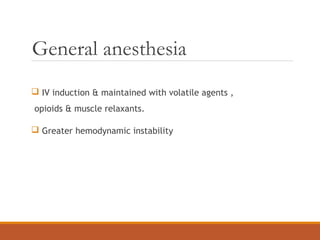
 IV induction & maintained with volatile agents ,
opioids & muscle relaxants.
 Greater hemodynamic instability
Drug combination for
hemodynamics
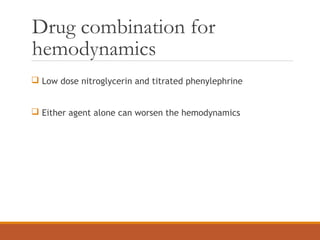
 Low dose nitroglycerin and titrated phenylephrine
 Either agent alone can worsen the hemodynamics
Nitroglycerine + Titrated
phenylephrine
1. Preserves vascular distensibility
2. Avoids reduction in preload
3. Maintains coronary perfusion pressure
4. Maintains stroke volume with minimal cardiac work
Management of hypertensive
crisis
 Sound anesthetic practices
 Plan for post-op analgesia
 Intravenous calcium channel blocker
 IV nitroglycerin
Post-op diastolic heart failure
 Optimise preload
 Diuretics
 Use of nitrates
 CPAP
As contractile function is preserved, the role of sympathomimetic
inotropes is limited.
Specific drugs for diastole
 Milrinone
o Phosphodiesterase III inhibitor
o Inotropic, vasodilatory with minimal chronotropy
o Increases calcium ion uptake to SR
o Lusitropic effect more evident in heart failure
o Bolus dose of 50µgm/Kg over 60 minutes
o Infusion of 0.375 to 0.75µgm/Kg/min
Specific drugs for diastole
 Levosimendan
o Sensitizes the contractile elements to calcium and a has
positive inotropic effect, by modulating the interaction
between troponin and calcium.
o combines a vasodilator effect, by opening ATP-sensitive
potassium channels.
o Improves both systolic and diastolic function
Conclusion
 The prognostic significance of diastolic dysfunction in
cardiac patients cannot be understated.
 A simplified approach will allow assessment of severity of
diastolic function in nearly all cases and allow tailoring of
management.
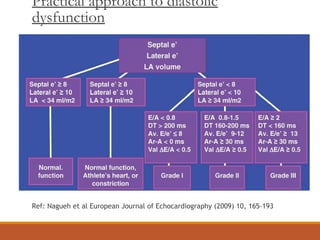
Practical approach to diastolic
dysfunction
Ref: Nagueh et al European Journal of Echocardiography (2009) 10, 165–193
Thank you

Diastolic dysfunction

  • 1.
    Assessment of diastolicdysfunction and anesthetic considerations in diastolic dysfunction By: Dr.Gopan. G Date: 19-01-2015 Moderator: Dr. Satyen Parida
  • 2.
    Definition Inability of ventricleto fill at low atrial pressures. Impaired relaxation impaired compliance ( Active process) ( passive process) (Lusitrophy)
  • 3.
    Duration of diastole Mechanicalpoint of view starts with closure of aortic valve ends with closure of mitral valve Molecular level Dissociation of actin-myosin cross bridges Ref: Gillebert TC, Leite-Moreira AF, De Hert SG. Relaxation-systolic pressure relation. A load- independent assessment of left ventricular contractility. Circulation 1997; 95: 745–52 Early phase of LV Ejection
  • 4.
    Diastole – anactive process
  • 5.
    4 phases ofDiastole  Isovolumetric relaxation from closure of semi-lunar valves till opening of AV valves Rapid filling Trans valvular pressure gradient Diastasis Low flow Late rapid filling Atrial kick
  • 7.
    Diastolic dysfunction- mechanisms Slow/incomplete myocardial relaxation- MI, LVH Impaired peak LV filling rate Altered elasticity- fibrosis Pericardial constriction LVEDP LVEDV
  • 8.
  • 9.
    Diagnosis  Gold standardDirect measurement of LV pressure & volume. Micromanometer & conduction catheters.  Echocardiography
  • 10.
  • 11.
    Trans-mitral flow Preferred view-ME 4 chamber Modality- PWD Sample volume: 1-3 mm @ mitral leaflets
  • 12.
    Trans-mitral flow  PeakE wave velocity: 70 – 100 cm/sec.  Peak A wave velocity: 45 – 70 cm/sec.  E deceleration time (DT): 160 – 240 msec.  Iso- Vol. Relaxation Time- 65± 20 ms.  The deceleration time (DT) shows the pressure decay of early filling. The shorter the DT, the higher the filling pressure.
  • 13.
    1) Impaired relaxationpattern  E/A <1  DT ↑ ( >240 ms)  IVRT > 90 ms.
  • 14.
  • 15.
    3) Restrictive pattern E/A > 1.5  DT ↓ (<160 ms)  IVRT < 70 ms.
  • 16.
    Trans-mitral flow Limitations Affected byage, rate, rhythm, loading conditions, LV systolic function, Atrial function & mitral valve disease. Cannot be used in isolation to predict Diastolic dysfunction Limitations Affected by age, rate, rhythm, loading conditions, LV systolic function, Atrial function & mitral valve disease. Cannot be used in isolation to predict Diastolic dysfunction
  • 17.
    Pulmonary venous inflow Preferred view- ME 4C view for LUPV  Modality- PWD  Sample volume 2-3mm, 1-2 cm into PV Pulsatile PVF pattern is generated by the ‘x’ and ‘y’ descents of the LAP tracing
  • 18.
    Normal pulmonary venousflow  Peak S wave velocity: 60 ± 15 cm/sec.  Peak D wave velocity: 40 ± 15 cm/sec.  Peak S / Peak D ratio: 1.3 – 1.5 ( ± 0.3).  Peak Ar wave velocity: -32 cm/sec.  Ar duration: 137 + 31 msec.
  • 19.
    Pulmonary venous flow Limitingfactors Technical difficulties in getting arterial waveforms Load dependence LA wall artifacts Effects of arrhythmias Ar velocity > 35 cm/s and (Ar- Adur) > 30 msec is highly predictive of LVEDP > 15 mm Hg. Ref: Rossvol et al JACC; 1999 21: 1687
  • 20.
    Trans-mitral Color M-Mode–Derived EarlyPropagation Velocity Early diastolic LV filling Wave front of propagation from LV base to apex  Preferred view- ME 4C view  Modality- CFD and M mode  Colour flow sector- on LV cavity with parallel M-mode alignment  Trans- mitral velocity profile (Vp) ≈ LV suction in early diastole  Less affected by preload than TMF and PVF.
  • 21.
    Trans-mitral Color M-Mode– DerivedEarly Propagation Velocity
  • 22.
    Trans-mitral Color M-Mode– DerivedEarly Propagation Velocity  Method described by Garcia et al., in which the slope of the first aliasing velocity (the outermost velocity) is measured, is considered the most reliable and reproducible method.  A Vp value of <0.50 m/s is consistent with impaired relaxation.
  • 23.
    Trans-mitral Color M-Mode– DerivedEarly Propagation Velocity Limitations may not be possible to measure Vp because the slope of flow propagation is sometimes curvilinear and does not “travel” a sufficient distance (<4 cm) into the LV cavity or is difficult to appreciate. merely diagnoses the presence of abnormal relaxation, and not necessarily its severity.
  • 24.
    Doppler Tissue Imaging Measures tissue velocities and motion.  Preferred view- ME 4C  Modality- PWD optimized for tissue motion  Sample volume- 5- 10 mm within 1 cm of mitral leaflet insertion
  • 25.
    Doppler Tissue Imaging Reduced E’velocity for age is considered diagnostic of abnormal LV relaxation. E’- Early diastolic wave A’ – Late diastolic wave S’ – Systolic wave
  • 26.
    Doppler Tissue Imaging E/E’ ratio < 8 identifies patients with normal LVEDP E/ E’ ratio > 15 identifies patients with LVEDP > 12 mm Hg Ref: Nagueh et al. JACC 1997. 30: 1527
  • 27.
    Doppler Tissue Imaging Average E’ velocity may not accurately represent global LV diastolic function in the presence of basal lateral and septal wall motion abnormalities.  E’ wave represents only the relaxation (early) phase of diastole and does not provide any information about LV compliance.
  • 28.
    Prognosis  Diastolic dysfunctiondevelops early in most cardiac diseases.  Clinical studies have shown the association of short mitral DT with heart-failure and death.  Pulmonary venous velocities was less frequently examined but were still predictive of clinical events.  Several studies have shown that E/E´ is highly predictive of adverse events. It is the most reproducible echocardiographic parameters to estimate PCWP and is the preferred prognostic parameter in many cardiac conditions.
  • 29.
  • 30.
    Effect of inhalationalanaesthetics on diastolic function Halothane and sevoflurane do not cause prolongation of the IVRT. In preexisting diastolic dysfunction, sevoflurane causes a slight improvement in early LV relaxation assessed with E’ velocity. Isoflurane did not exacerbate preexistent diastolic dysfunction and had no lusitropic effects.
  • 31.
    Effect of IVanaesthetics on diastolic function Propofol prolongs the IVRT in patients with no history of cardiac disease, but does not cause worsening of preexisting diastolic dysfunction. Barbiturates and ketamine exert similar effects by inhibition of sarcolemmal transport of calcium ions. The impact of etomidate on LV diastolic function has not been studied
  • 32.
    Anaesthetic considerations  DetailedPre-operative evaluation  Assessment of functional status & exercise tolerance  Optimizing the patient
  • 33.
    Perioperative drugs Diuretics Beta blockers,calcium channel blockers ACEI & ARBs Statins Antiplatlets
  • 34.
    Monitoring - Majorsurgeries Standard monitoring tools Invasive arterial pressures Monitoring volume status is important Central venous pressures or Pulmonary artery catheter or TEE
  • 35.
    GA or Regional No definite recommendation either way  Epidural vs. spinal ? Epidural wins
  • 36.
    General anesthesia  Goodinduction practices  Consideration for age  Titrate to effect Hpoxia, hypercarbia worsens PHT
  • 37.
    General anesthesia  IVinduction & maintained with volatile agents , opioids & muscle relaxants.  Greater hemodynamic instability
  • 38.
    Drug combination for hemodynamics Low dose nitroglycerin and titrated phenylephrine  Either agent alone can worsen the hemodynamics
  • 39.
    Nitroglycerine + Titrated phenylephrine 1.Preserves vascular distensibility 2. Avoids reduction in preload 3. Maintains coronary perfusion pressure 4. Maintains stroke volume with minimal cardiac work
  • 40.
    Management of hypertensive crisis Sound anesthetic practices  Plan for post-op analgesia  Intravenous calcium channel blocker  IV nitroglycerin
  • 41.
    Post-op diastolic heartfailure  Optimise preload  Diuretics  Use of nitrates  CPAP As contractile function is preserved, the role of sympathomimetic inotropes is limited.
  • 42.
    Specific drugs fordiastole  Milrinone o Phosphodiesterase III inhibitor o Inotropic, vasodilatory with minimal chronotropy o Increases calcium ion uptake to SR o Lusitropic effect more evident in heart failure o Bolus dose of 50µgm/Kg over 60 minutes o Infusion of 0.375 to 0.75µgm/Kg/min
  • 43.
    Specific drugs fordiastole  Levosimendan o Sensitizes the contractile elements to calcium and a has positive inotropic effect, by modulating the interaction between troponin and calcium. o combines a vasodilator effect, by opening ATP-sensitive potassium channels. o Improves both systolic and diastolic function
  • 44.
    Conclusion  The prognosticsignificance of diastolic dysfunction in cardiac patients cannot be understated.  A simplified approach will allow assessment of severity of diastolic function in nearly all cases and allow tailoring of management.
  • 45.
    Practical approach todiastolic dysfunction Ref: Nagueh et al European Journal of Echocardiography (2009) 10, 165–193
  • 46.