
Infant feeding and intolerances Dr Ali Bokhari Consultant Paediatrician & Divisional Director for Women’s, Children and Clinical support Services South London Health Care NHS Trust.  London
South London Health Care NHS Trust One of the UK’s largest maternity with over 12,000 births a year, 16,000 by 2016 One of London’s busiest neonatal services with 3000 intensive care days per year 50 bedded in-patient Paediatric Unit 2 Paediatric Ambulatory services 50,000 Paediatric A&E attendances UK’s largest POSCU
Infant feeding WHO 2009 Exclusive breast feeding for first 6 months (180 days) Complimentary feeding from 6 months, breast feeding continuing till 2 years of age, breast feeding may continue beyond 2 years Specific recommendations apply to HIV +ve mothers Overall under 35% of babies are exclusively breast fed for first 6 months 1/3 of babies and children <5 deaths related to poor feeding and nutrition related causes
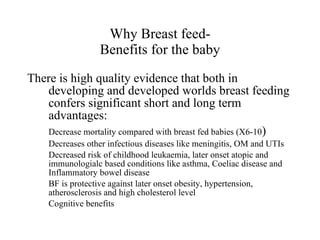
Why Breast feed- Benefits for the baby There is high quality evidence that both in developing and developed worlds breast feeding confers significant short and long term advantages: Decrease mortality compared with breast fed babies (X6-10 ) Decreases other infectious diseases like meningitis, OM and UTIs Decreased risk of childhood leukaemia, later onset atopic and immunologialc based conditions like asthma, Coeliac disease and Inflammatory bowel disease BF is protective against later onset obesity, hypertension, atherosclerosis and high cholesterol level Cognitive benefits
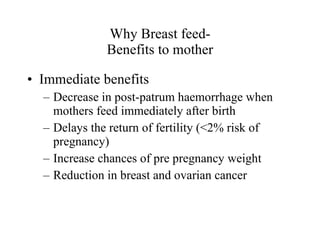
Why Breast feed- Benefits to mother Immediate benefits Decrease in post-patrum haemorrhage when mothers feed immediately after birth Delays the return of fertility (<2% risk of pregnancy) Increase chances of pre pregnancy weight Reduction in breast and ovarian cancer
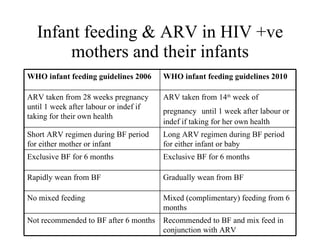
Infant feeding & ARV in HIV +ve mothers and their infants WHO infant feeding guidelines 2006 WHO infant feeding guidelines 2010 ARV taken from 28 weeks pregnancy until 1 week after labour or indef if taking for their own health ARV taken from 14 th  week of pregnancy   until 1 week after labour or indef if taking for her own health Short ARV regimen during BF period for either mother or infant Long ARV regimen during BF period for either infant or baby Exclusive BF for 6 months Exclusive BF for 6 months Rapidly wean from BF Gradually wean from BF No mixed feeding Mixed (complimentary) feeding from 6 months Not recommended to BF after 6 months Recommended to BF and mix feed in conjunction with ARV
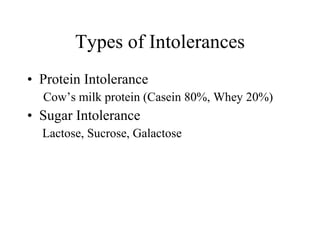
Types of Intolerances Protein Intolerance Cow’s milk protein (Casein 80%, Whey 20%) Sugar Intolerance    Lactose, Sucrose, Galactose
Identification and Treatment of Milk intolerance in infants Lactose Intolerance Presentation: Severe unresolved colic, Continued diarrhoea after GE, Previous surgery, +ve reducing substances in stool Treatment: Present in all standard formulae milk and breast feeding. If bottle feeding use reduced lactose formula milk, if breast feeding lactase drops can be tried Notes: Congenital  lactase deficiency is rare, Secondary lactase deficiency resolves in a few months, Can be secondary to CMPI
Lactose Intolerance Primary:Relative deficiency. 70% of world population. Highest amongst Asians Secondary: Post GE, CMPA, post chemo, Coeliac disease, Crohn’s disease Congenital: Extremely rare, no survival before 20 th  century Developmental: Premature babies <34 weeks
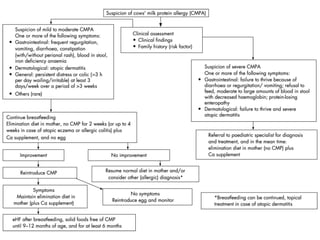
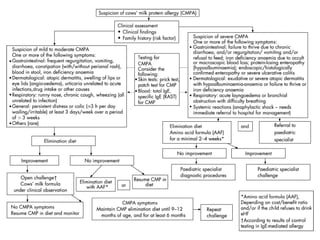
Identification and Treatment of Milk intolerance in infants Cow’s Milk Protein Intolerance Presentation: Regular large vomits post feed, GORD symptoms that don’t resolve, Abdominal pain and further syptoms- colitis/ rectal bleeding, diarrhoea, FTT/weight loss Treatment: Breast fed babies-mothers to avoid milk, If formula fed try extensively hydrolysed formula initially, if rectal bleeding or in very young or fragile babies AA formula Notes: Can be introduced gradually if babies don’t take willingly
Cow’s Milk Protein Intolerance Reported for infants 1-3 months 2-5% Can be IgE or non IgE mediated May be part of atopic spectrum of conditions SPT +ve and RAST +ve have later recovery SPT -ve less likely to have atopy or multiple food allergies 1 parent or sibling atopic increases= 20-40% risk of developing atopy Both parents = 50-60% risk of developing atopy


Identification and Treatment of Milk intolerance in infants Milk allergy- Immediate or delayed IgE response Presentation: Eczema/urticaria/ wheeze/sneeze, swelling of tongue, mouth, lips. Angiooedema, anaphylaxis Treatment: Use AA formula until old enough to try Soya based products, Mothers of BF babies to avoid the milk Notes: Can also have problems with fish, egg, Soya, salicylates and occ wheat. Need specific weaning advice designed to the patient
Alternative formula milks Lactose free formula:  Contains CMP, minimal lactose- SMA LF, Galactaomin ,  Enfamil Lactofree  Extensively hydrolysed formula:  Pre-digestion and hydrolysis of CMP, low allergencity- Neutramigen,  Neutramigen 2, Pepti Junior, Pepti , Pregegtamil, Prejomin, Peptide  Amino Acid Based formula:  Protein source based on L AA, very low allergenicity and expensive, Neocate, Neutramigen AA,  Partially hydrolysed formula:  Minor digestive problems- Nan-HA1&2, Comfort, Atamil easy digest  Unsuitable milks:  Soya milk, Animal milk e.g. goat & sheep, Cereal milk (rice and oat), Enzyme treated milk e.g. lactacid lacto free
Finally Thank you for your kind invitation

Dr. Ali Joo.

  • 1.
    Infant feeding andintolerances Dr Ali Bokhari Consultant Paediatrician & Divisional Director for Women’s, Children and Clinical support Services South London Health Care NHS Trust. London
  • 2.
    South London HealthCare NHS Trust One of the UK’s largest maternity with over 12,000 births a year, 16,000 by 2016 One of London’s busiest neonatal services with 3000 intensive care days per year 50 bedded in-patient Paediatric Unit 2 Paediatric Ambulatory services 50,000 Paediatric A&E attendances UK’s largest POSCU
  • 3.
    Infant feeding WHO2009 Exclusive breast feeding for first 6 months (180 days) Complimentary feeding from 6 months, breast feeding continuing till 2 years of age, breast feeding may continue beyond 2 years Specific recommendations apply to HIV +ve mothers Overall under 35% of babies are exclusively breast fed for first 6 months 1/3 of babies and children <5 deaths related to poor feeding and nutrition related causes
  • 4.
    Why Breast feed-Benefits for the baby There is high quality evidence that both in developing and developed worlds breast feeding confers significant short and long term advantages: Decrease mortality compared with breast fed babies (X6-10 ) Decreases other infectious diseases like meningitis, OM and UTIs Decreased risk of childhood leukaemia, later onset atopic and immunologialc based conditions like asthma, Coeliac disease and Inflammatory bowel disease BF is protective against later onset obesity, hypertension, atherosclerosis and high cholesterol level Cognitive benefits
  • 5.
    Why Breast feed-Benefits to mother Immediate benefits Decrease in post-patrum haemorrhage when mothers feed immediately after birth Delays the return of fertility (<2% risk of pregnancy) Increase chances of pre pregnancy weight Reduction in breast and ovarian cancer
  • 6.
    Infant feeding &ARV in HIV +ve mothers and their infants WHO infant feeding guidelines 2006 WHO infant feeding guidelines 2010 ARV taken from 28 weeks pregnancy until 1 week after labour or indef if taking for their own health ARV taken from 14 th week of pregnancy until 1 week after labour or indef if taking for her own health Short ARV regimen during BF period for either mother or infant Long ARV regimen during BF period for either infant or baby Exclusive BF for 6 months Exclusive BF for 6 months Rapidly wean from BF Gradually wean from BF No mixed feeding Mixed (complimentary) feeding from 6 months Not recommended to BF after 6 months Recommended to BF and mix feed in conjunction with ARV
  • 7.
    Types of IntolerancesProtein Intolerance Cow’s milk protein (Casein 80%, Whey 20%) Sugar Intolerance Lactose, Sucrose, Galactose
  • 8.
    Identification and Treatmentof Milk intolerance in infants Lactose Intolerance Presentation: Severe unresolved colic, Continued diarrhoea after GE, Previous surgery, +ve reducing substances in stool Treatment: Present in all standard formulae milk and breast feeding. If bottle feeding use reduced lactose formula milk, if breast feeding lactase drops can be tried Notes: Congenital lactase deficiency is rare, Secondary lactase deficiency resolves in a few months, Can be secondary to CMPI
  • 9.
    Lactose Intolerance Primary:Relativedeficiency. 70% of world population. Highest amongst Asians Secondary: Post GE, CMPA, post chemo, Coeliac disease, Crohn’s disease Congenital: Extremely rare, no survival before 20 th century Developmental: Premature babies <34 weeks
  • 10.
    Identification and Treatmentof Milk intolerance in infants Cow’s Milk Protein Intolerance Presentation: Regular large vomits post feed, GORD symptoms that don’t resolve, Abdominal pain and further syptoms- colitis/ rectal bleeding, diarrhoea, FTT/weight loss Treatment: Breast fed babies-mothers to avoid milk, If formula fed try extensively hydrolysed formula initially, if rectal bleeding or in very young or fragile babies AA formula Notes: Can be introduced gradually if babies don’t take willingly
  • 11.
    Cow’s Milk ProteinIntolerance Reported for infants 1-3 months 2-5% Can be IgE or non IgE mediated May be part of atopic spectrum of conditions SPT +ve and RAST +ve have later recovery SPT -ve less likely to have atopy or multiple food allergies 1 parent or sibling atopic increases= 20-40% risk of developing atopy Both parents = 50-60% risk of developing atopy
  • 12.
  • 13.
  • 14.
  • 15.
  • 16.
  • 17.
    Identification and Treatmentof Milk intolerance in infants Milk allergy- Immediate or delayed IgE response Presentation: Eczema/urticaria/ wheeze/sneeze, swelling of tongue, mouth, lips. Angiooedema, anaphylaxis Treatment: Use AA formula until old enough to try Soya based products, Mothers of BF babies to avoid the milk Notes: Can also have problems with fish, egg, Soya, salicylates and occ wheat. Need specific weaning advice designed to the patient
  • 18.
    Alternative formula milksLactose free formula: Contains CMP, minimal lactose- SMA LF, Galactaomin , Enfamil Lactofree Extensively hydrolysed formula: Pre-digestion and hydrolysis of CMP, low allergencity- Neutramigen, Neutramigen 2, Pepti Junior, Pepti , Pregegtamil, Prejomin, Peptide Amino Acid Based formula: Protein source based on L AA, very low allergenicity and expensive, Neocate, Neutramigen AA, Partially hydrolysed formula: Minor digestive problems- Nan-HA1&2, Comfort, Atamil easy digest Unsuitable milks: Soya milk, Animal milk e.g. goat & sheep, Cereal milk (rice and oat), Enzyme treated milk e.g. lactacid lacto free
  • 19.
    Finally Thank youfor your kind invitation