




MANAGEMENT OF OBESITY Dr. ALI JAWA  MD (USA), MPH (USA), FACE (USA) Diplomate American Board of Endocrinology & Diabetes Diplomate American Board of Internal Medicine Diplomate American Board of Physician Nutrition Specialists Assistant Professor of Endocrinology/Diabetes Allama Iqbal Medical College, Lahore


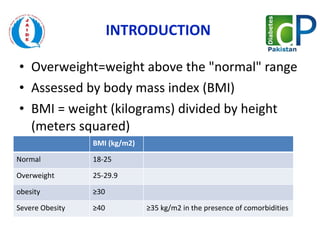
INTRODUCTION  Overweight=weight above the "normal" range Assessed by body mass index (BMI) BMI = weight (kilograms) divided by height (meters squared)  BMI (kg/m2) Normal 18-25 Overweight  25-29.9 obesity  ≥ 30  Severe Obesity ≥ 40 ≥ 35 kg/m2 in the presence of comorbidities
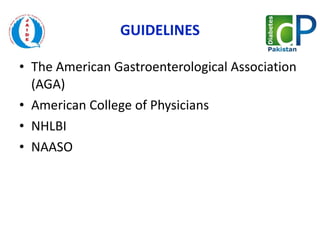
GUIDELINES The American Gastroenterological Association (AGA)  American College of Physicians NHLBI NAASO
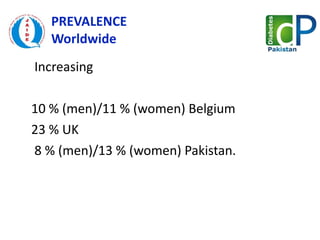
PREVALENCE  Worldwide   Increasing  10 % (men)/11 % (women) Belgium  23 % UK    8 % (men)/13 % (women) Pakistan.
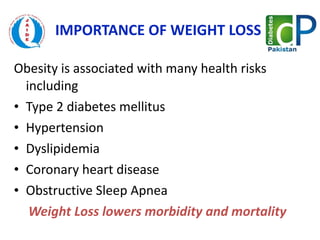
IMPORTANCE OF WEIGHT LOSS  Obesity is associated with many health risks including  Type 2 diabetes mellitus  Hypertension  Dyslipidemia  Coronary heart disease Obstructive Sleep Apnea Weight Loss lowers morbidity and mortality
Maintenance of weight loss The reduction in energy expenditure that is induced by weight loss. Maintenance of body weight at 10 percent below the baseline weight in obese subjects was associated with an 8 kcal/kg decrease in energy expenditure. Recidivism, that is regaining of lost weight
Characteristics of those who are likely to succeed in maintaining weight loss Weight loss of more than 2 kg in four weeks  Frequent and regular attendance at a weight loss program Subject's belief that his or her weight can be controlled.  Exercise consistently
APPROACH TO THERAPY  All treatments of obesity entail some risk What are the risks of treatment? Is treatment appropriate? What is the most appropriate treatment regimen?
What are the risks of treatment? Most of the currently available drugs have minor side effects that diminish with treatment
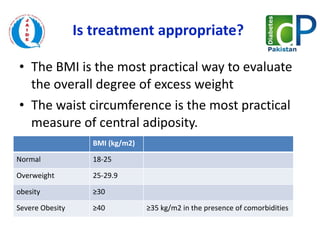
Is treatment appropriate?  The BMI is the most practical way to evaluate the overall degree of excess weight  The waist circumference is the most practical measure of central adiposity. BMI (kg/m2) Normal 18-25 Overweight  25-29.9 obesity  ≥ 30  Severe Obesity ≥ 40 ≥ 35 kg/m2 in the presence of comorbidities
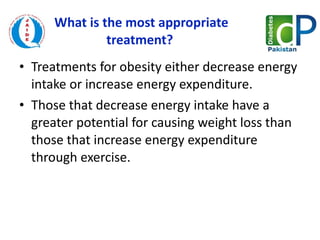
What is the most appropriate treatment?  Treatments for obesity either decrease energy intake or increase energy expenditure.  Those that decrease energy intake have a greater potential for causing weight loss than those that increase energy expenditure through exercise.
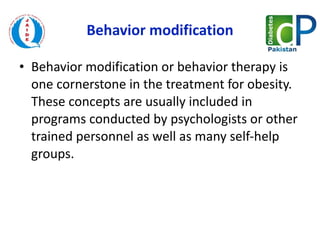
Behavior modification Behavior modification or behavior therapy is one cornerstone in the treatment for obesity. These concepts are usually included in programs conducted by psychologists or other trained personnel as well as many self-help groups.
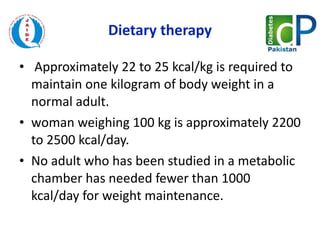
Dietary therapy   Approximately 22 to 25 kcal/kg is required to maintain one kilogram of body weight in a normal adult. woman weighing 100 kg is approximately 2200 to 2500 kcal/day.  No adult who has been studied in a metabolic chamber has needed fewer than 1000 kcal/day for weight maintenance.
Exercise   Increasing energy expenditure through physical activity has particular attractiveness in efforts at long-term maintenance of a lower body weight.
DRUG THERAPY IINDICATIONS BMI greater than 30 kg/m2, or  BMI of 27 to 30 kg/m2 if they have comorbid conditions Orlistat is the only FDA approved anti-obesity drug
LIPOSUCTION    Removal of fat by aspiration after injection of physiologic saline has been used to remove and contour subcutaneous fat.  Does not appear to improve insulin sensitivity or risk factors for coronary heart disease.
BARIATRIC SURGERY  Indications (NIH Consensus 1991 Panel) Be well-informed and motivated Have a BMI ≥40 kg/m2 Have acceptable risk for surgery Have failed previous non-surgical weight loss Adults with a BMI ≥35 kg/m2 who have serious comorbidities such as severe diabetes, sleep apnea, or joint disease
BARIATRIC SURGERY  Benefits Complete resolution or improvement in diabetes,  hypertension,  hyperlipidemia, and  obstructive sleep apnea
Complementary therapies Ephedra Acupuncture - modest benefit of acupuncture for weight loss
TAKE HOME MESSAGE Overweight (BMI ≥ 27) or obese (BMI ≥ 30)    counseling on diet, lifestyle, and goals for weight loss .  Failed to achieve weight loss goals through diet and exercise    pharmacologic therapy  BMI ≥40 kg/m2 who have failed diet and exercise (with or without drug therapy) or for patients with BMI >35 kg/m2 and obesity-related co-morbidities    bariatric surgery
THANK YOU

Dr. Ali java

  • 1.
    MANAGEMENT OF OBESITYDr. ALI JAWA MD (USA), MPH (USA), FACE (USA) Diplomate American Board of Endocrinology & Diabetes Diplomate American Board of Internal Medicine Diplomate American Board of Physician Nutrition Specialists Assistant Professor of Endocrinology/Diabetes Allama Iqbal Medical College, Lahore
  • 2.
  • 3.
  • 4.
  • 5.
  • 6.
  • 7.
  • 8.
    INTRODUCTION  Overweight=weight abovethe "normal" range Assessed by body mass index (BMI) BMI = weight (kilograms) divided by height (meters squared) BMI (kg/m2) Normal 18-25 Overweight 25-29.9 obesity ≥ 30 Severe Obesity ≥ 40 ≥ 35 kg/m2 in the presence of comorbidities
  • 9.
    GUIDELINES The AmericanGastroenterological Association (AGA) American College of Physicians NHLBI NAASO
  • 10.
    PREVALENCE Worldwide  Increasing 10 % (men)/11 % (women) Belgium 23 % UK 8 % (men)/13 % (women) Pakistan.
  • 11.
    IMPORTANCE OF WEIGHTLOSS  Obesity is associated with many health risks including Type 2 diabetes mellitus Hypertension Dyslipidemia Coronary heart disease Obstructive Sleep Apnea Weight Loss lowers morbidity and mortality
  • 12.
    Maintenance of weightloss The reduction in energy expenditure that is induced by weight loss. Maintenance of body weight at 10 percent below the baseline weight in obese subjects was associated with an 8 kcal/kg decrease in energy expenditure. Recidivism, that is regaining of lost weight
  • 13.
    Characteristics of thosewho are likely to succeed in maintaining weight loss Weight loss of more than 2 kg in four weeks Frequent and regular attendance at a weight loss program Subject's belief that his or her weight can be controlled. Exercise consistently
  • 14.
    APPROACH TO THERAPY All treatments of obesity entail some risk What are the risks of treatment? Is treatment appropriate? What is the most appropriate treatment regimen?
  • 15.
    What are therisks of treatment? Most of the currently available drugs have minor side effects that diminish with treatment
  • 16.
    Is treatment appropriate? The BMI is the most practical way to evaluate the overall degree of excess weight The waist circumference is the most practical measure of central adiposity. BMI (kg/m2) Normal 18-25 Overweight 25-29.9 obesity ≥ 30 Severe Obesity ≥ 40 ≥ 35 kg/m2 in the presence of comorbidities
  • 17.
    What is themost appropriate treatment?  Treatments for obesity either decrease energy intake or increase energy expenditure. Those that decrease energy intake have a greater potential for causing weight loss than those that increase energy expenditure through exercise.
  • 18.
    Behavior modification Behaviormodification or behavior therapy is one cornerstone in the treatment for obesity. These concepts are usually included in programs conducted by psychologists or other trained personnel as well as many self-help groups.
  • 19.
    Dietary therapy  Approximately 22 to 25 kcal/kg is required to maintain one kilogram of body weight in a normal adult. woman weighing 100 kg is approximately 2200 to 2500 kcal/day. No adult who has been studied in a metabolic chamber has needed fewer than 1000 kcal/day for weight maintenance.
  • 20.
    Exercise   Increasingenergy expenditure through physical activity has particular attractiveness in efforts at long-term maintenance of a lower body weight.
  • 21.
    DRUG THERAPY IINDICATIONSBMI greater than 30 kg/m2, or BMI of 27 to 30 kg/m2 if they have comorbid conditions Orlistat is the only FDA approved anti-obesity drug
  • 22.
    LIPOSUCTION    Removalof fat by aspiration after injection of physiologic saline has been used to remove and contour subcutaneous fat. Does not appear to improve insulin sensitivity or risk factors for coronary heart disease.
  • 23.
    BARIATRIC SURGERY  Indications(NIH Consensus 1991 Panel) Be well-informed and motivated Have a BMI ≥40 kg/m2 Have acceptable risk for surgery Have failed previous non-surgical weight loss Adults with a BMI ≥35 kg/m2 who have serious comorbidities such as severe diabetes, sleep apnea, or joint disease
  • 24.
    BARIATRIC SURGERY  BenefitsComplete resolution or improvement in diabetes, hypertension, hyperlipidemia, and obstructive sleep apnea
  • 25.
    Complementary therapies EphedraAcupuncture - modest benefit of acupuncture for weight loss
  • 26.
    TAKE HOME MESSAGEOverweight (BMI ≥ 27) or obese (BMI ≥ 30)  counseling on diet, lifestyle, and goals for weight loss . Failed to achieve weight loss goals through diet and exercise  pharmacologic therapy BMI ≥40 kg/m2 who have failed diet and exercise (with or without drug therapy) or for patients with BMI >35 kg/m2 and obesity-related co-morbidities  bariatric surgery
  • 27.