



Intensive Care Unit
Hospital Universitario La Paz. Madrid. Spain
Massive	
  transfusion	
  and	
  massive	
  
bleeding	
  protocols	
  	
  
Dr. M. Quintana
“The	
  white	
  rabbit	
  wore	
  his	
  eyeglasses	


—¿Where	
  do	
  I	
  start,	
  your	
  majesty?	


—Start	
  from	
  the	
  biggining	
  —replied	
  
the	
  king—.	
  Follow	
  unEl	
  you	
  get	
  to	
  the	
  
end.	
  Then	
  stop.”	
  
Alice's	
  Adventures	
  in	
  Wonderland.	
  
	
  Lewis	
  Carroll.	
  1865	
  
What	
  we	
  know……	
  
MASSIVE	
  BLEEDING	
  -­‐	
  CAUSES	
  
Cri$cal	
  Care	
  2007,	
  11:R	
  17(doi:10.1186/cc5686)	
  
trauma	
  =	
  bleeding	
  
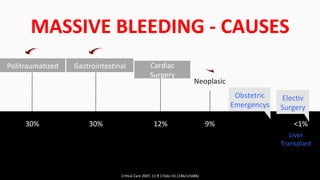
MASSIVE	
  BLEEDING	
  -­‐	
  CAUSES	
  
<1%	
  
Elec$v	
  
Surgery	
  
Liver	
  
Transplant	
  
Gastrointes$nal	
  
30%	
  
Neoplasic	
  
9%	
  30%	
  
Politrauma$zed	
  
Obstetric	
  	
  
Emergencys	
  
12%	
  
Cardiac	
  
Surgery	
  
Cri$cal	
  Care	
  2007,	
  11:R	
  17(doi:10.1186/cc5686)	
  
Massive	
  
Bleeding
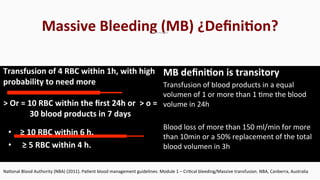
Transfusion	
  of	
  4	
  RBC	
  within	
  1h,	
  with	
  high	
  
probability	
  to	
  need	
  more	
  
>	
  Or	
  =	
  10	
  RBC	
  within	
  the	
  first	
  24h	
  or	
  	
  >	
  o	
  =	
  
30	
  blood	
  products	
  in	
  7	
  days	
  
MB	
  definiEon	
  is	
  transitory	
  
Transfusion	
  of	
  blood	
  products	
  in	
  a	
  equal	
  
volumen	
  of	
  1	
  or	
  more	
  than	
  1	
  $me	
  the	
  blood	
  
volume	
  in	
  24h	


Blood	
  loss	
  of	
  more	
  than	
  150	
  ml/min	
  for	
  more	
  
than	
  10min	
  or	
  a	
  50%	
  replacement	
  of	
  the	
  total	
  
blood	
  volumen	
  in	
  3h	
  
Na$onal	
  Blood	
  Authority	
  (NBA)	
  (2011).	
  Pa$ent	
  blood	
  management	
  guidelines:	
  Module	
  1	
  –	
  Cri$cal	
  bleeding/Massive	
  transfusion.	
  NBA,	
  Canberra,	
  Australia	
  
•  ≥	
  10	
  RBC	
  within	
  6	
  h.	
  	
  
•  	
  ≥	
  5	
  RBC	
  within	
  4	
  h.	
  
Massive	
  Bleeding	
  (MB)	
  ¿DefiniEon?	
  
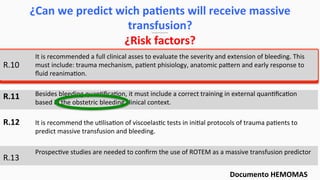
R.10	


R.11	


R.12	


R.13	
  
It	
  is	
  recommended	
  a	
  full	
  clinical	
  asses	
  to	
  evaluate	
  the	
  severity	
  and	
  extension	
  of	
  bleeding.	
  This	
  
must	
  include:	
  trauma	
  mechanism,	
  pa$ent	
  phisiology,	
  anatomic	
  paern	
  and	
  early	
  response	
  to	
  
fluid	
  reanima$on.	


Besides	
  bleeding	
  quan$fica$on,	
  it	
  must	
  include	
  a	
  correct	
  training	
  in	
  external	
  quan$fica$on	
  
based	
  in	
  the	
  obstetric	
  bleeding	
  clinical	
  context.	


It	
  is	
  recommend	
  the	
  u$lisa$on	
  of	
  viscoelas$c	
  tests	
  in	
  ini$al	
  protocols	
  of	
  trauma	
  pa$ents	
  to	
  
predict	
  massive	
  transfusion	
  and	
  bleeding.	


Prospec$ve	
  studies	
  are	
  needed	
  to	
  confirm	
  the	
  use	
  of	
  ROTEM	
  as	
  a	
  massive	
  transfusion	
  predictor	
  
¿Can	
  we	
  predict	
  wich	
  paEents	
  will	
  receive	
  massive	
  
transfusion?	
  
¿Risk	
  factors?	
  
Documento	
  HEMOMAS	
  
and	
  for	
  this….	
  we	
  nedeed	
  
PredicEve	
  Factors	
  and	
  Scores!!!	
  
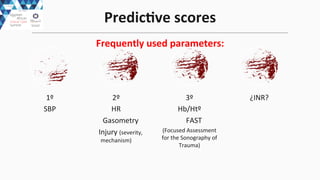
1º	
  	
  
SBP	
  
2º	
  	
  
HR	


  Gasometry	


  Injury	
  (severity,	
  
mechanism)	
  
3º	
  	
  
Hb/Htº	


  FAST	
  
(Focused	
  Assessment	
  
for	
  the	
  Sonography	
  of	
  
Trauma)	
  
¿INR?	
  
PredicEve	
  scores	
  
Frequently	
  used	
  parameters:	
  	
  
PredicEve	
  Scores	
  
TASH	
  (Trauma	
  Associated	
  Severe	
  Hemorrhage)	
  
7	
  independent	
  variables.	
  
Punctua$on:	
  0-­‐28.	
  
-­‐	
  Each	
  punctua$on	
  represents	
  a	
  %	
  of	
  massive	
  transfusion	
  (MT).	
  
-­‐Equa$on:	
  p	
  =	
  1	
  /	
  [1	
  +	
  exp(5.4	
  –	
  0.3	
  x	
  TASH)]	
  
TASH>	
  16	
  →	
  MT	
  >	
  50%	
  
TASH>	
  27	
  →	
  MT	
  100%	


Maegele	
  M.	
  Transfusion	
  Medicine	
  and	
  Hemotherapy	
  2012;	
  39:85-­‐97.	
  
Maegele	
  M.	
  Vox	
  Sanguinis	
  2011;	
  100:231-­‐238.	
  	
  
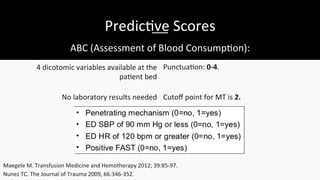
Predic$ve	
  Scores	
  
ABC	
  (Assessment	
  of	
  Blood	
  Consump$on):	
  
Punctua$on:	
  0-­‐4.	
  
Cutoff	
  point	
  for	
  MT	
  is	
  2.	
  	
  
4	
  dicotomic	
  variables	
  available	
  at	
  the	
  
pa$ent	
  bed	
  
No	
  laboratory	
  results	
  needed	
  
Maegele	
  M.	
  Transfusion	
  Medicine	
  and	
  Hemotherapy	
  2012;	
  39:85-­‐97.	
  	
  
Nunez	
  TC.	
  The	
  Journal	
  of	
  Trauma	
  2009,	
  66:346-­‐352.	
  
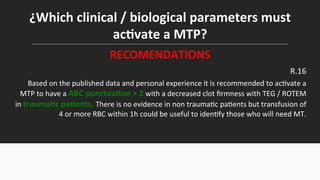
¿Which	
  clinical	
  /	
  biological	
  parameters	
  must	
  
acEvate	
  a	
  MTP?	
  
RECOMENDATIONS	
  
R.16	
  
Based	
  on	
  the	
  published	
  data	
  and	
  personal	
  experience	
  it	
  is	
  recommended	
  to	
  ac$vate	
  a	
  
MTP	
  to	
  have	
  a	
  ABC	
  punctuaEon	
  >	
  2	
  with	
  a	
  decreased	
  clot	
  firmness	
  with	
  TEG	
  /	
  ROTEM	
  
in	
  traumaEc	
  paEents.	
  There	
  is	
  no	
  evidence	
  in	
  non	
  trauma$c	
  pa$ents	
  but	
  transfusion	
  of	
  
4	
  or	
  more	
  RBC	
  within	
  1h	
  could	
  be	
  useful	
  to	
  iden$fy	
  those	
  who	
  will	
  need	
  MT.	
  
B-O-F
BLOOD	
  	
  
ON	
  	
  
FLOOR	
  
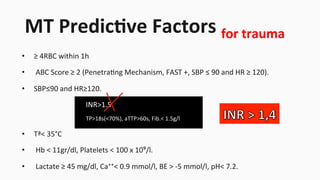
•  ≥	
  4RBC	
  within	
  1h	
  
•  	
  ABC	
  Score	
  ≥	
  2	
  (Penetra$ng	
  Mechanism,	
  FAST	
  +,	
  SBP	
  ≤	
  90	
  and	
  HR	
  ≥	
  120).	
  	
  
•  SBP≤90	
  and	
  HR≥120.	


  INR>1.5	


  TP>18s(<70%),	
  aTTP>60s,	
  Fib.<	
  1.5g/l	
  
•  Tª<	
  35°C	


•  	
  Hb	
  <	
  11gr/dl,	
  Platelets	
  <	
  100	
  x	
  10⁹/l.	
  
•  	
  Lactate	
  ≥	
  45	
  mg/dl,	
  Ca⁺⁺<	
  0.9	
  mmol/l,	
  BE	
  >	
  -­‐5	
  mmol/l,	
  pH<	
  7.2.	
  
MT	
  PredicEve	
  Factors	
  for	
  trauma	
  
21
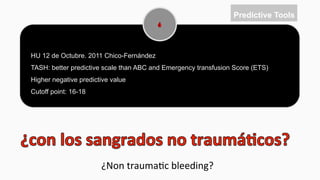
HU 12 de Octubre. 2011 Chico-Fernández
TASH: better predictive scale than ABC and Emergency transfusion Score (ETS)
Higher negative predictive value
Cutoff point: 16-18
Predictive Tools
¿Non	
  trauma$c	
  bleeding?	
  
It	
  is	
  essenEal	
  to	
  have	
  a	
  local	
  
agreement	
  to	
  acEvate	
  a	
  MTP	
  
We need
protocols…
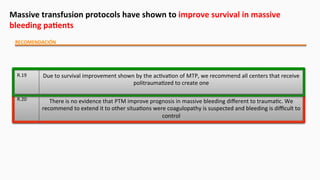
Massive	
  transfusion	
  protocols	
  have	
  shown	
  to	
  improve	
  survival	
  in	
  massive	
  
bleeding	
  paEents	
  
RECOMENDACIÓN	
  
R.19	
   Due	
  to	
  survival	
  improvement	
  shown	
  by	
  the	
  ac$va$on	
  of	
  MTP,	
  we	
  recommend	
  all	
  centers	
  that	
  receive	
  
politrauma$zed	
  to	
  create	
  one	
  
R.20	
   There	
  is	
  no	
  evidence	
  that	
  PTM	
  improve	
  prognosis	
  in	
  massive	
  bleeding	
  different	
  to	
  trauma$c.	
  We	
  
recommend	
  to	
  extend	
  it	
  to	
  other	
  situa$ons	
  were	
  coagulopathy	
  is	
  suspected	
  and	
  bleeding	
  is	
  difficult	
  to	
  
control
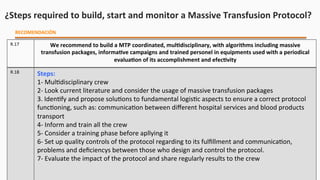
¿Steps	
  required	
  to	
  build,	
  start	
  and	
  monitor	
  a	
  Massive	
  Transfusion	
  Protocol?	
  
RECOMENDACIÓN	
  
R.17	
   We	
  recommend	
  to	
  build	
  a	
  MTP	
  coordinated,	
  mulEdisciplinary,	
  with	
  algorithms	
  including	
  massive	
  
transfusion	
  packages,	
  informaEve	
  campaigns	
  and	
  trained	
  personel	
  in	
  equipments	
  used	
  with	
  a	
  periodical	
  
evaluaEon	
  of	
  its	
  accomplishment	
  and	
  efecEvity	
  
R.18	
   Steps:	
  
1-­‐	
  Mul$disciplinary	
  crew	
  
2-­‐	
  Look	
  current	
  literature	
  and	
  consider	
  the	
  usage	
  of	
  massive	
  transfusion	
  packages	
  
3.	
  Iden$fy	
  and	
  propose	
  solu$ons	
  to	
  fundamental	
  logis$c	
  aspects	
  to	
  ensure	
  a	
  correct	
  protocol	
  
func$oning,	
  such	
  as:	
  communica$on	
  between	
  different	
  hospital	
  services	
  and	
  blood	
  products	
  
transport	
  
4-­‐	
  Inform	
  and	
  train	
  all	
  the	
  crew	
  	
  
5-­‐	
  Consider	
  a	
  training	
  phase	
  before	
  apllying	
  it	
  
6-­‐	
  Set	
  up	
  quality	
  controls	
  of	
  the	
  protocol	
  regarding	
  to	
  its	
  fulfillment	
  and	
  communica$on,	
  
problems	
  and	
  deficiencys	
  between	
  those	
  who	
  design	
  and	
  control	
  the	
  protocol.	
  
7-­‐	
  Evaluate	
  the	
  impact	
  of	
  the	
  protocol	
  and	
  share	
  regularly	
  results	
  to	
  the	
  crew	
  
2º	
  
5º	
  4º	
  
3º	
  
6º	
  
1º	
  
28	
  
Curr Opin Anesthesiol 2013,
26:000 – 000
Administrar: A. Tranexámico Bolus 1g +bomba infusión
continua (1g/40ml SF) a pasar en 8h (5ml/h)
Mantener: Ta>35oC;Ph>7,2;Ca>1mmol/l;Hb>8 gr/l
Analizar: TP;TTPA; Reptilase;PLQ; Fibrinógeno+EXTEM;INTEM
Normal
Desmopresina 0,3ug/Kg
1 pool Plaquetas
STOP
SANGRADO
Repetir pruebas después de cada tratamiento
¿Antivitaminicos K?
Rotem: ML>15% en 1h y corregido en APTEM
Rotem: MCF [(Extem<45 + Fibtem ≥ 8mm) ó Ex<33mm]
N° PLQ <50 x 109/L
Rotem: MCF (Extem<45 + Fibtem< 8)
Lab: Fibrinógeno<1,5 g/L
Rotem: CT Extem>80 y/o CTIntem>240
Lab: TP/TTPa>1,5Anormal
Coagulopatía
INR > 1,5 15UI/Kg. à CCP
INR >3 ó ? à 30 UI/Kg.
¿Sangrado
quirúrgico?
¿Disfunción Plaquetas?
Revisión
quirúrgica
Diagnóstico
diferencial
P. laboratorio
FIBTEM / HEPTEM / APTEM
Fibrinógeno
Plasma
15-30 mL/Kg
CCP
15-30 UI/Kg
FVII
90 µg/Kg
Plaquetas
1 pool
TMX 1 g
Rotem: CT Heptem < CT Intem
Lab: TTPa>1,5 + Trombina>60 + Reptilase Normal.
Protamina
1:1
30	
  
We	
  nedeed	
  protocolos	
  
because….
Massive	
  transfusion	
  protocol	
  (MTP)	
  and	
  non	
  massive	
  
Standardized	
  care	
  to	
  improve	
  prognosis	
  
32	
  
the	
  best	
  protocol?
33	
  
The	
  one	
  that	
  you	
  have	
  ......	
  	
  the	
  one	
  that	
  you	
  have	
  
been	
  able	
  to	
  adapt	
  of	
  another	
  place	
  to	
  your	
  
reality	


As	
  long	
  as	
  it	
  is	
  known	
  by	
  all	
  the	
  parEcipants,	
  and	
  
it	
  is	
  monitored	
  for	
  compliance	


Coordinated	
  with	
  Blood	
  Bank	
  and	
  Hospital	
  
Pharmacy
34	
  
blood	
  products	
  or	
  
prohemostaEc	
  drugs?
35	
  
both!!!!!	


quesEonable	
  the	
  moment	
  (early	
  !!!)	
  and	
  the	
  amount	


You	
  have	
  to	
  know	
  what	
  blood	
  products	
  you	
  
have
You	
  have	
  to	
  understand	
  that	
  you	
  read
WHAT DO YOU NEED
TO TAKE HOME?
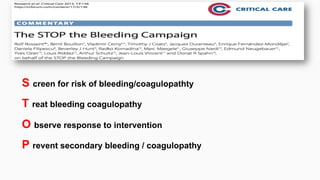
S creen for risk of bleeding/coagulopathty
T reat bleeding coagulopathy
O bserve response to intervention
P revent secondary bleeding / coagulopathy
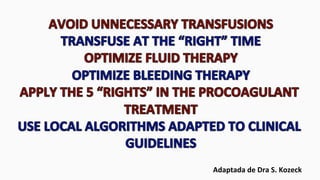
Adaptada	
  de	
  Dra	
  S.	
  Kozeck	
  
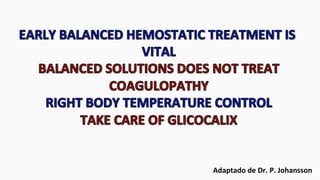
Adaptado	
  de	
  Dr.	
  P.	
  Johansson	
  
“If	
  you	
  are	
  looking	
  for	
  different	
  results,	
  
do	
  not	
  always	
  do	
  the	
  same	
  ”	


Albert Einstein
new	
  approaches
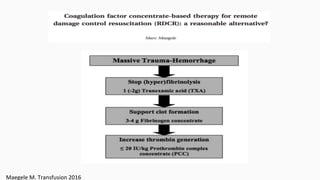
 Maegele	
  M.	
  Transfusion	
  2016	
  
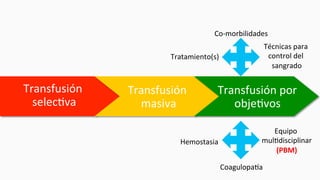
and	
  this	
  has	
  meant	
  that	
  ....
Transfusión	
  
masiva	
  
Transfusión	
  por	
  
obje$vos	
  
Tratamiento(s)	
  
Técnicas	
  para	
  
control	
  del	
  
sangrado	
  
Co-­‐morbilidades	
  
Equipo	
  
mul$disciplinar	
  
(PBM)	
  
Coagulopa{a	
  
Hemostasia	
  
Transfusión	
  
selec$va	
  
Without	
  forgesng	
  that	
  ....	
  
in	
  relaEon	
  to	
  prohemostaEc	
  drugs
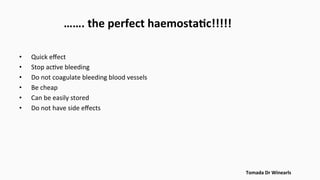
…….	
  the	
  perfect	
  haemostaEc!!!!!	
  
•  Quick	
  effect	
  
•  Stop	
  ac$ve	
  bleeding	
  
•  Do	
  not	
  coagulate	
  bleeding	
  blood	
  vessels	
  
•  Be	
  cheap	
  
•  Can	
  be	
  easily	
  stored	
  
•  Do	
  not	
  have	
  side	
  effects	
  
Tomada	
  Dr	
  Winearls	
  
48	
  
How	
  far	
  can	
  we	
  get?	
  
Ganter MT, Spahn DR
near	
  
Grupo SEMICYUC de Transfusiones
Gracias por vuestra atención
MQ
manuel.quintana@uam.es

Massive transfusion protocols

  • 2.
    Intensive Care Unit HospitalUniversitario La Paz. Madrid. Spain Massive  transfusion  and  massive   bleeding  protocols     Dr. M. Quintana
  • 3.
    “The  white  rabbit  wore  his  eyeglasses     —¿Where  do  I  start,  your  majesty?     —Start  from  the  biggining  —replied   the  king—.  Follow  unEl  you  get  to  the   end.  Then  stop.”   Alice's  Adventures  in  Wonderland.    Lewis  Carroll.  1865  
  • 4.
  • 5.
    MASSIVE  BLEEDING  -­‐  CAUSES   Cri$cal  Care  2007,  11:R  17(doi:10.1186/cc5686)  
  • 6.
  • 7.
    MASSIVE  BLEEDING  -­‐  CAUSES   <1%   Elec$v   Surgery   Liver   Transplant   Gastrointes$nal   30%   Neoplasic   9%  30%   Politrauma$zed   Obstetric     Emergencys   12%   Cardiac   Surgery   Cri$cal  Care  2007,  11:R  17(doi:10.1186/cc5686)  
  • 8.
  • 9.
    Transfusion  of  4  RBC  within  1h,  with  high   probability  to  need  more   >  Or  =  10  RBC  within  the  first  24h  or    >  o  =   30  blood  products  in  7  days   MB  definiEon  is  transitory   Transfusion  of  blood  products  in  a  equal   volumen  of  1  or  more  than  1  $me  the  blood   volume  in  24h     Blood  loss  of  more  than  150  ml/min  for  more   than  10min  or  a  50%  replacement  of  the  total   blood  volumen  in  3h   Na$onal  Blood  Authority  (NBA)  (2011).  Pa$ent  blood  management  guidelines:  Module  1  –  Cri$cal  bleeding/Massive  transfusion.  NBA,  Canberra,  Australia   •  ≥  10  RBC  within  6  h.     •   ≥  5  RBC  within  4  h.   Massive  Bleeding  (MB)  ¿DefiniEon?  
  • 10.
    R.10     R.11     R.12     R.13   It  is  recommended  a  full  clinical  asses  to  evaluate  the  severity  and  extension  of  bleeding.  This   must  include:  trauma  mechanism,  pa$ent  phisiology,  anatomic  paern  and  early  response  to   fluid  reanima$on.     Besides  bleeding  quan$fica$on,  it  must  include  a  correct  training  in  external  quan$fica$on   based  in  the  obstetric  bleeding  clinical  context.     It  is  recommend  the  u$lisa$on  of  viscoelas$c  tests  in  ini$al  protocols  of  trauma  pa$ents  to   predict  massive  transfusion  and  bleeding.       Prospec$ve  studies  are  needed  to  confirm  the  use  of  ROTEM  as  a  massive  transfusion  predictor   ¿Can  we  predict  wich  paEents  will  receive  massive   transfusion?   ¿Risk  factors?   Documento  HEMOMAS  
  • 11.
    and  for  this….  we  nedeed   PredicEve  Factors  and  Scores!!!  
  • 12.
    1º     SBP   2º     HR            Gasometry            Injury  (severity,   mechanism)   3º     Hb/Htº            FAST   (Focused  Assessment   for  the  Sonography  of   Trauma)   ¿INR?   PredicEve  scores   Frequently  used  parameters:    
  • 13.
    PredicEve  Scores   TASH  (Trauma  Associated  Severe  Hemorrhage)   7  independent  variables.   Punctua$on:  0-­‐28.   -­‐  Each  punctua$on  represents  a  %  of  massive  transfusion  (MT).   -­‐Equa$on:  p  =  1  /  [1  +  exp(5.4  –  0.3  x  TASH)]   TASH>  16  →  MT  >  50%   TASH>  27  →  MT  100%                             Maegele  M.  Transfusion  Medicine  and  Hemotherapy  2012;  39:85-­‐97.   Maegele  M.  Vox  Sanguinis  2011;  100:231-­‐238.    
  • 14.
    Predic$ve  Scores   ABC  (Assessment  of  Blood  Consump$on):   Punctua$on:  0-­‐4.   Cutoff  point  for  MT  is  2.     4  dicotomic  variables  available  at  the   pa$ent  bed   No  laboratory  results  needed   Maegele  M.  Transfusion  Medicine  and  Hemotherapy  2012;  39:85-­‐97.     Nunez  TC.  The  Journal  of  Trauma  2009,  66:346-­‐352.  
  • 15.
    ¿Which  clinical  /  biological  parameters  must   acEvate  a  MTP?   RECOMENDATIONS   R.16   Based  on  the  published  data  and  personal  experience  it  is  recommended  to  ac$vate  a   MTP  to  have  a  ABC  punctuaEon  >  2  with  a  decreased  clot  firmness  with  TEG  /  ROTEM   in  traumaEc  paEents.  There  is  no  evidence  in  non  trauma$c  pa$ents  but  transfusion  of   4  or  more  RBC  within  1h  could  be  useful  to  iden$fy  those  who  will  need  MT.  
  • 17.
  • 18.
    BLOOD     ON     FLOOR  
  • 20.
    •  ≥  4RBC  within  1h   •   ABC  Score  ≥  2  (Penetra$ng  Mechanism,  FAST  +,  SBP  ≤  90  and  HR  ≥  120).     •  SBP≤90  and  HR≥120.                                          INR>1.5      TP>18s(<70%),  aTTP>60s,  Fib.<  1.5g/l   •  Tª<  35°C                                                                       •   Hb  <  11gr/dl,  Platelets  <  100  x  10⁹/l.   •   Lactate  ≥  45  mg/dl,  Ca⁺⁺<  0.9  mmol/l,  BE  >  -­‐5  mmol/l,  pH<  7.2.   MT  PredicEve  Factors  for  trauma  
  • 21.
    21 HU 12 deOctubre. 2011 Chico-Fernández TASH: better predictive scale than ABC and Emergency transfusion Score (ETS) Higher negative predictive value Cutoff point: 16-18 Predictive Tools ¿Non  trauma$c  bleeding?  
  • 22.
    It  is  essenEal  to  have  a  local   agreement  to  acEvate  a  MTP  
  • 23.
  • 24.
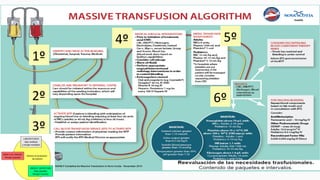
    Massive  transfusion  protocols  have  shown  to  improve  survival  in  massive   bleeding  paEents   RECOMENDACIÓN   R.19   Due  to  survival  improvement  shown  by  the  ac$va$on  of  MTP,  we  recommend  all  centers  that  receive   politrauma$zed  to  create  one   R.20   There  is  no  evidence  that  PTM  improve  prognosis  in  massive  bleeding  different  to  trauma$c.  We   recommend  to  extend  it  to  other  situa$ons  were  coagulopathy  is  suspected  and  bleeding  is  difficult  to   control
  • 25.
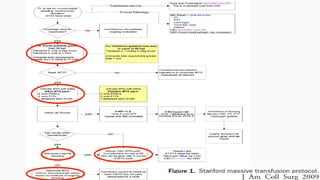
    ¿Steps  required  to  build,  start  and  monitor  a  Massive  Transfusion  Protocol?   RECOMENDACIÓN   R.17   We  recommend  to  build  a  MTP  coordinated,  mulEdisciplinary,  with  algorithms  including  massive   transfusion  packages,  informaEve  campaigns  and  trained  personel  in  equipments  used  with  a  periodical   evaluaEon  of  its  accomplishment  and  efecEvity   R.18   Steps:   1-­‐  Mul$disciplinary  crew   2-­‐  Look  current  literature  and  consider  the  usage  of  massive  transfusion  packages   3.  Iden$fy  and  propose  solu$ons  to  fundamental  logis$c  aspects  to  ensure  a  correct  protocol   func$oning,  such  as:  communica$on  between  different  hospital  services  and  blood  products   transport   4-­‐  Inform  and  train  all  the  crew     5-­‐  Consider  a  training  phase  before  apllying  it   6-­‐  Set  up  quality  controls  of  the  protocol  regarding  to  its  fulfillment  and  communica$on,   problems  and  deficiencys  between  those  who  design  and  control  the  protocol.   7-­‐  Evaluate  the  impact  of  the  protocol  and  share  regularly  results  to  the  crew  
  • 26.
    2º   5º  4º   3º   6º   1º  
  • 28.
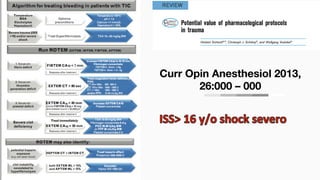
    28   Curr OpinAnesthesiol 2013, 26:000 – 000
  • 29.
    Administrar: A. TranexámicoBolus 1g +bomba infusión continua (1g/40ml SF) a pasar en 8h (5ml/h) Mantener: Ta>35oC;Ph>7,2;Ca>1mmol/l;Hb>8 gr/l Analizar: TP;TTPA; Reptilase;PLQ; Fibrinógeno+EXTEM;INTEM Normal Desmopresina 0,3ug/Kg 1 pool Plaquetas STOP SANGRADO Repetir pruebas después de cada tratamiento ¿Antivitaminicos K? Rotem: ML>15% en 1h y corregido en APTEM Rotem: MCF [(Extem<45 + Fibtem ≥ 8mm) ó Ex<33mm] N° PLQ <50 x 109/L Rotem: MCF (Extem<45 + Fibtem< 8) Lab: Fibrinógeno<1,5 g/L Rotem: CT Extem>80 y/o CTIntem>240 Lab: TP/TTPa>1,5Anormal Coagulopatía INR > 1,5 15UI/Kg. à CCP INR >3 ó ? à 30 UI/Kg. ¿Sangrado quirúrgico? ¿Disfunción Plaquetas? Revisión quirúrgica Diagnóstico diferencial P. laboratorio FIBTEM / HEPTEM / APTEM Fibrinógeno Plasma 15-30 mL/Kg CCP 15-30 UI/Kg FVII 90 µg/Kg Plaquetas 1 pool TMX 1 g Rotem: CT Heptem < CT Intem Lab: TTPa>1,5 + Trombina>60 + Reptilase Normal. Protamina 1:1
  • 30.
    30   We  nedeed  protocolos   because….
  • 31.
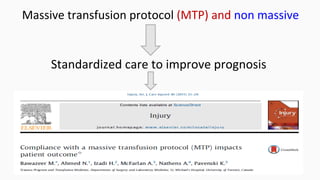
    Massive  transfusion  protocol  (MTP)  and  non  massive   Standardized  care  to  improve  prognosis  
  • 32.
    32   the  best  protocol?
  • 33.
    33   The  one  that  you  have  ......    the  one  that  you  have   been  able  to  adapt  of  another  place  to  your   reality     As  long  as  it  is  known  by  all  the  parEcipants,  and   it  is  monitored  for  compliance     Coordinated  with  Blood  Bank  and  Hospital   Pharmacy
  • 34.
    34   blood  products  or   prohemostaEc  drugs?
  • 35.
    35   both!!!!!     quesEonable  the  moment  (early  !!!)  and  the  amount     You  have  to  know  what  blood  products  you   have You  have  to  understand  that  you  read
  • 36.
    WHAT DO YOUNEED TO TAKE HOME?
  • 37.
    S creen forrisk of bleeding/coagulopathty T reat bleeding coagulopathy O bserve response to intervention P revent secondary bleeding / coagulopathy
  • 38.
    Adaptada  de  Dra  S.  Kozeck  
  • 39.
    Adaptado  de  Dr.  P.  Johansson  
  • 40.
    “If  you  are  looking  for  different  results,   do  not  always  do  the  same  ”   Albert Einstein
  • 41.
  • 42.
  • 44.
    and  this  has  meant  that  ....
  • 45.
    Transfusión   masiva   Transfusión  por   obje$vos   Tratamiento(s)   Técnicas  para   control  del   sangrado   Co-­‐morbilidades   Equipo   mul$disciplinar   (PBM)   Coagulopa{a   Hemostasia   Transfusión   selec$va  
  • 46.
    Without  forgesng  that  ....   in  relaEon  to  prohemostaEc  drugs
  • 47.
    …….  the  perfect  haemostaEc!!!!!   •  Quick  effect   •  Stop  ac$ve  bleeding   •  Do  not  coagulate  bleeding  blood  vessels   •  Be  cheap   •  Can  be  easily  stored   •  Do  not  have  side  effects   Tomada  Dr  Winearls  
  • 48.
    48   How  far  can  we  get?  
  • 49.
  • 50.
    near   Grupo SEMICYUCde Transfusiones
  • 51.
    Gracias por vuestraatención MQ manuel.quintana@uam.es