Percutaneous circulatory support.
IABP, Impella and beyond
Holger Thiele
Medical Clinic II (Cardiology/Angiology/Intensive Care)
University Heart Center of Lübeck, Germany
Disclosures
Funding:
German Research Foundation
German Heart Research Foundation
German Cardiac Society
EU
Arbeitsgemeinschaft Leitende Kardiologische Krankenhausärzte
Consulting:
None
Speaker Honoraria:
Lilly, Astra Zeneca, Daiichi Sankyo, Boehringer Ingelheim, Maquet
Cardiovascular, Medicines Company
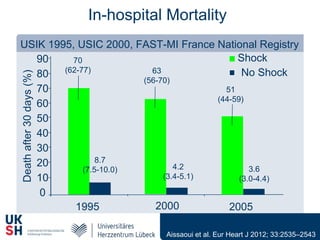
In-hospital Mortality
Aissaoui et al. Eur Heart J 2012; 33:2535–2543
USIK 1995, USIC 2000, FAST-MI France National Registry
1995 2000 2005
90
80
70
60
50
40
30
20
10
0
Deathafter30days(%)
8.7
(7.5-10.0) 4.2
(3.4-5.1)
3.6
(3.0-4.4)
51
(44-59)
63
(56-70)
70
(62-77)
Shock
No Shock
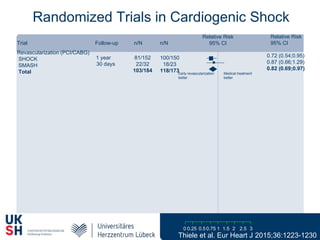
Trial n/N n/N
Relative Risk
95% CI
Relative Risk
95% CI
0 0.5 1 2 3
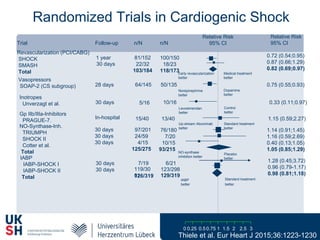
Randomized Trials in Cardiogenic Shock
Follow-up
Revascularization (PCI/CABG)
SHOCK
SMASH
Total
81/152
22/32
103/184
100/150
18/23
118/173
1 year
30 days
Early revascularization
better
Medical treatment
better
0.75 1.5 2.50.25
Thiele et al. Eur Heart J 2015;36:1223-1230
0.72 (0.54;0.95)
0.87 (0.66;1.29)
0.82 (0.69;0.97)
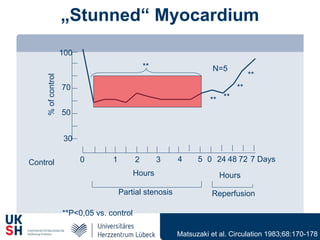
„Stunned“ Myocardium
Partial stenosis Reperfusion
Hours Hours
7 Days
N=5
Control 0 1 2 3 4 5 0 24 48 72
100
70
50
30
%ofcontrol
**
** **
**
**
**P<0,05 vs. control
Matsuzaki et al. Circulation 1983;68:170-178
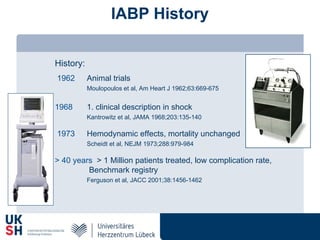
IABP History
History:
1962 Animal trials
Moulopoulos et al, Am Heart J 1962;63:669-675
1968 1. clinical description in shock
Kantrowitz et al, JAMA 1968;203:135-140
1973 Hemodynamic effects, mortality unchanged
Scheidt et al, NEJM 1973;288:979-984
> 40 years > 1 Million patients treated, low complication rate,
Benchmark registry
Ferguson et al, JACC 2001;38:1456-1462
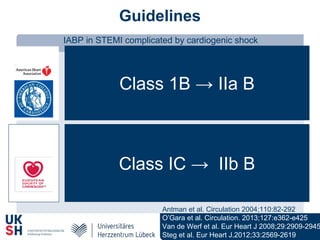
Guidelines
IABP in STEMI complicated by cardiogenic shock
Class 1B → IIa B
ACC/AHA
ESC
Class IC → IIb B
Antman et al. Circulation 2004;110:82-292
O’Gara et al. Circulation. 2013;127:e362-e425
Van de Werf et al. Eur Heart J 2008;29:2909-2945
Steg et al. Eur Heart J.2012;33:2569-2619
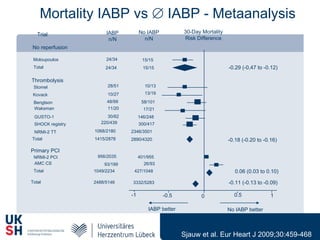
Sjauw et al. Eur Heart J 2009;30:459-468
Mortality IABP vs  IABP - Metaanalysis
-1 -0.5 0.5 10
No IABP betterIABP better
30-Day Mortality
Risk Difference
IABP
n/N
No IABP
n/N
Trial
-0.18 (-0.20 to -0.16)Total
Thrombolysis
Stomel
Kovack
Bengtson
Waksman
GUSTO-1
SHOCK registry
NRMI-2 TT
28/51
10/27
48/99
11/20
30/62
220/439
1068/2180
1415/2878
10/13
13/19
58/101
17/21
146/248
300/417
2346/3501
2890/4320
-0.11 (-0.13 to -0.09)Total 2488/5146 3332/5283
Total 1049/2234 0.06 (0.03 to 0.10)
Primary PCI
NRMI-2 PCI
AMC CS
956/2035
93/199
401/955
26/93
427/1048
-0.29 (-0,47 to -0.12)
No reperfusion
24/34
24/34
15/15
15/15
Moloupoulos
Total
0
1
2
3
4
5
6
7
8
9
P=0.43
P=0.12
P=0.06
P=0.32
P=0.32 P=0.37
Baseline 8 h 16 h 24 h 32 h 40 h 48 h
Serumlactate(mmol/l)
P=0.09
Control
IABP
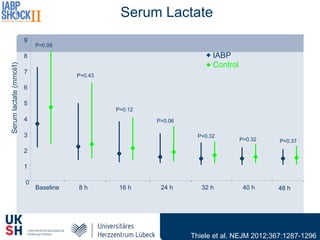
Serum Lactate
Thiele et al. NEJM 2012;367:1287-1296
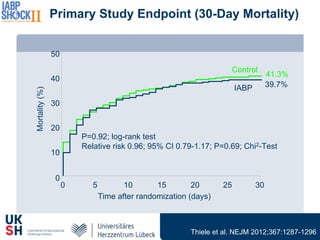
Mortality(%)
Time after randomization (days)
P=0.92; log-rank test
Relative risk 0.96; 95% CI 0.79-1.17; P=0.69; Chi2-Test
Primary Study Endpoint (30-Day Mortality)
Control
41.3%
IABP 39.7%
0
10
20
30
40
50
0 5 10 15 20 25 30
Thiele et al. NEJM 2012;367:1287-1296
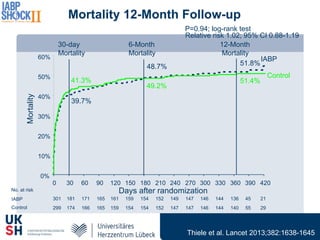
Mortality 12-Month Follow-up
Control
IABP
0%
10%
20%
30%
40%
50%
60%
0 30 60 90 120 150 180 210 240 270 300 330 360 390 420
Mortality
Days after randomization
P=0.94; log-rank test
Relative risk 1.02; 95% CI 0.88-1.19
12-Month
Mortality
49.2%
48.7%
6-Month
Mortality
30-day
Mortality
41.3%
39.7%
51.8%
51.4%
301 181 171 165 161 159 154 152 149 147 146 144 136 45 21
299 174 166 165 159 154 154 152 147 147 146 144 140 55 29
No. at risk
IABP
Control
Thiele et al. Lancet 2013;382:1638-1645
Trial n/N n/N
Relative Risk
95% CI
Relative Risk
95% CI
0 0.5 1 2 3
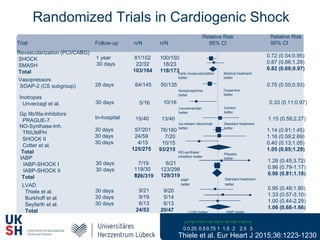
Randomized Trials in Cardiogenic Shock
Follow-up
Revascularization (PCI/CABG)
SHOCK
SMASH
Total
81/152
22/32
103/184
100/150
18/23
118/173
1 year
30 days
Early revascularization
better
Medical treatment
better
0.75 1.5 2.50.25
0.72 (0.54;0.95)
0.87 (0.66;1.29)
0.82 (0.69;0.97)
0.75 (0.55;0.93)64/145 50/13528 days
Norepinephrine
better
Dopamine
better
Vasopressors
SOAP-2 (CS subgroup)
0.33 (0.11;0.97)5/16 10/1630 days
Levosimendan
better
Control
better
Inotropes
Unverzagt et al.
Gp IIb/IIIa-Inhibitors
PRAGUE-7.
In-hospital 15/40 13/40 1.15 (0.59;2.27)
Up-stream Abciximab
better
Standard treatment
better
30 days
30 days
7/19 6/21
IABP
better
Standard treatment
better
1.28 (0.45;3.72)
0.96 (0.79-1.17)
0.98 (0.81;1.18)
119/30
01
123/298
126/319 129/319
IABP
IABP-SHOCK I
IABP-SHOCK II
Total
30 days
30 days
30 days
97/201
24/59
4/15
125/275
76/180
7/20
10/15
93/215
1.14 (0.91;1.45)
1.16 (0.59;2.69)
0.40 (0.13;1.05)
1.05 (0.85;1.29)NO-synthase
inhibition better
Placebo
better
NO-Synthase-Inh.
TRIUMPH
SHOCK II
Cotter et al.
Total
Thiele et al. Eur Heart J 2015;36:1223-1230
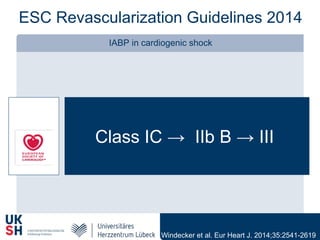
ESC Revascularization Guidelines 2014
IABP in cardiogenic shock
ESC
Class IC → IIb B → III
Windecker et al. Eur Heart J. 2014;35:2541-2619
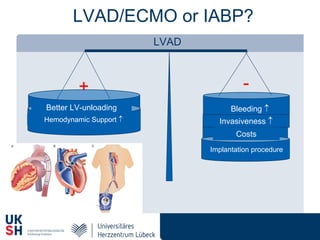
LVAD/ECMO or IABP?
Bleeding 
Invasiveness 
+ -
Implantation procedure
LVAD
Hemodynamic Support 
Better LV-unloading
Costs
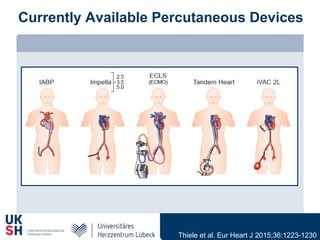
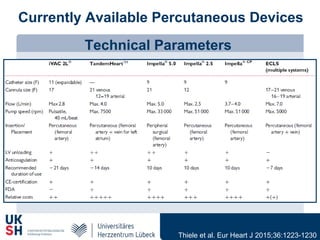
Currently Available Percutaneous Devices
Thiele et al. Eur Heart J 2015;36:1223-1230
Technical Parameters
Currently Available Percutaneous Devices
Thiele et al. Eur Heart J 2015;36:1223-1230
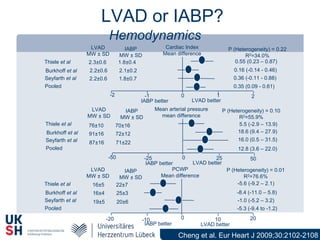
LVAD or IABP?
Cheng et al. Eur Heart J 2009;30:2102-2108
Hemodynamics
LVAD
MW ± SD
IABP
MW ± SD
Cardiac Index
Mean difference
P (Heterogeneity) = 0.22
R2=34.0%
Thiele et al
Burkhoff et al
Seyfarth et al
Pooled
-2 -1 0 1 2
LVAD betterIABP better
0.55 (0.23 – 0.87)
0.16 (-0.14 - 0.46)
0.36 (-0.11 - 0.88)
0.35 (0.09 - 0.61)
2.3±0.6 1.8±0.4
2.2±0.6 2.1±0.2
2.2±0.6 1.8±0.7
LVAD betterIABP better
LVAD
MW ± SD
IABP
MW ± SD
Mean arterial pressure
mean difference
P (Heterogeneity) = 0.10
R2=55.9%
Thiele et al
Burkhoff et al
Seyfarth et al
Pooled
-50 -25 0 25 50
5.5 (-2.9 – 13.9)
18.6 (9.4 – 27.9)
16.0 (0.5 – 31.5)
12.8 (3.6 – 22.0)
76±10 70±16
91±16 72±12
87±16 71±22
16±5 22±7
16±4 25±3
19±5 20±6
LVAD
MW ± SD
IABP
MW ± SD
PCWP
Mean difference
P (Heterogeneity) = 0.01
R2=76.6%
Thiele et al
Burkhoff et al
Seyfarth et al
Pooled
-20 -10 0 10 20
LVAD betterIABP better
-5.6 (-9.2 – 2.1)
-8.4 (-11.0 – 5.8)
-1.0 (-5.2 – 3.2)
-5.3 (-9.4 to -1.2)
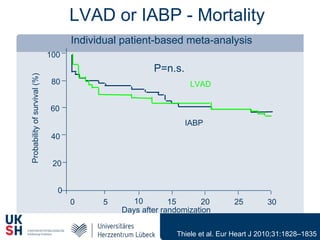
LVAD or IABP - Mortality
Individual patient-based meta-analysis
0 5 10 15 20 25 30
0
20
40
60
80
100
Probabilityofsurvival(%)
Days after randomization
IABP
LVAD
P=n.s.
Thiele et al. Eur Heart J 2010;31:1828–1835
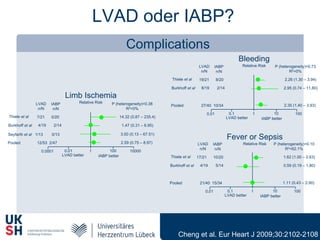
LVAD oder IABP?
Complications
Cheng et al. Eur Heart J 2009;30:2102-2108
LVAD
n/N
IABP
n/N
Limb Ischemia
Relative Risk P (heterogeneity)=0.38
R2=0%
Thiele et al
Burkhoff et al
Seyfarth et al
Pooled
0.0001 0.01 1 100 10000
IABP betterLVAD better
14.32 (0.87 – 235.4)
1.47 (0.31 – 6.95)
3.00 (0.13 – 67.51)
2.59 (0.75 – 8.97)
7/21 0/20
4/19 2/14
1/13 0/13
12/53 2/47
LVAD
n/N
IABP
n/N
Bleeding
Relative Risk P (heterogeneity)=0.73
R2=0%
Thiele et al
Burkhoff et al
Pooled
0.01 0.1 1 10 100
IABP betterLVAD better
2.26 (1.30 – 3.94)
2.95 (0.74 – 11.80)
2.35 (1.40 – 3.93)
19/21 8/20
8/19 2/14
27/40 10/34
LVAD
n/N
IABP
n/N
Fever or Sepsis
Relative Risk P (heterogeneity)=0.10
R2=62.1%
Thiele et al
Burkhoff et al
Pooled
0.01 0.1 1 10 100
IABP betterLVAD better
1.62 (1.00 – 2.63)
0.59 (0.19 – 1.80)
1.11 (0.43 – 2.90)
17/21 10/20
4/19 5/14
21/40 15/34
Trial n/N n/N
Relative Risk
95% CI
Relative Risk
95% CI
0 0.5 1 2 3
Randomized Trials in Cardiogenic Shock
Follow-up
Revascularization (PCI/CABG)
SHOCK
SMASH
Total
81/152
22/32
103/184
100/150
18/23
118/173
1 year
30 days
Early revascularization
better
Medical treatment
better
0.75 1.5 2.50.25
0.72 (0.54;0.95)
0.87 (0.66;1.29)
0.82 (0.69;0.97)
0.75 (0.55;0.93)64/145 50/13528 days
Norepinephrine
better
Dopamine
better
Vasopressors
SOAP-2 (CS subgroup)
0.33 (0.11;0.97)5/16 10/1630 days
Levosimendan
better
Control
better
Inotropes
Unverzagt et al.
Gp IIb/IIIa-Inhibitors
PRAGUE-7.
In-hospital 15/40 13/40 1.15 (0.59;2.27)
Up-stream Abciximab
better
Standard treatment
better
30 days
30 days
7/19 6/21
IABP
better
Standard treatment
better
1.28 (0.45;3.72)
0.96 (0.79-1.17)
0.98 (0.81;1.18)
119/30
01
123/298
126/319 129/319
IABP
IABP-SHOCK I
IABP-SHOCK II
Total
30 days
30 days
30 days
97/201
24/59
4/15
125/275
76/180
7/20
10/15
93/215
1.14 (0.91;1.45)
1.16 (0.59;2.69)
0.40 (0.13;1.05)
1.05 (0.85;1.29)NO-synthase
inhibition better
Placebo
better
NO-Synthase-Inh.
TRIUMPH
SHOCK II
Cotter et al.
Total
30 days
30 days
30 days
9/21
9/19
6/13
24/53
9/20
5/14
6/13
20/47
0.95 (0.48;1.90)
1.33 (0.57-3.10)
1.00 (0.44-2.29)
1.06 (0.68-1.66)
IABP better
LVAD
Thiele et al.
Burkhoff et al.
Seyfarth et al.
Total LVAD better
Thiele et al. Eur Heart J 2015;36:1223-1230
Sheu et al. Crit Care Med 2010;38:1810-1817
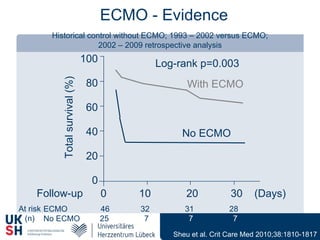
ECMO - Evidence
Historical control without ECMO; 1993 – 2002 versus ECMO;
2002 – 2009 retrospective analysis
Log-rank p=0.003
0 10 20 30 (Days)
100
80
60
40
20
0
Follow-up
At risk
(n)
ECMO 46 32 31 28
No ECMO 25 7 7 7
Totalsurvival(%)
With ECMO
No ECMO
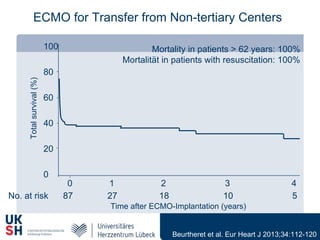
Time after ECMO-Implantation (years)
Totalsurvival(%)
0 1 2 3 4
100
80
60
40
20
0
No. at risk 87 27 18 10 5
Beurtheret et al. Eur Heart J 2013;34:112-120
ECMO for Transfer from Non-tertiary Centers
Mortality in patients > 62 years: 100%
Mortalität in patients with resuscitation: 100%
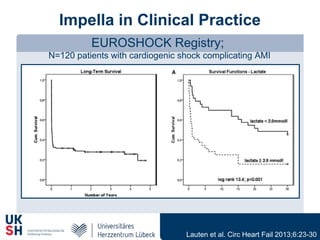
Impella in Clinical Practice
EUROSHOCK Registry;
N=120 patients with cardiogenic shock complicating AMI
Lauten et al. Circ Heart Fail 2013;6:23-30
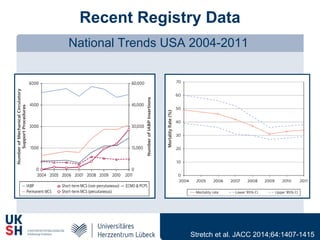
Recent Registry Data
National Trends USA 2004-2011
Stretch et al. JACC 2014;64:1407-1415
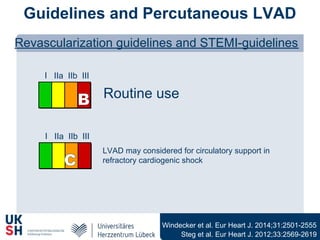
Guidelines and Percutaneous LVAD
Revascularization guidelines and STEMI-guidelines
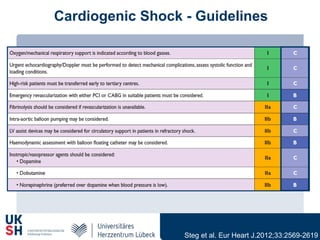
Steg et al. Eur Heart J. 2012;33:2569-2619
I IIa IIb III
C
LVAD may considered for circulatory support in
refractory cardiogenic shock
I IIa IIb III
B Routine use
Windecker et al. Eur Heart J. 2014;31:2501-2555
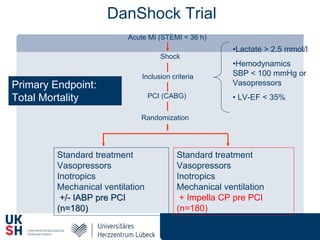
•Lactate > 2.5 mmol/l
•Hemodynamics
SBP < 100 mmHg or
Vasopressors
• LV-EF < 35%
Standard treatment
Vasopressors
Inotropics
Mechanical ventilation
+/- IABP pre PCI+/- IABP pre PCI
(n=180)(n=180)
Acute MI (STEMI < 36 h)
Shock
PCI (CABG)
Inclusion criteria
Randomization
Standard treatment
Vasopressors
Inotropics
Mechanical ventilation
+ Impella CP pre PCI
(n=180)
DanShock Trial
Primary Endpoint:
Total Mortality
Treatment Algorithm Cardiogenic Shock
No stabilization
Short-term percutaneous mechanical
support (IIb/C)
Revascularization (IB)
Inotropes/Vasopressors (IIa/C + IIb/B)
Fluids
Ventilation
Weaning
Stabilization
Assessment neurology +
endorgan function
Age, comorbidities?
Cardiogenic shock complicating infarction
Invasive Angiography (IB)
Echocardiography (IC) or Levocardiography
Myocardial dysfunction
Recovery cardiac function
Mechanical complication
No recovery cardiac function
Weaning
Severe neurological deficit Normal neurological function
Weaning Long-term surgical
mechanical support
Bridge-to recovery Bridge-to
transplant
Destination
therapy
Ventricular septal
defect
Free wall ruptureMitral
regurgitation
Mitral repair/
replacement (IC)
Surgical closure
(IC)
Surgical (IC)/Inter-ventional
closure (IIb/C)
IABP (IIa/C)
Revascularization (IB)
Inotropes/Vasopressors (IIa/C + IIb/B)
Fluids
Ventilation
Thiele et al. Eur Heart J 2015;36:1223-1230
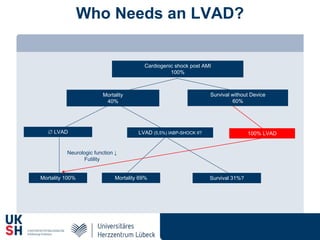
Who Needs an LVAD?
Mortality
40%
Cardiogenic shock post AMI
100%
Survival without Device
60%
 LVAD
Mortality 100%
Neurologic function ↓
Futility
LVAD (5,5%) IABP-SHOCK II?
Survival 31%?Mortality 69%
100% LVAD
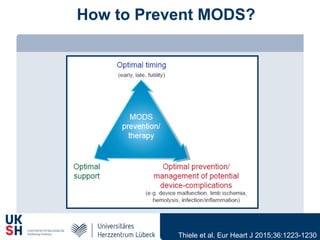
How to Prevent MODS?
Thiele et al. Eur Heart J 2015;36:1223-1230
Cardiogenic Shock - Guidelines
Steg et al. Eur Heart J.2012;33:2569-2619
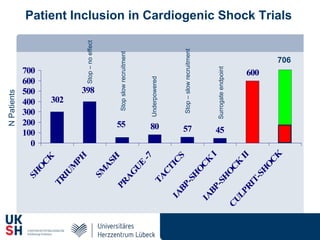
NPatients
Patient Inclusion in Cardiogenic Shock Trials
Stop–noeffect
Stopslowrecruitment
Underpowered
Surrogateendpoint
706
Stop–slowrecruitment
Thank you for your attention
holger.thiele@uksh.de

Percutaneous circulatory support. iabp, impella and beyond

  • 1.
    Percutaneous circulatory support. IABP,Impella and beyond Holger Thiele Medical Clinic II (Cardiology/Angiology/Intensive Care) University Heart Center of Lübeck, Germany
  • 2.
    Disclosures Funding: German Research Foundation GermanHeart Research Foundation German Cardiac Society EU Arbeitsgemeinschaft Leitende Kardiologische Krankenhausärzte Consulting: None Speaker Honoraria: Lilly, Astra Zeneca, Daiichi Sankyo, Boehringer Ingelheim, Maquet Cardiovascular, Medicines Company
  • 3.
    In-hospital Mortality Aissaoui etal. Eur Heart J 2012; 33:2535–2543 USIK 1995, USIC 2000, FAST-MI France National Registry 1995 2000 2005 90 80 70 60 50 40 30 20 10 0 Deathafter30days(%) 8.7 (7.5-10.0) 4.2 (3.4-5.1) 3.6 (3.0-4.4) 51 (44-59) 63 (56-70) 70 (62-77) Shock No Shock
  • 4.
    Trial n/N n/N RelativeRisk 95% CI Relative Risk 95% CI 0 0.5 1 2 3 Randomized Trials in Cardiogenic Shock Follow-up Revascularization (PCI/CABG) SHOCK SMASH Total 81/152 22/32 103/184 100/150 18/23 118/173 1 year 30 days Early revascularization better Medical treatment better 0.75 1.5 2.50.25 Thiele et al. Eur Heart J 2015;36:1223-1230 0.72 (0.54;0.95) 0.87 (0.66;1.29) 0.82 (0.69;0.97)
  • 5.
    „Stunned“ Myocardium Partial stenosisReperfusion Hours Hours 7 Days N=5 Control 0 1 2 3 4 5 0 24 48 72 100 70 50 30 %ofcontrol ** ** ** ** ** **P<0,05 vs. control Matsuzaki et al. Circulation 1983;68:170-178
  • 6.
    IABP History History: 1962 Animaltrials Moulopoulos et al, Am Heart J 1962;63:669-675 1968 1. clinical description in shock Kantrowitz et al, JAMA 1968;203:135-140 1973 Hemodynamic effects, mortality unchanged Scheidt et al, NEJM 1973;288:979-984 > 40 years > 1 Million patients treated, low complication rate, Benchmark registry Ferguson et al, JACC 2001;38:1456-1462
  • 7.
    Guidelines IABP in STEMIcomplicated by cardiogenic shock Class 1B → IIa B ACC/AHA ESC Class IC → IIb B Antman et al. Circulation 2004;110:82-292 O’Gara et al. Circulation. 2013;127:e362-e425 Van de Werf et al. Eur Heart J 2008;29:2909-2945 Steg et al. Eur Heart J.2012;33:2569-2619
  • 8.
    Sjauw et al.Eur Heart J 2009;30:459-468 Mortality IABP vs  IABP - Metaanalysis -1 -0.5 0.5 10 No IABP betterIABP better 30-Day Mortality Risk Difference IABP n/N No IABP n/N Trial -0.18 (-0.20 to -0.16)Total Thrombolysis Stomel Kovack Bengtson Waksman GUSTO-1 SHOCK registry NRMI-2 TT 28/51 10/27 48/99 11/20 30/62 220/439 1068/2180 1415/2878 10/13 13/19 58/101 17/21 146/248 300/417 2346/3501 2890/4320 -0.11 (-0.13 to -0.09)Total 2488/5146 3332/5283 Total 1049/2234 0.06 (0.03 to 0.10) Primary PCI NRMI-2 PCI AMC CS 956/2035 93/199 401/955 26/93 427/1048 -0.29 (-0,47 to -0.12) No reperfusion 24/34 24/34 15/15 15/15 Moloupoulos Total
  • 9.
    0 1 2 3 4 5 6 7 8 9 P=0.43 P=0.12 P=0.06 P=0.32 P=0.32 P=0.37 Baseline 8h 16 h 24 h 32 h 40 h 48 h Serumlactate(mmol/l) P=0.09 Control IABP Serum Lactate Thiele et al. NEJM 2012;367:1287-1296
  • 10.
    Mortality(%) Time after randomization(days) P=0.92; log-rank test Relative risk 0.96; 95% CI 0.79-1.17; P=0.69; Chi2-Test Primary Study Endpoint (30-Day Mortality) Control 41.3% IABP 39.7% 0 10 20 30 40 50 0 5 10 15 20 25 30 Thiele et al. NEJM 2012;367:1287-1296
  • 11.
    Mortality 12-Month Follow-up Control IABP 0% 10% 20% 30% 40% 50% 60% 030 60 90 120 150 180 210 240 270 300 330 360 390 420 Mortality Days after randomization P=0.94; log-rank test Relative risk 1.02; 95% CI 0.88-1.19 12-Month Mortality 49.2% 48.7% 6-Month Mortality 30-day Mortality 41.3% 39.7% 51.8% 51.4% 301 181 171 165 161 159 154 152 149 147 146 144 136 45 21 299 174 166 165 159 154 154 152 147 147 146 144 140 55 29 No. at risk IABP Control Thiele et al. Lancet 2013;382:1638-1645
  • 12.
    Trial n/N n/N RelativeRisk 95% CI Relative Risk 95% CI 0 0.5 1 2 3 Randomized Trials in Cardiogenic Shock Follow-up Revascularization (PCI/CABG) SHOCK SMASH Total 81/152 22/32 103/184 100/150 18/23 118/173 1 year 30 days Early revascularization better Medical treatment better 0.75 1.5 2.50.25 0.72 (0.54;0.95) 0.87 (0.66;1.29) 0.82 (0.69;0.97) 0.75 (0.55;0.93)64/145 50/13528 days Norepinephrine better Dopamine better Vasopressors SOAP-2 (CS subgroup) 0.33 (0.11;0.97)5/16 10/1630 days Levosimendan better Control better Inotropes Unverzagt et al. Gp IIb/IIIa-Inhibitors PRAGUE-7. In-hospital 15/40 13/40 1.15 (0.59;2.27) Up-stream Abciximab better Standard treatment better 30 days 30 days 7/19 6/21 IABP better Standard treatment better 1.28 (0.45;3.72) 0.96 (0.79-1.17) 0.98 (0.81;1.18) 119/30 01 123/298 126/319 129/319 IABP IABP-SHOCK I IABP-SHOCK II Total 30 days 30 days 30 days 97/201 24/59 4/15 125/275 76/180 7/20 10/15 93/215 1.14 (0.91;1.45) 1.16 (0.59;2.69) 0.40 (0.13;1.05) 1.05 (0.85;1.29)NO-synthase inhibition better Placebo better NO-Synthase-Inh. TRIUMPH SHOCK II Cotter et al. Total Thiele et al. Eur Heart J 2015;36:1223-1230
  • 13.
    ESC Revascularization Guidelines2014 IABP in cardiogenic shock ESC Class IC → IIb B → III Windecker et al. Eur Heart J. 2014;35:2541-2619
  • 14.
    LVAD/ECMO or IABP? Bleeding Invasiveness  + - Implantation procedure LVAD Hemodynamic Support  Better LV-unloading Costs
  • 15.
    Currently Available PercutaneousDevices Thiele et al. Eur Heart J 2015;36:1223-1230
  • 16.
    Technical Parameters Currently AvailablePercutaneous Devices Thiele et al. Eur Heart J 2015;36:1223-1230
  • 17.
    LVAD or IABP? Chenget al. Eur Heart J 2009;30:2102-2108 Hemodynamics LVAD MW ± SD IABP MW ± SD Cardiac Index Mean difference P (Heterogeneity) = 0.22 R2=34.0% Thiele et al Burkhoff et al Seyfarth et al Pooled -2 -1 0 1 2 LVAD betterIABP better 0.55 (0.23 – 0.87) 0.16 (-0.14 - 0.46) 0.36 (-0.11 - 0.88) 0.35 (0.09 - 0.61) 2.3±0.6 1.8±0.4 2.2±0.6 2.1±0.2 2.2±0.6 1.8±0.7 LVAD betterIABP better LVAD MW ± SD IABP MW ± SD Mean arterial pressure mean difference P (Heterogeneity) = 0.10 R2=55.9% Thiele et al Burkhoff et al Seyfarth et al Pooled -50 -25 0 25 50 5.5 (-2.9 – 13.9) 18.6 (9.4 – 27.9) 16.0 (0.5 – 31.5) 12.8 (3.6 – 22.0) 76±10 70±16 91±16 72±12 87±16 71±22 16±5 22±7 16±4 25±3 19±5 20±6 LVAD MW ± SD IABP MW ± SD PCWP Mean difference P (Heterogeneity) = 0.01 R2=76.6% Thiele et al Burkhoff et al Seyfarth et al Pooled -20 -10 0 10 20 LVAD betterIABP better -5.6 (-9.2 – 2.1) -8.4 (-11.0 – 5.8) -1.0 (-5.2 – 3.2) -5.3 (-9.4 to -1.2)
  • 18.
    LVAD or IABP- Mortality Individual patient-based meta-analysis 0 5 10 15 20 25 30 0 20 40 60 80 100 Probabilityofsurvival(%) Days after randomization IABP LVAD P=n.s. Thiele et al. Eur Heart J 2010;31:1828–1835
  • 19.
    LVAD oder IABP? Complications Chenget al. Eur Heart J 2009;30:2102-2108 LVAD n/N IABP n/N Limb Ischemia Relative Risk P (heterogeneity)=0.38 R2=0% Thiele et al Burkhoff et al Seyfarth et al Pooled 0.0001 0.01 1 100 10000 IABP betterLVAD better 14.32 (0.87 – 235.4) 1.47 (0.31 – 6.95) 3.00 (0.13 – 67.51) 2.59 (0.75 – 8.97) 7/21 0/20 4/19 2/14 1/13 0/13 12/53 2/47 LVAD n/N IABP n/N Bleeding Relative Risk P (heterogeneity)=0.73 R2=0% Thiele et al Burkhoff et al Pooled 0.01 0.1 1 10 100 IABP betterLVAD better 2.26 (1.30 – 3.94) 2.95 (0.74 – 11.80) 2.35 (1.40 – 3.93) 19/21 8/20 8/19 2/14 27/40 10/34 LVAD n/N IABP n/N Fever or Sepsis Relative Risk P (heterogeneity)=0.10 R2=62.1% Thiele et al Burkhoff et al Pooled 0.01 0.1 1 10 100 IABP betterLVAD better 1.62 (1.00 – 2.63) 0.59 (0.19 – 1.80) 1.11 (0.43 – 2.90) 17/21 10/20 4/19 5/14 21/40 15/34
  • 20.
    Trial n/N n/N RelativeRisk 95% CI Relative Risk 95% CI 0 0.5 1 2 3 Randomized Trials in Cardiogenic Shock Follow-up Revascularization (PCI/CABG) SHOCK SMASH Total 81/152 22/32 103/184 100/150 18/23 118/173 1 year 30 days Early revascularization better Medical treatment better 0.75 1.5 2.50.25 0.72 (0.54;0.95) 0.87 (0.66;1.29) 0.82 (0.69;0.97) 0.75 (0.55;0.93)64/145 50/13528 days Norepinephrine better Dopamine better Vasopressors SOAP-2 (CS subgroup) 0.33 (0.11;0.97)5/16 10/1630 days Levosimendan better Control better Inotropes Unverzagt et al. Gp IIb/IIIa-Inhibitors PRAGUE-7. In-hospital 15/40 13/40 1.15 (0.59;2.27) Up-stream Abciximab better Standard treatment better 30 days 30 days 7/19 6/21 IABP better Standard treatment better 1.28 (0.45;3.72) 0.96 (0.79-1.17) 0.98 (0.81;1.18) 119/30 01 123/298 126/319 129/319 IABP IABP-SHOCK I IABP-SHOCK II Total 30 days 30 days 30 days 97/201 24/59 4/15 125/275 76/180 7/20 10/15 93/215 1.14 (0.91;1.45) 1.16 (0.59;2.69) 0.40 (0.13;1.05) 1.05 (0.85;1.29)NO-synthase inhibition better Placebo better NO-Synthase-Inh. TRIUMPH SHOCK II Cotter et al. Total 30 days 30 days 30 days 9/21 9/19 6/13 24/53 9/20 5/14 6/13 20/47 0.95 (0.48;1.90) 1.33 (0.57-3.10) 1.00 (0.44-2.29) 1.06 (0.68-1.66) IABP better LVAD Thiele et al. Burkhoff et al. Seyfarth et al. Total LVAD better Thiele et al. Eur Heart J 2015;36:1223-1230
  • 21.
    Sheu et al.Crit Care Med 2010;38:1810-1817 ECMO - Evidence Historical control without ECMO; 1993 – 2002 versus ECMO; 2002 – 2009 retrospective analysis Log-rank p=0.003 0 10 20 30 (Days) 100 80 60 40 20 0 Follow-up At risk (n) ECMO 46 32 31 28 No ECMO 25 7 7 7 Totalsurvival(%) With ECMO No ECMO
  • 22.
    Time after ECMO-Implantation(years) Totalsurvival(%) 0 1 2 3 4 100 80 60 40 20 0 No. at risk 87 27 18 10 5 Beurtheret et al. Eur Heart J 2013;34:112-120 ECMO for Transfer from Non-tertiary Centers Mortality in patients > 62 years: 100% Mortalität in patients with resuscitation: 100%
  • 23.
    Impella in ClinicalPractice EUROSHOCK Registry; N=120 patients with cardiogenic shock complicating AMI Lauten et al. Circ Heart Fail 2013;6:23-30
  • 24.
    Recent Registry Data NationalTrends USA 2004-2011 Stretch et al. JACC 2014;64:1407-1415
  • 25.
    Guidelines and PercutaneousLVAD Revascularization guidelines and STEMI-guidelines Steg et al. Eur Heart J. 2012;33:2569-2619 I IIa IIb III C LVAD may considered for circulatory support in refractory cardiogenic shock I IIa IIb III B Routine use Windecker et al. Eur Heart J. 2014;31:2501-2555
  • 26.
    •Lactate > 2.5mmol/l •Hemodynamics SBP < 100 mmHg or Vasopressors • LV-EF < 35% Standard treatment Vasopressors Inotropics Mechanical ventilation +/- IABP pre PCI+/- IABP pre PCI (n=180)(n=180) Acute MI (STEMI < 36 h) Shock PCI (CABG) Inclusion criteria Randomization Standard treatment Vasopressors Inotropics Mechanical ventilation + Impella CP pre PCI (n=180) DanShock Trial Primary Endpoint: Total Mortality
  • 27.
    Treatment Algorithm CardiogenicShock No stabilization Short-term percutaneous mechanical support (IIb/C) Revascularization (IB) Inotropes/Vasopressors (IIa/C + IIb/B) Fluids Ventilation Weaning Stabilization Assessment neurology + endorgan function Age, comorbidities? Cardiogenic shock complicating infarction Invasive Angiography (IB) Echocardiography (IC) or Levocardiography Myocardial dysfunction Recovery cardiac function Mechanical complication No recovery cardiac function Weaning Severe neurological deficit Normal neurological function Weaning Long-term surgical mechanical support Bridge-to recovery Bridge-to transplant Destination therapy Ventricular septal defect Free wall ruptureMitral regurgitation Mitral repair/ replacement (IC) Surgical closure (IC) Surgical (IC)/Inter-ventional closure (IIb/C) IABP (IIa/C) Revascularization (IB) Inotropes/Vasopressors (IIa/C + IIb/B) Fluids Ventilation Thiele et al. Eur Heart J 2015;36:1223-1230
  • 28.
    Who Needs anLVAD? Mortality 40% Cardiogenic shock post AMI 100% Survival without Device 60%  LVAD Mortality 100% Neurologic function ↓ Futility LVAD (5,5%) IABP-SHOCK II? Survival 31%?Mortality 69% 100% LVAD
  • 29.
    How to PreventMODS? Thiele et al. Eur Heart J 2015;36:1223-1230
  • 30.
    Cardiogenic Shock -Guidelines Steg et al. Eur Heart J.2012;33:2569-2619
  • 31.
    NPatients Patient Inclusion inCardiogenic Shock Trials Stop–noeffect Stopslowrecruitment Underpowered Surrogateendpoint 706 Stop–slowrecruitment
  • 32.
    Thank you foryour attention holger.thiele@uksh.de