Perinatal infections
Done by Dr. Marwan Adnan Zuaiter
Perinatal infections
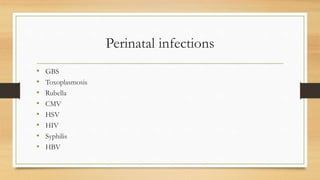
• GBS
• Toxoplasmosis
• Rubella
• CMV
• HSV
• HIV
• Syphilis
• HBV
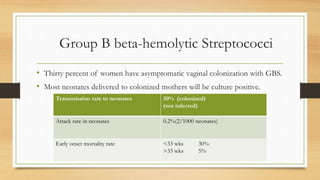
Group B beta-hemolytic Streptococci
• Thirty percent of women have asymptomatic vaginal colonization with GBS.
• Most neonates delivered to colonized mothers will be culture positive.
Transmission rate to neonates 50% (colonized)
(not infected)
Attack rate in neonates 0.2%(2/1000 neonates)
Early onset mortality rate <33 wks 30%
>33 wks 5%
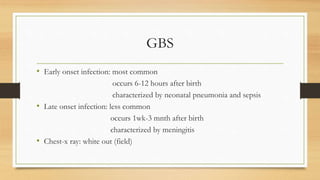
GBS
• Early onset infection: most common
occurs 6-12 hours after birth
characterized by neonatal pneumonia and sepsis
• Late onset infection: less common
occurs 1wk-3 mnth after birth
characterized by meningitis
• Chest-x ray: white out (field)
GBS
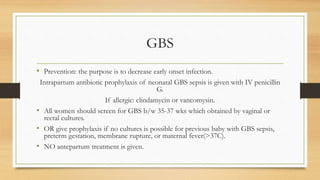
• Prevention: the purpose is to decrease early onset infection.
Intrapartum antibiotic prophylaxis of neonatal GBS sepsis is given with IV penicillin
G.
If allergic: clindamycin or vancomysin.
• All women should screen for GBS b/w 35-37 wks which obtained by vaginal or
rectal cultures.
• OR give prophylaxis if no cultures is possible for previous baby with GBS sepsis,
preterm gestation, membrane rupture, or maternal fever(>37C).
• NO antepartum treatment is given.
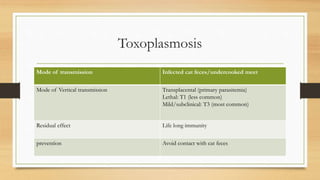
Toxoplasmosis
Mode of transmission Infected cat feces/undercooked meet
Mode of Vertical transmission Transplacental (primary parasitemia)
Lethal: T1 (less common)
Mild/subclinical: T3 (most common)
Residual effect Life long immunity
prevention Avoid contact with cat feces
Toxoplasmosis
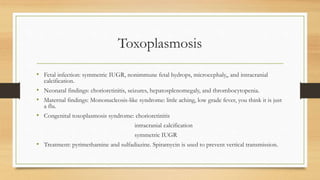
• Fetal infection: symmetric IUGR, nonimmune fetal hydrops, microcephaly,, and intracranial
calcification.
• Neonatal findings: chorioretinitis, seizures, hepatosplenomegaly, and thrombocytopenia.
• Maternal findings: Mononucleosis-like syndrome: little aching, low grade fever, you think it is just
a flu.
• Congenital toxoplasmosis syndrome: chorioretinitis
intracranial calcification
symmetric IUGR
• Treatment: pyrimethamine and sulfadiazine. Spiramycin is used to prevent vertical transmission.
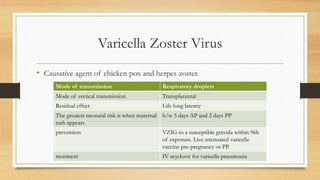
Varicella Zoster Virus
• Causative agent of chicken pox and herpes zoster.
Mode of transmission Respiratory droplets
Mode of vertical transmission Transplacental
Residual effect Life long latency
The greatest neonatal risk is when maternal
rash appears
b/w 5 days AP and 2 days PP
prevention VZIG to a susceptible gravida within 96h
of exposure. Live attenuated varicella
vaccine pre-pregnancy or PP.
treatment IV acyclovir for varicella pneumonia
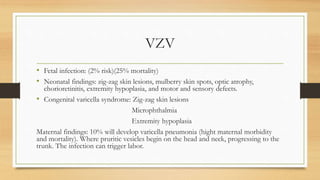
VZV
• Fetal infection: (2% risk)(25% mortality)
• Neonatal findings: zig-zag skin lesions, mulberry skin spots, optic atrophy,
chorioretinitis, extremity hypoplasia, and motor and sensory defects.
• Congenital varicella syndrome: Zig-zag skin lesions
Microphthalmia
Extremity hypoplasia
Maternal findings: 10% will develop varicella pneumonia (hight maternal morbidity
and mortality). Where pruritic vesicles begin on the head and neck, progressing to the
trunk. The infection can trigger labor.
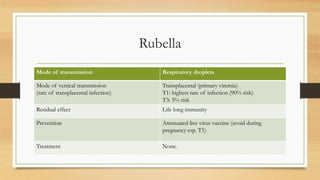
Rubella
Mode of transmission Respiratory droplets
Mode of vertical transmission
(rate of transplacental infection)
Transplacental (primary viremia)
T1: highest rate of infection (90% risk)
T3: 5% risk
Residual effect Life long immunity
Prevention Attenuated live virus vaccine (avoid during
pregnancy esp. T1)
Treatment None.
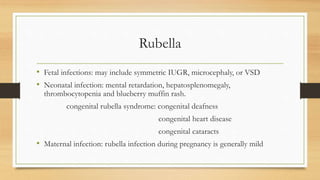
Rubella
• Fetal infections: may include symmetric IUGR, microcephaly, or VSD
• Neonatal infection: mental retardation, hepatosplenomegaly,
thrombocytopenia and blueberry muffin rash.
congenital rubella syndrome: congenital deafness
congenital heart disease
congenital cataracts
• Maternal infection: rubella infection during pregnancy is generally mild
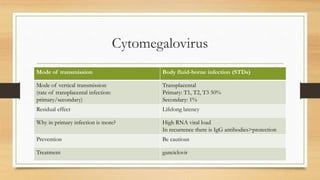
Cytomegalovirus
Mode of transmission Body fluid-borne infection (STDs)
Mode of vertical transmission
(rate of transplacental infection:
primary/secondary)
Transplacental
Primary: T1, T2, T3 50%
Secondary: 1%
Residual effect Lifelong latency
Why in primary infection is more? High RNA viral load
In recurrence there is IgG antibodies>protection
Prevention Be cautious
Treatment ganciclovir
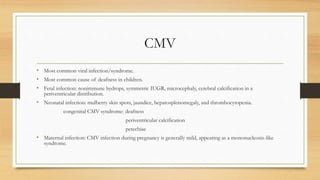
CMV
• Most common viral infection/syndrome.
• Most common cause of deafness in children.
• Fetal infection: nonimmune hydrops, symmetric IUGR, microcephaly, cerebral calcification in a
periventricular distribution.
• Neonatal infection: mulberry skin spots, jaundice, hepatosplenomegaly, and thrombocytopenia.
congenital CMV syndrome: deafness
periventricular calcification
petechiae
• Maternal infection: CMV infection during pregnancy is generally mild, appearing as a mononucleosis-like
syndrome.
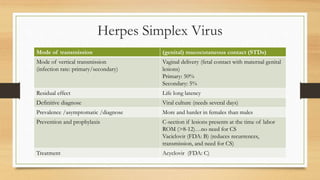
Herpes Simplex Virus
Mode of transmission (genital) mucocutaneous contact (STDs)
Mode of vertical transmission
(infection rate: primary/secondary)
Vaginal delivery (fetal contact with maternal genital
lesions)
Primary: 50%
Secondary: 5%
Residual effect Life long latency
Definitive diagnose Viral culture (needs several days)
Prevalence /asymptomatic /diagnose More and harder in females than males
Prevention and prophylaxis C-section if lesions presents at the time of labor
ROM (>8-12)…no need for CS
Vaciclovir (FDA: B) (reduces recurrences,
transmission, and need for CS)
Treatment Acyclovir (FDA: C)
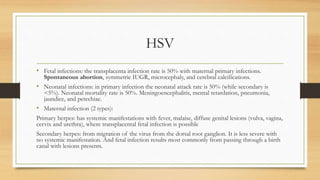
HSV
• Fetal infections: the transplacenta infection rate is 50% with maternal primary infections.
Spontaneous abortion, symmetric IUGR, microcephaly, and cerebral calcifications.
• Neonatal infections: in primary infection the neonatal attack rate is 50% (while secondary is
<5%). Neonatal mortality rate is 50%. Meningoencephalitis, mental retardation, pneumonia,
jaundice, and petechiae.
• Maternal infection (2 types):
Primary herpes: has systemic manifestations with fever, malaise, diffuse genital lesions (vulva, vagina,
cervix and urethra), where transplacental fetal infection is possible
Secondary herpes: from migration of the virus from the dorsal root ganglion. It is less severe with
no systemic manifestation. And fetal infection results most commonly from passing through a birth
canal with lesions presents.
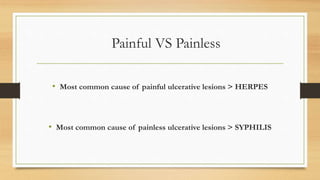
Painful VS Painless
• Most common cause of painful ulcerative lesions > HERPES
• Most common cause of painless ulcerative lesions > SYPHILIS
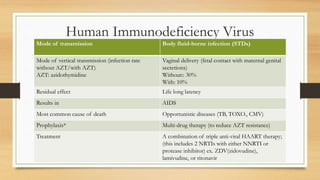
Human Immunodeficiency Virus
Mode of transmission Body fluid-borne infection (STDs)
Mode of vertical transmission (infection rate
without AZT/with AZT)
AZT: azidothymidine
Vaginal delivery (fetal contact with maternal genital
secretions)
Without:: 30%
With: 10%
Residual effect Life long latency
Results in AIDS
Most common cause of death Opportunistic diseases (TB, TOXO., CMV)
Prophylaxis* Multi-drug therapy (to reduce AZT resistance)
Treatment A combination of triple anti-viral HAART therapy;
(this includes 2 NRTIs with either NNRTI or
protease inhibitor) ex. ZDV(zidovudine),
lamivudine, or ritonavir
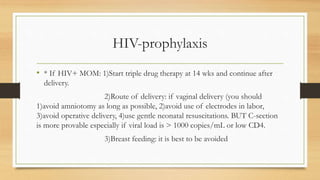
HIV-prophylaxis
• * If HIV+ MOM: 1)Start triple drug therapy at 14 wks and continue after
delivery.
2)Route of delivery: if vaginal delivery (you should
1)avoid amniotomy as long as possible, 2)avoid use of electrodes in labor,
3)avoid operative delivery, 4)use gentle neonatal resuscitations. BUT C-section
is more provable especially if viral load is > 1000 copies/mL or low CD4.
3)Breast feeding: it is best to be avoided
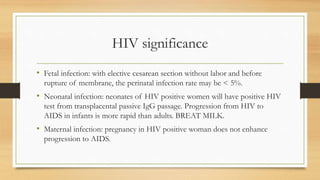
HIV significance
• Fetal infection: with elective cesarean section without labor and before
rupture of membrane, the perinatal infection rate may be < 5%.
• Neonatal infection: neonates of HIV positive women will have positive HIV
test from transplacental passive IgG passage. Progression from HIV to
AIDS in infants is more rapid than adults. BREAT MILK.
• Maternal infection: pregnancy in HIV positive woman does not enhance
progression to AIDS.
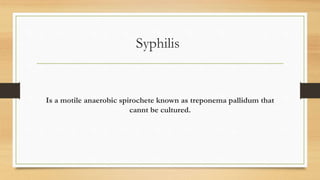
Syphilis
Is a motile anaerobic spirochete known as treponema pallidum that
cannt be cultured.
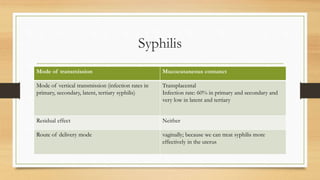
Syphilis
Mode of transmission Mucocutaneous contanct
Mode of vertical transmission (infection rates in
primary, secondary, latent, tertiary syphilis)
Transplacental
Infection rate: 60% in primary and secondary and
very low in latent and tertiary
Residual effect Neither
Route of delivery mode vaginally; because we can treat syphilis more
effectively in the uterus
Syphilis
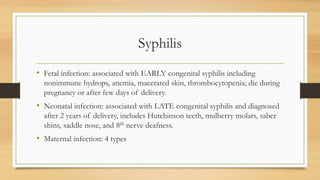
• Fetal infection: associated with EARLY congenital syphilis including
nonimmune hydrops, anemia, macerated skin, thrombocytopenia; die during
pregnancy or after few days of delivery.
• Neonatal infection: associated with LATE congenital syphilis and diagnosed
after 2 years of delivery, includes Hutchinson teeth, mulberry molars, saber
shins, saddle nose, and 8th nerve deafness.
• Maternal infection: 4 types
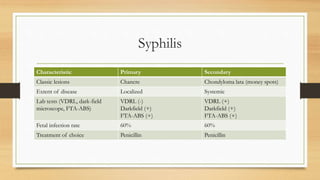
Syphilis
Characteristic Primary Secondary
Classic lesions Chancre Chondyloma lata (money spots)
Extent of disease Localized Systemic
Lab tests (VDRL, dark-field
microscope, FTA-ABS)
VDRL (-)
Darkfield (+)
FTA-ABS (+)
VDRL (+)
Darkfield (+)
FTA-ABS (+)
Fetal infection rate 60% 60%
Treatment of choice Penicillin Penicillin
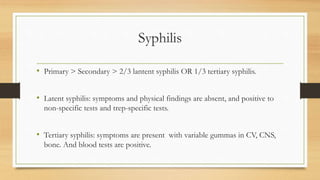
Syphilis
• Primary > Secondary > 2/3 lantent syphilis OR 1/3 tertiary syphilis.
• Latent syphilis: symptoms and physical findings are absent, and positive to
non-specific tests and trep-specific tests.
• Tertiary syphilis: symptoms are present with variable gummas in CV, CNS,
bone. And blood tests are positive.
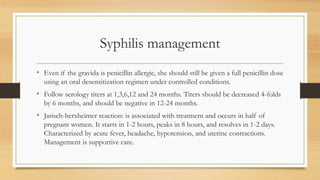
Syphilis management
• Even if the gravida is penicillin allergic, she should still be given a full penicillin dose
using an oral desensitization regimen under controlled conditions.
• Follow serology titers at 1,3,6,12 and 24 months. Titers should be decreased 4-folds
by 6 months, and should be negative in 12-24 months.
• Jarisch-herxheimer reaction: is associated with treatment and occurs in half of
pregnant women. It starts in 1-2 hours, peaks in 8 hours, and resolves in 1-2 days.
Characterized by acute fever, headache, hypotension, and uterine contractions.
Management is supportive care.
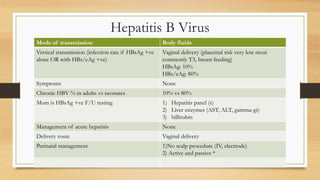
Hepatitis B Virus
Mode of transmission Body fluids
Vertical transmission (infection rate if HBsAg +ve
alone OR with HBs/eAg +ve)
Vaginal delivery (placental risk very low most
commonly T3, breast feeding)
HBsAg: 10%
HBs/eAg: 80%
Symptoms None
Chronic HBV % in adults vs neonates 10% vs 80%
Mom is HBsAg +ve F/U testing 1) Hepatitis panel (s)
2) Liver enzymes (AST, ALT, gamma-gt)
3) billirubin
Management of acute hepatitis None
Delivery route Vaginal delivery
Perinatal management 1)No scalp procedure (IV, electrode)
2) Active and passive *
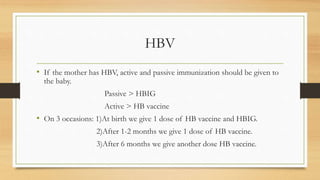
HBV
• If the mother has HBV, active and passive immunization should be given to
the baby.
Passive > HBIG
Active > HB vaccine
• On 3 occasions: 1)At birth we give 1 dose of HB vaccine and HBIG.
2)After 1-2 months we give 1 dose of HB vaccine.
3)After 6 months we give another dose HB vaccine.
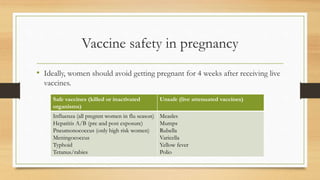
Vaccine safety in pregnancy
• Ideally, women should avoid getting pregnant for 4 weeks after receiving live
vaccines.
Safe vaccines (killed or inactivated
organisms)
Unsafe (live attenuated vaccines)
Influenza (all pregnnt women in flu season)
Hepatitis A/B (pre and post exposure)
Pneumonococcus (only high risk women)
Meningococcus
Typhoid
Tetanus/rabies
Measles
Mumps
Rubella
Varicella
Yellow fever
Polio
Urinary Tract Infections
• Lower urinary tract infection: bladder and urethra
• Upper urinary tract infection: kidney
• The most common organisms are gram negative enteric bacteria with E. coli
the most frequent (80%).
• Risk factors: the gravid uterus compresses the lower ureter and reduces the
urethral tone this causes urinary stasis and increase vesicourethral reflux.
Hydonephrosis (R>L).
UTI
• Asymptomatic bacteriuria
• Acute cystitis
• Acute Pyelonephritis
Asymptomatic bacteriuria
• Most common
• Lacalized
• No symptoms or signs; no urgency, frequency, burning, or fever (urine
culture and analysis (+))
• 30% of cases will develop pyelonephritis if not treated
• Outpatient oral antibiotic (nitrofurantoin)
• African-American with sickle cell trait have highest incidence
Acute cystitis
• Localized without systemic findings
• Urgency, frequency, and burning are common but without fever. (urine
culture and analysis (+))
• 30% of cases will develop pyelonephritis if not treated
• Outpatient oral antibiotic (nitrofurantoin)
Acute Pyelonephritis
• The most common serious medical complications of pregnancy
• Involving the upper urinary tract with SYSTEMIC findings
• Unilateral, right sided >50% of cases
• E. coli cultured 80% of cases
• Bacteremia in 20% of women with pyeloniphritis
Acute Pyelonephritis
• Signs and symptoms: urgency, frequency, burning, plank pain, fever, and CVAT.
• Complications: preterm labor, renal dysfunction, pulmonary edema (endotoxin),
ARDS, hemolysis.
• DD: preterm labor, chorioamnionitis, appendicitis, placental abruption, or infarcted
myoma.
• Management: hospitalization with IV antibiotic (cephalosporin) and IV hydration
for adequate urinary output.
• If persistent pyelonephritis think of NEPHROLITHIASIS.
•Thank you ^_^

Perinatal infections

  • 1.
    Perinatal infections Done byDr. Marwan Adnan Zuaiter
  • 2.
    Perinatal infections • GBS •Toxoplasmosis • Rubella • CMV • HSV • HIV • Syphilis • HBV
  • 3.
    Group B beta-hemolyticStreptococci • Thirty percent of women have asymptomatic vaginal colonization with GBS. • Most neonates delivered to colonized mothers will be culture positive. Transmission rate to neonates 50% (colonized) (not infected) Attack rate in neonates 0.2%(2/1000 neonates) Early onset mortality rate <33 wks 30% >33 wks 5%
  • 4.
    GBS • Early onsetinfection: most common occurs 6-12 hours after birth characterized by neonatal pneumonia and sepsis • Late onset infection: less common occurs 1wk-3 mnth after birth characterized by meningitis • Chest-x ray: white out (field)
  • 5.
    GBS • Prevention: thepurpose is to decrease early onset infection. Intrapartum antibiotic prophylaxis of neonatal GBS sepsis is given with IV penicillin G. If allergic: clindamycin or vancomysin. • All women should screen for GBS b/w 35-37 wks which obtained by vaginal or rectal cultures. • OR give prophylaxis if no cultures is possible for previous baby with GBS sepsis, preterm gestation, membrane rupture, or maternal fever(>37C). • NO antepartum treatment is given.
  • 6.
    Toxoplasmosis Mode of transmissionInfected cat feces/undercooked meet Mode of Vertical transmission Transplacental (primary parasitemia) Lethal: T1 (less common) Mild/subclinical: T3 (most common) Residual effect Life long immunity prevention Avoid contact with cat feces
  • 7.
    Toxoplasmosis • Fetal infection:symmetric IUGR, nonimmune fetal hydrops, microcephaly,, and intracranial calcification. • Neonatal findings: chorioretinitis, seizures, hepatosplenomegaly, and thrombocytopenia. • Maternal findings: Mononucleosis-like syndrome: little aching, low grade fever, you think it is just a flu. • Congenital toxoplasmosis syndrome: chorioretinitis intracranial calcification symmetric IUGR • Treatment: pyrimethamine and sulfadiazine. Spiramycin is used to prevent vertical transmission.
  • 8.
    Varicella Zoster Virus •Causative agent of chicken pox and herpes zoster. Mode of transmission Respiratory droplets Mode of vertical transmission Transplacental Residual effect Life long latency The greatest neonatal risk is when maternal rash appears b/w 5 days AP and 2 days PP prevention VZIG to a susceptible gravida within 96h of exposure. Live attenuated varicella vaccine pre-pregnancy or PP. treatment IV acyclovir for varicella pneumonia
  • 9.
    VZV • Fetal infection:(2% risk)(25% mortality) • Neonatal findings: zig-zag skin lesions, mulberry skin spots, optic atrophy, chorioretinitis, extremity hypoplasia, and motor and sensory defects. • Congenital varicella syndrome: Zig-zag skin lesions Microphthalmia Extremity hypoplasia Maternal findings: 10% will develop varicella pneumonia (hight maternal morbidity and mortality). Where pruritic vesicles begin on the head and neck, progressing to the trunk. The infection can trigger labor.
  • 10.
    Rubella Mode of transmissionRespiratory droplets Mode of vertical transmission (rate of transplacental infection) Transplacental (primary viremia) T1: highest rate of infection (90% risk) T3: 5% risk Residual effect Life long immunity Prevention Attenuated live virus vaccine (avoid during pregnancy esp. T1) Treatment None.
  • 11.
    Rubella • Fetal infections:may include symmetric IUGR, microcephaly, or VSD • Neonatal infection: mental retardation, hepatosplenomegaly, thrombocytopenia and blueberry muffin rash. congenital rubella syndrome: congenital deafness congenital heart disease congenital cataracts • Maternal infection: rubella infection during pregnancy is generally mild
  • 12.
    Cytomegalovirus Mode of transmissionBody fluid-borne infection (STDs) Mode of vertical transmission (rate of transplacental infection: primary/secondary) Transplacental Primary: T1, T2, T3 50% Secondary: 1% Residual effect Lifelong latency Why in primary infection is more? High RNA viral load In recurrence there is IgG antibodies>protection Prevention Be cautious Treatment ganciclovir
  • 13.
    CMV • Most commonviral infection/syndrome. • Most common cause of deafness in children. • Fetal infection: nonimmune hydrops, symmetric IUGR, microcephaly, cerebral calcification in a periventricular distribution. • Neonatal infection: mulberry skin spots, jaundice, hepatosplenomegaly, and thrombocytopenia. congenital CMV syndrome: deafness periventricular calcification petechiae • Maternal infection: CMV infection during pregnancy is generally mild, appearing as a mononucleosis-like syndrome.
  • 14.
    Herpes Simplex Virus Modeof transmission (genital) mucocutaneous contact (STDs) Mode of vertical transmission (infection rate: primary/secondary) Vaginal delivery (fetal contact with maternal genital lesions) Primary: 50% Secondary: 5% Residual effect Life long latency Definitive diagnose Viral culture (needs several days) Prevalence /asymptomatic /diagnose More and harder in females than males Prevention and prophylaxis C-section if lesions presents at the time of labor ROM (>8-12)…no need for CS Vaciclovir (FDA: B) (reduces recurrences, transmission, and need for CS) Treatment Acyclovir (FDA: C)
  • 15.
    HSV • Fetal infections:the transplacenta infection rate is 50% with maternal primary infections. Spontaneous abortion, symmetric IUGR, microcephaly, and cerebral calcifications. • Neonatal infections: in primary infection the neonatal attack rate is 50% (while secondary is <5%). Neonatal mortality rate is 50%. Meningoencephalitis, mental retardation, pneumonia, jaundice, and petechiae. • Maternal infection (2 types): Primary herpes: has systemic manifestations with fever, malaise, diffuse genital lesions (vulva, vagina, cervix and urethra), where transplacental fetal infection is possible Secondary herpes: from migration of the virus from the dorsal root ganglion. It is less severe with no systemic manifestation. And fetal infection results most commonly from passing through a birth canal with lesions presents.
  • 16.
    Painful VS Painless •Most common cause of painful ulcerative lesions > HERPES • Most common cause of painless ulcerative lesions > SYPHILIS
  • 17.
    Human Immunodeficiency Virus Modeof transmission Body fluid-borne infection (STDs) Mode of vertical transmission (infection rate without AZT/with AZT) AZT: azidothymidine Vaginal delivery (fetal contact with maternal genital secretions) Without:: 30% With: 10% Residual effect Life long latency Results in AIDS Most common cause of death Opportunistic diseases (TB, TOXO., CMV) Prophylaxis* Multi-drug therapy (to reduce AZT resistance) Treatment A combination of triple anti-viral HAART therapy; (this includes 2 NRTIs with either NNRTI or protease inhibitor) ex. ZDV(zidovudine), lamivudine, or ritonavir
  • 18.
    HIV-prophylaxis • * IfHIV+ MOM: 1)Start triple drug therapy at 14 wks and continue after delivery. 2)Route of delivery: if vaginal delivery (you should 1)avoid amniotomy as long as possible, 2)avoid use of electrodes in labor, 3)avoid operative delivery, 4)use gentle neonatal resuscitations. BUT C-section is more provable especially if viral load is > 1000 copies/mL or low CD4. 3)Breast feeding: it is best to be avoided
  • 19.
    HIV significance • Fetalinfection: with elective cesarean section without labor and before rupture of membrane, the perinatal infection rate may be < 5%. • Neonatal infection: neonates of HIV positive women will have positive HIV test from transplacental passive IgG passage. Progression from HIV to AIDS in infants is more rapid than adults. BREAT MILK. • Maternal infection: pregnancy in HIV positive woman does not enhance progression to AIDS.
  • 20.
    Syphilis Is a motileanaerobic spirochete known as treponema pallidum that cannt be cultured.
  • 21.
    Syphilis Mode of transmissionMucocutaneous contanct Mode of vertical transmission (infection rates in primary, secondary, latent, tertiary syphilis) Transplacental Infection rate: 60% in primary and secondary and very low in latent and tertiary Residual effect Neither Route of delivery mode vaginally; because we can treat syphilis more effectively in the uterus
  • 22.
    Syphilis • Fetal infection:associated with EARLY congenital syphilis including nonimmune hydrops, anemia, macerated skin, thrombocytopenia; die during pregnancy or after few days of delivery. • Neonatal infection: associated with LATE congenital syphilis and diagnosed after 2 years of delivery, includes Hutchinson teeth, mulberry molars, saber shins, saddle nose, and 8th nerve deafness. • Maternal infection: 4 types
  • 23.
    Syphilis Characteristic Primary Secondary Classiclesions Chancre Chondyloma lata (money spots) Extent of disease Localized Systemic Lab tests (VDRL, dark-field microscope, FTA-ABS) VDRL (-) Darkfield (+) FTA-ABS (+) VDRL (+) Darkfield (+) FTA-ABS (+) Fetal infection rate 60% 60% Treatment of choice Penicillin Penicillin
  • 24.
    Syphilis • Primary >Secondary > 2/3 lantent syphilis OR 1/3 tertiary syphilis. • Latent syphilis: symptoms and physical findings are absent, and positive to non-specific tests and trep-specific tests. • Tertiary syphilis: symptoms are present with variable gummas in CV, CNS, bone. And blood tests are positive.
  • 25.
    Syphilis management • Evenif the gravida is penicillin allergic, she should still be given a full penicillin dose using an oral desensitization regimen under controlled conditions. • Follow serology titers at 1,3,6,12 and 24 months. Titers should be decreased 4-folds by 6 months, and should be negative in 12-24 months. • Jarisch-herxheimer reaction: is associated with treatment and occurs in half of pregnant women. It starts in 1-2 hours, peaks in 8 hours, and resolves in 1-2 days. Characterized by acute fever, headache, hypotension, and uterine contractions. Management is supportive care.
  • 26.
    Hepatitis B Virus Modeof transmission Body fluids Vertical transmission (infection rate if HBsAg +ve alone OR with HBs/eAg +ve) Vaginal delivery (placental risk very low most commonly T3, breast feeding) HBsAg: 10% HBs/eAg: 80% Symptoms None Chronic HBV % in adults vs neonates 10% vs 80% Mom is HBsAg +ve F/U testing 1) Hepatitis panel (s) 2) Liver enzymes (AST, ALT, gamma-gt) 3) billirubin Management of acute hepatitis None Delivery route Vaginal delivery Perinatal management 1)No scalp procedure (IV, electrode) 2) Active and passive *
  • 27.
    HBV • If themother has HBV, active and passive immunization should be given to the baby. Passive > HBIG Active > HB vaccine • On 3 occasions: 1)At birth we give 1 dose of HB vaccine and HBIG. 2)After 1-2 months we give 1 dose of HB vaccine. 3)After 6 months we give another dose HB vaccine.
  • 28.
    Vaccine safety inpregnancy • Ideally, women should avoid getting pregnant for 4 weeks after receiving live vaccines. Safe vaccines (killed or inactivated organisms) Unsafe (live attenuated vaccines) Influenza (all pregnnt women in flu season) Hepatitis A/B (pre and post exposure) Pneumonococcus (only high risk women) Meningococcus Typhoid Tetanus/rabies Measles Mumps Rubella Varicella Yellow fever Polio
  • 29.
    Urinary Tract Infections •Lower urinary tract infection: bladder and urethra • Upper urinary tract infection: kidney • The most common organisms are gram negative enteric bacteria with E. coli the most frequent (80%). • Risk factors: the gravid uterus compresses the lower ureter and reduces the urethral tone this causes urinary stasis and increase vesicourethral reflux. Hydonephrosis (R>L).
  • 30.
    UTI • Asymptomatic bacteriuria •Acute cystitis • Acute Pyelonephritis
  • 31.
    Asymptomatic bacteriuria • Mostcommon • Lacalized • No symptoms or signs; no urgency, frequency, burning, or fever (urine culture and analysis (+)) • 30% of cases will develop pyelonephritis if not treated • Outpatient oral antibiotic (nitrofurantoin) • African-American with sickle cell trait have highest incidence
  • 32.
    Acute cystitis • Localizedwithout systemic findings • Urgency, frequency, and burning are common but without fever. (urine culture and analysis (+)) • 30% of cases will develop pyelonephritis if not treated • Outpatient oral antibiotic (nitrofurantoin)
  • 33.
    Acute Pyelonephritis • Themost common serious medical complications of pregnancy • Involving the upper urinary tract with SYSTEMIC findings • Unilateral, right sided >50% of cases • E. coli cultured 80% of cases • Bacteremia in 20% of women with pyeloniphritis
  • 34.
    Acute Pyelonephritis • Signsand symptoms: urgency, frequency, burning, plank pain, fever, and CVAT. • Complications: preterm labor, renal dysfunction, pulmonary edema (endotoxin), ARDS, hemolysis. • DD: preterm labor, chorioamnionitis, appendicitis, placental abruption, or infarcted myoma. • Management: hospitalization with IV antibiotic (cephalosporin) and IV hydration for adequate urinary output. • If persistent pyelonephritis think of NEPHROLITHIASIS.
  • 35.