NURUL SHAMEEN BT ABDUL RASHIDA’QILAH BT BAHARUDINWAN AHMAD SYAZANI B MOHAMED FEVER WITH RASH
WHAT IS THAT?FEVER- temporary ↑ in the body’s temperature in response to some disease or illness (37.5°C)RASH- temporary eruption of the skin- discrete red spots / generalized reddening- accompanied by itching
In HISTORY TAKING :Exposures	- Ill contacts (home, day care…)	- Travelling history	-Pets, insects	- Medications and drugs	- ImmunizationFeatures of rash	- Temporal association (onset relative to fever)	- Progression and evolution	- Location and distribution	- Pain or pruritus
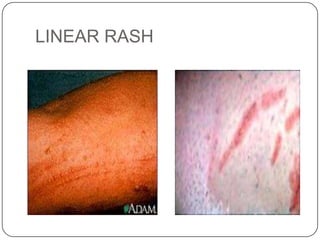
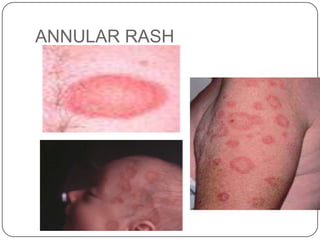
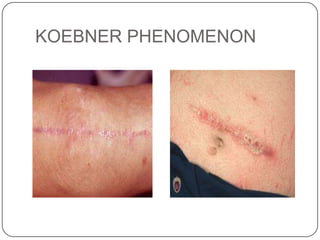
In PHYSICAL EXAMINATION :Distribution pattern- symmetrical eruption- asymmetrical rashesMorphology- monomorphic- pleomorphicConfiguration- linear, annular, grouped, - Koebner phenomenon (eruption in an area   of local trauma)
LINEAR RASH
ANNULAR RASH
KOEBNER PHENOMENON
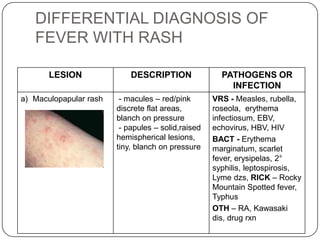
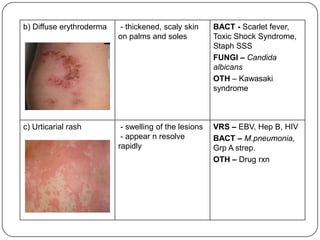
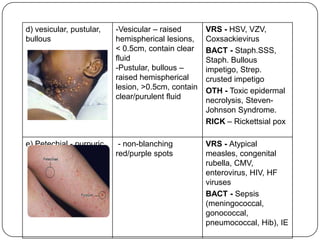
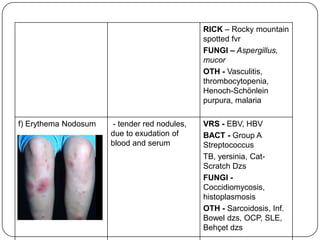
DIFFERENTIAL DIAGNOSIS OF FEVER WITH RASH
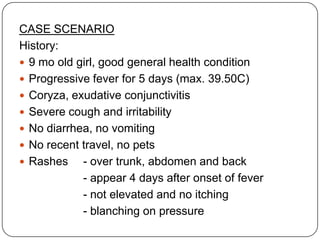
CASE SCENARIOHistory:9 mo old girl, good general health conditionProgressive fever for 5 days (max. 39.50C)Coryza, exudative conjunctivitisSevere cough and irritabilityNo diarrhea, no vomitingNo recent travel, no petsRashes	- over trunk, abdomen and back			- appear 4 days after onset of fever		   	- not elevated and no itching			- blanching on pressure
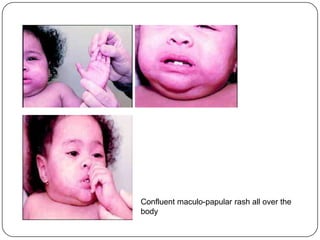
Confluent maculo-papular rash all over the body
MEASLES
EPIDEMIOLOGYEndemic in regions where measles vaccination is not availableYoung infants - protected by transplacental antibody, but become more susceptible toward the end of the first year.Passive immunity may interfere with effective vaccination until 12 to 15 months of age.
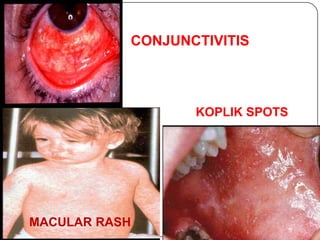
CLINICAL MANIFESTATIONDivided into 4 phases :-Incubation- IP = 8 to 12 days from exposure to the onset of symptoms, 14 days from exposure to the onset of rash.Prodromal (catarrhal)- cough, coryza, conjunctivitis (Stimson line) Koplik spots (buccal mucosa)
Exanthematous (rash)	- accompanied by high grade fever (40-40.5°C)	- The rash starts behind the ears and on the forehead at the hair line spread down to the leg (descending)	- show severity of the illnessd)	recovery
CONJUNCTIVITISKOPLIK SPOTS MACULAR RASH
Other manifestations :Cervical lymphadenitisSpleenomegalyAbdominal painMesenteric lymphadenopathyOtitis mediaPneumonia		common in infantsDiarrheaLiver involvement – common in adult
INVESTIGATIONSSerological test  	- IgM antibody		- appear in 1-2 days of rash		- persist for 1-2 monthChest X-ray   	- interstitial infiltration	- -vemeasle pneumonia vs bacterial superinfection
DIAGNOSISClinicalSerologyViral culturePCR
COMPLICATIONSAcute otitis media (10-15%)Interstitial pneumonia (50-75% pathological chest XR)Myocarditis and pericarditisEncephalitis (1/1000 cases) 7-10 days after rashSubacute sclerosis panencephalitisMesenteric lymphadenitis
MANAGEMENTTREATMENTRoutine supportive care maintain adequate hydrationantipyretics IV ribavirin  (severe infection)High dose for vitamin A supplementation
PREVENTIONMMR Live attenuated measles vaccine1st dose   : 12-15 month of life2nd dose : 4-6 yrs old* Contraindicated for severe immunosupression patient
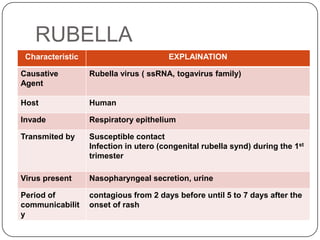
RUBELLA
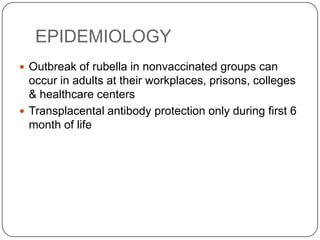
EPIDEMIOLOGYOutbreak of rubella in nonvaccinated groups can occur in adults at their workplaces, prisons, colleges & healthcare centersTransplacental antibody protection only during first 6 month of life
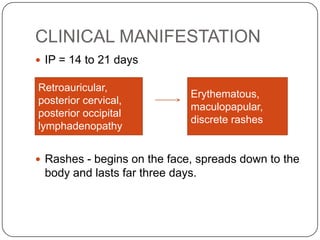
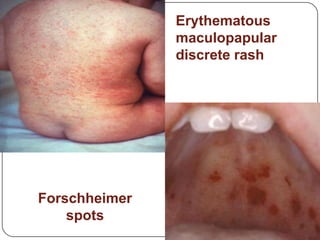
CLINICAL MANIFESTATIONIP = 14 to 21 daysRashes - begins on the face, spreads down to the body and lasts far three days.Retroauricular, posterior cervical, posterior occipital lymphadenopathyErythematous, maculopapular, discrete rashes
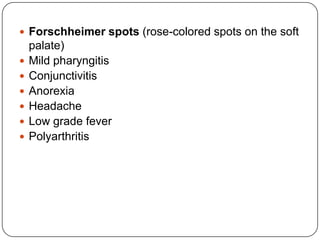
Forschheimerspots (rose-colored spots on the soft palate)Mild pharyngitisConjunctivitisAnorexiaHeadacheLow grade feverPolyarthritis
Erythematousmaculopapular  discrete rashForschheimer spots
INVESTIGATIONSNON-SPECIFIC and do not aid in diagnosisWBC – normal or lowThrombocytopenia – rareSerological testIgM antibodyFourfold rise in specific IgG antibodies in paired acute & convalescent sera
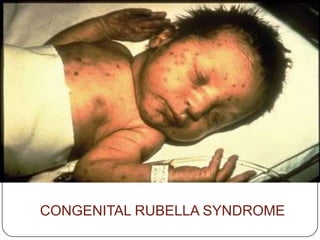
COMPLICATIONSRarely complicated compared to measlespregnancy – congenital rubella syndrome- IUGR	- cataracts	- deafness	- patent ductusarteriosus (PDA)
CONGENITAL RUBELLA SYNDROME
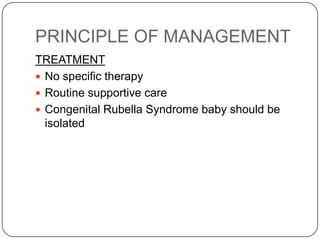
PRINCIPLE OF MANAGEMENTTREATMENTNo specific therapyRoutine supportive care Congenital Rubella Syndrome baby should be isolated
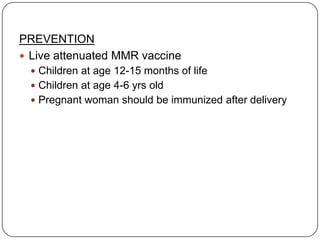
PREVENTIONLive attenuated MMR vaccineChildren at age 12-15 months of lifeChildren at age 4-6 yrs oldPregnant woman should be immunized after delivery
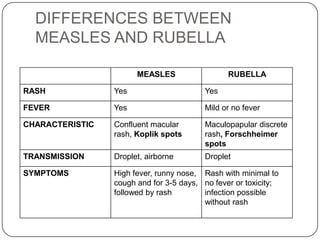
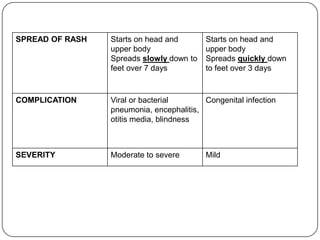
DIFFERENCES BETWEEN MEASLES AND RUBELLA
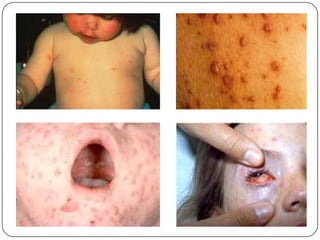
Varicella (chickenpox)
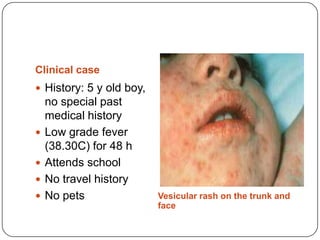
Clinical caseVesicular rash on the trunk and faceHistory: 5 y old boy, no special past medical historyLow grade fever (38.30C) for 48 hAttends schoolNo travel historyNo pets
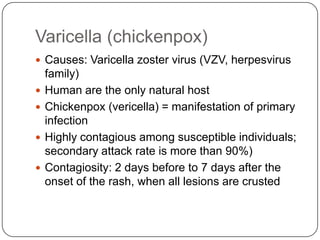
Varicella (chickenpox)Causes: Varicella zoster virus (VZV, herpesvirus family)Human are the only natural hostChickenpox (vericella) = manifestation of primary infectionHighly contagious among susceptible individuals; secondary attack rate is more than 90%)Contagiosity: 2 days before to 7 days after the onset of the rash, when all lesions are crusted
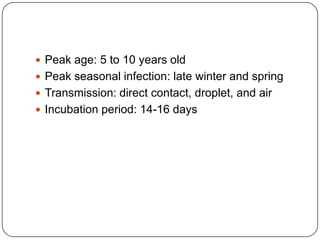
Peak age: 5 to 10 years oldPeak seasonal infection: late winter and springTransmission: direct contact, droplet, and airIncubation period: 14-16 days
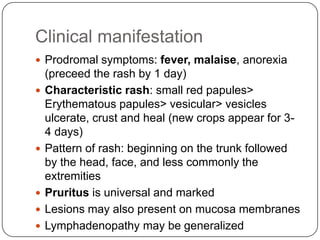
Clinical manifestationProdromal symptoms: fever, malaise, anorexia (preceed the rash by 1 day)Characteristic rash: small red papules> Erythematous papules> vesicular> vesicles ulcerate, crust and heal (new crops appear for 3-4 days)Pattern of rash: beginning on the trunk followed by the head, face, and less commonly the extremitiesPruritusis universal and markedLesions may also present on mucosa membranesLymphadenopathy may be generalized
ComplicationCommonMore severe for neonates, adults, and immunocompromised persons.-	Secondary infection of skin by streptococci pr staphylococciThrombocytopenia and haemorragic lesions or bleeding may occur (varicellagangrenosa)
Pneumonia (15-20% 0f healty adults and immunlcompromised persons, uncommon in healthy children)
Myocarditis, pericarditis, orchitis, hepatitis, ulcerative gastritis, glomerulonephritis and athritis may complicate
Reye syndrome may follow varicella (aspirin use is contraindicated)
Neurological complication: post infectious enencephaly, cerebellar ataxia, nystagmus and tremor. Congenital infection-characteristic: low birth weight, cortical atrophy, seizure, mental retardation, chorioretinitis, cataracts,microcephalyPerinatal infection	-severe form of noenatalvaricella
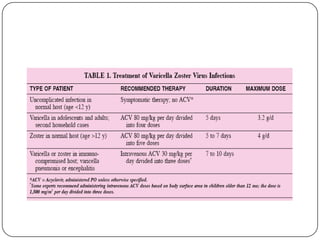
TreatmentSymptomatic therapy: Nonaspirin antipyretics, cool baths, careful hygieneAntiviral treatment: acyclovir, famciclovir, valacyclovir
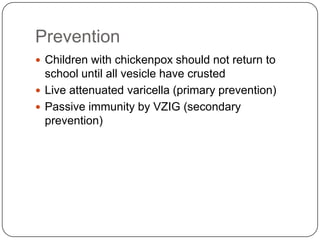
PreventionChildren with chickenpox should not return to school until all vesicle have crustedLive attenuated varicella (primary prevention)Passive immunity by VZIG (secondary prevention)
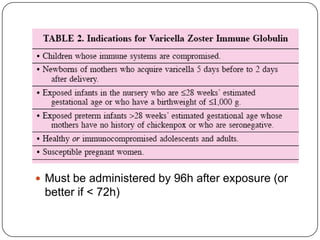
Must be administered by 96h after exposure (or better if < 72h)
Hand,foot and mouth disease
Hand,foot and mouth diseasemost often occurs in children under 10 years old. Causes: coxsackievirus A16, enterovirus 71 (EV71) and other enteroviruses. The enterovirus group includes polioviruses, coxsackieviruses, echoviruses and other enteroviruses.  more frequent in summer and early autumn (in temperate countries)
moderately contagious. A person is most contagious during the first week of the illness.transmitted from person to person via direct contact with nose and throat discharges, saliva, fluid from blisters, or the stool of infected persons.(incubation period) is 3 to 7 days. Fever is often the first symptom of HFMD followed by blister/rash.
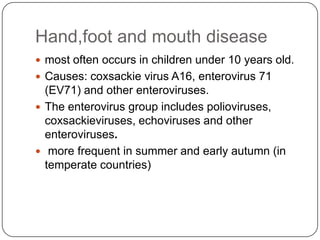
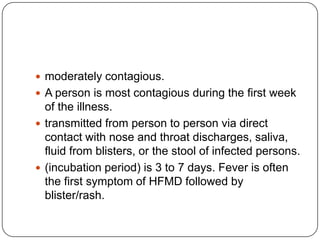
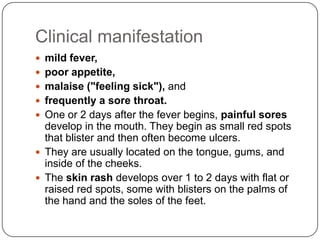
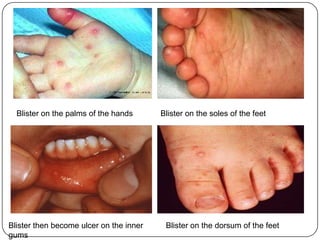
Clinical manifestationmild fever, poor appetite, malaise ("feeling sick"), and frequently a sore throat. One or 2 days after the fever begins, painful sores develop in the mouth. They begin as small red spots that blister and then often become ulcers. They are usually located on the tongue, gums, and inside of the cheeks. The skin rash develops over 1 to 2 days with flat or raised red spots, some with blisters on the palms of the hand and the soles of the feet.
Blister on the palms of the hands Blister on the soles of the feet Blister then become ulcer on the inner gums Blister on the dorsum of the feet
Complication HFMD caused by coxsackie virus A16 infection is a mild disease and nearly all patients recover within 7 to 10 days. Complications are uncommon. HFMD caused by Enterovirus EV71 may be associated with neurological complications such as aseptic meningitis and encephalitis
Treatmentno specific effective antiviral drugs and vaccine available for the treatment of HFMD. Symptomatic treatment is given to provide relief from fever, aches, or pain from the mouth ulcers.Dehydrationis a concern because the mouth sores may make it difficult and painful for children to eat and drink.
Preventiongood hygienic practices. Preventive measures include: a. Frequent hand washing, especially after diaper changes, after using toilet and before preparing food, b. Maintain cleanliness of house, child care center, kindergartens or schools and its surrounding, c. Cleaning of contaminated surfaces and soiled items with soap and water, and then disinfecting them with diluted solution of chlorine-containing bleach (10% concentration), d. Parents are advised not to bring young children to crowded public places such as shopping centers, cinemas, swimming pools, markets or bus stations, e. Bring children to the nearest clinic if they show signs and symptoms. Refrain from sending them to child care centers, kindergartens or schools. f. Avoidance of close contact (kissing, hugging, sharing utensils, etc.) with children having HFMD illness to reduce of the risk of infection
MENINGOCOCCAL DISEASE
caused by Neisseriameningitidis (meningococcus)
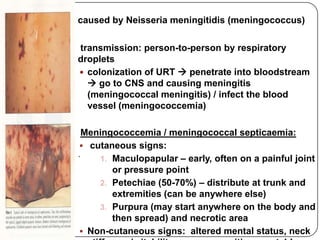
 transmission: person-to-person by respiratory dropletscolonization of URT  penetrate into bloodstream  go to CNS and causing meningitis (meningococcal meningitis) / infect the blood vessel (meningococcemia)Meningococcemia / meningococcal septicaemia:
cutaneous signs:Maculopapular – early, often on a painful joint or pressure pointPetechiae (50-70%) – distribute at trunk and extremities (can be anywhere else)Purpura (may start anywhere on the body and then spread) and necrotic areaNon-cutaneous signs:  altered mental status, neck stiffness, irritability, nausea, vomiting, unstable vital signs, seizure.
Meningococcal septicemia can kill children in hours, therefore optimal outcome requires immediate recognition, prompt resuscitation and antibiotics.Although there are now polysaccharide conjugate vaccines against groups A and C meningococcus, there is still no effective vaccines for group B meningococcus
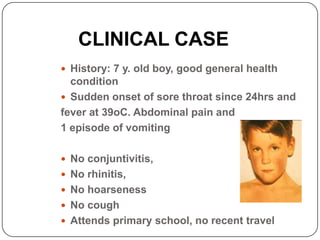
CLINICAL CASEHistory: 7 y. old boy, good general health conditionSudden onset of sore throat since 24hrs andfever at 39oC. Abdominal pain and1 episode of vomitingNo conjuntivitis,No rhinitis,No hoarsenessNo coughAttends primary school, no recent travel
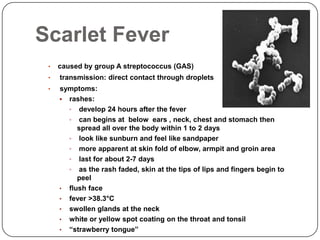
Scarlet Fevercaused by group A streptococcus (GAS)
 transmission: direct contact through droplets
 symptoms:
 rashes:
 develop 24 hours after the fever
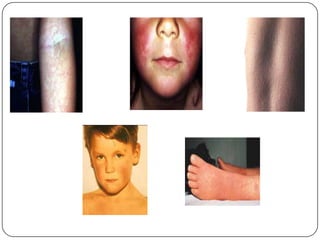
 can begins at  below  ears , neck, chest and stomach then spread all over the body within 1 to 2 days
 look like sunburn and feel like sandpaper
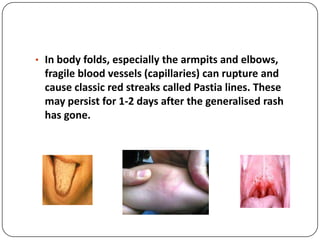
 more apparent at skin fold of elbow, armpit and groin area
 last for about 2-7 days

2. fever with rash

  • 1.
    NURUL SHAMEEN BTABDUL RASHIDA’QILAH BT BAHARUDINWAN AHMAD SYAZANI B MOHAMED FEVER WITH RASH
  • 2.
    WHAT IS THAT?FEVER-temporary ↑ in the body’s temperature in response to some disease or illness (37.5°C)RASH- temporary eruption of the skin- discrete red spots / generalized reddening- accompanied by itching
  • 3.
    In HISTORY TAKING:Exposures - Ill contacts (home, day care…) - Travelling history -Pets, insects - Medications and drugs - ImmunizationFeatures of rash - Temporal association (onset relative to fever) - Progression and evolution - Location and distribution - Pain or pruritus
  • 4.
    In PHYSICAL EXAMINATION:Distribution pattern- symmetrical eruption- asymmetrical rashesMorphology- monomorphic- pleomorphicConfiguration- linear, annular, grouped, - Koebner phenomenon (eruption in an area of local trauma)
  • 5.
  • 6.
  • 7.
  • 8.
  • 12.
    CASE SCENARIOHistory:9 moold girl, good general health conditionProgressive fever for 5 days (max. 39.50C)Coryza, exudative conjunctivitisSevere cough and irritabilityNo diarrhea, no vomitingNo recent travel, no petsRashes - over trunk, abdomen and back - appear 4 days after onset of fever - not elevated and no itching - blanching on pressure
  • 13.
  • 14.
  • 15.
    EPIDEMIOLOGYEndemic in regionswhere measles vaccination is not availableYoung infants - protected by transplacental antibody, but become more susceptible toward the end of the first year.Passive immunity may interfere with effective vaccination until 12 to 15 months of age.
  • 16.
    CLINICAL MANIFESTATIONDivided into4 phases :-Incubation- IP = 8 to 12 days from exposure to the onset of symptoms, 14 days from exposure to the onset of rash.Prodromal (catarrhal)- cough, coryza, conjunctivitis (Stimson line) Koplik spots (buccal mucosa)
  • 17.
    Exanthematous (rash) - accompaniedby high grade fever (40-40.5°C) - The rash starts behind the ears and on the forehead at the hair line spread down to the leg (descending) - show severity of the illnessd) recovery
  • 18.
  • 19.
    Other manifestations :CervicallymphadenitisSpleenomegalyAbdominal painMesenteric lymphadenopathyOtitis mediaPneumonia common in infantsDiarrheaLiver involvement – common in adult
  • 20.
    INVESTIGATIONSSerological test - IgM antibody - appear in 1-2 days of rash - persist for 1-2 monthChest X-ray - interstitial infiltration - -vemeasle pneumonia vs bacterial superinfection
  • 21.
  • 22.
    COMPLICATIONSAcute otitis media(10-15%)Interstitial pneumonia (50-75% pathological chest XR)Myocarditis and pericarditisEncephalitis (1/1000 cases) 7-10 days after rashSubacute sclerosis panencephalitisMesenteric lymphadenitis
  • 23.
    MANAGEMENTTREATMENTRoutine supportive caremaintain adequate hydrationantipyretics IV ribavirin (severe infection)High dose for vitamin A supplementation
  • 24.
    PREVENTIONMMR Live attenuatedmeasles vaccine1st dose : 12-15 month of life2nd dose : 4-6 yrs old* Contraindicated for severe immunosupression patient
  • 25.
  • 26.
    EPIDEMIOLOGYOutbreak of rubellain nonvaccinated groups can occur in adults at their workplaces, prisons, colleges & healthcare centersTransplacental antibody protection only during first 6 month of life
  • 27.
    CLINICAL MANIFESTATIONIP =14 to 21 daysRashes - begins on the face, spreads down to the body and lasts far three days.Retroauricular, posterior cervical, posterior occipital lymphadenopathyErythematous, maculopapular, discrete rashes
  • 28.
    Forschheimerspots (rose-colored spotson the soft palate)Mild pharyngitisConjunctivitisAnorexiaHeadacheLow grade feverPolyarthritis
  • 29.
  • 30.
    INVESTIGATIONSNON-SPECIFIC and donot aid in diagnosisWBC – normal or lowThrombocytopenia – rareSerological testIgM antibodyFourfold rise in specific IgG antibodies in paired acute & convalescent sera
  • 31.
    COMPLICATIONSRarely complicated comparedto measlespregnancy – congenital rubella syndrome- IUGR - cataracts - deafness - patent ductusarteriosus (PDA)
  • 32.
  • 33.
    PRINCIPLE OF MANAGEMENTTREATMENTNospecific therapyRoutine supportive care Congenital Rubella Syndrome baby should be isolated
  • 34.
    PREVENTIONLive attenuated MMRvaccineChildren at age 12-15 months of lifeChildren at age 4-6 yrs oldPregnant woman should be immunized after delivery
  • 35.
  • 37.
  • 38.
    Clinical caseVesicular rashon the trunk and faceHistory: 5 y old boy, no special past medical historyLow grade fever (38.30C) for 48 hAttends schoolNo travel historyNo pets
  • 39.
    Varicella (chickenpox)Causes: Varicellazoster virus (VZV, herpesvirus family)Human are the only natural hostChickenpox (vericella) = manifestation of primary infectionHighly contagious among susceptible individuals; secondary attack rate is more than 90%)Contagiosity: 2 days before to 7 days after the onset of the rash, when all lesions are crusted
  • 40.
    Peak age: 5to 10 years oldPeak seasonal infection: late winter and springTransmission: direct contact, droplet, and airIncubation period: 14-16 days
  • 41.
    Clinical manifestationProdromal symptoms:fever, malaise, anorexia (preceed the rash by 1 day)Characteristic rash: small red papules> Erythematous papules> vesicular> vesicles ulcerate, crust and heal (new crops appear for 3-4 days)Pattern of rash: beginning on the trunk followed by the head, face, and less commonly the extremitiesPruritusis universal and markedLesions may also present on mucosa membranesLymphadenopathy may be generalized
  • 43.
    ComplicationCommonMore severe forneonates, adults, and immunocompromised persons.- Secondary infection of skin by streptococci pr staphylococciThrombocytopenia and haemorragic lesions or bleeding may occur (varicellagangrenosa)
  • 44.
    Pneumonia (15-20% 0fhealty adults and immunlcompromised persons, uncommon in healthy children)
  • 45.
    Myocarditis, pericarditis, orchitis,hepatitis, ulcerative gastritis, glomerulonephritis and athritis may complicate
  • 46.
    Reye syndrome mayfollow varicella (aspirin use is contraindicated)
  • 47.
    Neurological complication: postinfectious enencephaly, cerebellar ataxia, nystagmus and tremor. Congenital infection-characteristic: low birth weight, cortical atrophy, seizure, mental retardation, chorioretinitis, cataracts,microcephalyPerinatal infection -severe form of noenatalvaricella
  • 48.
    TreatmentSymptomatic therapy: Nonaspirinantipyretics, cool baths, careful hygieneAntiviral treatment: acyclovir, famciclovir, valacyclovir
  • 50.
    PreventionChildren with chickenpoxshould not return to school until all vesicle have crustedLive attenuated varicella (primary prevention)Passive immunity by VZIG (secondary prevention)
  • 51.
    Must be administeredby 96h after exposure (or better if < 72h)
  • 52.
  • 53.
    Hand,foot and mouthdiseasemost often occurs in children under 10 years old. Causes: coxsackievirus A16, enterovirus 71 (EV71) and other enteroviruses. The enterovirus group includes polioviruses, coxsackieviruses, echoviruses and other enteroviruses. more frequent in summer and early autumn (in temperate countries)
  • 54.
    moderately contagious. Aperson is most contagious during the first week of the illness.transmitted from person to person via direct contact with nose and throat discharges, saliva, fluid from blisters, or the stool of infected persons.(incubation period) is 3 to 7 days. Fever is often the first symptom of HFMD followed by blister/rash.
  • 55.
    Clinical manifestationmild fever,poor appetite, malaise ("feeling sick"), and frequently a sore throat. One or 2 days after the fever begins, painful sores develop in the mouth. They begin as small red spots that blister and then often become ulcers. They are usually located on the tongue, gums, and inside of the cheeks. The skin rash develops over 1 to 2 days with flat or raised red spots, some with blisters on the palms of the hand and the soles of the feet.
  • 56.
    Blister on thepalms of the hands Blister on the soles of the feet Blister then become ulcer on the inner gums Blister on the dorsum of the feet
  • 57.
    Complication HFMD causedby coxsackie virus A16 infection is a mild disease and nearly all patients recover within 7 to 10 days. Complications are uncommon. HFMD caused by Enterovirus EV71 may be associated with neurological complications such as aseptic meningitis and encephalitis
  • 58.
    Treatmentno specific effectiveantiviral drugs and vaccine available for the treatment of HFMD. Symptomatic treatment is given to provide relief from fever, aches, or pain from the mouth ulcers.Dehydrationis a concern because the mouth sores may make it difficult and painful for children to eat and drink.
  • 59.
    Preventiongood hygienic practices.Preventive measures include: a. Frequent hand washing, especially after diaper changes, after using toilet and before preparing food, b. Maintain cleanliness of house, child care center, kindergartens or schools and its surrounding, c. Cleaning of contaminated surfaces and soiled items with soap and water, and then disinfecting them with diluted solution of chlorine-containing bleach (10% concentration), d. Parents are advised not to bring young children to crowded public places such as shopping centers, cinemas, swimming pools, markets or bus stations, e. Bring children to the nearest clinic if they show signs and symptoms. Refrain from sending them to child care centers, kindergartens or schools. f. Avoidance of close contact (kissing, hugging, sharing utensils, etc.) with children having HFMD illness to reduce of the risk of infection
  • 60.
  • 61.
  • 62.
    transmission: person-to-personby respiratory dropletscolonization of URT  penetrate into bloodstream  go to CNS and causing meningitis (meningococcal meningitis) / infect the blood vessel (meningococcemia)Meningococcemia / meningococcal septicaemia:
  • 63.
    cutaneous signs:Maculopapular –early, often on a painful joint or pressure pointPetechiae (50-70%) – distribute at trunk and extremities (can be anywhere else)Purpura (may start anywhere on the body and then spread) and necrotic areaNon-cutaneous signs: altered mental status, neck stiffness, irritability, nausea, vomiting, unstable vital signs, seizure.
  • 64.
    Meningococcal septicemia cankill children in hours, therefore optimal outcome requires immediate recognition, prompt resuscitation and antibiotics.Although there are now polysaccharide conjugate vaccines against groups A and C meningococcus, there is still no effective vaccines for group B meningococcus
  • 65.
    CLINICAL CASEHistory: 7y. old boy, good general health conditionSudden onset of sore throat since 24hrs andfever at 39oC. Abdominal pain and1 episode of vomitingNo conjuntivitis,No rhinitis,No hoarsenessNo coughAttends primary school, no recent travel
  • 66.
    Scarlet Fevercaused bygroup A streptococcus (GAS)
  • 67.
    transmission: directcontact through droplets
  • 68.
  • 69.
  • 70.
    develop 24hours after the fever
  • 71.
    can beginsat below ears , neck, chest and stomach then spread all over the body within 1 to 2 days
  • 72.
    look likesunburn and feel like sandpaper
  • 73.
    more apparentat skin fold of elbow, armpit and groin area
  • 74.
    last forabout 2-7 days