EVD/EVHF—International Health
Prevention
Dr. Ashok Laddha
Occupational Health Physician
History
Ebola VIRUS WAS FIRST ISOLATED in 1976
outbreak
Name of disease originates from one of
those recorded outbreak in 1976 –Zaire—
which lies near Ebola river
No approved vaccine or treatment available
Classified as Bio-safety level 4 agent and
category A bioterrorism agent by the CDC
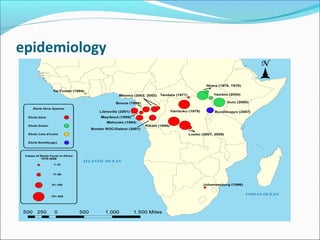
epidemiology
India
NO
EBOLA(EVD)
IN INDIA
Facts-1
 EVD is severe and lethal disease
 Fatality rate-----more than 90%
 Outbreaks primarily occurs in tropical area of central and west Africa
 It is caused by virus
 Five types virus identified
 Transmission occurs to human via infected animals and animal materials.
 Human to human transmission occurs via infected fluids and needles
 One of the world’s most virulent disease
 One of the world’s most deadly disease
 It is highly infectious virus
 There have been more than 3000 cases of Ebola and more than 2000 deaths
since 1976
Facts--2
Fruit bats may be the natural host of Ebola virus
Virus is Zoonotic
Genus Ebolavirus comprises five distinct subspecies: Bundibugyo
Ebolavirus (BDBV), Zaire Ebolavirus (EBOV), Reston Ebolavirus
(RESTV), Sudan Ebolavirus (SUDV) and Taï Forest Ebolavirus (TAFV).
Incubation period is 2 to 21 days
Ebla virus was isolated from semen 61 days after onset of illness in
semen of infected person
It is also occurs in non primates such as monkeys, gorillas and
chimpanzees
EVD is often characterized by the abrupt onset of fever, intense
weakness, muscle pain, headache and sore throat. These signs are
usually followed by vomiting, diarrhea, rash, impaired kidney and
liver function, and in some severe cases, both internal and external
bleeding.
Facts-3
No risk of transmission during incubation period
Historically, many HAEMORRAGHIC DISEASE
WERE REPORTED IN LONG DISTANCE TRAVELESR
(AS PER WHO)
No airborne transmission documented
Risk factors
Travelling to Africa
Animal research
Health professionals treating infected cases
Burial of death body of infected person
Handling of the following infected animals found ill/death/or in the
rainforest -----
 Chimpanzees
 Gorillas
 Fruit bats
 Monkeys
 Forest antelope
 Porcupines
Signs and symptoms--1
Fever
Headache
Muscle pain and aches
Joint pains
Diarrhea
Pain in abdomen
Vomiting
Loss of appetite
Signs and symptoms--2
May also have following
Red eyes
Internal/External Bleeding
Sore Throat
Difficulty in breathing/Swallowing
Chest pain
Rash over body--HAEMORRAHGIC
Genital swelling
Transmission
Ebola transmitted to human by direct contact with
blood secretion, body fluids or organs of infected
person. and handling infected animals like non –
primates
Community spread by human to human
Burial ceremonies can play important role in
transmission
Sexual Transmission By the recovered infected
Transmission to health workers when protection
protocol not followed
Complications
Coma
DIC
Shock
Death
Lab. Investigations
ELISA
PCR
CBC Including platelet count
Electrolytes
Virus isolation
IgM ELISA
In advanced stage—IgM and IgG Antibodies
Retrospective diagnosis---Immunohistochemistry,PCR,Virus isolation
LFT
Coagulation Profile
Treatment
No treatment
Isolation
Intensive and supportive care
Fluid and electrolyte management
Blood and platelet transfusion
Antibiotics to prevent infection
Maintaining Oxygen and blood pressure
experimental serum that destroy the infected cells
Experimental Treatment
Zmapp
TKM-Ebola, is designed to target the strands of
genetic material of the virus (RNA)
The US-based pharmaceutical company, has
developed a similar RNA treatment. TESTED IN
HUMAN VOLUNTERS
Scientists have been working on a number of
prototype vaccines against Ebola. Most are in very
early stages of research in animal models and no
vaccine has been licensed.
Prevention-1
Isolation
Use of PPE—Gloves. Face mask, Gown, Eye Protection
Additional PPE--Double gloving, Disposable shoe covers, Leg
coverings ( In special situation e.g. copious amounts of blood, other
body fluids, vomit, or feces present in the environment
Hand Hygiene
Patient care equipments--Dedicated medical equipment (preferably
disposable, when possible) should be used for the provision of patient
care,All non-dedicated, non-disposable medical equipment used for
patient care should be cleaned and disinfected according to
manufacturer's instructions and hospital policies
Avoid Aerosol Generating Procedures (AGPs) as far as possible
Prevention-2
Patient Care Considerations: Limit the use of needles and other sharps
as much as possible, Phlebotomy, procedures, and laboratory testing
should be limited to the minimum necessary for essential diagnostic
evaluation and medical care, All needles and sharps should be
handled with extreme care and disposed in puncture-proof, sealed
containers
Monitoring, Management, and Training of Visitors
Monitoring and Management of Potentially Exposed Personnel
Safe Injection practices
Environmental Infection Control
Avoid bush Meat
Avoid contact with infected people
Sterilization and disinfection of instrument used
Message to Health Professionals and
workers
The recommended occupational health and safety,
and infection prevention and control measures are
based on the Routine practices and additional
Precautions that health workers apply on a daily
basis. Consistently following the recommended
occupational health and safety, and infection
prevention and control measures will protect health
workers against infection by Ebola.
WHO-Statement
The Ebola outbreak in West Africa constitutes an
‘extraordinary event’ and a public health risk to other
States;
the possible consequences of further international spread
are particularly serious in view of the virulence of the
virus, the intensive community and health facility
transmission patterns, and the weak health systems in the
currently affected and most at-risk countries.
a coordinated international response is deemed essential
to stop and reverse the international spread of Ebola.
Ebola guidance for airlines
Stop ill travelers from boarding aircraft—(Commercial)
Management of ill people on aircraft if Ebola virus is
suspected
Keep the sick person separated from others as much as possible.
Provide the sick person with a surgical mask (if the sick person can
tolerate wearing one) to reduce the number of droplets expelled into
the air by talking, sneezing, or coughing.
Give tissues to a sick person who cannot tolerate a mask. Provide a
plastic bag for disposing of used tissues.
Wear impermeable disposable gloves for direct contact with blood or
other body fluids.
Carry Universal Precaution kit
Awareness among Travelers'
minimize any risk of getting infected if they avoid:
Contact with blood or bodily fluids of a person or
corpse infected with the Ebola virus.
Contact with or handling of wild animals, alive or
dead or their raw or undercooked meat.
Having sexual intercourse with a sick person or a
person recovering from EVD for at least 7 weeks.
Having contact with any object, such as needles, that
has been contaminated with blood or bodily fluids.

Ebola viral disease--------- prevention

  • 1.
    EVD/EVHF—International Health Prevention Dr. AshokLaddha Occupational Health Physician
  • 2.
    History Ebola VIRUS WASFIRST ISOLATED in 1976 outbreak Name of disease originates from one of those recorded outbreak in 1976 –Zaire— which lies near Ebola river No approved vaccine or treatment available Classified as Bio-safety level 4 agent and category A bioterrorism agent by the CDC
  • 3.
  • 4.
  • 5.
    Facts-1  EVD issevere and lethal disease  Fatality rate-----more than 90%  Outbreaks primarily occurs in tropical area of central and west Africa  It is caused by virus  Five types virus identified  Transmission occurs to human via infected animals and animal materials.  Human to human transmission occurs via infected fluids and needles  One of the world’s most virulent disease  One of the world’s most deadly disease  It is highly infectious virus  There have been more than 3000 cases of Ebola and more than 2000 deaths since 1976
  • 6.
    Facts--2 Fruit bats maybe the natural host of Ebola virus Virus is Zoonotic Genus Ebolavirus comprises five distinct subspecies: Bundibugyo Ebolavirus (BDBV), Zaire Ebolavirus (EBOV), Reston Ebolavirus (RESTV), Sudan Ebolavirus (SUDV) and Taï Forest Ebolavirus (TAFV). Incubation period is 2 to 21 days Ebla virus was isolated from semen 61 days after onset of illness in semen of infected person It is also occurs in non primates such as monkeys, gorillas and chimpanzees EVD is often characterized by the abrupt onset of fever, intense weakness, muscle pain, headache and sore throat. These signs are usually followed by vomiting, diarrhea, rash, impaired kidney and liver function, and in some severe cases, both internal and external bleeding.
  • 7.
    Facts-3 No risk oftransmission during incubation period Historically, many HAEMORRAGHIC DISEASE WERE REPORTED IN LONG DISTANCE TRAVELESR (AS PER WHO) No airborne transmission documented
  • 8.
    Risk factors Travelling toAfrica Animal research Health professionals treating infected cases Burial of death body of infected person Handling of the following infected animals found ill/death/or in the rainforest -----  Chimpanzees  Gorillas  Fruit bats  Monkeys  Forest antelope  Porcupines
  • 9.
    Signs and symptoms--1 Fever Headache Musclepain and aches Joint pains Diarrhea Pain in abdomen Vomiting Loss of appetite
  • 10.
    Signs and symptoms--2 Mayalso have following Red eyes Internal/External Bleeding Sore Throat Difficulty in breathing/Swallowing Chest pain Rash over body--HAEMORRAHGIC Genital swelling
  • 11.
    Transmission Ebola transmitted tohuman by direct contact with blood secretion, body fluids or organs of infected person. and handling infected animals like non – primates Community spread by human to human Burial ceremonies can play important role in transmission Sexual Transmission By the recovered infected Transmission to health workers when protection protocol not followed
  • 12.
  • 13.
    Lab. Investigations ELISA PCR CBC Includingplatelet count Electrolytes Virus isolation IgM ELISA In advanced stage—IgM and IgG Antibodies Retrospective diagnosis---Immunohistochemistry,PCR,Virus isolation LFT Coagulation Profile
  • 14.
    Treatment No treatment Isolation Intensive andsupportive care Fluid and electrolyte management Blood and platelet transfusion Antibiotics to prevent infection Maintaining Oxygen and blood pressure experimental serum that destroy the infected cells
  • 15.
    Experimental Treatment Zmapp TKM-Ebola, isdesigned to target the strands of genetic material of the virus (RNA) The US-based pharmaceutical company, has developed a similar RNA treatment. TESTED IN HUMAN VOLUNTERS Scientists have been working on a number of prototype vaccines against Ebola. Most are in very early stages of research in animal models and no vaccine has been licensed.
  • 16.
    Prevention-1 Isolation Use of PPE—Gloves.Face mask, Gown, Eye Protection Additional PPE--Double gloving, Disposable shoe covers, Leg coverings ( In special situation e.g. copious amounts of blood, other body fluids, vomit, or feces present in the environment Hand Hygiene Patient care equipments--Dedicated medical equipment (preferably disposable, when possible) should be used for the provision of patient care,All non-dedicated, non-disposable medical equipment used for patient care should be cleaned and disinfected according to manufacturer's instructions and hospital policies Avoid Aerosol Generating Procedures (AGPs) as far as possible
  • 17.
    Prevention-2 Patient Care Considerations:Limit the use of needles and other sharps as much as possible, Phlebotomy, procedures, and laboratory testing should be limited to the minimum necessary for essential diagnostic evaluation and medical care, All needles and sharps should be handled with extreme care and disposed in puncture-proof, sealed containers Monitoring, Management, and Training of Visitors Monitoring and Management of Potentially Exposed Personnel Safe Injection practices Environmental Infection Control Avoid bush Meat Avoid contact with infected people Sterilization and disinfection of instrument used
  • 18.
    Message to HealthProfessionals and workers The recommended occupational health and safety, and infection prevention and control measures are based on the Routine practices and additional Precautions that health workers apply on a daily basis. Consistently following the recommended occupational health and safety, and infection prevention and control measures will protect health workers against infection by Ebola.
  • 19.
    WHO-Statement The Ebola outbreakin West Africa constitutes an ‘extraordinary event’ and a public health risk to other States; the possible consequences of further international spread are particularly serious in view of the virulence of the virus, the intensive community and health facility transmission patterns, and the weak health systems in the currently affected and most at-risk countries. a coordinated international response is deemed essential to stop and reverse the international spread of Ebola.
  • 20.
    Ebola guidance forairlines Stop ill travelers from boarding aircraft—(Commercial) Management of ill people on aircraft if Ebola virus is suspected Keep the sick person separated from others as much as possible. Provide the sick person with a surgical mask (if the sick person can tolerate wearing one) to reduce the number of droplets expelled into the air by talking, sneezing, or coughing. Give tissues to a sick person who cannot tolerate a mask. Provide a plastic bag for disposing of used tissues. Wear impermeable disposable gloves for direct contact with blood or other body fluids. Carry Universal Precaution kit
  • 21.
    Awareness among Travelers' minimizeany risk of getting infected if they avoid: Contact with blood or bodily fluids of a person or corpse infected with the Ebola virus. Contact with or handling of wild animals, alive or dead or their raw or undercooked meat. Having sexual intercourse with a sick person or a person recovering from EVD for at least 7 weeks. Having contact with any object, such as needles, that has been contaminated with blood or bodily fluids.