Earthquakes
How Earthquakes work Investigating Earthquakes--San Francisco  Introductory Clips
Earthquakes :  Vibrations  (seismic waves) within Earth materials are produced by the rapid release of  energy Earth’s crust is in  constant motion  because of  tectonic forces Earth’s crust can store  elastic   energy When forces exceed the elastic limits and structural strength of the rocks, the rocks will  break  and/or  move  producing  vibrations  that travel outward in all directions What is an Earthquake?
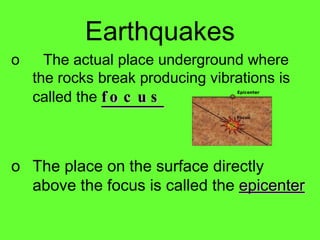
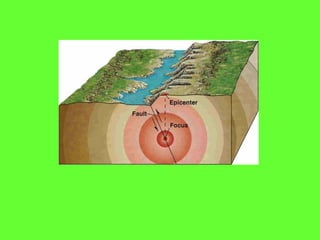
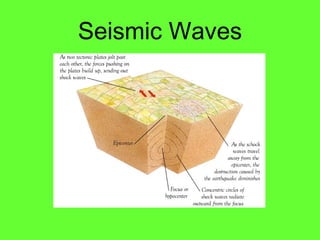
The actual place underground where the rocks break producing vibrations is called the  focus The place on the surface directly above the focus is called the  epicenter Earthquakes
 
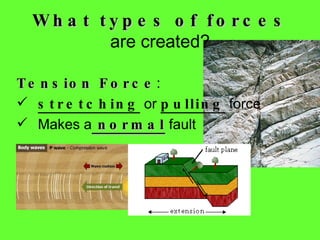
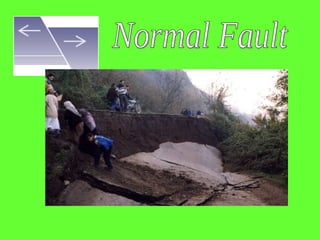
Tension Force :  stretching  or  pulling  force Makes a  normal  fault What types of  forces  are created?
Normal Fault
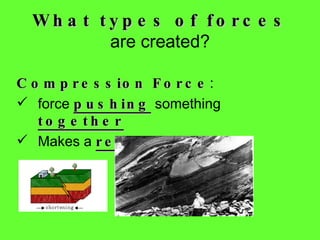
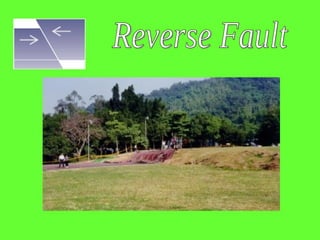
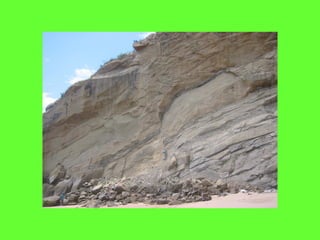
Compression Force :  force  pushing  something  together Makes a  reverse  fault What types of  forces  are created?
Reverse Fault
 
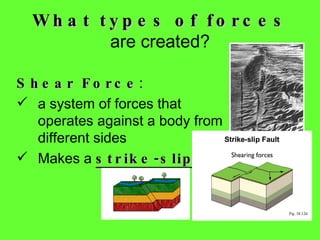
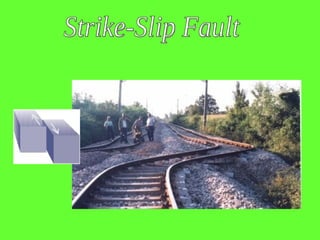
Shear Force :  a system of forces that operates against a body from different sides Makes a  strike-slip  fault What types of  forces  are created?
Strike-Slip Fault
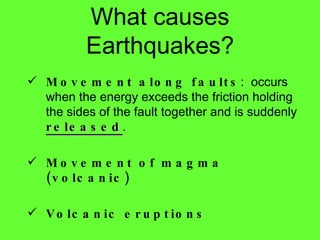
Movement along faults :  occurs when the energy exceeds the friction holding the sides of the fault together and is suddenly  released . Movement of magma (volcanic)  Volcanic eruptions What causes Earthquakes?
Originate at the  focus  and travel outward in all directions Foreshocks :  small earthquakes that come before a major earthquake Aftershocks :  Are adjustments in the crust  after  in earthquake Smaller than main earthquake, but can cause as much or more damage.  They can continue for  weeks  to  months .  Not every earthquake produces aftershocks Seismic Waves
Seismic Waves
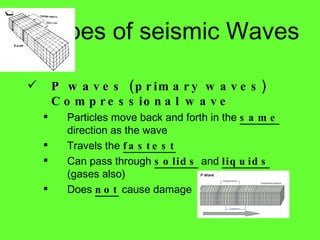
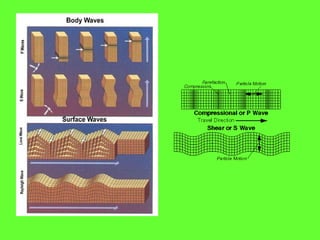
P waves  (primary waves) Compressional wave Particles move back and forth in the  same  direction as the wave Travels the  fastest Can pass through  solids  and  liquids  (gases also) Does  not  cause damage 3 Types of seismic Waves
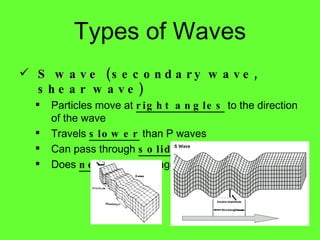
S wave  (secondary wave, shear wave) Particles move at  right angles  to the direction of the wave Travels  slower  than P waves Can pass through  solids  only Does  not  cause damage Types of Waves
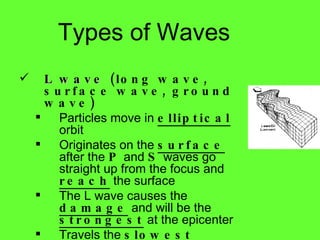
L wave  (long wave, surface wave, ground wave) Particles move in  elliptical  orbit Originates on the  surface  after the  P  and  S  waves go straight up from the focus and  reach  the surface The L wave causes the  damage  and will be the  strongest  at the epicenter Travels the  slowest Types of Waves
 
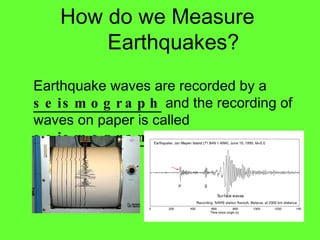
How do we Measure Earthquakes? Earthquake waves are recorded by a  seismograph  and the recording of waves on paper is called  seismogram
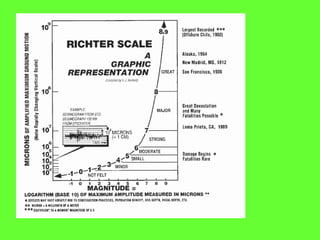
How do we Measure Earthquakes? Intensity  – a measure of the  effects  on an earthquake at a particular  location Magnitude :  a measure of the  strength  or amount of  energy  released during an earthquake
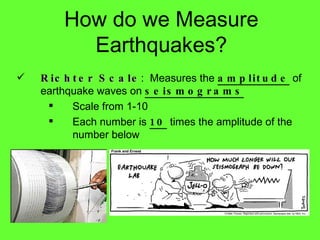
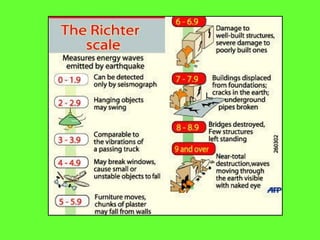
Richter Scale :  Measures the  amplitude  of earthquake waves on  seismograms Scale from 1-10 Each number is  10  times the amplitude of the number below How do we Measure Earthquakes?
 
 
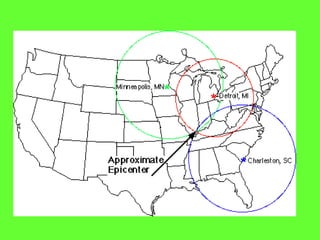
Locating the epicenter Lag time  between the arrival of the  P wave and the S wave  to the seismograph station is converted to a distance A circle with a  radius  that  equals  the distance is drawn around the station.  Two stations can narrow down the location to two places where the two circles  intersect Locating the focus :  the  lag-time  of the  L  wave will determine the depth of the focus Measuring Earthquakes
 
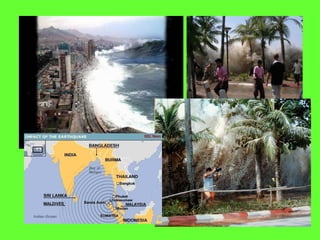
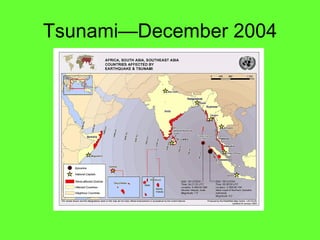
Earthquake Dangers Most injuries and deaths are caused by  falling objects   and most property damage results from  fires  that start  Tsunami :  seismic sea wave  sometimes generated when an earthquake originates on the ocean floor
 
Tsunami—December 2004
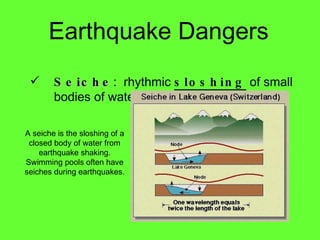
Earthquake Dangers Seiche :  rhythmic  sloshing  of small bodies of water A seiche is the sloshing of a closed body of water from earthquake shaking. Swimming pools often have seiches during earthquakes.
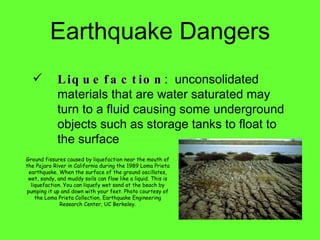
Liquefaction :  unconsolidated materials that are water saturated may turn to a fluid causing some underground objects such as storage tanks to float to the surface Earthquake Dangers Ground fissures caused by liquefaction near the mouth of the Pajaro River in California during the 1989 Loma Prieta earthquake. When the surface of the ground oscillates, wet, sandy, and muddy soils can flow like a liquid. This is liquefaction. You can liquefy wet sand at the beach by pumping it up and down with your feet. Photo courtesy of the Loma Prieta Collection, Earthquake Engineering Research Center, UC Berkeley.
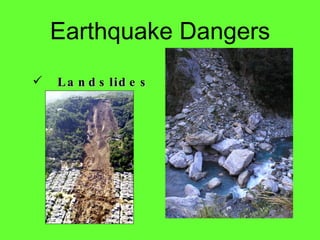
Landslides Earthquake Dangers
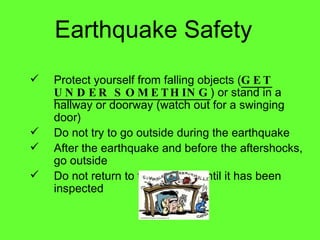
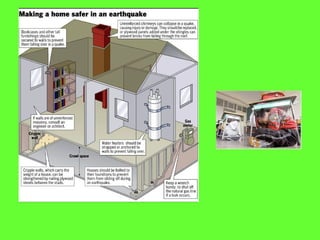
Earthquake Safety Protect yourself from falling objects ( GET UNDER SOMETHING ) or stand in a hallway or doorway (watch out for a swinging door) Do not try to go outside during the earthquake After the earthquake and before the aftershocks, go outside Do not return to the building until it has been inspected
 

Earthquake Notes

  • 1.
  • 2.
    How Earthquakes workInvestigating Earthquakes--San Francisco Introductory Clips
  • 3.
    Earthquakes : Vibrations (seismic waves) within Earth materials are produced by the rapid release of energy Earth’s crust is in constant motion because of tectonic forces Earth’s crust can store elastic energy When forces exceed the elastic limits and structural strength of the rocks, the rocks will break and/or move producing vibrations that travel outward in all directions What is an Earthquake?
  • 4.
    The actual placeunderground where the rocks break producing vibrations is called the focus The place on the surface directly above the focus is called the epicenter Earthquakes
  • 5.
  • 6.
    Tension Force : stretching or pulling force Makes a normal fault What types of forces are created?
  • 7.
  • 8.
    Compression Force : force pushing something together Makes a reverse fault What types of forces are created?
  • 9.
  • 10.
  • 11.
    Shear Force : a system of forces that operates against a body from different sides Makes a strike-slip fault What types of forces are created?
  • 12.
  • 13.
    Movement along faults: occurs when the energy exceeds the friction holding the sides of the fault together and is suddenly released . Movement of magma (volcanic) Volcanic eruptions What causes Earthquakes?
  • 14.
    Originate at the focus and travel outward in all directions Foreshocks : small earthquakes that come before a major earthquake Aftershocks : Are adjustments in the crust after in earthquake Smaller than main earthquake, but can cause as much or more damage. They can continue for weeks to months . Not every earthquake produces aftershocks Seismic Waves
  • 15.
  • 16.
    P waves (primary waves) Compressional wave Particles move back and forth in the same direction as the wave Travels the fastest Can pass through solids and liquids (gases also) Does not cause damage 3 Types of seismic Waves
  • 17.
    S wave (secondary wave, shear wave) Particles move at right angles to the direction of the wave Travels slower than P waves Can pass through solids only Does not cause damage Types of Waves
  • 18.
    L wave (long wave, surface wave, ground wave) Particles move in elliptical orbit Originates on the surface after the P and S waves go straight up from the focus and reach the surface The L wave causes the damage and will be the strongest at the epicenter Travels the slowest Types of Waves
  • 19.
  • 20.
    How do weMeasure Earthquakes? Earthquake waves are recorded by a seismograph and the recording of waves on paper is called seismogram
  • 21.
    How do weMeasure Earthquakes? Intensity – a measure of the effects on an earthquake at a particular location Magnitude : a measure of the strength or amount of energy released during an earthquake
  • 22.
    Richter Scale : Measures the amplitude of earthquake waves on seismograms Scale from 1-10 Each number is 10 times the amplitude of the number below How do we Measure Earthquakes?
  • 23.
  • 24.
  • 25.
    Locating the epicenterLag time between the arrival of the P wave and the S wave to the seismograph station is converted to a distance A circle with a radius that equals the distance is drawn around the station. Two stations can narrow down the location to two places where the two circles intersect Locating the focus : the lag-time of the L wave will determine the depth of the focus Measuring Earthquakes
  • 26.
  • 27.
    Earthquake Dangers Mostinjuries and deaths are caused by falling objects and most property damage results from fires that start Tsunami : seismic sea wave sometimes generated when an earthquake originates on the ocean floor
  • 28.
  • 29.
  • 30.
    Earthquake Dangers Seiche: rhythmic sloshing of small bodies of water A seiche is the sloshing of a closed body of water from earthquake shaking. Swimming pools often have seiches during earthquakes.
  • 31.
    Liquefaction : unconsolidated materials that are water saturated may turn to a fluid causing some underground objects such as storage tanks to float to the surface Earthquake Dangers Ground fissures caused by liquefaction near the mouth of the Pajaro River in California during the 1989 Loma Prieta earthquake. When the surface of the ground oscillates, wet, sandy, and muddy soils can flow like a liquid. This is liquefaction. You can liquefy wet sand at the beach by pumping it up and down with your feet. Photo courtesy of the Loma Prieta Collection, Earthquake Engineering Research Center, UC Berkeley.
  • 32.
  • 33.
    Earthquake Safety Protectyourself from falling objects ( GET UNDER SOMETHING ) or stand in a hallway or doorway (watch out for a swinging door) Do not try to go outside during the earthquake After the earthquake and before the aftershocks, go outside Do not return to the building until it has been inspected
  • 34.