TopicTopic
Seismic wavesSeismic waves
theirtheir typestypes
&& Seismicity of PakistanSeismicity of Pakistan
Prepared byPrepared by
Azhar MahmoodAzhar Mahmood
Seismic WavesSeismic Waves
 Seismic waves are the waves of energySeismic waves are the waves of energy
that travel through the earth layers, andthat travel through the earth layers, and
are a result of an earthquake, explosion orare a result of an earthquake, explosion or
a volcanism.a volcanism.
 Seismic waves are studied bySeismic waves are studied by
geophysicist called seismologist and thesegeophysicist called seismologist and these
waves are recorded by a seismometerwaves are recorded by a seismometer
hydrophone in water, or accelerometer.hydrophone in water, or accelerometer.
 The propagation The propagation velocityvelocity of the waves depends of the waves depends
on on densitydensity and  and elasticityelasticity of the medium. of the medium.
Velocity tends to increase with depth, andVelocity tends to increase with depth, and
ranges from approximately 2 to 8 km/s in theranges from approximately 2 to 8 km/s in the
Earth's Earth's crustcrust up to 13 km/s in the deep  up to 13 km/s in the deep mantlemantle..
 Earthquakes create distinct types of waves withEarthquakes create distinct types of waves with
different velocities; when reaching seismicdifferent velocities; when reaching seismic
observatories, their different observatories, their different travel timetravel time help help
scientists to locate the source of thescientists to locate the source of the
earthquake earthquake hypocenterhypocenter..
66
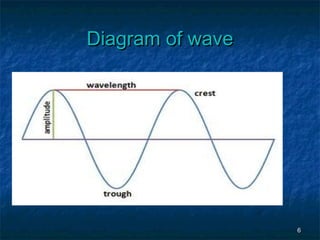
Diagram of waveDiagram of wave
   In geophysics the refraction or reflectionIn geophysics the refraction or reflection
of seismic waves is used for of seismic waves is used for researchresearch into into
the structure of the Earth's interior, andthe structure of the Earth's interior, and
man made vibrations are often generatedman made vibrations are often generated
to investigate shallow, subsurfaceto investigate shallow, subsurface
structures.structures.
1.1. Body WavesBody Waves
 Primary WavesPrimary Waves
 Secondary WavesSecondary Waves
2.2. Surface WavesSurface Waves
 Rayleigh WavesRayleigh Waves
 Love WavesLove Waves
Types of seismic wavesTypes of seismic waves
 Traveling through the interior of theTraveling through the interior of the
earth, earth, body wavesbody waves arrive before the arrive before the
surface waves emitted by an earthquake.surface waves emitted by an earthquake.
These waves are of a higherThese waves are of a higher
frequency than surface waves.frequency than surface waves.
Body WavesBody Waves
1010
Body wavesBody waves
Primary WavesPrimary Waves
 The first kind of body wave is the The first kind of body wave is the PP
wavewave or  or primary waveprimary wave. This is the. This is the
fastest kind of seismic wave, and,fastest kind of seismic wave, and,
consequently, the first to 'arrive' at aconsequently, the first to 'arrive' at a
seismic station. The P wave can moveseismic station. The P wave can move
through solid rock and fluids, like water orthrough solid rock and fluids, like water or
the liquid layers of the earth.the liquid layers of the earth.
 It pushes and pulls the rock it movesIt pushes and pulls the rock it moves
through just like sound waves push andthrough just like sound waves push and
pull the air.pull the air.
 P waves are also knownP waves are also known
as as compressional wavescompressional waves , because of, because of
the pushing and pulling they do.the pushing and pulling they do.
Secondary WavesSecondary Waves
 The second type of body wave is the The second type of body wave is the SS
wavewave or  or secondary wavesecondary wave, which is the, which is the
second wave you feel in an earthquake.second wave you feel in an earthquake.
 An S wave is slower than a P wave andAn S wave is slower than a P wave and
can only move through solid rock, notcan only move through solid rock, not
through any liquid medium. It is thisthrough any liquid medium. It is this
property of S waves that led seismologistsproperty of S waves that led seismologists
to conclude that the Earth's to conclude that the Earth's outer coreouter core is is
a liquid.a liquid.
Surface WavesSurface Waves
 Travelling only through the crust, Travelling only through the crust, surfacesurface
waveswaves are of a lower frequency than are of a lower frequency than
body waves, and are easily distinguishedbody waves, and are easily distinguished
on a seismogram as a result. on a seismogram as a result. 
 Though they arrive after body waves, it isThough they arrive after body waves, it is
surface waves that are almost enitrelysurface waves that are almost enitrely
responsible for the damage andresponsible for the damage and
destruction associated with earthquakes.destruction associated with earthquakes.
1414
Surface wavesSurface waves
Love WavesLove Waves
 The first kind of surface wave is calledThe first kind of surface wave is called
a a Love waveLove wave, named after A.E.H. Love,, named after A.E.H. Love,
a British mathematician.a British mathematician.
       It's the fastest surface wave and movesIt's the fastest surface wave and moves
the ground from side-to-side. Confined tothe ground from side-to-side. Confined to
the surface of the crust, Love wavesthe surface of the crust, Love waves
produce entirely horizontal motion.produce entirely horizontal motion.
1616
DiagramDiagram
Rayleigh WavesRayleigh Waves
 The other kind of surface wave isThe other kind of surface wave is
the the Rayleigh waveRayleigh wave, named for John, named for John
William Strutt, Lord RayleighWilliam Strutt, Lord Rayleigh
   A Rayleigh wave rolls along the groundA Rayleigh wave rolls along the ground
just like a wave rolls across a lake or anjust like a wave rolls across a lake or an
ocean. Because it rolls, it moves theocean. Because it rolls, it moves the
ground up and down, and side-to-side inground up and down, and side-to-side in
the same direction that the wave isthe same direction that the wave is
moving.moving.
1818
DiagramDiagram
 Most of the shaking felt from anMost of the shaking felt from an
earthquake is due to the Rayleigh wave,earthquake is due to the Rayleigh wave,
which can be much larger than the otherwhich can be much larger than the other
waves.waves.
 On the basis of seismic waves weOn the basis of seismic waves we
differentiate different layers of earthdifferentiate different layers of earth
 On the basis of seismic waves we subOn the basis of seismic waves we sub
classified the layers.classified the layers.
FaisalFaisal 2020
Uses of seismic wavesUses of seismic waves
 Use in the identification of hydrocarbonsUse in the identification of hydrocarbons
reservoirs.reservoirs.
 Oil and gas exploration.Oil and gas exploration.
2121
Uses;Uses;
SEISMICITY OF PAKISTANSEISMICITY OF PAKISTAN
Pakistan is an earthquake prone country. APakistan is an earthquake prone country. A
number of earthquakes have hit Pakistannumber of earthquakes have hit Pakistan
resulting in losses of life and property.resulting in losses of life and property.
Pakistan Meteorological Department (PMD)Pakistan Meteorological Department (PMD)
presently has a network of eleven seismicpresently has a network of eleven seismic
stations. By using recorded data thestations. By using recorded data the
seismicity and zoning maps of Pakistanseismicity and zoning maps of Pakistan
From our experiences derived from theFrom our experiences derived from the
recent October 8, 2005, Kashmir earthquakerecent October 8, 2005, Kashmir earthquake
it emphasized the importance of redefiningit emphasized the importance of redefining
the seismic zonation for whole Pakistanthe seismic zonation for whole Pakistan
especially seismically active areas toespecially seismically active areas to
minimize further losses of human lives andminimize further losses of human lives and
failure of infrastructure due to suchfailure of infrastructure due to such
earthquakesearthquakes
Geographical and Tectonic location ofGeographical and Tectonic location of
PakistanPakistan
Pakistan is situated in South Asian regionPakistan is situated in South Asian region
between longitudes 61º & 76º E and latitudesbetween longitudes 61º & 76º E and latitudes
24º & 37º N covering a total land area of24º & 37º N covering a total land area of
796,095 sq. km. The country shares its796,095 sq. km. The country shares its
borders with Iran to the West, India in theborders with Iran to the West, India in the
Southeast, Afghanistan in the Northwest, andSoutheast, Afghanistan in the Northwest, and
China in the North.China in the North. Figure 1Figure 1 shows, theshows, the
Geographical location of Pakistan in SouthGeographical location of Pakistan in South
Asia.Asia.
Seismic Zones of PakistanSeismic Zones of Pakistan
Seismic zoning map of Pakistan have beenSeismic zoning map of Pakistan have been
developed by Pakistan Meteorologicaldeveloped by Pakistan Meteorological
Department in 1998 by earthquake data collectedDepartment in 1998 by earthquake data collected
from United States of Geological Survey (USGS),from United States of Geological Survey (USGS),
International Seismological Centre (ISC) andInternational Seismological Centre (ISC) and
PMD for the period from 1905 to 1998.PMD for the period from 1905 to 1998.
Seismicity of PakistanSeismicity of Pakistan
 The seismicity of Pakistan concern withThe seismicity of Pakistan concern with
the series of EARTHQUAKES damagingthe series of EARTHQUAKES damaging
different areas of Pakistan at huge extent.different areas of Pakistan at huge extent.
 Two major earthquakes areTwo major earthquakes are
 1: Earthquake of 20051: Earthquake of 2005
 2: Earthquake of 20082: Earthquake of 2008
 3: Earthquake of 20133: Earthquake of 2013
Earthquake of 8 oct,2005Earthquake of 8 oct,2005
 Use in the identification of hydrocarbonsUse in the identification of hydrocarbons
reservoirs.reservoirs.
 Oil and gas exploration.Oil and gas exploration.
2929
Location MapLocation Map
 The M 7.6 quake on Oct. 8, 2005,The M 7.6 quake on Oct. 8, 2005,
killed about 80,000 people inkilled about 80,000 people in
northwestern Pakistan and Kashmirnorthwestern Pakistan and Kashmir
and left more than 3 millionand left more than 3 million
homelesshomeless
 THE SEVERITY OF THETHE SEVERITY OF THE
2005 KASHMIR EARTHQUAKE2005 KASHMIR EARTHQUAKE
DISASTERDISASTER WAS RELATED TO ITSWAS RELATED TO ITS
MAGNITUDE, SHALLOW DEPTH,MAGNITUDE, SHALLOW DEPTH,
SOIL AMPLIFICATION, AND POORSOIL AMPLIFICATION, AND POOR
CONSTRUCTIONCONSTRUCTION
KASHMIR EARTHQUAKEKASHMIR EARTHQUAKE
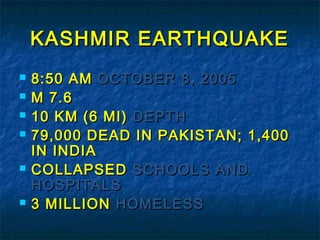
 8:50 AM8:50 AM OCTOBER 8, 2005OCTOBER 8, 2005
 M 7.6M 7.6
 10 KM (6 MI)10 KM (6 MI) DEPTHDEPTH
 79,000 DEAD IN PAKISTAN; 1,40079,000 DEAD IN PAKISTAN; 1,400
IN INDIAIN INDIA
 COLLAPSEDCOLLAPSED SCHOOLS ANDSCHOOLS AND
HOSPITALSHOSPITALS
 3 MILLION3 MILLION HOMELESSHOMELESS
OCTOBER 8, 2005 PAKISTANOCTOBER 8, 2005 PAKISTAN
EARTHQUAKEEARTHQUAKE
OCCURRENCEOCCURRENCE
 The earthquake occurred in theThe earthquake occurred in the
Main Boundary Thrust ZoneMain Boundary Thrust Zone
(MBTZ), which runs along the(MBTZ), which runs along the
Himalayan Arc for about 2,500 km.Himalayan Arc for about 2,500 km.
 The epicenter was nearThe epicenter was near
MuzaffarabadMuzaffarabad, the capital of, the capital of
Pakistani administered KashmirPakistani administered Kashmir
MUZARAFFABADMUZARAFFABAD
MUZAFFARABADMUZAFFARABAD
(LANDSLIDE)(LANDSLIDE)
Earthquake of 24 sep,2013Earthquake of 24 sep,2013
4:29 PM, SEPT. 24, 20134:29 PM, SEPT. 24, 2013
 AtAt 4:29 pm local time4:29 pm local time , a dangerous, a dangerous
time of the day, a magnitude-7.7time of the day, a magnitude-7.7
earthquake occurred at aearthquake occurred at a
SHALLOWSHALLOW depth of 23 km in adepth of 23 km in a
seismically active area 63 km (36seismically active area 63 km (36
miles) from the city ofmiles) from the city of Awaran,Awaran,
located in Pakistan’s Balochistanlocated in Pakistan’s Balochistan
Province.Province.
TECTONIC SETTINGTECTONIC SETTING
 According to the US GeologicalAccording to the US Geological
Survey, the earthquake, which hadSurvey, the earthquake, which had
a relatively shallow depth, wasa relatively shallow depth, was
centered at acentered at a complex triplecomplex triple
junction in the Earth’s subsurfacejunction in the Earth’s subsurface
where the Arabian tectonic plate iswhere the Arabian tectonic plate is
pushing its way beneath thepushing its way beneath the
Eurasian plate as the Indian plate isEurasian plate as the Indian plate is
ramming both of them from theramming both of them from the
south:south:
A COMPLEX TECTONICA COMPLEX TECTONIC
SETTINGSETTING
UNIQUE HAPPENING:UNIQUE HAPPENING:
THE QUAKE’STHE QUAKE’S
TECTONICS CREATEDTECTONICS CREATED
AN ISLANDAN ISLAND
ISLAND CREATEDISLAND CREATED
DURING THE QUAKEDURING THE QUAKE
ISLAND: EARTHQUAKEISLAND: EARTHQUAKE
OR VOLCANO RELATED?OR VOLCANO RELATED?
NEW ISLAND EMMITINGNEW ISLAND EMMITING
POISONOUS GASPOISONOUS GAS
 The new island, nowThe new island, now
extending 20 m (60-70 feet)extending 20 m (60-70 feet)
above the water, beganabove the water, began
emitting poisonous methaneemitting poisonous methane
gas on September 26.gas on September 26.
EARLY REPORTS OFEARLY REPORTS OF
DEATHSDEATHS
 Early reportsEarly reports indicate thatindicate that at leastat least
350 people died350 people died andand 450 were450 were
injuredinjured as the result of collapses ofas the result of collapses of
mud brick houses and poorlymud brick houses and poorly
constructed buildings.constructed buildings.
 90 present of Anwaran destroyed.90 present of Anwaran destroyed.
Earthquake of 29Earthquake of 29
oct,2008oct,2008
2008 PAKISTAN2008 PAKISTAN
EARTHQUAKEEARTHQUAKE
2008 PAKISTAN2008 PAKISTAN
EARTHQUAKEEARTHQUAKE
 The earthquake struck near Quetta,The earthquake struck near Quetta,
the capital of Baluchistan Province.the capital of Baluchistan Province.
 QuettaQuetta, hit by a devastating, hit by a devastating
earthquakeearthquake in 1935in 1935, is located in a, is located in a
known fault zone caused byknown fault zone caused by
ongoing collision of the Indo-ongoing collision of the Indo-
Australian and Eurasian plates.Australian and Eurasian plates.
2008 PAKISTAN2008 PAKISTAN
EARTHQUAKEEARTHQUAKE
 ZiaratZiarat, located in the hills and, located in the hills and one ofone of
the poorest areas of Pakistanthe poorest areas of Pakistan, was, was
devastated bydevastated by landslides andlandslides and
collapse of mud brick housescollapse of mud brick houses..
 Early estimates indicate that asEarly estimates indicate that as
many asmany as 12,000 are now homeless12,000 are now homeless
in 40 degree weatherin 40 degree weather..
The The 2008 Pakistan earthquake2008 Pakistan earthquake  was a was a
magnitude M6.4 earthquake that hit themagnitude M6.4 earthquake that hit the
Pakistani province of Balochistan on OctoberPakistani province of Balochistan on October
29, 2008. The US Geological29, 2008. The US Geological
Survey reported that the quake occurredSurvey reported that the quake occurred
60 km north of Quetta and 185 km southeast60 km north of Quetta and 185 km southeast
of the Afghanistan city of Kandahar at 04:09of the Afghanistan city of Kandahar at 04:09
local time (28 October, 23:09 UTC) at alocal time (28 October, 23:09 UTC) at a
depth of 15 km at 30.653°N, 67.323°E.depth of 15 km at 30.653°N, 67.323°E. MoreMore
than 200 were injured and 120,000 werethan 200 were injured and 120,000 were
homelesshomeless
LONG-TERM RECOVERYLONG-TERM RECOVERY
NEEDS AFTER EARTHQUAKENEEDS AFTER EARTHQUAKE
DISASTERDISASTER
 NEEDNEED: 2 TO 3 MILLION NEW: 2 TO 3 MILLION NEW
DWELLINGS THAT ARE EARTHQUAKEDWELLINGS THAT ARE EARTHQUAKE
RESILIENT.RESILIENT.
 NEEDNEED:: NEW SCHOOLS THAT ARENEW SCHOOLS THAT ARE
EARTHQUAKE RESILIENT.EARTHQUAKE RESILIENT.
 NEEDNEED:: NEW HOSPITALS THAT ARENEW HOSPITALS THAT ARE
EARTHQUAKE RESILIENT.EARTHQUAKE RESILIENT.
 NEEDNEED:: INFRASTRUCTURE THAT ISINFRASTRUCTURE THAT IS
EARTHQUAKE RESILIENT(Public HealthEARTHQUAKE RESILIENT(Public Health
for example).for example).
28 December 1974, at 12:1128 December 1974, at 12:11
UTC35°06′N 72°54′E6.2UTC35°06′N 72°54′E6.2
5300 deaths, 17000 injured5300 deaths, 17000 injured
Hunza, Hazara and Swat districtHunza, Hazara and Swat district
 North-West Frontier Province North-West Frontier Province
Named asNamed as 1974 Hunza1974 Hunza
earthquakeearthquake
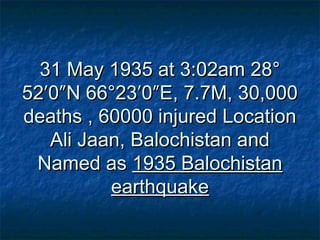
31 May 1935 at 3:02am 28°31 May 1935 at 3:02am 28°
52′0″N 66°23′0″E, 7.7M, 30,00052′0″N 66°23′0″E, 7.7M, 30,000
deaths , 60000 injured Locationdeaths , 60000 injured Location
Ali Jaan, Balochistan andAli Jaan, Balochistan and
Named asNamed as 1935 Balochistan1935 Balochistan
earthquakeearthquake
Precautionary Measures forPrecautionary Measures for
Disasters.Disasters.
STARTING POINTSSTARTING POINTS
 IN-COUNTRYIN-COUNTRY
BASIC ANDBASIC AND
APPLIEDAPPLIED
RESEARCHRESEARCH
 IMPLEMENTATIONIMPLEMENTATION
OF LESSONSOF LESSONS
FROMFROM
DISASTERSDISASTERS
 GROUNDGROUND
SHAKING MAPSSHAKING MAPS
 BUILDING CODESBUILDING CODES
 EDUCATIONALEDUCATIONAL
SURGES ANDSURGES AND
TRAINING FORTRAINING FOR
COMMUNITYCOMMUNITY
PROFESSIONALSPROFESSIONALS
STEPS TOWARDSSTEPS TOWARDS
EARTHQUAKE RESILIENCEEARTHQUAKE RESILIENCE
 CONTINUOUS PUBLICCONTINUOUS PUBLIC
AWARENESSAWARENESS
PROGRAMSPROGRAMS
 EDUCATIONALEDUCATIONAL
SURGES ANDSURGES AND
TRAINING FORTRAINING FOR
PROFESSIONALSPROFESSIONALS
 EXPANDED SEISMICEXPANDED SEISMIC
AND BUILDINGAND BUILDING
MONITORINGMONITORING
SYSTEMSSYSTEMS
 EXPANDEDEXPANDED
COMMUNICATIONCOMMUNICATION
SYSTEMSSYSTEMS
 MODERN BUILDINGMODERN BUILDING
CODES FOR NEWCODES FOR NEW
BUILDINGSBUILDINGS
 MODERN STANDARDSMODERN STANDARDS
FOR NEWFOR NEW
INFRASTRUCTUREINFRASTRUCTURE
 STRENGTHENING ANDSTRENGTHENING AND
RETROFIT FORRETROFIT FOR
EXISTINGEXISTING
STRUCTURESSTRUCTURES
 EXPANDED HEALTH-EXPANDED HEALTH-
CARE SYSTEMSCARE SYSTEMS
LONG-TERM NEEDS OF PAKISTANLONG-TERM NEEDS OF PAKISTAN
 NEED:NEED: 2 TO 3 MILLION NEW2 TO 3 MILLION NEW
DWELLINGS THAT AREDWELLINGS THAT ARE
EARTHQUAKE RESILIENT.EARTHQUAKE RESILIENT.
 NEED:NEED: NEW SCHOOLS THAT ARENEW SCHOOLS THAT ARE
EARTHQUAKE RESILIENT.EARTHQUAKE RESILIENT.
 NEED:NEED: NEW HOSPITALS THATNEW HOSPITALS THAT
ARE EARTHQUAKE RESILIENT.ARE EARTHQUAKE RESILIENT.
 NEED:NEED: NEW INFRASTRUCTURENEW INFRASTRUCTURE
THAT IS EARTHQUAKETHAT IS EARTHQUAKE
THE END-GAME OF AN
EDUCATIONAL SURGE
UNDER-
STAND
UNDER-
STAND
IDENT-
IFY
IDENT-
IFY
HEARHEAR
PERSON
-ALIZE
PERSON
-ALIZE
APPLI-
CATIONS
APPLI-
CATIONS
PERIOD OFPERIOD OF
INTEGRATIONINTEGRATION
WINDOW OFWINDOW OF
OPPORTUNITYOPPORTUNITY
PERIOD OFPERIOD OF
IMPLEMENTAIMPLEMENTA
TIONTION

Seismic waves their types & Seismicity of Pakistan

  • 2.
    TopicTopic Seismic wavesSeismic waves theirtheirtypestypes && Seismicity of PakistanSeismicity of Pakistan Prepared byPrepared by Azhar MahmoodAzhar Mahmood
  • 3.
    Seismic WavesSeismic Waves Seismic waves are the waves of energySeismic waves are the waves of energy that travel through the earth layers, andthat travel through the earth layers, and are a result of an earthquake, explosion orare a result of an earthquake, explosion or a volcanism.a volcanism.
  • 4.
     Seismic wavesare studied bySeismic waves are studied by geophysicist called seismologist and thesegeophysicist called seismologist and these waves are recorded by a seismometerwaves are recorded by a seismometer hydrophone in water, or accelerometer.hydrophone in water, or accelerometer.
  • 5.
     The propagation Thepropagation velocityvelocity of the waves depends of the waves depends on on densitydensity and  and elasticityelasticity of the medium. of the medium. Velocity tends to increase with depth, andVelocity tends to increase with depth, and ranges from approximately 2 to 8 km/s in theranges from approximately 2 to 8 km/s in the Earth's Earth's crustcrust up to 13 km/s in the deep  up to 13 km/s in the deep mantlemantle..  Earthquakes create distinct types of waves withEarthquakes create distinct types of waves with different velocities; when reaching seismicdifferent velocities; when reaching seismic observatories, their different observatories, their different travel timetravel time help help scientists to locate the source of thescientists to locate the source of the earthquake earthquake hypocenterhypocenter..
  • 6.
  • 7.
       In geophysicsthe refraction or reflectionIn geophysics the refraction or reflection of seismic waves is used for of seismic waves is used for researchresearch into into the structure of the Earth's interior, andthe structure of the Earth's interior, and man made vibrations are often generatedman made vibrations are often generated to investigate shallow, subsurfaceto investigate shallow, subsurface structures.structures.
  • 8.
    1.1. Body WavesBodyWaves  Primary WavesPrimary Waves  Secondary WavesSecondary Waves 2.2. Surface WavesSurface Waves  Rayleigh WavesRayleigh Waves  Love WavesLove Waves Types of seismic wavesTypes of seismic waves
  • 9.
     Traveling throughthe interior of theTraveling through the interior of the earth, earth, body wavesbody waves arrive before the arrive before the surface waves emitted by an earthquake.surface waves emitted by an earthquake. These waves are of a higherThese waves are of a higher frequency than surface waves.frequency than surface waves. Body WavesBody Waves
  • 10.
  • 11.
    Primary WavesPrimary Waves The first kind of body wave is the The first kind of body wave is the PP wavewave or  or primary waveprimary wave. This is the. This is the fastest kind of seismic wave, and,fastest kind of seismic wave, and, consequently, the first to 'arrive' at aconsequently, the first to 'arrive' at a seismic station. The P wave can moveseismic station. The P wave can move through solid rock and fluids, like water orthrough solid rock and fluids, like water or the liquid layers of the earth.the liquid layers of the earth.  It pushes and pulls the rock it movesIt pushes and pulls the rock it moves through just like sound waves push andthrough just like sound waves push and pull the air.pull the air.  P waves are also knownP waves are also known as as compressional wavescompressional waves , because of, because of the pushing and pulling they do.the pushing and pulling they do.
  • 12.
    Secondary WavesSecondary Waves The second type of body wave is the The second type of body wave is the SS wavewave or  or secondary wavesecondary wave, which is the, which is the second wave you feel in an earthquake.second wave you feel in an earthquake.  An S wave is slower than a P wave andAn S wave is slower than a P wave and can only move through solid rock, notcan only move through solid rock, not through any liquid medium. It is thisthrough any liquid medium. It is this property of S waves that led seismologistsproperty of S waves that led seismologists to conclude that the Earth's to conclude that the Earth's outer coreouter core is is a liquid.a liquid.
  • 13.
    Surface WavesSurface Waves Travelling only through the crust, Travelling only through the crust, surfacesurface waveswaves are of a lower frequency than are of a lower frequency than body waves, and are easily distinguishedbody waves, and are easily distinguished on a seismogram as a result. on a seismogram as a result.   Though they arrive after body waves, it isThough they arrive after body waves, it is surface waves that are almost enitrelysurface waves that are almost enitrely responsible for the damage andresponsible for the damage and destruction associated with earthquakes.destruction associated with earthquakes.
  • 14.
  • 15.
    Love WavesLove Waves The first kind of surface wave is calledThe first kind of surface wave is called a a Love waveLove wave, named after A.E.H. Love,, named after A.E.H. Love, a British mathematician.a British mathematician.        It's the fastest surface wave and movesIt's the fastest surface wave and moves the ground from side-to-side. Confined tothe ground from side-to-side. Confined to the surface of the crust, Love wavesthe surface of the crust, Love waves produce entirely horizontal motion.produce entirely horizontal motion.
  • 16.
  • 17.
    Rayleigh WavesRayleigh Waves The other kind of surface wave isThe other kind of surface wave is the the Rayleigh waveRayleigh wave, named for John, named for John William Strutt, Lord RayleighWilliam Strutt, Lord Rayleigh    A Rayleigh wave rolls along the groundA Rayleigh wave rolls along the ground just like a wave rolls across a lake or anjust like a wave rolls across a lake or an ocean. Because it rolls, it moves theocean. Because it rolls, it moves the ground up and down, and side-to-side inground up and down, and side-to-side in the same direction that the wave isthe same direction that the wave is moving.moving.
  • 18.
  • 19.
     Most ofthe shaking felt from anMost of the shaking felt from an earthquake is due to the Rayleigh wave,earthquake is due to the Rayleigh wave, which can be much larger than the otherwhich can be much larger than the other waves.waves.
  • 20.
     On thebasis of seismic waves weOn the basis of seismic waves we differentiate different layers of earthdifferentiate different layers of earth  On the basis of seismic waves we subOn the basis of seismic waves we sub classified the layers.classified the layers. FaisalFaisal 2020 Uses of seismic wavesUses of seismic waves
  • 21.
     Use inthe identification of hydrocarbonsUse in the identification of hydrocarbons reservoirs.reservoirs.  Oil and gas exploration.Oil and gas exploration. 2121 Uses;Uses;
  • 22.
    SEISMICITY OF PAKISTANSEISMICITYOF PAKISTAN Pakistan is an earthquake prone country. APakistan is an earthquake prone country. A number of earthquakes have hit Pakistannumber of earthquakes have hit Pakistan resulting in losses of life and property.resulting in losses of life and property. Pakistan Meteorological Department (PMD)Pakistan Meteorological Department (PMD) presently has a network of eleven seismicpresently has a network of eleven seismic stations. By using recorded data thestations. By using recorded data the seismicity and zoning maps of Pakistanseismicity and zoning maps of Pakistan
  • 23.
    From our experiencesderived from theFrom our experiences derived from the recent October 8, 2005, Kashmir earthquakerecent October 8, 2005, Kashmir earthquake it emphasized the importance of redefiningit emphasized the importance of redefining the seismic zonation for whole Pakistanthe seismic zonation for whole Pakistan especially seismically active areas toespecially seismically active areas to minimize further losses of human lives andminimize further losses of human lives and failure of infrastructure due to suchfailure of infrastructure due to such earthquakesearthquakes
  • 24.
    Geographical and Tectoniclocation ofGeographical and Tectonic location of PakistanPakistan Pakistan is situated in South Asian regionPakistan is situated in South Asian region between longitudes 61º & 76º E and latitudesbetween longitudes 61º & 76º E and latitudes 24º & 37º N covering a total land area of24º & 37º N covering a total land area of 796,095 sq. km. The country shares its796,095 sq. km. The country shares its borders with Iran to the West, India in theborders with Iran to the West, India in the Southeast, Afghanistan in the Northwest, andSoutheast, Afghanistan in the Northwest, and China in the North.China in the North. Figure 1Figure 1 shows, theshows, the Geographical location of Pakistan in SouthGeographical location of Pakistan in South Asia.Asia.
  • 25.
    Seismic Zones ofPakistanSeismic Zones of Pakistan Seismic zoning map of Pakistan have beenSeismic zoning map of Pakistan have been developed by Pakistan Meteorologicaldeveloped by Pakistan Meteorological Department in 1998 by earthquake data collectedDepartment in 1998 by earthquake data collected from United States of Geological Survey (USGS),from United States of Geological Survey (USGS), International Seismological Centre (ISC) andInternational Seismological Centre (ISC) and PMD for the period from 1905 to 1998.PMD for the period from 1905 to 1998.
  • 27.
    Seismicity of PakistanSeismicityof Pakistan  The seismicity of Pakistan concern withThe seismicity of Pakistan concern with the series of EARTHQUAKES damagingthe series of EARTHQUAKES damaging different areas of Pakistan at huge extent.different areas of Pakistan at huge extent.  Two major earthquakes areTwo major earthquakes are  1: Earthquake of 20051: Earthquake of 2005  2: Earthquake of 20082: Earthquake of 2008  3: Earthquake of 20133: Earthquake of 2013
  • 28.
    Earthquake of 8oct,2005Earthquake of 8 oct,2005
  • 29.
     Use inthe identification of hydrocarbonsUse in the identification of hydrocarbons reservoirs.reservoirs.  Oil and gas exploration.Oil and gas exploration. 2929 Location MapLocation Map
  • 30.
     The M7.6 quake on Oct. 8, 2005,The M 7.6 quake on Oct. 8, 2005, killed about 80,000 people inkilled about 80,000 people in northwestern Pakistan and Kashmirnorthwestern Pakistan and Kashmir and left more than 3 millionand left more than 3 million homelesshomeless
  • 31.
     THE SEVERITYOF THETHE SEVERITY OF THE 2005 KASHMIR EARTHQUAKE2005 KASHMIR EARTHQUAKE DISASTERDISASTER WAS RELATED TO ITSWAS RELATED TO ITS MAGNITUDE, SHALLOW DEPTH,MAGNITUDE, SHALLOW DEPTH, SOIL AMPLIFICATION, AND POORSOIL AMPLIFICATION, AND POOR CONSTRUCTIONCONSTRUCTION
  • 32.
    KASHMIR EARTHQUAKEKASHMIR EARTHQUAKE 8:50 AM8:50 AM OCTOBER 8, 2005OCTOBER 8, 2005  M 7.6M 7.6  10 KM (6 MI)10 KM (6 MI) DEPTHDEPTH  79,000 DEAD IN PAKISTAN; 1,40079,000 DEAD IN PAKISTAN; 1,400 IN INDIAIN INDIA  COLLAPSEDCOLLAPSED SCHOOLS ANDSCHOOLS AND HOSPITALSHOSPITALS  3 MILLION3 MILLION HOMELESSHOMELESS
  • 33.
    OCTOBER 8, 2005PAKISTANOCTOBER 8, 2005 PAKISTAN EARTHQUAKEEARTHQUAKE
  • 34.
    OCCURRENCEOCCURRENCE  The earthquakeoccurred in theThe earthquake occurred in the Main Boundary Thrust ZoneMain Boundary Thrust Zone (MBTZ), which runs along the(MBTZ), which runs along the Himalayan Arc for about 2,500 km.Himalayan Arc for about 2,500 km.  The epicenter was nearThe epicenter was near MuzaffarabadMuzaffarabad, the capital of, the capital of Pakistani administered KashmirPakistani administered Kashmir
  • 35.
  • 36.
  • 37.
    Earthquake of 24sep,2013Earthquake of 24 sep,2013
  • 38.
    4:29 PM, SEPT.24, 20134:29 PM, SEPT. 24, 2013  AtAt 4:29 pm local time4:29 pm local time , a dangerous, a dangerous time of the day, a magnitude-7.7time of the day, a magnitude-7.7 earthquake occurred at aearthquake occurred at a SHALLOWSHALLOW depth of 23 km in adepth of 23 km in a seismically active area 63 km (36seismically active area 63 km (36 miles) from the city ofmiles) from the city of Awaran,Awaran, located in Pakistan’s Balochistanlocated in Pakistan’s Balochistan Province.Province.
  • 39.
    TECTONIC SETTINGTECTONIC SETTING According to the US GeologicalAccording to the US Geological Survey, the earthquake, which hadSurvey, the earthquake, which had a relatively shallow depth, wasa relatively shallow depth, was centered at acentered at a complex triplecomplex triple junction in the Earth’s subsurfacejunction in the Earth’s subsurface where the Arabian tectonic plate iswhere the Arabian tectonic plate is pushing its way beneath thepushing its way beneath the Eurasian plate as the Indian plate isEurasian plate as the Indian plate is ramming both of them from theramming both of them from the south:south:
  • 40.
    A COMPLEX TECTONICACOMPLEX TECTONIC SETTINGSETTING
  • 41.
    UNIQUE HAPPENING:UNIQUE HAPPENING: THEQUAKE’STHE QUAKE’S TECTONICS CREATEDTECTONICS CREATED AN ISLANDAN ISLAND
  • 42.
    ISLAND CREATEDISLAND CREATED DURINGTHE QUAKEDURING THE QUAKE
  • 43.
    ISLAND: EARTHQUAKEISLAND: EARTHQUAKE ORVOLCANO RELATED?OR VOLCANO RELATED?
  • 44.
    NEW ISLAND EMMITINGNEWISLAND EMMITING POISONOUS GASPOISONOUS GAS  The new island, nowThe new island, now extending 20 m (60-70 feet)extending 20 m (60-70 feet) above the water, beganabove the water, began emitting poisonous methaneemitting poisonous methane gas on September 26.gas on September 26.
  • 45.
    EARLY REPORTS OFEARLYREPORTS OF DEATHSDEATHS  Early reportsEarly reports indicate thatindicate that at leastat least 350 people died350 people died andand 450 were450 were injuredinjured as the result of collapses ofas the result of collapses of mud brick houses and poorlymud brick houses and poorly constructed buildings.constructed buildings.  90 present of Anwaran destroyed.90 present of Anwaran destroyed.
  • 46.
    Earthquake of 29Earthquakeof 29 oct,2008oct,2008
  • 47.
  • 48.
    2008 PAKISTAN2008 PAKISTAN EARTHQUAKEEARTHQUAKE The earthquake struck near Quetta,The earthquake struck near Quetta, the capital of Baluchistan Province.the capital of Baluchistan Province.  QuettaQuetta, hit by a devastating, hit by a devastating earthquakeearthquake in 1935in 1935, is located in a, is located in a known fault zone caused byknown fault zone caused by ongoing collision of the Indo-ongoing collision of the Indo- Australian and Eurasian plates.Australian and Eurasian plates.
  • 49.
    2008 PAKISTAN2008 PAKISTAN EARTHQUAKEEARTHQUAKE ZiaratZiarat, located in the hills and, located in the hills and one ofone of the poorest areas of Pakistanthe poorest areas of Pakistan, was, was devastated bydevastated by landslides andlandslides and collapse of mud brick housescollapse of mud brick houses..  Early estimates indicate that asEarly estimates indicate that as many asmany as 12,000 are now homeless12,000 are now homeless in 40 degree weatherin 40 degree weather..
  • 50.
    The The 2008 Pakistan earthquake2008Pakistan earthquake  was a was a magnitude M6.4 earthquake that hit themagnitude M6.4 earthquake that hit the Pakistani province of Balochistan on OctoberPakistani province of Balochistan on October 29, 2008. The US Geological29, 2008. The US Geological Survey reported that the quake occurredSurvey reported that the quake occurred 60 km north of Quetta and 185 km southeast60 km north of Quetta and 185 km southeast of the Afghanistan city of Kandahar at 04:09of the Afghanistan city of Kandahar at 04:09 local time (28 October, 23:09 UTC) at alocal time (28 October, 23:09 UTC) at a depth of 15 km at 30.653°N, 67.323°E.depth of 15 km at 30.653°N, 67.323°E. MoreMore than 200 were injured and 120,000 werethan 200 were injured and 120,000 were homelesshomeless
  • 51.
    LONG-TERM RECOVERYLONG-TERM RECOVERY NEEDSAFTER EARTHQUAKENEEDS AFTER EARTHQUAKE DISASTERDISASTER  NEEDNEED: 2 TO 3 MILLION NEW: 2 TO 3 MILLION NEW DWELLINGS THAT ARE EARTHQUAKEDWELLINGS THAT ARE EARTHQUAKE RESILIENT.RESILIENT.  NEEDNEED:: NEW SCHOOLS THAT ARENEW SCHOOLS THAT ARE EARTHQUAKE RESILIENT.EARTHQUAKE RESILIENT.  NEEDNEED:: NEW HOSPITALS THAT ARENEW HOSPITALS THAT ARE EARTHQUAKE RESILIENT.EARTHQUAKE RESILIENT.  NEEDNEED:: INFRASTRUCTURE THAT ISINFRASTRUCTURE THAT IS EARTHQUAKE RESILIENT(Public HealthEARTHQUAKE RESILIENT(Public Health for example).for example).
  • 52.
    28 December 1974,at 12:1128 December 1974, at 12:11 UTC35°06′N 72°54′E6.2UTC35°06′N 72°54′E6.2 5300 deaths, 17000 injured5300 deaths, 17000 injured Hunza, Hazara and Swat districtHunza, Hazara and Swat district  North-West Frontier Province North-West Frontier Province Named asNamed as 1974 Hunza1974 Hunza earthquakeearthquake
  • 53.
    31 May 1935at 3:02am 28°31 May 1935 at 3:02am 28° 52′0″N 66°23′0″E, 7.7M, 30,00052′0″N 66°23′0″E, 7.7M, 30,000 deaths , 60000 injured Locationdeaths , 60000 injured Location Ali Jaan, Balochistan andAli Jaan, Balochistan and Named asNamed as 1935 Balochistan1935 Balochistan earthquakeearthquake
  • 54.
    Precautionary Measures forPrecautionaryMeasures for Disasters.Disasters.
  • 55.
    STARTING POINTSSTARTING POINTS IN-COUNTRYIN-COUNTRY BASIC ANDBASIC AND APPLIEDAPPLIED RESEARCHRESEARCH  IMPLEMENTATIONIMPLEMENTATION OF LESSONSOF LESSONS FROMFROM DISASTERSDISASTERS  GROUNDGROUND SHAKING MAPSSHAKING MAPS  BUILDING CODESBUILDING CODES  EDUCATIONALEDUCATIONAL SURGES ANDSURGES AND TRAINING FORTRAINING FOR COMMUNITYCOMMUNITY PROFESSIONALSPROFESSIONALS
  • 56.
    STEPS TOWARDSSTEPS TOWARDS EARTHQUAKERESILIENCEEARTHQUAKE RESILIENCE  CONTINUOUS PUBLICCONTINUOUS PUBLIC AWARENESSAWARENESS PROGRAMSPROGRAMS  EDUCATIONALEDUCATIONAL SURGES ANDSURGES AND TRAINING FORTRAINING FOR PROFESSIONALSPROFESSIONALS  EXPANDED SEISMICEXPANDED SEISMIC AND BUILDINGAND BUILDING MONITORINGMONITORING SYSTEMSSYSTEMS  EXPANDEDEXPANDED COMMUNICATIONCOMMUNICATION SYSTEMSSYSTEMS  MODERN BUILDINGMODERN BUILDING CODES FOR NEWCODES FOR NEW BUILDINGSBUILDINGS  MODERN STANDARDSMODERN STANDARDS FOR NEWFOR NEW INFRASTRUCTUREINFRASTRUCTURE  STRENGTHENING ANDSTRENGTHENING AND RETROFIT FORRETROFIT FOR EXISTINGEXISTING STRUCTURESSTRUCTURES  EXPANDED HEALTH-EXPANDED HEALTH- CARE SYSTEMSCARE SYSTEMS
  • 57.
    LONG-TERM NEEDS OFPAKISTANLONG-TERM NEEDS OF PAKISTAN  NEED:NEED: 2 TO 3 MILLION NEW2 TO 3 MILLION NEW DWELLINGS THAT AREDWELLINGS THAT ARE EARTHQUAKE RESILIENT.EARTHQUAKE RESILIENT.  NEED:NEED: NEW SCHOOLS THAT ARENEW SCHOOLS THAT ARE EARTHQUAKE RESILIENT.EARTHQUAKE RESILIENT.  NEED:NEED: NEW HOSPITALS THATNEW HOSPITALS THAT ARE EARTHQUAKE RESILIENT.ARE EARTHQUAKE RESILIENT.  NEED:NEED: NEW INFRASTRUCTURENEW INFRASTRUCTURE THAT IS EARTHQUAKETHAT IS EARTHQUAKE
  • 58.
    THE END-GAME OFAN EDUCATIONAL SURGE UNDER- STAND UNDER- STAND IDENT- IFY IDENT- IFY HEARHEAR PERSON -ALIZE PERSON -ALIZE APPLI- CATIONS APPLI- CATIONS PERIOD OFPERIOD OF INTEGRATIONINTEGRATION WINDOW OFWINDOW OF OPPORTUNITYOPPORTUNITY PERIOD OFPERIOD OF IMPLEMENTAIMPLEMENTA TIONTION