A Wavelet Transform based
application for seismic waves.
Analysis of the performance.
Telecommunication Engineering Thesis

Author: Pedro Cerón Colás
Fraunhofer IIS, Erlangen December 9th 2013
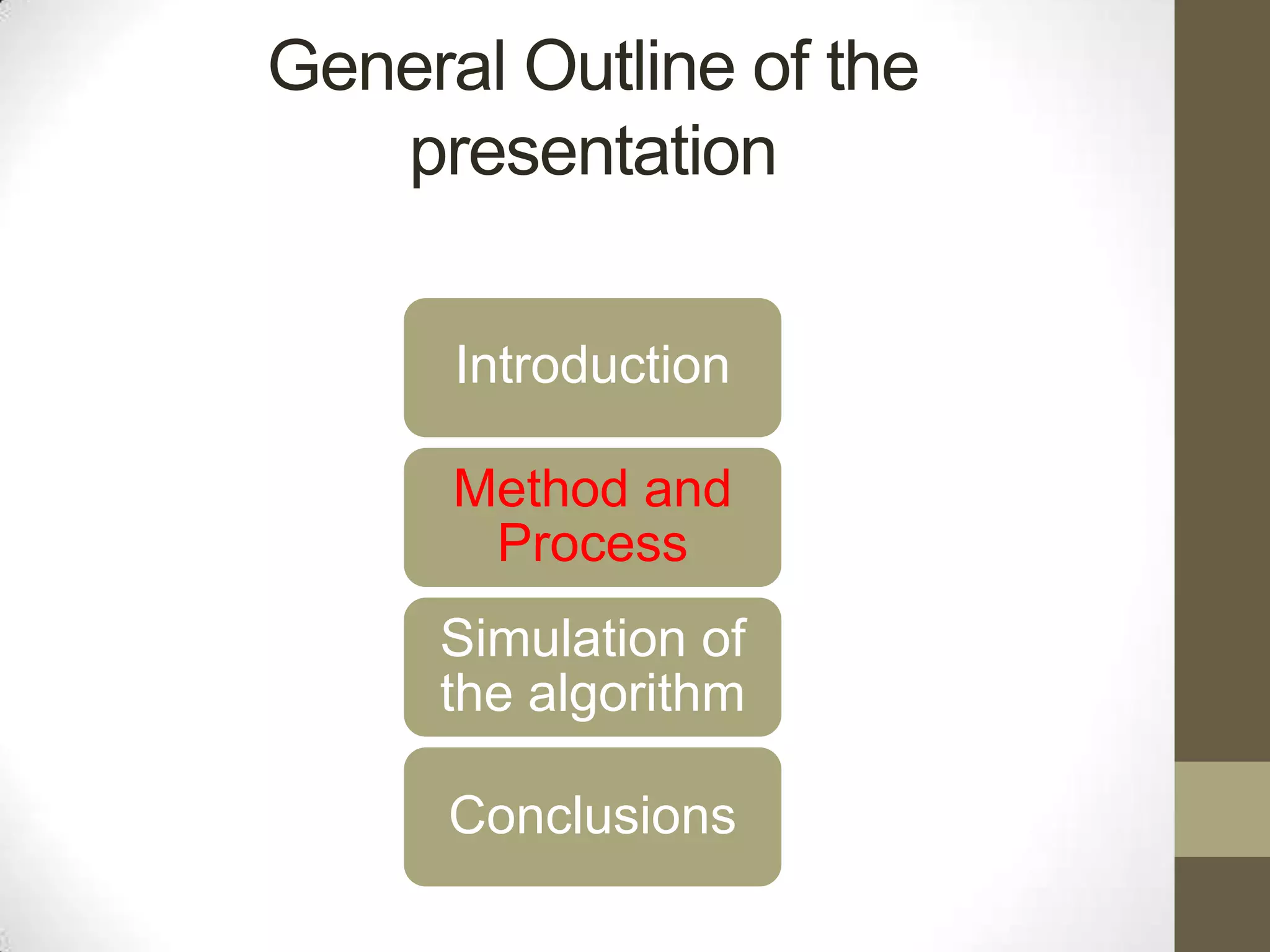
General outline of the presentation
Introduction
Method and
Process
Simulation of
the algorithm
Conclusions
Overview of the problem
Geophysics
field
Design of Matlab
algorithms

Complex
Continuous
Wavelet
Transform

Bio

_QRS Complex, “Biomedical Signal
Processing”, Sorno & Laguna.
_Circular buffer 3rd FIR filter. “Sound digital
processing”, Rocchesso.

Sound
Procces
ing

But… Where can we apply the
Wavelet Transform?
Some geophysical issues
•

3 components: EW, NS,
Z (transverse)

•

Body Waves (P and S
waves) and Surphase
Waves (Rayleigh and
Love).

•

Seismic Spectrum:
0.001-10hz [1].

•

Frequency
characterization:
Spectrum overlaping of
Body and Surphase
Waves .

Image taken from Dr. José Ignacio Badal Nicolás (Faculty
of Geologics, Zaragoza University). Shared resource.
[1] “Fundamentals of Geophysics” Agustín Udías & Julio
Mezcua. Chap.13
General Outline of the
presentation
Introduction
Method and
Process
Simulation of
the algorithm
Conclusions
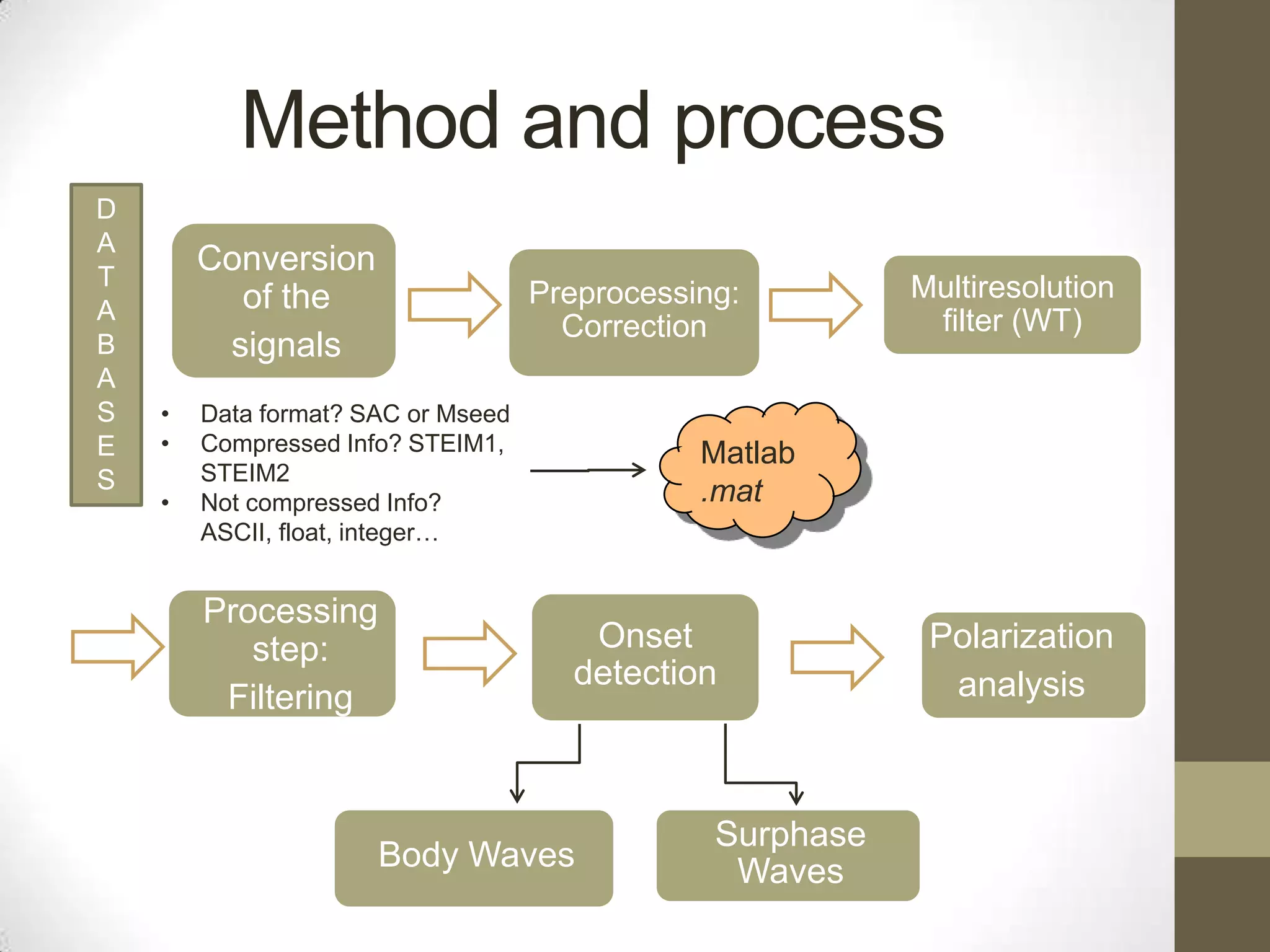
Method and process
D
A
T
A
B
A
S
E
S

Conversion
of the
signals
•
•
•

Preprocessing:
Correction

Data format? SAC or Mseed
Compressed Info? STEIM1,
STEIM2
Not compressed Info?
ASCII, float, integer…

Processing
step:
Filtering

Multiresolution
filter (WT)

Matlab
.mat

Onset
detection

Body Waves

Surphase
Waves

Polarization
analysis
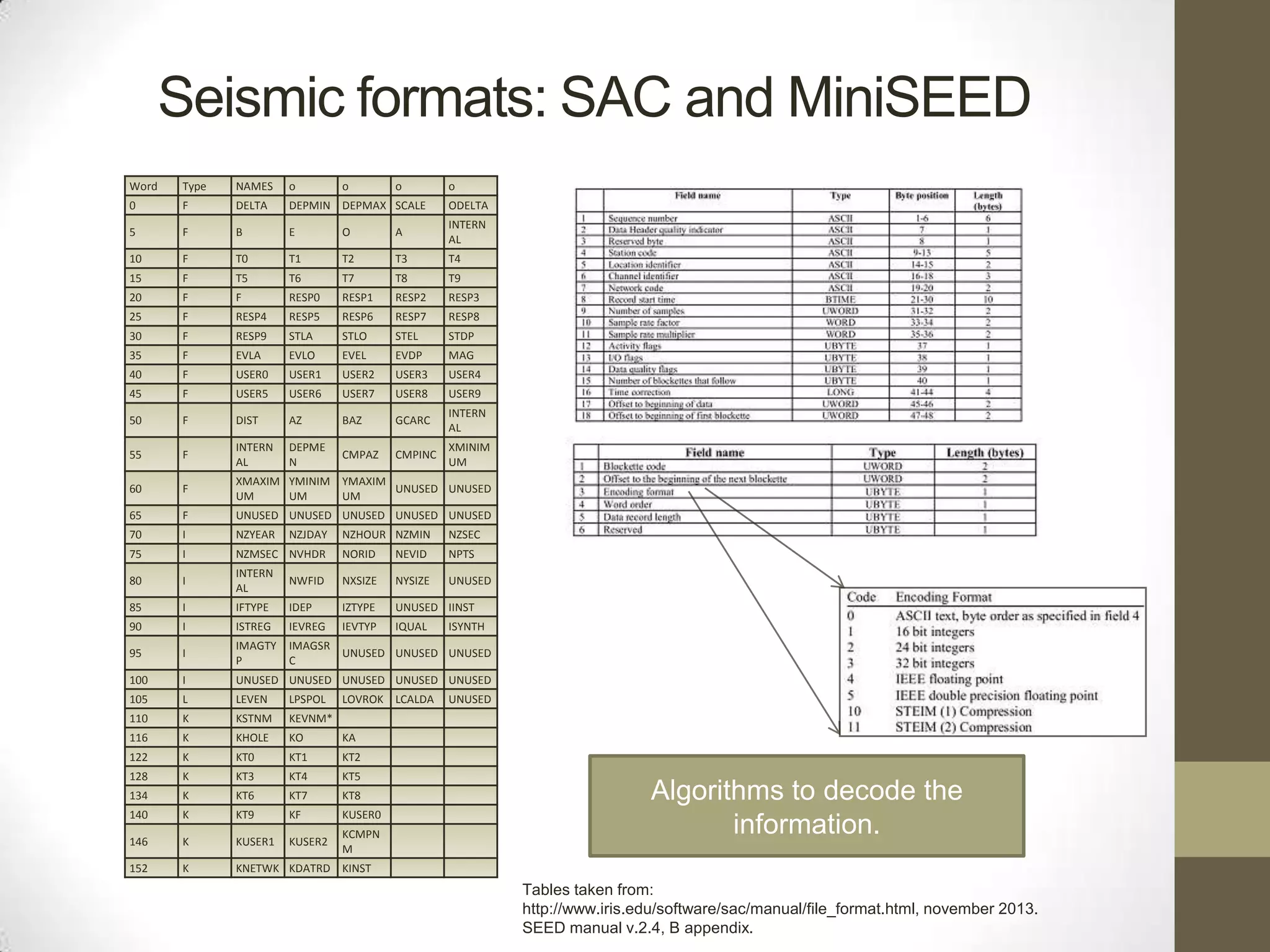
Seismic formats: SAC and MiniSEED
Word

Type

NAMES

o

0

F

DELTA

DEPMIN DEPMAX SCALE

ODELTA

5

F

B

E

O

A

INTERN
AL

10

F

T0

T1

T2

T3

T4

15

F

T5

T6

T7

T8

T9

20

F

F

RESP0

RESP1

RESP2

RESP3

25

F

RESP4

RESP5

RESP6

RESP7

RESP8

30

F

RESP9

STLA

STLO

STEL

STDP

35

F

EVLA

EVLO

EVEL

EVDP

MAG

40

F

USER0

USER1

USER2

USER3

USER4

45

F

USER5

USER6

USER7

USER8

USER9

50

F

DIST

AZ

BAZ

GCARC

INTERN
AL

55

F

INTERN
AL

DEPME
N

CMPAZ

CMPINC

XMINIM
UM

60

F

XMAXIM YMINIM YMAXIM
UNUSED UNUSED
UM
UM
UM

65

F

UNUSED UNUSED UNUSED UNUSED UNUSED

70

I

NZYEAR

NZHOUR NZMIN

NZSEC

75

I

NZMSEC NVHDR

NORID

NEVID

NPTS

80

I

INTERN
AL

NWFID

NXSIZE

NYSIZE

UNUSED

85

I

IFTYPE

IDEP

IZTYPE

UNUSED IINST

90

I

ISTREG

IEVREG

IEVTYP

IQUAL

95

I

IMAGTY
P

IMAGSR
UNUSED UNUSED UNUSED
C

100

I

UNUSED UNUSED UNUSED UNUSED UNUSED

105

L

LEVEN

LPSPOL

110

K

KSTNM

KEVNM*

116

K

KHOLE

KO

KA

122

K

KT0

KT1

KT2

128

K

KT3

KT4

KT5

134

K

KT6

KT7

KT8

140

K

KT9

KF

KUSER0

146

K

KUSER1

KUSER2

KCMPN
M

152

K

KNETWK KDATRD KINST

NZJDAY

o

o

LOVROK LCALDA

o

ISYNTH

UNUSED

Algorithms to decode the
information.
Tables taken from:
http://www.iris.edu/software/sac/manual/file_format.html, november 2013.
SEED manual v.2.4, B appendix.
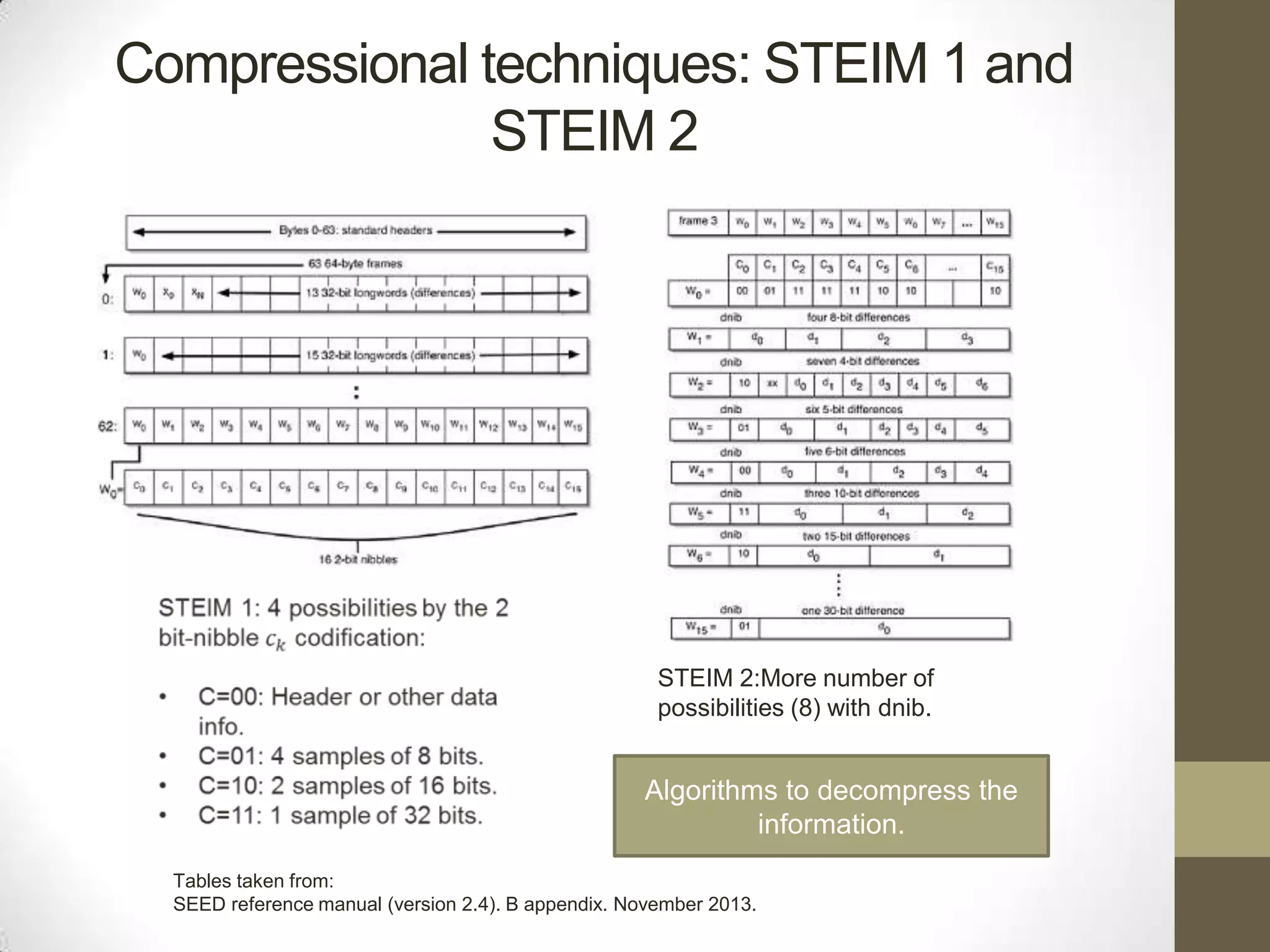
Compressional techniques: STEIM 1 and
STEIM 2

STEIM 2:More number of
possibilities (8) with dnib.

Algorithms to decompress the
information.
Tables taken from:
SEED reference manual (version 2.4). B appendix. November 2013.
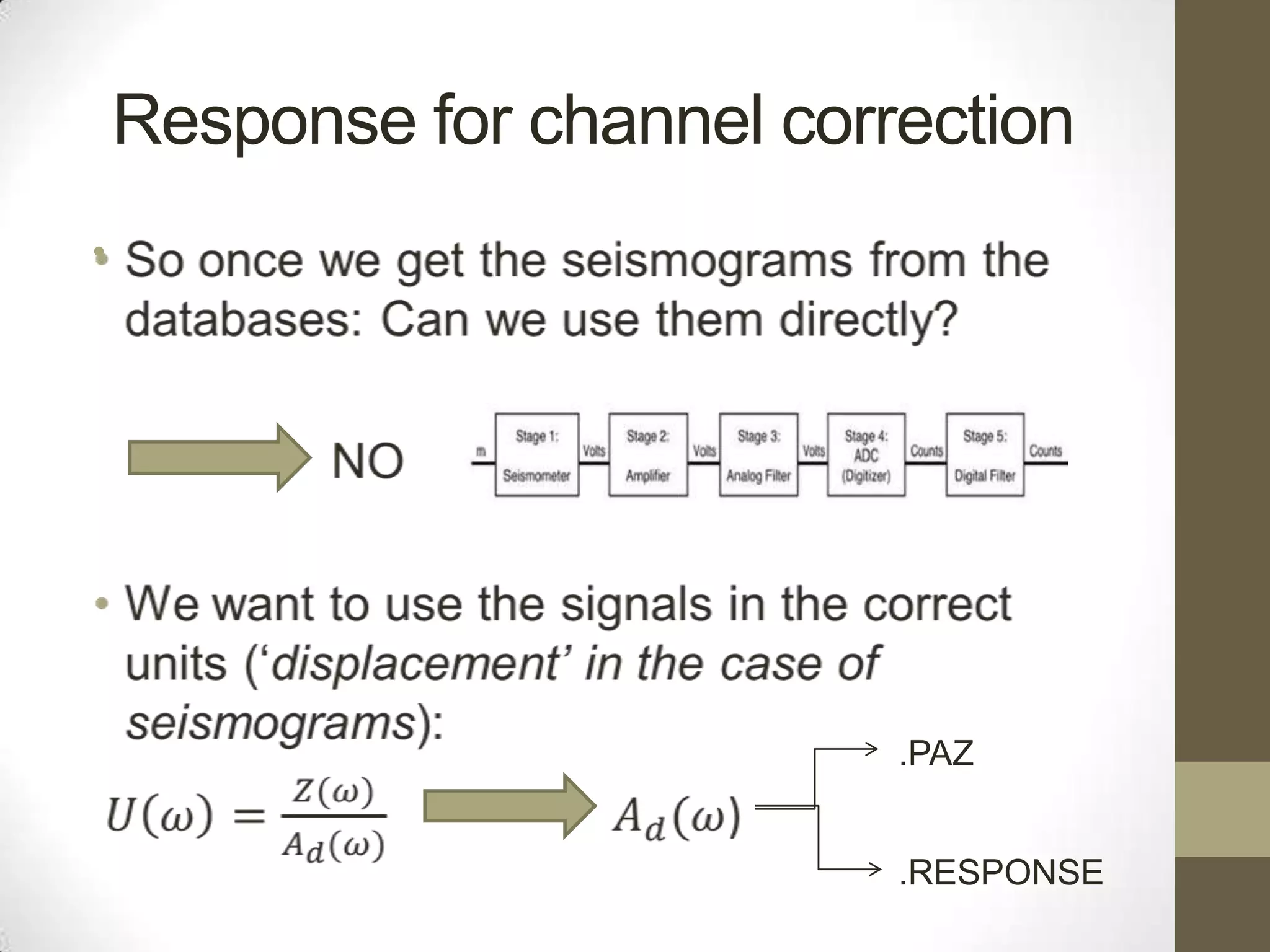
Response for channel correction
•

.PAZ
.RESPONSE
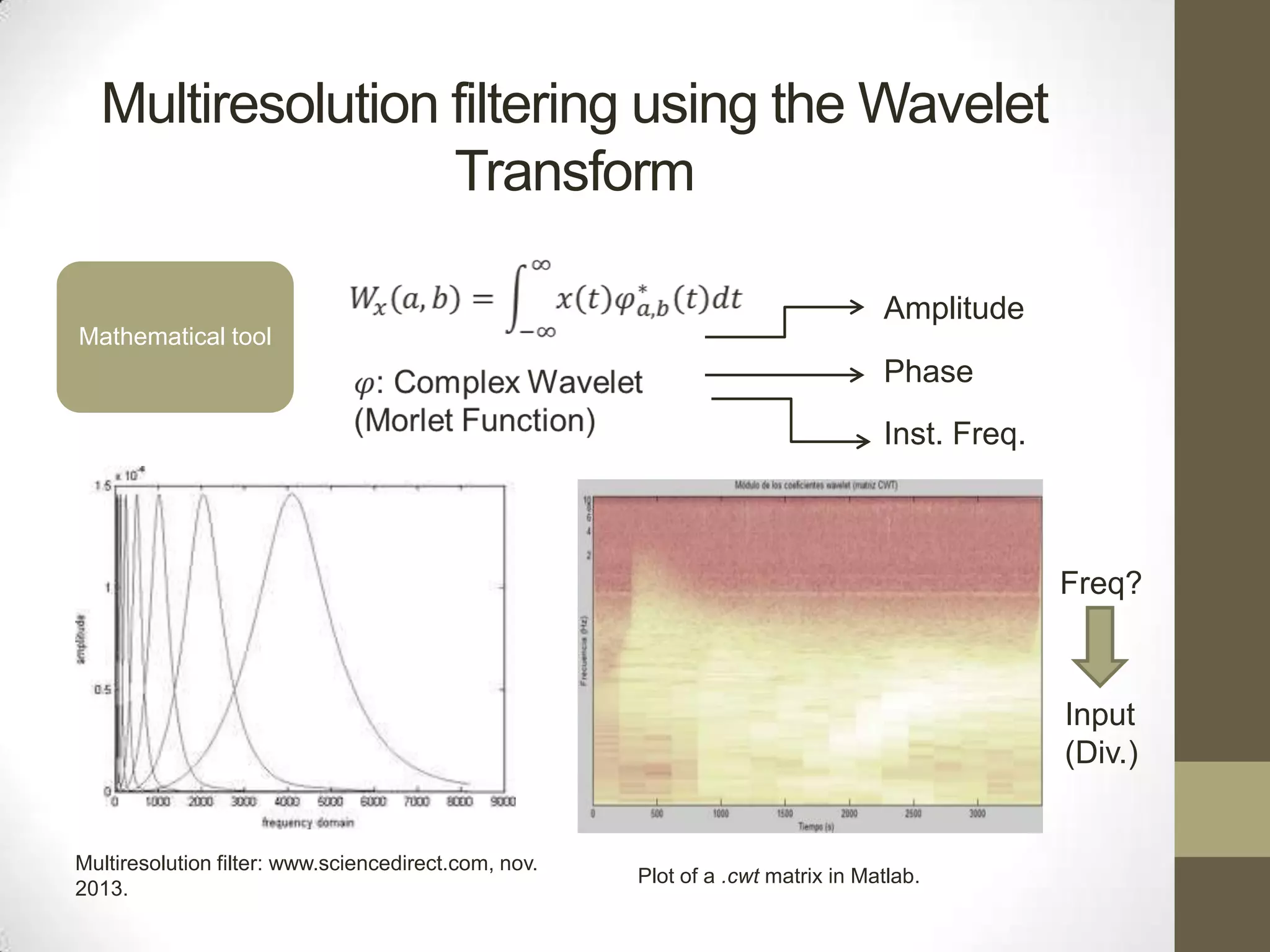
Multiresolution filtering using the Wavelet
Transform
Amplitude
Mathematical tool

Phase
Inst. Freq.

Freq?

Input
(Div.)

Multiresolution filter: www.sciencedirect.com, nov.
2013.

Plot of a .cwt matrix in Matlab.
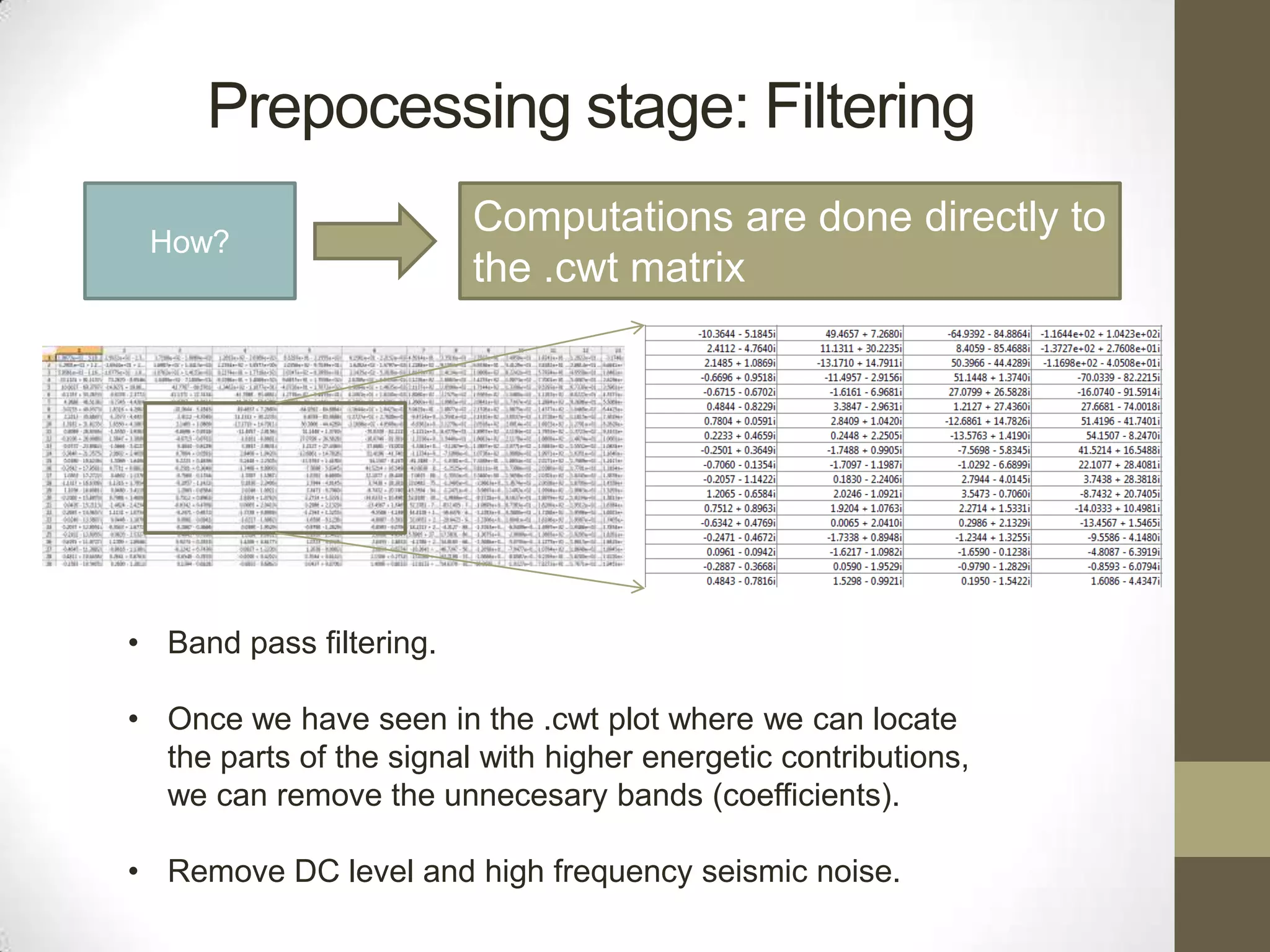
Prepocessing stage: Filtering
How?

Computations are done directly to
the .cwt matrix

• Band pass filtering.
• Once we have seen in the .cwt plot where we can locate
the parts of the signal with higher energetic contributions,
we can remove the unnecesary bands (coefficients).

• Remove DC level and high frequency seismic noise.
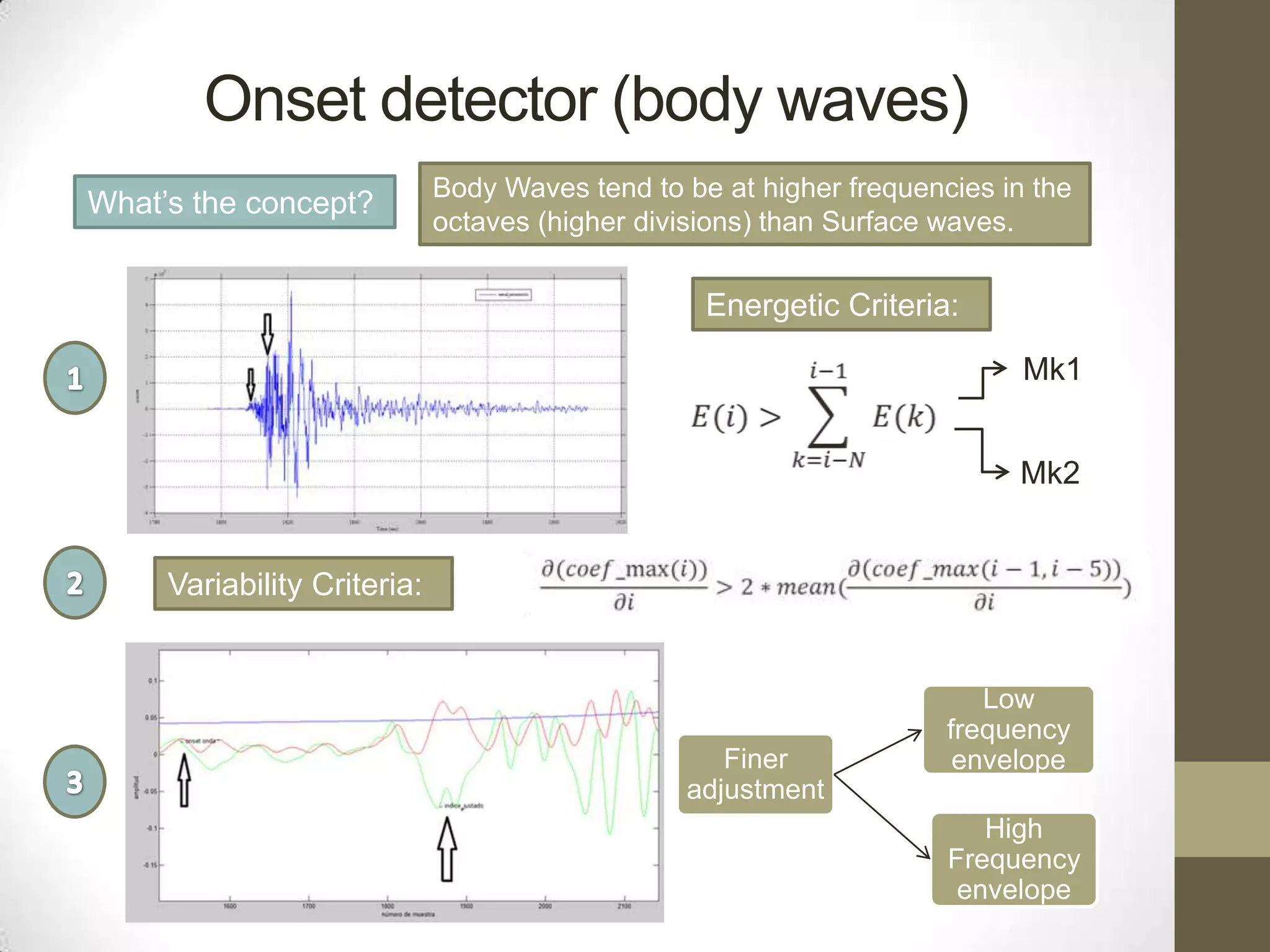
Onset detector (body waves)
What’s the concept?

Body Waves tend to be at higher frequencies in the
octaves (higher divisions) than Surface waves.

Energetic Criteria:

Mk1
Mk2

Variability Criteria:

Finer
adjustment

Low
frequency
envelope
High
Frequency
envelope
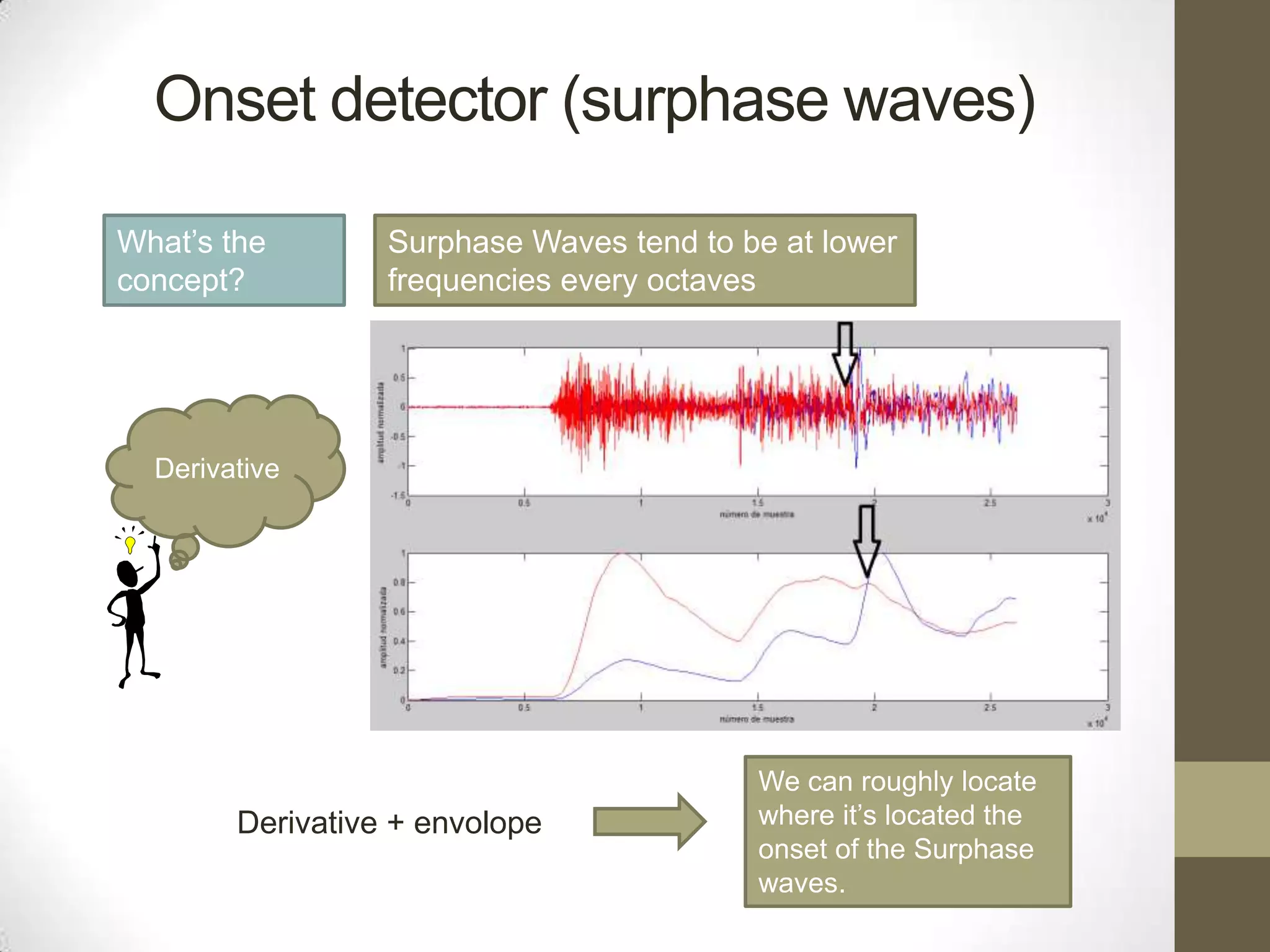
Onset detector (surphase waves)
What’s the
concept?

Surphase Waves tend to be at lower
frequencies every octaves

Derivative

Derivative + envolope

We can roughly locate
where it’s located the
onset of the Surphase
waves.
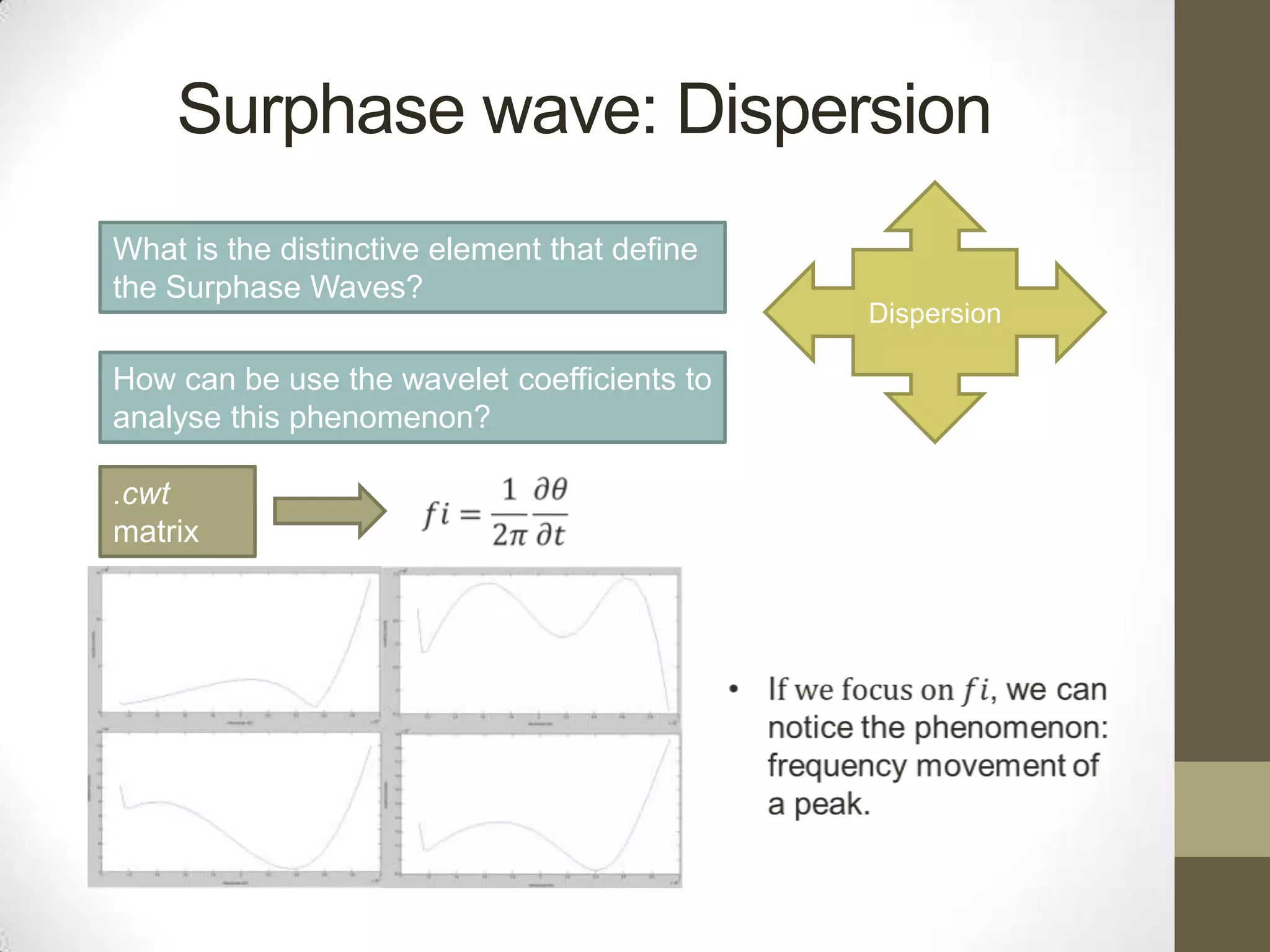
Surphase wave: Dispersion
What is the distinctive element that define
the Surphase Waves?
How can be use the wavelet coefficients to
analyse this phenomenon?
.cwt
matrix

Dispersion
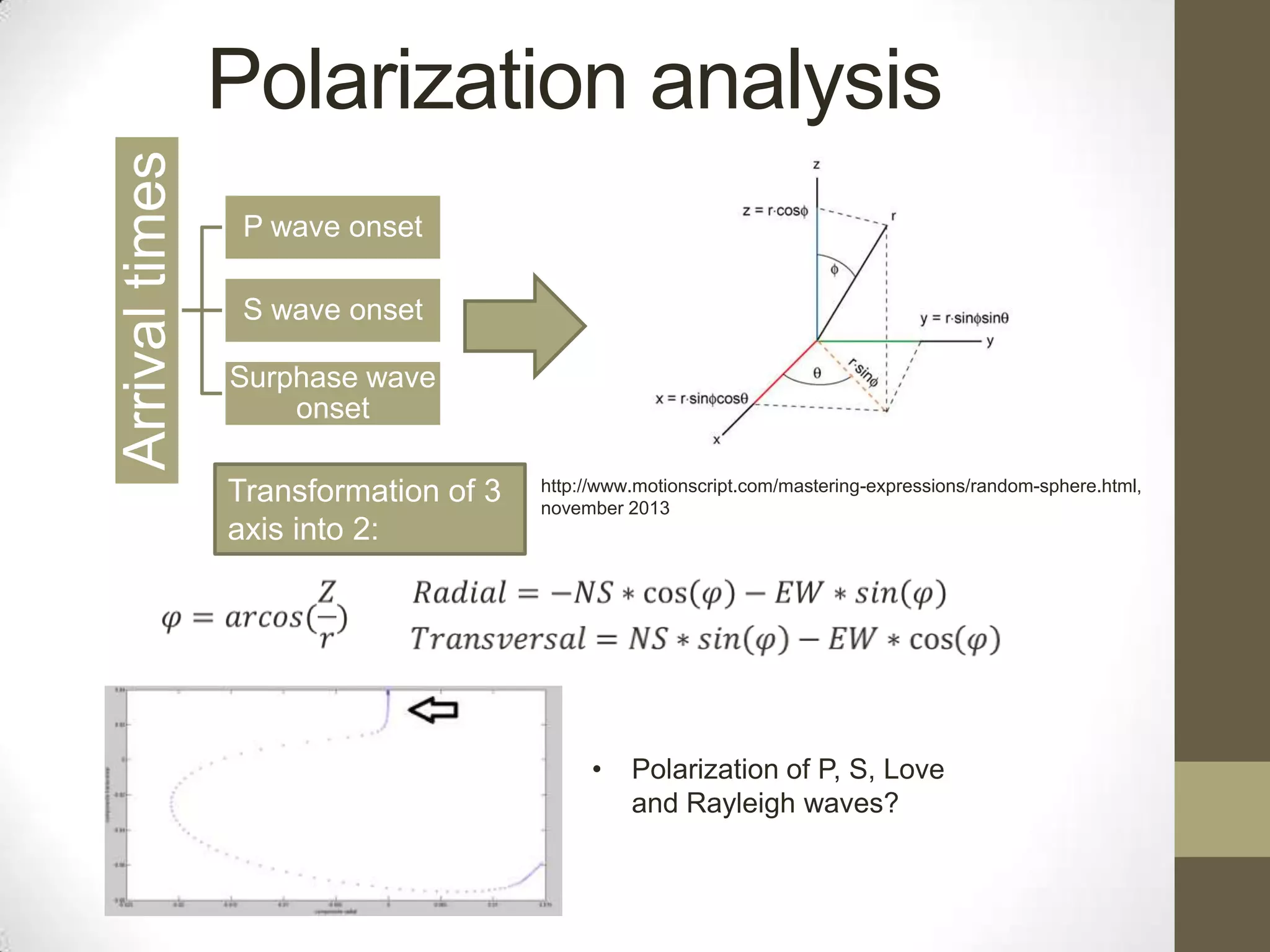
Arrival times

Polarization analysis
P wave onset
S wave onset
Surphase wave
onset

Transformation of 3
axis into 2:

http://www.motionscript.com/mastering-expressions/random-sphere.html,
november 2013

•

Polarization of P, S, Love
and Rayleigh waves?
General Outline of the
presentation
Introduction
Method and
Process
Simulation of
the algorithm
Conclusions
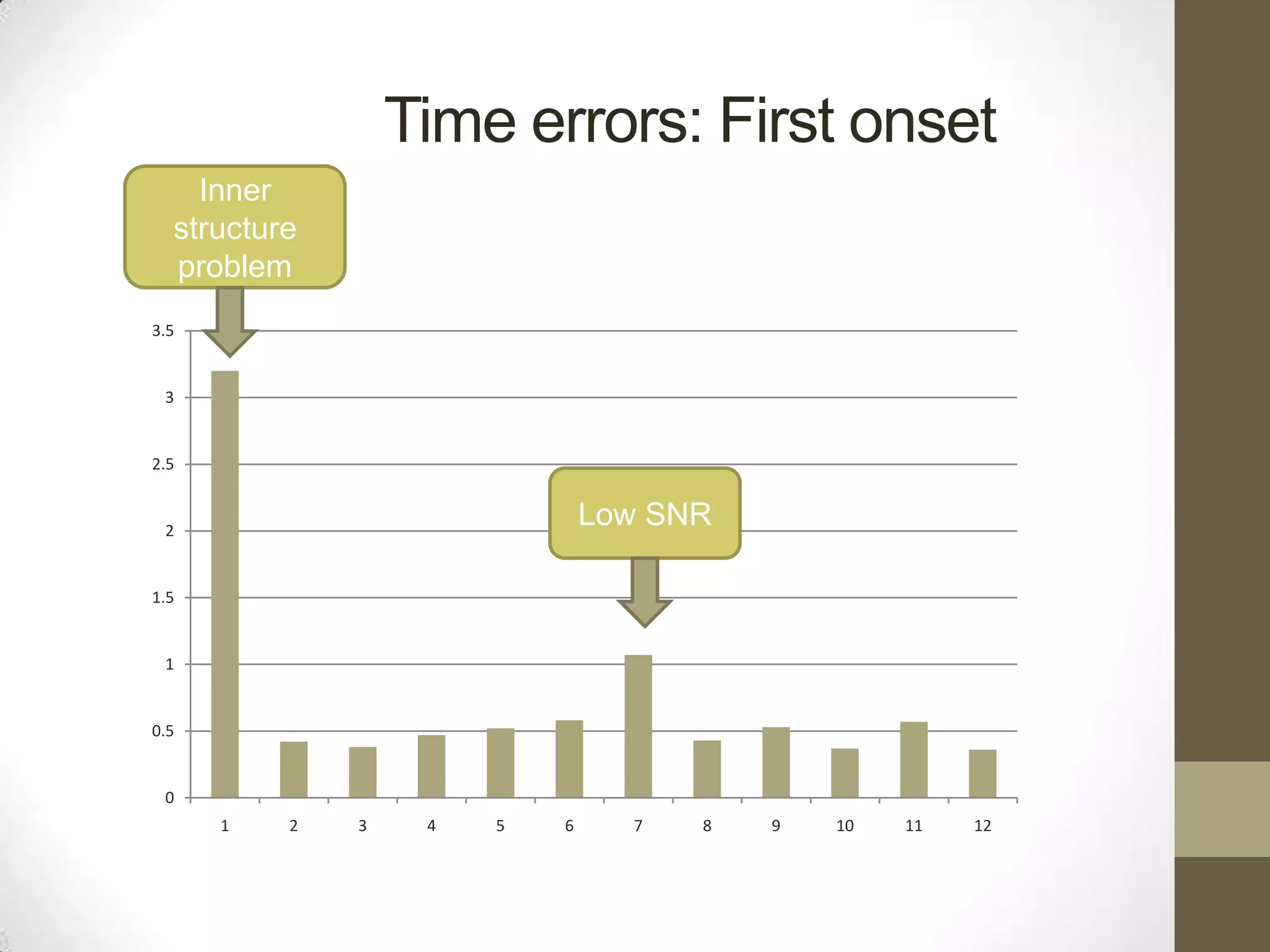
Time errors: First onset
Inner
structure
problem
3.5

3

2.5

Low SNR

2

1.5

1

0.5

0
1

2

3

4

5

6

7

8

9

10

11

12
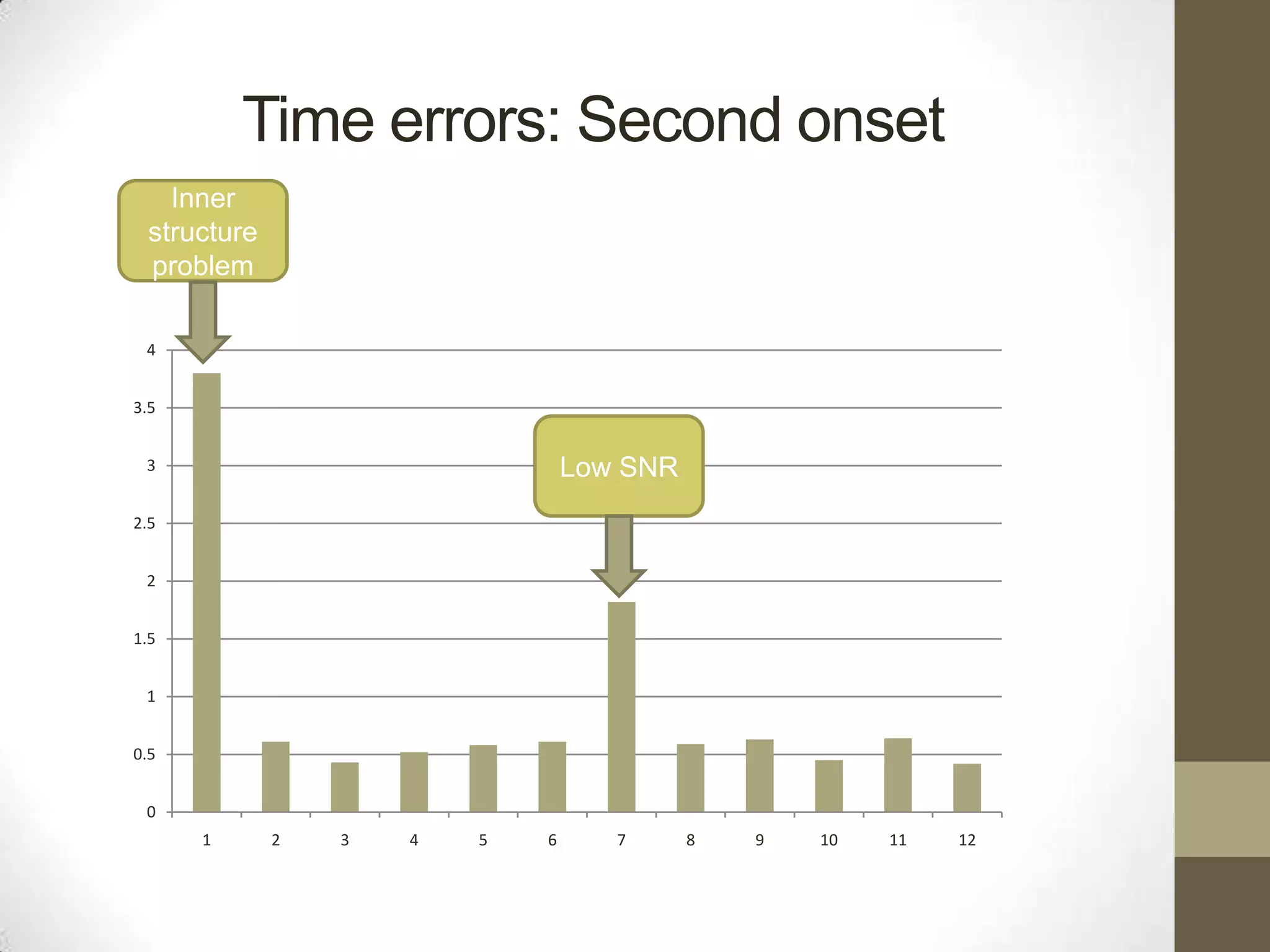
Time errors: Second onset
Inner
structure
problem
4
3.5

Low SNR

3
2.5
2
1.5
1
0.5
0
1

2

3

4

5

6

7

8

9

10

11

12
General Outline of the
presentation
Introduction
Method and
Process
Simulation of
the algorithm
Conclusions
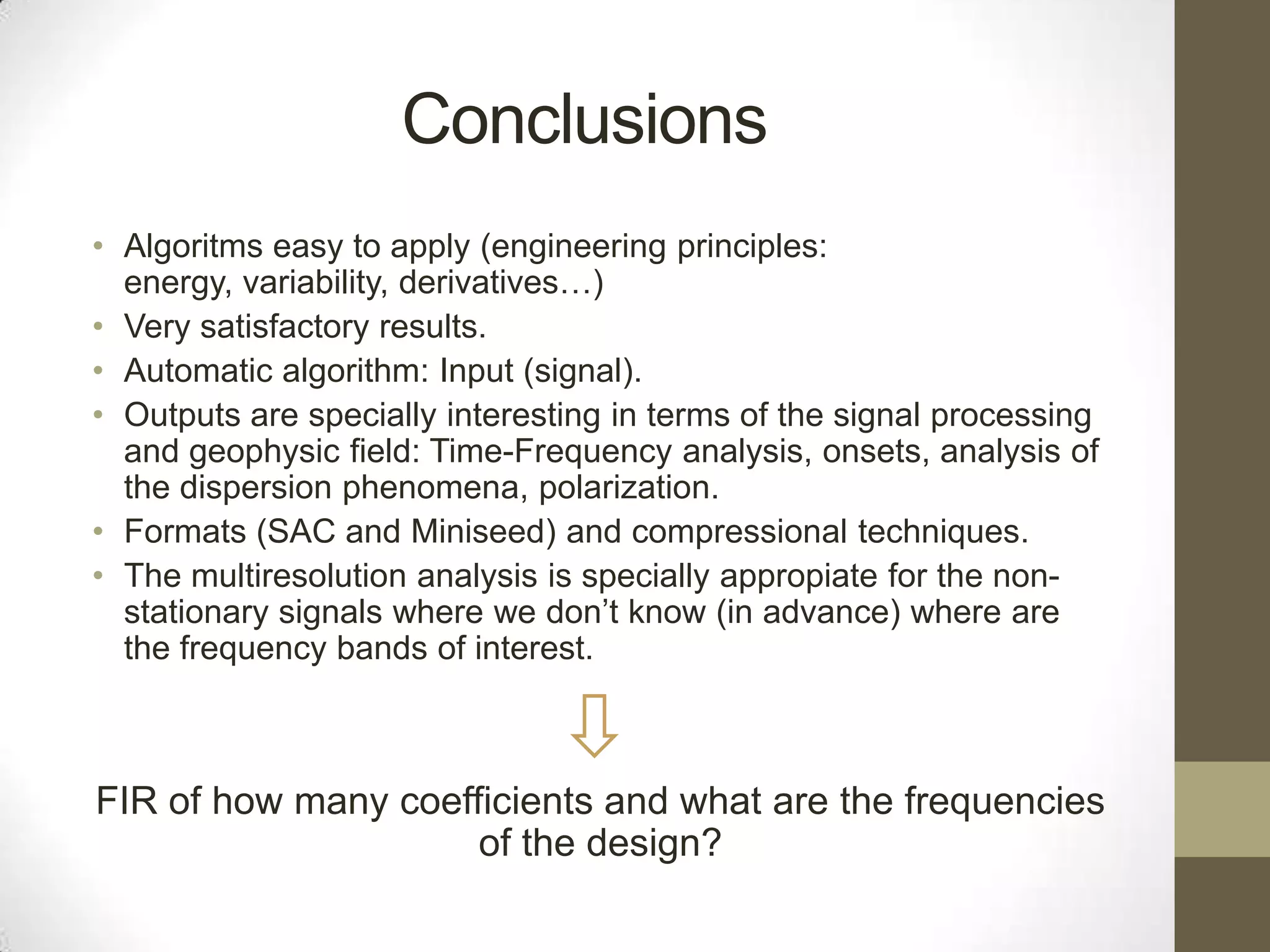
Conclusions
• Algoritms easy to apply (engineering principles:
energy, variability, derivatives…)
• Very satisfactory results.
• Automatic algorithm: Input (signal).
• Outputs are specially interesting in terms of the signal processing
and geophysic field: Time-Frequency analysis, onsets, analysis of
the dispersion phenomena, polarization.
• Formats (SAC and Miniseed) and compressional techniques.
• The multiresolution analysis is specially appropiate for the nonstationary signals where we don’t know (in advance) where are
the frequency bands of interest.

FIR of how many coefficients and what are the frequencies
of the design?

Presentation in the Franhoufer IIS about my thesis: A wavelet transform based application for seismic waves. Analysis of the performance. Code made in Matlab.

  • 1.
    A Wavelet Transformbased application for seismic waves. Analysis of the performance. Telecommunication Engineering Thesis Author: Pedro Cerón Colás Fraunhofer IIS, Erlangen December 9th 2013
  • 2.
    General outline ofthe presentation Introduction Method and Process Simulation of the algorithm Conclusions
  • 3.
    Overview of theproblem Geophysics field Design of Matlab algorithms Complex Continuous Wavelet Transform Bio _QRS Complex, “Biomedical Signal Processing”, Sorno & Laguna. _Circular buffer 3rd FIR filter. “Sound digital processing”, Rocchesso. Sound Procces ing But… Where can we apply the Wavelet Transform?
  • 4.
    Some geophysical issues • 3components: EW, NS, Z (transverse) • Body Waves (P and S waves) and Surphase Waves (Rayleigh and Love). • Seismic Spectrum: 0.001-10hz [1]. • Frequency characterization: Spectrum overlaping of Body and Surphase Waves . Image taken from Dr. José Ignacio Badal Nicolás (Faculty of Geologics, Zaragoza University). Shared resource. [1] “Fundamentals of Geophysics” Agustín Udías & Julio Mezcua. Chap.13
  • 5.
    General Outline ofthe presentation Introduction Method and Process Simulation of the algorithm Conclusions
  • 6.
    Method and process D A T A B A S E S Conversion ofthe signals • • • Preprocessing: Correction Data format? SAC or Mseed Compressed Info? STEIM1, STEIM2 Not compressed Info? ASCII, float, integer… Processing step: Filtering Multiresolution filter (WT) Matlab .mat Onset detection Body Waves Surphase Waves Polarization analysis
  • 7.
    Seismic formats: SACand MiniSEED Word Type NAMES o 0 F DELTA DEPMIN DEPMAX SCALE ODELTA 5 F B E O A INTERN AL 10 F T0 T1 T2 T3 T4 15 F T5 T6 T7 T8 T9 20 F F RESP0 RESP1 RESP2 RESP3 25 F RESP4 RESP5 RESP6 RESP7 RESP8 30 F RESP9 STLA STLO STEL STDP 35 F EVLA EVLO EVEL EVDP MAG 40 F USER0 USER1 USER2 USER3 USER4 45 F USER5 USER6 USER7 USER8 USER9 50 F DIST AZ BAZ GCARC INTERN AL 55 F INTERN AL DEPME N CMPAZ CMPINC XMINIM UM 60 F XMAXIM YMINIM YMAXIM UNUSED UNUSED UM UM UM 65 F UNUSED UNUSED UNUSED UNUSED UNUSED 70 I NZYEAR NZHOUR NZMIN NZSEC 75 I NZMSEC NVHDR NORID NEVID NPTS 80 I INTERN AL NWFID NXSIZE NYSIZE UNUSED 85 I IFTYPE IDEP IZTYPE UNUSED IINST 90 I ISTREG IEVREG IEVTYP IQUAL 95 I IMAGTY P IMAGSR UNUSED UNUSED UNUSED C 100 I UNUSED UNUSED UNUSED UNUSED UNUSED 105 L LEVEN LPSPOL 110 K KSTNM KEVNM* 116 K KHOLE KO KA 122 K KT0 KT1 KT2 128 K KT3 KT4 KT5 134 K KT6 KT7 KT8 140 K KT9 KF KUSER0 146 K KUSER1 KUSER2 KCMPN M 152 K KNETWK KDATRD KINST NZJDAY o o LOVROK LCALDA o ISYNTH UNUSED Algorithms to decode the information. Tables taken from: http://www.iris.edu/software/sac/manual/file_format.html, november 2013. SEED manual v.2.4, B appendix.
  • 8.
    Compressional techniques: STEIM1 and STEIM 2 STEIM 2:More number of possibilities (8) with dnib. Algorithms to decompress the information. Tables taken from: SEED reference manual (version 2.4). B appendix. November 2013.
  • 9.
    Response for channelcorrection • .PAZ .RESPONSE
  • 10.
    Multiresolution filtering usingthe Wavelet Transform Amplitude Mathematical tool Phase Inst. Freq. Freq? Input (Div.) Multiresolution filter: www.sciencedirect.com, nov. 2013. Plot of a .cwt matrix in Matlab.
  • 11.
    Prepocessing stage: Filtering How? Computationsare done directly to the .cwt matrix • Band pass filtering. • Once we have seen in the .cwt plot where we can locate the parts of the signal with higher energetic contributions, we can remove the unnecesary bands (coefficients). • Remove DC level and high frequency seismic noise.
  • 12.
    Onset detector (bodywaves) What’s the concept? Body Waves tend to be at higher frequencies in the octaves (higher divisions) than Surface waves. Energetic Criteria: Mk1 Mk2 Variability Criteria: Finer adjustment Low frequency envelope High Frequency envelope
  • 13.
    Onset detector (surphasewaves) What’s the concept? Surphase Waves tend to be at lower frequencies every octaves Derivative Derivative + envolope We can roughly locate where it’s located the onset of the Surphase waves.
  • 14.
    Surphase wave: Dispersion Whatis the distinctive element that define the Surphase Waves? How can be use the wavelet coefficients to analyse this phenomenon? .cwt matrix Dispersion
  • 15.
    Arrival times Polarization analysis Pwave onset S wave onset Surphase wave onset Transformation of 3 axis into 2: http://www.motionscript.com/mastering-expressions/random-sphere.html, november 2013 • Polarization of P, S, Love and Rayleigh waves?
  • 16.
    General Outline ofthe presentation Introduction Method and Process Simulation of the algorithm Conclusions
  • 17.
    Time errors: Firstonset Inner structure problem 3.5 3 2.5 Low SNR 2 1.5 1 0.5 0 1 2 3 4 5 6 7 8 9 10 11 12
  • 18.
    Time errors: Secondonset Inner structure problem 4 3.5 Low SNR 3 2.5 2 1.5 1 0.5 0 1 2 3 4 5 6 7 8 9 10 11 12
  • 19.
    General Outline ofthe presentation Introduction Method and Process Simulation of the algorithm Conclusions
  • 20.
    Conclusions • Algoritms easyto apply (engineering principles: energy, variability, derivatives…) • Very satisfactory results. • Automatic algorithm: Input (signal). • Outputs are specially interesting in terms of the signal processing and geophysic field: Time-Frequency analysis, onsets, analysis of the dispersion phenomena, polarization. • Formats (SAC and Miniseed) and compressional techniques. • The multiresolution analysis is specially appropiate for the nonstationary signals where we don’t know (in advance) where are the frequency bands of interest. FIR of how many coefficients and what are the frequencies of the design?