VOLCANOES
A. Definition
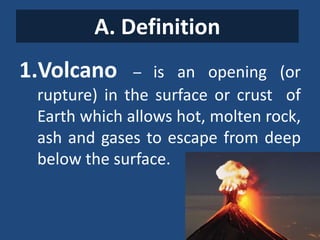
1.Volcano – is an opening (or
rupture) in the surface or crust of
Earth which allows hot, molten rock,
ash and gases to escape from deep
below the surface.
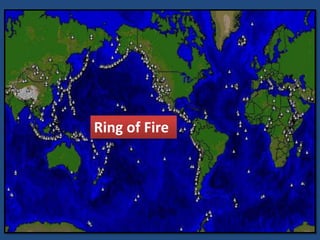
Ring of Fire
A. Definition
2. Ring of Fire – is the region
where more than half of the active
volcanoes of the world that are above
sea level are located or found.
B. How Volcanoes are
Formed
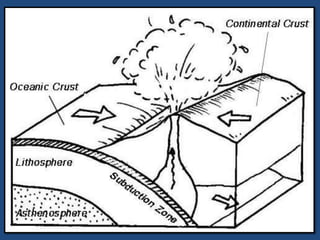
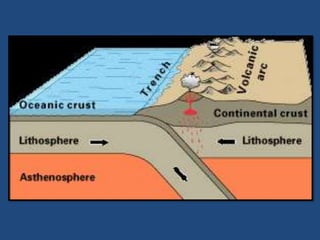
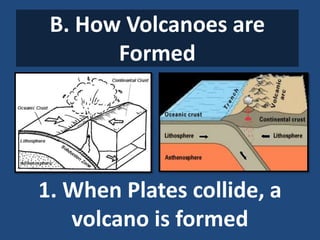
1. When Plates collide, a
volcano is formed
B. How Volcanoes are
Formed
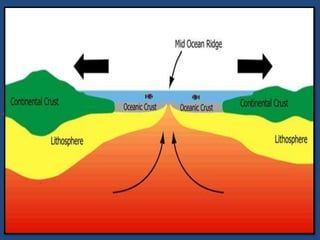
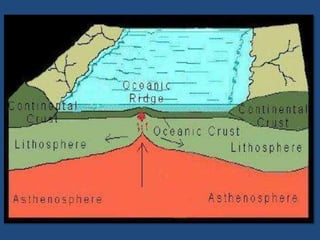
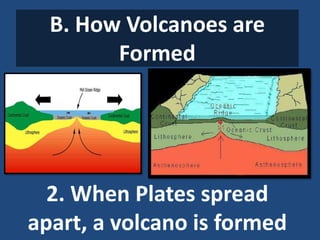
2. When Plates spread
apart, a volcano is formed
B. How Volcanoes are
Formed
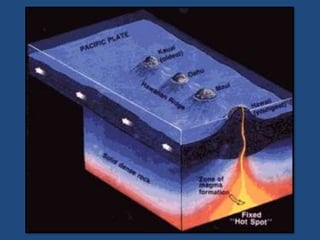
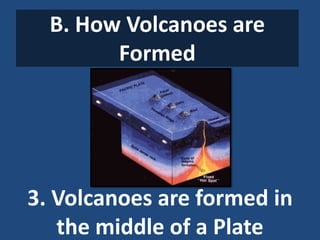
3. Volcanoes are formed in
the middle of a Plate
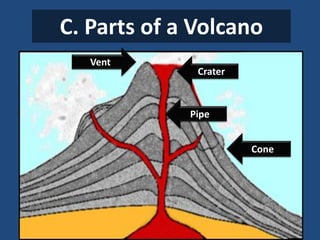
C. Parts of a Volcano
Crater
Pipe
Cone
Vent
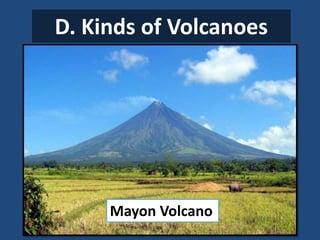
D. Kinds of Volcanoes
Mayon Volcano
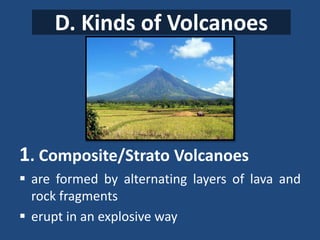
D. Kinds of Volcanoes
1. Composite/Strato Volcanoes
 are formed by alternating layers of lava and
rock fragments
 erupt in an explosive way
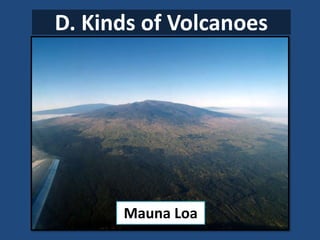
D. Kinds of Volcanoes
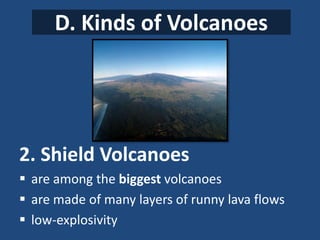
Mauna Loa
D. Kinds of Volcanoes
2. Shield Volcanoes
 are among the biggest volcanoes
 are made of many layers of runny lava flows
 low-explosivity
D. Kinds of Volcanoes
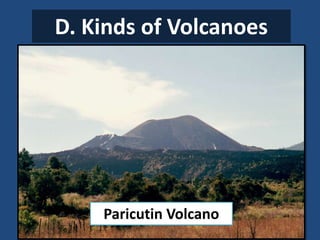
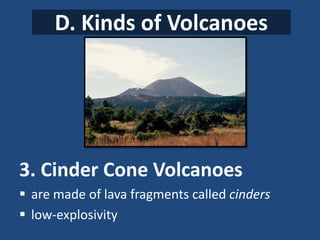
Paricutin Volcano
D. Kinds of Volcanoes
3. Cinder Cone Volcanoes
 are made of lava fragments called cinders
 low-explosivity
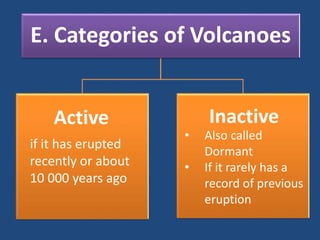
E. Categories of Volcanoes
if it has erupted
recently or about
10 000 years ago
• Also called
Dormant
• If it rarely has a
record of previous
eruption
Active Inactive
F. Kinds of Volcanic
Eruptions
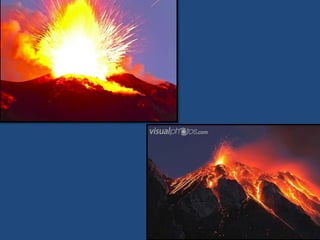
VIDEO
F. Kinds of Volcanic
Eruptions
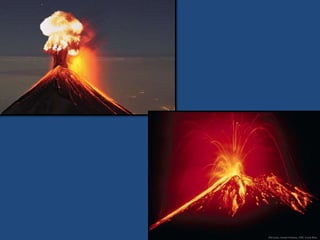
1. Eruptive Pulse
 an explosion with eruption plume
 may last from a few seconds to
minutes
F. Kinds of Volcanic
Eruptions
2. Eruptive Phase
 numerous eruptions that may
alternate between plume and
lava surges
 may last from a few hours to days
F. Kinds of Volcanic
Eruptions
3. Eruptive Episode
 is composed of several phases
that may last a few days, months
or years
G. Beneficial and harmful
Effects of Volcanic Eruptions
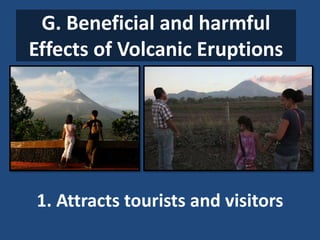
1. Attracts tourists and visitors
G. Beneficial and harmful
Effects of Volcanic Eruptions
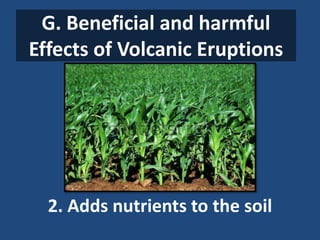
2. Adds nutrients to the soil
G. Beneficial and harmful
Effects of Volcanic Eruptions
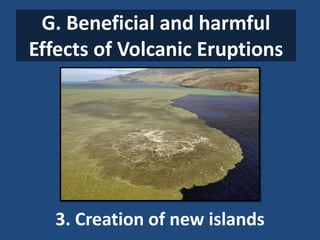
3. Creation of new islands
G. Beneficial and harmful
Effects of Volcanic Eruptions
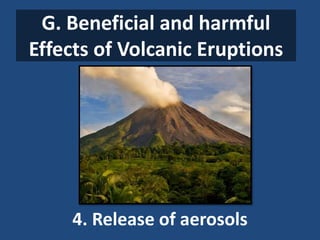
4. Release of aerosols
G. Beneficial and harmful
Effects of Volcanic Eruptions
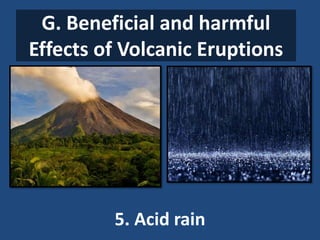
5. Acid rain
G. Beneficial and harmful
Effects of Volcanic Eruptions
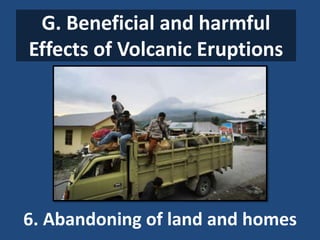
6. Abandoning of land and homes
Directions: Classify the effects of
Volcanic eruptions as
Beneficial or Harmful.
Put the effects in their
corresponding column.
Beneficial Harmful
Directions: Answer the following
questions.
1. What is a volcano?
2-4.How are volcanoes formed?
5-8. What are the parts of a
volcano?
9-10. What are the categories of
Volcanoes?
11-13. What are the classifications
of Volcanoes?
14. Give 1 beneficial effect of
Volcanic eruptions
15. Give 1 harmful effect of Volcanic
eruptions
2-19-13
Assignment
Directions: On a ½ crosswise, write
in five to six sentences the effects
of volcanic eruptions. Pass it next
meeting, February 20, 2013,
Wednesday.

Volcanoes

  • 1.
  • 2.
    A. Definition 1.Volcano –is an opening (or rupture) in the surface or crust of Earth which allows hot, molten rock, ash and gases to escape from deep below the surface.
  • 3.
  • 4.
    A. Definition 2. Ringof Fire – is the region where more than half of the active volcanoes of the world that are above sea level are located or found.
  • 7.
    B. How Volcanoesare Formed 1. When Plates collide, a volcano is formed
  • 10.
    B. How Volcanoesare Formed 2. When Plates spread apart, a volcano is formed
  • 12.
    B. How Volcanoesare Formed 3. Volcanoes are formed in the middle of a Plate
  • 13.
    C. Parts ofa Volcano Crater Pipe Cone Vent
  • 14.
    D. Kinds ofVolcanoes Mayon Volcano
  • 15.
    D. Kinds ofVolcanoes 1. Composite/Strato Volcanoes  are formed by alternating layers of lava and rock fragments  erupt in an explosive way
  • 16.
    D. Kinds ofVolcanoes Mauna Loa
  • 17.
    D. Kinds ofVolcanoes 2. Shield Volcanoes  are among the biggest volcanoes  are made of many layers of runny lava flows  low-explosivity
  • 18.
    D. Kinds ofVolcanoes Paricutin Volcano
  • 19.
    D. Kinds ofVolcanoes 3. Cinder Cone Volcanoes  are made of lava fragments called cinders  low-explosivity
  • 20.
    E. Categories ofVolcanoes if it has erupted recently or about 10 000 years ago • Also called Dormant • If it rarely has a record of previous eruption Active Inactive
  • 21.
    F. Kinds ofVolcanic Eruptions VIDEO
  • 22.
    F. Kinds ofVolcanic Eruptions 1. Eruptive Pulse  an explosion with eruption plume  may last from a few seconds to minutes
  • 24.
    F. Kinds ofVolcanic Eruptions 2. Eruptive Phase  numerous eruptions that may alternate between plume and lava surges  may last from a few hours to days
  • 26.
    F. Kinds ofVolcanic Eruptions 3. Eruptive Episode  is composed of several phases that may last a few days, months or years
  • 27.
    G. Beneficial andharmful Effects of Volcanic Eruptions 1. Attracts tourists and visitors
  • 28.
    G. Beneficial andharmful Effects of Volcanic Eruptions 2. Adds nutrients to the soil
  • 29.
    G. Beneficial andharmful Effects of Volcanic Eruptions 3. Creation of new islands
  • 30.
    G. Beneficial andharmful Effects of Volcanic Eruptions 4. Release of aerosols
  • 31.
    G. Beneficial andharmful Effects of Volcanic Eruptions 5. Acid rain
  • 32.
    G. Beneficial andharmful Effects of Volcanic Eruptions 6. Abandoning of land and homes
  • 33.
    Directions: Classify theeffects of Volcanic eruptions as Beneficial or Harmful. Put the effects in their corresponding column.
  • 34.
  • 35.
    Directions: Answer thefollowing questions. 1. What is a volcano? 2-4.How are volcanoes formed? 5-8. What are the parts of a volcano? 9-10. What are the categories of Volcanoes?
  • 36.
    11-13. What arethe classifications of Volcanoes? 14. Give 1 beneficial effect of Volcanic eruptions 15. Give 1 harmful effect of Volcanic eruptions
  • 37.
    2-19-13 Assignment Directions: On a½ crosswise, write in five to six sentences the effects of volcanic eruptions. Pass it next meeting, February 20, 2013, Wednesday.