What are Earthquakes?
• The shaking or trembling caused by the sudden
release of energy
• Usually associated with faulting or breaking of rocks
• Continuing adjustment of position results in
aftershocks
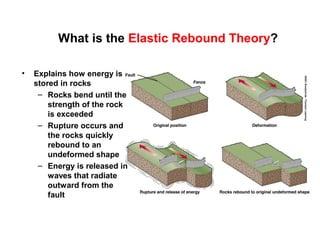
What is the Elastic Rebound Theory?
• Explains how energy is
stored in rocks
– Rocks bend until the
strength of the rock
is exceeded
– Rupture occurs and
the rocks quickly
rebound to an
undeformed shape
– Energy is released in
waves that radiate
outward from the
fault
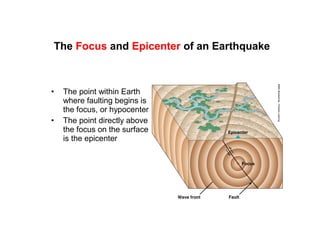
The Focus and Epicenter of an Earthquake
• The point within Earth
where faulting begins is
the focus, or hypocenter
• The point directly above
the focus on the surface
is the epicenter
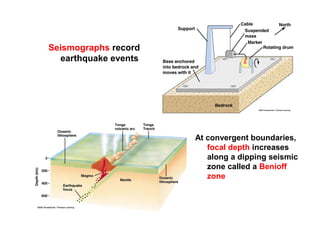
Seismographs record
earthquake events
At convergent boundaries,
focal depth increases
along a dipping seismic
zone called a Benioff
zone
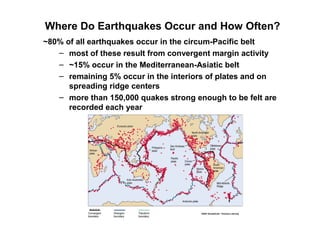
Where Do Earthquakes Occur and How Often?
~80% of all earthquakes occur in the circum-Pacific belt
– most of these result from convergent margin activity
– ~15% occur in the Mediterranean-Asiatic belt
– remaining 5% occur in the interiors of plates and on
spreading ridge centers
– more than 150,000 quakes strong enough to be felt are
recorded each year
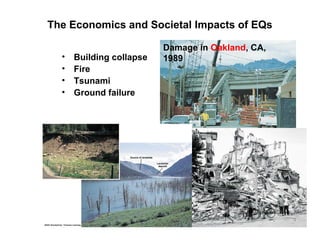
The Economics and Societal Impacts of EQs
Damage in Oakland, CA,
1989• Building collapse
• Fire
• Tsunami
• Ground failure
What are Seismic Waves?
• Response of material to the
arrival of energy fronts released
by rupture
• Two types:
– Body waves
• P and S
– Surface waves
• R and L
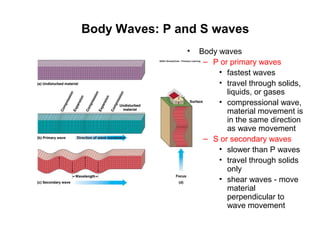
Body Waves: P and S waves
• Body waves
– P or primary waves
• fastest waves
• travel through solids,
liquids, or gases
• compressional wave,
material movement is
in the same direction
as wave movement
– S or secondary waves
• slower than P waves
• travel through solids
only
• shear waves - move
material
perpendicular to
wave movement
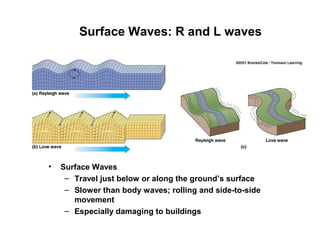
Surface Waves: R and L waves
• Surface Waves
– Travel just below or along the ground’s surface
– Slower than body waves; rolling and side-to-side
movement
– Especially damaging to buildings
How is an Earthquake’s Epicenter Located?
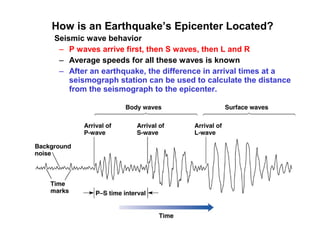
Seismic wave behavior
– P waves arrive first, then S waves, then L and R
– Average speeds for all these waves is known
– After an earthquake, the difference in arrival times at a
seismograph station can be used to calculate the distance
from the seismograph to the epicenter.
How is an Earthquake’s Epicenter Located?
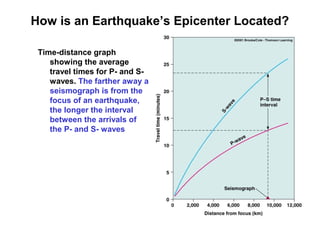
Time-distance graph
showing the average
travel times for P- and S-
waves. The farther away a
seismograph is from the
focus of an earthquake,
the longer the interval
between the arrivals of
the P- and S- waves
How is an Earthquake’s
Epicenter Located?
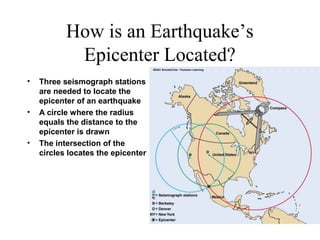
• Three seismograph stations
are needed to locate the
epicenter of an earthquake
• A circle where the radius
equals the distance to the
epicenter is drawn
• The intersection of the
circles locates the epicenter
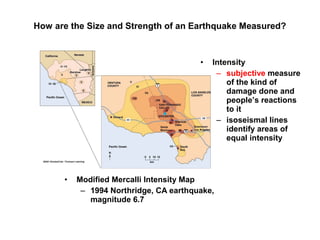
How are the Size and Strength of an Earthquake Measured?
• Modified Mercalli Intensity Map
– 1994 Northridge, CA earthquake,
magnitude 6.7
• Intensity
– subjective measure
of the kind of
damage done and
people’s reactions
to it
– isoseismal lines
identify areas of
equal intensity
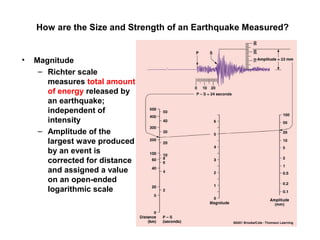
How are the Size and Strength of an Earthquake Measured?
• Magnitude
– Richter scale
measures total amount
of energy released by
an earthquake;
independent of
intensity
– Amplitude of the
largest wave produced
by an event is
corrected for distance
and assigned a value
on an open-ended
logarithmic scale
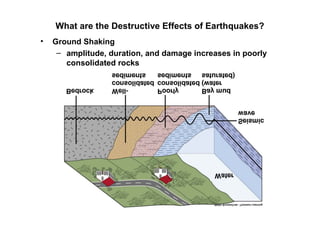
What are the Destructive Effects of Earthquakes?
• Ground Shaking
– amplitude, duration, and damage increases in poorly
consolidated rocks
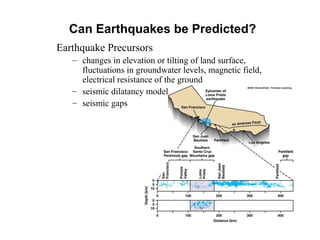
Can Earthquakes be Predicted?
Earthquake Precursors
– changes in elevation or tilting of land surface,
fluctuations in groundwater levels, magnetic field,
electrical resistance of the ground
– seismic dilatancy model
– seismic gaps
Can Earthquakes be Predicted?
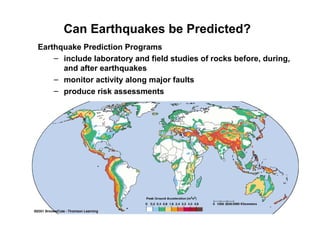
Earthquake Prediction Programs
– include laboratory and field studies of rocks before, during,
and after earthquakes
– monitor activity along major faults
– produce risk assessments
Can Earthquakes be Controlled?
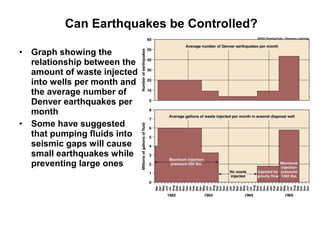
• Graph showing the
relationship between the
amount of waste injected
into wells per month and
the average number of
Denver earthquakes per
month
• Some have suggested
that pumping fluids into
seismic gaps will cause
small earthquakes while
preventing large ones

earthquakes

  • 1.
    What are Earthquakes? •The shaking or trembling caused by the sudden release of energy • Usually associated with faulting or breaking of rocks • Continuing adjustment of position results in aftershocks
  • 2.
    What is theElastic Rebound Theory? • Explains how energy is stored in rocks – Rocks bend until the strength of the rock is exceeded – Rupture occurs and the rocks quickly rebound to an undeformed shape – Energy is released in waves that radiate outward from the fault
  • 3.
    The Focus andEpicenter of an Earthquake • The point within Earth where faulting begins is the focus, or hypocenter • The point directly above the focus on the surface is the epicenter
  • 4.
    Seismographs record earthquake events Atconvergent boundaries, focal depth increases along a dipping seismic zone called a Benioff zone
  • 5.
    Where Do EarthquakesOccur and How Often? ~80% of all earthquakes occur in the circum-Pacific belt – most of these result from convergent margin activity – ~15% occur in the Mediterranean-Asiatic belt – remaining 5% occur in the interiors of plates and on spreading ridge centers – more than 150,000 quakes strong enough to be felt are recorded each year
  • 6.
    The Economics andSocietal Impacts of EQs Damage in Oakland, CA, 1989• Building collapse • Fire • Tsunami • Ground failure
  • 7.
    What are SeismicWaves? • Response of material to the arrival of energy fronts released by rupture • Two types: – Body waves • P and S – Surface waves • R and L
  • 8.
    Body Waves: Pand S waves • Body waves – P or primary waves • fastest waves • travel through solids, liquids, or gases • compressional wave, material movement is in the same direction as wave movement – S or secondary waves • slower than P waves • travel through solids only • shear waves - move material perpendicular to wave movement
  • 9.
    Surface Waves: Rand L waves • Surface Waves – Travel just below or along the ground’s surface – Slower than body waves; rolling and side-to-side movement – Especially damaging to buildings
  • 10.
    How is anEarthquake’s Epicenter Located? Seismic wave behavior – P waves arrive first, then S waves, then L and R – Average speeds for all these waves is known – After an earthquake, the difference in arrival times at a seismograph station can be used to calculate the distance from the seismograph to the epicenter.
  • 11.
    How is anEarthquake’s Epicenter Located? Time-distance graph showing the average travel times for P- and S- waves. The farther away a seismograph is from the focus of an earthquake, the longer the interval between the arrivals of the P- and S- waves
  • 12.
    How is anEarthquake’s Epicenter Located? • Three seismograph stations are needed to locate the epicenter of an earthquake • A circle where the radius equals the distance to the epicenter is drawn • The intersection of the circles locates the epicenter
  • 13.
    How are theSize and Strength of an Earthquake Measured? • Modified Mercalli Intensity Map – 1994 Northridge, CA earthquake, magnitude 6.7 • Intensity – subjective measure of the kind of damage done and people’s reactions to it – isoseismal lines identify areas of equal intensity
  • 14.
    How are theSize and Strength of an Earthquake Measured? • Magnitude – Richter scale measures total amount of energy released by an earthquake; independent of intensity – Amplitude of the largest wave produced by an event is corrected for distance and assigned a value on an open-ended logarithmic scale
  • 15.
    What are theDestructive Effects of Earthquakes? • Ground Shaking – amplitude, duration, and damage increases in poorly consolidated rocks
  • 16.
    Can Earthquakes bePredicted? Earthquake Precursors – changes in elevation or tilting of land surface, fluctuations in groundwater levels, magnetic field, electrical resistance of the ground – seismic dilatancy model – seismic gaps
  • 17.
    Can Earthquakes bePredicted? Earthquake Prediction Programs – include laboratory and field studies of rocks before, during, and after earthquakes – monitor activity along major faults – produce risk assessments
  • 18.
    Can Earthquakes beControlled? • Graph showing the relationship between the amount of waste injected into wells per month and the average number of Denver earthquakes per month • Some have suggested that pumping fluids into seismic gaps will cause small earthquakes while preventing large ones