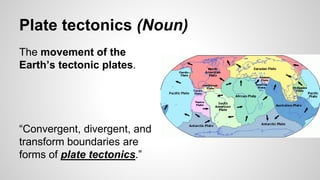
Plate tectonics (Noun)
The movement of the
Earth’s tectonic plates.
“Convergent, divergent, and
transform boundaries are
forms of plate tectonics.”
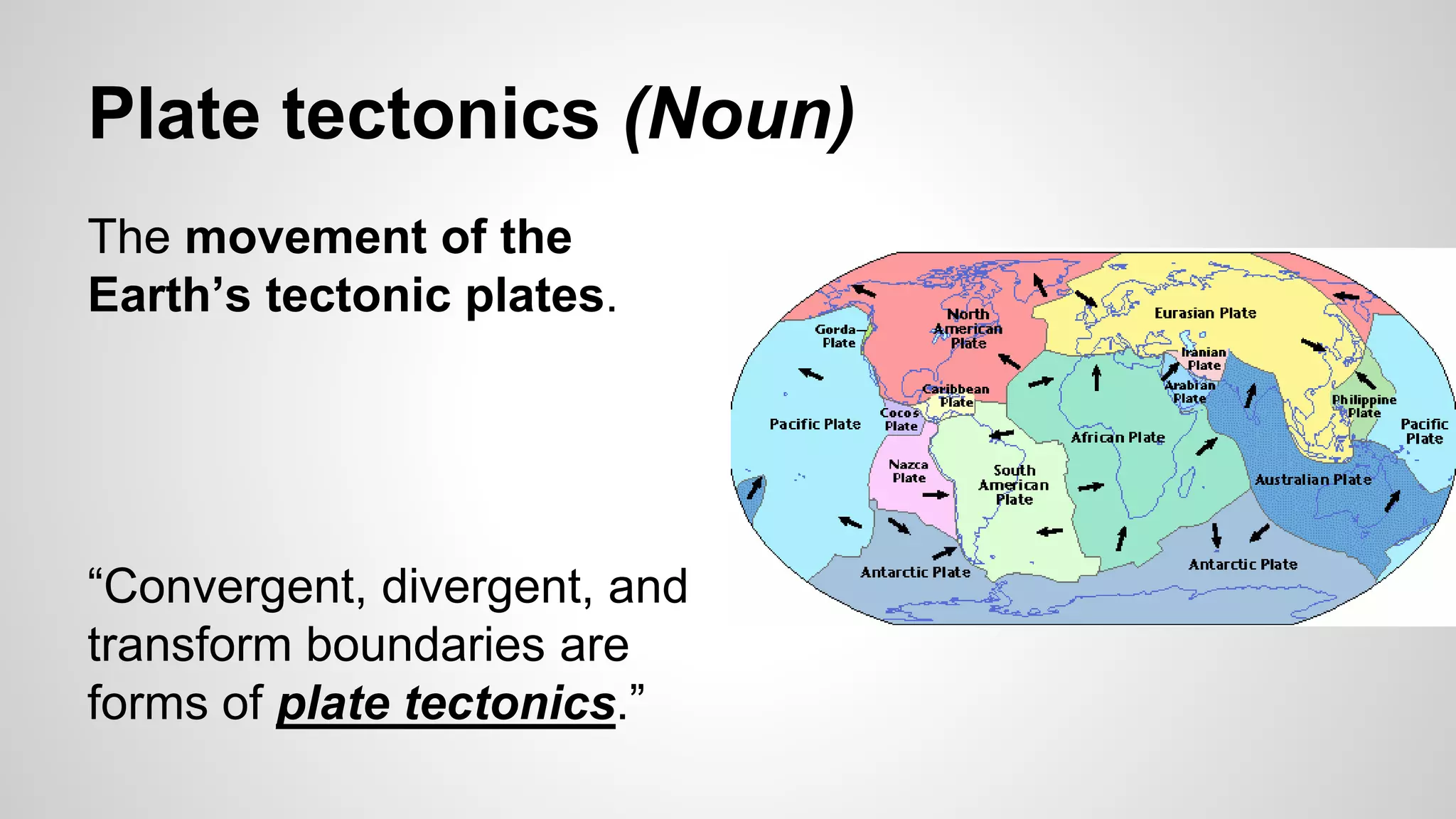
Tectonic plate (Noun)
The pieces of the Earth’s
crust that float on the mantle,
causing continental drift and
earthquakes and creating
volcanoes, trenches, and
mountains.
“The Earth’s crust is divided
into tectonic plates that move
away, into, and around each
other.
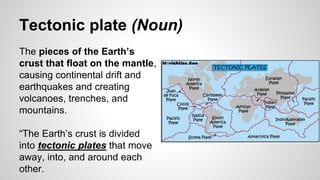
Oceanic crust/plate (Noun)
The part of the Earth’s
crust found
underneath oceans.
“The larger the ocean,
the larger the oceanic
crust under it.”
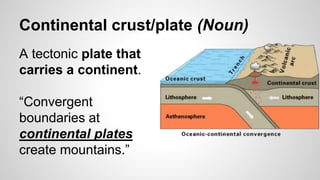
Continental crust/plate (Noun)
A tectonic plate that
carries a continent.
“Convergent
boundaries at
continental plates
create mountains.”
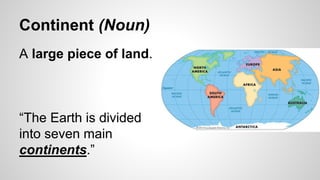
Continent (Noun)
A large piece of land.
“The Earth is divided
into seven main
continents.”
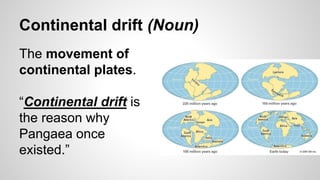
Continental drift (Noun)
The movement of
continental plates.
“Continental drift is
the reason why
Pangaea once
existed.”
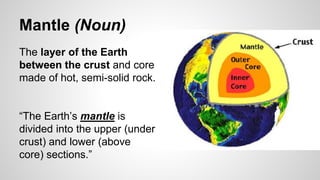
Mantle (Noun)
The layer of the Earth
between the crust and core
made of hot, semi-solid rock.
“The Earth’s mantle is
divided into the upper (under
crust) and lower (above
core) sections.”
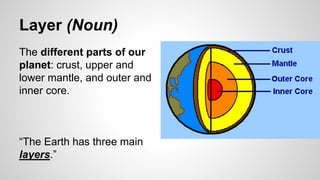
Layer (Noun)
The different parts of our
planet: crust, upper and
lower mantle, and outer and
inner core.
“The Earth has three main
layers.”
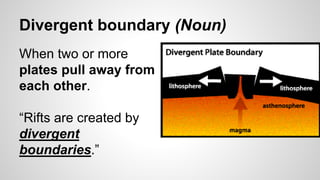
Divergent boundary (Noun)
When two or more
plates pull away from
each other.
“Rifts are created by
divergent
boundaries.”
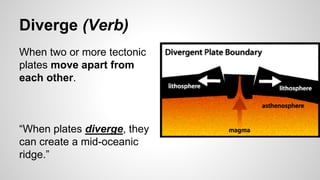
Diverge (Verb)
When two or more tectonic
plates move apart from
each other.
“When plates diverge, they
can create a mid-oceanic
ridge.”
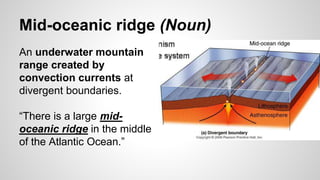
Mid-oceanic ridge (Noun)
An underwater mountain
range created by
convection currents at
divergent boundaries.
“There is a large mid-
oceanic ridge in the middle
of the Atlantic Ocean.”
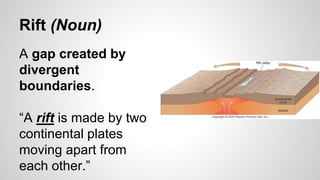
Rift (Noun)
A gap created by
divergent
boundaries.
“A rift is made by two
continental plates
moving apart from
each other.”
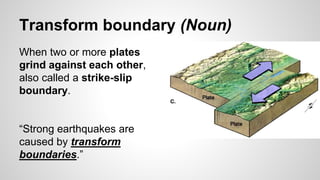
Transform boundary (Noun)
When two or more plates
grind against each other,
also called a strike-slip
boundary.
“Strong earthquakes are
caused by transform
boundaries.”
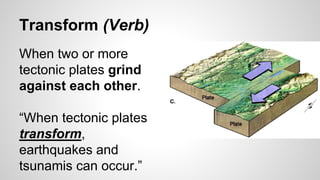
Transform (Verb)
When two or more
tectonic plates grind
against each other.
“When tectonic plates
transform,
earthquakes and
tsunamis can occur.”
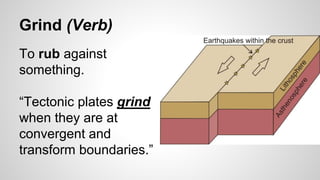
Grind (Verb)
To rub against
something.
“Tectonic plates grind
when they are at
convergent and
transform boundaries.”
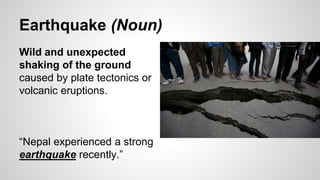
Earthquake (Noun)
Wild and unexpected
shaking of the ground
caused by plate tectonics or
volcanic eruptions.
“Nepal experienced a strong
earthquake recently.”
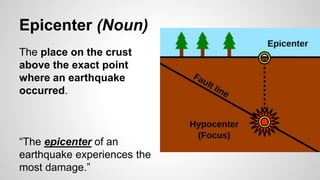
Epicenter (Noun)
The place on the crust
above the exact point
where an earthquake
occurred.
“The epicenter of an
earthquake experiences the
most damage.”
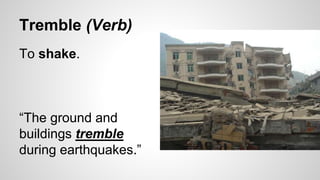
Tremble (Verb)
To shake.
“The ground and
buildings tremble
during earthquakes.”
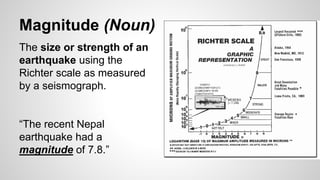
Magnitude (Noun)
The size or strength of an
earthquake using the
Richter scale as measured
by a seismograph.
“The recent Nepal
earthquake had a
magnitude of 7.8.”
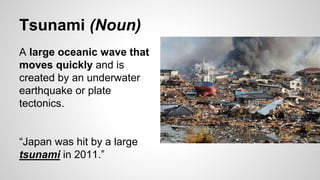
Tsunami (Noun)
A large oceanic wave that
moves quickly and is
created by an underwater
earthquake or plate
tectonics.
“Japan was hit by a large
tsunami in 2011.”
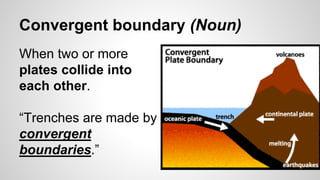
Convergent boundary (Noun)
When two or more
plates collide into
each other.
“Trenches are made by
convergent
boundaries.”
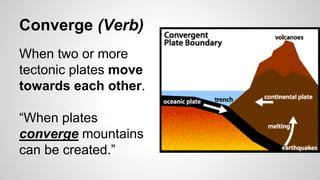
Converge (Verb)
When two or more
tectonic plates move
towards each other.
“When plates
converge mountains
can be created.”
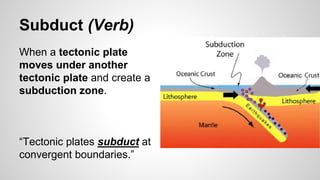
Subduct (Verb)
When a tectonic plate
moves under another
tectonic plate and create a
subduction zone.
“Tectonic plates subduct at
convergent boundaries.”
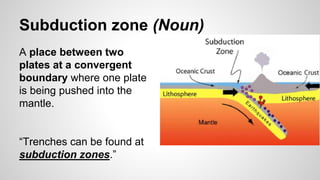
Subduction zone (Noun)
A place between two
plates at a convergent
boundary where one plate
is being pushed into the
mantle.
“Trenches can be found at
subduction zones.”
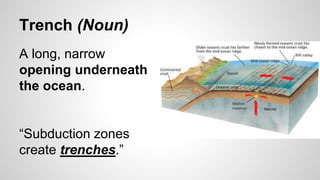
Trench (Noun)
A long, narrow
opening underneath
the ocean.
“Subduction zones
create trenches.”
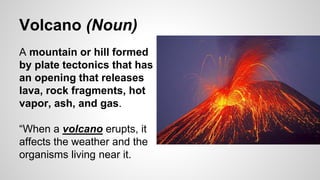
Volcano (Noun)
A mountain or hill formed
by plate tectonics that has
an opening that releases
lava, rock fragments, hot
vapor, ash, and gas.
“When a volcano erupts, it
affects the weather and the
organisms living near it.
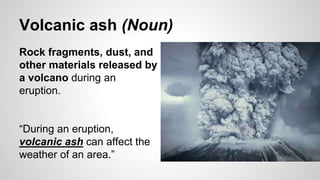
Volcanic ash (Noun)
Rock fragments, dust, and
other materials released by
a volcano during an
eruption.
“During an eruption,
volcanic ash can affect the
weather of an area.”
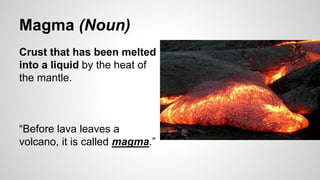
Magma (Noun)
Crust that has been melted
into a liquid by the heat of
the mantle.
“Before lava leaves a
volcano, it is called magma.”
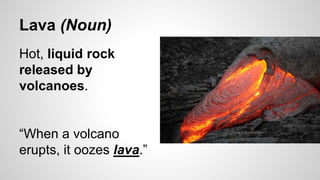
Lava (Noun)
Hot, liquid rock
released by
volcanoes.
“When a volcano
erupts, it oozes lava.”
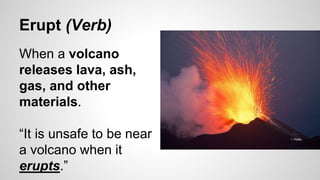
Erupt (Verb)
When a volcano
releases lava, ash,
gas, and other
materials.
“It is unsafe to be near
a volcano when it
erupts.”
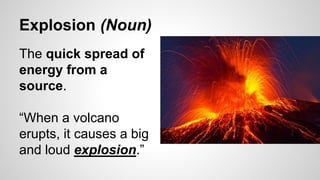
Explosion (Noun)
The quick spread of
energy from a
source.
“When a volcano
erupts, it causes a big
and loud explosion.”

Earth Science Vocabulary

  • 1.
    Plate tectonics (Noun) Themovement of the Earth’s tectonic plates. “Convergent, divergent, and transform boundaries are forms of plate tectonics.”
  • 2.
    Tectonic plate (Noun) Thepieces of the Earth’s crust that float on the mantle, causing continental drift and earthquakes and creating volcanoes, trenches, and mountains. “The Earth’s crust is divided into tectonic plates that move away, into, and around each other.
  • 3.
    Oceanic crust/plate (Noun) Thepart of the Earth’s crust found underneath oceans. “The larger the ocean, the larger the oceanic crust under it.”
  • 4.
    Continental crust/plate (Noun) Atectonic plate that carries a continent. “Convergent boundaries at continental plates create mountains.”
  • 5.
    Continent (Noun) A largepiece of land. “The Earth is divided into seven main continents.”
  • 6.
    Continental drift (Noun) Themovement of continental plates. “Continental drift is the reason why Pangaea once existed.”
  • 7.
    Mantle (Noun) The layerof the Earth between the crust and core made of hot, semi-solid rock. “The Earth’s mantle is divided into the upper (under crust) and lower (above core) sections.”
  • 8.
    Layer (Noun) The differentparts of our planet: crust, upper and lower mantle, and outer and inner core. “The Earth has three main layers.”
  • 9.
    Divergent boundary (Noun) Whentwo or more plates pull away from each other. “Rifts are created by divergent boundaries.”
  • 10.
    Diverge (Verb) When twoor more tectonic plates move apart from each other. “When plates diverge, they can create a mid-oceanic ridge.”
  • 11.
    Mid-oceanic ridge (Noun) Anunderwater mountain range created by convection currents at divergent boundaries. “There is a large mid- oceanic ridge in the middle of the Atlantic Ocean.”
  • 12.
    Rift (Noun) A gapcreated by divergent boundaries. “A rift is made by two continental plates moving apart from each other.”
  • 13.
    Transform boundary (Noun) Whentwo or more plates grind against each other, also called a strike-slip boundary. “Strong earthquakes are caused by transform boundaries.”
  • 14.
    Transform (Verb) When twoor more tectonic plates grind against each other. “When tectonic plates transform, earthquakes and tsunamis can occur.”
  • 15.
    Grind (Verb) To rubagainst something. “Tectonic plates grind when they are at convergent and transform boundaries.”
  • 16.
    Earthquake (Noun) Wild andunexpected shaking of the ground caused by plate tectonics or volcanic eruptions. “Nepal experienced a strong earthquake recently.”
  • 17.
    Epicenter (Noun) The placeon the crust above the exact point where an earthquake occurred. “The epicenter of an earthquake experiences the most damage.”
  • 18.
    Tremble (Verb) To shake. “Theground and buildings tremble during earthquakes.”
  • 19.
    Magnitude (Noun) The sizeor strength of an earthquake using the Richter scale as measured by a seismograph. “The recent Nepal earthquake had a magnitude of 7.8.”
  • 20.
    Tsunami (Noun) A largeoceanic wave that moves quickly and is created by an underwater earthquake or plate tectonics. “Japan was hit by a large tsunami in 2011.”
  • 21.
    Convergent boundary (Noun) Whentwo or more plates collide into each other. “Trenches are made by convergent boundaries.”
  • 22.
    Converge (Verb) When twoor more tectonic plates move towards each other. “When plates converge mountains can be created.”
  • 23.
    Subduct (Verb) When atectonic plate moves under another tectonic plate and create a subduction zone. “Tectonic plates subduct at convergent boundaries.”
  • 24.
    Subduction zone (Noun) Aplace between two plates at a convergent boundary where one plate is being pushed into the mantle. “Trenches can be found at subduction zones.”
  • 25.
    Trench (Noun) A long,narrow opening underneath the ocean. “Subduction zones create trenches.”
  • 26.
    Volcano (Noun) A mountainor hill formed by plate tectonics that has an opening that releases lava, rock fragments, hot vapor, ash, and gas. “When a volcano erupts, it affects the weather and the organisms living near it.
  • 27.
    Volcanic ash (Noun) Rockfragments, dust, and other materials released by a volcano during an eruption. “During an eruption, volcanic ash can affect the weather of an area.”
  • 28.
    Magma (Noun) Crust thathas been melted into a liquid by the heat of the mantle. “Before lava leaves a volcano, it is called magma.”
  • 29.
    Lava (Noun) Hot, liquidrock released by volcanoes. “When a volcano erupts, it oozes lava.”
  • 30.
    Erupt (Verb) When avolcano releases lava, ash, gas, and other materials. “It is unsafe to be near a volcano when it erupts.”
  • 31.
    Explosion (Noun) The quickspread of energy from a source. “When a volcano erupts, it causes a big and loud explosion.”