How are you feeling today?
Let’s Pray
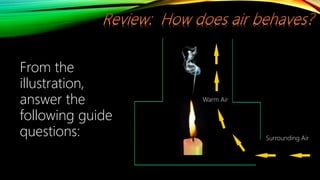
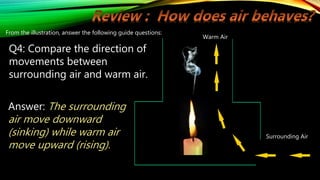
Warm Air
Surrounding Air
From the
illustration,
answer the
following guide
questions:
Warm Air
Surrounding Air
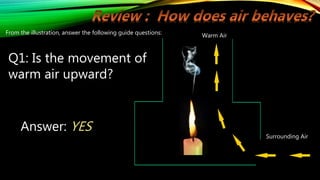
From the illustration, answer the following guide questions:
Q1: Is the movement of
warm air upward?
Answer: YES
Warm Air
Surrounding Air
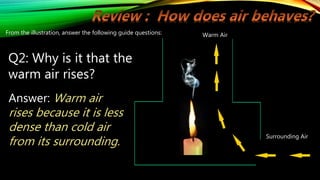
From the illustration, answer the following guide questions:
Q2: Why is it that the
warm air rises?
Answer: Warm air
rises because it is less
dense than cold air
from its surrounding.
Warm Air
Surrounding Air
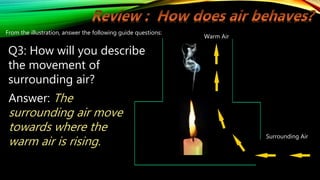
From the illustration, answer the following guide questions:
Q3: How will you describe
the movement of
surrounding air?
Answer: The
surrounding air move
towards where the
warm air is rising.
Warm Air
Surrounding Air
From the illustration, answer the following guide questions:
Q4: Compare the direction of
movements between
surrounding air and warm air.
Answer: The surrounding
air move downward
(sinking) while warm air
move upward (rising).
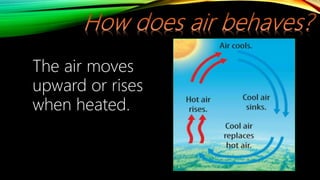
The air moves
upward or rises
when heated.
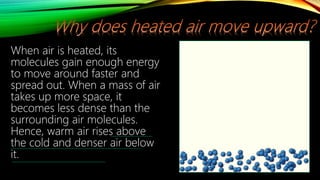
When air is heated, its
molecules gain enough energy
to move around faster and
spread out. When a mass of air
takes up more space, it
becomes less dense than the
surrounding air molecules.
Hence, warm air rises above
the cold and denser air below
it.
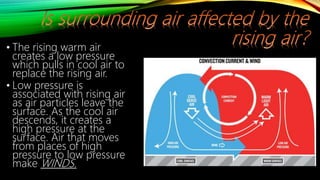
• The rising warm air
creates a low pressure
which pulls in cool air to
replace the rising air.
• Low pressure is
associated with rising air
as air particles leave the
surface. As the cool air
descends, it creates a
high pressure at the
surface. Air that moves
from places of high
pressure to low pressure
make WINDS.
A. Breezes
B. Monsoon
C. Intertropical Convergence Zone
LEARNING OBJECTIVES:
1. Identify common atmospheric phenomena such as
breezes, monsoons, and intertropical convergence zone;
2. Compare the types of breezes and monsoons; and
3. Explains the occurrences of Intertropical convergence
zone, breezes, and monsoon.
4. Cite how the monsoons affect the Filipino farmers.
-Moving air.
- Air that is moving horizontally.
-Are caused by differences in air pressure.
AIR MOVES TOWARD THE PLACE WHERE
WARM AIR IS RISING.
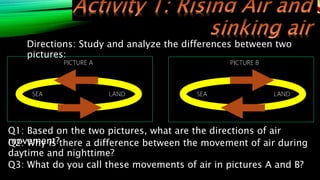
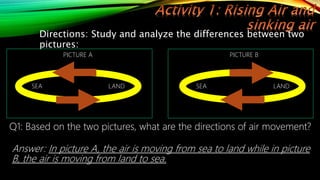
Directions: Study and analyze the differences between two
pictures:
SEA LAND LAND
SEA
PICTURE A PICTURE B
Q1: Based on the two pictures, what are the directions of air
movement?
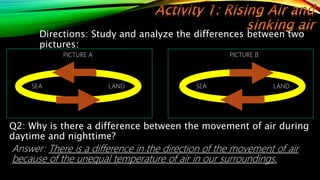
Q2: Why is there a difference between the movement of air during
daytime and nighttime?
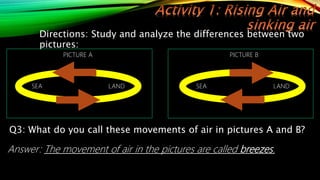
Q3: What do you call these movements of air in pictures A and B?
Directions: Study and analyze the differences between two
pictures:
SEA LAND LAND
SEA
PICTURE A PICTURE B
Q1: Based on the two pictures, what are the directions of air movement?
Answer: In picture A, the air is moving from sea to land while in picture
B, the air is moving from land to sea.
Directions: Study and analyze the differences between two
pictures:
SEA LAND LAND
SEA
PICTURE A PICTURE B
Q2: Why is there a difference between the movement of air during
daytime and nighttime?
Answer: There is a difference in the direction of the movement of air
because of the unequal temperature of air in our surroundings.
Directions: Study and analyze the differences between two
pictures:
SEA LAND LAND
SEA
PICTURE A PICTURE B
Q3: What do you call these movements of air in pictures A and B?
Answer: The movement of air in the pictures are called breezes.
-a wind that blows over a short distance.
-caused by the UNEQUAL heating of Earth’s
surface within a small region.
Example:
1.Sea breeze
2. Land breeze
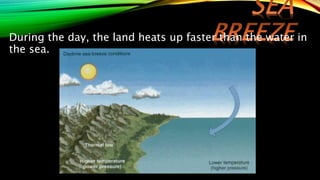
During the day, the land heats up faster than the water in
the sea.
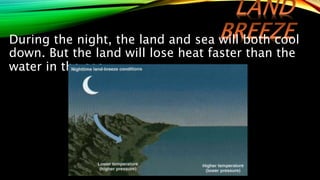
During the night, the land and sea will both cool
down. But the land will lose heat faster than the
water in the sea.
• Wind system that is characterized by seasonal reversal of
direction.
• Sea and land breezes over a large region that change
direction with seasons.
• Characterized by a dramatic seasonal change in the
direction of the prevailing winds over a large area. This
change in the direction of the prevailing winds brings about
changes in the amount of rainfall and leads to the distinct
wet and dry seasons.
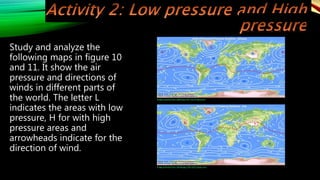
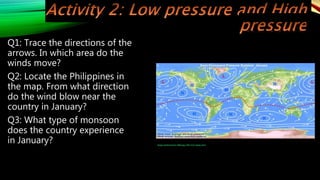
Study and analyze the
following maps in figure 10
and 11. It show the air
pressure and directions of
winds in different parts of
the world. The letter L
indicates the areas with low
pressure, H for with high
pressure areas and
arrowheads indicate for the
direction of wind.
Image retrieved from: 0aIR2.jpg (700×332) (imgur.com)
Image retrieved from: H6oA6.jpg (700×332) (imgur.com)
Q1: Trace the directions of the
arrows. In which area do the
winds move?
Q2: Locate the Philippines in
the map. From what direction
do the wind blow near the
country in January?
Q3: What type of monsoon
does the country experience
in January? Image retrieved from: 0aIR2.jpg (700×332) (imgur.com)
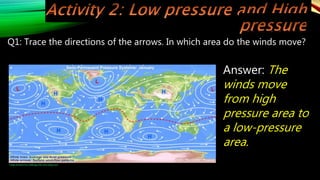
Q1: Trace the directions of the arrows. In which area do the winds move?
Image retrieved from: 0aIR2.jpg (700×332) (imgur.com)
Answer: The
winds move
from high
pressure area to
a low-pressure
area.
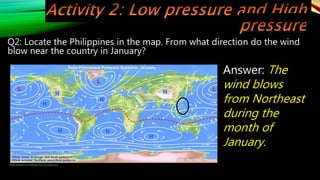
Q2: Locate the Philippines in the map. From what direction do the wind
blow near the country in January?
Image retrieved from: 0aIR2.jpg (700×332) (imgur.com)
Answer: The
wind blows
from Northeast
during the
month of
January.
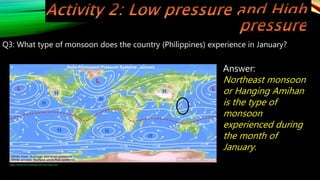
Q3: What type of monsoon does the country (Philippines) experience in January?
Image retrieved from: 0aIR2.jpg (700×332) (imgur.com)
Answer:
Northeast monsoon
or Hanging Amihan
is the type of
monsoon
experienced during
the month of
January.
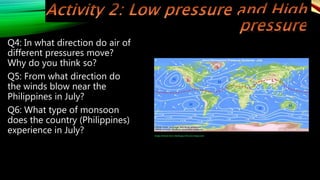
Q4: In what direction do air of
different pressures move?
Why do you think so?
Q5: From what direction do
the winds blow near the
Philippines in July?
Q6: What type of monsoon
does the country (Philippines)
experience in July? Image retrieved from: H6oA6.jpg (700×332) (imgur.com)
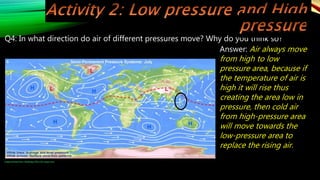
Q4: In what direction do air of different pressures move? Why do you think so?
Answer: Air always move
from high to low
pressure area, because if
the temperature of air is
high it will rise thus
creating the area low in
pressure, then cold air
from high-pressure area
will move towards the
low-pressure area to
replace the rising air.
Image retrieved from: H6oA6.jpg (700×332) (imgur.com)
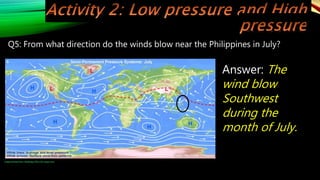
Q5: From what direction do the winds blow near the Philippines in July?
Answer: The
wind blow
Southwest
during the
month of July.
Image retrieved from: H6oA6.jpg (700×332) (imgur.com)
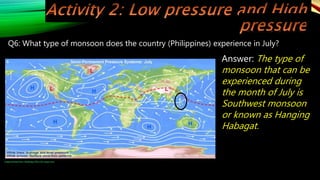
Q6: What type of monsoon does the country (Philippines) experience in July?
Answer: The type of
monsoon that can be
experienced during
the month of July is
Southwest monsoon
or known as Hanging
Habagat.
Image retrieved from: H6oA6.jpg (700×332) (imgur.com)
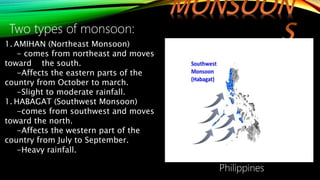
Two types of monsoon:
1. AMIHAN (Northeast Monsoon)
- comes from northeast and moves
toward the south.
-Affects the eastern parts of the
country from October to march.
-Slight to moderate rainfall.
1. HABAGAT (Southwest Monsoon)
-comes from southwest and moves
toward the north.
-Affects the western part of the
country from July to September.
-Heavy rainfall.
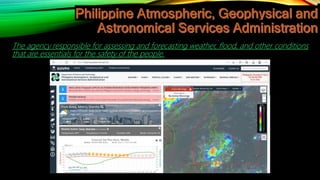
Philippines
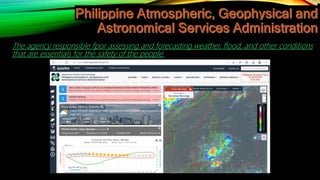
The agency responsible fpor assessing and forecasting weather, flood, and other conditions
that are essentials for the safety of the people.
The agency responsible for assessing and forecasting weather, flood, and other conditions
that are essentials for the safety of the people.
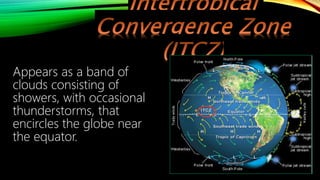
Appears as a band of
clouds consisting of
showers, with occasional
thunderstorms, that
encircles the globe near
the equator.
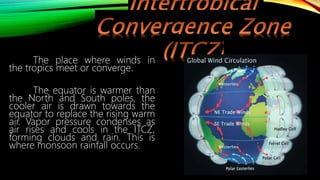
The place where winds in
the tropics meet or converge.
The equator is warmer than
the North and South poles, the
cooler air is drawn towards the
equator to replace the rising warm
air. Vapor pressure condenses as
air rises and cools in the ITCZ,
forming clouds and rain. This is
where monsoon rainfall occurs.
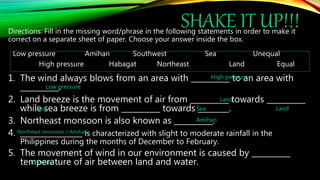
SHAKE IT UP!!!
Directions: Fill in the missing word/phrase in the following statements in order to make it
correct on a separate sheet of paper. Choose your answer inside the box.
Low pressure Amihan Southwest Sea Unequal
High pressure Habagat Northeast Land Equal
1. The wind always blows from an area with __________ to an area with
__________.
2. Land breeze is the movement of air from __________ towards __________
while sea breeze is from __________ towards ________.
3. Northeast monsoon is also known as __________.
4. ________________ is characterized with slight to moderate rainfall in the
Philippines during the months of December to February.
5. The movement of wind in our environment is caused by __________
temperature of air between land and water.
High pressure
Low pressure
Land
Land
Sea Sea
Amihan
Northeast monsoon / Amihan
Unequal
YOUR TURN!
How the monsoons
affect the Filipino
farmers. Give some
monsoons’advantages
and disadvantages in
farming.
YOUR TURN!
How the monsoons affect the Filipino farmers.
Give some monsoons’advantages and disadvantages
in farming.
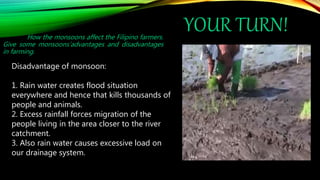
Disadvantage of monsoon:
1. Rain water creates flood situation

everywhere and hence that kills thousands of
people and animals.
2. Excess rainfall forces migration of the
people living in the area closer to the river
catchment.
3. Also rain water causes excessive load on
our drainage system.
YOUR TURN!
How the monsoons affect the Filipino farmers.
Give some monsoons’advantages and disadvantages
in farming.
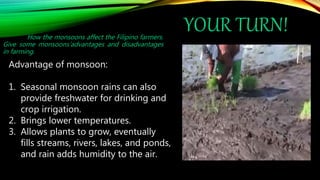
Advantage of monsoon:
1. Seasonal monsoon rains can also
provide freshwater for drinking and
crop irrigation.
2. Brings lower temperatures.
3. Allows plants to grow, eventually
fills streams, rivers, lakes, and ponds,
and rain adds humidity to the air.
QUIZ
Directions: Read and understand the
questions carefully.
Your quiz link:
https://forms.gle/taujJ2nZmFbrFjRR
6
Wind_Breezes_Monsoon_ITCZ.pptx

Wind_Breezes_Monsoon_ITCZ.pptx

  • 1.
    How are youfeeling today?
  • 2.
  • 3.
    Warm Air Surrounding Air Fromthe illustration, answer the following guide questions:
  • 4.
    Warm Air Surrounding Air Fromthe illustration, answer the following guide questions: Q1: Is the movement of warm air upward? Answer: YES
  • 5.
    Warm Air Surrounding Air Fromthe illustration, answer the following guide questions: Q2: Why is it that the warm air rises? Answer: Warm air rises because it is less dense than cold air from its surrounding.
  • 6.
    Warm Air Surrounding Air Fromthe illustration, answer the following guide questions: Q3: How will you describe the movement of surrounding air? Answer: The surrounding air move towards where the warm air is rising.
  • 7.
    Warm Air Surrounding Air Fromthe illustration, answer the following guide questions: Q4: Compare the direction of movements between surrounding air and warm air. Answer: The surrounding air move downward (sinking) while warm air move upward (rising).
  • 8.
    The air moves upwardor rises when heated.
  • 9.
    When air isheated, its molecules gain enough energy to move around faster and spread out. When a mass of air takes up more space, it becomes less dense than the surrounding air molecules. Hence, warm air rises above the cold and denser air below it.
  • 10.
    • The risingwarm air creates a low pressure which pulls in cool air to replace the rising air. • Low pressure is associated with rising air as air particles leave the surface. As the cool air descends, it creates a high pressure at the surface. Air that moves from places of high pressure to low pressure make WINDS.
  • 11.
    A. Breezes B. Monsoon C.Intertropical Convergence Zone
  • 12.
    LEARNING OBJECTIVES: 1. Identifycommon atmospheric phenomena such as breezes, monsoons, and intertropical convergence zone; 2. Compare the types of breezes and monsoons; and 3. Explains the occurrences of Intertropical convergence zone, breezes, and monsoon. 4. Cite how the monsoons affect the Filipino farmers.
  • 13.
    -Moving air. - Airthat is moving horizontally. -Are caused by differences in air pressure. AIR MOVES TOWARD THE PLACE WHERE WARM AIR IS RISING.
  • 14.
    Directions: Study andanalyze the differences between two pictures: SEA LAND LAND SEA PICTURE A PICTURE B Q1: Based on the two pictures, what are the directions of air movement? Q2: Why is there a difference between the movement of air during daytime and nighttime? Q3: What do you call these movements of air in pictures A and B?
  • 15.
    Directions: Study andanalyze the differences between two pictures: SEA LAND LAND SEA PICTURE A PICTURE B Q1: Based on the two pictures, what are the directions of air movement? Answer: In picture A, the air is moving from sea to land while in picture B, the air is moving from land to sea.
  • 16.
    Directions: Study andanalyze the differences between two pictures: SEA LAND LAND SEA PICTURE A PICTURE B Q2: Why is there a difference between the movement of air during daytime and nighttime? Answer: There is a difference in the direction of the movement of air because of the unequal temperature of air in our surroundings.
  • 17.
    Directions: Study andanalyze the differences between two pictures: SEA LAND LAND SEA PICTURE A PICTURE B Q3: What do you call these movements of air in pictures A and B? Answer: The movement of air in the pictures are called breezes.
  • 18.
    -a wind thatblows over a short distance. -caused by the UNEQUAL heating of Earth’s surface within a small region. Example: 1.Sea breeze 2. Land breeze
  • 20.
    During the day,the land heats up faster than the water in the sea.
  • 21.
    During the night,the land and sea will both cool down. But the land will lose heat faster than the water in the sea.
  • 22.
    • Wind systemthat is characterized by seasonal reversal of direction. • Sea and land breezes over a large region that change direction with seasons. • Characterized by a dramatic seasonal change in the direction of the prevailing winds over a large area. This change in the direction of the prevailing winds brings about changes in the amount of rainfall and leads to the distinct wet and dry seasons.
  • 23.
    Study and analyzethe following maps in figure 10 and 11. It show the air pressure and directions of winds in different parts of the world. The letter L indicates the areas with low pressure, H for with high pressure areas and arrowheads indicate for the direction of wind. Image retrieved from: 0aIR2.jpg (700×332) (imgur.com) Image retrieved from: H6oA6.jpg (700×332) (imgur.com)
  • 24.
    Q1: Trace thedirections of the arrows. In which area do the winds move? Q2: Locate the Philippines in the map. From what direction do the wind blow near the country in January? Q3: What type of monsoon does the country experience in January? Image retrieved from: 0aIR2.jpg (700×332) (imgur.com)
  • 25.
    Q1: Trace thedirections of the arrows. In which area do the winds move? Image retrieved from: 0aIR2.jpg (700×332) (imgur.com) Answer: The winds move from high pressure area to a low-pressure area.
  • 26.
    Q2: Locate thePhilippines in the map. From what direction do the wind blow near the country in January? Image retrieved from: 0aIR2.jpg (700×332) (imgur.com) Answer: The wind blows from Northeast during the month of January.
  • 27.
    Q3: What typeof monsoon does the country (Philippines) experience in January? Image retrieved from: 0aIR2.jpg (700×332) (imgur.com) Answer: Northeast monsoon or Hanging Amihan is the type of monsoon experienced during the month of January.
  • 28.
    Q4: In whatdirection do air of different pressures move? Why do you think so? Q5: From what direction do the winds blow near the Philippines in July? Q6: What type of monsoon does the country (Philippines) experience in July? Image retrieved from: H6oA6.jpg (700×332) (imgur.com)
  • 29.
    Q4: In whatdirection do air of different pressures move? Why do you think so? Answer: Air always move from high to low pressure area, because if the temperature of air is high it will rise thus creating the area low in pressure, then cold air from high-pressure area will move towards the low-pressure area to replace the rising air. Image retrieved from: H6oA6.jpg (700×332) (imgur.com)
  • 30.
    Q5: From whatdirection do the winds blow near the Philippines in July? Answer: The wind blow Southwest during the month of July. Image retrieved from: H6oA6.jpg (700×332) (imgur.com)
  • 31.
    Q6: What typeof monsoon does the country (Philippines) experience in July? Answer: The type of monsoon that can be experienced during the month of July is Southwest monsoon or known as Hanging Habagat. Image retrieved from: H6oA6.jpg (700×332) (imgur.com)
  • 32.
    Two types ofmonsoon: 1. AMIHAN (Northeast Monsoon) - comes from northeast and moves toward the south. -Affects the eastern parts of the country from October to march. -Slight to moderate rainfall. 1. HABAGAT (Southwest Monsoon) -comes from southwest and moves toward the north. -Affects the western part of the country from July to September. -Heavy rainfall. Philippines
  • 33.
    The agency responsiblefpor assessing and forecasting weather, flood, and other conditions that are essentials for the safety of the people.
  • 34.
    The agency responsiblefor assessing and forecasting weather, flood, and other conditions that are essentials for the safety of the people.
  • 35.
    Appears as aband of clouds consisting of showers, with occasional thunderstorms, that encircles the globe near the equator.
  • 36.
    The place wherewinds in the tropics meet or converge. The equator is warmer than the North and South poles, the cooler air is drawn towards the equator to replace the rising warm air. Vapor pressure condenses as air rises and cools in the ITCZ, forming clouds and rain. This is where monsoon rainfall occurs.
  • 37.
    SHAKE IT UP!!! Directions:Fill in the missing word/phrase in the following statements in order to make it correct on a separate sheet of paper. Choose your answer inside the box. Low pressure Amihan Southwest Sea Unequal High pressure Habagat Northeast Land Equal 1. The wind always blows from an area with __________ to an area with __________. 2. Land breeze is the movement of air from __________ towards __________ while sea breeze is from __________ towards ________. 3. Northeast monsoon is also known as __________. 4. ________________ is characterized with slight to moderate rainfall in the Philippines during the months of December to February. 5. The movement of wind in our environment is caused by __________ temperature of air between land and water. High pressure Low pressure Land Land Sea Sea Amihan Northeast monsoon / Amihan Unequal
  • 38.
    YOUR TURN! How themonsoons affect the Filipino farmers. Give some monsoons’advantages and disadvantages in farming.
  • 39.
    YOUR TURN! How themonsoons affect the Filipino farmers. Give some monsoons’advantages and disadvantages in farming. Disadvantage of monsoon: 1. Rain water creates flood situation everywhere and hence that kills thousands of people and animals. 2. Excess rainfall forces migration of the people living in the area closer to the river catchment. 3. Also rain water causes excessive load on our drainage system.
  • 40.
    YOUR TURN! How themonsoons affect the Filipino farmers. Give some monsoons’advantages and disadvantages in farming. Advantage of monsoon: 1. Seasonal monsoon rains can also provide freshwater for drinking and crop irrigation. 2. Brings lower temperatures. 3. Allows plants to grow, eventually fills streams, rivers, lakes, and ponds, and rain adds humidity to the air.
  • 41.
    QUIZ Directions: Read andunderstand the questions carefully. Your quiz link: https://forms.gle/taujJ2nZmFbrFjRR 6