Dynamic Earth Dr. Jennifer Wright
Shake, Rattle, ‘n Roll Plate Tectonics – the big picture, creation of the major geographic features of the Earth Layers of the Earth Plate Boundaries Earthquakes Volcanoes Impact Craters
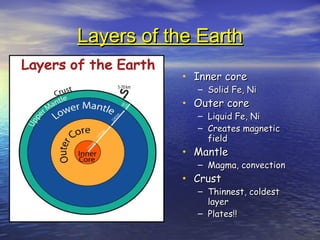
Layers of the Earth Inner core  Solid Fe, Ni Outer core Liquid Fe, Ni  Creates magnetic field Mantle Magma, convection Crust Thinnest, coldest layer Plates!!
Plate Tectonics Framework for understanding most geographic features of the planet  Mountain ranges, volcanoes, earthquakes Deepest point (Marianas Trench), Highest point (Mt. Everest) caused by plate interaction 3 kinds of plate boundaries Divergent Convergent Transform
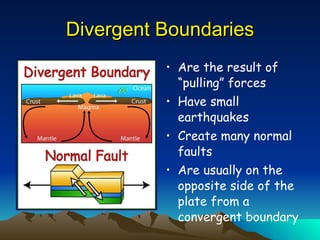
Divergent Boundaries Are the result of “pulling” forces Have small earthquakes Create many normal faults Are usually on the opposite side of the plate from a convergent boundary
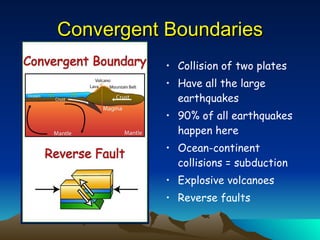
Convergent Boundaries Collision of two plates Have all the large earthquakes 90% of all earthquakes happen here Ocean-continent collisions = subduction Explosive volcanoes Reverse faults
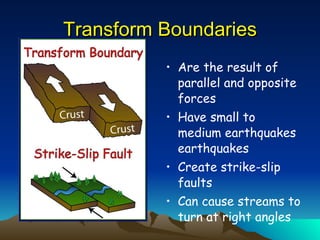
Transform Boundaries Are the result of parallel and opposite forces Have small to medium earthquakes earthquakes Create strike-slip faults Can cause streams to turn at right angles
Earthquakes Mostly happen on plate boundaries 90% happen on convergent boundaries Seismographs can record earthquakes from all over the world above 2.5-3 on magnitude scale Are a release of energy as two blocks move relative to each other Are measured on a logarithmic scale (multiply by 10)
Volcanoes Mostly created by melting of oceanic plate in the subduction zone and by hot spots in the mantle Explosive volcanoes associated with dissolved gases (H 2 O) in lava Ex. Mt. St. Helen’s
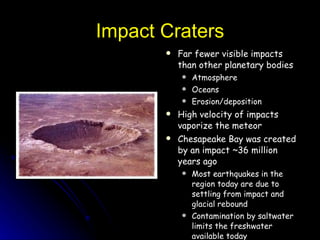
Impact Craters Far fewer visible impacts than other planetary bodies Atmosphere Oceans Erosion/deposition High velocity of impacts vaporize the meteor Chesapeake Bay was created by an impact ~36 million years ago Most earthquakes in the region today are due to settling from impact and glacial rebound Contamination by saltwater limits the freshwater available today
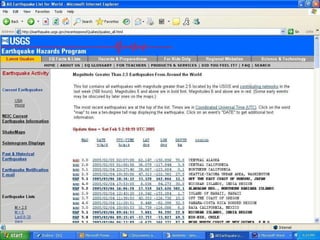
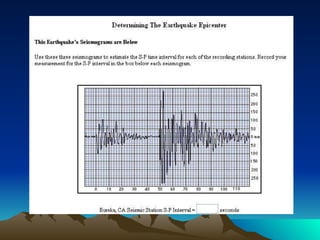
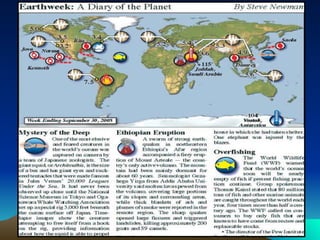
Classroom Activities Plate Boundaries Plot earthquakes on maps Graph earthquakes based on depth, magnitude, and boundary type Earthquakes on convergent boundaries are deeper and larger For more advanced students, locate the epicenter using “Virtual Earthquake” Plot volcanoes to locate plate boundaries (convergent) and hot spots (Hawaii) Discuss the week’s planetary events in terms of potential human impact


Dynamic Earth

  • 1.
    Dynamic Earth Dr.Jennifer Wright
  • 2.
    Shake, Rattle, ‘nRoll Plate Tectonics – the big picture, creation of the major geographic features of the Earth Layers of the Earth Plate Boundaries Earthquakes Volcanoes Impact Craters
  • 3.
    Layers of theEarth Inner core Solid Fe, Ni Outer core Liquid Fe, Ni Creates magnetic field Mantle Magma, convection Crust Thinnest, coldest layer Plates!!
  • 4.
    Plate Tectonics Frameworkfor understanding most geographic features of the planet Mountain ranges, volcanoes, earthquakes Deepest point (Marianas Trench), Highest point (Mt. Everest) caused by plate interaction 3 kinds of plate boundaries Divergent Convergent Transform
  • 5.
    Divergent Boundaries Arethe result of “pulling” forces Have small earthquakes Create many normal faults Are usually on the opposite side of the plate from a convergent boundary
  • 6.
    Convergent Boundaries Collisionof two plates Have all the large earthquakes 90% of all earthquakes happen here Ocean-continent collisions = subduction Explosive volcanoes Reverse faults
  • 7.
    Transform Boundaries Arethe result of parallel and opposite forces Have small to medium earthquakes earthquakes Create strike-slip faults Can cause streams to turn at right angles
  • 8.
    Earthquakes Mostly happenon plate boundaries 90% happen on convergent boundaries Seismographs can record earthquakes from all over the world above 2.5-3 on magnitude scale Are a release of energy as two blocks move relative to each other Are measured on a logarithmic scale (multiply by 10)
  • 9.
    Volcanoes Mostly createdby melting of oceanic plate in the subduction zone and by hot spots in the mantle Explosive volcanoes associated with dissolved gases (H 2 O) in lava Ex. Mt. St. Helen’s
  • 10.
    Impact Craters Farfewer visible impacts than other planetary bodies Atmosphere Oceans Erosion/deposition High velocity of impacts vaporize the meteor Chesapeake Bay was created by an impact ~36 million years ago Most earthquakes in the region today are due to settling from impact and glacial rebound Contamination by saltwater limits the freshwater available today
  • 11.
    Classroom Activities PlateBoundaries Plot earthquakes on maps Graph earthquakes based on depth, magnitude, and boundary type Earthquakes on convergent boundaries are deeper and larger For more advanced students, locate the epicenter using “Virtual Earthquake” Plot volcanoes to locate plate boundaries (convergent) and hot spots (Hawaii) Discuss the week’s planetary events in terms of potential human impact
  • 12.
  • 13.
  • 14.