VOCABULARY
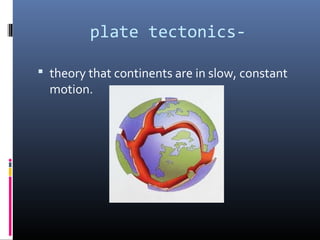
plate tectonics-

 theory that continents are in slow, constant
  motion.
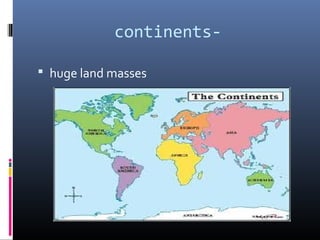
continents-

 huge land masses
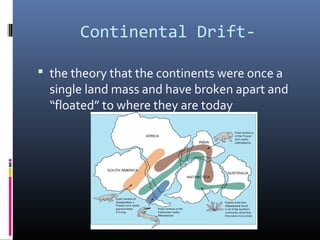
Continental Drift-

 the theory that the continents were once a
  single land mass and have broken apart and
  “floated” to where they are today
Alfred Wegener-

 German geologist who first came up with the
  Continental Drift theory in 1915
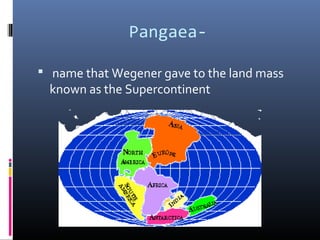
Pangaea-

 name that Wegener gave to the land mass
 known as the Supercontinent
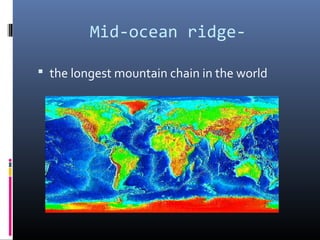
Mid-ocean ridge-

 the longest mountain chain in the world
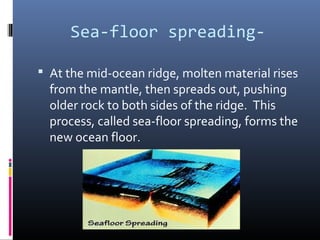
Sea-floor spreading-

 At the mid-ocean ridge, molten material rises
  from the mantle, then spreads out, pushing
  older rock to both sides of the ridge. This
  process, called sea-floor spreading, forms the
  new ocean floor.
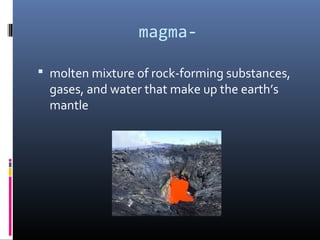
magma-

 molten mixture of rock-forming substances,
  gases, and water that make up the earth’s
  mantle
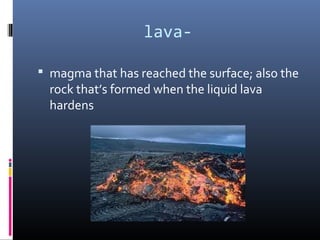
lava-

 magma that has reached the surface; also the
  rock that’s formed when the liquid lava
  hardens
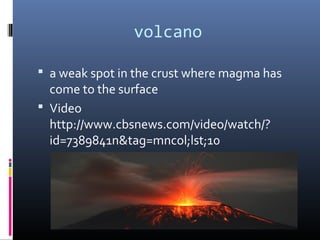
volcano

 a weak spot in the crust where magma has
  come to the surface
 Video
  http://www.cbsnews.com/video/watch/?
  id=7389841n&tag=mncol;lst;10
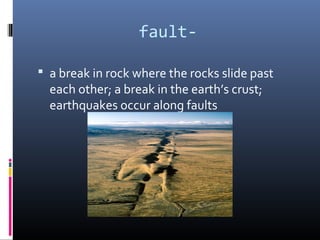
fault-

 a break in rock where the rocks slide past
  each other; a break in the earth’s crust;
  earthquakes occur along faults
earthquake-

 the shaking that results from the movement
  of rock beneath the earth’s surface
http://video.nationalgeographic.com/video/play
  er/environment/environment-natural-
  disasters/earthquakes/earthquake-101.html
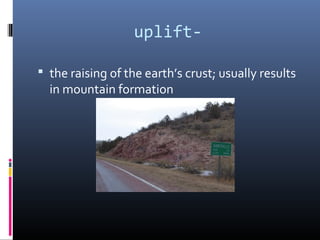
uplift-

 the raising of the earth’s crust; usually results
  in mountain formation
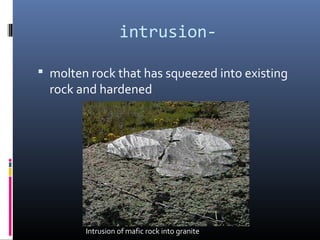
intrusion-

 molten rock that has squeezed into existing
  rock and hardened


        Intrusion of mafic rock into granite
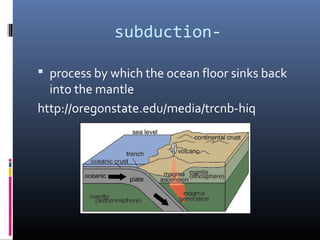
subduction-

 process by which the ocean floor sinks back
  into the mantle
http://oregonstate.edu/media/trcnb-hiq
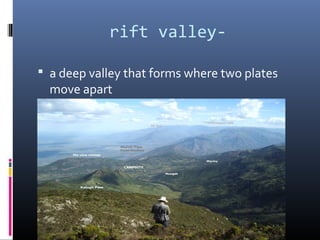
rift valley-

 a deep valley that forms where two plates
  move apart

Plate tectonics with vocabulary