Lada Martinez Benesova
January 15th, 2014
ES Faculty Meeting, International School Manila
• Mastery of unit vocabulary is one of the
essential requirements in understanding the
concepts and terms of units of inquiry
• Vocabulary strategies play a central role in
our teaching
• Vocabulary must be taught within a
meaningful context
•
•
•
•

In the ESL enrichment classes
In our Inclusion Lessons
In our Literacy / Unit of Inquiry sections
In Math sections
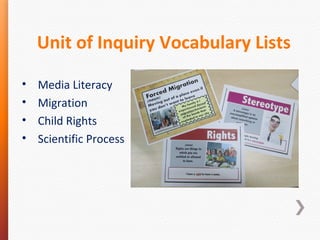
Unit of Inquiry Vocabulary Lists
•
•
•
•

Media Literacy
Migration
Child Rights
Scientific Process
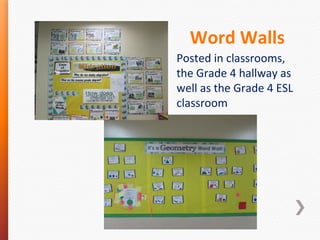
Word Walls
Posted in classrooms,
the Grade 4 hallway as
well as the Grade 4 ESL
classroom
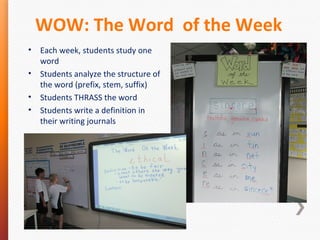
WOW: The Word of the Week
•
•
•
•

Each week, students study one
word
Students analyze the structure of
the word (prefix, stem, suffix)
Students THRASS the word
Students write a definition in
their writing journals
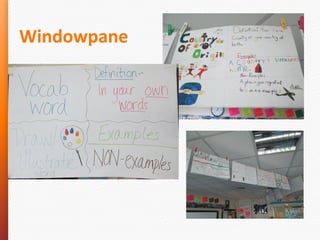
Windowpane
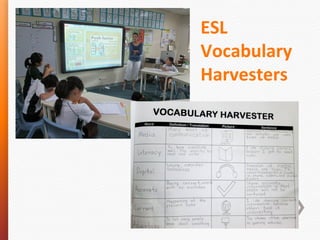
ESL
Vocabulary
Harvesters
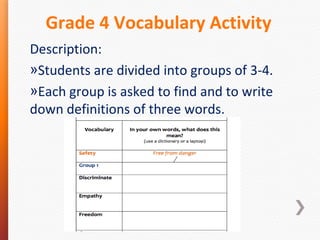
Grade 4 Vocabulary Activity
Description:
»Students are divided into groups of 3-4.
»Each group is asked to find and to write
down definitions of three words.
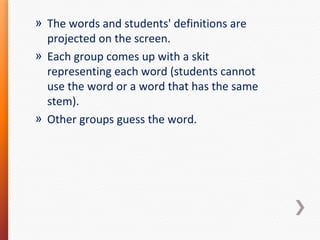
» The words and students' definitions are
projected on the screen.
» Each group comes up with a skit
representing each word (students cannot
use the word or a word that has the same
stem).
» Other groups guess the word.
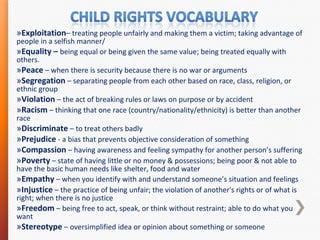
»Exploitation– treating people unfairly and making them a victim; taking advantage of
people in a selfish manner/
»Equality – being equal or being given the same value; being treated equally with
others.
»Peace – when there is security because there is no war or arguments
»Segregation – separating people from each other based on race, class, religion, or
ethnic group
»Violation – the act of breaking rules or laws on purpose or by accident
»Racism – thinking that one race (country/nationality/ethnicity) is better than another
race
»Discriminate – to treat others badly
»Prejudice - a bias that prevents objective consideration of something
»Compassion – having awareness and feeling sympathy for another person’s suffering
»Poverty – state of having little or no money & possessions; being poor & not able to
have the basic human needs like shelter, food and water
»Empathy – when you identify with and understand someone’s situation and feelings
»Injustice – the practice of being unfair; the violation of another's rights or of what is
right; when there is no justice
»Freedom – being free to act, speak, or think without restraint; able to do what you
want
»Stereotype – oversimplified idea or opinion about something or someone
Thank you for watching!
benesoval@ismanila.org

Vocabulary Instruction in Grade 4

  • 1.
    Lada Martinez Benesova January15th, 2014 ES Faculty Meeting, International School Manila
  • 2.
    • Mastery ofunit vocabulary is one of the essential requirements in understanding the concepts and terms of units of inquiry • Vocabulary strategies play a central role in our teaching • Vocabulary must be taught within a meaningful context
  • 3.
    • • • • In the ESLenrichment classes In our Inclusion Lessons In our Literacy / Unit of Inquiry sections In Math sections
  • 4.
    Unit of InquiryVocabulary Lists • • • • Media Literacy Migration Child Rights Scientific Process
  • 5.
    Word Walls Posted inclassrooms, the Grade 4 hallway as well as the Grade 4 ESL classroom
  • 6.
    WOW: The Wordof the Week • • • • Each week, students study one word Students analyze the structure of the word (prefix, stem, suffix) Students THRASS the word Students write a definition in their writing journals
  • 7.
  • 8.
  • 9.
    Grade 4 VocabularyActivity Description: »Students are divided into groups of 3-4. »Each group is asked to find and to write down definitions of three words.
  • 10.
    » The wordsand students' definitions are projected on the screen. » Each group comes up with a skit representing each word (students cannot use the word or a word that has the same stem). » Other groups guess the word.
  • 11.
    »Exploitation– treating peopleunfairly and making them a victim; taking advantage of people in a selfish manner/ »Equality – being equal or being given the same value; being treated equally with others. »Peace – when there is security because there is no war or arguments »Segregation – separating people from each other based on race, class, religion, or ethnic group »Violation – the act of breaking rules or laws on purpose or by accident »Racism – thinking that one race (country/nationality/ethnicity) is better than another race »Discriminate – to treat others badly »Prejudice - a bias that prevents objective consideration of something »Compassion – having awareness and feeling sympathy for another person’s suffering »Poverty – state of having little or no money & possessions; being poor & not able to have the basic human needs like shelter, food and water »Empathy – when you identify with and understand someone’s situation and feelings »Injustice – the practice of being unfair; the violation of another's rights or of what is right; when there is no justice »Freedom – being free to act, speak, or think without restraint; able to do what you want »Stereotype – oversimplified idea or opinion about something or someone
  • 12.
    Thank you forwatching! benesoval@ismanila.org