prayer
We offer you, Oh God
Our studies and prayers
And we beg you to enlighten our minds
And make us ever pleasing to you
Amen
Quick Kamustahan:
1 2 3 4 5
6 7 8 9 10
ABC in classroom
A- lign the chair
B-its of pieces of paper
C-hecking of attendance
LECTURE # 4
SCIENCE 9 (THIRD QUARTER)
Factors Affecting
the Climate
JUMBLED LETTERS
Directions: Arrange the jumbled
letters to find the hidden word
described below.
JUMBLED LETTERS
Directions: Arrange the jumbled
letters to find the hidden word
described below.
JUMBLED LETTERS
It refers to the day-to-day
condition of the atmosphere at
a particular place and time.
E W A T H E R
JUMBLED LETTERS
Defined as the general pattern
of weather in a certain area
over a long period of time.
E T I M A C L
JUMBLED LETTERS
Measures how hot or cold the
air is.
P A T E R M I A E T E R U R
(2 words)
JUMBLED LETTERS
Measures how heavy the air is
over a unit of area.
S U R E I R A R P S
(2 words)
JUMBLED LETTERS
Any form of water particles -
liquid or solid - that falls from
the atmosphere and reaches
the ground.
C I P T A I O N P R E I T
JUMBLED LETTERS
The scientists who specialize in the
study of climate, They learn the
climate of a place by analyzing its
weather from season to season and
year to year.
T S L O I G A M T I L O C S
JUMBLED LETTERS
scientists who study weather and they
study about weather conditions of
different places and predict them in
advance.
I S O T E R M O L O G E T
JUMBLED LETTERS
the national institution that gives
official weather forecasts which
are televised daily nationwide in the
Philippines.
S A G A P A
FACTORS AFFECTING CLIMATE:
1. LATITUDE
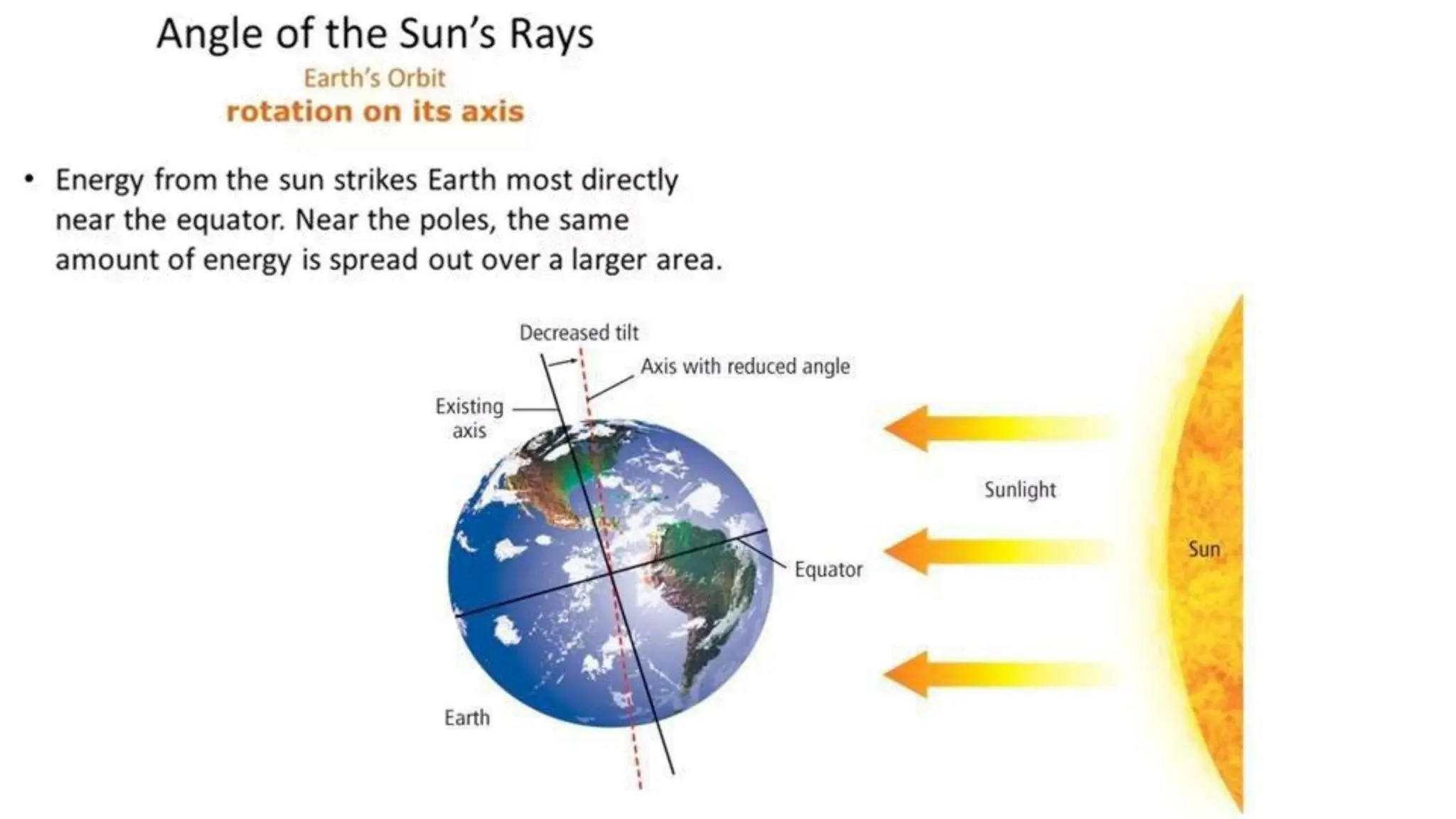
-an imaginary line that is parallel to the equator.
-The equator receives much of the radiant
energy released by the sun, so places near the
equator have warm climate. The areas closer to
the poles receive less amount of heat because
the angle of sunlight becomes smaller.
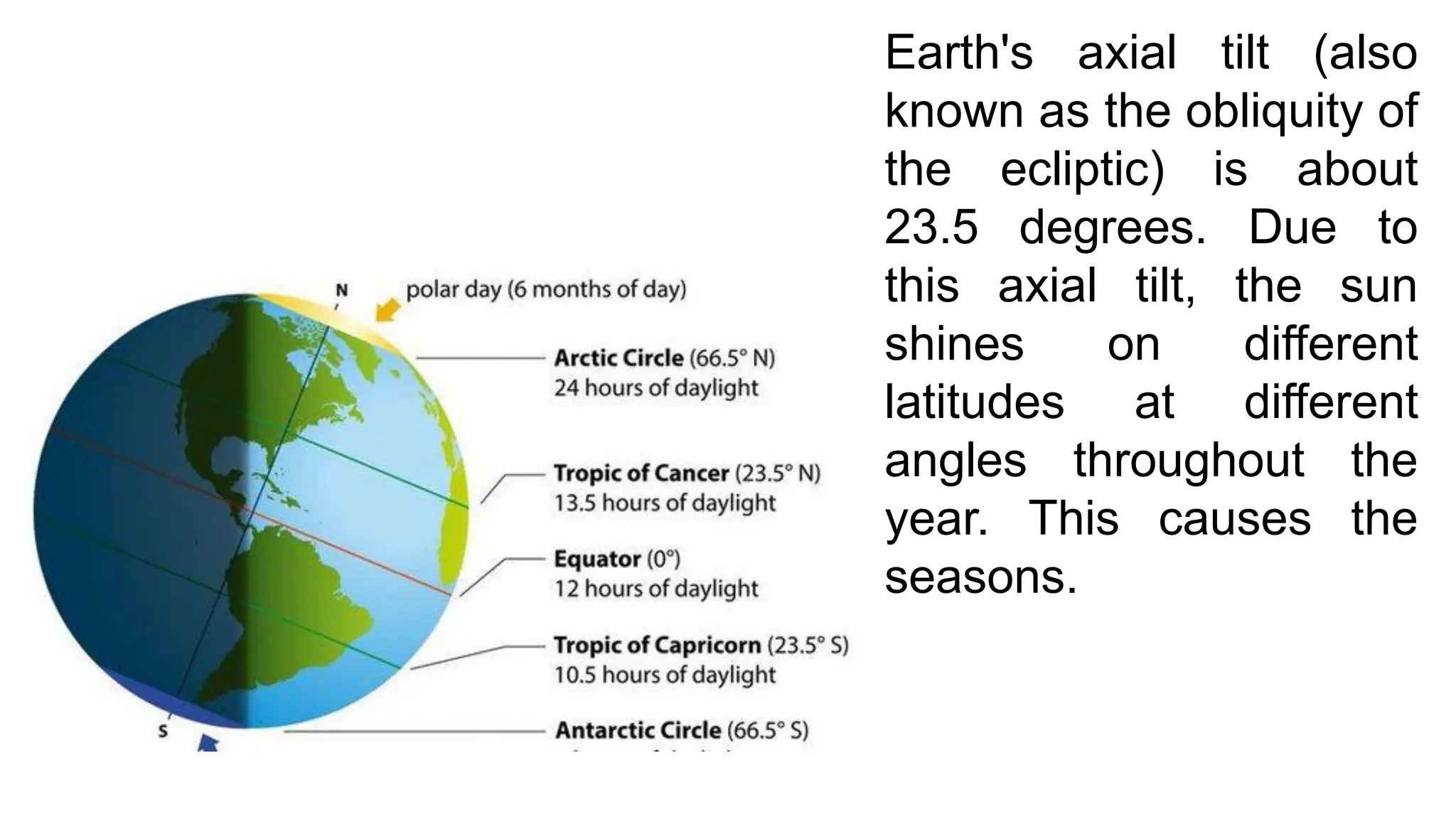
Earth's axial tilt (also
known as the obliquity of
the ecliptic) is about
23.5 degrees. Due to
this axial tilt, the sun
shines on different
latitudes at different
angles throughout the
year. This causes the
seasons.
FACTORS AFFECTING CLIMATE:
2. ALTITUDE
-the height above sea level
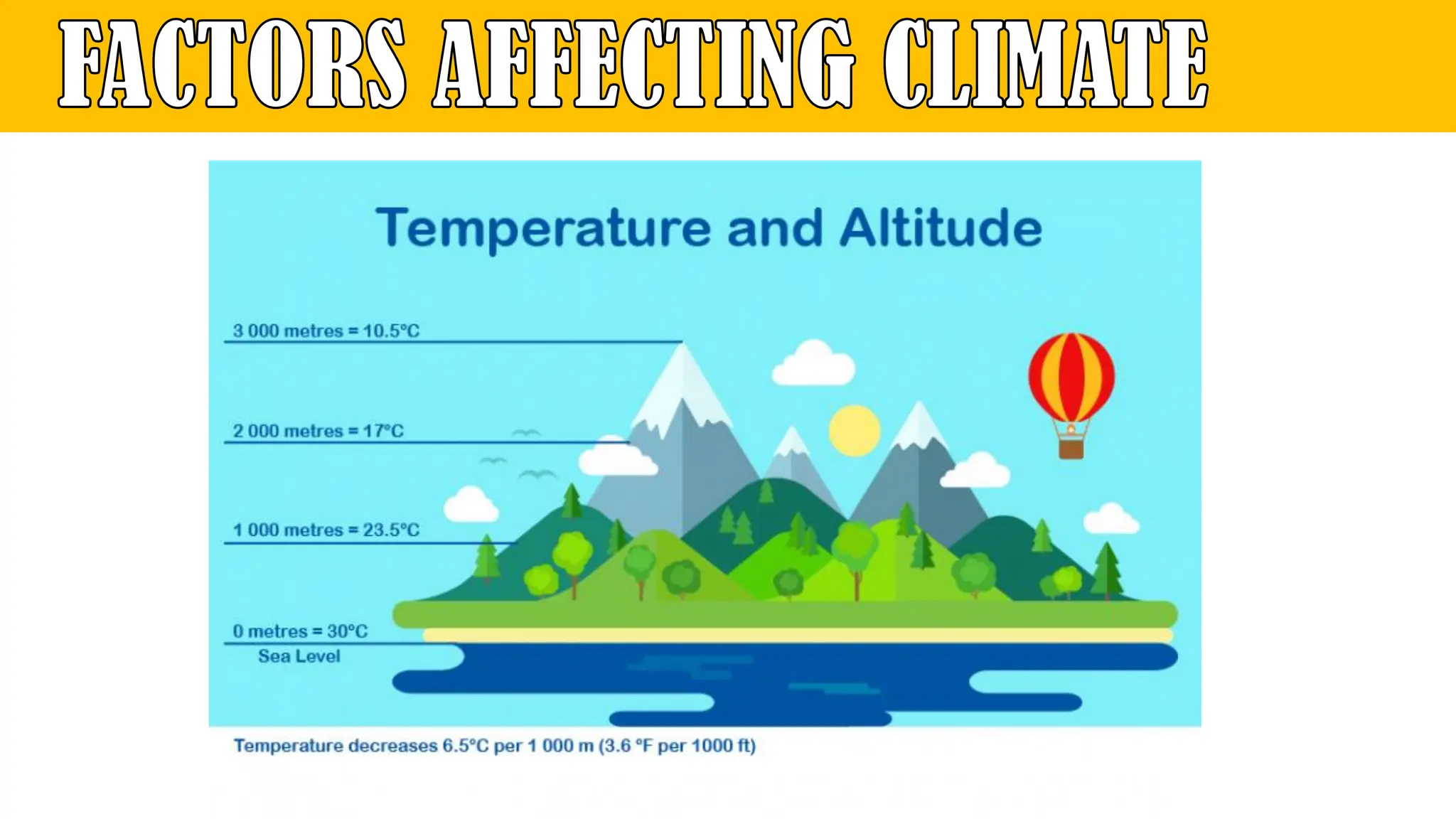
-The altitude of a place will affect the air temperature. That’s
because the air Temperature decreases as the altitude
increases. For every 1000 m, there is a drop of 6.50C. At
higher elevations, there is less air. The air molecules are
farther apart, thus making the air less dense. Lighter air
cannot absorb much heat, making air temperature lower.
Ultimately, the decrease in air temperature is due to the
decrease in air pressure.
FACTORS AFFECTING CLIMATE:
Altitude in Baguio
1,500 m (18.3 degrees Celsius)
FACTORS AFFECTING CLIMATE
FACTORS AFFECTING CLIMATE:
3. TOPOGRAPHY
-the surface features of an area.
-shape of the land
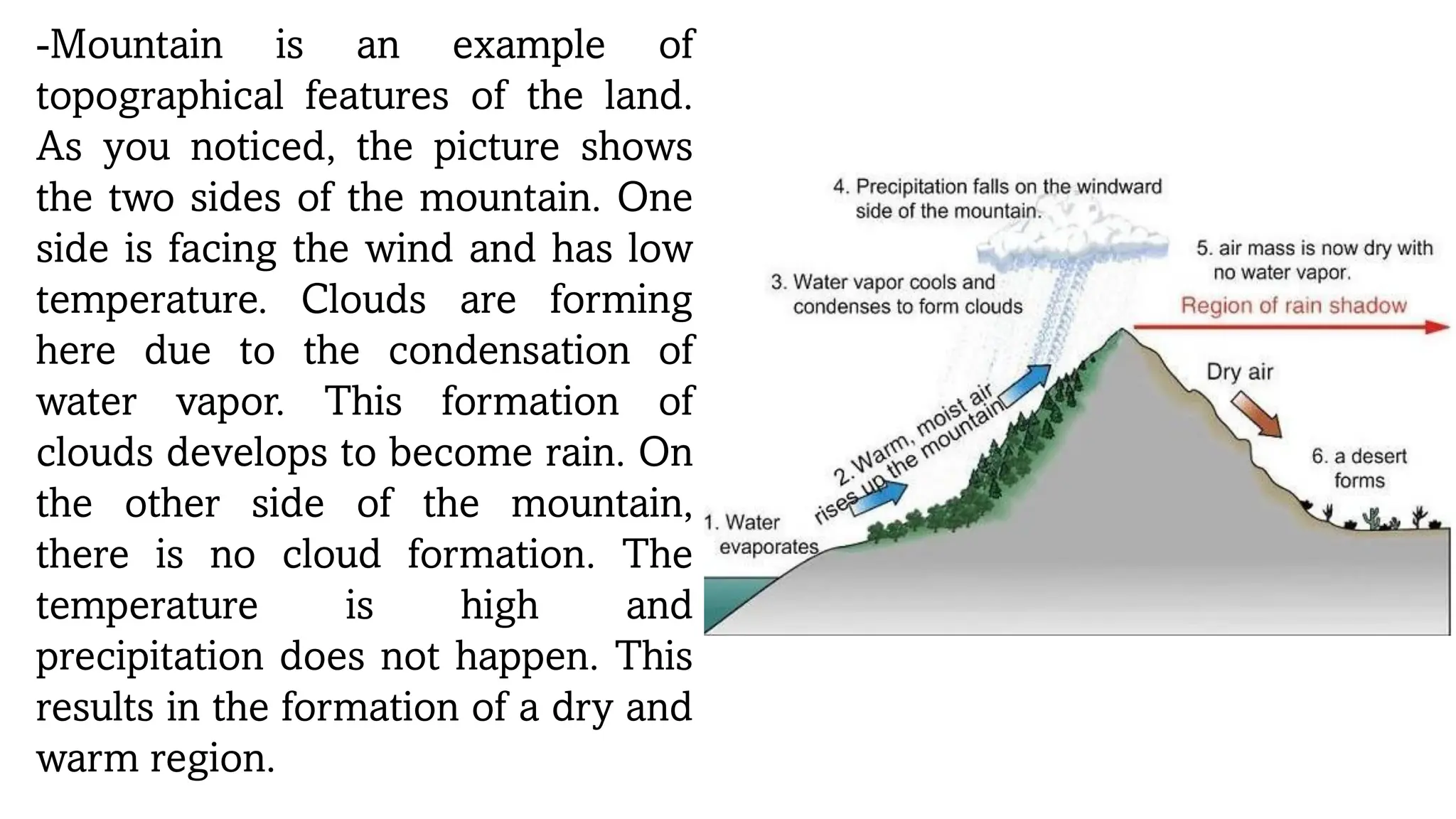
-Mountain is an example of
topographical features of the land.
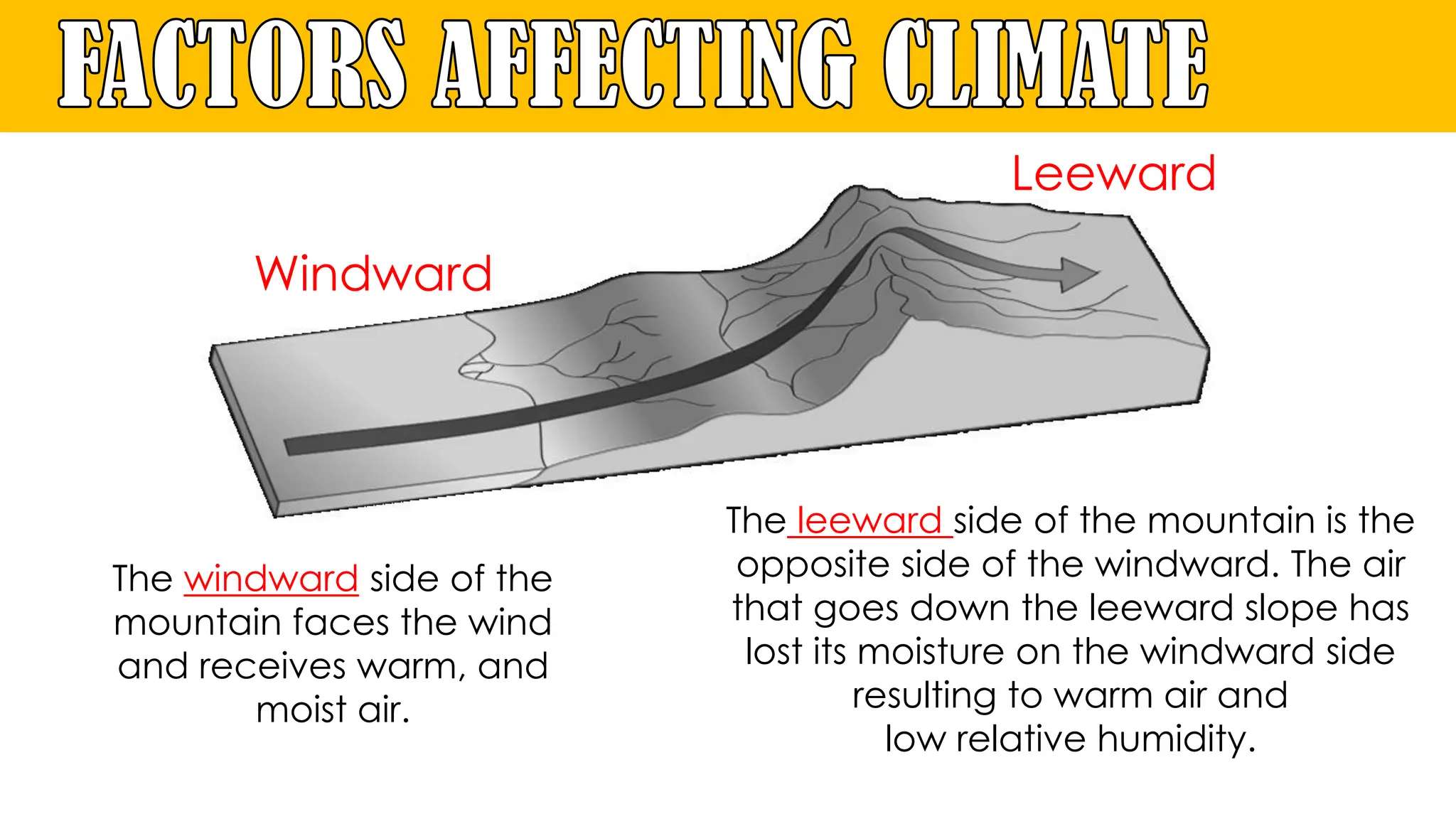
As you noticed, the picture shows
the two sides of the mountain. One
side is facing the wind and has low
temperature. Clouds are forming
here due to the condensation of
water vapor. This formation of
clouds develops to become rain. On
the other side of the mountain,
there is no cloud formation. The
temperature is high and
precipitation does not happen. This
results in the formation of a dry and
warm region.
FACTORS AFFECTING CLIMATE
Windward
Leeward
The windward side of the
mountain faces the wind
and receives warm, and
moist air.
The leeward side of the mountain is the
opposite side of the windward. The air
that goes down the leeward slope has
lost its moisture on the windward side
resulting to warm air and
low relative humidity.
FACTORS AFFECTING CLIMATE:
4. OCEAN CURRENT
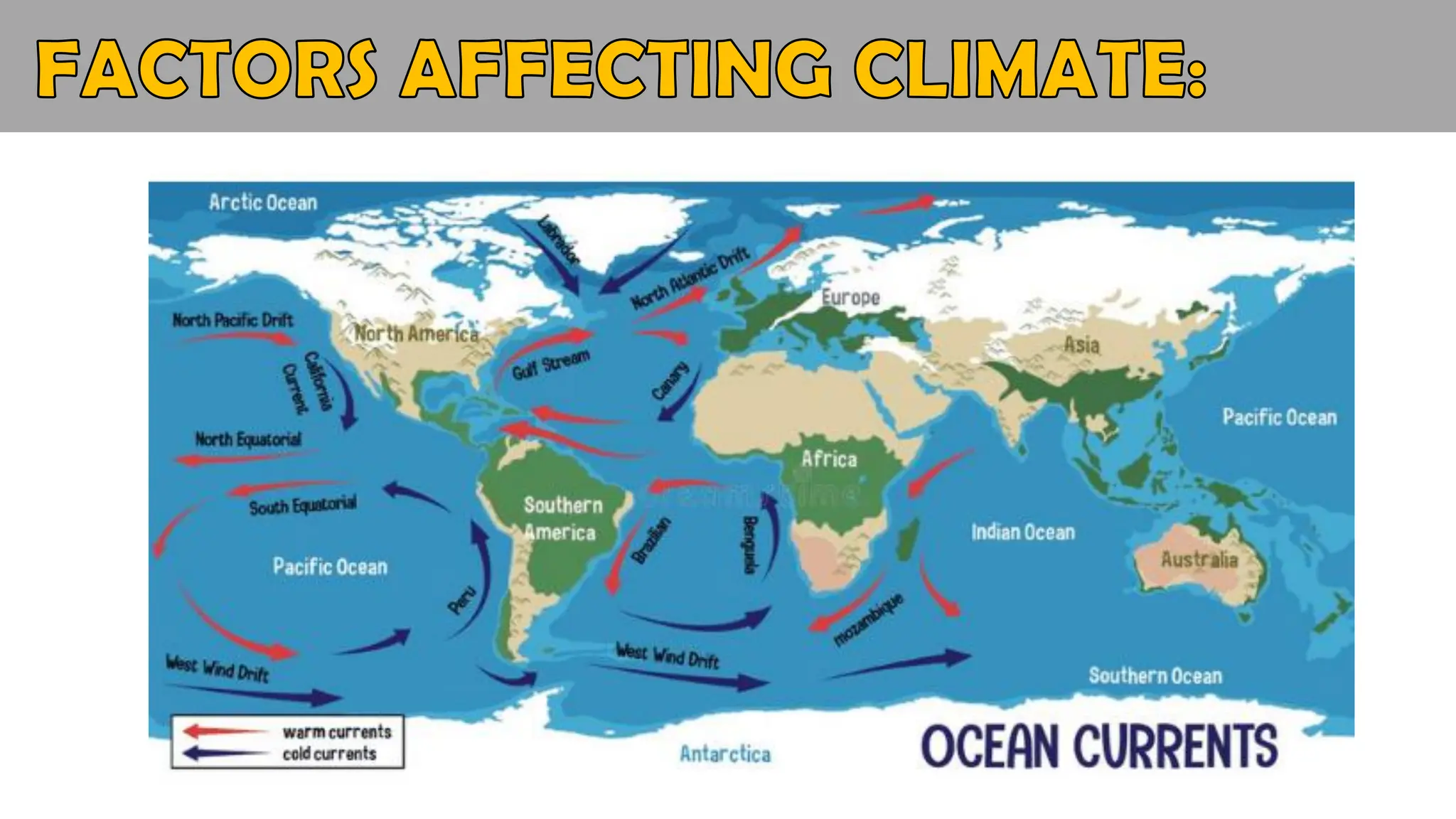
-Great flows of water running in the oceans are called ocean
currents. Some currents bring warm water to cool areas.
Warm ocean currents stream from the tropical seas toward
the polar areas. Other ocean currents bring cool water to
warm areas. These currents influence climate in many parts
of the world.
FACTORS AFFECTING CLIMATE:
5. WIND SYSTEMS
-light and gentle winds
-People residing nearby oceans and lakes feel
the breeze. There are two types of breeze – land
breeze and sea breeze.
FACTORS AFFECTING CLIMATE:
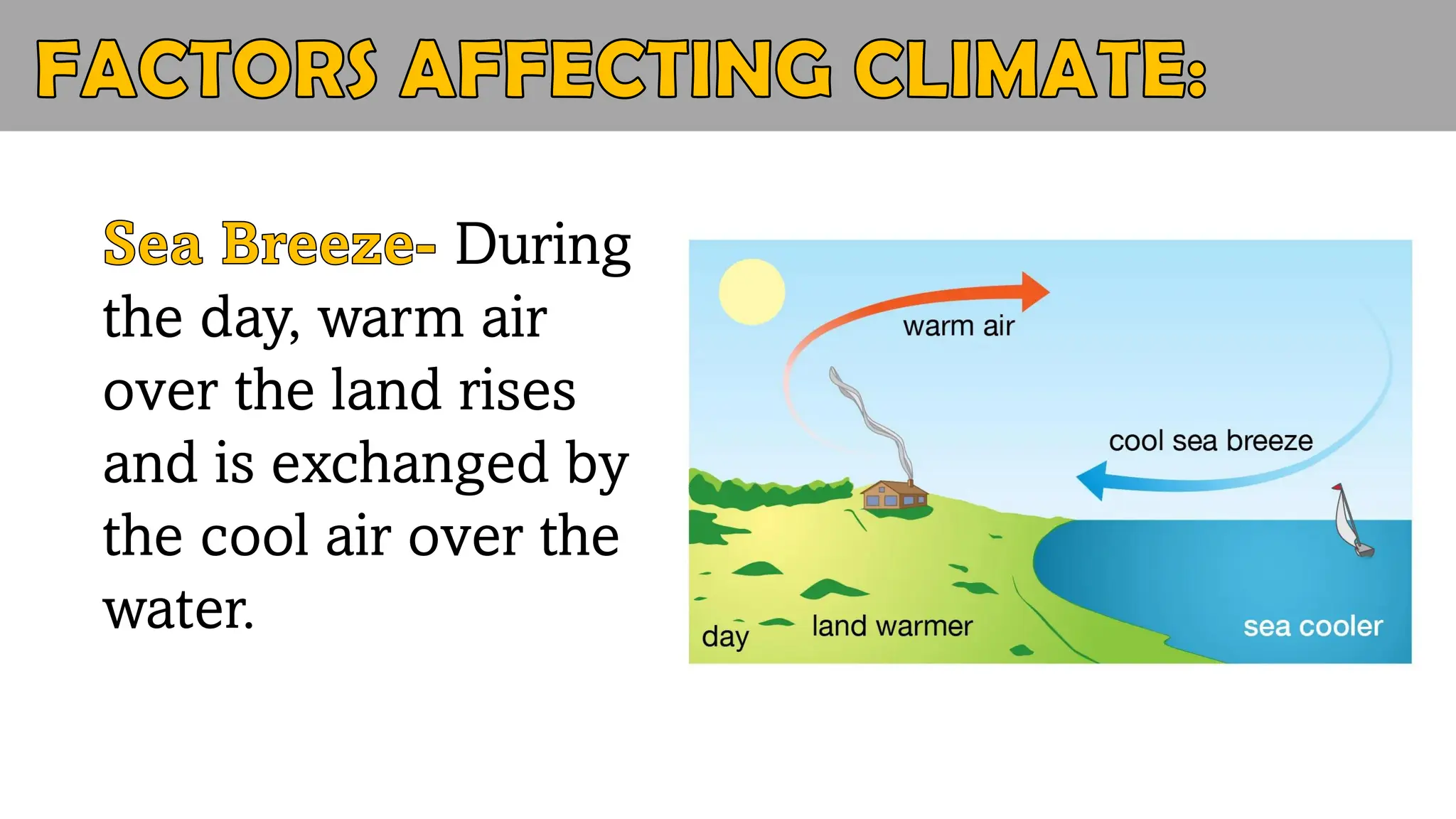
Sea Breeze- During
the day, warm air
over the land rises
and is exchanged by
the cool air over the
water.
FACTORS AFFECTING CLIMATE:
Land Breeze- During
the night, the land turns
out to be cooler than
water. Warmer air over
the water increases and
is replaced by cooler
air from the land.
FACTORS AFFECTING CLIMATE:
The Philippines is influenced by these
following wind systems:
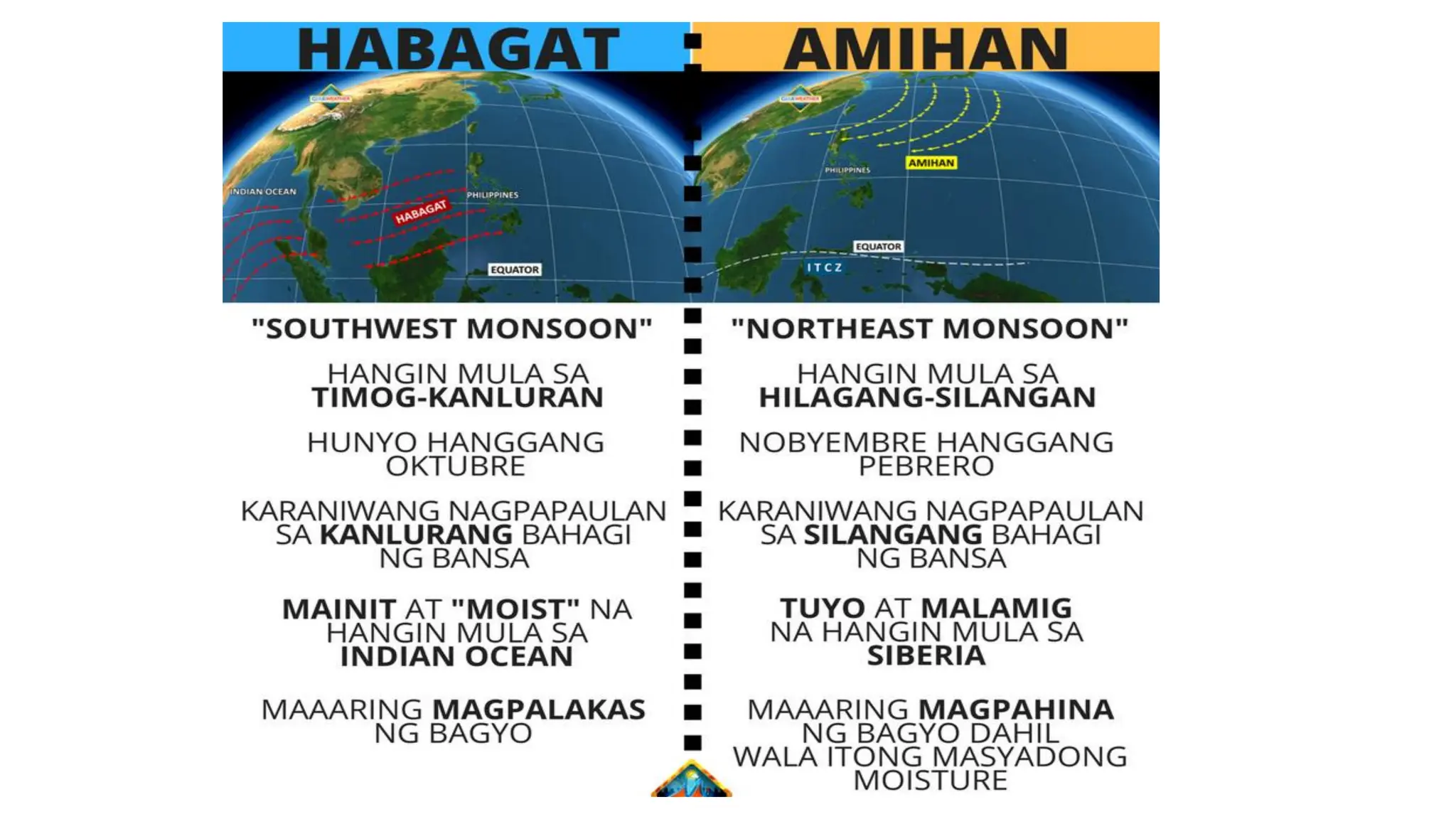
a. NORTHEAST MONSOON
b. SOUTHWEST MONSOON
FACTORS AFFECTING CLIMATE
The Philippines is influenced by these
following wind systems:
a.NORTHEAST MONSOON
(AMIHAN)
b. SOUTHWEST MONSOON
(HABAGAT)
NORTHEAST MONSOON
From October to February, a high-pressure region builds
over Southern Siberia and India in winter because of the
cold air over these areas. This mass of cold air goes in the
direction of the Pacific Ocean. It reaches the Philippines
from a northeasterly direction, as a result, the name
northeast monsoon. This monsoon gives cold mornings
and strong rainfall along the eastern coastal regions of the
Philippines.
SOUTHWEST MONSOON
From June to September, the continent of Asia turns
out to be warmer than the oceans nearby. A cold air
mass builds over the Pacific Ocean. It goes toward
the Asian continent from a southwest direction.
Southwest monsoon gives heavy rainfall along the
western coastal regions of the Philippines.
FACTORS AFFECTING CLIMATE:
6. EARTH’S MOVEMENT
AFFECTS CLIMATE
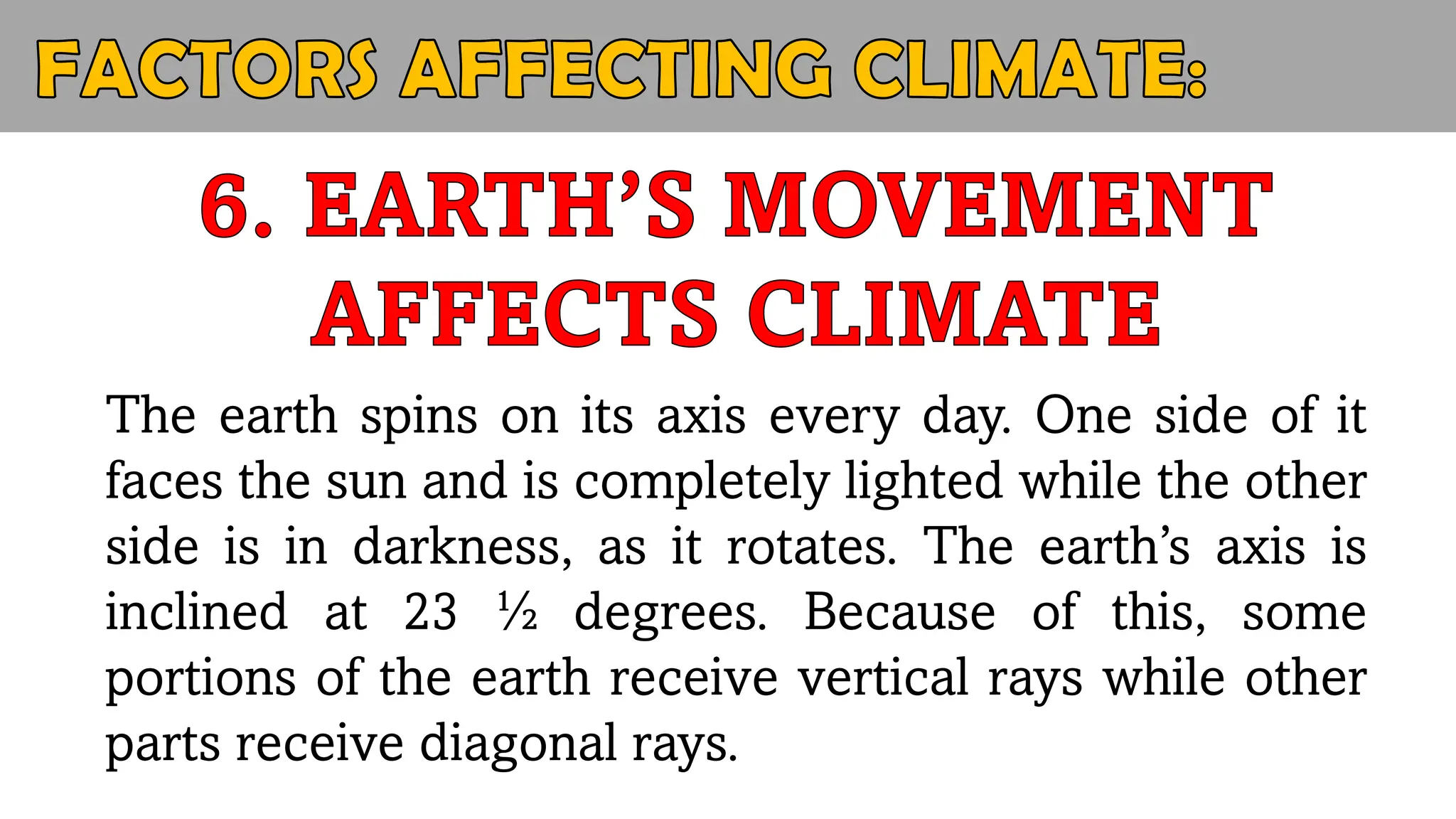
The earth spins on its axis every day. One side of it
faces the sun and is completely lighted while the other
side is in darkness, as it rotates. The earth’s axis is
inclined at 23 ½ degrees. Because of this, some
portions of the earth receive vertical rays while other
parts receive diagonal rays.
Factors Affecting the Climate Grade 9 Quarter 3 Week 4

Factors Affecting the Climate Grade 9 Quarter 3 Week 4

  • 2.
    prayer We offer you,Oh God Our studies and prayers And we beg you to enlighten our minds And make us ever pleasing to you Amen
  • 3.
    Quick Kamustahan: 1 23 4 5 6 7 8 9 10
  • 4.
    ABC in classroom A-lign the chair B-its of pieces of paper C-hecking of attendance
  • 5.
    LECTURE # 4 SCIENCE9 (THIRD QUARTER) Factors Affecting the Climate
  • 6.
    JUMBLED LETTERS Directions: Arrangethe jumbled letters to find the hidden word described below.
  • 7.
    JUMBLED LETTERS Directions: Arrangethe jumbled letters to find the hidden word described below.
  • 8.
    JUMBLED LETTERS It refersto the day-to-day condition of the atmosphere at a particular place and time. E W A T H E R
  • 9.
    JUMBLED LETTERS Defined asthe general pattern of weather in a certain area over a long period of time. E T I M A C L
  • 10.
    JUMBLED LETTERS Measures howhot or cold the air is. P A T E R M I A E T E R U R (2 words)
  • 11.
    JUMBLED LETTERS Measures howheavy the air is over a unit of area. S U R E I R A R P S (2 words)
  • 12.
    JUMBLED LETTERS Any formof water particles - liquid or solid - that falls from the atmosphere and reaches the ground. C I P T A I O N P R E I T
  • 13.
    JUMBLED LETTERS The scientistswho specialize in the study of climate, They learn the climate of a place by analyzing its weather from season to season and year to year. T S L O I G A M T I L O C S
  • 14.
    JUMBLED LETTERS scientists whostudy weather and they study about weather conditions of different places and predict them in advance. I S O T E R M O L O G E T
  • 15.
    JUMBLED LETTERS the nationalinstitution that gives official weather forecasts which are televised daily nationwide in the Philippines. S A G A P A
  • 16.
    FACTORS AFFECTING CLIMATE: 1.LATITUDE -an imaginary line that is parallel to the equator. -The equator receives much of the radiant energy released by the sun, so places near the equator have warm climate. The areas closer to the poles receive less amount of heat because the angle of sunlight becomes smaller.
  • 19.
    Earth's axial tilt(also known as the obliquity of the ecliptic) is about 23.5 degrees. Due to this axial tilt, the sun shines on different latitudes at different angles throughout the year. This causes the seasons.
  • 22.
    FACTORS AFFECTING CLIMATE: 2.ALTITUDE -the height above sea level -The altitude of a place will affect the air temperature. That’s because the air Temperature decreases as the altitude increases. For every 1000 m, there is a drop of 6.50C. At higher elevations, there is less air. The air molecules are farther apart, thus making the air less dense. Lighter air cannot absorb much heat, making air temperature lower. Ultimately, the decrease in air temperature is due to the decrease in air pressure.
  • 23.
    FACTORS AFFECTING CLIMATE: Altitudein Baguio 1,500 m (18.3 degrees Celsius)
  • 24.
  • 25.
  • 26.
    FACTORS AFFECTING CLIMATE: 3.TOPOGRAPHY -the surface features of an area. -shape of the land
  • 27.
    -Mountain is anexample of topographical features of the land. As you noticed, the picture shows the two sides of the mountain. One side is facing the wind and has low temperature. Clouds are forming here due to the condensation of water vapor. This formation of clouds develops to become rain. On the other side of the mountain, there is no cloud formation. The temperature is high and precipitation does not happen. This results in the formation of a dry and warm region.
  • 28.
    FACTORS AFFECTING CLIMATE Windward Leeward Thewindward side of the mountain faces the wind and receives warm, and moist air. The leeward side of the mountain is the opposite side of the windward. The air that goes down the leeward slope has lost its moisture on the windward side resulting to warm air and low relative humidity.
  • 29.
    FACTORS AFFECTING CLIMATE: 4.OCEAN CURRENT -Great flows of water running in the oceans are called ocean currents. Some currents bring warm water to cool areas. Warm ocean currents stream from the tropical seas toward the polar areas. Other ocean currents bring cool water to warm areas. These currents influence climate in many parts of the world.
  • 30.
  • 31.
    FACTORS AFFECTING CLIMATE: 5.WIND SYSTEMS -light and gentle winds -People residing nearby oceans and lakes feel the breeze. There are two types of breeze – land breeze and sea breeze.
  • 32.
    FACTORS AFFECTING CLIMATE: SeaBreeze- During the day, warm air over the land rises and is exchanged by the cool air over the water.
  • 33.
    FACTORS AFFECTING CLIMATE: LandBreeze- During the night, the land turns out to be cooler than water. Warmer air over the water increases and is replaced by cooler air from the land.
  • 34.
    FACTORS AFFECTING CLIMATE: ThePhilippines is influenced by these following wind systems: a. NORTHEAST MONSOON b. SOUTHWEST MONSOON
  • 35.
    FACTORS AFFECTING CLIMATE ThePhilippines is influenced by these following wind systems: a.NORTHEAST MONSOON (AMIHAN) b. SOUTHWEST MONSOON (HABAGAT)
  • 37.
    NORTHEAST MONSOON From Octoberto February, a high-pressure region builds over Southern Siberia and India in winter because of the cold air over these areas. This mass of cold air goes in the direction of the Pacific Ocean. It reaches the Philippines from a northeasterly direction, as a result, the name northeast monsoon. This monsoon gives cold mornings and strong rainfall along the eastern coastal regions of the Philippines.
  • 38.
    SOUTHWEST MONSOON From Juneto September, the continent of Asia turns out to be warmer than the oceans nearby. A cold air mass builds over the Pacific Ocean. It goes toward the Asian continent from a southwest direction. Southwest monsoon gives heavy rainfall along the western coastal regions of the Philippines.
  • 39.
    FACTORS AFFECTING CLIMATE: 6.EARTH’S MOVEMENT AFFECTS CLIMATE The earth spins on its axis every day. One side of it faces the sun and is completely lighted while the other side is in darkness, as it rotates. The earth’s axis is inclined at 23 ½ degrees. Because of this, some portions of the earth receive vertical rays while other parts receive diagonal rays.