• It is an act
• It is an expression
• It is a habit
•   Pleasant tone and sound (Tone and sound)
•   Audible (Volume)
•   Good pitch (Pitch)
•   Easy to understand (Clarity/ Pronunciation)
•   Sensible (Intelligible)
Pleasant tone and sound (Tone and sound)
A pleasant voice can be achieved by relaxing the
  vocal chords. Relaxing the body through deep
  breathing is effective in relaxing the vocal the
                   vocal chords.)
Audible (Volume)
  Softer volume is more professional on the
   telephone. It must neither be too loud nor
                    too soft.
Good pitch (Pitch)
    Lower pitch is more professional on the
   telephone. It shows that you are confident
                  and in control.
Easy to Understand (Clarity/ Pronunciation)
 Follow the Standard American English Accent.
   You will be perceived by your customers as
    more professional and educated. Learn to
    use a dictionary to guide you in improving.
   Also, speak clearly. Don’t be tongue-lazy. Do
               some tongue-twisters.
Sensible (Intelligible)
  Make sense. Intelligible speech catches the
     attention if it has interesting content.
REMEMBER:
Your voice is an important
     tool when you are
    conversing because
     people will build a
 perception of you through
        your voice.
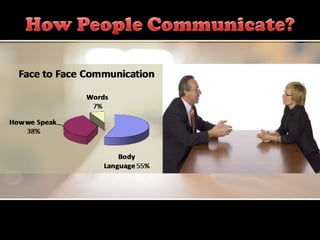
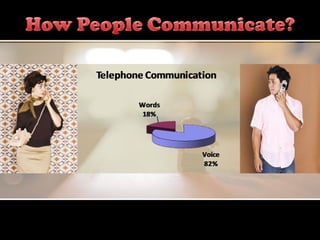
Over the phone, people tend to…
• create a mental picture of what the person look like
• determine whether they like them or not;
                       Because…
• approximately 60% of our communication (eye
  contact, gestures, facial expressions, etc.) is lost over
  the telephone.
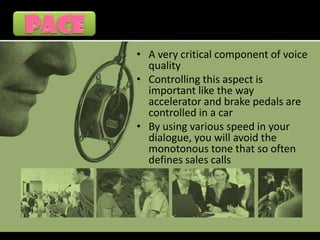
• A very critical component of voice
  quality
• Controlling this aspect is
  important like the way
  accelerator and brake pedals are
  controlled in a car
• By using various speed in your
  dialogue, you will avoid the
  monotonous tone that so often
  defines sales calls
• Use the “variable speed”
  approach:
    1.   Speed up when you want to quickly
         get through a part of your sentence,
         or
    2.   Slow down when you want to gain
         your audience’s full, focused
         attention.
•    It is also best to mirror the pace
     of the person you are talking to
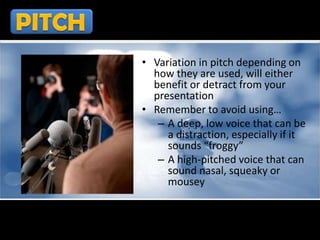
• Variation in pitch depending on
  how they are used, will either
  benefit or detract from your
  presentation
• Remember to avoid using…
   – A deep, low voice that can be
     a distraction, especially if it
     sounds “froggy”
   – A high-pitched voice that can
     sound nasal, squeaky or
     mousey
Control your pitch at or
about a level that makes
 it easy for listening and
     use an appealing
 pleasant voice that can
 soothe and attract your
         audience
• Always vary the quality and tone of
  your voice
• Do not use flat, monotonous voice
  because it is distracting
• Convey a sense of enthusiasm
  to the people you are
  talking to
• Vary your tone or
  modulate your voice so you
  will generate emotion
Reasons why we need intonation
• It indicates mood and meaning
• Without it, your speech would be flat,
  mechanical and would be confusing
  for your listener
• Provides exaggerations to make
  a point
• If you use intonation not only
  will you be easier to
  understand, but you will sound more
  confident, dynamic & persuasive
How to make intonation
• LOUDER – simply raising the volume
• STRETCH – stretch the word out or
  lengthen the word that you want
  to draw attention to
• PITCH – change the pitch,
  which is the most refined.
  This will make your
  listeners stop & listen
  because they think you
  are going to say something
  interesting
• Clarity is the crispness
  of your voice,
  enunciation and your
  pronunciation
• So speak clearly by:
  – Pronouncing words
    perfectly and
  – Enunciating sounds well
• Posture affects voice
  quality
• To have good posture –
  – Sit or stand upright, back
    and straight, with feet flat
    on the floor and
  – Practice doing things that
    do not require additional
    work and strain your sound
    production
• Smile often whenever you
  speak or talk, even when you
  are on the phone because the
  voice projection improves when
  you smile
• Be watchful of your expressions
  and gestures
• Persuade and generate interest
  not only with words but with
  your facial expressions and
  body gestures
• Avoid annoying mannerisms
•   Up ending words and sentences
•   Fillers
•   Reading
•   Talking over People
•   Rhythm
•   Professionalism
Up ending words and sentence
  • This means your voice raises or gets higher as
    you say a word or come to the end of a sentence
  • It makes everything you say sound like a
    question
  • Your voice should actually go down at the end of
    the sentence to signal the end of an idea
  • Up ending words and sentences makes you
    sound unsure of yourself and unassertive
Fillers
    • Uhms, Er, Ahs, Ya’knows are a few of the
       common fillers that you should avoid using
    • These fillers tend to undercut the speaker’s
       effectiveness because they produce a
       perception of uncertainty
    • Habitual use of fillers also cause articulation
       problems especially when used while stuttering
Reading
  • You should not sound like you are reading when
     speaking
  • Instead, one should sound conversational,
     personable, having enthusiasm and having voice
     inflection will keep you from giving the
     impression that you are reading a script
Talking Over People
   • Talking over people and interrupting them
      before they finish talking during conversations
      are extremely rude
   • This behavior can cause strains in your
      relationship with the people you are conversing
      with
   • So avoid talking over, practice LISTENING first
      and wait for your turn before speaking
Rhythm
  • Placing punctuations where it doesn’t belong
     can make it difficult for your audience to follow
  • Also, it can cause misconceptions that lead to
     misunderstanding s
  • So practice

General speech training (part 1)

  • 2.
    • It isan act • It is an expression • It is a habit
  • 3.
    Pleasant tone and sound (Tone and sound) • Audible (Volume) • Good pitch (Pitch) • Easy to understand (Clarity/ Pronunciation) • Sensible (Intelligible)
  • 4.
    Pleasant tone andsound (Tone and sound) A pleasant voice can be achieved by relaxing the vocal chords. Relaxing the body through deep breathing is effective in relaxing the vocal the vocal chords.)
  • 5.
    Audible (Volume) Softer volume is more professional on the telephone. It must neither be too loud nor too soft.
  • 6.
    Good pitch (Pitch) Lower pitch is more professional on the telephone. It shows that you are confident and in control.
  • 7.
    Easy to Understand(Clarity/ Pronunciation) Follow the Standard American English Accent. You will be perceived by your customers as more professional and educated. Learn to use a dictionary to guide you in improving. Also, speak clearly. Don’t be tongue-lazy. Do some tongue-twisters.
  • 8.
    Sensible (Intelligible) Make sense. Intelligible speech catches the attention if it has interesting content.
  • 11.
    REMEMBER: Your voice isan important tool when you are conversing because people will build a perception of you through your voice.
  • 12.
    Over the phone,people tend to… • create a mental picture of what the person look like • determine whether they like them or not; Because… • approximately 60% of our communication (eye contact, gestures, facial expressions, etc.) is lost over the telephone.
  • 14.
    • A verycritical component of voice quality • Controlling this aspect is important like the way accelerator and brake pedals are controlled in a car • By using various speed in your dialogue, you will avoid the monotonous tone that so often defines sales calls
  • 15.
    • Use the“variable speed” approach: 1. Speed up when you want to quickly get through a part of your sentence, or 2. Slow down when you want to gain your audience’s full, focused attention. • It is also best to mirror the pace of the person you are talking to
  • 16.
    • Variation inpitch depending on how they are used, will either benefit or detract from your presentation • Remember to avoid using… – A deep, low voice that can be a distraction, especially if it sounds “froggy” – A high-pitched voice that can sound nasal, squeaky or mousey
  • 17.
    Control your pitchat or about a level that makes it easy for listening and use an appealing pleasant voice that can soothe and attract your audience
  • 18.
    • Always varythe quality and tone of your voice • Do not use flat, monotonous voice because it is distracting • Convey a sense of enthusiasm to the people you are talking to • Vary your tone or modulate your voice so you will generate emotion
  • 19.
    Reasons why weneed intonation • It indicates mood and meaning • Without it, your speech would be flat, mechanical and would be confusing for your listener • Provides exaggerations to make a point • If you use intonation not only will you be easier to understand, but you will sound more confident, dynamic & persuasive
  • 20.
    How to makeintonation • LOUDER – simply raising the volume • STRETCH – stretch the word out or lengthen the word that you want to draw attention to • PITCH – change the pitch, which is the most refined. This will make your listeners stop & listen because they think you are going to say something interesting
  • 21.
    • Clarity isthe crispness of your voice, enunciation and your pronunciation • So speak clearly by: – Pronouncing words perfectly and – Enunciating sounds well
  • 22.
    • Posture affectsvoice quality • To have good posture – – Sit or stand upright, back and straight, with feet flat on the floor and – Practice doing things that do not require additional work and strain your sound production
  • 23.
    • Smile oftenwhenever you speak or talk, even when you are on the phone because the voice projection improves when you smile • Be watchful of your expressions and gestures • Persuade and generate interest not only with words but with your facial expressions and body gestures • Avoid annoying mannerisms
  • 24.
    Up ending words and sentences • Fillers • Reading • Talking over People • Rhythm • Professionalism
  • 25.
    Up ending wordsand sentence • This means your voice raises or gets higher as you say a word or come to the end of a sentence • It makes everything you say sound like a question • Your voice should actually go down at the end of the sentence to signal the end of an idea • Up ending words and sentences makes you sound unsure of yourself and unassertive
  • 26.
    Fillers • Uhms, Er, Ahs, Ya’knows are a few of the common fillers that you should avoid using • These fillers tend to undercut the speaker’s effectiveness because they produce a perception of uncertainty • Habitual use of fillers also cause articulation problems especially when used while stuttering
  • 27.
    Reading •You should not sound like you are reading when speaking • Instead, one should sound conversational, personable, having enthusiasm and having voice inflection will keep you from giving the impression that you are reading a script
  • 28.
    Talking Over People • Talking over people and interrupting them before they finish talking during conversations are extremely rude • This behavior can cause strains in your relationship with the people you are conversing with • So avoid talking over, practice LISTENING first and wait for your turn before speaking
  • 29.
    Rhythm •Placing punctuations where it doesn’t belong can make it difficult for your audience to follow • Also, it can cause misconceptions that lead to misunderstanding s • So practice

Editor's Notes

  • #4 1) PLEASANT TONE AND SOUND:A pleasant voice can be achieved by relaxing the vocal chords. Relaxing the body through deep breathing is effective in relaxing the vocal the vocal chords.2) AUDIBLE VOLUME: Softer volume is more professional on the telephone. It must neither be too loud nor too soft.3) GOOD PITCH: Lower pitch is more professional on the telephone. It shows that you are confident and in control.4) EASY TO UNDERSTAND: Follow the Standard American English Accent. You will be perceived by your customers as more professional and educated. Learn to use a dictionary to guide you in improving. Also, speak clearly. Don’t be tongue-lazy. Do some tongue-twisters.5) SENSIBLE: Make sense. Intelligible speech catches the attention if it has interesting content.
  • #5 1) PLEASANT TONE AND SOUND:A pleasant voice can be achieved by relaxing the vocal chords. Relaxing the body through deep breathing is effective in relaxing the vocal the vocal chords.2) AUDIBLE VOLUME: Softer volume is more professional on the telephone. It must neither be too loud nor too soft.3) GOOD PITCH: Lower pitch is more professional on the telephone. It shows that you are confident and in control.4) EASY TO UNDERSTAND: Follow the Standard American English Accent. You will be perceived by your customers as more professional and educated. Learn to use a dictionary to guide you in improving. Also, speak clearly. Don’t be tongue-lazy. Do some tongue-twisters.5) SENSIBLE: Make sense. Intelligible speech catches the attention if it has interesting content.
  • #6 1) PLEASANT TONE AND SOUND:A pleasant voice can be achieved by relaxing the vocal chords. Relaxing the body through deep breathing is effective in relaxing the vocal the vocal chords.2) AUDIBLE VOLUME: Softer volume is more professional on the telephone. It must neither be too loud nor too soft.3) GOOD PITCH: Lower pitch is more professional on the telephone. It shows that you are confident and in control.4) EASY TO UNDERSTAND: Follow the Standard American English Accent. You will be perceived by your customers as more professional and educated. Learn to use a dictionary to guide you in improving. Also, speak clearly. Don’t be tongue-lazy. Do some tongue-twisters.5) SENSIBLE: Make sense. Intelligible speech catches the attention if it has interesting content.
  • #7 1) PLEASANT TONE AND SOUND:A pleasant voice can be achieved by relaxing the vocal chords. Relaxing the body through deep breathing is effective in relaxing the vocal the vocal chords.2) AUDIBLE VOLUME: Softer volume is more professional on the telephone. It must neither be too loud nor too soft.3) GOOD PITCH: Lower pitch is more professional on the telephone. It shows that you are confident and in control.4) EASY TO UNDERSTAND: Follow the Standard American English Accent. You will be perceived by your customers as more professional and educated. Learn to use a dictionary to guide you in improving. Also, speak clearly. Don’t be tongue-lazy. Do some tongue-twisters.5) SENSIBLE: Make sense. Intelligible speech catches the attention if it has interesting content.
  • #8 1) PLEASANT TONE AND SOUND:A pleasant voice can be achieved by relaxing the vocal chords. Relaxing the body through deep breathing is effective in relaxing the vocal the vocal chords.2) AUDIBLE VOLUME: Softer volume is more professional on the telephone. It must neither be too loud nor too soft.3) GOOD PITCH: Lower pitch is more professional on the telephone. It shows that you are confident and in control.4) EASY TO UNDERSTAND: Follow the Standard American English Accent. You will be perceived by your customers as more professional and educated. Learn to use a dictionary to guide you in improving. Also, speak clearly. Don’t be tongue-lazy. Do some tongue-twisters.5) SENSIBLE: Make sense. Intelligible speech catches the attention if it has interesting content.
  • #9 1) PLEASANT TONE AND SOUND:A pleasant voice can be achieved by relaxing the vocal chords. Relaxing the body through deep breathing is effective in relaxing the vocal the vocal chords.2) AUDIBLE VOLUME: Softer volume is more professional on the telephone. It must neither be too loud nor too soft.3) GOOD PITCH: Lower pitch is more professional on the telephone. It shows that you are confident and in control.4) EASY TO UNDERSTAND: Follow the Standard American English Accent. You will be perceived by your customers as more professional and educated. Learn to use a dictionary to guide you in improving. Also, speak clearly. Don’t be tongue-lazy. Do some tongue-twisters.5) SENSIBLE: Make sense. Intelligible speech catches the attention if it has interesting content.