Early Middle Age
Northern European Art
Sandrine Le Bail AP Art History
Early Middle Age and Romanesque
Early Middle Age (2 works)
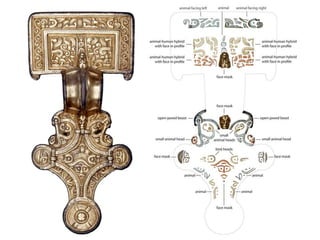
53. Merovingian looped fibula. Early medieval Europe. Mid-sixth century C.E.
Silver gilt worked in filigree, with inlays of garnets and other stones.
55. Lindisfarne Gospels: St. Matthew, cross-carpet page; St. Luke portrait
page; St. Luke incipit page. Early medieval (Hiberno Saxon) Europe. c. 700 C.E.
Illuminated manuscript (ink, pigments, and gold on vellum).
Romanesque Art (2 works)
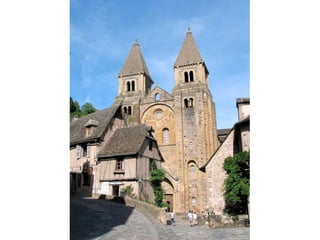
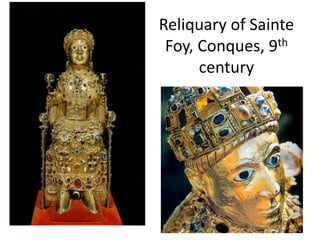
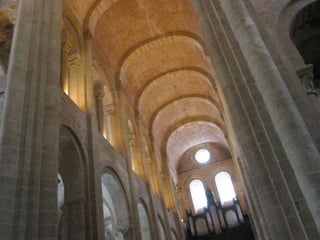
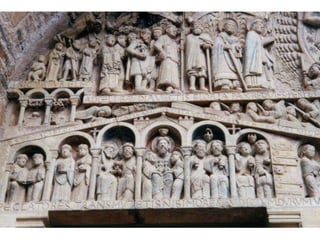
58. Church of Sainte-Foy. Conques, France. Romanesque Europe. Church: c.
1050–1130 C.E.; Reliquary of Saint Foy: ninth century C.E., with later
additions. Stone (architecture); stone and paint (tympanum); gold, silver,
gemstones, and enamel over wood (reliquary).
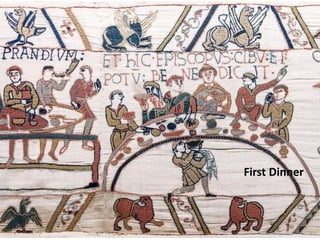
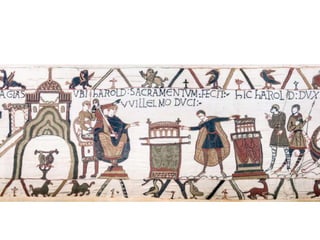
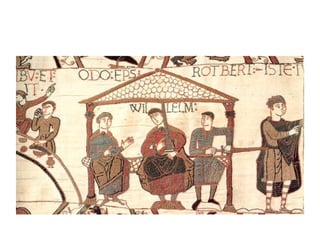
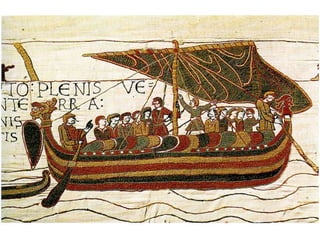
59. Bayeux Tapestry. Romanesque Europe (English or Norman). c. 1066–1080
C.E. Embroidery on linen.
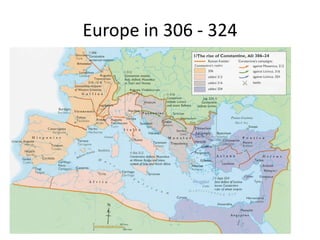
Europe in 306 - 324
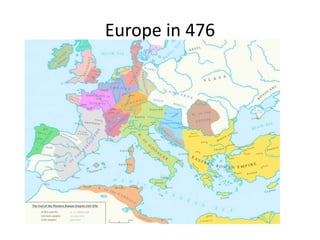
Europe in 476
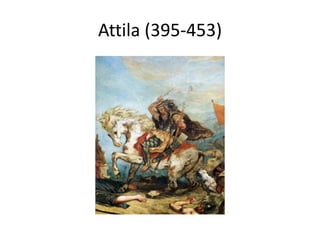
Attila (395-453)
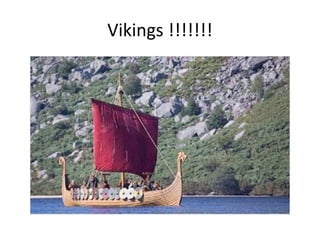
Vikings !!!!!!!
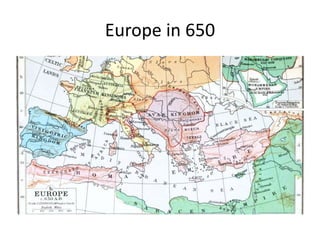
Europe in 650
Summary
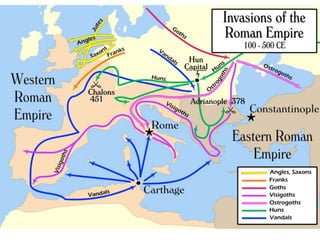
• 410 - Fall of Rome – Political Chaos
• 7th century : Dark Ages – Mass migrations
Attila, Vandals, Vikings… created a period of
instability
• Destruction of the remains of Roman
civilization
• Unifying force - Christianity
Anglo-Saxon Metalwork
Art of the Warrior Lords
5th to 10th centuries
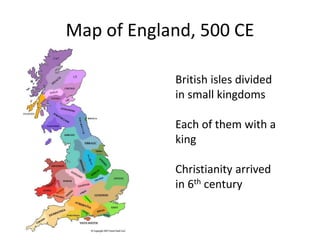
Map of England, 500 CE
British isles divided
in small kingdoms
Each of them with a
king
Christianity arrived
in 6th century
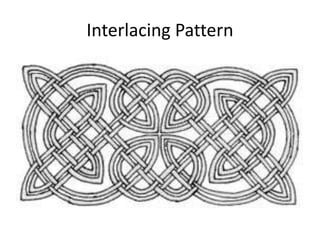
Interlacing Pattern
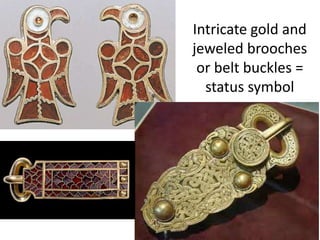
Intricate gold and
jeweled brooches
or belt buckles =
status symbol
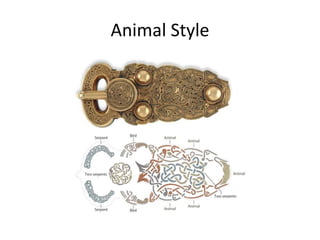
Animal Style
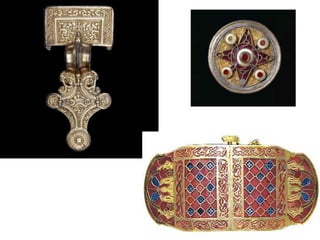
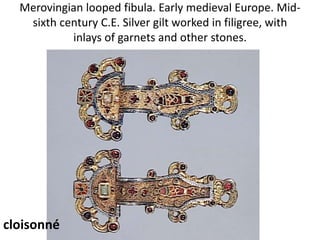
Merovingian looped fibula. Early medieval Europe. Mid-
sixth century C.E. Silver gilt worked in filigree, with
inlays of garnets and other stones.
cloisonné
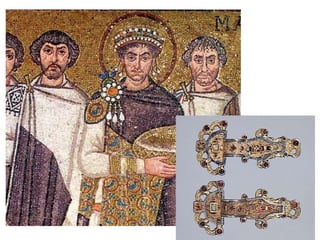
Merovingian looped fibula. Early medieval
Europe. Mid-sixth century C.E. Silver gilt worked
in filigree, with inlays of garnets and other
stones.
• Used to fasten garments
• Found in the tomb of a wealthy Merovingian
woman
• Emblems of office and of prestige
• decorative patterns adjusted carefully to the
basic shape of the object
• Integration of zoomorphic elements
Characteristics of Early Middle Ages
• Portable objects (fibuale, belt buckles…)
• Interlacing pattern (from Celts)
• Horror Vacui
• Abstract depictions of animals and figures
• Animal style
Art of the Warrior Lords
Other than the ornamentation of ships used for
burials, the surviving artworks of this period are
almost exclusively small-scale status symbols,
especially items of personal adornment such as
bracelets, pins, purses and belt buckles, often
featuring cloisonné decoration. A mixture of
abstract and zoomorphic motifs appear on
these portable treasures. Especially
characteristics are intertwined animal and
interlace patterns.
Illuminated Manuscripts
Hiberno-Saxon Art
6th-10th centuries
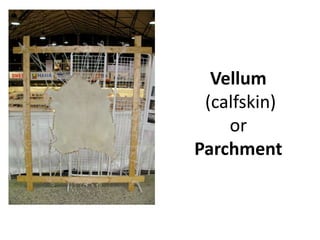
Vellum
(calfskin)
or
Parchment
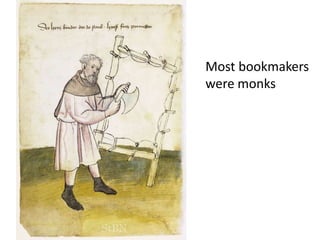
Most bookmakers
were monks
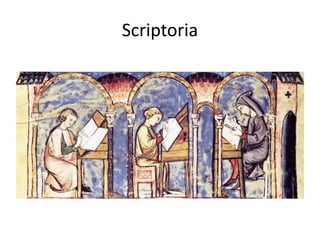
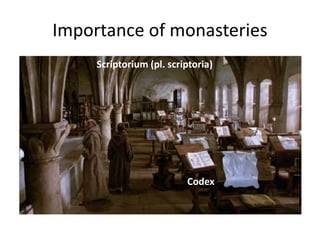
Scriptoria
Importance of monasteries
Codex
Scriptorium (pl. scriptoria)
Importance of Monasteries
• Repositories for books and documents
Library filled with sacred texts as well as literary,
scientific and philosophical works by Greek and
Roman authors.
• Learning centers
• Literacy centers
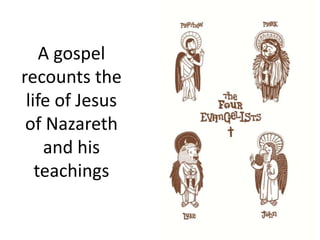
A gospel
recounts the
life of Jesus
of Nazareth
and his
teachings
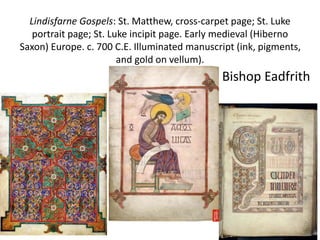
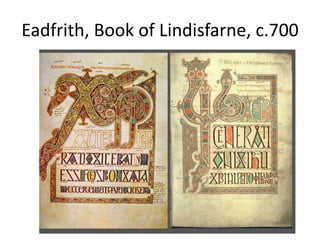
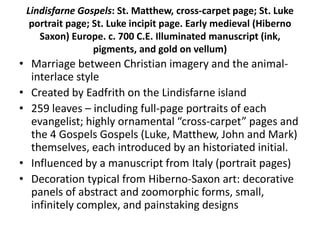
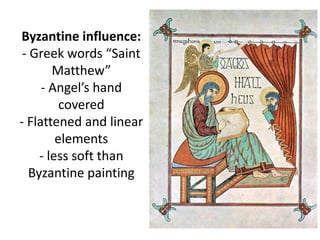
Lindisfarne Gospels: St. Matthew, cross-carpet page; St. Luke
portrait page; St. Luke incipit page. Early medieval (Hiberno
Saxon) Europe. c. 700 C.E. Illuminated manuscript (ink, pigments,
and gold on vellum).
Bishop Eadfrith
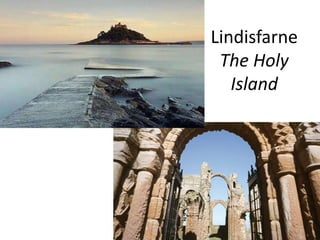
Lindisfarne
The Holy
Island
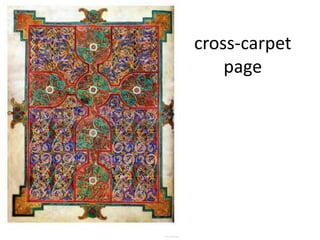
cross-carpet
page
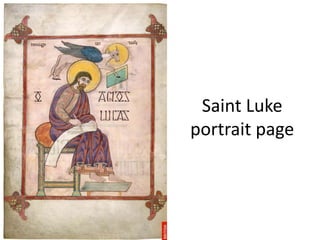
Saint Luke
portrait page
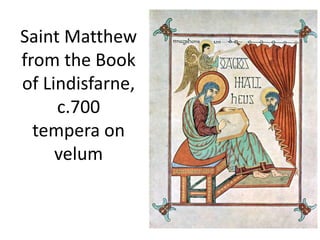
Saint Matthew
from the Book
of Lindisfarne,
c.700
tempera on
velum
Byzantine influence:
- Greek words “Saint
Matthew”
- Angel’s hand
covered
- Flattened and linear
elements
- less soft than
Byzantine painting
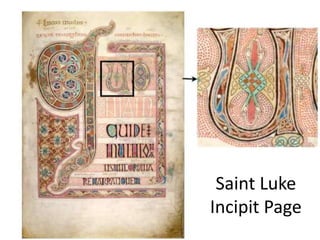
Saint Luke
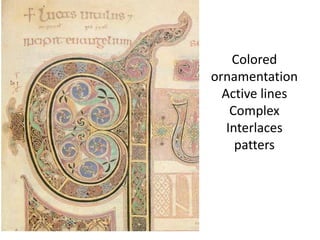
Incipit Page
Colored
ornamentation
Active lines
Complex
Interlaces
patters
Eadfrith, Book of Lindisfarne, c.700
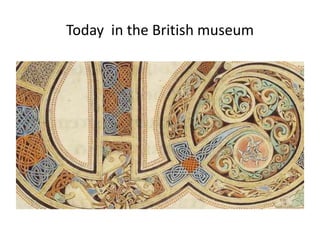
Today in the British museum
Lindisfarne Gospels: St. Matthew, cross-carpet page; St. Luke
portrait page; St. Luke incipit page. Early medieval (Hiberno
Saxon) Europe. c. 700 C.E. Illuminated manuscript (ink,
pigments, and gold on vellum)
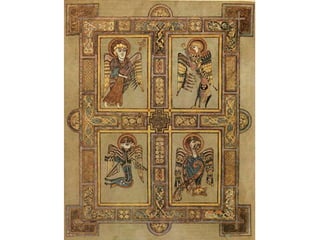
• Marriage between Christian imagery and the animal-
interlace style
• Created by Eadfrith on the Lindisfarne island
• 259 leaves – including full-page portraits of each
evangelist; highly ornamental “cross-carpet” pages and
the 4 Gospels Gospels (Luke, Matthew, John and Mark)
themselves, each introduced by an historiated initial.
• Influenced by a manuscript from Italy (portrait pages)
• Decoration typical from Hiberno-Saxon art: decorative
panels of abstract and zoomorphic forms, small,
infinitely complex, and painstaking designs
Hiberno-Saxon Art
Art Historians call the Christian art of the early
medieval Britain and Ireland Hiberno-Saxon or
Insular.
The most important existant artworks are the
illuminated manuscripts produced in the
monastic scriptoria of Ireland and Northumbria
Hiberno-Saxon Art
Insular books feature folios devoted neither to the
text nor to illustration but to pure embellishment.
“Carpet pages” consist of decorative panels of
abstract and zoomorphic motifs. Some books also
have full pages depicting the four evangelists or
their symbols.
Text pages often present the initial letters of
important passages enlarged and transformed into
elaborate decorative patterns.
Romanesque Art
Western Europe
11th – 12th century
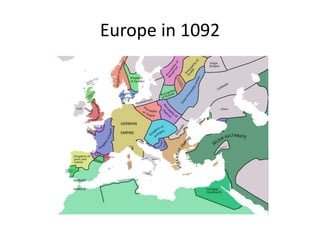
Europe in 1092
Historical Background
• End of the great migration
• Economic Growth
• Political stability
• Increase of the population
• Vikings Christianized (10th century): Normandy
/ Britain / Sicily
• Beginning of the reconquest of Spain by
Christians
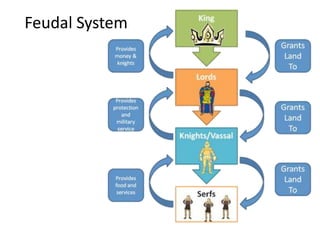
Feudal System
Importance o
Church
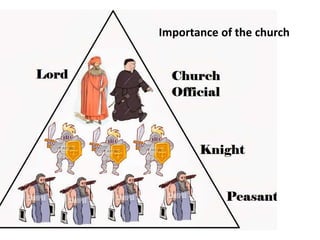
Importance of the church
• Importance of the pope
• Monasteries – important economic and
intellectual centers
Age of pilgrimages
• Fear of Apocalypse in 1000
• Crusades (from 1095 to 15th century)
• Pilgrimages (Jerusalem, Rome and Santiago)
• Importance of Relics
• Last Judgment scenes popular
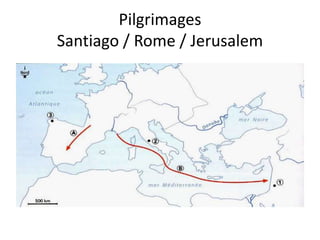
Pilgrimages
Santiago / Rome / Jerusalem
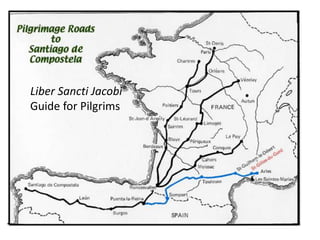
Pilgrimage Roads
Liber Sancti Jacobi
Guide for Pilgrims
Consequence of pilgrimages
• Multiplication of the relics
• New important religious centers “building
boom”
• Massive flow of People – Need of a new kind
of architecture
• Flow of ideas around the continent
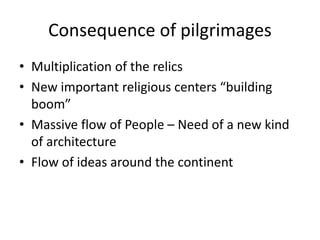
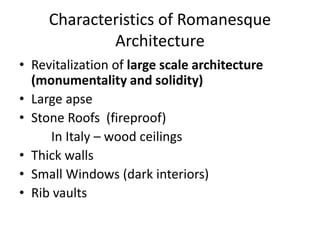
Characteristics of Romanesque
Architecture
• Revitalization of large scale architecture
(monumentality and solidity)
• Large apse
• Stone Roofs (fireproof)
In Italy – wood ceilings
• Thick walls
• Small Windows (dark interiors)
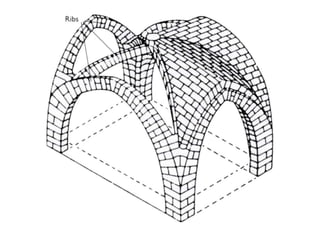
• Rib vaults
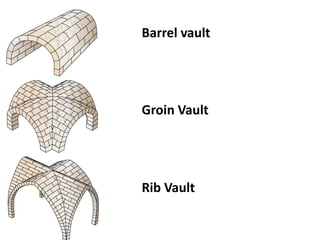
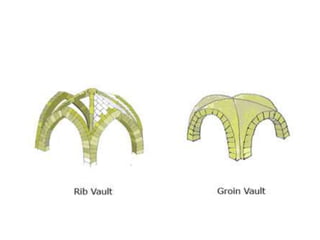
Barrel vault
Groin Vault
Rib Vault
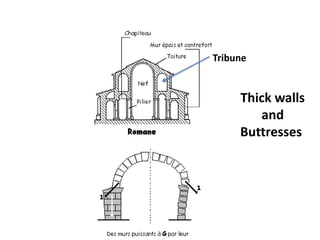
Thick walls
and
Buttresses
Tribune
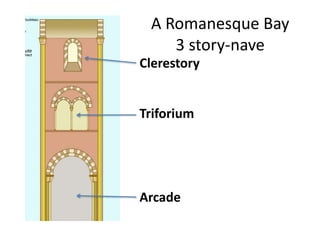
A Romanesque Bay
3 story-nave
Arcade
Triforium
Clerestory
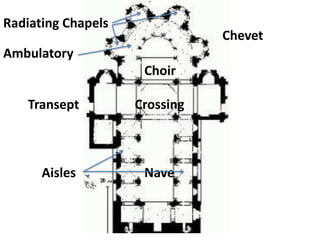
Ambulatory
Transept
Nave
Radiating Chapels
Aisles
Choir
Chevet
Crossing
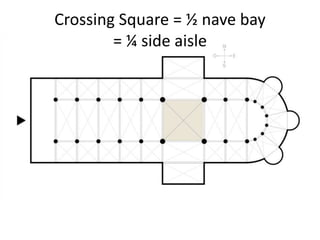
Crossing Square = ½ nave bay
= ¼ side aisle
Romanesque Architecture
Romanesque takes its name from the Roman-
like barrel and groin vaults based on round
arches employed in many European churches
built between 1050 and 1200. Romanesque
vaults, however, are made of stone, not
concrete.
Romanesque Architecture
Numerous churches sprang up along the
pilgrimage roads leading to the shrine of Saint
James at Santiago de Campostela. These
churches were large enough to accommodate
crowds of pilgrims who came to view the relics
displayed in radiating chapels off the
ambulatory and transept.
France
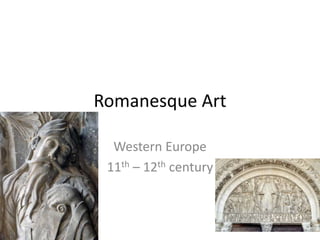
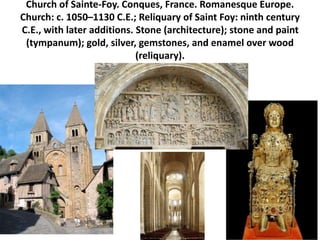
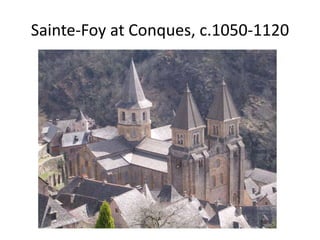
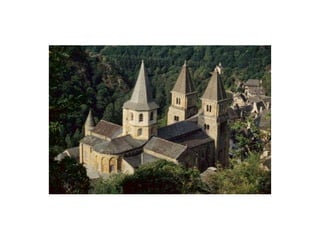
Church of Sainte-Foy. Conques, France. Romanesque Europe.
Church: c. 1050–1130 C.E.; Reliquary of Saint Foy: ninth century
C.E., with later additions. Stone (architecture); stone and paint
(tympanum); gold, silver, gemstones, and enamel over wood
(reliquary).
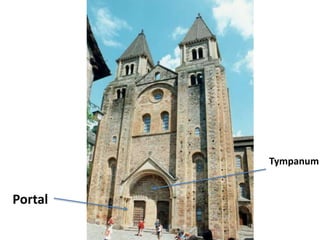
Sainte-Foy at Conques, c.1050-1120
Reliquary of Sainte
Foy, Conques, 9th
century
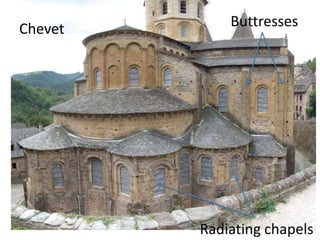
Chevet
Radiating chapels
Buttresses
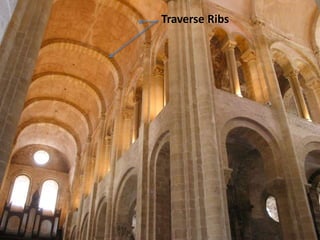
Traverse Ribs
Portal
Tympanum
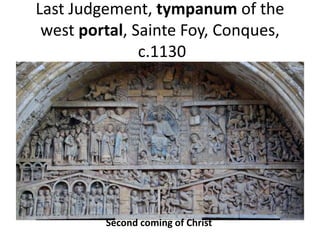
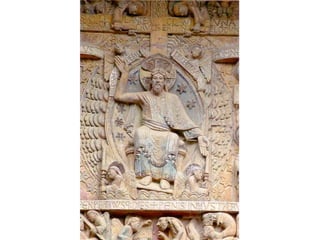
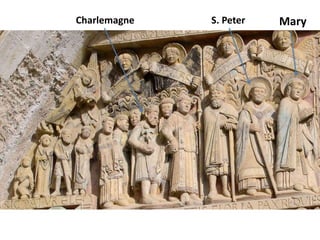
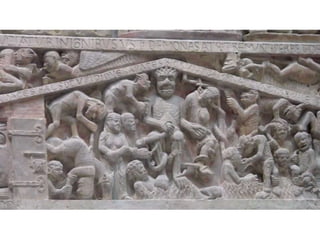
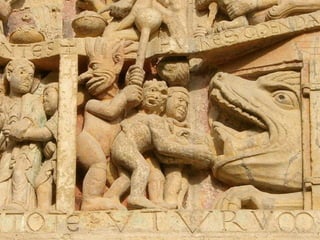
Last Judgement, tympanum of the
west portal, Sainte Foy, Conques,
c.1130
Second coming of Christ
MaryS. PeterCharlemagne
Church of Sainte-Foy. Conques,
France. Romanesque Europe. Church:
c. 1050–1130 C.E.
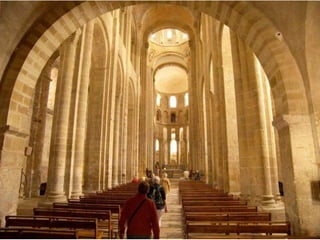
• Important pilgrimage center – Saint’s relics
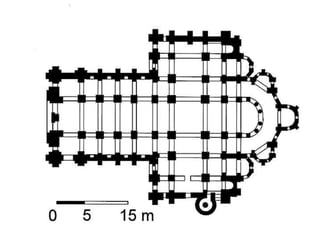
• Builders have to accommodate large crowds
• Latin-cross basilica and radiating chapels
• Wooden roofs substituted by stone barrel
vault that needs extra support (buttresses)
• Christian stories accessible to a largely
illiterate population through sculptures
• Christ in Majesty and Last Judgment
Characteristics of Romanesque
Sculpture
• Revitalization of large scale sculpture
• Importance of the church portal sculpture
(Last Judgment)
• Flattened look / zigzagging drapery
• Importance of expression (bigger head and
hands)
• Hierarchy of scale
Romanesque sculpture
The Romanesque period brought the revival of
monumental stone relief sculpture in cloisters
and especially in church portals, where scenes
of Christ as last judge often greeted the faithful
as they entered the doorway to the road to
salvation.
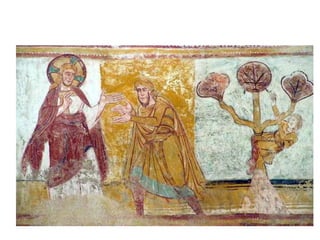
Romanesque Painting
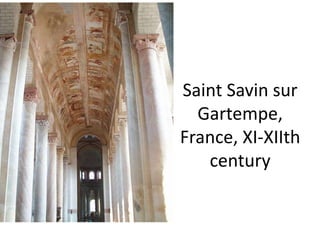
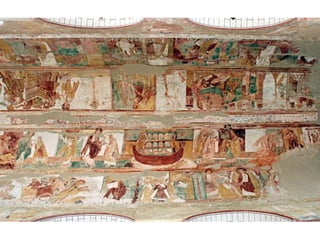
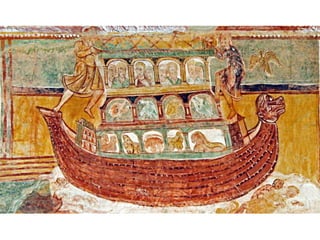
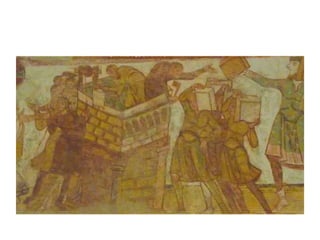
Saint Savin sur
Gartempe,
France, XI-XIIth
century
• ←→←
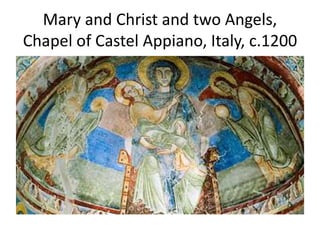
Mary and Christ and two Angels,
Chapel of Castel Appiano, Italy, c.1200
Romanesque Painting
• Manuscripts and Mural painting
• Figures outlined in black and colored
• Rich colors
• Bi dimensional (flat)
• No reality (figures float)
• Importance of drapery for decoration (no
definition of the body)
• Importance of human figure
Bayeux Tapestry
c.1070-1080
Bayeux Tapestry. Romanesque Europe
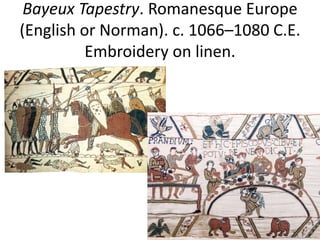
(English or Norman). c. 1066–1080 C.E.
Embroidery on linen.
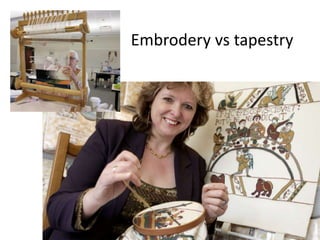
Embrodery vs tapestry
70 meters
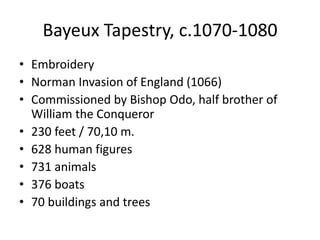
Bayeux Tapestry, c.1070-1080
• Embroidery
• Norman Invasion of England (1066)
• Commissioned by Bishop Odo, half brother of
William the Conqueror
• 230 feet / 70,10 m.
• 628 human figures
• 731 animals
• 376 boats
• 70 buildings and trees
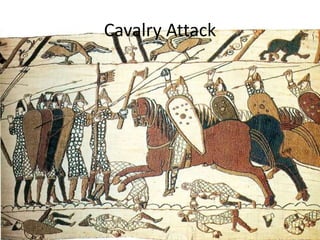
Cavalry Attack
First Dinner
The Bayeux Tapestry
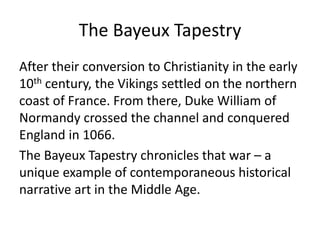
After their conversion to Christianity in the early
10th century, the Vikings settled on the northern
coast of France. From there, Duke William of
Normandy crossed the channel and conquered
England in 1066.
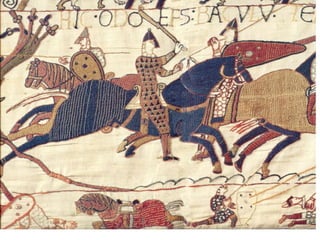
The Bayeux Tapestry chronicles that war – a
unique example of contemporaneous historical
narrative art in the Middle Age.
Bayeux Tapestry. Romanesque Europe
(English or Norman). c. 1066–1080 C.E.
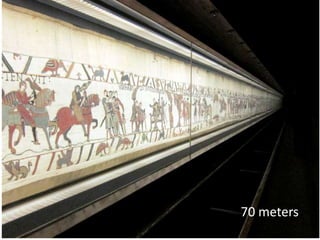
Embroidery on linen.
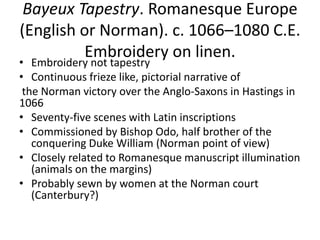
• Embroidery not tapestry
• Continuous frieze like, pictorial narrative of
the Norman victory over the Anglo-Saxons in Hastings in
1066
• Seventy-five scenes with Latin inscriptions
• Commissioned by Bishop Odo, half brother of the
conquering Duke William (Norman point of view)
• Closely related to Romanesque manuscript illumination
(animals on the margins)
• Probably sewn by women at the Norman court
(Canterbury?)
Romanesque Art is a mixture of:
• Roman style
• Insular Style
• Byzantine Style
Romanesque Art is a mixture of:
• Roman style
• Insular Style
• Byzantine Style
Romanesque Art is a mixture of:
• Roman style – Roman-style architecture
without concrete
• Insular Style – Interlace and abstracts animals
• Byzantine Style – Emotional depictions of Bible
stories and the fairly realistic bodies under the
drapery
Italy
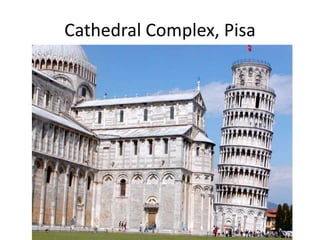
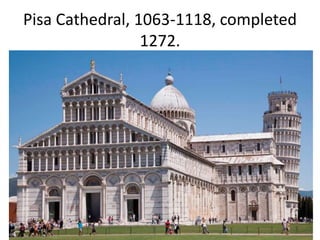
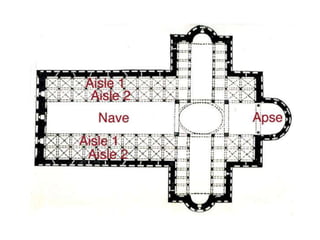
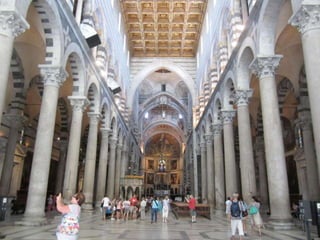
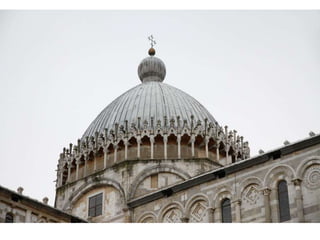
Cathedral Complex, Pisa
Pisa Cathedral, 1063-1118, completed
1272.
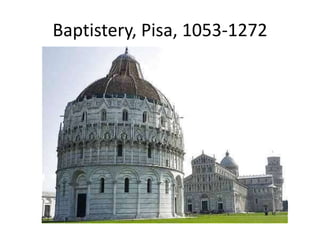
Baptistery, Pisa, 1053-1272
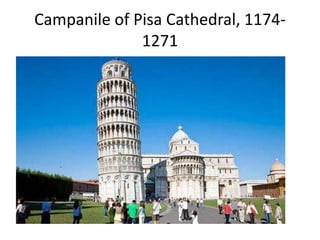
Campanile of Pisa Cathedral, 1174-
1271
Romanesque in Italy
The regional diversity of Romanesque art and
architecture is especially evident in Italy, where
the heritage of ancient Rome and Early
Christianity was strongest.
Romanesque in Italy
Romanesque churches in Pisa and Florence have
timber roofs in contrast to the vaulted interiors
of northern European buildings. The exterior
often feature marble paneling of different
colors. Churches campaniles were usually
freestanding, as were baptistery, which took the
form of independent central-plan building.
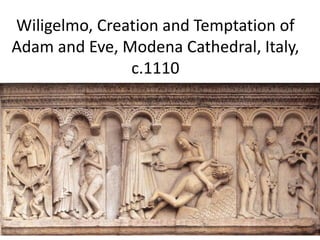
Wiligelmo, Creation and Temptation of
Adam and Eve, Modena Cathedral, Italy,
c.1110
Bibliography
• Adams, Laurie Schneider. Art across Time. 4th
ed. Boston:McGraw-Hill, 2011.
• Kleiner, Fred S. Gardner’s Art Throught the
Ages: A Global History. 13th ed.
Thomson/Wadsworth, 2009.
• Stokstad, Marilyn and Cothren, Michael. Art
History. 5th ed. Prentice Hall, 2014.
And …
• Nici, John, Barron's AP Art History, Barron, 3rd
Edition, 2015

Unit 3 a

  • 1.
    Early Middle Age NorthernEuropean Art Sandrine Le Bail AP Art History
  • 2.
    Early Middle Ageand Romanesque Early Middle Age (2 works) 53. Merovingian looped fibula. Early medieval Europe. Mid-sixth century C.E. Silver gilt worked in filigree, with inlays of garnets and other stones. 55. Lindisfarne Gospels: St. Matthew, cross-carpet page; St. Luke portrait page; St. Luke incipit page. Early medieval (Hiberno Saxon) Europe. c. 700 C.E. Illuminated manuscript (ink, pigments, and gold on vellum). Romanesque Art (2 works) 58. Church of Sainte-Foy. Conques, France. Romanesque Europe. Church: c. 1050–1130 C.E.; Reliquary of Saint Foy: ninth century C.E., with later additions. Stone (architecture); stone and paint (tympanum); gold, silver, gemstones, and enamel over wood (reliquary). 59. Bayeux Tapestry. Romanesque Europe (English or Norman). c. 1066–1080 C.E. Embroidery on linen.
  • 3.
  • 4.
  • 6.
  • 7.
  • 8.
  • 9.
    Summary • 410 -Fall of Rome – Political Chaos • 7th century : Dark Ages – Mass migrations Attila, Vandals, Vikings… created a period of instability • Destruction of the remains of Roman civilization • Unifying force - Christianity
  • 10.
    Anglo-Saxon Metalwork Art ofthe Warrior Lords 5th to 10th centuries
  • 11.
    Map of England,500 CE British isles divided in small kingdoms Each of them with a king Christianity arrived in 6th century
  • 12.
  • 13.
    Intricate gold and jeweledbrooches or belt buckles = status symbol
  • 15.
  • 17.
    Merovingian looped fibula.Early medieval Europe. Mid- sixth century C.E. Silver gilt worked in filigree, with inlays of garnets and other stones. cloisonné
  • 19.
    Merovingian looped fibula.Early medieval Europe. Mid-sixth century C.E. Silver gilt worked in filigree, with inlays of garnets and other stones. • Used to fasten garments • Found in the tomb of a wealthy Merovingian woman • Emblems of office and of prestige • decorative patterns adjusted carefully to the basic shape of the object • Integration of zoomorphic elements
  • 20.
    Characteristics of EarlyMiddle Ages • Portable objects (fibuale, belt buckles…) • Interlacing pattern (from Celts) • Horror Vacui • Abstract depictions of animals and figures • Animal style
  • 21.
    Art of theWarrior Lords Other than the ornamentation of ships used for burials, the surviving artworks of this period are almost exclusively small-scale status symbols, especially items of personal adornment such as bracelets, pins, purses and belt buckles, often featuring cloisonné decoration. A mixture of abstract and zoomorphic motifs appear on these portable treasures. Especially characteristics are intertwined animal and interlace patterns.
  • 22.
  • 23.
  • 24.
  • 27.
  • 28.
  • 29.
    Importance of Monasteries •Repositories for books and documents Library filled with sacred texts as well as literary, scientific and philosophical works by Greek and Roman authors. • Learning centers • Literacy centers
  • 30.
    A gospel recounts the lifeof Jesus of Nazareth and his teachings
  • 32.
    Lindisfarne Gospels: St.Matthew, cross-carpet page; St. Luke portrait page; St. Luke incipit page. Early medieval (Hiberno Saxon) Europe. c. 700 C.E. Illuminated manuscript (ink, pigments, and gold on vellum). Bishop Eadfrith
  • 33.
  • 34.
  • 35.
  • 36.
    Saint Matthew from theBook of Lindisfarne, c.700 tempera on velum
  • 37.
    Byzantine influence: - Greekwords “Saint Matthew” - Angel’s hand covered - Flattened and linear elements - less soft than Byzantine painting
  • 38.
  • 39.
  • 40.
    Eadfrith, Book ofLindisfarne, c.700
  • 41.
    Today in theBritish museum
  • 43.
    Lindisfarne Gospels: St.Matthew, cross-carpet page; St. Luke portrait page; St. Luke incipit page. Early medieval (Hiberno Saxon) Europe. c. 700 C.E. Illuminated manuscript (ink, pigments, and gold on vellum) • Marriage between Christian imagery and the animal- interlace style • Created by Eadfrith on the Lindisfarne island • 259 leaves – including full-page portraits of each evangelist; highly ornamental “cross-carpet” pages and the 4 Gospels Gospels (Luke, Matthew, John and Mark) themselves, each introduced by an historiated initial. • Influenced by a manuscript from Italy (portrait pages) • Decoration typical from Hiberno-Saxon art: decorative panels of abstract and zoomorphic forms, small, infinitely complex, and painstaking designs
  • 44.
    Hiberno-Saxon Art Art Historianscall the Christian art of the early medieval Britain and Ireland Hiberno-Saxon or Insular. The most important existant artworks are the illuminated manuscripts produced in the monastic scriptoria of Ireland and Northumbria
  • 45.
    Hiberno-Saxon Art Insular booksfeature folios devoted neither to the text nor to illustration but to pure embellishment. “Carpet pages” consist of decorative panels of abstract and zoomorphic motifs. Some books also have full pages depicting the four evangelists or their symbols. Text pages often present the initial letters of important passages enlarged and transformed into elaborate decorative patterns.
  • 46.
  • 47.
  • 48.
    Historical Background • Endof the great migration • Economic Growth • Political stability • Increase of the population • Vikings Christianized (10th century): Normandy / Britain / Sicily • Beginning of the reconquest of Spain by Christians
  • 49.
  • 50.
  • 51.
    Importance of thechurch • Importance of the pope • Monasteries – important economic and intellectual centers
  • 52.
    Age of pilgrimages •Fear of Apocalypse in 1000 • Crusades (from 1095 to 15th century) • Pilgrimages (Jerusalem, Rome and Santiago) • Importance of Relics • Last Judgment scenes popular
  • 53.
  • 54.
    Pilgrimage Roads Liber SanctiJacobi Guide for Pilgrims
  • 55.
    Consequence of pilgrimages •Multiplication of the relics • New important religious centers “building boom” • Massive flow of People – Need of a new kind of architecture • Flow of ideas around the continent
  • 56.
    Characteristics of Romanesque Architecture •Revitalization of large scale architecture (monumentality and solidity) • Large apse • Stone Roofs (fireproof) In Italy – wood ceilings • Thick walls • Small Windows (dark interiors) • Rib vaults
  • 57.
  • 60.
  • 61.
    A Romanesque Bay 3story-nave Arcade Triforium Clerestory
  • 62.
  • 63.
    Crossing Square =½ nave bay = ¼ side aisle
  • 64.
    Romanesque Architecture Romanesque takesits name from the Roman- like barrel and groin vaults based on round arches employed in many European churches built between 1050 and 1200. Romanesque vaults, however, are made of stone, not concrete.
  • 65.
    Romanesque Architecture Numerous churchessprang up along the pilgrimage roads leading to the shrine of Saint James at Santiago de Campostela. These churches were large enough to accommodate crowds of pilgrims who came to view the relics displayed in radiating chapels off the ambulatory and transept.
  • 66.
  • 67.
    Church of Sainte-Foy.Conques, France. Romanesque Europe. Church: c. 1050–1130 C.E.; Reliquary of Saint Foy: ninth century C.E., with later additions. Stone (architecture); stone and paint (tympanum); gold, silver, gemstones, and enamel over wood (reliquary).
  • 69.
  • 70.
    Reliquary of Sainte Foy,Conques, 9th century
  • 72.
  • 74.
  • 77.
  • 78.
    Last Judgement, tympanumof the west portal, Sainte Foy, Conques, c.1130 Second coming of Christ
  • 81.
  • 84.
    Church of Sainte-Foy.Conques, France. Romanesque Europe. Church: c. 1050–1130 C.E. • Important pilgrimage center – Saint’s relics • Builders have to accommodate large crowds • Latin-cross basilica and radiating chapels • Wooden roofs substituted by stone barrel vault that needs extra support (buttresses) • Christian stories accessible to a largely illiterate population through sculptures • Christ in Majesty and Last Judgment
  • 85.
    Characteristics of Romanesque Sculpture •Revitalization of large scale sculpture • Importance of the church portal sculpture (Last Judgment) • Flattened look / zigzagging drapery • Importance of expression (bigger head and hands) • Hierarchy of scale
  • 86.
    Romanesque sculpture The Romanesqueperiod brought the revival of monumental stone relief sculpture in cloisters and especially in church portals, where scenes of Christ as last judge often greeted the faithful as they entered the doorway to the road to salvation.
  • 87.
  • 88.
  • 92.
  • 93.
    Mary and Christand two Angels, Chapel of Castel Appiano, Italy, c.1200
  • 94.
    Romanesque Painting • Manuscriptsand Mural painting • Figures outlined in black and colored • Rich colors • Bi dimensional (flat) • No reality (figures float) • Importance of drapery for decoration (no definition of the body) • Importance of human figure
  • 95.
  • 96.
    Bayeux Tapestry. RomanesqueEurope (English or Norman). c. 1066–1080 C.E. Embroidery on linen.
  • 97.
  • 98.
  • 99.
    Bayeux Tapestry, c.1070-1080 •Embroidery • Norman Invasion of England (1066) • Commissioned by Bishop Odo, half brother of William the Conqueror • 230 feet / 70,10 m. • 628 human figures • 731 animals • 376 boats • 70 buildings and trees
  • 100.
  • 103.
  • 109.
    The Bayeux Tapestry Aftertheir conversion to Christianity in the early 10th century, the Vikings settled on the northern coast of France. From there, Duke William of Normandy crossed the channel and conquered England in 1066. The Bayeux Tapestry chronicles that war – a unique example of contemporaneous historical narrative art in the Middle Age.
  • 110.
    Bayeux Tapestry. RomanesqueEurope (English or Norman). c. 1066–1080 C.E. Embroidery on linen. • Embroidery not tapestry • Continuous frieze like, pictorial narrative of the Norman victory over the Anglo-Saxons in Hastings in 1066 • Seventy-five scenes with Latin inscriptions • Commissioned by Bishop Odo, half brother of the conquering Duke William (Norman point of view) • Closely related to Romanesque manuscript illumination (animals on the margins) • Probably sewn by women at the Norman court (Canterbury?)
  • 111.
    Romanesque Art isa mixture of: • Roman style • Insular Style • Byzantine Style
  • 112.
    Romanesque Art isa mixture of: • Roman style • Insular Style • Byzantine Style
  • 113.
    Romanesque Art isa mixture of: • Roman style – Roman-style architecture without concrete • Insular Style – Interlace and abstracts animals • Byzantine Style – Emotional depictions of Bible stories and the fairly realistic bodies under the drapery
  • 114.
  • 115.
  • 116.
  • 120.
  • 121.
    Campanile of PisaCathedral, 1174- 1271
  • 122.
    Romanesque in Italy Theregional diversity of Romanesque art and architecture is especially evident in Italy, where the heritage of ancient Rome and Early Christianity was strongest.
  • 123.
    Romanesque in Italy Romanesquechurches in Pisa and Florence have timber roofs in contrast to the vaulted interiors of northern European buildings. The exterior often feature marble paneling of different colors. Churches campaniles were usually freestanding, as were baptistery, which took the form of independent central-plan building.
  • 124.
    Wiligelmo, Creation andTemptation of Adam and Eve, Modena Cathedral, Italy, c.1110
  • 125.
    Bibliography • Adams, LaurieSchneider. Art across Time. 4th ed. Boston:McGraw-Hill, 2011. • Kleiner, Fred S. Gardner’s Art Throught the Ages: A Global History. 13th ed. Thomson/Wadsworth, 2009. • Stokstad, Marilyn and Cothren, Michael. Art History. 5th ed. Prentice Hall, 2014.
  • 126.
    And … • Nici,John, Barron's AP Art History, Barron, 3rd Edition, 2015

Editor's Notes

  • #4 After the fall of Constantine, many Western territories of the Roman Empire were lost to the numerous indgenous and migrating tribes of Europe
  • #7 Beginning of the Barbarian Invasion Go to Italy Destroy everything
  • #8 https://www.youtube.com/watch?v=xdm7Z3TQhDg 750-850 Invasion of the British Isles/ Colonization of the North of France
  • #10 Competiton for the territory
  • #11 British isles divided in small kingdoms – each of them with a king
  • #23 Hand decorated pages of texts Printing invented only in 15th century (China 11th century) Importance of the library
  • #24 Parchment (all animals goat / sheep…) Today confusion Vellum more precious Soak in lime to make them white and remove hair
  • #25 Artisans scrapped them down to an even thickness. Each page should be without impurities
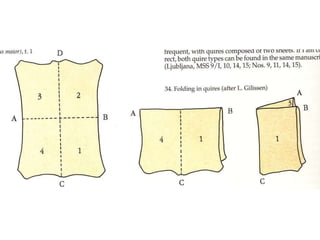
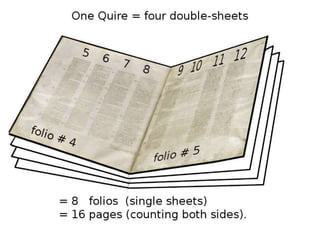
  • #26 Booklet of 8 pages - quires
  • #27 So valuable that they have been used more than once
  • #28 Importance of monastery Only way we have to know the Antic texts Conservative / Copy Very expensive Vow of silence
  • #29 Most of the people during this time were illiterate Monastery = central repositories for books and documents Creatin of manuscripts
  • #32 Book of kells According to the historian Bede from the nearby monastery in Monkwearmouth (d. 735), this calf, or ox, symbolizes Christ’s sacrifice on the cross. Bede assigns symbols for the other three evangelists as well, which Eadfrith duly includes in their respective portraits: Matthew’s is a man, suggesting the human aspect of Christ; Mark’s the lion, symbolizing the triumphant and divine Christ of the Resurrection; and John’s the eagle, referring to Christ’s second coming.
  • #37 S. Matthew on a bench, writing his gospel Behind the curtain – inspiration from God (Moise) Byzantine influence : Greek words and handcovered Flattened and linear elements Soft modeling of Byzantine art turned into crisp cusp-shaped in S.Mmatthew’s drapery
  • #38 S. Matthew on a bench, writing his gospel Behind the curtain – inspiration from God (Moise) Byzantine influence : Greek words and handcovered Flattened and linear elements Soft modeling of Byzantine art turned into crisp cusp-shaped in S.Mmatthew’s drapery
  • #40 Oure ornementation
  • #41 British Library in London Lindisfarne Gospel Island North “Holy Island” combining Mediterranean, Anglo-Saxon and Celtic elements Flattened elements 259 pges and full-page portraits of each evangelist highly ornamental “cross-carpet” pages, each of which features a large cross set against a background of ordered and yet teeming ornamentation; and the Gospels themselves, each introduced by an historiated initial. The codex also includes sixteen pages of canon tables set in arcades. Here correlating passages from each evangelist are set side-by-side, enabling a reader to compare narrations. Interlace Eadfrith became bishop of Lindisfarne Egg and fishglue to bind the colour Local and exported mineral (lapis Lazuli)
  • #43 The originbal jewel-encrusted leather cover was lost during one of the many Vikings raid
  • #47 “Roman like” (19th century) Stylistic trends for than historical period Heir of the Carolingian architecture In the same time than Ottonian Stone vault – Arch – Roman First appeared in 1818
  • #48 Muslim in the South Magyar (hungary in the North) Normandy – Vikings William the Conqueror conquested Britain in 1066 Every country with strong region Importance of the Church More innovative area – France 11th century less invasion – everybody is Christian 12th century – Sicily becomes Normand
  • #50 No centralized power Allegiance Lot of conflict but an equilibrium has been reached – Economic growth (in particular in Italy) Symbiotic relationship between lords and peasants
  • #51 The Pope is the only unifying authority. Church owned lot of land (In France 1/3)
  • #52 Atone - expier
  • #53 What is a relic? Miraculous.
  • #55 Santiago – Saint James Less dangerous than Jerusalem and Rome Attracted many French (// Charlemagne) Along the road, may churches and abbeys, Hospice (lodging places) for the pilgrims A year or more Shrines on key point Most wellknown because guide
  • #57 Adaptation of Roman basilica
  • #58 Many Romanesque churches use Barrel Vault or groin vault Later building – Rib vault – taller and lighter The concrete has been lost Stone and mortar
  • #60 The weight is load down to the walls onto the massive piers below Higher – open larger window – Fireproof Weatherproof Easy to maintain Better acoustic
  • #61 Fireproof Waterproof Excellent acoustic – gregorian musique
  • #70 Church of the village Massive Ostentation Ealiest example of pilgrimage church On the tomb of S. Foy (3rd century martyrs)
  • #71 Gold / gemstones on a wooden chore (85 cm) Skull inside? Power
  • #73 Buttresses
  • #74 Importance of ambulatory for crowds
  • #75 Barrel vaults with vault to divided the space in bay Massive piers with columns Very nude – idea of the 19th century – back to a primitive faith Lot of destruction Tapestry and decoration
  • #79 Around 1000 – fear of apocalypse – popular last judgement scene Still colours Tympanum _ Vision of the other world Display biblical scenes over the doorway+More symbolic than realistic You can understand even if you don’t know how to read
  • #80 Mandorla Right // Left
  • #89 The Medieval Sixtine Representation of the old testament
  • #90 Borders / frame
  • #91 Abel and Cain People bigger than buiding Legs are often crossed (dansing movement)
  • #93 Big head and hands Expressif
  • #94 Elegant, curvilinear pattern Drapery reaveled the body // Byzatine
  • #98 Embrodery : a woven product in which the design is stitched into a premage fabric Loom – metier à tisser
  • #99 Probably realized by women but designed by a man
  • #100 Queen Mathilde Norman Invasion of England Stitching 8 colours of wool onto bleached linen Made by women but designed by a man Mabybe for the cathedral
  • #102 Borders sometimes comment on the main scenes or show scenes of everyday life Color used in a non-natural manner: different part of a horse are colored variously
  • #105 Flat Schematic architecture
  • #106 Fanciful beasts in upper and lower register Inscription Fanciful beays in upper and lower register Inscription on latein Neutraò background Flatness // no shadow // Trajan’s column on latein Borders sometimes comment on the main scenes or show scenes of everyday life Color used in a non-natural manner: different part of a horse are colored variously Neutraò background Flatness // no shadow // Trajan’s column
  • #116 Influenced by classical tradition No façade tower, No westw orks // Early Christian Basilicas Pisa : republic – defeated the muslims – booty _ new cathedral 11-13th century
  • #117 Antiquity elements: Columns / Arches Arcades and blind arcades on the facese Polychromy // French portal 4 stories of freestanding columns – arcaded gallery
  • #118 Double aisles in transept Apses at the end of transpet Wooden ceilng on the nave Groin vault on the aisles
  • #120 Elliptical Dome // islamic tradition Crusade / trade in the mediteranee
  • #121 Same arcades on the lower level than cathedral Upper stories and dome later.
  • #122 In Italy - bell tower divided from the Church In Northern Europe, makes part of the church 6 stories od arcated galleries Cylindrical leaning tower Sense of unity of the entire complex
  • #125 Inscription illustrates the pride the donors felt in havong such a significamt artist work for them. Inspired by Early Christian sarcophagi Domination of human figures / narrative breaks the frame High relief