Gallery 7 APAH Review
Medieval Times before it became a tourist attraction…
Time for some mental push-ups to
get warmed up!!
• Let’s play stump the teacher! Below type a question about the
Medieval period and let’s see if you can stump me!
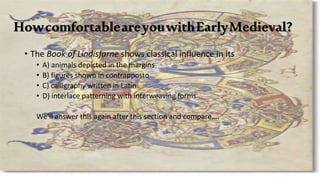
HowcomfortableareyouwithEarlyMedieval?
• The Book of Lindisfarne shows classical influence in its
• A) animals depicted in the margins
• B) figures shown in contrapposto
• C) calligraphy written in Latin
• D) interlace patterning with interweaving forms
We’ll answer this again after this section and compare….
First, some background…
• Time Period: about 450 CE to 1400 CE
• 3 periods/styles
• Early Medieval 450 CE-1050 CE
• Romanesque 1050 CE – 1150 CE (1200 CE in some places)
• Gothic 1140 CE – 1400 CE
• These are not all part of the “Dark Ages”…more on that in a bit!
First, some background…
• Essential knowledge for this period:
• No uniform style
• Some periods and styles use Classicism
• Some periods use geometric and natural designs
• Influences come from contemporaries in other parts of Europe and from
ancient traditional styles
First, some background…
• Essential knowledge for this period:
• Learning was spread trough trade, military conquest, and pilgrimage
• Studied specific fields
• Most architecture is religious
• Art avoids naturalistic depictions
• There will be periods of aniconism
First, some background…
• Historical background (i.e. CULTURAL CONTEXT)
• Most Roman technology and knowledge had been lost/forgotten
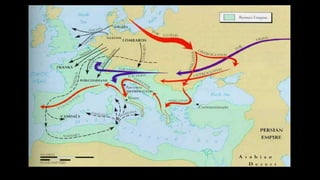
• Mass migrations of people happen in Early Medieval/Migration period
• Attila and the Huns
• Vikings from Scandinavia
• Vandals
• THIS is the “Dark Ages” (about 400-700 CE)
• Stability in Europe returns during the 8th century with the rise of Charlemagne and the
Frankish kings
First, some background…
• Historical background (i.e. CULTURAL CONTEXT)
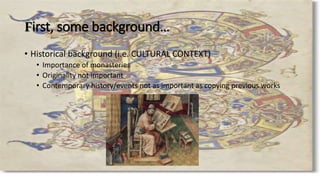
• Importance of monasteries
• Originality not important
• Contemporary history/events not as important as copying previous works
Manuscripts 101
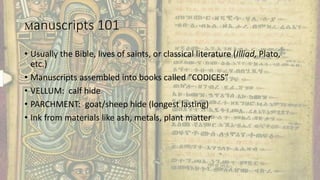
• Usually the Bible, lives of saints, or classical literature (Illiad, Plato,
etc.)
• Manuscripts assembled into books called “CODICES”
• VELLUM: calf hide
• PARCHMENT: goat/sheep hide (longest lasting)
• Ink from materials like ash, metals, plant matter
Manuscripts 101
• Thought to ponder:
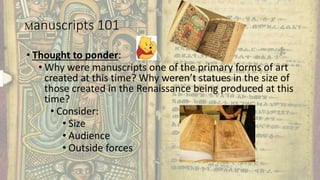
• Why were manuscripts one of the primary forms of art
created at this time? Why weren’t statues in the size of
those created in the Renaissance being produced at this
time?
• Consider:
• Size
• Audience
• Outside forces
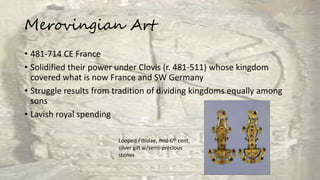
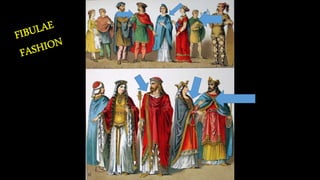
Merovingian Art
• 481-714 CE France
• Solidified their power under Clovis (r. 481-511) whose kingdom
covered what is now France and SW Germany
• Struggle results from tradition of dividing kingdoms equally among
sons
• Lavish royal spending
Looped Fibulae, mid-6th cent,
silver gilt w/semi-precious
stones
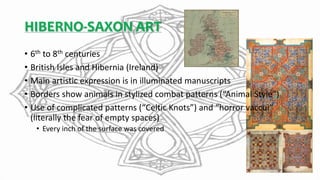
HIBERNO-SAXON ART
• 6th to 8th centuries
• British Isles and Hibernia (Ireland)
• Main artistic expression is in illuminated manuscripts
• Borders show animals in stylized combat patterns (“Animal Style”)
• Use of complicated patterns (“Celtic Knots”) and “horror vaccui”
(literally the fear of empty spaces)
• Every inch of the surface was covered
HIBERNO-SAXON ART
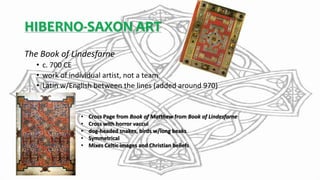
The Book of Lindesfarne
• c. 700 CE
• work of individual artist, not a team
• Latin w/English between the lines (added around 970)
• Cross Page from Book of Matthew from Book of Lindesfarne
• Cross with horror vaccui
• dog-headed snakes, birds w/long beaks
• Symmetrical
• Mixes Celtic images and Christian beliefs
HIBERNO-SAXON ART
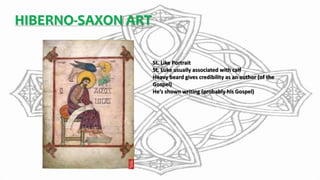
St. Like Portrait
St. Luke usually associated with calf
Heavy beard gives credibility as an author (of the
Gospel)
He’s shown writing (probably his Gospel)
HIBERNO-SAXON ART
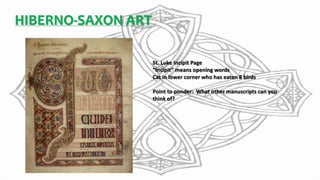
St. Luke Incipit Page
“Incipit” means opening words
Cat in lower corner who has eaten 8 birds
Point to ponder: What other manuscripts can you
think of?
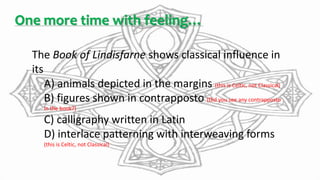
One more time with feeling…
The Book of Lindisfarne shows classical influence in
its
A) animals depicted in the margins
B) figures shown in contrapposto
C) calligraphy written in Latin
D) interlace patterning with interweaving forms
One more time with feeling…
The Book of Lindisfarne shows classical influence in
its
A) animals depicted in the margins
B) figures shown in contrapposto
C) calligraphy written in Latin
D) interlace patterning with interweaving forms
One more time with feeling…
The Book of Lindisfarne shows classical influence in
its
A) animals depicted in the margins (this is Celtic, not Classical)
B) figures shown in contrapposto (Did you see any contrapposto
in the book?)
C) calligraphy written in Latin
D) interlace patterning with interweaving forms
(this is Celtic, not Classical)
ROMANESQUE
Are you feeling the love??
Romanesque architecture can be characterized as
A)small, intimate, and warm
B)soaring, vertical, and uplifting
C)thick, heavy, and massive
D)irregular, unbalanced, and asymmetrical
ROMANESQUE
• 1050-1150 (ish)
• Europe settled after turmoil of Migration Period
• Vikings Christianized and settled in places like Normandy (France), S. Italy, and
Sicily
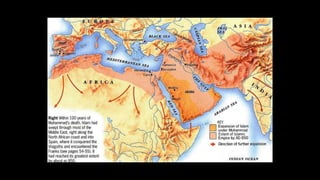
• Muslims on the move and making incursions into Christian areas
• Pushed out of Spain and N. Africa (they’ll go back and forth here for some time)
• What’s with that name??
• From 19th century art historians who thought it was derivative of Ancient
Roman art
ROMANESQUE
• In art and history, like in physics…
ROMANESQUE
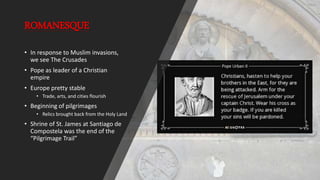
• In response to Muslim invasions,
we see The Crusades
• Pope as leader of a Christian
empire
• Europe pretty stable
• Trade, arts, and cities flourish
• Beginning of pilgrimages
• Relics brought back from the Holy Land
• Shrine of St. James at Santiago de
Compostela was the end of the
“Pilgrimage Trail”
ROMANESQUE
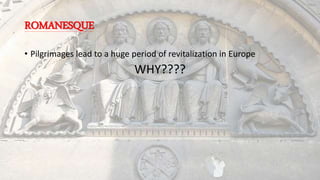
• Pilgrimages lead to a huge period of revitalization in Europe
WHY????
ROMANESQUE
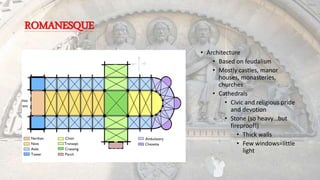
• Architecture
• Based on feudalism
• Mostly castles, manor
houses, monasteries,
churches
• Cathedrals
• Civic and religious pride
and devotion
• Stone (so heavy…but
fireproof!)
• Thick walls
• Few windows=little
light
ROMANESQUE
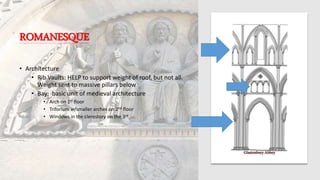
• Architecture
• Rib Vaults: HELP to support weight of roof, but not all.
Weight sent to massive pillars below
• Bay: basic unit of medieval architecture
• Arch on 1st floor
• Triforium w/smaller arches on 2nd floor
• Windows in the clerestory on the 3rd
ROMANESQUE
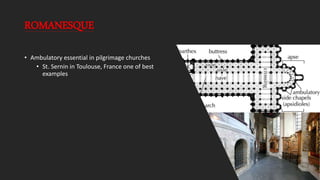
• Ambulatory essential in pilgrimage churches
• St. Sernin in Toulouse, France one of best
examples
ROMANESQUE
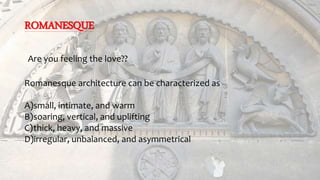
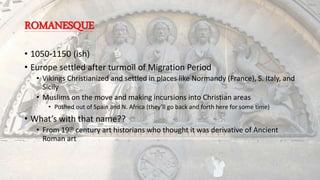
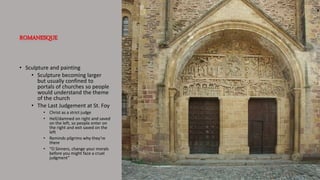
• Sculpture and painting
• Sculpture becoming larger
but usually confined to
portals of churches so people
would understand the theme
of the church
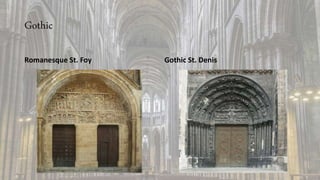
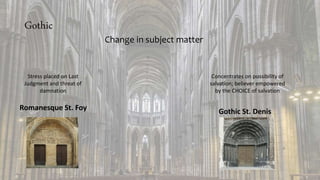
• The Last Judgement at St. Foy
• Christ as a strict judge
• Hell/damned on right and saved
on the left, so people enter on
the right and exit saved on the
left
• Reminds pilgrims why they’re
there
• “O Sinners, change your morals
before you might face a cruel
judgment”
ROMANESQUE
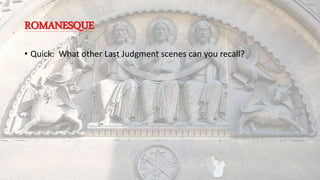
• Quick: What other Last Judgment scenes can you recall?
ROMANESQUE
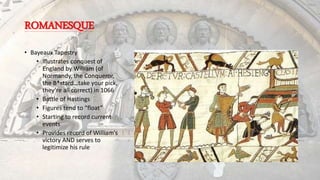
• Bayeaux Tapestry
• Illustrates conquest of
England by William (of
Normandy, the Conqueror,
the B*stard…take your pick,
they’re all correct) in 1066
• Battle of Hastings
• Figures tend to “float”
• Starting to record current
events
• Provides record of William’s
victory AND serves to
legitimize his rule
ROMANESQUE
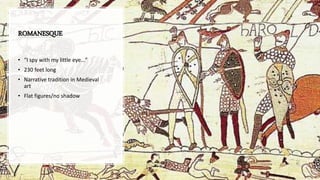
• “I spy with my little eye…”
• 230 feet long
• Narrative tradition in Medieval
art
• Flat figures/no shadow
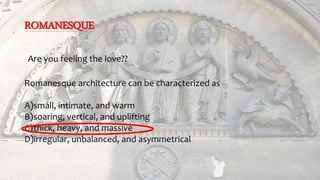
ROMANESQUE
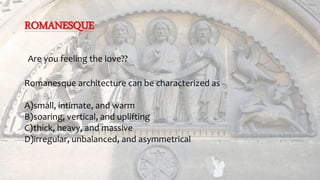
Are you feeling the love??
Romanesque architecture can be characterized as
A)small, intimate, and warm
B)soaring, vertical, and uplifting
C)thick, heavy, and massive
D)irregular, unbalanced, and asymmetrical
ROMANESQUE
Are you feeling the love??
Romanesque architecture can be characterized as
A)small, intimate, and warm
B)soaring, vertical, and uplifting
C)thick, heavy, and massive
D)irregular, unbalanced, and asymmetrical
Gothic
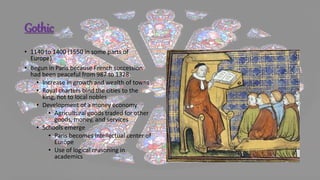
• 1140 to 1400 (1550 in some parts of
Europe)
• Begun in Paris because French succession
had been peaceful from 987 to 1328
• Increase in growth and wealth of towns
• Royal charters bind the cities to the
king, not to local nobles
• Development of a money economy
• Agricultural goods traded for other
goods, money, and services
• Schools emerge
• Paris becomes intellectual center of
Europe
• Use of logical reasoning in
academics
Gothic
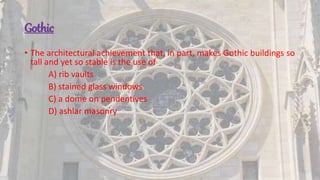
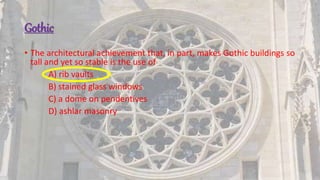
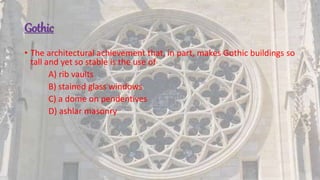
• The architectural achievement that, in part, makes Gothic buildings so
tall and yet so stable is the use of
A) rib vaults
B) stained glass windows
C) a dome on pendentives
D) ashlar masonry
Gothic
• Late Gothic events
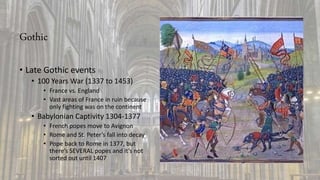
• 100 Years War (1337 to 1453)
• France vs. England
• Vast areas of France in ruin because
only fighting was on the continent
• Babylonian Captivity 1304-1377
• French popes move to Avignon
• Rome and St. Peter’s fall into decay
• Pope back to Rome in 1377, but
there’s SEVERAL popes and it’s not
sorted out until 1407
Gothic
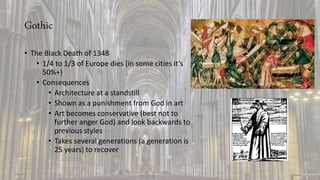
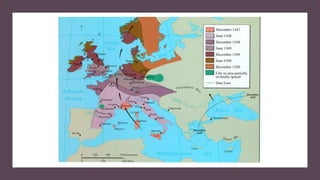
• The Black Death of 1348
• 1/4 to 1/3 of Europe dies (in some cities it’s
50%+)
• Consequences
• Architecture at a standstill
• Shown as a punishment from God in art
• Art becomes conservative (best not to
further anger God) and look backwards to
previous styles
• Takes several generations (a generation is
25 years) to recover
Gothic
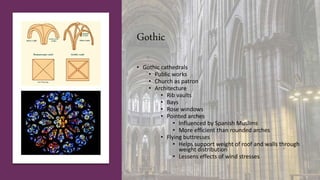
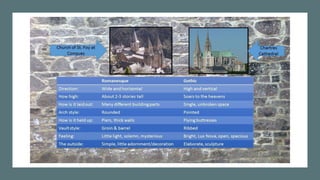
• Gothic cathedrals
• Public works
• Church as patron
• Architecture
• Rib vaults
• Bays
• Rose windows
• Pointed arches
• Influenced by Spanish Muslims
• More efficient than rounded arches
• Flying buttresses
• Helps support weight of roof and walls through
weight distribution
• Lessens effects of wind stresses
Gothic
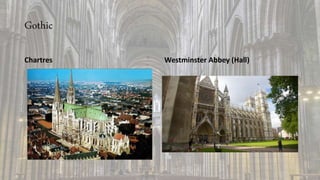
Chartres Westminster Abbey (Hall)
Gothic
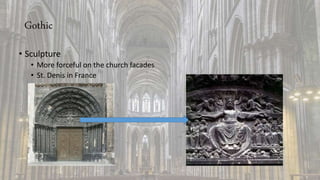
• Sculpture
• More forceful on the church facades
• St. Denis in France
Gothic
Romanesque St. Foy Gothic St. Denis
Gothic
Romanesque St. Foy Gothic St. Denis
Change in subject matter
Stress placed on Last
Judgment and threat of
damnation
Concentrates on possibility of
salvation; believer empowered
by the CHOICE of salvation
Gothic
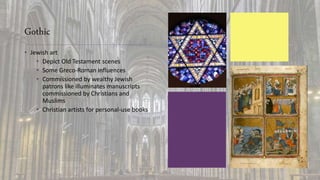
• Jewish art
• Depict Old Testament scenes
• Some Greco-Roman influences
• Commissioned by wealthy Jewish
patrons like illuminates manuscripts
commissioned by Christians and
Muslims
• Christian artists for personal-use books
Gothic
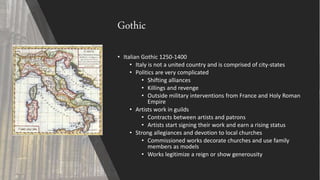
• Italian Gothic 1250-1400
• Italy is not a united country and is comprised of city-states
• Politics are very complicated
• Shifting alliances
• Killings and revenge
• Outside military interventions from France and Holy Roman
Empire
• Artists work in guilds
• Contracts between artists and patrons
• Artists start signing their work and earn a rising status
• Strong allegiances and devotion to local churches
• Commissioned works decorate churches and use family
members as models
• Works legitimize a reign or show generousity
Gothic
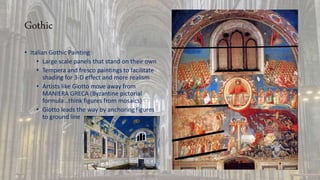
• Italian Gothic Painting
• Large scale panels that stand on their own
• Tempera and fresco paintings to facilitate
shading for 3-D effect and more realism
• Artists like Giotto move away from
MANIERA GRECA (Byzantine pictorial
formula…think figures from mosaics)
• Giotto leads the way by anchoring figures
to ground line
Gothic
• Quick: Give me a work that is an example of MANIERA GRECA!
Gothic
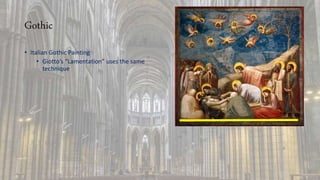
• Italian Gothic Painting
• Giotto’s “Lamentation” uses the same
technique
Gothic
• The architectural achievement that, in part, makes Gothic buildings so
tall and yet so stable is the use of
A) rib vaults
B) stained glass windows
C) a dome on pendentives
D) ashlar masonry
Gothic
• The architectural achievement that, in part, makes Gothic buildings so
tall and yet so stable is the use of
A) rib vaults
B) stained glass windows
C) a dome on pendentives
D) ashlar masonry
Your Ticket to 75 Enrichment Points!
DIRECTIONS:
1) Type your name below.
2) Submit screenshot AND a couple of sentences in the Student Comment section about what was covered and
what you learned with Enrichment Assignment

APAH Medieval Review

  • 1.
    Gallery 7 APAHReview Medieval Times before it became a tourist attraction…
  • 2.
    Time for somemental push-ups to get warmed up!! • Let’s play stump the teacher! Below type a question about the Medieval period and let’s see if you can stump me!
  • 3.
    HowcomfortableareyouwithEarlyMedieval? • The Bookof Lindisfarne shows classical influence in its • A) animals depicted in the margins • B) figures shown in contrapposto • C) calligraphy written in Latin • D) interlace patterning with interweaving forms We’ll answer this again after this section and compare….
  • 4.
    First, some background… •Time Period: about 450 CE to 1400 CE • 3 periods/styles • Early Medieval 450 CE-1050 CE • Romanesque 1050 CE – 1150 CE (1200 CE in some places) • Gothic 1140 CE – 1400 CE • These are not all part of the “Dark Ages”…more on that in a bit!
  • 5.
    First, some background… •Essential knowledge for this period: • No uniform style • Some periods and styles use Classicism • Some periods use geometric and natural designs • Influences come from contemporaries in other parts of Europe and from ancient traditional styles
  • 6.
    First, some background… •Essential knowledge for this period: • Learning was spread trough trade, military conquest, and pilgrimage • Studied specific fields • Most architecture is religious • Art avoids naturalistic depictions • There will be periods of aniconism
  • 7.
    First, some background… •Historical background (i.e. CULTURAL CONTEXT) • Most Roman technology and knowledge had been lost/forgotten • Mass migrations of people happen in Early Medieval/Migration period • Attila and the Huns • Vikings from Scandinavia • Vandals • THIS is the “Dark Ages” (about 400-700 CE) • Stability in Europe returns during the 8th century with the rise of Charlemagne and the Frankish kings
  • 9.
    First, some background… •Historical background (i.e. CULTURAL CONTEXT) • Importance of monasteries • Originality not important • Contemporary history/events not as important as copying previous works
  • 10.
    Manuscripts 101 • Usuallythe Bible, lives of saints, or classical literature (Illiad, Plato, etc.) • Manuscripts assembled into books called “CODICES” • VELLUM: calf hide • PARCHMENT: goat/sheep hide (longest lasting) • Ink from materials like ash, metals, plant matter
  • 11.
    Manuscripts 101 • Thoughtto ponder: • Why were manuscripts one of the primary forms of art created at this time? Why weren’t statues in the size of those created in the Renaissance being produced at this time? • Consider: • Size • Audience • Outside forces
  • 12.
    Merovingian Art • 481-714CE France • Solidified their power under Clovis (r. 481-511) whose kingdom covered what is now France and SW Germany • Struggle results from tradition of dividing kingdoms equally among sons • Lavish royal spending Looped Fibulae, mid-6th cent, silver gilt w/semi-precious stones
  • 14.
    HIBERNO-SAXON ART • 6thto 8th centuries • British Isles and Hibernia (Ireland) • Main artistic expression is in illuminated manuscripts • Borders show animals in stylized combat patterns (“Animal Style”) • Use of complicated patterns (“Celtic Knots”) and “horror vaccui” (literally the fear of empty spaces) • Every inch of the surface was covered
  • 15.
    HIBERNO-SAXON ART The Bookof Lindesfarne • c. 700 CE • work of individual artist, not a team • Latin w/English between the lines (added around 970) • Cross Page from Book of Matthew from Book of Lindesfarne • Cross with horror vaccui • dog-headed snakes, birds w/long beaks • Symmetrical • Mixes Celtic images and Christian beliefs
  • 16.
    HIBERNO-SAXON ART St. LikePortrait St. Luke usually associated with calf Heavy beard gives credibility as an author (of the Gospel) He’s shown writing (probably his Gospel)
  • 17.
    HIBERNO-SAXON ART St. LukeIncipit Page “Incipit” means opening words Cat in lower corner who has eaten 8 birds Point to ponder: What other manuscripts can you think of?
  • 18.
    One more timewith feeling… The Book of Lindisfarne shows classical influence in its A) animals depicted in the margins B) figures shown in contrapposto C) calligraphy written in Latin D) interlace patterning with interweaving forms
  • 19.
    One more timewith feeling… The Book of Lindisfarne shows classical influence in its A) animals depicted in the margins B) figures shown in contrapposto C) calligraphy written in Latin D) interlace patterning with interweaving forms
  • 20.
    One more timewith feeling… The Book of Lindisfarne shows classical influence in its A) animals depicted in the margins (this is Celtic, not Classical) B) figures shown in contrapposto (Did you see any contrapposto in the book?) C) calligraphy written in Latin D) interlace patterning with interweaving forms (this is Celtic, not Classical)
  • 21.
    ROMANESQUE Are you feelingthe love?? Romanesque architecture can be characterized as A)small, intimate, and warm B)soaring, vertical, and uplifting C)thick, heavy, and massive D)irregular, unbalanced, and asymmetrical
  • 22.
    ROMANESQUE • 1050-1150 (ish) •Europe settled after turmoil of Migration Period • Vikings Christianized and settled in places like Normandy (France), S. Italy, and Sicily • Muslims on the move and making incursions into Christian areas • Pushed out of Spain and N. Africa (they’ll go back and forth here for some time) • What’s with that name?? • From 19th century art historians who thought it was derivative of Ancient Roman art
  • 24.
    ROMANESQUE • In artand history, like in physics…
  • 25.
    ROMANESQUE • In responseto Muslim invasions, we see The Crusades • Pope as leader of a Christian empire • Europe pretty stable • Trade, arts, and cities flourish • Beginning of pilgrimages • Relics brought back from the Holy Land • Shrine of St. James at Santiago de Compostela was the end of the “Pilgrimage Trail”
  • 26.
    ROMANESQUE • Pilgrimages leadto a huge period of revitalization in Europe WHY????
  • 27.
    ROMANESQUE • Architecture • Basedon feudalism • Mostly castles, manor houses, monasteries, churches • Cathedrals • Civic and religious pride and devotion • Stone (so heavy…but fireproof!) • Thick walls • Few windows=little light
  • 28.
    ROMANESQUE • Architecture • RibVaults: HELP to support weight of roof, but not all. Weight sent to massive pillars below • Bay: basic unit of medieval architecture • Arch on 1st floor • Triforium w/smaller arches on 2nd floor • Windows in the clerestory on the 3rd
  • 29.
    ROMANESQUE • Ambulatory essentialin pilgrimage churches • St. Sernin in Toulouse, France one of best examples
  • 30.
    ROMANESQUE • Sculpture andpainting • Sculpture becoming larger but usually confined to portals of churches so people would understand the theme of the church • The Last Judgement at St. Foy • Christ as a strict judge • Hell/damned on right and saved on the left, so people enter on the right and exit saved on the left • Reminds pilgrims why they’re there • “O Sinners, change your morals before you might face a cruel judgment”
  • 31.
    ROMANESQUE • Quick: Whatother Last Judgment scenes can you recall?
  • 32.
    ROMANESQUE • Bayeaux Tapestry •Illustrates conquest of England by William (of Normandy, the Conqueror, the B*stard…take your pick, they’re all correct) in 1066 • Battle of Hastings • Figures tend to “float” • Starting to record current events • Provides record of William’s victory AND serves to legitimize his rule
  • 33.
    ROMANESQUE • “I spywith my little eye…” • 230 feet long • Narrative tradition in Medieval art • Flat figures/no shadow
  • 34.
    ROMANESQUE Are you feelingthe love?? Romanesque architecture can be characterized as A)small, intimate, and warm B)soaring, vertical, and uplifting C)thick, heavy, and massive D)irregular, unbalanced, and asymmetrical
  • 35.
    ROMANESQUE Are you feelingthe love?? Romanesque architecture can be characterized as A)small, intimate, and warm B)soaring, vertical, and uplifting C)thick, heavy, and massive D)irregular, unbalanced, and asymmetrical
  • 36.
    Gothic • 1140 to1400 (1550 in some parts of Europe) • Begun in Paris because French succession had been peaceful from 987 to 1328 • Increase in growth and wealth of towns • Royal charters bind the cities to the king, not to local nobles • Development of a money economy • Agricultural goods traded for other goods, money, and services • Schools emerge • Paris becomes intellectual center of Europe • Use of logical reasoning in academics
  • 37.
    Gothic • The architecturalachievement that, in part, makes Gothic buildings so tall and yet so stable is the use of A) rib vaults B) stained glass windows C) a dome on pendentives D) ashlar masonry
  • 38.
    Gothic • Late Gothicevents • 100 Years War (1337 to 1453) • France vs. England • Vast areas of France in ruin because only fighting was on the continent • Babylonian Captivity 1304-1377 • French popes move to Avignon • Rome and St. Peter’s fall into decay • Pope back to Rome in 1377, but there’s SEVERAL popes and it’s not sorted out until 1407
  • 39.
    Gothic • The BlackDeath of 1348 • 1/4 to 1/3 of Europe dies (in some cities it’s 50%+) • Consequences • Architecture at a standstill • Shown as a punishment from God in art • Art becomes conservative (best not to further anger God) and look backwards to previous styles • Takes several generations (a generation is 25 years) to recover
  • 41.
    Gothic • Gothic cathedrals •Public works • Church as patron • Architecture • Rib vaults • Bays • Rose windows • Pointed arches • Influenced by Spanish Muslims • More efficient than rounded arches • Flying buttresses • Helps support weight of roof and walls through weight distribution • Lessens effects of wind stresses
  • 42.
  • 43.
    Gothic • Sculpture • Moreforceful on the church facades • St. Denis in France
  • 44.
    Gothic Romanesque St. FoyGothic St. Denis
  • 45.
    Gothic Romanesque St. FoyGothic St. Denis Change in subject matter Stress placed on Last Judgment and threat of damnation Concentrates on possibility of salvation; believer empowered by the CHOICE of salvation
  • 46.
    Gothic • Jewish art •Depict Old Testament scenes • Some Greco-Roman influences • Commissioned by wealthy Jewish patrons like illuminates manuscripts commissioned by Christians and Muslims • Christian artists for personal-use books
  • 47.
    Gothic • Italian Gothic1250-1400 • Italy is not a united country and is comprised of city-states • Politics are very complicated • Shifting alliances • Killings and revenge • Outside military interventions from France and Holy Roman Empire • Artists work in guilds • Contracts between artists and patrons • Artists start signing their work and earn a rising status • Strong allegiances and devotion to local churches • Commissioned works decorate churches and use family members as models • Works legitimize a reign or show generousity
  • 48.
    Gothic • Italian GothicPainting • Large scale panels that stand on their own • Tempera and fresco paintings to facilitate shading for 3-D effect and more realism • Artists like Giotto move away from MANIERA GRECA (Byzantine pictorial formula…think figures from mosaics) • Giotto leads the way by anchoring figures to ground line
  • 49.
    Gothic • Quick: Giveme a work that is an example of MANIERA GRECA!
  • 50.
    Gothic • Italian GothicPainting • Giotto’s “Lamentation” uses the same technique
  • 52.
    Gothic • The architecturalachievement that, in part, makes Gothic buildings so tall and yet so stable is the use of A) rib vaults B) stained glass windows C) a dome on pendentives D) ashlar masonry
  • 53.
    Gothic • The architecturalachievement that, in part, makes Gothic buildings so tall and yet so stable is the use of A) rib vaults B) stained glass windows C) a dome on pendentives D) ashlar masonry
  • 54.
    Your Ticket to75 Enrichment Points! DIRECTIONS: 1) Type your name below. 2) Submit screenshot AND a couple of sentences in the Student Comment section about what was covered and what you learned with Enrichment Assignment