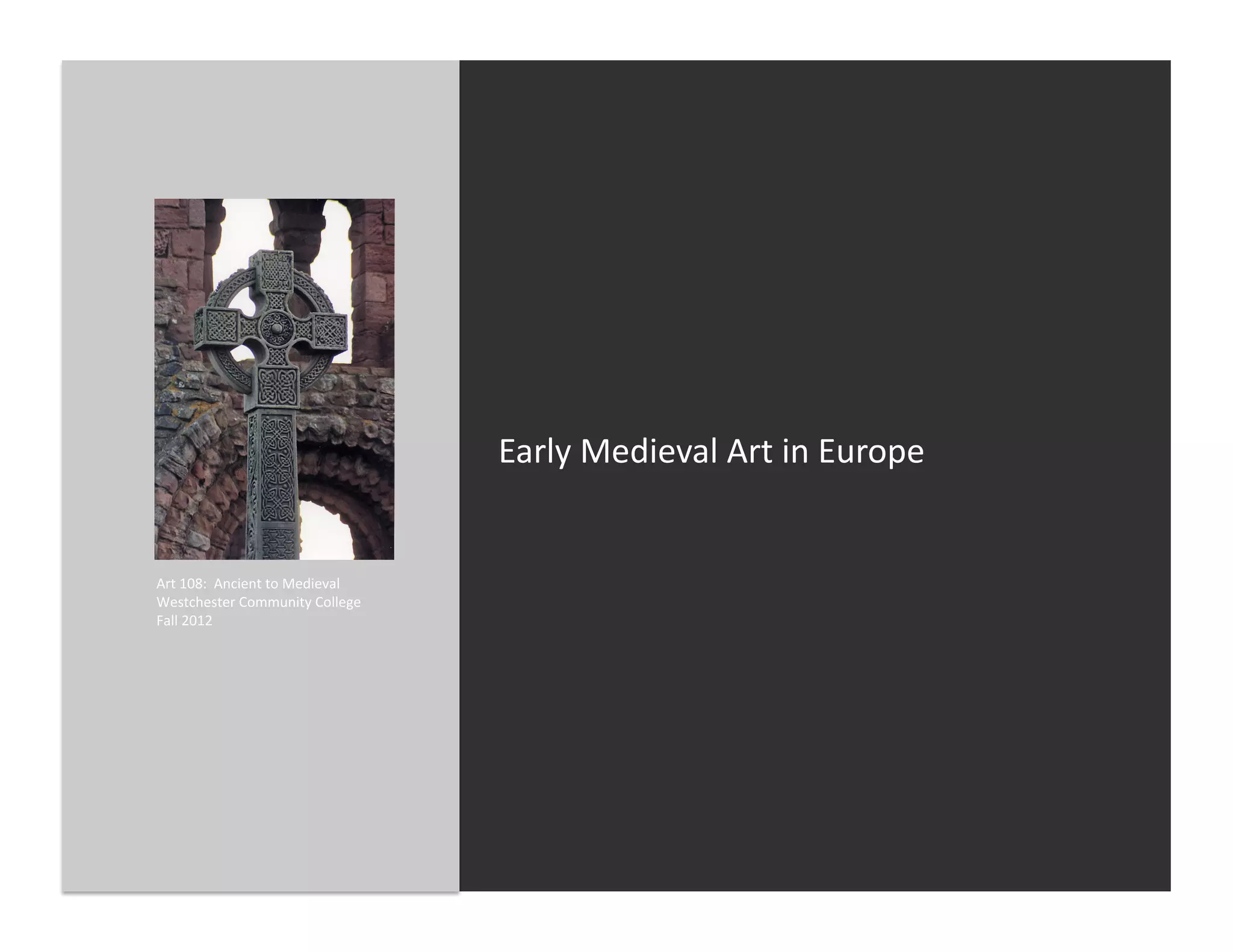
Early	
  Medieval	
  Art	
  in	
  Europe	


Art	
  108:	
  	
  Ancient	
  to	
  Medieval	
  
Westchester	
  Community	
  College	
  
Fall	
  2012	
  
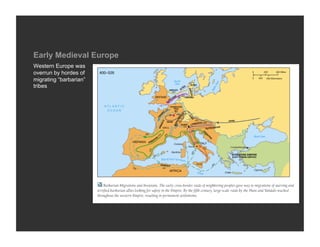
Early Medieval Europe
Western Europe was
overrun by hordes of
migrating “barbarian”
tribes
Early Medieval Europe
Middle Ages/Medieval period:
• Fall of Roman Empire (5th century)
• Renaissance (15th century)
Early Medieval Europe

This period of roughly 1,000 years is further divided into three phases

    1.  Early Medieval (ending in the 10-11th century)

    2.  Romanesque (11th-12th century)

    3.  Gothic (12th-15th century)
Early Medieval Europe
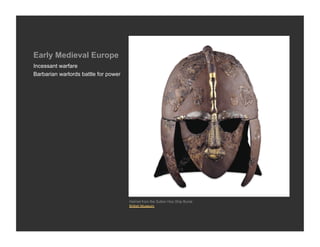
Incessant warfare
Barbarian warlords battle for power


                                      Helmet from the Sutton Hoo Ship Burial
                                      British Museum
Early Medieval Europe
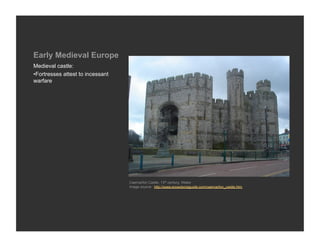
Medieval castle:
• Fortresses attest to incessant
warfare


                                   Caernarfon Castle, 13th century, Wales
                                   Image source: http://www.snowdoniaguide.com/caernarfon_castle.htm
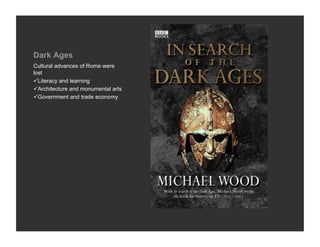
Dark Ages
Cultural advances of Rome were
lost
 Literacy and learning
 Architecture and monumental arts
 Government and trade economy
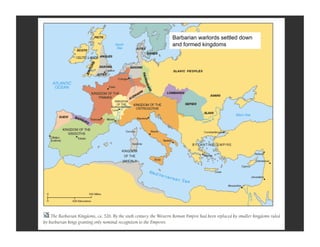
Barbarian warlords settled down
and formed kingdoms
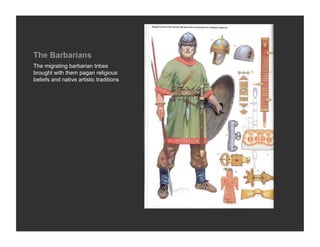
The Barbarians
The migrating barbarian tribes
brought with them pagan religious
beliefs and native artistic traditions
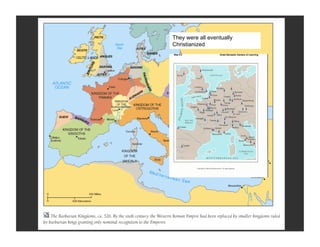
They were all eventually
Christianized
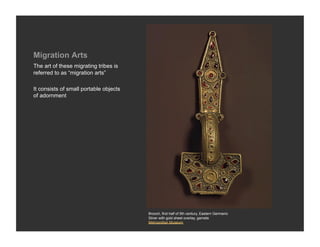
Migration Arts
The art of these migrating tribes is
referred to as “migration arts”

It consists of small portable objects
of adornment


                                        Brooch, first half of 5th century, Eastern Germanic
                                        Silver with gold sheet overlay, garnets
                                        Metropolitan Museum
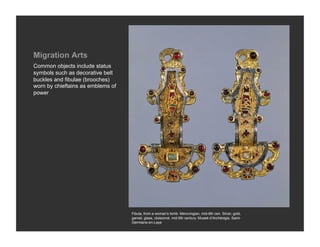
Migration Arts
Common objects include status
symbols such as decorative belt
buckles and fibulae (brooches)
worn by chieftains as emblems of
power


                                   Fibula, from a woman’s tomb. Merovingian, mid-6th cen. Silver, gold,
                                   garnet, glass, cloisonné, mid 6th century. Museé d’Archéolgie, Saint-
                                   Germiane-en-Laye
Migration Arts


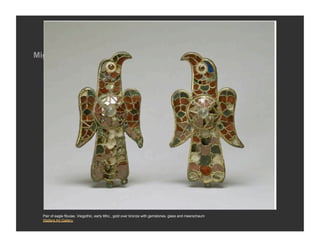
  Pair of eagle fibulae, Visigothic, early 6thc., gold over bronze with gemstones, glass and meerschaum
  Walters Art Gallery
Migration Arts
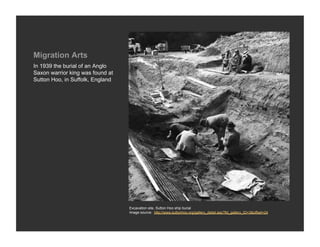
In 1939 the burial of an Anglo
Saxon warrior king was found at
Sutton Hoo, in Suffolk, England


                                  Excavation site, Sutton Hoo ship burial
                                  Image source: http://www.suttonhoo.org/gallery_detail.asp?fld_gallery_ID=3&offset=24
Migration Arts
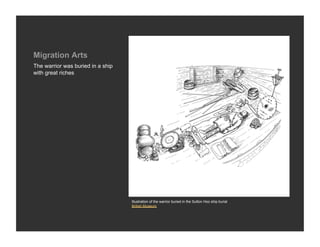
The warrior was buried in a ship
with great riches


                                   Illustration of the warrior buried in the Sutton Hoo ship burial
                                   British Museum
Migration Arts
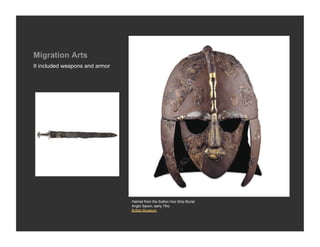
It included weapons and armor


                                Helmet from the Sutton Hoo Ship Burial
                                Anglo Saxon, early 7thc
                                British Museum
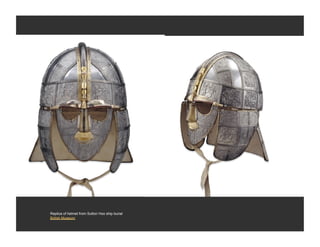
Replica of helmet from Sutton Hoo ship burial
British Museum
Migration Arts
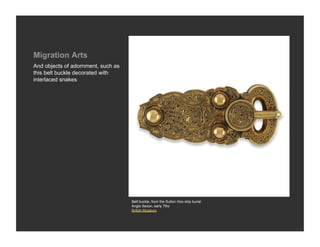
And objects of adornment, such as
this belt buckle decorated with
interlaced snakes


                                    Belt buckle, from the Sutton Hoo ship burial
                                    Anglo Saxon, early 7thc
                                    British Museum
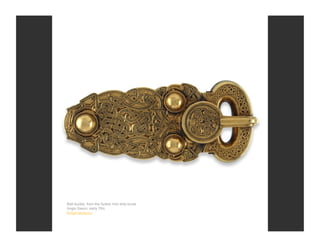
Belt buckle, from the Sutton Hoo ship burial
Anglo Saxon, early 7thc
British Museum
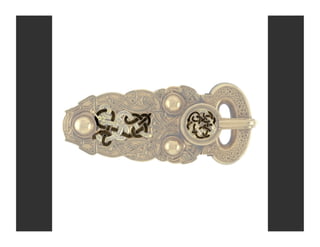
Belt buckle, from the Sutton Hoo ship burial
Anglo Saxon, early 7thc
British Museum
Migration Arts
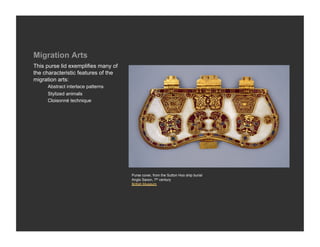
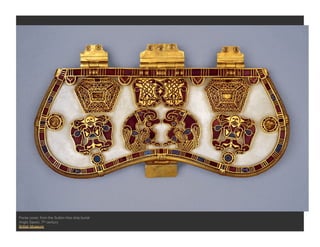
This purse lid exemplifies many of
the characteristic features of the
migration arts:
     Abstract interlace patterns
     Stylized animals
     Cloisonné technique


                                     Purse cover, from the Sutton Hoo ship burial
                                     Anglo Saxon, 7th century
                                     British Museum
Purse cover, from the Sutton Hoo ship burial
Anglo Saxon, 7th century
British Museum
Migration Arts
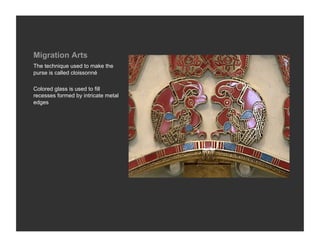
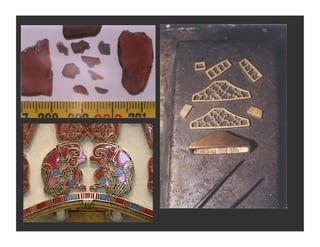
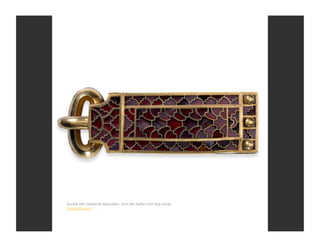
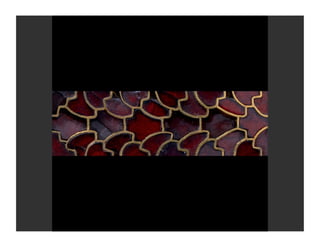
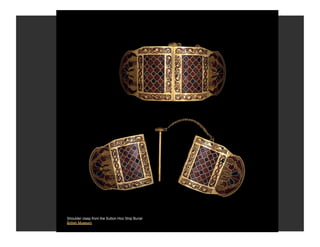
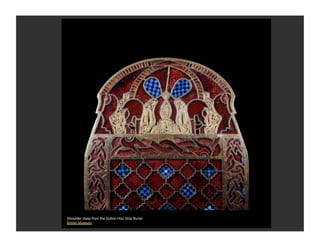
The technique used to make the
purse is called cloissonné

Colored glass is used to fill
recesses formed by intricate metal
edges
Buckle with cloisonné decoration, from the Sutton Hoo ship burial
British Museum
Shoulder clasp from the Sutton Hoo Ship Burial
British Museum
Shoulder clasp from the Sutton Hoo Ship Burial
British Museum
Migration Arts
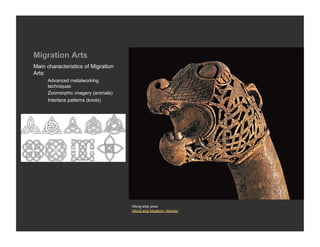
Main characteristics of Migration
Arts:
     Advanced metalworking
     techniques
     Zoomorphic imagery (animals)
     Interlace patterns (knots)


                                    Viking ship prow
                                    Viking ship Museum, Norway
Migration Arts
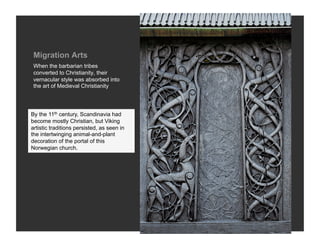
 When the barbarian tribes
 converted to Christianity, their
 vernacular style was absorbed into
 the art of Medieval Christianity


By the 11th century, Scandinavia had
become mostly Christian, but Viking
artistic traditions persisted, as seen in
the intertwinging animal-and-plant
decoration of the portal of this
Norwegian church.
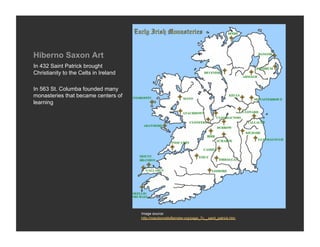
Hiberno Saxon Art
In 432 Saint Patrick brought
Christianity to the Celts in Ireland

In 563 St. Columba founded many
monasteries that became centers of
learning


                                       Image source:
                                       http://macdonnellofleinster.org/page_7c__saint_patrick.htm
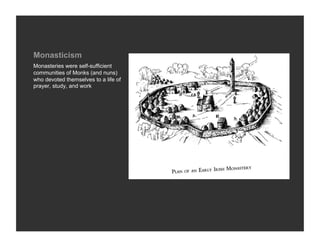
Monasticism
Monasteries were self-sufficient
communities of Monks (and nuns)
who devoted themselves to a life of
prayer, study, and work
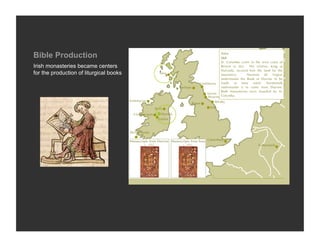
Bible Production
Irish monasteries became centers
for the production of liturgical books
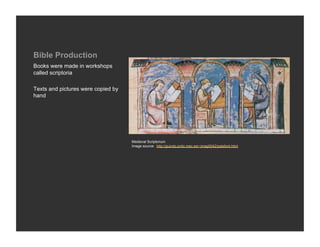
Bible Production
Books were made in workshops
called scriptoria

Texts and pictures were copied by
hand


                                    Medieval Scriptorium
                                    Image source: http://guindo.pntic.mec.es/~jmag0042/palefont.html
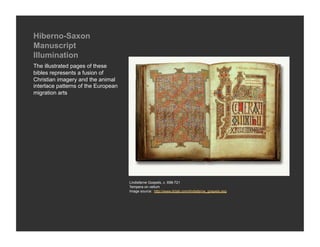
Hiberno-Saxon
Manuscript
Illumination
The illustrated pages of these
bibles represents a fusion of
Christian imagery and the animal
interlace patterns of the European
migration arts


                                     Lindisfarne Gospels, c. 698-721
                                     Tempera on vellum
                                     Image source: http://www.dclab.com/lindisfarne_gospels.asp
Hiberno-Saxon
Manuscript
Illumination
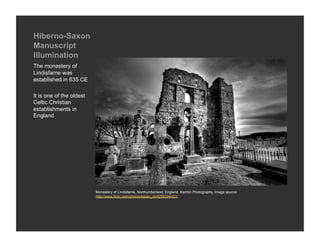
The monastery of
Lindisfarne was
established in 635 CE

It is one of the oldest
Celtic Christian
establishments in
England


                          Monastery of Lindisfarne, Northumberland, England. Karmin Photography. Image source:
                          http://www.flickr.com/photos/karen_cb/6258184421/
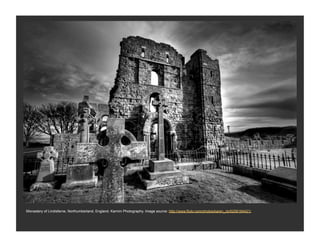
Monastery of Lindisfarne, Northumberland, England. Karmin Photography. Image source: http://www.flickr.com/photos/karen_cb/6258184421/
Hiberno-Saxon
Manuscript
Illumination
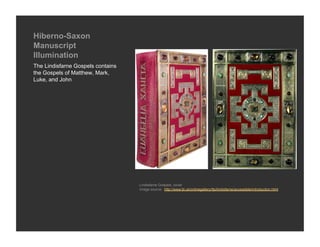
The Lindisfarne Gospels contains
the Gospels of Matthew, Mark,
Luke, and John


                                   Lindisfarne Gospels, cover
                                   Image source: http://www.bl.uk/onlinegallery/ttp/lindisfarne/accessible/introduction.html
Author Portraits
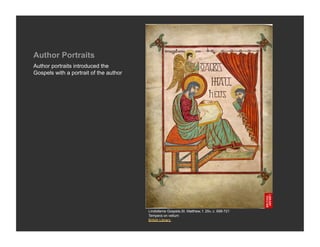
Author portraits introduced the
Gospels with a portrait of the author


                                        Lindisfarne Gospels,St. Matthew, f. 25v, c. 698-721
                                        Tempera on vellum
                                        British Library
Author Portraits
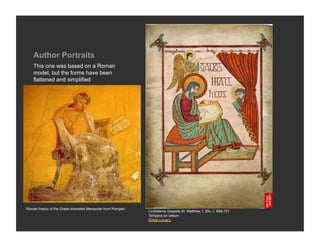
    This one was based on a Roman
    model, but the forms have been
    flattened and simplified


Roman fresco of the Greek dramatist Menander from Pompeii.
                                                             Lindisfarne Gospels,St. Matthew, f. 25v, c. 698-721
                                                             Tempera on vellum
                                                             British Library
Author Page
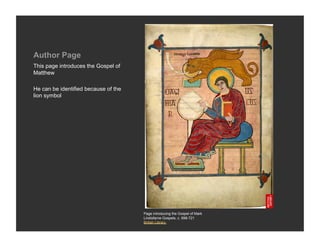
This page introduces the Gospel of
Matthew

He can be identified because of the
lion symbol


                                      Page introducing the Gospel of Mark
                                      Lindisfarne Gospels, c. 698-721
                                      British Library
Hiberno-Saxon
Manuscript
Illumination
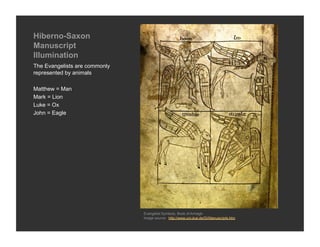
The Evangelists are commonly
represented by animals

Matthew = Man
Mark = Lion
Luke = Ox
John = Eagle


                               Evangelist Symbols, Book of Armagh
                               Image source: http://www.uni-due.de/DI/Manuscripts.htm
Hiberno-Saxon
 Manuscript
 Illumination
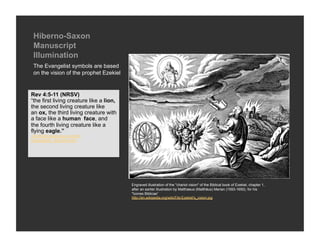
 The Evangelist symbols are based
 on the vision of the prophet Ezekiel


Rev 4:5-11 (NRSV)
“the first living creature like a lion,
the second living creature like
an ox, the third living creature with
a face like a human face, and
the fourth living creature like a
flying eagle.”
://catholic-resources.org/Art/
Evangelists_Symbols.htm


                                          Engraved illustration of the "chariot vision" of the Biblical book of Ezekiel, chapter 1,
                                          after an earlier illustration by Matthaeus (Matthäus) Merian (1593-1650), for his
                                          "Icones Biblicae”
                                          http://en.wikipedia.org/wiki/File:Ezekiel's_vision.jpg
Hiberno-Saxon
Manuscript
Illumination
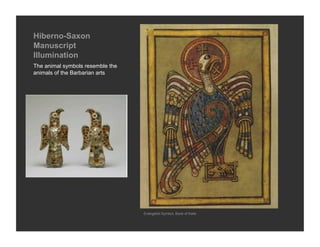
The animal symbols resemble the
animals of the Barbarian arts


                                  Evangelist Symbol, Book of Kells
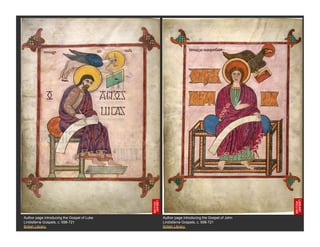
Author page introducing the Gospel of Luke   Author page introducing the Gospel of John
Lindisfarne Gospels, c. 698-721              Lindisfarne Gospels, c. 698-721
British Library                              British Library
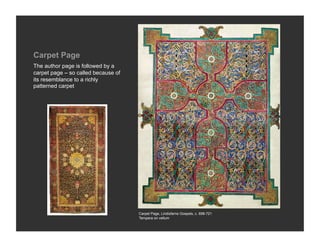
Carpet Page
The author page is followed by a
carpet page – so called because of
its resemblance to a richly
patterned carpet


                                     Carpet Page, Lindisfarne Gospels, c. 698-721
                                     Tempera on vellum
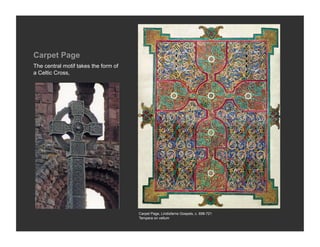
Carpet Page
The central motif takes the form of
a Celtic Cross,


                                      Carpet Page, Lindisfarne Gospels, c. 698-721
                                      Tempera on vellum
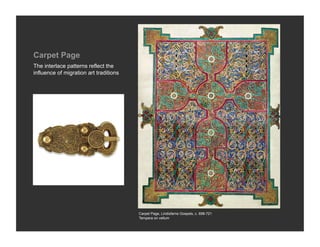
Carpet Page
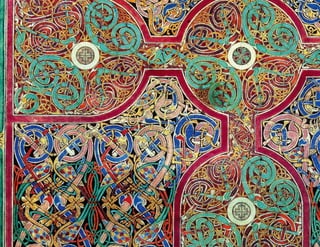
The interlace patterns reflect the
influence of migration art traditions


                                        Carpet Page, Lindisfarne Gospels, c. 698-721
                                        Tempera on vellum
Hiberno-Saxon
Manuscript
Illumination
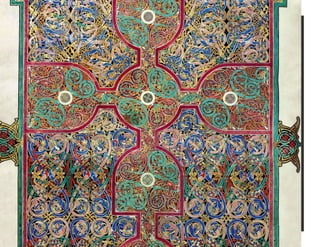
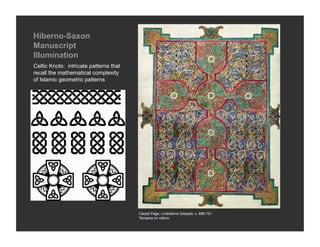
Celtic Knots: intricate patterns that
recall the mathematical complexity
of Islamic geometric patterns


                                        Carpet Page, Lindisfarne Gospels, c. 698-721
                                        Tempera on vellum
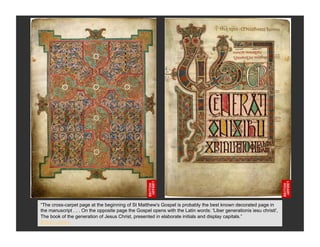
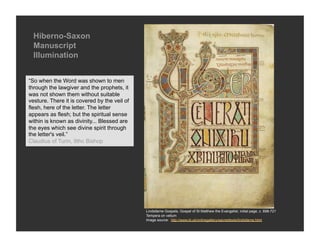
“The cross-carpet page at the beginning of St Matthew's Gospel is probably the best known decorated page in
the manuscript . . . On the opposite page the Gospel opens with the Latin words: 'Liber generationis iesu christi',
The book of the generation of Jesus Christ, presented in elaborate initials and display capitals.”
British Library
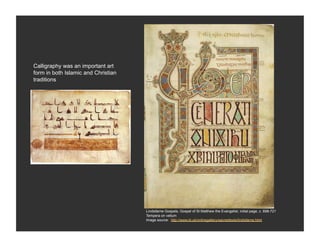
Calligraphy was an important art
form in both Islamic and Christian
traditions


                                     Lindisfarne Gospels, Gospel of St Matthew the Evangelist, initial page, c. 698-721
                                     Tempera on vellum
                                     Image source: http://www.bl.uk/onlinegallery/sacredtexts/lindisfarne.html
Hiberno-Saxon
  Manuscript
  Illumination


“So when the Word was shown to men
through the lawgiver and the prophets, it
was not shown them without suitable
vesture. There it is covered by the veil of
flesh, here of the letter. The letter
appears as flesh; but the spiritual sense
within is known as divinity... Blessed are
the eyes which see divine spirit through
the letter's veil.”
Claudius of Turin, 9thc Bishop


                                              Lindisfarne Gospels, Gospel of St Matthew the Evangelist, initial page, c. 698-721
                                              Tempera on vellum
                                              Image source: http://www.bl.uk/onlinegallery/sacredtexts/lindisfarne.html
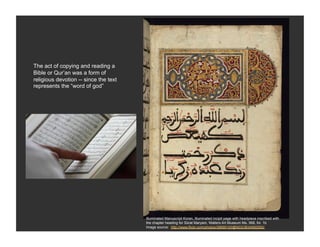
The act of copying and reading a
Bible or Qur’an was a form of
religious devotion -- since the text
represents the “word of god”


                                       Illuminated Manuscript Koran, Illuminated incipit page with headpiece inscribed with
                                       the chapter heading for Sūrat Maryam, Walters Art Museum Ms. 568, fol. 1b
                                       Image source: http://www.flickr.com/photos/39699193@N03/3834992550/
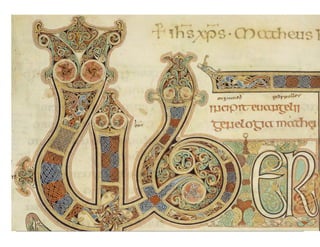
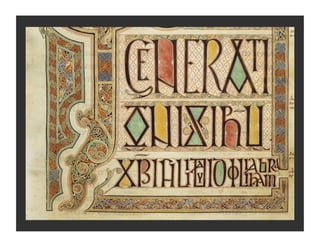
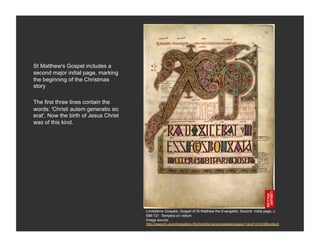
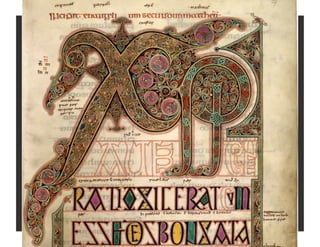
St Matthew's Gospel includes a
second major initial page, marking
the beginning of the Christmas
story

The first three lines contain the
words: 'Christi autem generatio sic
erat', Now the birth of Jesus Christ
was of this kind.


                                       Lindisfarne Gospels, Gospel of St Matthew the Evangelist, Second initial page, c.
                                       698-721 Tempera on vellum
                                       Image source:
                                       http://www.bl.uk/onlinegallery/ttp/lindisfarne/accessible/pages11and12.html#content
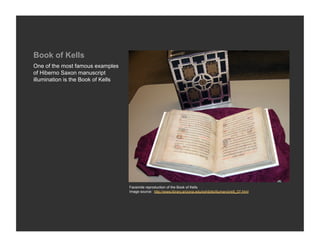
Book of Kells
One of the most famous examples
of Hiberno Saxon manuscript
illumination is the Book of Kells


                                    Facsimile reproduction of the Book of Kells
                                    Image source: http://www.library.arizona.edu/exhibits/illuman/pre9_07.html
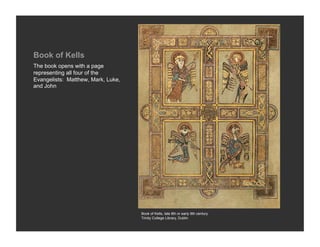
Book of Kells
The book opens with a page
representing all four of the
Evangelists: Matthew, Mark, Luke,
and John


                                    Book of Kells, late 8th or early 9th century
                                    Trinity College Library, Dublin
Hiberno-Saxon
Manuscript
Illumination
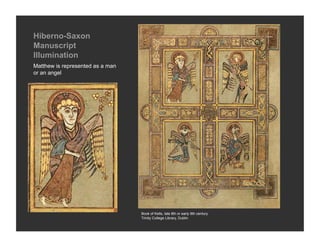
Matthew is represented as a man
or an angel


                                  Book of Kells, late 8th or early 9th century
                                  Trinity College Library, Dublin
Hiberno-Saxon
Manuscript
Illumination
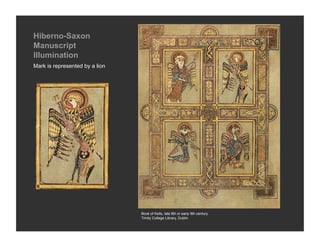
Mark is represented by a lion


                                Book of Kells, late 8th or early 9th century
                                Trinity College Library, Dublin
Hiberno-Saxon
Manuscript
Illumination
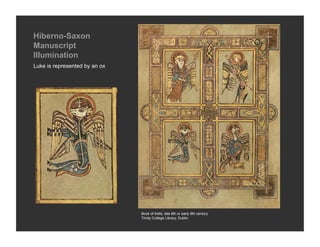
Luke is represented by an ox


                               Book of Kells, late 8th or early 9th century
                               Trinity College Library, Dublin
Hiberno-Saxon
Manuscript
Illumination
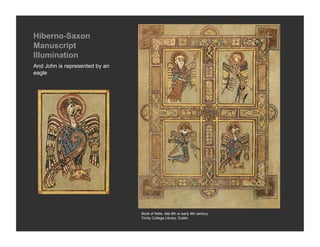
And John is represented by an
eagle


                                Book of Kells, late 8th or early 9th century
                                Trinity College Library, Dublin
Author Page
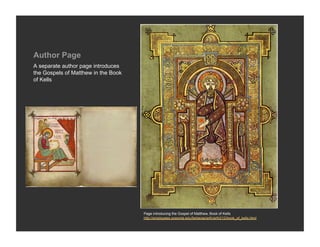
A separate author page introduces
the Gospels of Matthew in the Book
of Kells


                                     Page introducing the Gospel of Matthew, Book of Kells
                                     http://employees.oneonta.edu/farberas/arth/arth212/book_of_kells.html
Author Page
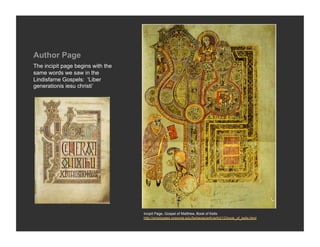
The incipit page begins with the
same words we saw in the
Lindisfarne Gospels: 'Liber
generationis iesu christi’


                                   Incipit Page, Gospel of Matthew, Book of Kells
                                   http://employees.oneonta.edu/farberas/arth/arth212/book_of_kells.html
Book of Kells
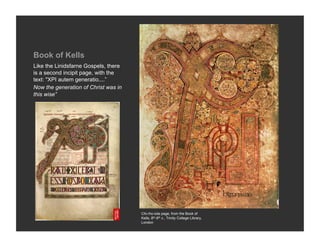
Like the Linidsfarne Gospels, there
is a second incipit page, with the
text: "XPI autem generatio....”
Now the generation of Christ was in
this wise”


                                      Chi-rho-iota page, from the Book of
                                      Kells, 8th-9th c., Trinity College Library,
                                      London
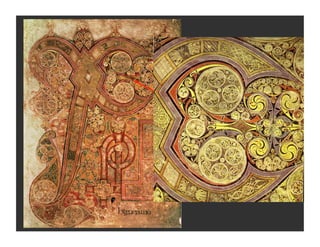
Book of Kells
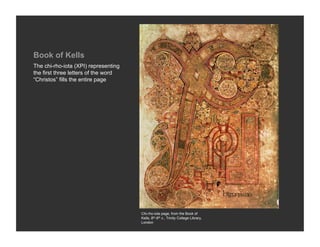
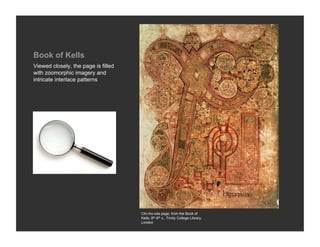
The chi-rho-iota (XPI) representing
the first three letters of the word
“Christos” fills the entire page


                                      Chi-rho-iota page, from the Book of
                                      Kells, 8th-9th c., Trinity College Library,
                                      London
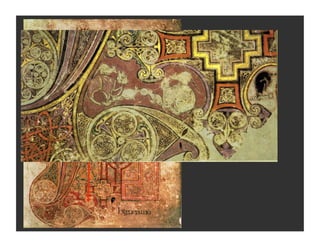
Book of Kells
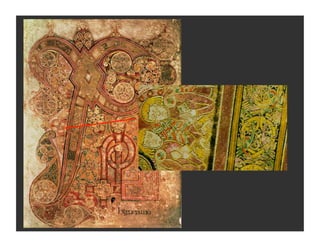
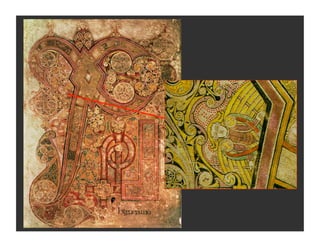
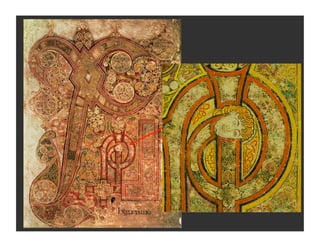
Viewed closely, the page is filled
with zoomorphic imagery and
intricate interlace patterns


                                     Chi-rho-iota page, from the Book of
                                     Kells, 8th-9th c., Trinity College Library,
                                     London
Early Medieval Art 2012

Early Medieval Art 2012

  • 1.
    Early  Medieval  Art  in  Europe   Art  108:    Ancient  to  Medieval   Westchester  Community  College   Fall  2012  
  • 2.
    Early Medieval Europe WesternEurope was overrun by hordes of migrating “barbarian” tribes
  • 3.
    Early Medieval Europe MiddleAges/Medieval period: • Fall of Roman Empire (5th century) • Renaissance (15th century)
  • 4.
    Early Medieval Europe Thisperiod of roughly 1,000 years is further divided into three phases 1.  Early Medieval (ending in the 10-11th century) 2.  Romanesque (11th-12th century) 3.  Gothic (12th-15th century)
  • 5.
    Early Medieval Europe Incessantwarfare Barbarian warlords battle for power Helmet from the Sutton Hoo Ship Burial British Museum
  • 6.
    Early Medieval Europe Medievalcastle: • Fortresses attest to incessant warfare Caernarfon Castle, 13th century, Wales Image source: http://www.snowdoniaguide.com/caernarfon_castle.htm
  • 7.
    Dark Ages Cultural advancesof Rome were lost  Literacy and learning  Architecture and monumental arts  Government and trade economy
  • 8.
    Barbarian warlords settleddown and formed kingdoms
  • 9.
    The Barbarians The migratingbarbarian tribes brought with them pagan religious beliefs and native artistic traditions
  • 10.
    They were alleventually Christianized
  • 11.
    Migration Arts The artof these migrating tribes is referred to as “migration arts” It consists of small portable objects of adornment Brooch, first half of 5th century, Eastern Germanic Silver with gold sheet overlay, garnets Metropolitan Museum
  • 12.
    Migration Arts Common objectsinclude status symbols such as decorative belt buckles and fibulae (brooches) worn by chieftains as emblems of power Fibula, from a woman’s tomb. Merovingian, mid-6th cen. Silver, gold, garnet, glass, cloisonné, mid 6th century. Museé d’Archéolgie, Saint- Germiane-en-Laye
  • 13.
    Migration Arts Pair of eagle fibulae, Visigothic, early 6thc., gold over bronze with gemstones, glass and meerschaum Walters Art Gallery
  • 14.
    Migration Arts In 1939the burial of an Anglo Saxon warrior king was found at Sutton Hoo, in Suffolk, England Excavation site, Sutton Hoo ship burial Image source: http://www.suttonhoo.org/gallery_detail.asp?fld_gallery_ID=3&offset=24
  • 15.
    Migration Arts The warriorwas buried in a ship with great riches Illustration of the warrior buried in the Sutton Hoo ship burial British Museum
  • 16.
    Migration Arts It includedweapons and armor Helmet from the Sutton Hoo Ship Burial Anglo Saxon, early 7thc British Museum
  • 17.
    Replica of helmetfrom Sutton Hoo ship burial British Museum
  • 18.
    Migration Arts And objectsof adornment, such as this belt buckle decorated with interlaced snakes Belt buckle, from the Sutton Hoo ship burial Anglo Saxon, early 7thc British Museum
  • 19.
    Belt buckle, fromthe Sutton Hoo ship burial Anglo Saxon, early 7thc British Museum
  • 20.
    Belt buckle, fromthe Sutton Hoo ship burial Anglo Saxon, early 7thc British Museum
  • 21.
    Migration Arts This purselid exemplifies many of the characteristic features of the migration arts: Abstract interlace patterns Stylized animals Cloisonné technique Purse cover, from the Sutton Hoo ship burial Anglo Saxon, 7th century British Museum
  • 22.
    Purse cover, fromthe Sutton Hoo ship burial Anglo Saxon, 7th century British Museum
  • 23.
    Migration Arts The techniqueused to make the purse is called cloissonné Colored glass is used to fill recesses formed by intricate metal edges
  • 25.
    Buckle with cloisonnédecoration, from the Sutton Hoo ship burial British Museum
  • 27.
    Shoulder clasp fromthe Sutton Hoo Ship Burial British Museum
  • 28.
    Shoulder clasp fromthe Sutton Hoo Ship Burial British Museum
  • 29.
    Migration Arts Main characteristicsof Migration Arts: Advanced metalworking techniques Zoomorphic imagery (animals) Interlace patterns (knots) Viking ship prow Viking ship Museum, Norway
  • 30.
    Migration Arts Whenthe barbarian tribes converted to Christianity, their vernacular style was absorbed into the art of Medieval Christianity By the 11th century, Scandinavia had become mostly Christian, but Viking artistic traditions persisted, as seen in the intertwinging animal-and-plant decoration of the portal of this Norwegian church.
  • 32.
    Hiberno Saxon Art In432 Saint Patrick brought Christianity to the Celts in Ireland In 563 St. Columba founded many monasteries that became centers of learning Image source: http://macdonnellofleinster.org/page_7c__saint_patrick.htm
  • 33.
    Monasticism Monasteries were self-sufficient communitiesof Monks (and nuns) who devoted themselves to a life of prayer, study, and work
  • 34.
    Bible Production Irish monasteriesbecame centers for the production of liturgical books
  • 35.
    Bible Production Books weremade in workshops called scriptoria Texts and pictures were copied by hand Medieval Scriptorium Image source: http://guindo.pntic.mec.es/~jmag0042/palefont.html
  • 36.
    Hiberno-Saxon Manuscript Illumination The illustrated pagesof these bibles represents a fusion of Christian imagery and the animal interlace patterns of the European migration arts Lindisfarne Gospels, c. 698-721 Tempera on vellum Image source: http://www.dclab.com/lindisfarne_gospels.asp
  • 37.
    Hiberno-Saxon Manuscript Illumination The monastery of Lindisfarnewas established in 635 CE It is one of the oldest Celtic Christian establishments in England Monastery of Lindisfarne, Northumberland, England. Karmin Photography. Image source: http://www.flickr.com/photos/karen_cb/6258184421/
  • 38.
    Monastery of Lindisfarne,Northumberland, England. Karmin Photography. Image source: http://www.flickr.com/photos/karen_cb/6258184421/
  • 39.
    Hiberno-Saxon Manuscript Illumination The Lindisfarne Gospelscontains the Gospels of Matthew, Mark, Luke, and John Lindisfarne Gospels, cover Image source: http://www.bl.uk/onlinegallery/ttp/lindisfarne/accessible/introduction.html
  • 40.
    Author Portraits Author portraitsintroduced the Gospels with a portrait of the author Lindisfarne Gospels,St. Matthew, f. 25v, c. 698-721 Tempera on vellum British Library
  • 41.
    Author Portraits This one was based on a Roman model, but the forms have been flattened and simplified Roman fresco of the Greek dramatist Menander from Pompeii. Lindisfarne Gospels,St. Matthew, f. 25v, c. 698-721 Tempera on vellum British Library
  • 42.
    Author Page This pageintroduces the Gospel of Matthew He can be identified because of the lion symbol Page introducing the Gospel of Mark Lindisfarne Gospels, c. 698-721 British Library
  • 43.
    Hiberno-Saxon Manuscript Illumination The Evangelists arecommonly represented by animals Matthew = Man Mark = Lion Luke = Ox John = Eagle Evangelist Symbols, Book of Armagh Image source: http://www.uni-due.de/DI/Manuscripts.htm
  • 44.
    Hiberno-Saxon Manuscript Illumination The Evangelist symbols are based on the vision of the prophet Ezekiel Rev 4:5-11 (NRSV) “the first living creature like a lion, the second living creature like an ox, the third living creature with a face like a human face, and the fourth living creature like a flying eagle.” ://catholic-resources.org/Art/ Evangelists_Symbols.htm Engraved illustration of the "chariot vision" of the Biblical book of Ezekiel, chapter 1, after an earlier illustration by Matthaeus (Matthäus) Merian (1593-1650), for his "Icones Biblicae” http://en.wikipedia.org/wiki/File:Ezekiel's_vision.jpg
  • 45.
    Hiberno-Saxon Manuscript Illumination The animal symbolsresemble the animals of the Barbarian arts Evangelist Symbol, Book of Kells
  • 46.
    Author page introducingthe Gospel of Luke Author page introducing the Gospel of John Lindisfarne Gospels, c. 698-721 Lindisfarne Gospels, c. 698-721 British Library British Library
  • 47.
    Carpet Page The authorpage is followed by a carpet page – so called because of its resemblance to a richly patterned carpet Carpet Page, Lindisfarne Gospels, c. 698-721 Tempera on vellum
  • 48.
    Carpet Page The centralmotif takes the form of a Celtic Cross, Carpet Page, Lindisfarne Gospels, c. 698-721 Tempera on vellum
  • 49.
    Carpet Page The interlacepatterns reflect the influence of migration art traditions Carpet Page, Lindisfarne Gospels, c. 698-721 Tempera on vellum
  • 52.
    Hiberno-Saxon Manuscript Illumination Celtic Knots: intricatepatterns that recall the mathematical complexity of Islamic geometric patterns Carpet Page, Lindisfarne Gospels, c. 698-721 Tempera on vellum
  • 53.
    “The cross-carpet pageat the beginning of St Matthew's Gospel is probably the best known decorated page in the manuscript . . . On the opposite page the Gospel opens with the Latin words: 'Liber generationis iesu christi', The book of the generation of Jesus Christ, presented in elaborate initials and display capitals.” British Library
  • 54.
    Calligraphy was animportant art form in both Islamic and Christian traditions Lindisfarne Gospels, Gospel of St Matthew the Evangelist, initial page, c. 698-721 Tempera on vellum Image source: http://www.bl.uk/onlinegallery/sacredtexts/lindisfarne.html
  • 55.
    Hiberno-Saxon Manuscript Illumination “So when the Word was shown to men through the lawgiver and the prophets, it was not shown them without suitable vesture. There it is covered by the veil of flesh, here of the letter. The letter appears as flesh; but the spiritual sense within is known as divinity... Blessed are the eyes which see divine spirit through the letter's veil.” Claudius of Turin, 9thc Bishop Lindisfarne Gospels, Gospel of St Matthew the Evangelist, initial page, c. 698-721 Tempera on vellum Image source: http://www.bl.uk/onlinegallery/sacredtexts/lindisfarne.html
  • 56.
    The act ofcopying and reading a Bible or Qur’an was a form of religious devotion -- since the text represents the “word of god” Illuminated Manuscript Koran, Illuminated incipit page with headpiece inscribed with the chapter heading for Sūrat Maryam, Walters Art Museum Ms. 568, fol. 1b Image source: http://www.flickr.com/photos/39699193@N03/3834992550/
  • 59.
    St Matthew's Gospelincludes a second major initial page, marking the beginning of the Christmas story The first three lines contain the words: 'Christi autem generatio sic erat', Now the birth of Jesus Christ was of this kind. Lindisfarne Gospels, Gospel of St Matthew the Evangelist, Second initial page, c. 698-721 Tempera on vellum Image source: http://www.bl.uk/onlinegallery/ttp/lindisfarne/accessible/pages11and12.html#content
  • 61.
    Book of Kells Oneof the most famous examples of Hiberno Saxon manuscript illumination is the Book of Kells Facsimile reproduction of the Book of Kells Image source: http://www.library.arizona.edu/exhibits/illuman/pre9_07.html
  • 62.
    Book of Kells Thebook opens with a page representing all four of the Evangelists: Matthew, Mark, Luke, and John Book of Kells, late 8th or early 9th century Trinity College Library, Dublin
  • 63.
    Hiberno-Saxon Manuscript Illumination Matthew is representedas a man or an angel Book of Kells, late 8th or early 9th century Trinity College Library, Dublin
  • 64.
    Hiberno-Saxon Manuscript Illumination Mark is representedby a lion Book of Kells, late 8th or early 9th century Trinity College Library, Dublin
  • 65.
    Hiberno-Saxon Manuscript Illumination Luke is representedby an ox Book of Kells, late 8th or early 9th century Trinity College Library, Dublin
  • 66.
    Hiberno-Saxon Manuscript Illumination And John isrepresented by an eagle Book of Kells, late 8th or early 9th century Trinity College Library, Dublin
  • 67.
    Author Page A separateauthor page introduces the Gospels of Matthew in the Book of Kells Page introducing the Gospel of Matthew, Book of Kells http://employees.oneonta.edu/farberas/arth/arth212/book_of_kells.html
  • 68.
    Author Page The incipitpage begins with the same words we saw in the Lindisfarne Gospels: 'Liber generationis iesu christi’ Incipit Page, Gospel of Matthew, Book of Kells http://employees.oneonta.edu/farberas/arth/arth212/book_of_kells.html
  • 69.
    Book of Kells Likethe Linidsfarne Gospels, there is a second incipit page, with the text: "XPI autem generatio....” Now the generation of Christ was in this wise” Chi-rho-iota page, from the Book of Kells, 8th-9th c., Trinity College Library, London
  • 70.
    Book of Kells Thechi-rho-iota (XPI) representing the first three letters of the word “Christos” fills the entire page Chi-rho-iota page, from the Book of Kells, 8th-9th c., Trinity College Library, London
  • 71.
    Book of Kells Viewedclosely, the page is filled with zoomorphic imagery and intricate interlace patterns Chi-rho-iota page, from the Book of Kells, 8th-9th c., Trinity College Library, London