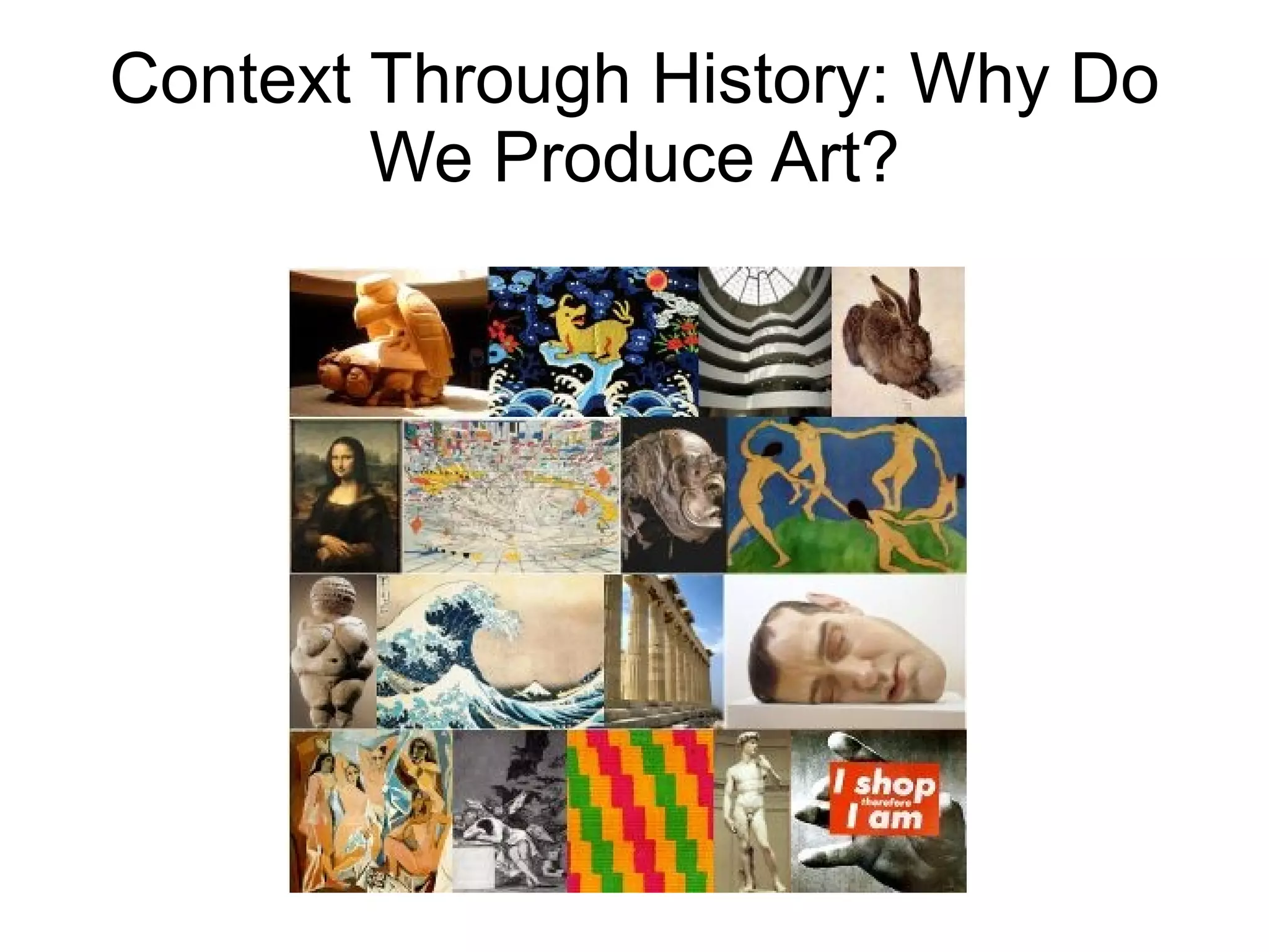
Context Through History: Why Do
We Produce Art?
● express personal thoughts and feelings
● communicate with others.
● create a more favorable environment.
● record a time, place, person, or object.
● commemorate important people or events.
● reinforce cultural ties and traditions.
● seek to affect social change.
● tell stories.
● explain the unknown.
● worship.
● do something no one else can (or has yet done).
● increase our global understanding.
Useful Terms for the Coming Unit
● Paleolithic: 2.6 Million BCE – 10,000 BCE
● Franco-Cantabrian: A style of art associated
with Paleolithic southwest France and northern
Spain.
● Semiotics: The study to signs and symbols.
● Petroglyph: A rock engraving consisting of
logograms and pictographs.
● Pictograph: A simple symbol referring to the
subject to which it illustrates.
● Logogram: An individual character or symbol
that represents a word.
More...
● Aurignacian: A culture based in Europe and
southwest Asia. Created zoomorphic and first
representational sculptures (45,000- 35,000 to
27,000 BCE).
● Magdalenian: A culture of the Upper Paleolthic
in western Europe. Mostly resided in the
Pyrenees region (15,000-7,000 BCE).
● Style: Qualities shared by other works of the
same artist, period, or area that help categorize
the characteristics into a broader field.
● Representational Art: Art that directly
references its subject matter.
… and more...
● Radiocarbon Dating: A method of measuring
Carbon 14's half-life (5,730 years). It is one of
the most accurate methods of dating ancient
artifacts.
● Nomadic Culture: Hunting and gathering
community culture that depended on travel.
● Cro-Magnon: The earliest Homo Sapien.
Appeared in 33,000 BCE.
● Neanderthal: Primitive relative to the Homo
Sapien. May have split from our species as
early as 700,000 years ago. Went extinct in
30,000 BCE
When Did We Start?
● The visual language is a the closest humanity
has ever come to attaining the a universal
language.
● As defined by a western canon, visual arts
began approximately 35,000 years before the
first written language (about 40,000 BCE in the
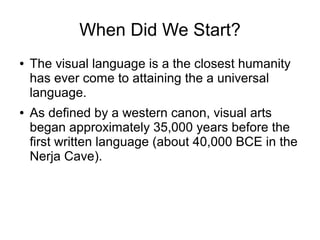
Nerja Cave).
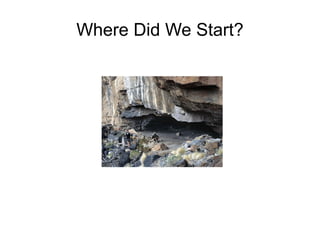
Where Did We Start?
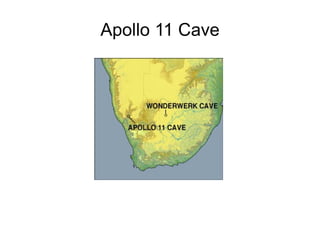
Apollo 11 Cave
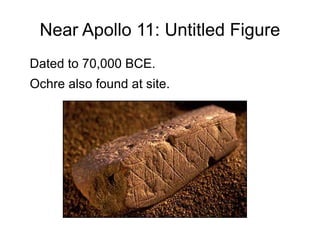
Near Apollo 11: Untitled Figure
Dated to 70,000 BCE.
Ochre also found at site.
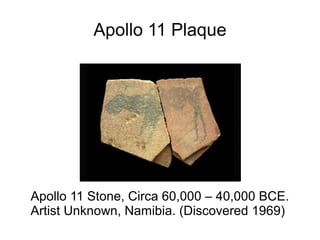
Apollo 11 Plaque
Apollo 11 Stone, Circa 60,000 – 40,000 BCE.
Artist Unknown, Namibia. (Discovered 1969)
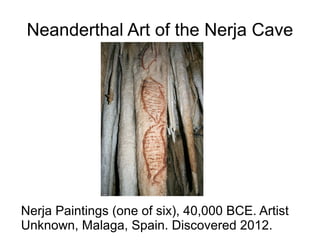
Neanderthal Art of the Nerja Cave
Nerja Paintings (one of six), 40,000 BCE. Artist
Unknown, Malaga, Spain. Discovered 2012.
Sequence of Figural Symbolization:
● Engravings on Tools
● Sculptural works
● Painted works
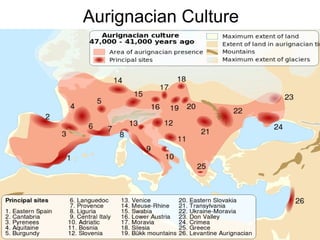
Aurignacian Culture
Aurignacian People
● Predominately located in Europe and
Southwest Asia.
● 45,000 BCE – 35,000 BCE
● They Are Considered to be the first Modern
Humans (breaking off of the preceding term,
Crom-Magnon).
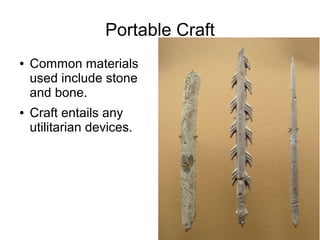
Portable Craft
● Common materials
used include stone
and bone.
● Craft entails any
utilitarian devices.
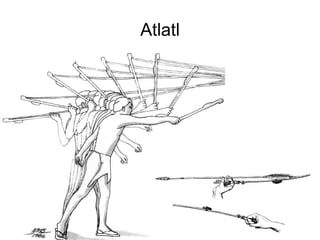
Atlatl
Art Mobilier: Portable Art
● Statuettes cut from soft stone or animal bone.
● Objects painted onto small stone
● Minor reliefs found in caves.
● First decorative works.
● First items of value.
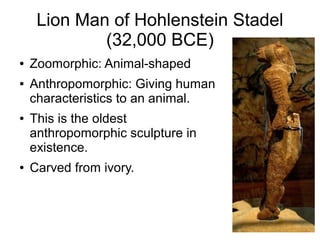
Lion Man of Hohlenstein Stadel
(32,000 BCE)
● Zoomorphic: Animal-shaped
● Anthropomorphic: Giving human
characteristics to an animal.
● This is the oldest
anthropomorphic sculpture in
existence.
● Carved from ivory.
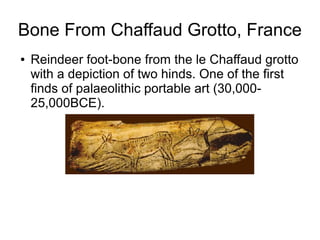
Bone From Chaffaud Grotto, France
● Reindeer foot-bone from the le Chaffaud grotto
with a depiction of two hinds. One of the first
finds of palaeolithic portable art (30,000-
25,000BCE).
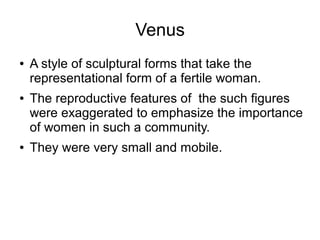
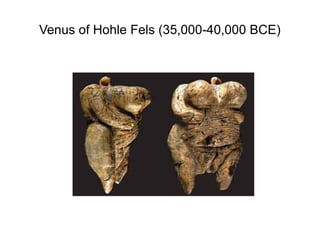
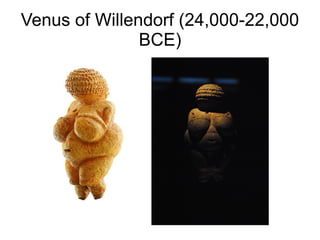
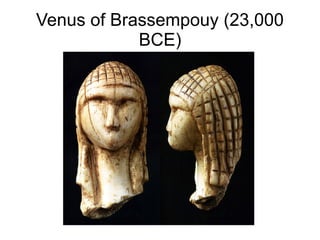
Venus
● A style of sculptural forms that take the
representational form of a fertile woman.
● The reproductive features of the such figures
were exaggerated to emphasize the importance
of women in such a community.
● They were very small and mobile.
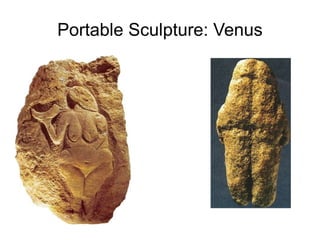
Portable Sculpture: Venus
Venus of Hohle Fels (35,000-40,000 BCE)
Venus of Willendorf (24,000-22,000
BCE)
Venus of Brassempouy (23,000
BCE)
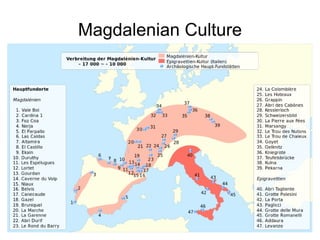
Magdalenian Culture
Magdalenian People
● Descendants of the Cro-Magnon (earliest
modern humans).
● Appear throughout Europe during the Upper
Paleolithic (Old Stone Age 40,000-10,000 BCE)
and early Mesolithic Period (10,000 BCE –
5,000 BCE). The dates: 15,000-7,000 BCE
● They set up semi-permanent residence and
maintained a hunter gathering lifestyle.
● Similarities in Upper Paleolithic paintings
indicate a possible continental network of early
communication between groups.
Cave Painting Characteristics:
-Keen observation skills
-Very realistic
-Very sophisticated
-Figures are always seen in profile
-Natural formation of caves was used
-Proportionate
-Overlapping
-Rarely see people, usually spiritual leaders,
stick people
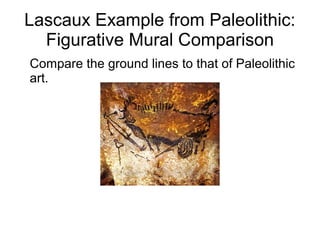
-No ground line (the base line for which a figure
stands in painting and sculpture)
Subject Matter
● Paleolithic Animals: A heavy emphasis is placed
on animals, signifying the importance of these
creatures to early humans. They were a source
of food, shelter, and warmth. Paleolithic
portrayal of animals is focused on the animals
rather than the people.
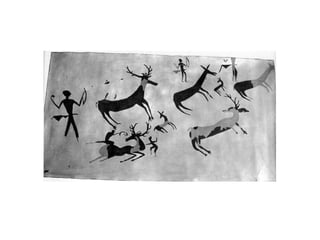
● During the Mesolithic and Neolithic Periods,
focus is drawn more towards the humans
(perhaps sometimes interacting with the
animals). This suggests the early development
of society through as stronger portrayal of
human achievement through cooperative
activities such as hunting.
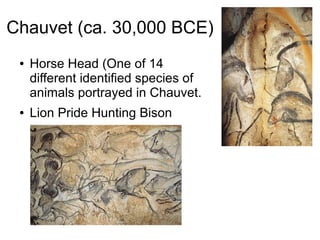
Chauvet (ca. 30,000 BCE)
● Horse Head (One of 14
different identified species of
animals portrayed in Chauvet.
● Lion Pride Hunting Bison
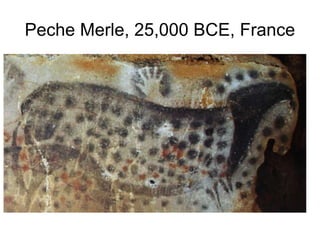
Peche Merle, 25,000 BCE, France
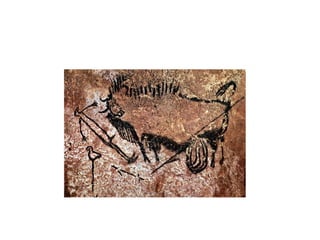
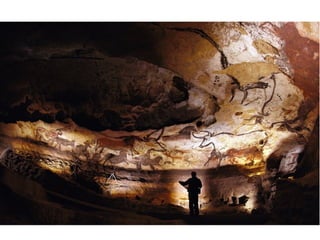
LASCAUX CAVE
Artist: Unknown
Date: Circa 17,000 BCE
Period: Upper Paleolithic
Discovered in 1940 by four boys and their dog.
Hunts were drawn on the wall like a comic strip.
The story of the hunt goes from the left to the
right, until the prey is captured. These pictures
were possibly used to tell stories. Including one
about a man who was killed by a bison.
About 2,000 years newer than the paintings
at Chauvet, one interesting feature is the lack of
fierce animals. Contains the famous Hall of
Bulls
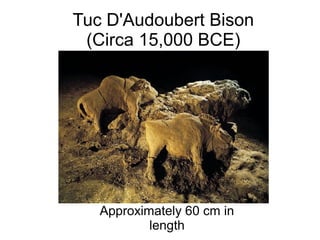
Tuc D'Audoubert Bison
(Circa 15,000 BCE)
Approximately 60 cm in
length
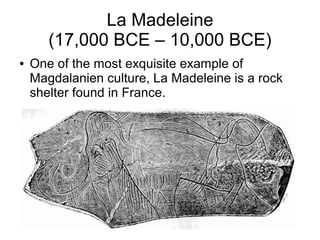
La Madeleine
(17,000 BCE – 10,000 BCE)
● One of the most exquisite example of
Magdalanien culture, La Madeleine is a rock
shelter found in France.
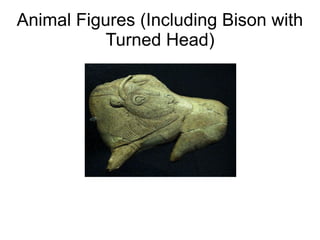
Animal Figures (Including Bison with
Turned Head)
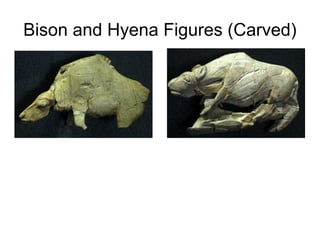
Bison and Hyena Figures (Carved)
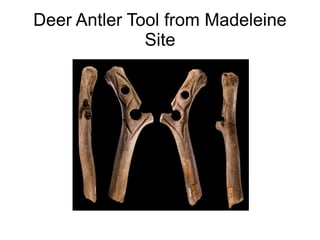
Deer Antler Tool from Madeleine
Site
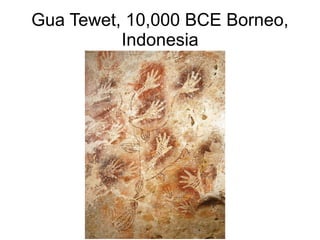
Gua Tewet, 10,000 BCE Borneo,
Indonesia
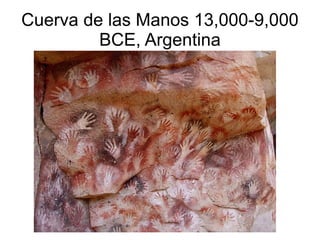
Cuerva de las Manos 13,000-9,000
BCE, Argentina
Mesolithic Period
(10,000 BCE - 5,000 BCE)
● Follows the Paleolithic Period
● Starts at the end of the last ice age.
● Transitional period from hunting-gathering
techniques to primitive agriculture.
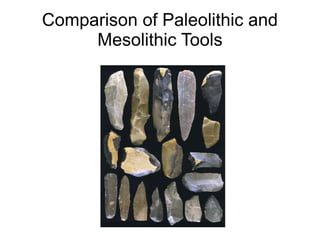
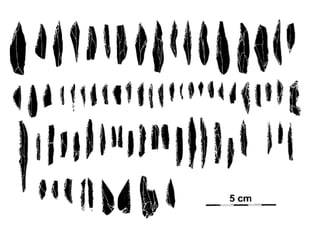
● Distinguished by improvements to stone tools.
The tools were generally smaller and finer than
that of the Paleolithic.
● Mesolithic introduces pre-agricultural habits,
including domestication.
Mesolithic Social Change
● Warmer post-glacial period provided more
suitable land for permanent settlements.
● Less migration of animals provided more
opportunities for humans to master their
hunting techniques and methods of fulfilling
their own needs.
Mesolithic Subject Matter
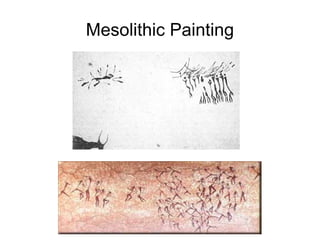
● As stated previously, Mesolithic art began to
explore humans in activity rather than a pure
appraisal of animals. Animals and humans were
in scenes together (often hunting scenes). This
suggests the dawn of proto-agriculture.
● Animal subjects were now become candidates
for domestication.
● Beginning in tail end of the Upper Paleolithic,
around 15,000 BCE, we begin to see a decline
in figurative forms and a stronger presence of
pictographs.
...Continued
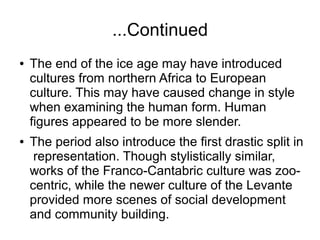
● The end of the ice age may have introduced
cultures from northern Africa to European
culture. This may have caused change in style
when examining the human form. Human
figures appeared to be more slender.
● The period also introduce the first drastic split in
representation. Though stylistically similar,
works of the Franco-Cantabric culture was zoo-
centric, while the newer culture of the Levante
provided more scenes of social development
and community building.
Mesolithic Painting
Lascaux Example from Paleolithic:
Figurative Mural Comparison
Compare the ground lines to that of Paleolithic
art.
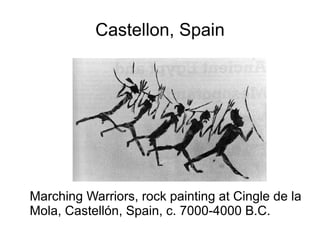
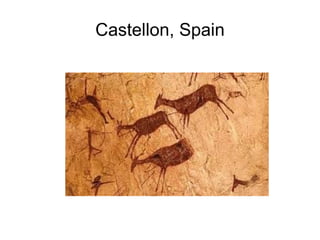
Castellon, Spain
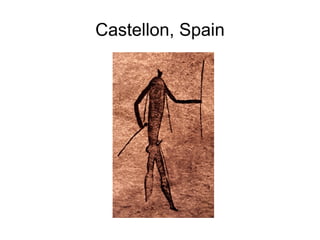
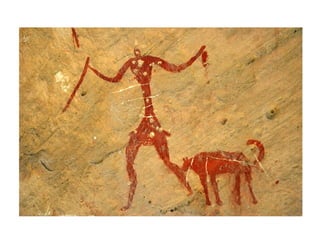
Marching Warriors, rock painting at Cingle de la
Mola, Castellón, Spain, c. 7000-4000 B.C.
Castellon, Spain
Castellon, Spain
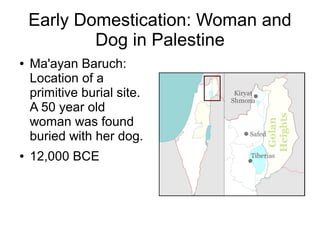
Early Domestication: Woman and
Dog in Palestine
● Ma'ayan Baruch:
Location of a
primitive burial site.
A 50 year old
woman was found
buried with her dog.
● 12,000 BCE
Comparison of Paleolithic and
Mesolithic Tools
Neolithic: The New Stone Age
● Cultural period beginning as early as 9,000
BCE in southwestern Asia and about 4,000
BCE in Europe.
● Marked by the beginning of settled societies
through agriculture. This period is also known
as the Agricultural Revolution.
● Ended in 6,000 BCE in southwestern Asia and
2,400 BCE in Europe.
● Introduction of abstraction.
Neolithic Art of Southwest Asia
(9,000 BCE – 6,000 BCE)
Jericho, Palestine
● One of the first continuously used permanent
settlements in the world.
● Settled circa 10,000 BCE
● Pre-pottery community.
● Houses were sun-dried clay huts with mud
plaster. They were often only five meters in
length.
Jericho, Palestine
● By 9,400 BCE, there were about 70 separate
dwellings in the area.
● Largest accomplishment was the establishment
of a large defensive stone wall. It was about 3.5
meters in height and two meters thick.
● Population could have been between 2,000-
3,000 people.
● Agriculture-based community.
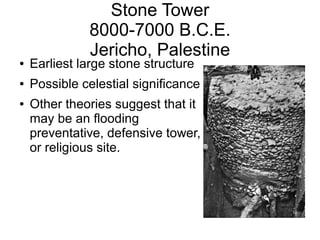
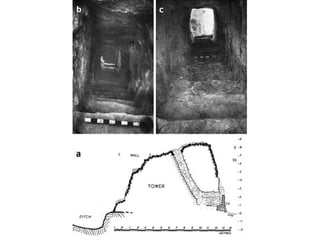
Stone Tower
8000-7000 B.C.E.
Jericho, Palestine
● Earliest large stone structure
● Possible celestial significance
● Other theories suggest that it
may be an flooding
preventative, defensive tower,
or religious site.
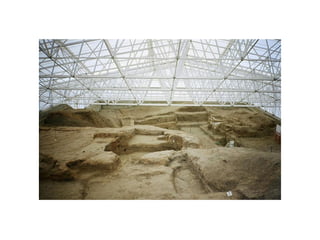
Çatalhöyük
6000-5900 B.C.E.
Turkey
● first known settlement of urban brick
● no streets (fortification) (sound structurally)
● constructed of mud brick
● painted walls
● Hosted early agriculture harvesting wheat,
pistachios, peas, and almonds.
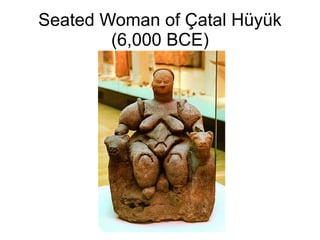
Seated Woman of Çatal Hüyük
(6,000 BCE)
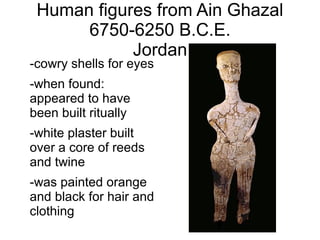
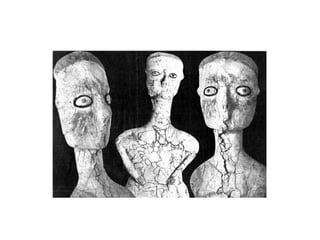
Human figures from Ain Ghazal
6750-6250 B.C.E.
Jordan
-cowry shells for eyes
-when found:
appeared to have
been built ritually
-white plaster built
over a core of reeds
and twine
-was painted orange
and black for hair and
clothing
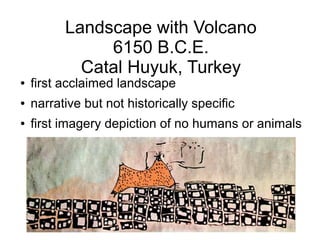
Landscape with Volcano
6150 B.C.E.
Catal Huyuk, Turkey
● first acclaimed landscape
● narrative but not historically specific
● first imagery depiction of no humans or animals
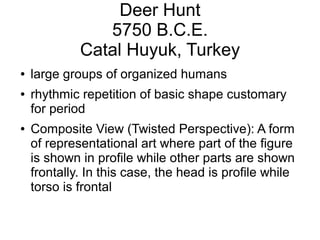
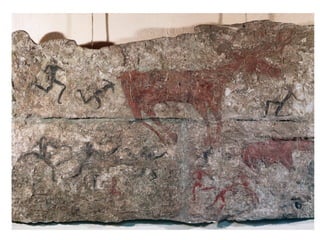
Deer Hunt
5750 B.C.E.
Catal Huyuk, Turkey
● large groups of organized humans
● rhythmic repetition of basic shape customary
for period
● Composite View (Twisted Perspective): A form
of representational art where part of the figure
is shown in profile while other parts are shown
frontally. In this case, the head is profile while
torso is frontal
Neolithic Art of Europe
(4,000 BCE - 2,400 BCE)
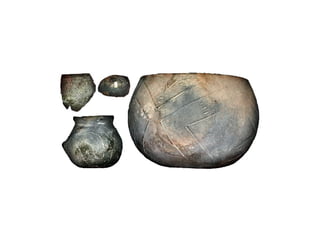
Linear Pottery Culture
● Most prevalent in central Europe from 5,500
BCE until 4,500 BCE.
● Vessels were very simple cups, jugs, vases,
and bowls. Did not include lugs.
● Though portable, they were used for local
purposes (kitchen use and short distance
transport). This is a product of settled life.
Megaliths (5,000 BCE -2,000 BCE)
● Means great stone
● Refers to any hug, human-built or assembled
structure or collection of stones.
● Typically refers to monumental architecture
(large man-made structure of stone or earth)
● Purpose of these structures include: burial sites
for the elite and masses, temple, astronomical
observatory, and meeting place.
● Mostly found in Brittany, France and the British
Isles.
Types of Megaliths
● Dolmens
● Cairns
● Henges
● Menhirs
● Monoliths
● Stone Circles
● Stone Alignments
Monolith
● A structure or statue carved from one solid
piece of stone (no stacking of multiple
materials); a large, single block or piece of
stone used in a megalithic structure.
● Structures like Stone Circles and Stone
Alignments (Stone Rows) were the built from a
series of monoliths.
● Stone Circles and Stone Alignments (Stone
Rows) first appear in large numbers around the
British Isles and Brittany (1,300 recorded stone
circles).
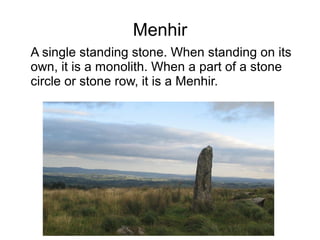
Menhir
A single standing stone. When standing on its
own, it is a monolith. When a part of a stone
circle or stone row, it is a Menhir.
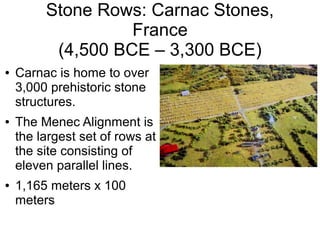
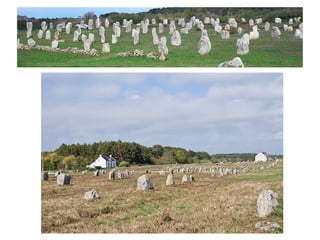
Stone Rows: Carnac Stones,
France
(4,500 BCE – 3,300 BCE)
● Carnac is home to over
3,000 prehistoric stone
structures.
● The Menec Alignment is
the largest set of rows at
the site consisting of
eleven parallel lines.
● 1,165 meters x 100
meters
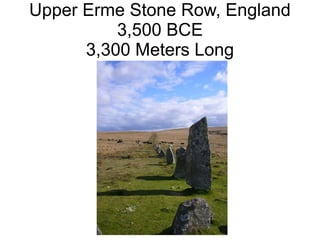
Upper Erme Stone Row, England
3,500 BCE
3,300 Meters Long
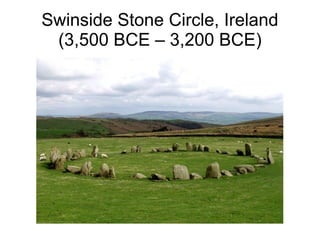
Swinside Stone Circle, Ireland
(3,500 BCE – 3,200 BCE)
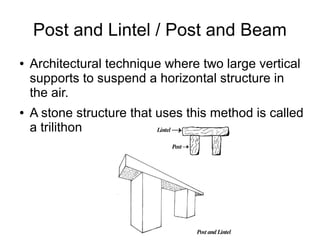
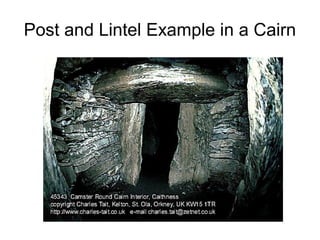
Post and Lintel / Post and Beam
● Architectural technique where two large vertical
supports to suspend a horizontal structure in
the air.
● A stone structure that uses this method is called
a trilithon
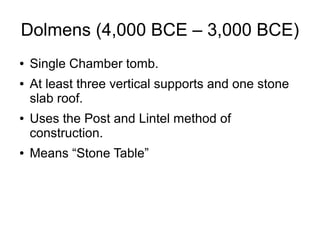
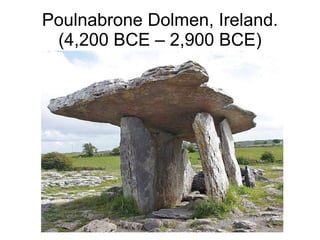
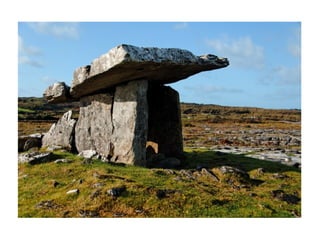
Dolmens (4,000 BCE – 3,000 BCE)
● Single Chamber tomb.
● At least three vertical supports and one stone
slab roof.
● Uses the Post and Lintel method of
construction.
● Means “Stone Table”
Poulnabrone Dolmen, Ireland.
(4,200 BCE – 2,900 BCE)
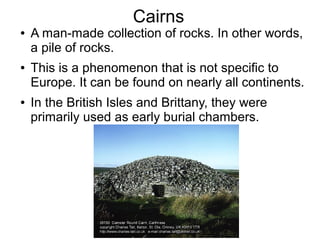
Cairns
● A man-made collection of rocks. In other words,
a pile of rocks.
● This is a phenomenon that is not specific to
Europe. It can be found on nearly all continents.
● In the British Isles and Brittany, they were
primarily used as early burial chambers.
Post and Lintel Example in a Cairn
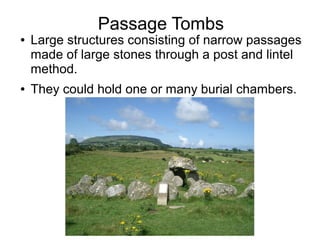
Passage Tombs
● Large structures consisting of narrow passages
made of large stones through a post and lintel
method.
● They could hold one or many burial chambers.
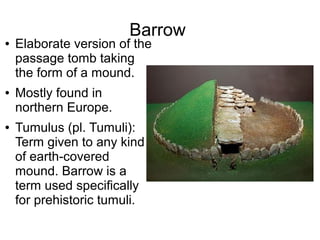
Barrow
● Elaborate version of the
passage tomb taking
the form of a mound.
● Mostly found in
northern Europe.
● Tumulus (pl. Tumuli):
Term given to any kind
of earth-covered
mound. Barrow is a
term used specifically
for prehistoric tumuli.
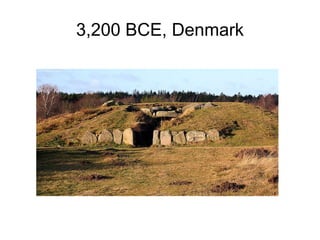
3,200 BCE, Denmark
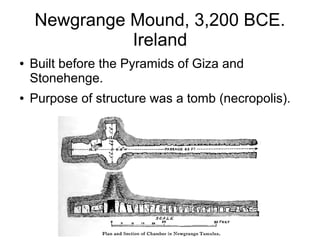
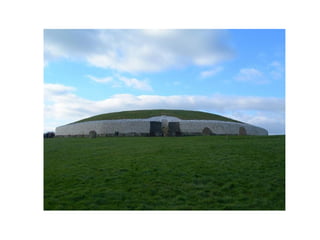
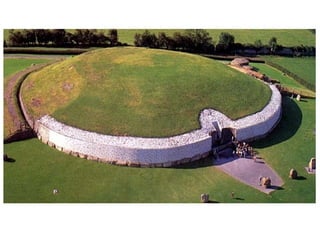
Newgrange Mound, 3,200 BCE.
Ireland
● Built before the Pyramids of Giza and
Stonehenge.
● Purpose of structure was a tomb (necropolis).
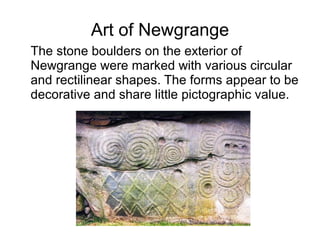
Art of Newgrange
The stone boulders on the exterior of
Newgrange were marked with various circular
and rectilinear shapes. The forms appear to be
decorative and share little pictographic value.
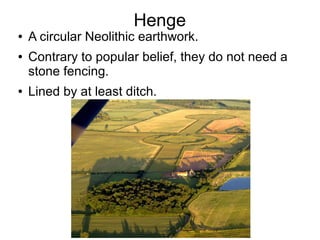
Henge
● A circular Neolithic earthwork.
● Contrary to popular belief, they do not need a
stone fencing.
● Lined by at least ditch.
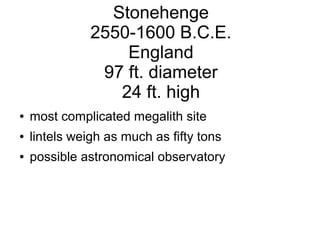
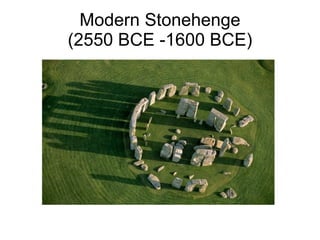
Stonehenge
2550-1600 B.C.E.
England
97 ft. diameter
24 ft. high
● most complicated megalith site
● lintels weigh as much as fifty tons
● possible astronomical observatory
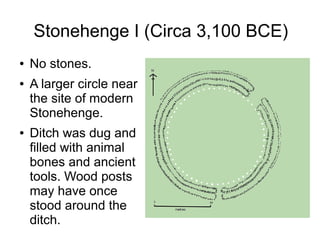
Stonehenge I (Circa 3,100 BCE)
● No stones.
● A larger circle near
the site of modern
Stonehenge.
● Ditch was dug and
filled with animal
bones and ancient
tools. Wood posts
may have once
stood around the
ditch.
Modern Stonehenge
(2550 BCE -1600 BCE)
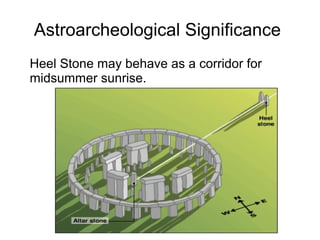
Astroarcheological Significance
Heel Stone may behave as a corridor for
midsummer sunrise.

Prehistoric Art (Paleolithic, Mesolithic, Neolithic)

  • 1.
    Context Through History:Why Do We Produce Art?
  • 2.
    ● express personalthoughts and feelings ● communicate with others. ● create a more favorable environment. ● record a time, place, person, or object. ● commemorate important people or events. ● reinforce cultural ties and traditions. ● seek to affect social change. ● tell stories. ● explain the unknown. ● worship. ● do something no one else can (or has yet done). ● increase our global understanding.
  • 3.
    Useful Terms forthe Coming Unit ● Paleolithic: 2.6 Million BCE – 10,000 BCE ● Franco-Cantabrian: A style of art associated with Paleolithic southwest France and northern Spain. ● Semiotics: The study to signs and symbols. ● Petroglyph: A rock engraving consisting of logograms and pictographs. ● Pictograph: A simple symbol referring to the subject to which it illustrates. ● Logogram: An individual character or symbol that represents a word.
  • 4.
    More... ● Aurignacian: Aculture based in Europe and southwest Asia. Created zoomorphic and first representational sculptures (45,000- 35,000 to 27,000 BCE). ● Magdalenian: A culture of the Upper Paleolthic in western Europe. Mostly resided in the Pyrenees region (15,000-7,000 BCE). ● Style: Qualities shared by other works of the same artist, period, or area that help categorize the characteristics into a broader field. ● Representational Art: Art that directly references its subject matter.
  • 5.
    … and more... ●Radiocarbon Dating: A method of measuring Carbon 14's half-life (5,730 years). It is one of the most accurate methods of dating ancient artifacts. ● Nomadic Culture: Hunting and gathering community culture that depended on travel. ● Cro-Magnon: The earliest Homo Sapien. Appeared in 33,000 BCE. ● Neanderthal: Primitive relative to the Homo Sapien. May have split from our species as early as 700,000 years ago. Went extinct in 30,000 BCE
  • 6.
    When Did WeStart? ● The visual language is a the closest humanity has ever come to attaining the a universal language. ● As defined by a western canon, visual arts began approximately 35,000 years before the first written language (about 40,000 BCE in the Nerja Cave).
  • 7.
  • 8.
  • 9.
    Near Apollo 11:Untitled Figure Dated to 70,000 BCE. Ochre also found at site.
  • 10.
    Apollo 11 Plaque Apollo11 Stone, Circa 60,000 – 40,000 BCE. Artist Unknown, Namibia. (Discovered 1969)
  • 11.
    Neanderthal Art ofthe Nerja Cave Nerja Paintings (one of six), 40,000 BCE. Artist Unknown, Malaga, Spain. Discovered 2012.
  • 12.
    Sequence of FiguralSymbolization: ● Engravings on Tools ● Sculptural works ● Painted works
  • 13.
  • 14.
    Aurignacian People ● Predominatelylocated in Europe and Southwest Asia. ● 45,000 BCE – 35,000 BCE ● They Are Considered to be the first Modern Humans (breaking off of the preceding term, Crom-Magnon).
  • 15.
    Portable Craft ● Commonmaterials used include stone and bone. ● Craft entails any utilitarian devices.
  • 16.
  • 17.
    Art Mobilier: PortableArt ● Statuettes cut from soft stone or animal bone. ● Objects painted onto small stone ● Minor reliefs found in caves. ● First decorative works. ● First items of value.
  • 18.
    Lion Man ofHohlenstein Stadel (32,000 BCE) ● Zoomorphic: Animal-shaped ● Anthropomorphic: Giving human characteristics to an animal. ● This is the oldest anthropomorphic sculpture in existence. ● Carved from ivory.
  • 19.
    Bone From ChaffaudGrotto, France ● Reindeer foot-bone from the le Chaffaud grotto with a depiction of two hinds. One of the first finds of palaeolithic portable art (30,000- 25,000BCE).
  • 20.
    Venus ● A styleof sculptural forms that take the representational form of a fertile woman. ● The reproductive features of the such figures were exaggerated to emphasize the importance of women in such a community. ● They were very small and mobile.
  • 21.
  • 22.
    Venus of HohleFels (35,000-40,000 BCE)
  • 23.
    Venus of Willendorf(24,000-22,000 BCE)
  • 24.
  • 25.
  • 26.
    Magdalenian People ● Descendantsof the Cro-Magnon (earliest modern humans). ● Appear throughout Europe during the Upper Paleolithic (Old Stone Age 40,000-10,000 BCE) and early Mesolithic Period (10,000 BCE – 5,000 BCE). The dates: 15,000-7,000 BCE ● They set up semi-permanent residence and maintained a hunter gathering lifestyle. ● Similarities in Upper Paleolithic paintings indicate a possible continental network of early communication between groups.
  • 27.
    Cave Painting Characteristics: -Keenobservation skills -Very realistic -Very sophisticated -Figures are always seen in profile -Natural formation of caves was used -Proportionate -Overlapping -Rarely see people, usually spiritual leaders, stick people -No ground line (the base line for which a figure stands in painting and sculpture)
  • 28.
    Subject Matter ● PaleolithicAnimals: A heavy emphasis is placed on animals, signifying the importance of these creatures to early humans. They were a source of food, shelter, and warmth. Paleolithic portrayal of animals is focused on the animals rather than the people. ● During the Mesolithic and Neolithic Periods, focus is drawn more towards the humans (perhaps sometimes interacting with the animals). This suggests the early development of society through as stronger portrayal of human achievement through cooperative activities such as hunting.
  • 29.
    Chauvet (ca. 30,000BCE) ● Horse Head (One of 14 different identified species of animals portrayed in Chauvet. ● Lion Pride Hunting Bison
  • 30.
  • 31.
    LASCAUX CAVE Artist: Unknown Date:Circa 17,000 BCE Period: Upper Paleolithic
  • 32.
    Discovered in 1940by four boys and their dog. Hunts were drawn on the wall like a comic strip. The story of the hunt goes from the left to the right, until the prey is captured. These pictures were possibly used to tell stories. Including one about a man who was killed by a bison. About 2,000 years newer than the paintings at Chauvet, one interesting feature is the lack of fierce animals. Contains the famous Hall of Bulls
  • 35.
    Tuc D'Audoubert Bison (Circa15,000 BCE) Approximately 60 cm in length
  • 36.
    La Madeleine (17,000 BCE– 10,000 BCE) ● One of the most exquisite example of Magdalanien culture, La Madeleine is a rock shelter found in France.
  • 37.
    Animal Figures (IncludingBison with Turned Head)
  • 38.
    Bison and HyenaFigures (Carved)
  • 39.
    Deer Antler Toolfrom Madeleine Site
  • 40.
    Gua Tewet, 10,000BCE Borneo, Indonesia
  • 41.
    Cuerva de lasManos 13,000-9,000 BCE, Argentina
  • 43.
    Mesolithic Period (10,000 BCE- 5,000 BCE) ● Follows the Paleolithic Period ● Starts at the end of the last ice age. ● Transitional period from hunting-gathering techniques to primitive agriculture. ● Distinguished by improvements to stone tools. The tools were generally smaller and finer than that of the Paleolithic. ● Mesolithic introduces pre-agricultural habits, including domestication.
  • 44.
    Mesolithic Social Change ●Warmer post-glacial period provided more suitable land for permanent settlements. ● Less migration of animals provided more opportunities for humans to master their hunting techniques and methods of fulfilling their own needs.
  • 45.
    Mesolithic Subject Matter ●As stated previously, Mesolithic art began to explore humans in activity rather than a pure appraisal of animals. Animals and humans were in scenes together (often hunting scenes). This suggests the dawn of proto-agriculture. ● Animal subjects were now become candidates for domestication. ● Beginning in tail end of the Upper Paleolithic, around 15,000 BCE, we begin to see a decline in figurative forms and a stronger presence of pictographs.
  • 46.
    ...Continued ● The endof the ice age may have introduced cultures from northern Africa to European culture. This may have caused change in style when examining the human form. Human figures appeared to be more slender. ● The period also introduce the first drastic split in representation. Though stylistically similar, works of the Franco-Cantabric culture was zoo- centric, while the newer culture of the Levante provided more scenes of social development and community building.
  • 47.
  • 48.
    Lascaux Example fromPaleolithic: Figurative Mural Comparison Compare the ground lines to that of Paleolithic art.
  • 49.
    Castellon, Spain Marching Warriors,rock painting at Cingle de la Mola, Castellón, Spain, c. 7000-4000 B.C.
  • 50.
  • 51.
  • 53.
    Early Domestication: Womanand Dog in Palestine ● Ma'ayan Baruch: Location of a primitive burial site. A 50 year old woman was found buried with her dog. ● 12,000 BCE
  • 54.
    Comparison of Paleolithicand Mesolithic Tools
  • 56.
    Neolithic: The NewStone Age ● Cultural period beginning as early as 9,000 BCE in southwestern Asia and about 4,000 BCE in Europe. ● Marked by the beginning of settled societies through agriculture. This period is also known as the Agricultural Revolution. ● Ended in 6,000 BCE in southwestern Asia and 2,400 BCE in Europe. ● Introduction of abstraction.
  • 57.
    Neolithic Art ofSouthwest Asia (9,000 BCE – 6,000 BCE)
  • 58.
    Jericho, Palestine ● Oneof the first continuously used permanent settlements in the world. ● Settled circa 10,000 BCE ● Pre-pottery community. ● Houses were sun-dried clay huts with mud plaster. They were often only five meters in length.
  • 59.
    Jericho, Palestine ● By9,400 BCE, there were about 70 separate dwellings in the area. ● Largest accomplishment was the establishment of a large defensive stone wall. It was about 3.5 meters in height and two meters thick. ● Population could have been between 2,000- 3,000 people. ● Agriculture-based community.
  • 60.
    Stone Tower 8000-7000 B.C.E. Jericho,Palestine ● Earliest large stone structure ● Possible celestial significance ● Other theories suggest that it may be an flooding preventative, defensive tower, or religious site.
  • 62.
    Çatalhöyük 6000-5900 B.C.E. Turkey ● firstknown settlement of urban brick ● no streets (fortification) (sound structurally) ● constructed of mud brick ● painted walls ● Hosted early agriculture harvesting wheat, pistachios, peas, and almonds.
  • 64.
    Seated Woman ofÇatal Hüyük (6,000 BCE)
  • 65.
    Human figures fromAin Ghazal 6750-6250 B.C.E. Jordan -cowry shells for eyes -when found: appeared to have been built ritually -white plaster built over a core of reeds and twine -was painted orange and black for hair and clothing
  • 67.
    Landscape with Volcano 6150B.C.E. Catal Huyuk, Turkey ● first acclaimed landscape ● narrative but not historically specific ● first imagery depiction of no humans or animals
  • 68.
    Deer Hunt 5750 B.C.E. CatalHuyuk, Turkey ● large groups of organized humans ● rhythmic repetition of basic shape customary for period ● Composite View (Twisted Perspective): A form of representational art where part of the figure is shown in profile while other parts are shown frontally. In this case, the head is profile while torso is frontal
  • 71.
    Neolithic Art ofEurope (4,000 BCE - 2,400 BCE)
  • 72.
    Linear Pottery Culture ●Most prevalent in central Europe from 5,500 BCE until 4,500 BCE. ● Vessels were very simple cups, jugs, vases, and bowls. Did not include lugs. ● Though portable, they were used for local purposes (kitchen use and short distance transport). This is a product of settled life.
  • 74.
    Megaliths (5,000 BCE-2,000 BCE) ● Means great stone ● Refers to any hug, human-built or assembled structure or collection of stones. ● Typically refers to monumental architecture (large man-made structure of stone or earth) ● Purpose of these structures include: burial sites for the elite and masses, temple, astronomical observatory, and meeting place. ● Mostly found in Brittany, France and the British Isles.
  • 75.
    Types of Megaliths ●Dolmens ● Cairns ● Henges ● Menhirs ● Monoliths ● Stone Circles ● Stone Alignments
  • 76.
    Monolith ● A structureor statue carved from one solid piece of stone (no stacking of multiple materials); a large, single block or piece of stone used in a megalithic structure. ● Structures like Stone Circles and Stone Alignments (Stone Rows) were the built from a series of monoliths. ● Stone Circles and Stone Alignments (Stone Rows) first appear in large numbers around the British Isles and Brittany (1,300 recorded stone circles).
  • 77.
    Menhir A single standingstone. When standing on its own, it is a monolith. When a part of a stone circle or stone row, it is a Menhir.
  • 78.
    Stone Rows: CarnacStones, France (4,500 BCE – 3,300 BCE) ● Carnac is home to over 3,000 prehistoric stone structures. ● The Menec Alignment is the largest set of rows at the site consisting of eleven parallel lines. ● 1,165 meters x 100 meters
  • 80.
    Upper Erme StoneRow, England 3,500 BCE 3,300 Meters Long
  • 81.
    Swinside Stone Circle,Ireland (3,500 BCE – 3,200 BCE)
  • 82.
    Post and Lintel/ Post and Beam ● Architectural technique where two large vertical supports to suspend a horizontal structure in the air. ● A stone structure that uses this method is called a trilithon
  • 83.
    Dolmens (4,000 BCE– 3,000 BCE) ● Single Chamber tomb. ● At least three vertical supports and one stone slab roof. ● Uses the Post and Lintel method of construction. ● Means “Stone Table”
  • 84.
  • 86.
    Cairns ● A man-madecollection of rocks. In other words, a pile of rocks. ● This is a phenomenon that is not specific to Europe. It can be found on nearly all continents. ● In the British Isles and Brittany, they were primarily used as early burial chambers.
  • 87.
    Post and LintelExample in a Cairn
  • 88.
    Passage Tombs ● Largestructures consisting of narrow passages made of large stones through a post and lintel method. ● They could hold one or many burial chambers.
  • 89.
    Barrow ● Elaborate versionof the passage tomb taking the form of a mound. ● Mostly found in northern Europe. ● Tumulus (pl. Tumuli): Term given to any kind of earth-covered mound. Barrow is a term used specifically for prehistoric tumuli.
  • 90.
  • 91.
    Newgrange Mound, 3,200BCE. Ireland ● Built before the Pyramids of Giza and Stonehenge. ● Purpose of structure was a tomb (necropolis).
  • 94.
    Art of Newgrange Thestone boulders on the exterior of Newgrange were marked with various circular and rectilinear shapes. The forms appear to be decorative and share little pictographic value.
  • 95.
    Henge ● A circularNeolithic earthwork. ● Contrary to popular belief, they do not need a stone fencing. ● Lined by at least ditch.
  • 96.
    Stonehenge 2550-1600 B.C.E. England 97 ft.diameter 24 ft. high ● most complicated megalith site ● lintels weigh as much as fifty tons ● possible astronomical observatory
  • 97.
    Stonehenge I (Circa3,100 BCE) ● No stones. ● A larger circle near the site of modern Stonehenge. ● Ditch was dug and filled with animal bones and ancient tools. Wood posts may have once stood around the ditch.
  • 98.
  • 99.
    Astroarcheological Significance Heel Stonemay behave as a corridor for midsummer sunrise.