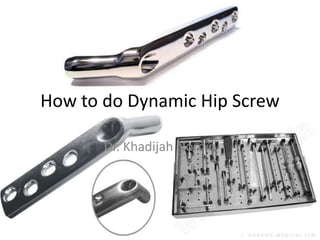
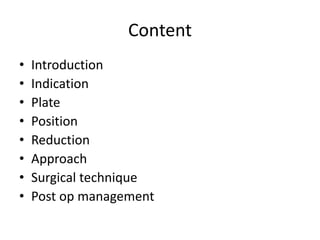
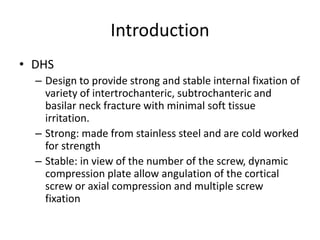
How to do Dynamic Hip Screw
Dr. Khadijah Nordin
Content
• Introduction
• Indication
• Plate
• Position
• Reduction
• Approach
• Surgical technique
• Post op management
Introduction
• DHS
– Design to provide strong and stable internal fixation of
variety of intertrochanteric, subtrochanteric and
basilar neck fracture with minimal soft tissue
irritation.
– Strong: made from stainless steel and are cold worked
for strength
– Stable: in view of the number of the screw, dynamic
compression plate allow angulation of the cortical
screw or axial compression and multiple screw
fixation
Indication
• Indicating for fracture of the proximal femur:
– Intertrochanteric fracture
– Subtrochanteric fracture
– Basilar neck fracture
• Indicated for the stable fracture and unstable
fracture in which a stable medial buttress can
be reconstructed.
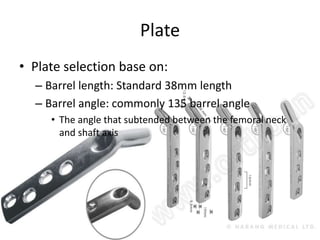
Plate
• Plate selection base on:
– Barrel length: Standard 38mm length
– Barrel angle: commonly 135 barrel angle
• The angle that subtended between the femoral neck
and shaft axis
Positioning
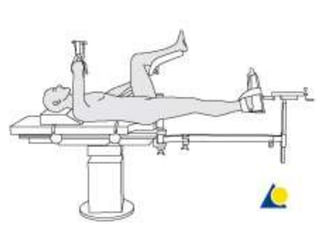
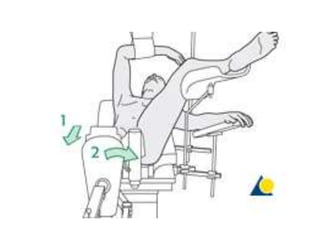
• The patient is positioned supine with traction
table.
• The ipsilateral arm is elevated in a sling while
the contralateral uninjured leg is placed on a
leg holder.
• This position is well suited for excellent true
AP and cross-table lateral x-rays.
Image intensification
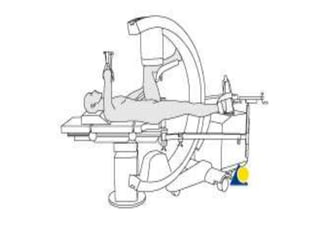
• An image intensifier is required for reduction
on the traction table.
• With the patient and fluoroscope properly
positioned, obtain AP and lateral images.
Closed reduction
• Reduction is usually achieved by first pulling in
the direction of the long axis of the leg in
order to distract the fragments and regain
length.
• Next comes internal rotation.
• The reduction must be checked in both the AP
and lateral with an image intensifier. In case
the closed reduction should fail, open
reduction will be necessary.
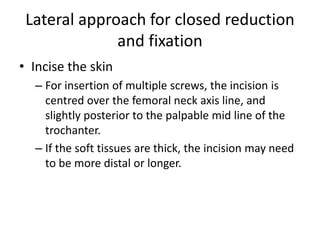
Lateral approach for closed reduction
and fixation
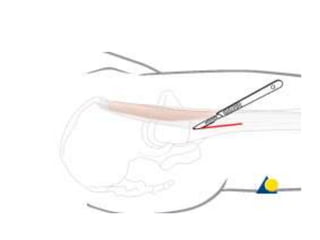
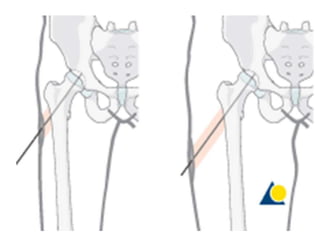
• Incise the skin
– For insertion of multiple screws, the incision is
centred over the femoral neck axis line, and
slightly posterior to the palpable mid line of the
trochanter.
– If the soft tissues are thick, the incision may need
to be more distal or longer.
Surgical technique
• Reduced the fracture
– Determine the anterversion
by placing the 2.5mm
threaded guide wire
anteriorly along the femoral
neck, using the appropriate
DHS guide.
– Gently hammer the wire into
the femoral head
– This anterversion wire will
later allow correct
placement of the central
guide wire in the center of
the femoral head
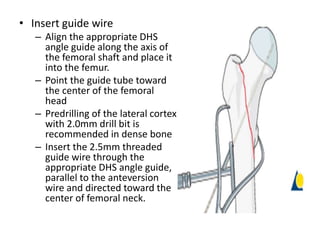
• Insert guide wire
– Align the appropriate DHS
angle guide along the axis of
the femoral shaft and place it
into the femur.
– Point the guide tube toward
the center of the femoral
head
– Predrilling of the lateral cortex
with 2.0mm drill bit is
recommended in dense bone
– Insert the 2.5mm threaded
guide wire through the
appropriate DHS angle guide,
parallel to the anteversion
wire and directed toward the
center of femoral neck.
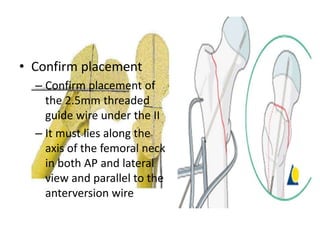
• Confirm placement
– Confirm placement of
the 2.5mm threaded
guide wire under the II
– It must lies along the
axis of the femoral neck
in both AP and lateral
view and parallel to the
anterversion wire
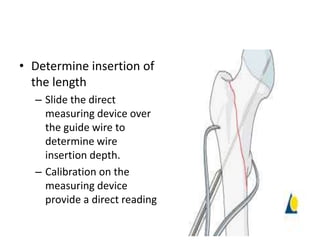
• Determine insertion of
the length
– Slide the direct
measuring device over
the guide wire to
determine wire
insertion depth.
– Calibration on the
measuring device
provide a direct reading
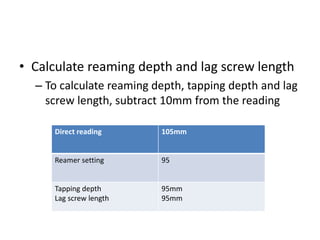
• Calculate reaming depth and lag screw length
– To calculate reaming depth, tapping depth and lag
screw length, subtract 10mm from the reading
Direct reading 105mm
Reamer setting 95
Tapping depth
Lag screw length
95mm
95mm
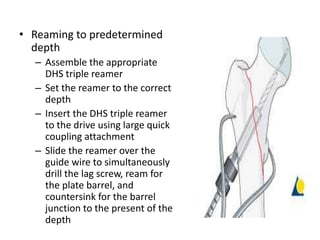
• Reaming to predetermined
depth
– Assemble the appropriate
DHS triple reamer
– Set the reamer to the correct
depth
– Insert the DHS triple reamer
to the drive using large quick
coupling attachment
– Slide the reamer over the
guide wire to simultaneously
drill the lag screw, ream for
the plate barrel, and
countersink for the barrel
junction to the present of the
depth
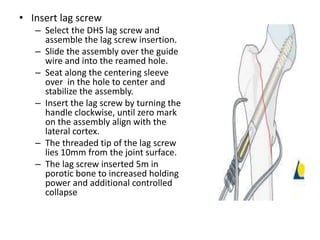
• Insert lag screw
– Select the DHS lag screw and
assemble the lag screw insertion.
– Slide the assembly over the guide
wire and into the reamed hole.
– Seat along the centering sleeve
over in the hole to center and
stabilize the assembly.
– Insert the lag screw by turning the
handle clockwise, until zero mark
on the assembly align with the
lateral cortex.
– The threaded tip of the lag screw
lies 10mm from the joint surface.
– The lag screw inserted 5m in
porotic bone to increased holding
power and additional controlled
collapse
• Align handle
– Before removing the
assembly, align the
handle so it is in the same
plane as the femoral
shaft( parallel to the
femoral shaft axis when
viewed laterally)
– This will allow the proper
placement of the DHS
plate onto the lag screw
• Removed wrench
– Removed DHS wrench and long centering sleeve.
– Slide the appropriate DHS plate onto the guide
shaft lag screw until it contact the lateral cortex
– Loosen and removed the coupling screw and
guide shaft
– Then withdraw the 2.5mm guide wire
• Seat plate
– Gently seat the plate
with the DHS
impactor.
• Fix plate to femur
– Fix the DHS to the
femur with 4.5mm
cortex screws
• Insert the compression screw
– The DHS compression screw may be used in
unstable fracture to prevent disengagement of the
lag screw from the barrel in NWB patient
Postoperative treatment
• Follow up
– The first postoperative visit is at 6 weeks.
– Check the position of the fracture with
appropriate x-rays.
– See the patient at six-week intervals until union of
the fracture and then as desired.
Thank you

dynamic hip screw

  • 1.
    How to doDynamic Hip Screw Dr. Khadijah Nordin
  • 2.
    Content • Introduction • Indication •Plate • Position • Reduction • Approach • Surgical technique • Post op management
  • 3.
    Introduction • DHS – Designto provide strong and stable internal fixation of variety of intertrochanteric, subtrochanteric and basilar neck fracture with minimal soft tissue irritation. – Strong: made from stainless steel and are cold worked for strength – Stable: in view of the number of the screw, dynamic compression plate allow angulation of the cortical screw or axial compression and multiple screw fixation
  • 4.
    Indication • Indicating forfracture of the proximal femur: – Intertrochanteric fracture – Subtrochanteric fracture – Basilar neck fracture • Indicated for the stable fracture and unstable fracture in which a stable medial buttress can be reconstructed.
  • 5.
    Plate • Plate selectionbase on: – Barrel length: Standard 38mm length – Barrel angle: commonly 135 barrel angle • The angle that subtended between the femoral neck and shaft axis
  • 6.
    Positioning • The patientis positioned supine with traction table. • The ipsilateral arm is elevated in a sling while the contralateral uninjured leg is placed on a leg holder. • This position is well suited for excellent true AP and cross-table lateral x-rays.
  • 8.
    Image intensification • Animage intensifier is required for reduction on the traction table. • With the patient and fluoroscope properly positioned, obtain AP and lateral images.
  • 10.
    Closed reduction • Reductionis usually achieved by first pulling in the direction of the long axis of the leg in order to distract the fragments and regain length. • Next comes internal rotation. • The reduction must be checked in both the AP and lateral with an image intensifier. In case the closed reduction should fail, open reduction will be necessary.
  • 12.
    Lateral approach forclosed reduction and fixation • Incise the skin – For insertion of multiple screws, the incision is centred over the femoral neck axis line, and slightly posterior to the palpable mid line of the trochanter. – If the soft tissues are thick, the incision may need to be more distal or longer.
  • 15.
    Surgical technique • Reducedthe fracture – Determine the anterversion by placing the 2.5mm threaded guide wire anteriorly along the femoral neck, using the appropriate DHS guide. – Gently hammer the wire into the femoral head – This anterversion wire will later allow correct placement of the central guide wire in the center of the femoral head
  • 16.
    • Insert guidewire – Align the appropriate DHS angle guide along the axis of the femoral shaft and place it into the femur. – Point the guide tube toward the center of the femoral head – Predrilling of the lateral cortex with 2.0mm drill bit is recommended in dense bone – Insert the 2.5mm threaded guide wire through the appropriate DHS angle guide, parallel to the anteversion wire and directed toward the center of femoral neck.
  • 17.
    • Confirm placement –Confirm placement of the 2.5mm threaded guide wire under the II – It must lies along the axis of the femoral neck in both AP and lateral view and parallel to the anterversion wire
  • 18.
    • Determine insertionof the length – Slide the direct measuring device over the guide wire to determine wire insertion depth. – Calibration on the measuring device provide a direct reading
  • 19.
    • Calculate reamingdepth and lag screw length – To calculate reaming depth, tapping depth and lag screw length, subtract 10mm from the reading Direct reading 105mm Reamer setting 95 Tapping depth Lag screw length 95mm 95mm
  • 20.
    • Reaming topredetermined depth – Assemble the appropriate DHS triple reamer – Set the reamer to the correct depth – Insert the DHS triple reamer to the drive using large quick coupling attachment – Slide the reamer over the guide wire to simultaneously drill the lag screw, ream for the plate barrel, and countersink for the barrel junction to the present of the depth
  • 21.
    • Insert lagscrew – Select the DHS lag screw and assemble the lag screw insertion. – Slide the assembly over the guide wire and into the reamed hole. – Seat along the centering sleeve over in the hole to center and stabilize the assembly. – Insert the lag screw by turning the handle clockwise, until zero mark on the assembly align with the lateral cortex. – The threaded tip of the lag screw lies 10mm from the joint surface. – The lag screw inserted 5m in porotic bone to increased holding power and additional controlled collapse
  • 22.
    • Align handle –Before removing the assembly, align the handle so it is in the same plane as the femoral shaft( parallel to the femoral shaft axis when viewed laterally) – This will allow the proper placement of the DHS plate onto the lag screw
  • 23.
    • Removed wrench –Removed DHS wrench and long centering sleeve. – Slide the appropriate DHS plate onto the guide shaft lag screw until it contact the lateral cortex – Loosen and removed the coupling screw and guide shaft – Then withdraw the 2.5mm guide wire
  • 24.
    • Seat plate –Gently seat the plate with the DHS impactor. • Fix plate to femur – Fix the DHS to the femur with 4.5mm cortex screws
  • 25.
    • Insert thecompression screw – The DHS compression screw may be used in unstable fracture to prevent disengagement of the lag screw from the barrel in NWB patient
  • 26.
    Postoperative treatment • Followup – The first postoperative visit is at 6 weeks. – Check the position of the fracture with appropriate x-rays. – See the patient at six-week intervals until union of the fracture and then as desired.
  • 27.