NEGATIVE PRESSURE
WOUND THERAPY
DR.KHADIJAH NORDIN
OUTLINE
• Introduction
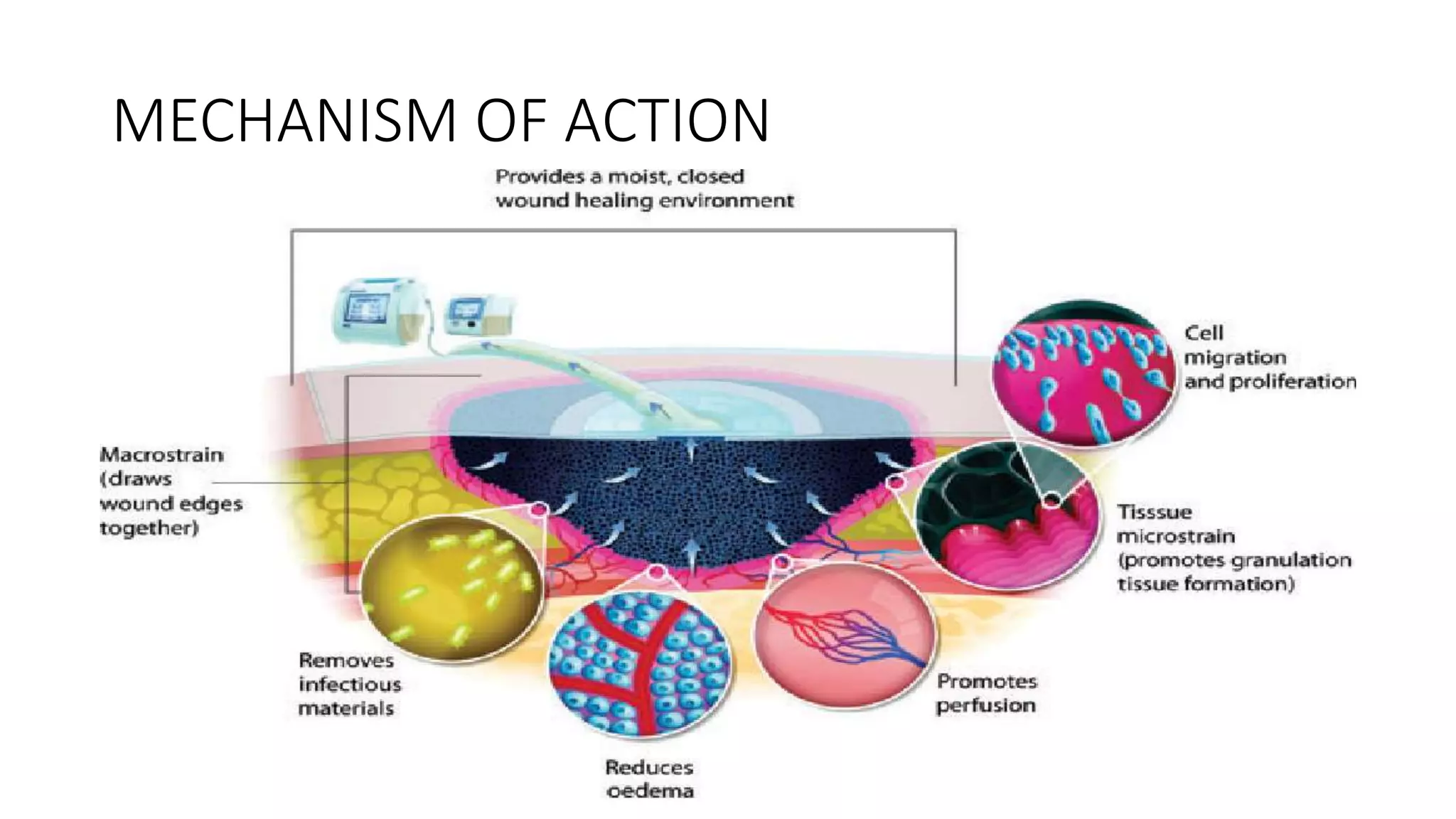
• Mechanism of action VAC
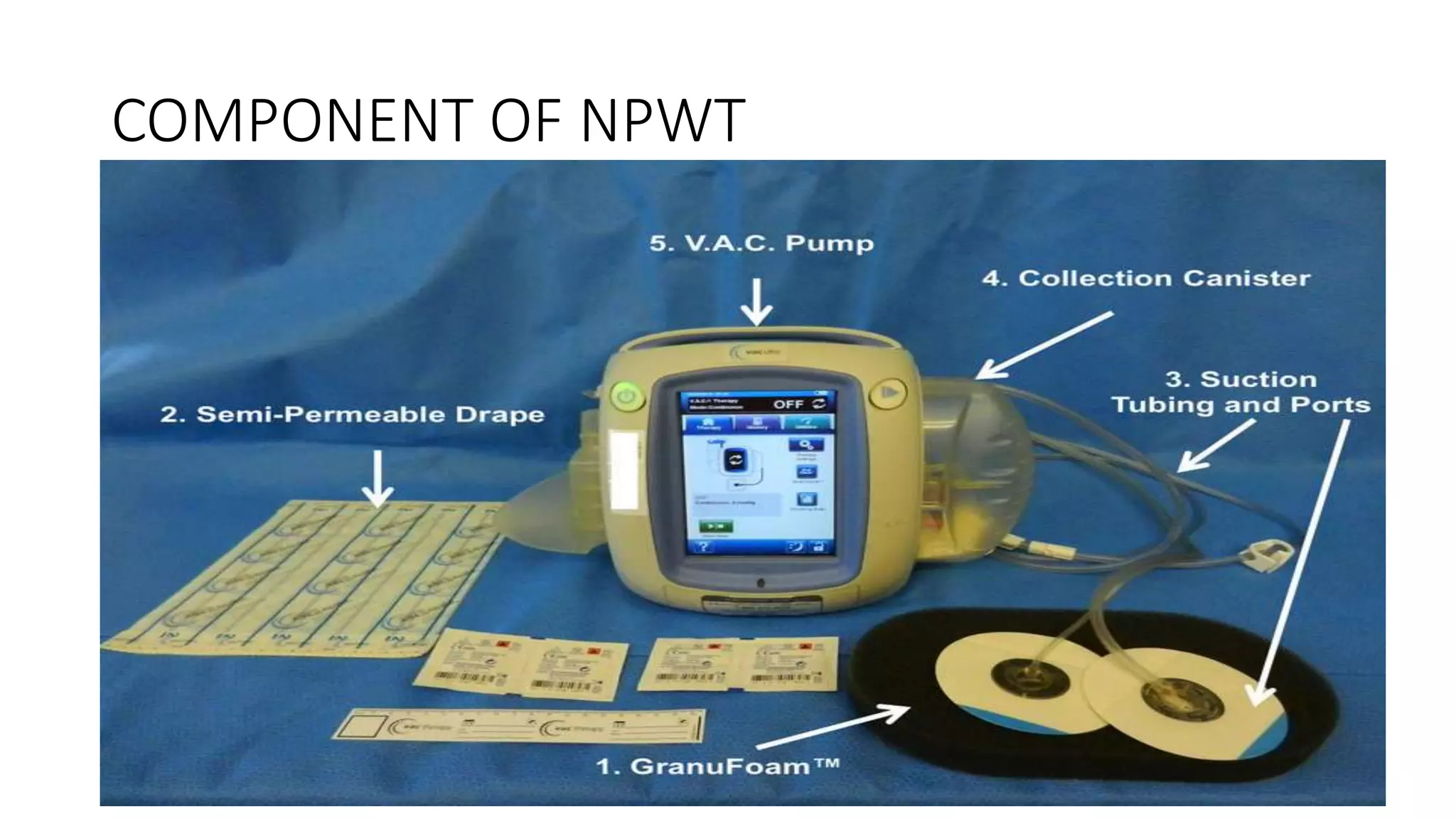
• Component of VAC
• Application
• Advantages
• Indications
• Contraindication
• Monitoring
• Complication
• Conclusion
INTRODUCTION
• Is a therapeutic technique using a vacuum dressing to promote
healing in acute or chronic wounds
• First described by Fleischmann et al in 1993
• promotes wound healing by applying a vacuum drainage through a
special sealed dressing.
• Also called Vacuum Assisted Closure (VAC),
MECHANISM OF ACTION
INDICATION OF NPWT
• indicated for almost any open wound where surgical closure is not feasible
or desirable.
• Full thickness pressure ulcers
• Dehisced surgical wounds
• Diabetic/neuropathic ulcers
• Venous leg ulcers
• Post-surgical wounds
• Traumatic wounds
• Pre & post op flaps & grafts
• Burns wounds
INDICATION: TRAUMA WOUND
INDICATION: DIABETIC FOOT ULCER
INDICATION: LEG ULCER
CRUSH INJURY:
AMPUTATION
CONTRAINDICATION OF NPWT
• Necrotic tissue & eschar
• Unexplored fistulas
• Malignant wounds
• Exposed vasculature
• Exposed anastomosis
• Exposed nerves
• Exposed organs.
COMPONENT OF NPWT
HOW WE APPLY THE VAC
APPLICATION PRESSURE ON VAC
• Neonates : - 50 mmHg.
• Children < 2 years : -50 to -75 mmHg
• Children > 2 years : -75 to -125 mmHg
• Adults : -125mmHg
ADVANTAGE OF NPWT
• Maintenance of moist
• Removal of excess interstitial fluid
• Increased local vascularity
• Decreased bacterial colonization
• Quantification of wound drainage
• Increased rate of granulation tissue formation
• Increased rate of contraction
• Increased rate of epithelization
• Protect wound
• Prevent cross infection
MONITORING
•Pressure (75 – 125mmHg)
•Effluent / Electrolytes
•Infections
•Pain control
TERMINATION OF NPWT
•Adequate granulation base allowing for:
•Changing to conventional dressing
• Split-thickness skin graft
• Flap closure
CONCLUSION
• NPWT has revolutionized wound management.
• It is easy, safe and can be achieved using cheap and conventional
material in resource constraint settings.
THANK YOU
WOUND COURSE – NEVER TOO LATE 2018

Negative pressure wound therapy

  • 1.
  • 2.
    OUTLINE • Introduction • Mechanismof action VAC • Component of VAC • Application • Advantages • Indications • Contraindication • Monitoring • Complication • Conclusion
  • 3.
    INTRODUCTION • Is atherapeutic technique using a vacuum dressing to promote healing in acute or chronic wounds • First described by Fleischmann et al in 1993 • promotes wound healing by applying a vacuum drainage through a special sealed dressing. • Also called Vacuum Assisted Closure (VAC),
  • 4.
  • 5.
    INDICATION OF NPWT •indicated for almost any open wound where surgical closure is not feasible or desirable. • Full thickness pressure ulcers • Dehisced surgical wounds • Diabetic/neuropathic ulcers • Venous leg ulcers • Post-surgical wounds • Traumatic wounds • Pre & post op flaps & grafts • Burns wounds
  • 6.
  • 8.
  • 12.
  • 13.
  • 14.
    CONTRAINDICATION OF NPWT •Necrotic tissue & eschar • Unexplored fistulas • Malignant wounds • Exposed vasculature • Exposed anastomosis • Exposed nerves • Exposed organs.
  • 15.
  • 16.
    HOW WE APPLYTHE VAC
  • 28.
    APPLICATION PRESSURE ONVAC • Neonates : - 50 mmHg. • Children < 2 years : -50 to -75 mmHg • Children > 2 years : -75 to -125 mmHg • Adults : -125mmHg
  • 29.
    ADVANTAGE OF NPWT •Maintenance of moist • Removal of excess interstitial fluid • Increased local vascularity • Decreased bacterial colonization • Quantification of wound drainage • Increased rate of granulation tissue formation • Increased rate of contraction • Increased rate of epithelization • Protect wound • Prevent cross infection
  • 30.
    MONITORING •Pressure (75 –125mmHg) •Effluent / Electrolytes •Infections •Pain control
  • 31.
    TERMINATION OF NPWT •Adequategranulation base allowing for: •Changing to conventional dressing • Split-thickness skin graft • Flap closure
  • 38.
    CONCLUSION • NPWT hasrevolutionized wound management. • It is easy, safe and can be achieved using cheap and conventional material in resource constraint settings.
  • 40.
    THANK YOU WOUND COURSE– NEVER TOO LATE 2018