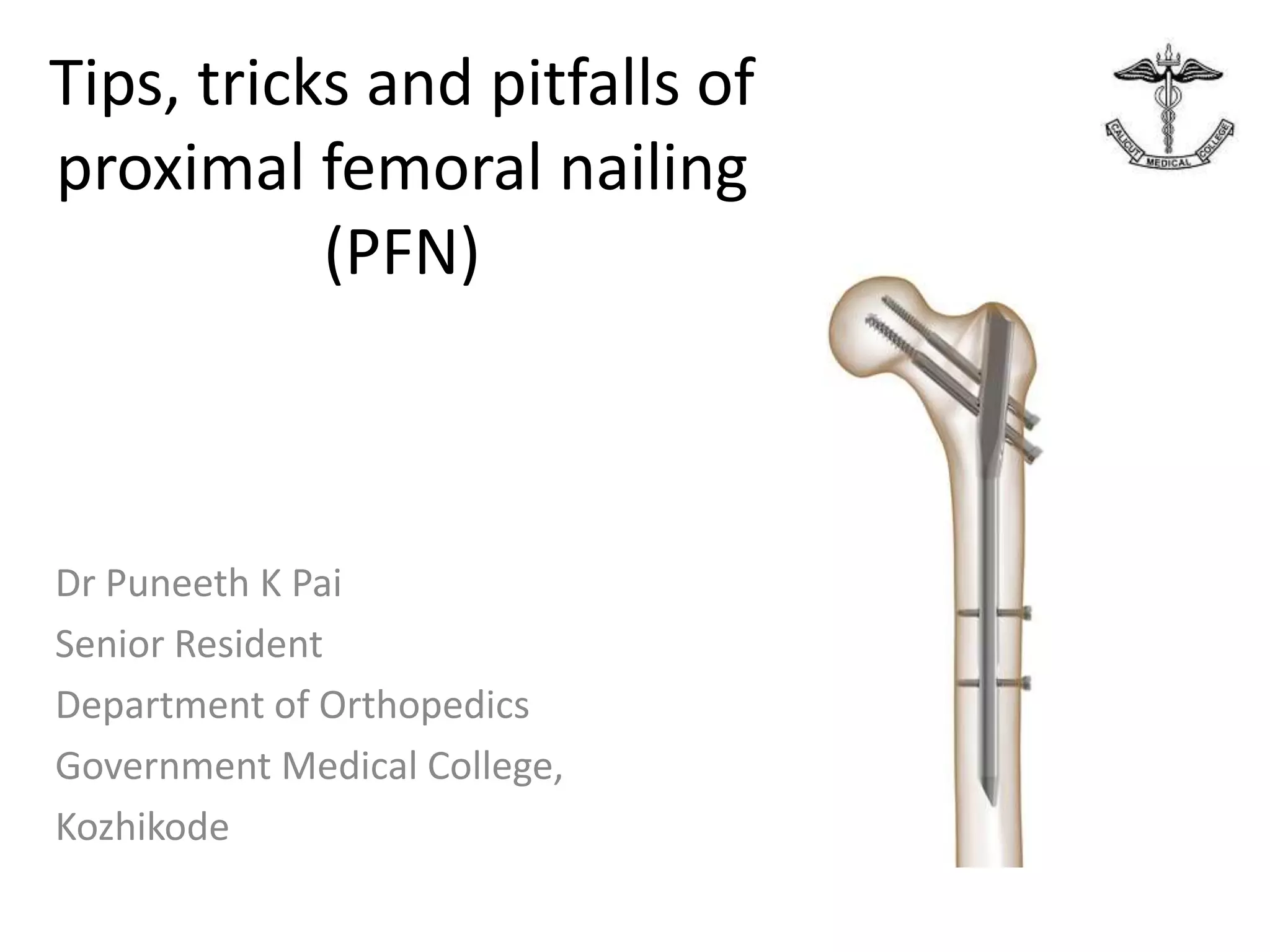
Tips, tricks and pitfalls of
proximal femoral nailing
(PFN)
Dr Puneeth K Pai
Senior Resident
Department of Orthopedics
Government Medical College,
Kozhikode
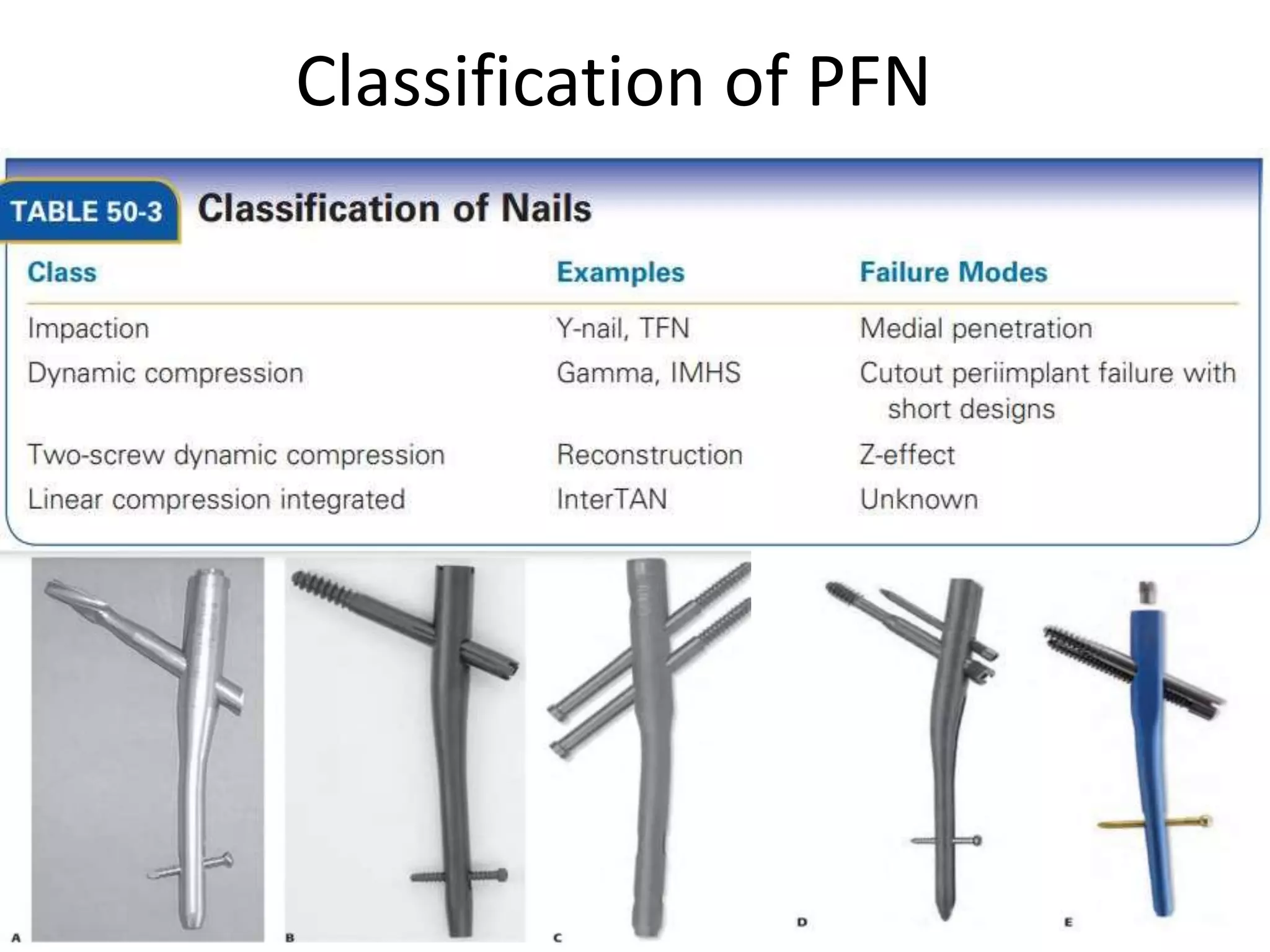
Classification of PFN
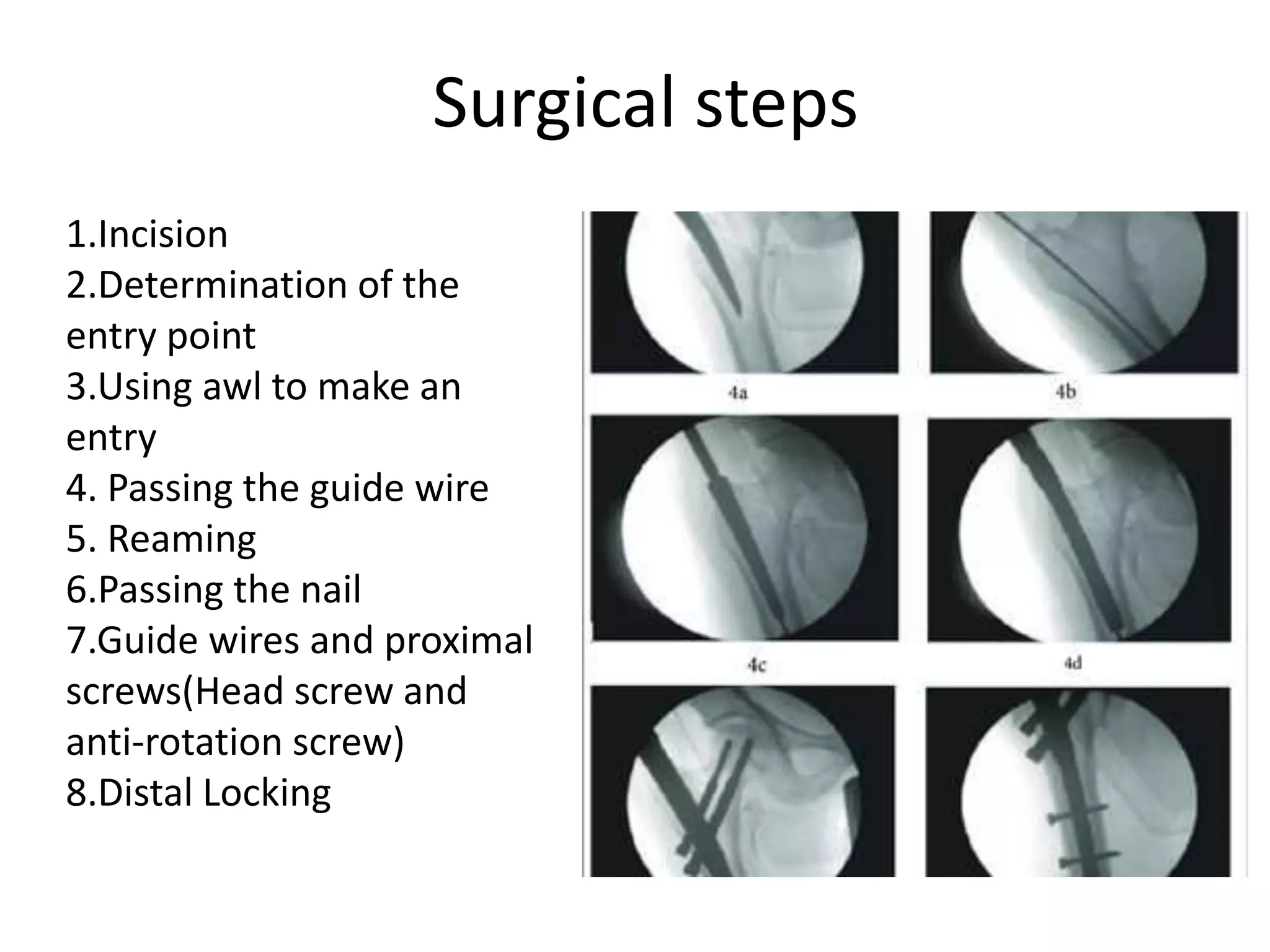
Surgical steps
1.Incision
2.Determination of the
entry point
3.Using awl to make an
entry
4. Passing the guide wire
5. Reaming
6.Passing the nail
7.Guide wires and proximal
screws(Head screw and
anti-rotation screw)
8.Distal Locking
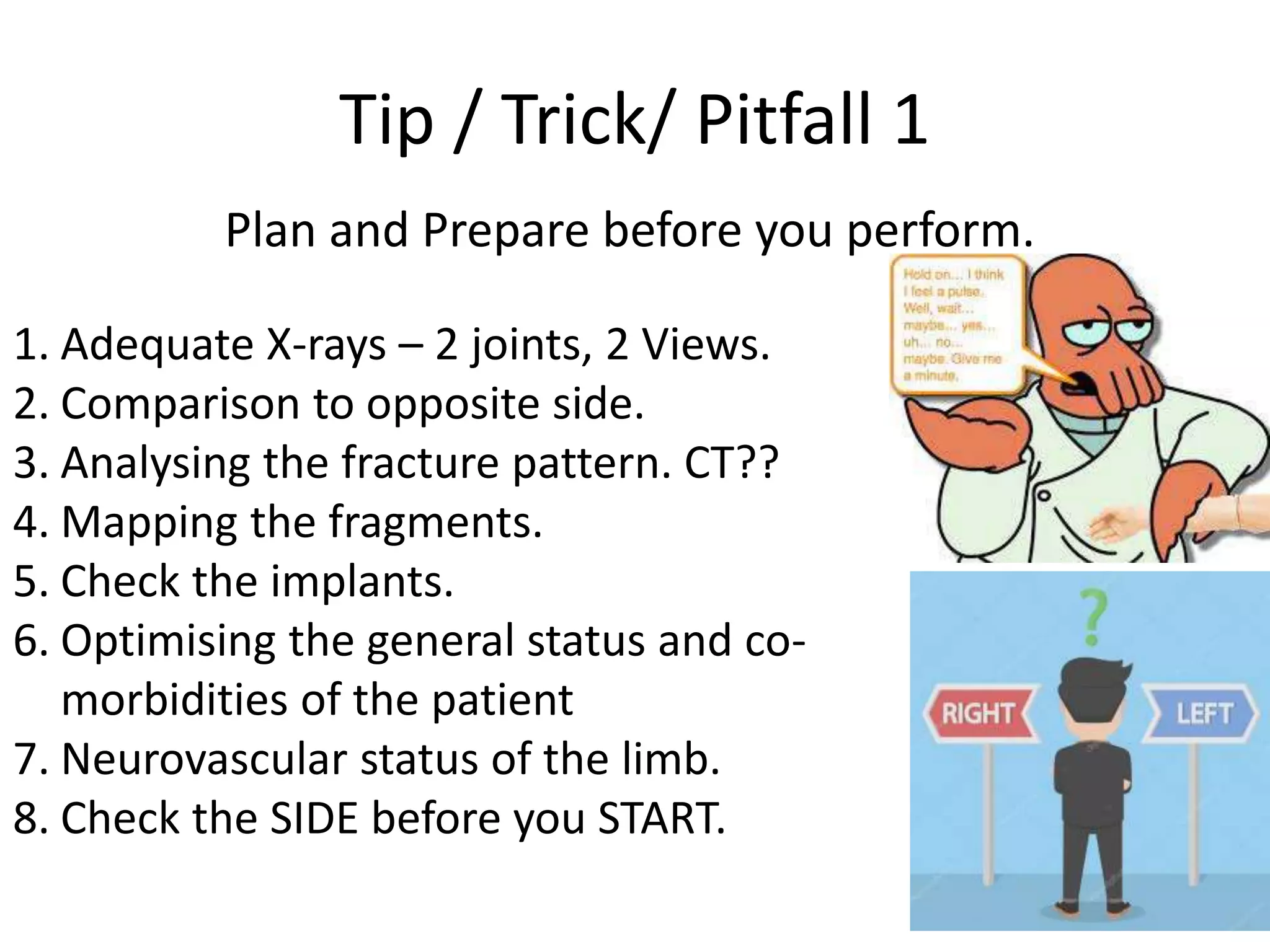
Tip / Trick/ Pitfall 1
Plan and Prepare before you perform.
1. Adequate X-rays – 2 joints, 2 Views.
2. Comparison to opposite side.
3. Analysing the fracture pattern. CT??
4. Mapping the fragments.
5. Check the implants.
6. Optimising the general status and co-
morbidities of the patient
7. Neurovascular status of the limb.
8. Check the SIDE before you START.
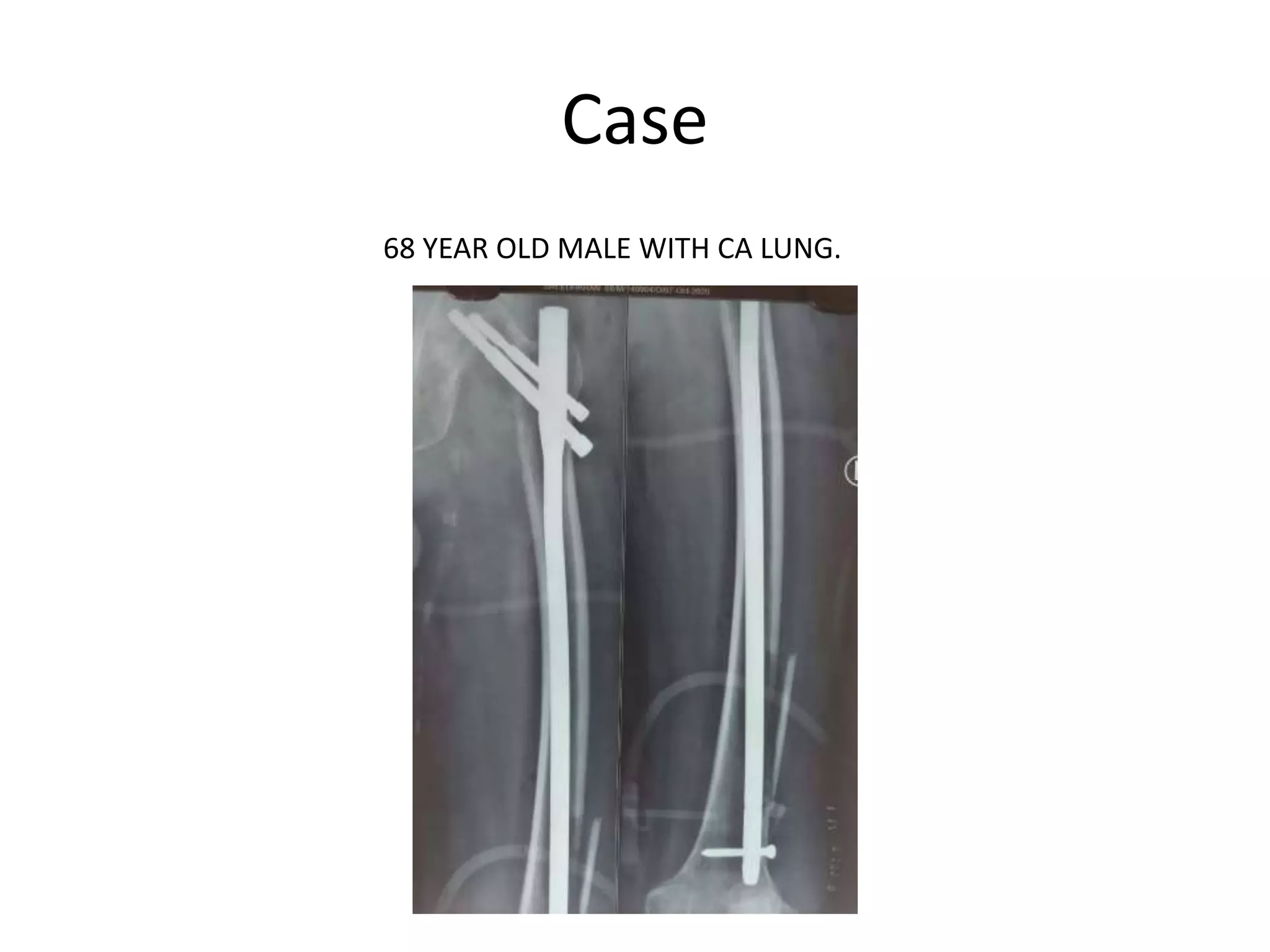
Case
68 YEAR OLD MALE WITH CA LUNG.
Tip/Trick/Pitfall 2
• PFN is a tool for fixation, not reduction.
• Supine vs lateral.
• Traction table – with or without?
• Closed vs Open.
• Assisted closed reduction.
Reduce the fracture before the entry
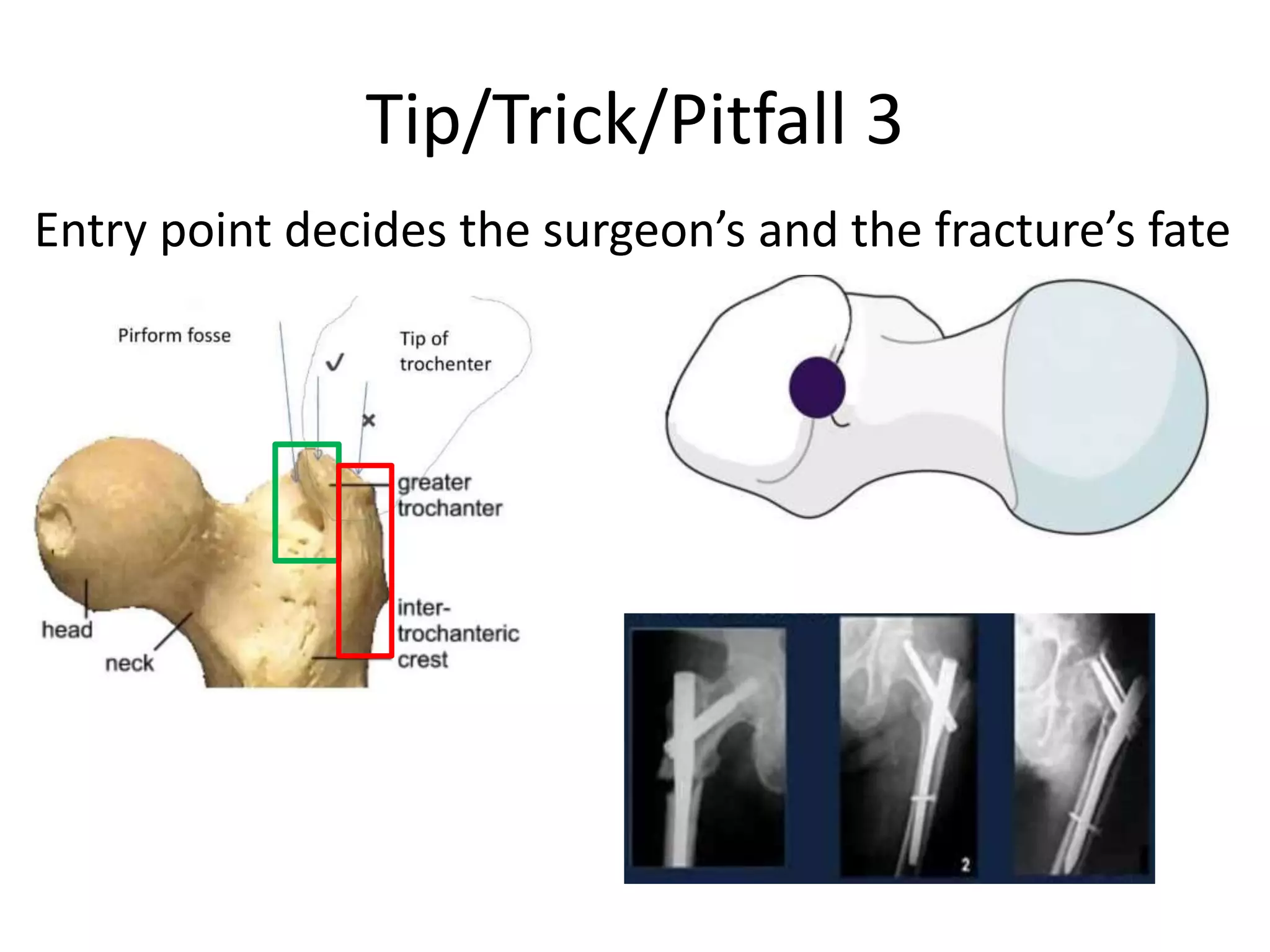
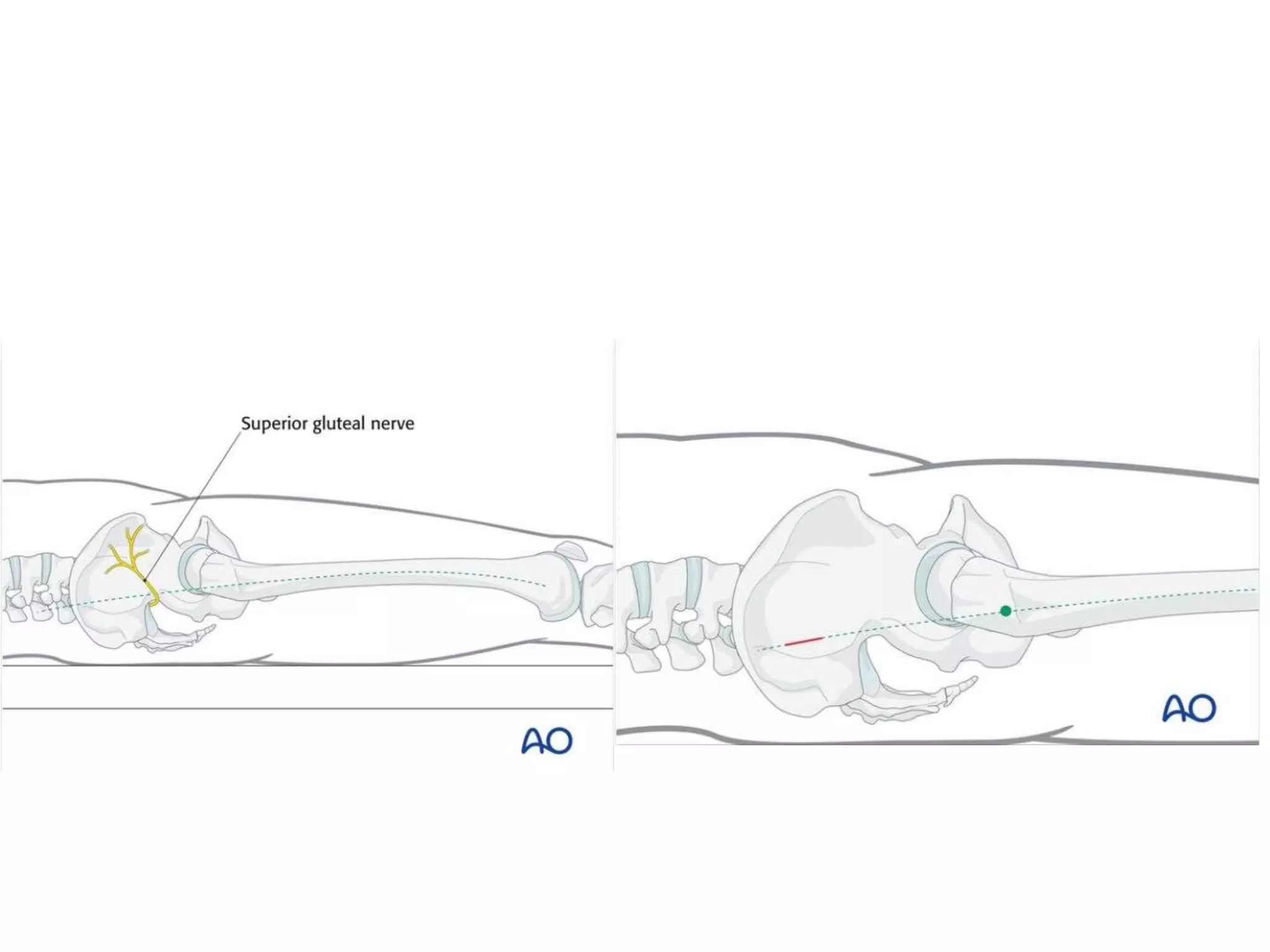
Tip/Trick/Pitfall 3
Entry point decides the surgeon’s and the fracture’s fate
Tip/trick/Pitfall 4
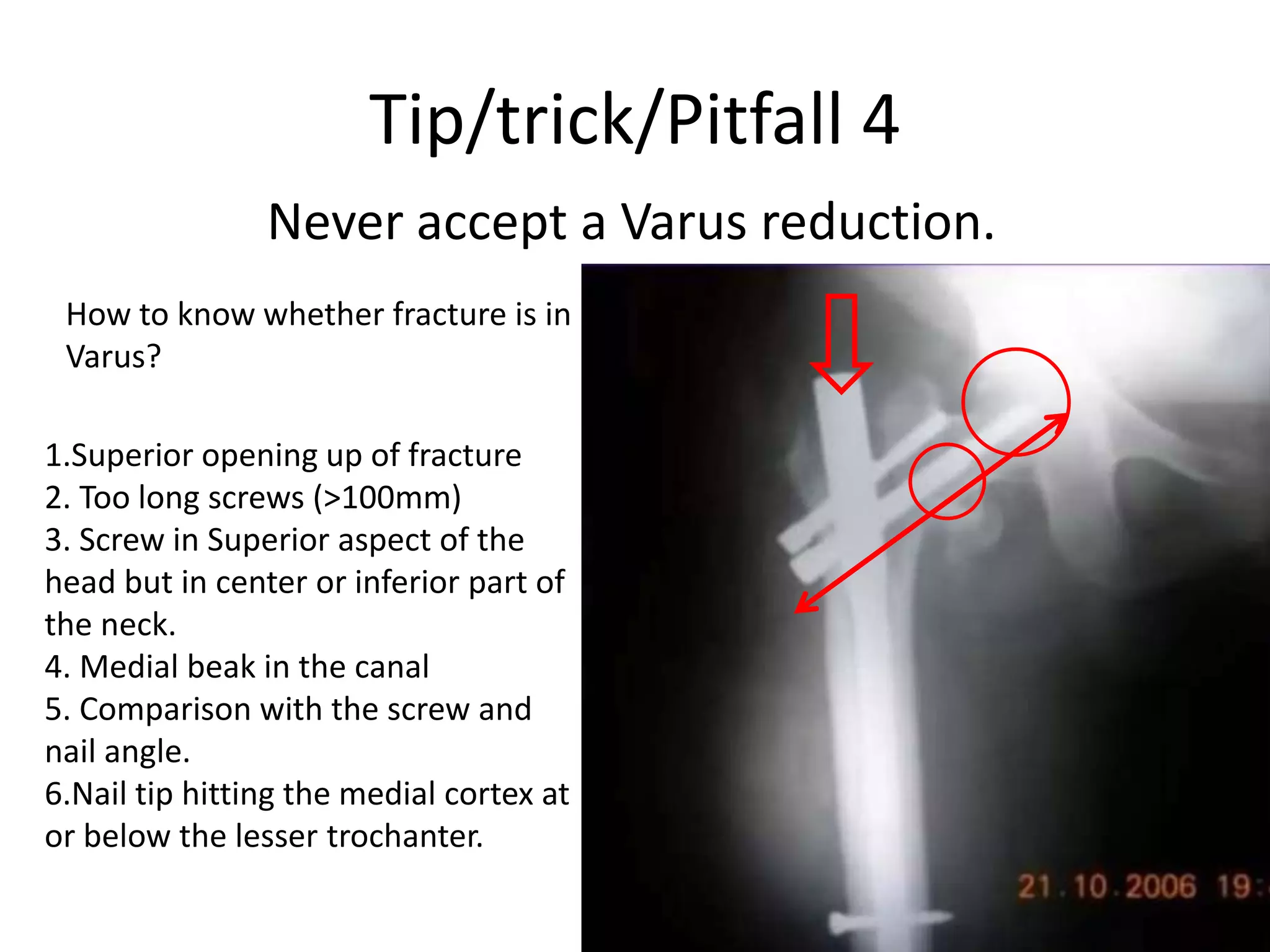
Never accept a Varus reduction.
How to know whether fracture is in
Varus?
1.Superior opening up of fracture
2. Too long screws (>100mm)
3. Screw in Superior aspect of the
head but in center or inferior part of
the neck.
4. Medial beak in the canal
5. Comparison with the screw and
nail angle.
6.Nail tip hitting the medial cortex at
or below the lesser trochanter.
Tip/trick/Pitfall 5
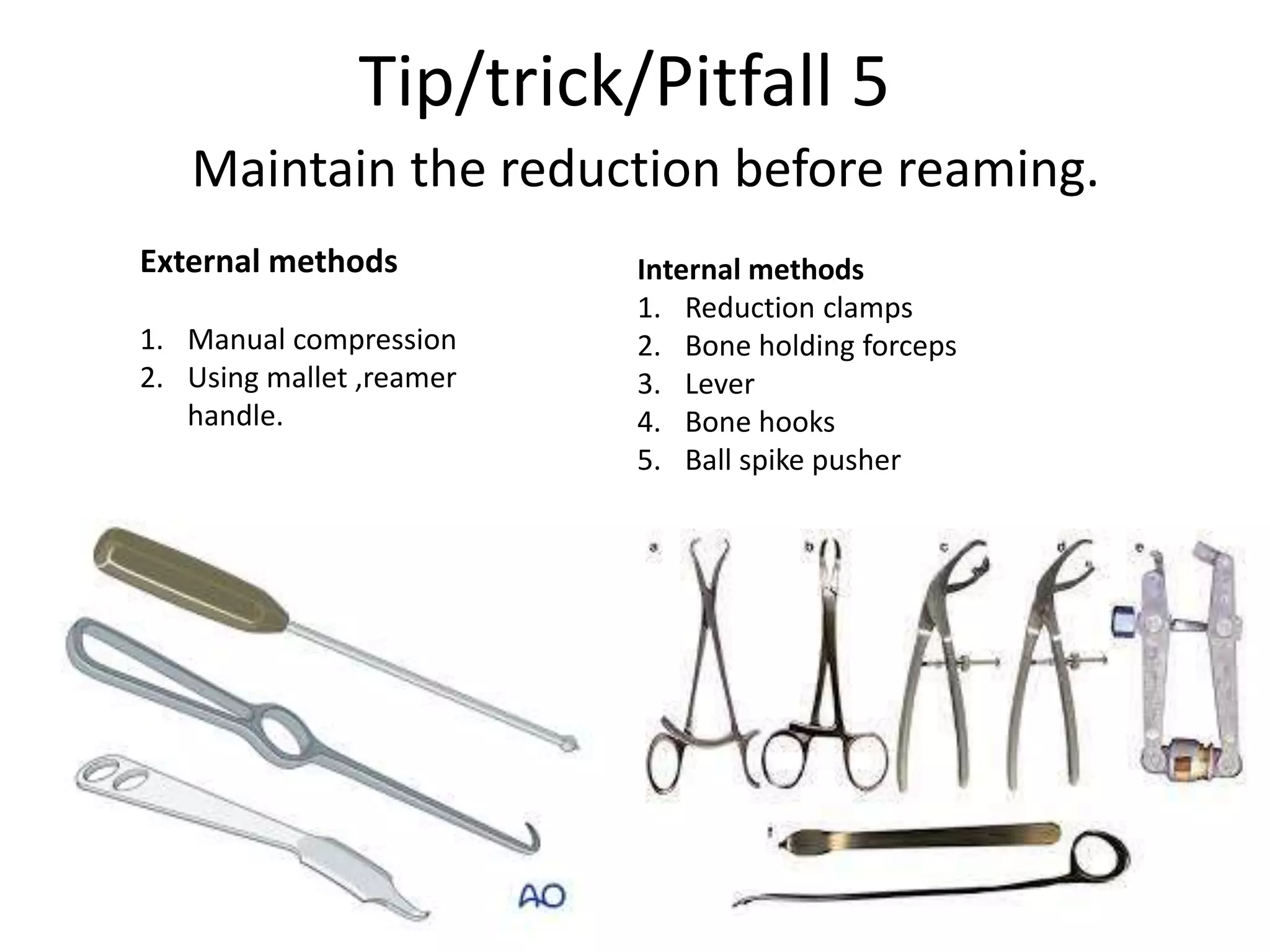
Maintain the reduction before reaming.
External methods
1. Manual compression
2. Using mallet ,reamer
handle.
Internal methods
1. Reduction clamps
2. Bone holding forceps
3. Lever
4. Bone hooks
5. Ball spike pusher
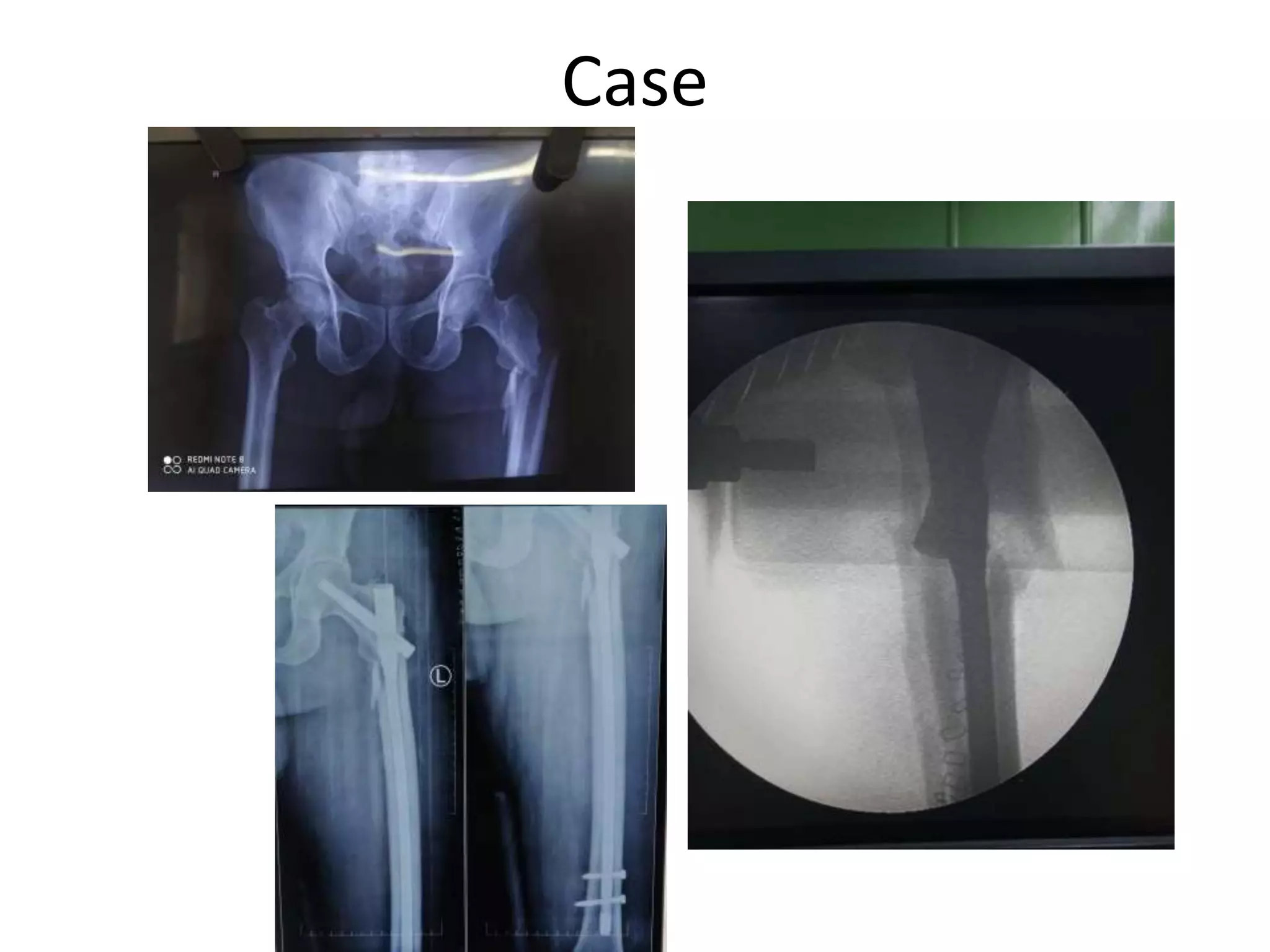
Case
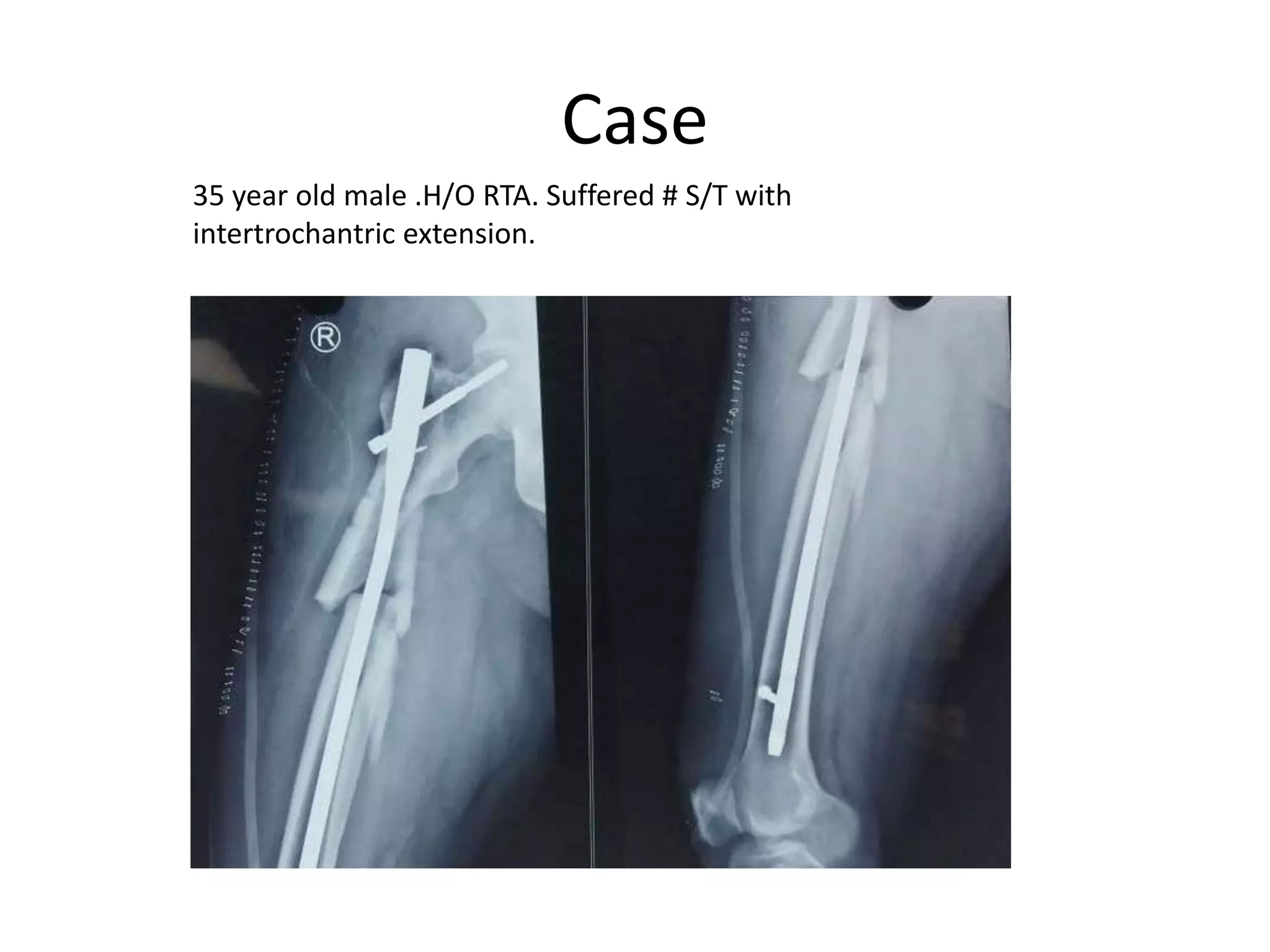
Case
35 year old male .H/O RTA. Suffered # S/T with
intertrochantric extension.
Case
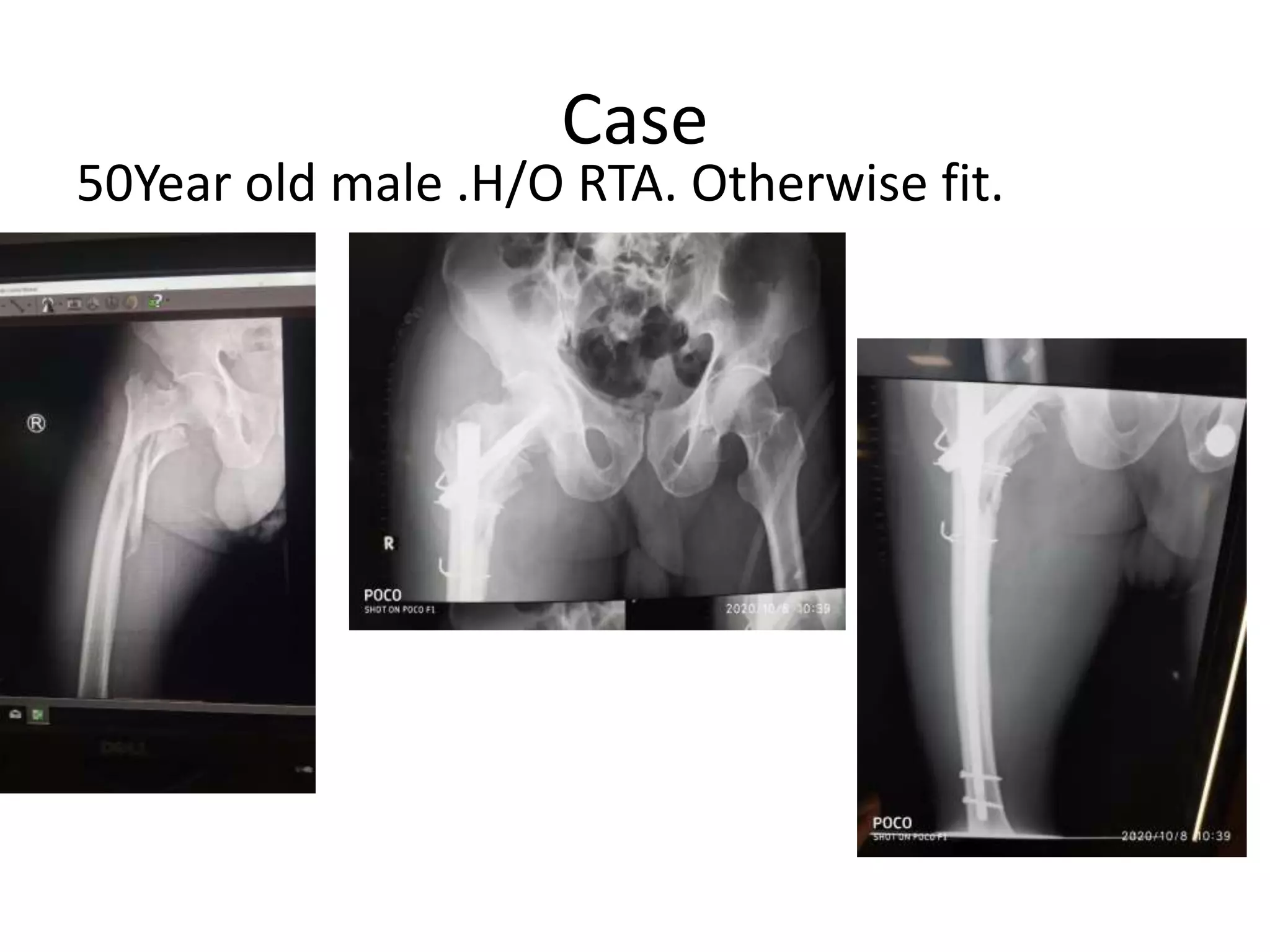
50Year old male .H/O RTA. Otherwise fit.
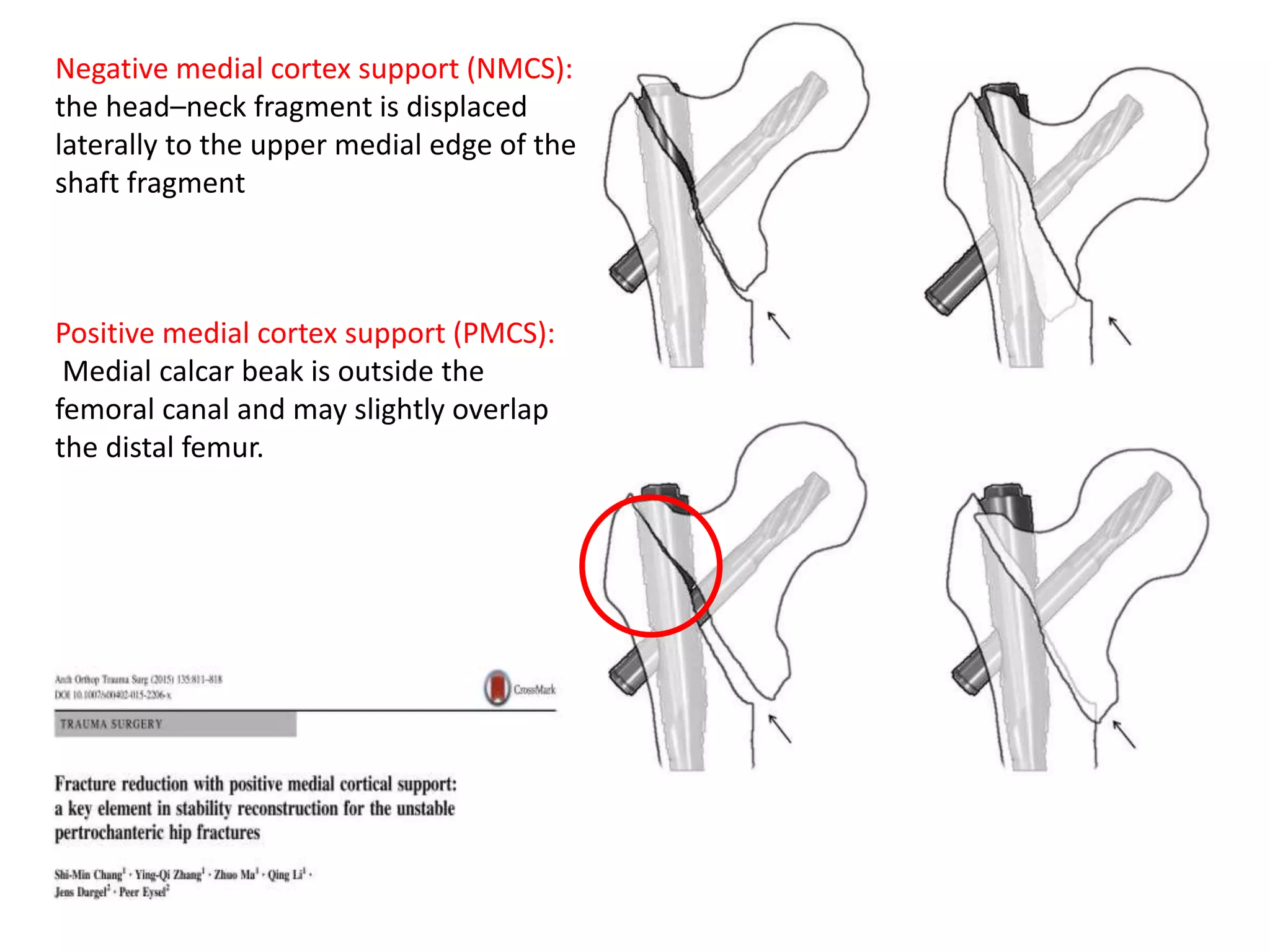
Positive medial cortex support (PMCS):
Medial calcar beak is outside the
femoral canal and may slightly overlap
the distal femur.
Negative medial cortex support (NMCS):
the head–neck fragment is displaced
laterally to the upper medial edge of the
shaft fragment
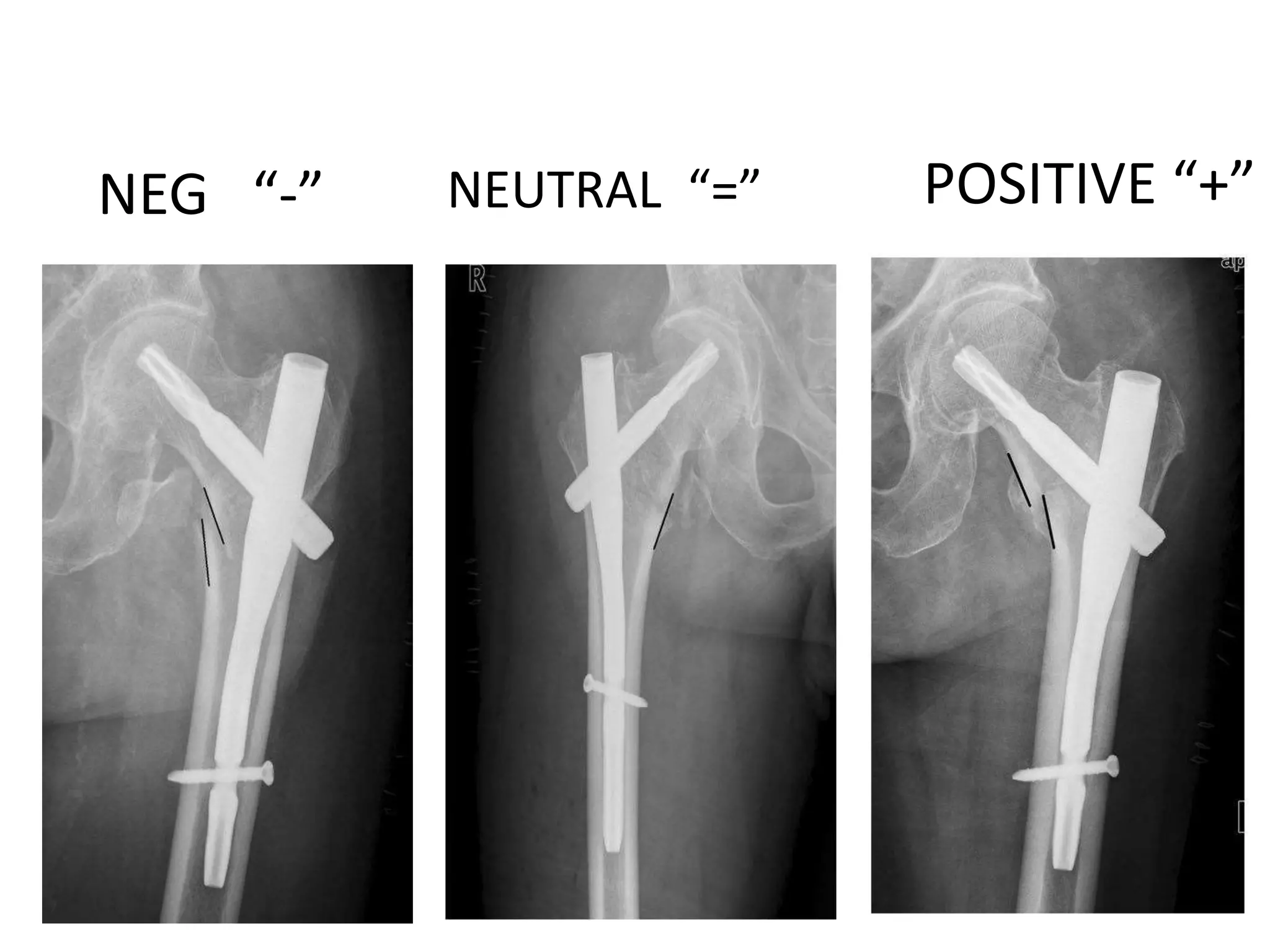
NEG “-” POSITIVE “+”
NEUTRAL “=”
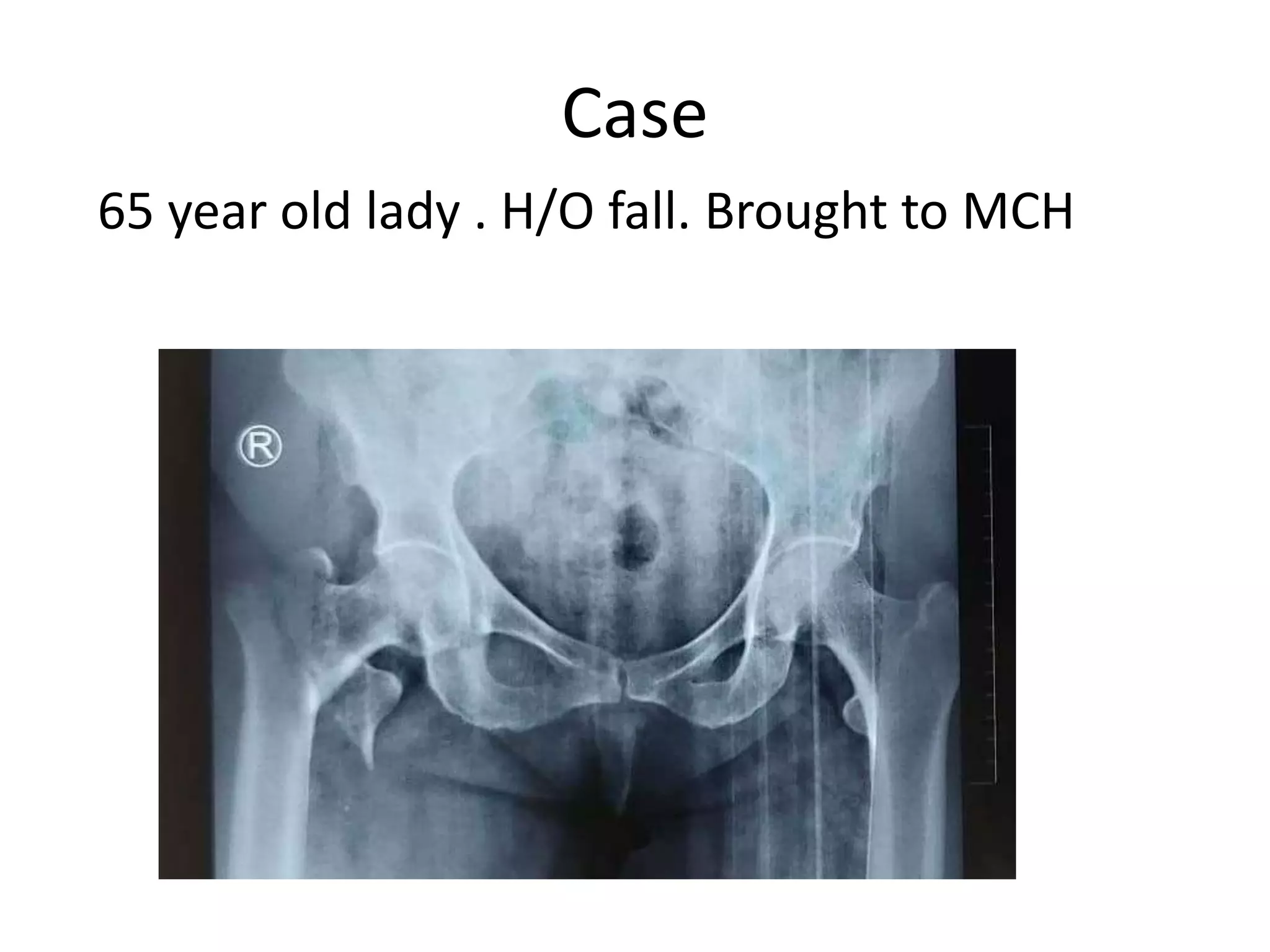
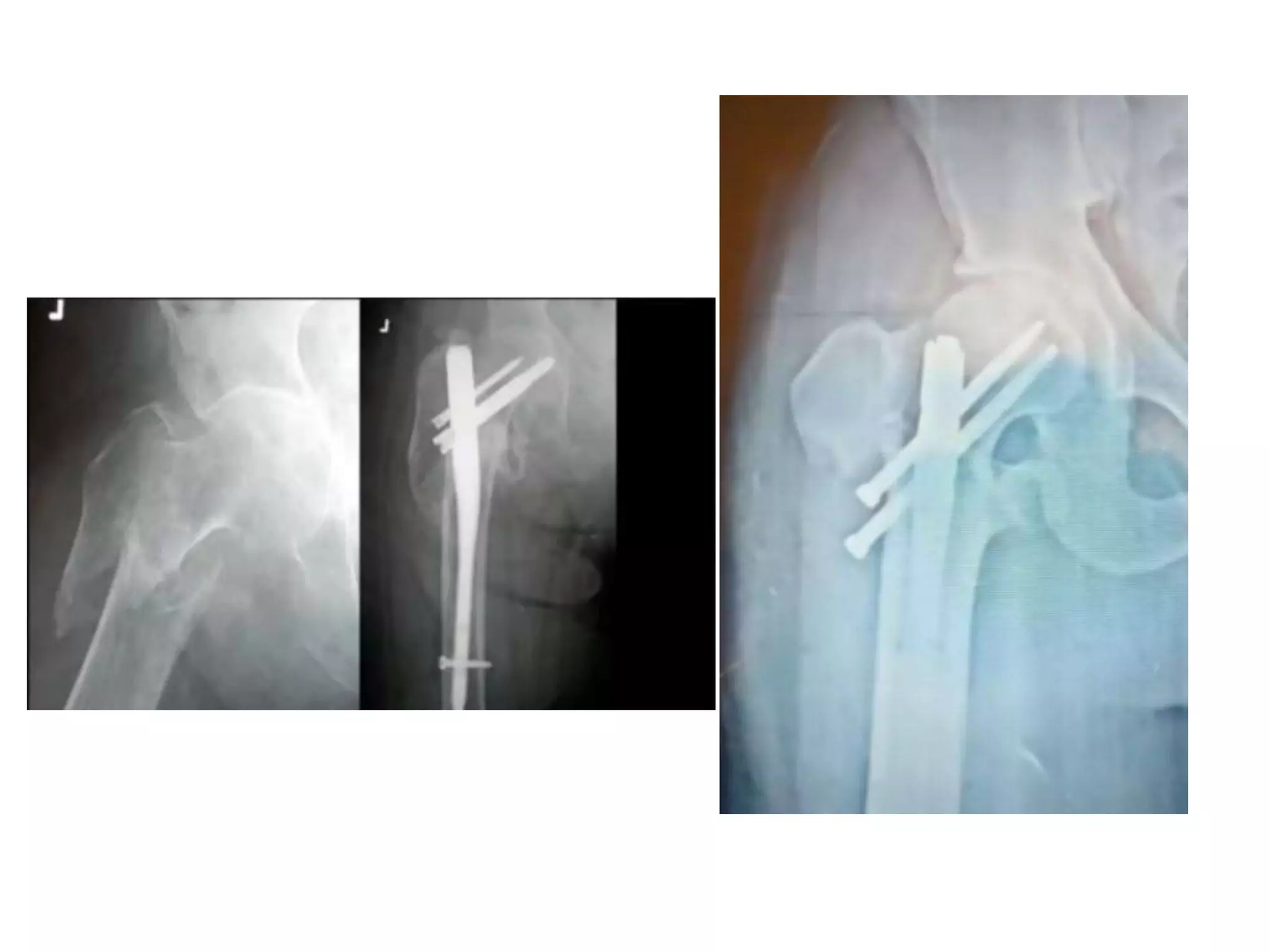
65 year old lady . H/O fall. Brought to MCH
Case
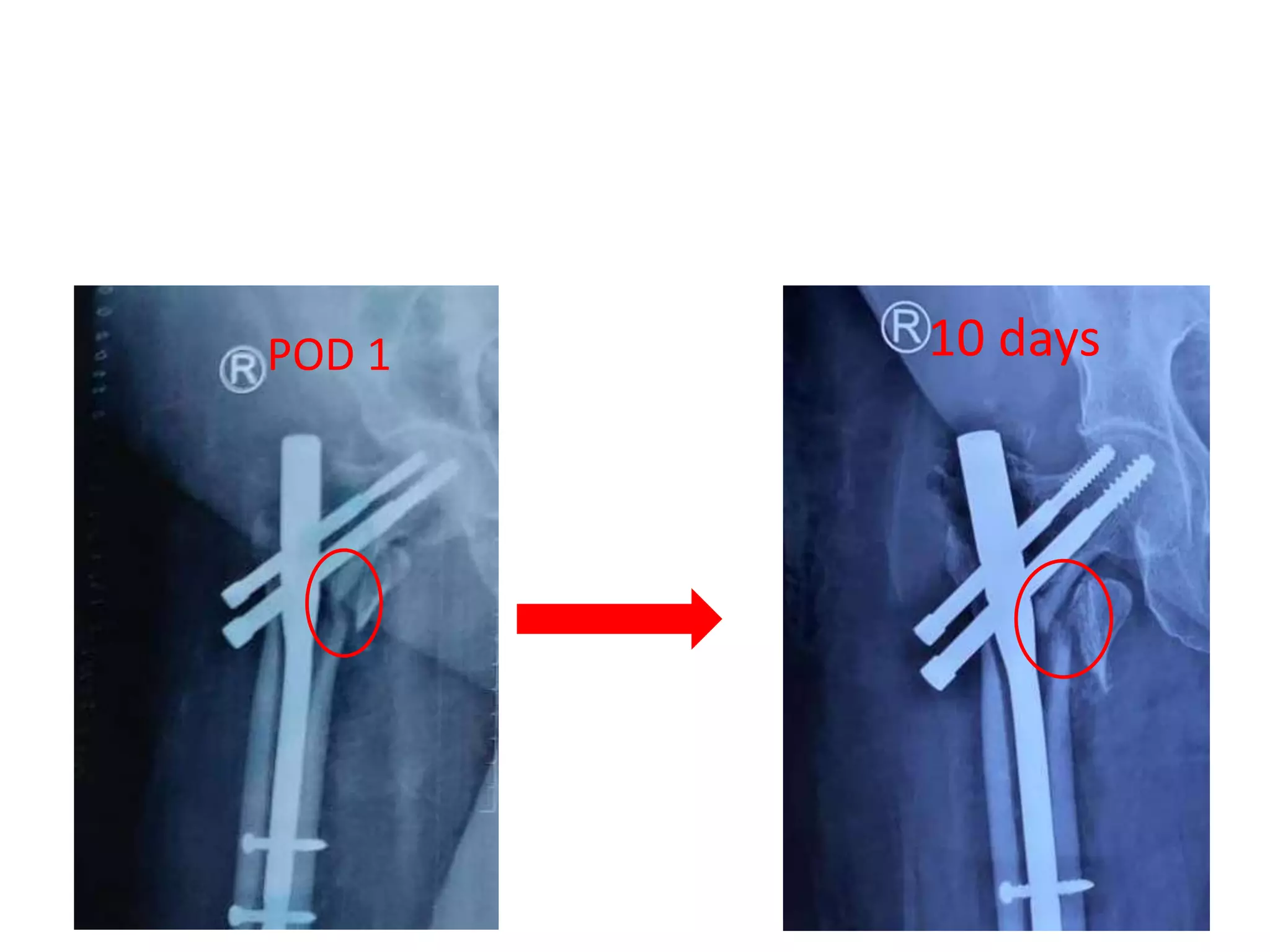
10 days
POD 1
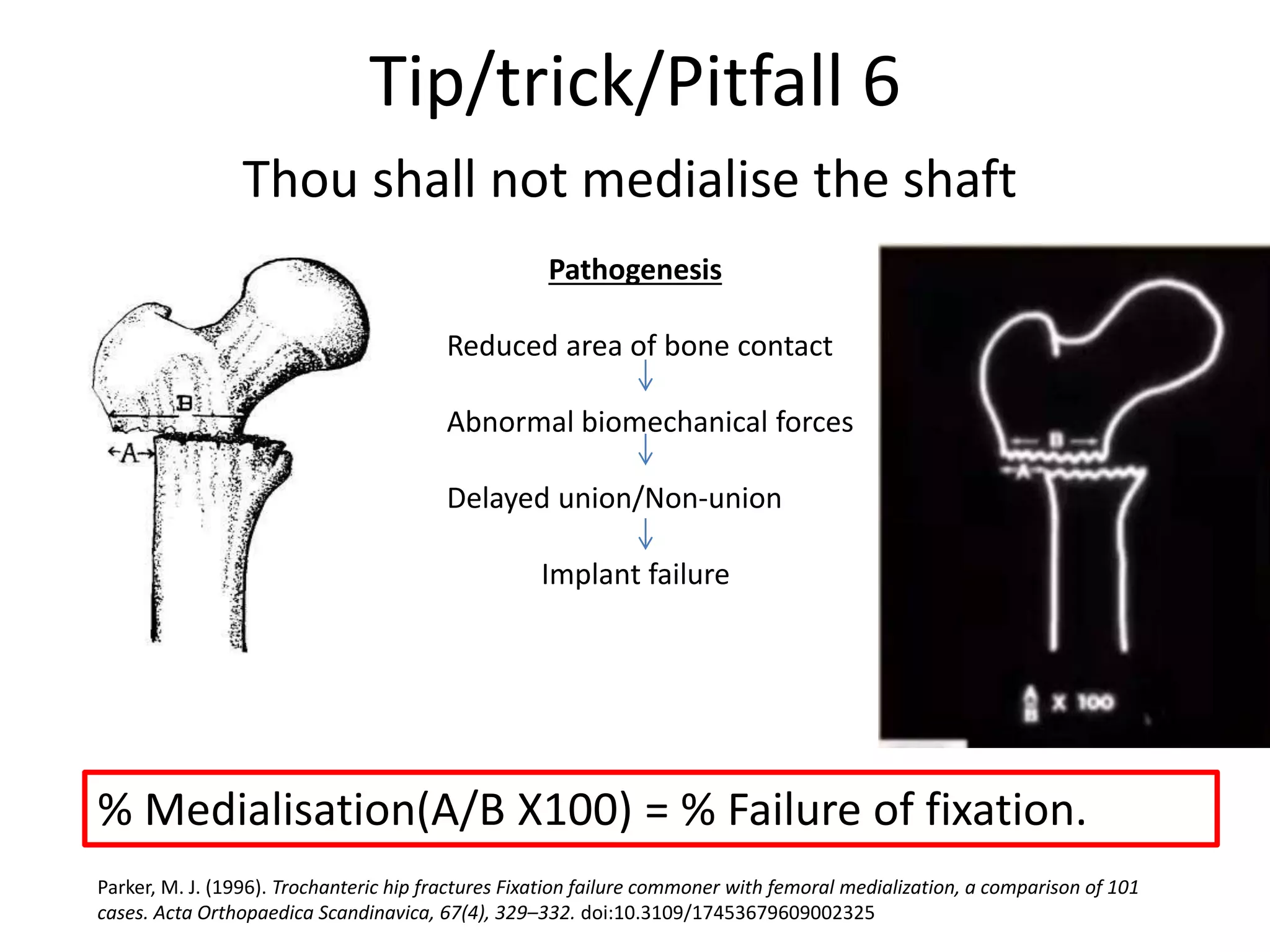
Tip/trick/Pitfall 6
Thou shall not medialise the shaft
Pathogenesis
Reduced area of bone contact
Abnormal biomechanical forces
Delayed union/Non-union
Implant failure
% Medialisation(A/B X100) = % Failure of fixation.
Parker, M. J. (1996). Trochanteric hip fractures Fixation failure commoner with femoral medialization, a comparison of 101
cases. Acta Orthopaedica Scandinavica, 67(4), 329–332. doi:10.3109/17453679609002325
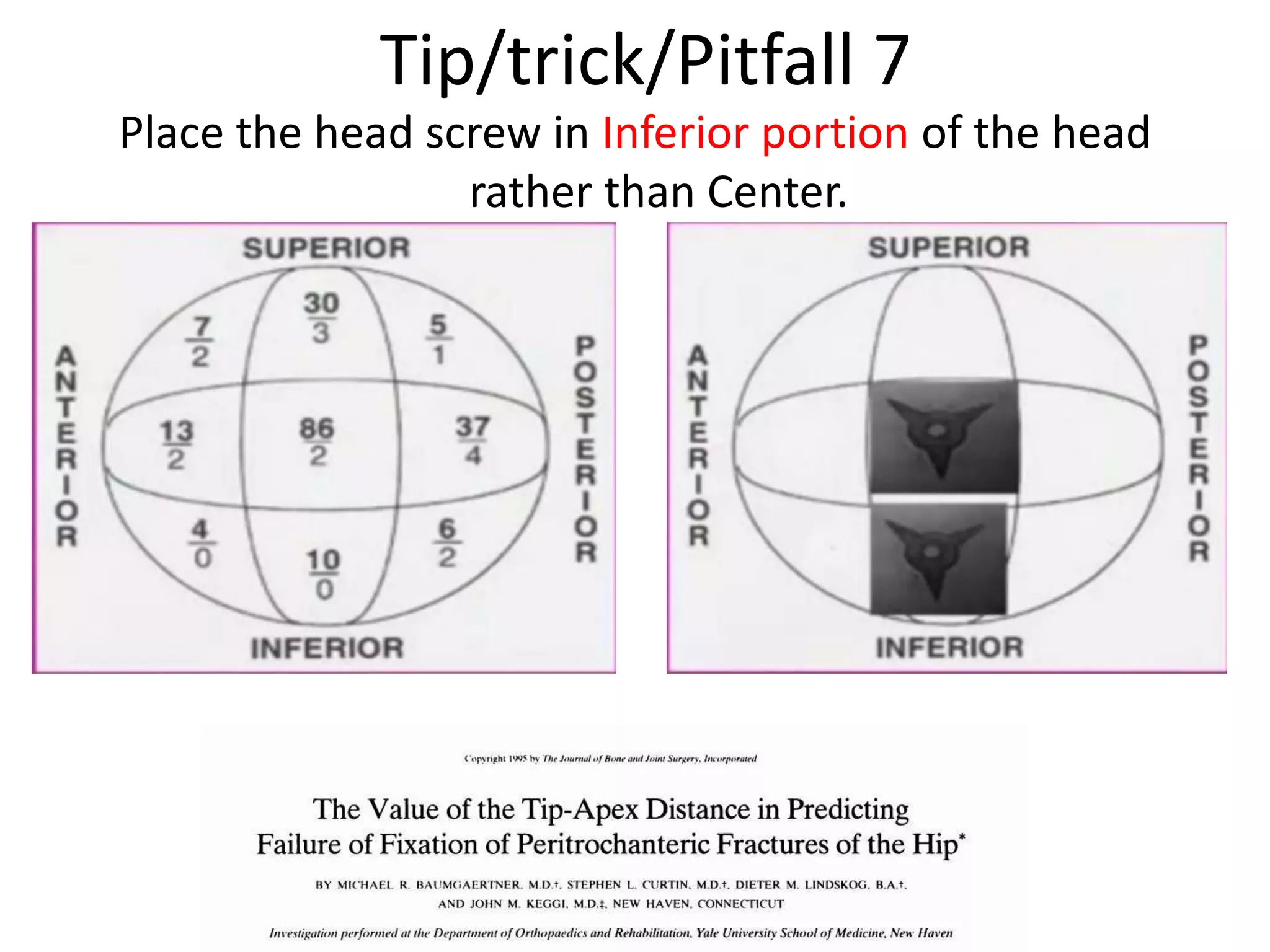
Tip/trick/Pitfall 7
Place the head screw in Inferior portion of the head
rather than Center.
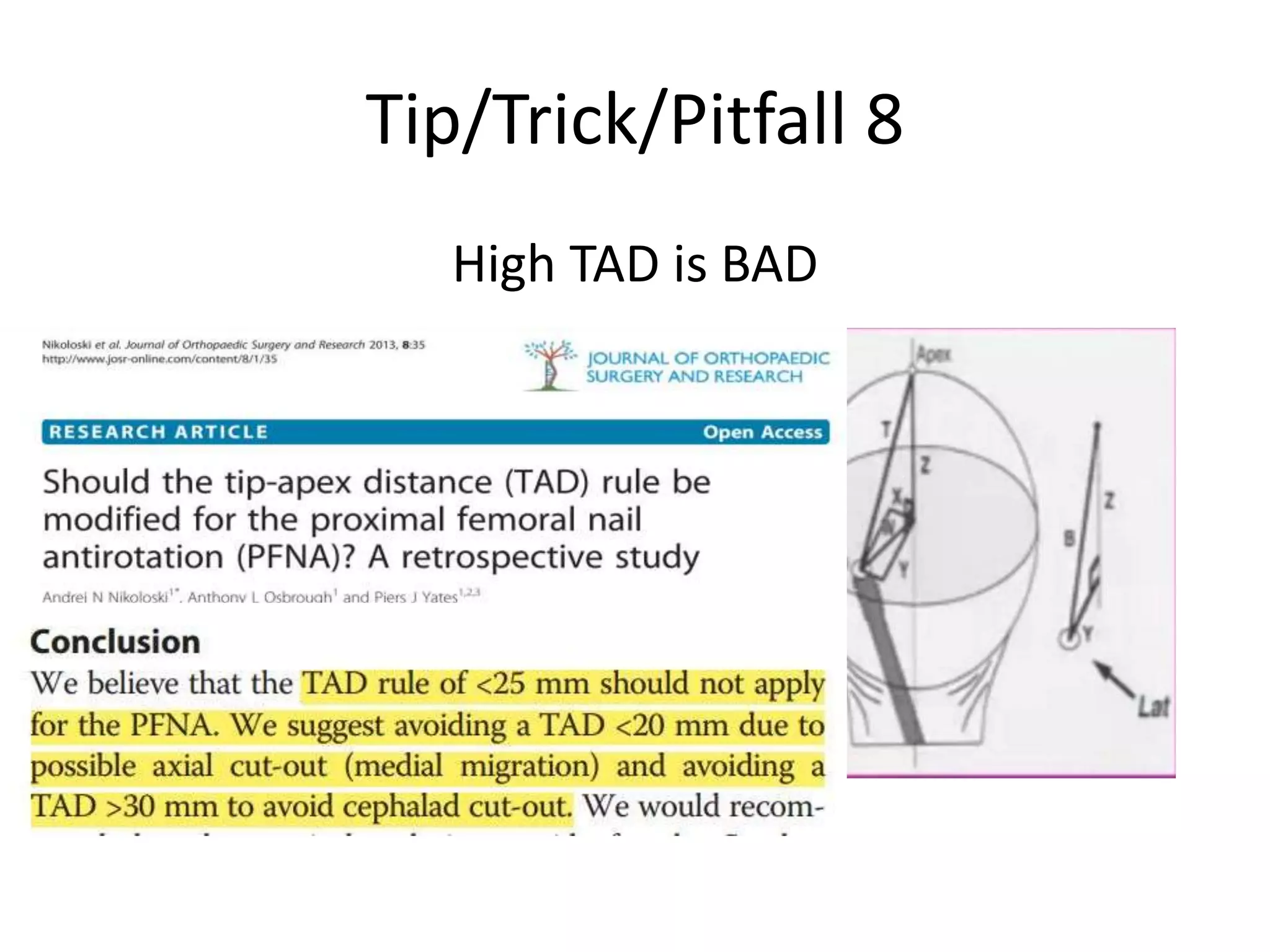
Tip/Trick/Pitfall 8
High TAD is BAD
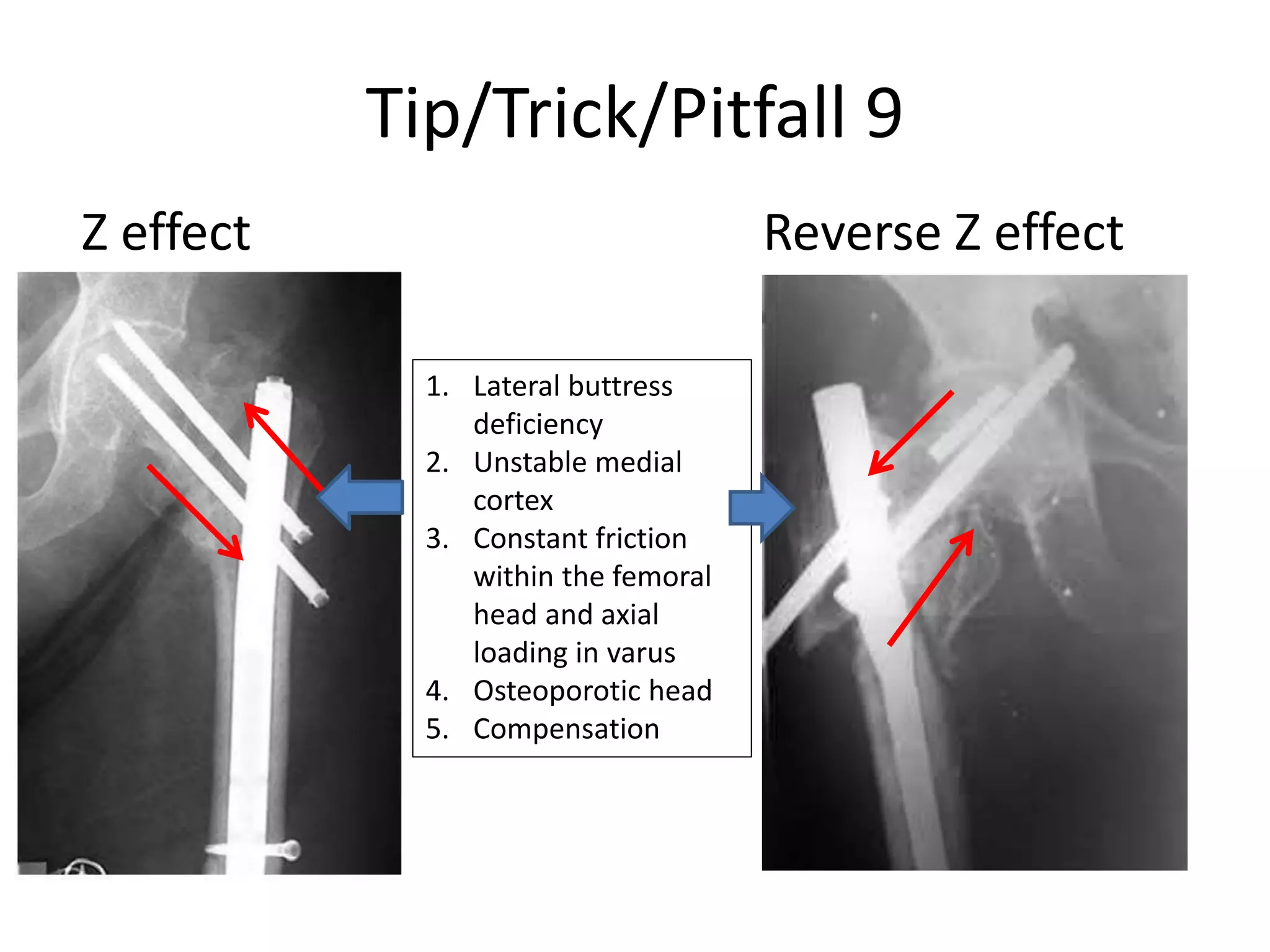
Tip/Trick/Pitfall 9
Z effect Reverse Z effect
1. Lateral buttress
deficiency
2. Unstable medial
cortex
3. Constant friction
within the femoral
head and axial
loading in varus
4. Osteoporotic head
5. Compensation
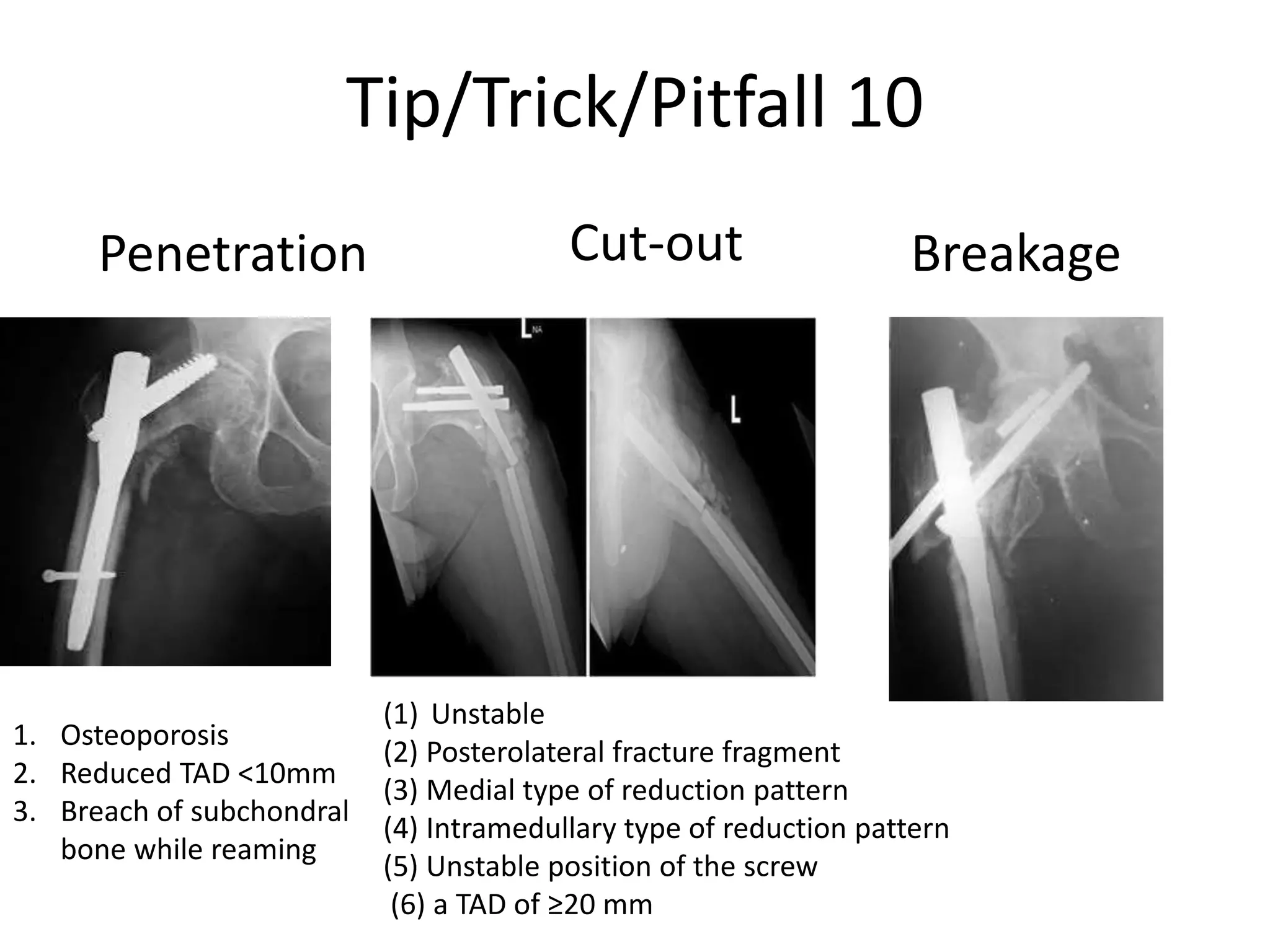
Tip/Trick/Pitfall 10
Penetration
(1) Unstable
(2) Posterolateral fracture fragment
(3) Medial type of reduction pattern
(4) Intramedullary type of reduction pattern
(5) Unstable position of the screw
(6) a TAD of ≥20 mm
Cut-out Breakage
1. Osteoporosis
2. Reduced TAD <10mm
3. Breach of subchondral
bone while reaming
Summary
1. Plan and Prepare before you perform.
2. Reduce the fracture before the entry.
3. Entry point decides the surgeon’s and the fracture’s fate.
4. Never accept a Varus reduction.
5. Maintain the reduction before reaming.
6. Never medialize the shaft.
7. Place the head screw in Inferior portion of the head rather than center
8. High TAD is BAD
9. Z and Reverse Z effect
10.Penetration/ Cut-out / Breakage
Tips, tricks and pitfalls of proximal femoral nailing (PFN)

Tips, tricks and pitfalls of proximal femoral nailing (PFN)

  • 1.
    Tips, tricks andpitfalls of proximal femoral nailing (PFN) Dr Puneeth K Pai Senior Resident Department of Orthopedics Government Medical College, Kozhikode
  • 2.
  • 3.
    Surgical steps 1.Incision 2.Determination ofthe entry point 3.Using awl to make an entry 4. Passing the guide wire 5. Reaming 6.Passing the nail 7.Guide wires and proximal screws(Head screw and anti-rotation screw) 8.Distal Locking
  • 4.
    Tip / Trick/Pitfall 1 Plan and Prepare before you perform. 1. Adequate X-rays – 2 joints, 2 Views. 2. Comparison to opposite side. 3. Analysing the fracture pattern. CT?? 4. Mapping the fragments. 5. Check the implants. 6. Optimising the general status and co- morbidities of the patient 7. Neurovascular status of the limb. 8. Check the SIDE before you START.
  • 5.
    Case 68 YEAR OLDMALE WITH CA LUNG.
  • 6.
    Tip/Trick/Pitfall 2 • PFNis a tool for fixation, not reduction. • Supine vs lateral. • Traction table – with or without? • Closed vs Open. • Assisted closed reduction. Reduce the fracture before the entry
  • 7.
    Tip/Trick/Pitfall 3 Entry pointdecides the surgeon’s and the fracture’s fate
  • 9.
    Tip/trick/Pitfall 4 Never accepta Varus reduction. How to know whether fracture is in Varus? 1.Superior opening up of fracture 2. Too long screws (>100mm) 3. Screw in Superior aspect of the head but in center or inferior part of the neck. 4. Medial beak in the canal 5. Comparison with the screw and nail angle. 6.Nail tip hitting the medial cortex at or below the lesser trochanter.
  • 10.
    Tip/trick/Pitfall 5 Maintain thereduction before reaming. External methods 1. Manual compression 2. Using mallet ,reamer handle. Internal methods 1. Reduction clamps 2. Bone holding forceps 3. Lever 4. Bone hooks 5. Ball spike pusher
  • 11.
  • 12.
    Case 35 year oldmale .H/O RTA. Suffered # S/T with intertrochantric extension.
  • 13.
    Case 50Year old male.H/O RTA. Otherwise fit.
  • 14.
    Positive medial cortexsupport (PMCS): Medial calcar beak is outside the femoral canal and may slightly overlap the distal femur. Negative medial cortex support (NMCS): the head–neck fragment is displaced laterally to the upper medial edge of the shaft fragment
  • 15.
    NEG “-” POSITIVE“+” NEUTRAL “=”
  • 16.
    65 year oldlady . H/O fall. Brought to MCH Case
  • 17.
  • 18.
    Tip/trick/Pitfall 6 Thou shallnot medialise the shaft Pathogenesis Reduced area of bone contact Abnormal biomechanical forces Delayed union/Non-union Implant failure % Medialisation(A/B X100) = % Failure of fixation. Parker, M. J. (1996). Trochanteric hip fractures Fixation failure commoner with femoral medialization, a comparison of 101 cases. Acta Orthopaedica Scandinavica, 67(4), 329–332. doi:10.3109/17453679609002325
  • 20.
    Tip/trick/Pitfall 7 Place thehead screw in Inferior portion of the head rather than Center.
  • 21.
  • 22.
    Tip/Trick/Pitfall 9 Z effectReverse Z effect 1. Lateral buttress deficiency 2. Unstable medial cortex 3. Constant friction within the femoral head and axial loading in varus 4. Osteoporotic head 5. Compensation
  • 23.
    Tip/Trick/Pitfall 10 Penetration (1) Unstable (2)Posterolateral fracture fragment (3) Medial type of reduction pattern (4) Intramedullary type of reduction pattern (5) Unstable position of the screw (6) a TAD of ≥20 mm Cut-out Breakage 1. Osteoporosis 2. Reduced TAD <10mm 3. Breach of subchondral bone while reaming
  • 24.
    Summary 1. Plan andPrepare before you perform. 2. Reduce the fracture before the entry. 3. Entry point decides the surgeon’s and the fracture’s fate. 4. Never accept a Varus reduction. 5. Maintain the reduction before reaming. 6. Never medialize the shaft. 7. Place the head screw in Inferior portion of the head rather than center 8. High TAD is BAD 9. Z and Reverse Z effect 10.Penetration/ Cut-out / Breakage

Editor's Notes

  • #3 TFN Stryker Gamma nail 2003 Most commonly nail world wide 17mm to 15.5mm 12mm to 10.5mm Inter tan Smith and nephew 2006 Worm gear mechanism Maintains compression Figure of 8 screw configuration Clothes pin at the distal end Mechanical stability 4 degrees lateral offset