HIP SURGICAL APPROACH
DR.KHADIJAH NORDIN
Hip surgical approach:
• Anterior - SMITH-PETERSEN
• Anterolateral - WATSON-JONES
• Lateral – HARDINGE
• Medial - LUDLOFF
The intermuscular intervals used in the anterior, anterolateral, and
posterior approaches to the hip.
Anterior - SMITH-PETERSEN
• Indications:
• Open reduction of congenital dislocation of the hip when the dislocated femoral head
lies anterior superior to the true acetabulum.
• Synovial biopsies
• Intra-articular fusions
• Total hip replacement
• Hemiarthroplasty
• Excision of tumours, especially of the pelvis
• Pelvis osteotomies
• Arthrotomy of hip joint
• Anterior column fractures of acetabulum
• Insertion of pin or nail in fracture femoral neck
Position of the patient
• The patient is placed supine with a small sandbag under the affected
buttock.
Incision
• Curvilinear Incision starting from the ant. half of iliac crest to ASIS and
from there curve it down for 8-10cm
Internervous Plane:
• The superficial plane
Sartorius (femoral nerve) and the tensor fasciae latae (superior gluteal
nerve)
• The lateral femoral cutaneous nerve (lateral cutaneous nerve of the
thigh) pierces the deep fascia close to the intermuscular interval
between the tensor fasciae latae and the sartorius.
Identify the gap between the tensor fasciae
latae and the sartorius by palpation.
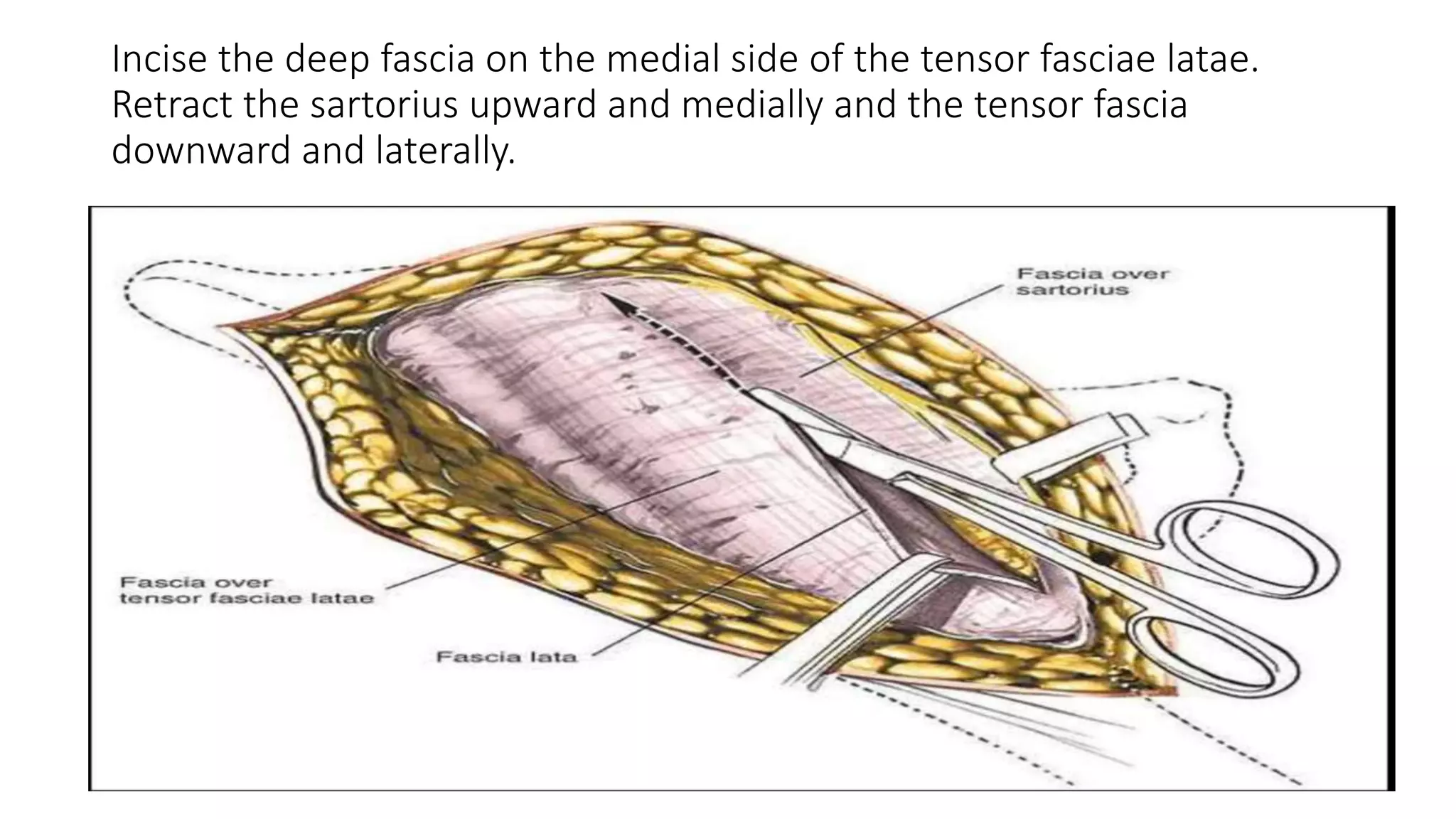
Incise the deep fascia on the medial side of the tensor fasciae latae.
Retract the sartorius upward and medially and the tensor fascia
downward and laterally.
The deeper internervous plane lies between the rectus
femoris (femoral nerve) and the gluteus medius
(superior gluteal nerve).
The deep layer of musculature, consisting of the rectus femoris and the gluteus
medius, is now visible. The ascending branch of the lateral femoral circumflex artery
must be ligated.
Detach the rectus femoris from both its origins, the anterior inferior iliac spine and
the superior lip of the acetabulum.
The hip joint capsule is now partly exposed.
Retract the iliopsoas tendon medially.
The hip joint capsule is fully exposed. Detach the
muscles of the ilium if further exposure is needed.
Incise the hip joint capsule.
Proximal extension of the wound exposes the ilium. Distal extension of
the incision exposes the anterior aspect of the femur in the interval
between the vastus lateralis and the rectus femoris.
Advantages:
• Excellent access to the anterior hip joint
• Good muscle function- if the surgeon stays within limitations and
employs sound postoperative care
• Can be extended distally and laterally through the iliotibial band for
features of lateral exposure
• May be extended proximally and medially and then subperiosteally to
expose the entire acetabulum
• Ready source of bone graft material
• Relaxation of gluteal muscles in cases of high riding dislocations
Disadvantages:
• Necessity for prolonged protection to avoid risk of late detachment of
TFL and gluteal medius because of major muscle dissection.
• High incidence of heterotrophic bone formation and joint stiffness
• Injuries to lateral femoral cutaneous nerve and disturbing dysesthasia
of thigh
• Exposure to femoral medullary canal is limited.
ANTEROLATERAL APPROACH TO THE HIP:
• Most commonly used for total hip replacement
• It combines an excellent exposure of the acetabulum with safety
during reaming of femoral shaft
• Popularized by Watson-Jones and modified by Charnley, Harris and
Muller.
• Uses :
 Total hip replacement
 Hemiarthroplasty
 ORIF of femoral neck fractures
 Synovial biopsy of the hip
 Biopsy of the femoral neck
Position of the patient on the operating table for the anterolateral
approach to the hip. Bring the greater trochanter to the edge of the
table, and allow the buttocks, skin, and fat to fall posteriorly, away
from the operative plane.
Incision for the anterolateral approach to the hip.
• Incision:
• Flex the leg about 30degree and adduct it so that it is lying across the
opposite knee both to bring the trochanter into greater relief and to move
the tensor fasciae latae anterior make 8-15 cm straight longitudinal incision
centered on the tip of the greater trochanter the incision crosses the
posterior third of the trochanter before running down the shaft of the
femur.
• Inter-nervous plane:
• There is no true internervous plane for this approach. Since the gluteus
medius and the tensor fasciae latae have a common nerve supply, the
superior gluteal nerve.
Incise the fascia lata posterior to the tensor fasciae
latae.
Retract the fascia lata and the tensor fasciae latae muscle, which it
envelopes, anteriorly, revealing the gluteus medius and a series of
vessels that cross the interval between the tensor fasciae latae and the
gluteus medius.
Retract the gluteus medius posteriorly and the
tensor fasciae latae anteriorly, uncovering the fatty
layer directly over the joint capsule.
Bluntly dissect the fat pad off the anterior portion of the
joint capsule to expose it and the rectus femoris tendon
Osteotomize the greater trochanter.
Reflect the osteotomized portion of the trochanter superiorly
(with the attached gluteus medius) to reveal the joint capsule.
The joint capsule may also be exposed by partial resection of the
gluteus medius tendon from the anterior portion of the trochanter.
Reflect the head of the rectus femoris from the
anterior portion of the joint capsule.
Incise the anterior joint capsule to reveal the femoral head and neck and the
acetabular rim. If further proximal exposure is needed, incise the fascia lata
proximally toward the iliac crest and along the iliac crest anteriorly. To facilitate
dislocation of the hip, incise the tight fascia lata and the fibers of the gluteus
maximus (inset).
To expose the acetabulum, dislocate and resect the femoral
head. Placing three or four Homan-type retractors around the
lip of the acetabulum provides excellent exposure
Position of the patient and incision:
• Supine on the operating table with the
greater trochanter at the edge of the
table. This allows the buttock muscles
and gluteal fat to fall posteriorly away
from the operative plane.
• Make a longitudinal incision centered
over the tip of the greater trochanter in
the line of the femoral shaft.
• Incision:
• Begin the incision 5cm above the tip of the greater trochanter make a
longitudinal incision that passes over the centre of the tip of the greater
trochanter and extends down the line of the shaft of the femur for
approximately 8cm.
• Internervous plane:
• There is no internervous plane.
• The fibers of the gluteus medius muscle are split in their own line distal to the
point where the superior gluteal nerve supplies the muscle. The vastus
lateralis muscle is also splint in its own line lateral to the point where it is
supplied by the femoral nerve.
Divide the deep fascia in the line of the skin incision,
retracting the fascial edges to pull the tensor fascia
latae anteriorly.
Split the fibers of gluteus medius above the tip of the greater
trochanter and extend this incision distally on the lateral
aspect of the trochanter until 2 cm of the vastus lateralis is
also split.
Develop this anterior flap and divide the tendon of the gluteus minimus
muscle to reveal the anterior aspect of the hip joint capsule.
Enter the capsule using a longitudinal T-
shaped incision.
Osteotomize the femoral neck using an
oscillating saw.
Extract the femoral head. Insert appropriate
retractors to reveal the acetabulum.
• Dangers:
• Superior gluteal nerve runs between gluteus medius and gluteus minimus
muscle approximately 3-5cms above the upper border of the greater
trochanter more proximal dissection may cut this nerve or may produce a
traction injury. For this reason insert a stay suture at the apex of the gluteus
medius split. This will ensure that the split does not inadvertently extend
itself during the operation.
• The femoral nerve the most lateral structure is anterior neurovascular bundle
of the thigh is vulnerable to inappropriate placed retractors.
• Vessels:
• The femoral artery and vein are also vulnerable to inappropriately placed
anterior retractors.
• The transverse branch of the lateral circumflex artery of the thigh is cut as the
vastus lateralis mobilized. It must be cauterized during the approach.
• How to enlarge the approach:
• The approach can easily be extended distally to expose the shaft of the femur,
split the vastus lateralis muscle in the direction of the fibers. The incision
cannot be extended proximally.
• Advantages:
• Improved exposure to acetabulum and femoral neck
• Preserves the integrity of gluteus medius
• Disadvantages:
• Difficulty to do revision surgery by this approach as it does not provide as
wide an exposure as anterolateral
• Slightly increased blood loss comparatively.
Hardinge Modification: (Direct Lateral Approach) (Trans Gluteal)
• Position:
• Patient supine with greater trochanter at the edge of table.
• Incision:
• Make a posteriorly directed lazy “J” incision centered over greater trochanter.
• The only Difference in this Step:
• Instead of osteotomizing greater trochanter, incise the tendon of gluteus
medius obliquely across the greater trochanter leaving the posterior half still
attached to the trochanter. Carry the incision proximally in line with the fibers
of gluteus medius.
• Distally carry the incision anteriorly in line with the fibers of vastus lateralis.
• Advantages:
• Greater trochanter and bulk of gluteus medius preserved allowing rapid
rehabilitation.
POSTERIOR APPROACH:
• The posterior approach is the most common approach used to expose
the hip joint. Popularized by Moore, it is often called the southern
approach.
• Indication:
• Hemiarthroplasty.
• THR including revision surgery.
• ORIF of post acetabular fractures.
• Dependent drainage of hip sepsis.
• Removal of loose body from hip joint
• Pedicle bone grafting.
• Open reduction of posterior hip dislocation
Position of the patient on the operating table
for the posterior approach to the hip joint.
There is no true internervous plane. Split the fibers
of the gluteus maximus, a procedure that does not
cause significant denervation of the muscle.
(A) Skin incision for the posterior approach to the
hip joint. (B) Incise the fascia lata.
• Incision:
• Start 10 cm distal to the PSIS extended distally, laterally parallel to
fibers of gluteus maximus to posterior margin of greater
trochanter then direct the incision 10-13 cm distally parallel to
femoral shaft
Retract the gluteus maximus to reveal the fatty layer over
the short external rotators of the hip.
• Danger Point:
• Avoid incision on greater trochanter (Bony prominence painful and scar)
• Approach:
• Expose and divide deep fascia. Separate the fibers of gluteus maximus (by
blunt dissection). First Muscle Layer.
Push the fat posteromedially to expose the insertions of the short rotators.
Note that the sciatic nerve is not visible; it lies within the substance of the fatty
tissue. Place your retractors within the substance of the gluteus maximus
superficial to the fatty tissue.
(A, B) Internally rotate the femur to bring the insertion of the short rotators of the hip as far lateral to
the sciatic nerve as possible. (C) Detach the short rotator muscles close to their femoral insertion and
reflect them backward, laying them over the sciatic nerve to protect it.
Incise the posterior joint capsule to expose the femoral
head and neck.
To gain additional exposure, cut the quadratus femoris
and the tendinous insertion of the gluteus maximus.
Advantages:
• Relative stability of operated
hip.
• Brief period of immobilization.
• Rapidity with which joints may
be opened and closed though
relatively blood less plane.
• Excellent exposure of posterior
lip and posterior column of
acetabulum.
Disadvantages:
• Dependent incision with a
tendency to oedema.
• Acetabular exposure is inferior.
• Increased post operative
infection.
• Weakening of posterior capsule
of hip, so increased chance of
dislocation.
• Vascular damage.
• Only limited exposure of sciatic
Nerve is possibility of sciatic
nerve injury.
Medial adductor approach of Ludloff:
• 1908 – He originally described a posteromedial approach.
• 1939 – He modified it to present anteromedial approach.
• Uses / Indications:
• Open reduction of congenital dislocation of hip.
• Approach of choice for lesions and lesser trochanter (such as osteoid osteoma)
• Biopsy and treatment of tumours of inferior portions and femoral neck and medial
aspect of proximal shaft.
• Psoas release.
• Obturator neurectomy.
• Disadvantages:
• Incision closer to perineum
• Limited exposure of capsule of hip joint.
• Deep incision – vascular injury.
Position of the patient on the operating table for the
medial approach to the hip.
Osteology of the medial approach to the hip.
Anatomy of the medial approach to the hip. The thigh is abducted,
slightly flexed, and externally rotated. The plane of the superficial
dissection runs between the adductor longus and the gracilis.
• Superficial dissection:
• Incise deep fascia along posterior margin of adductor longus.
• Develop the plane between adductor longus and gracilis.
• Deep dissection:
• Continue the dissection in the interval between adductor brevis and adductor
magnus until you feel the lesser trochanter. Develop the plane between
adductor longus and brevis anteriorly and gracilis, adductor magnus
posteriorly.
• Flex, abduct and externally rotate to bring lesser trochanter close to the skin.
Incision for the medial approach to the hip.
• Intrernervous plane:
• In superficial dissection does not exploit any internervous plane. (because
both adductor longus and gracilis – both are innervated by anterior division of
obturator nerve.
• More deeply:
• The plane of dissection is between adductor brevis (supplied by anterior
division of obturator nerve) and adductor magnus (Adductor portion from
posterior division of obturator nerve and ischial portion by tibial portion of
sciatic nerve.
The intermuscular interval between the adductor longus and the
gracilis is not an internervous plane because both muscles are
innervated by the anterior division of the obturator nerve. The
plane is safe, however, because the muscles receive their nerve
supplies proximal to the dissection.
(A) Develop the plane between the gracilis and the adductor longus.
(B) Retract the adductor longus and the gracilis to reveal the adductor brevis with
the overlying anterior division of the obturator nerve.
(C) Retract the adductor brevis from the muscle belly of the adductor magnus to
uncover the posterior division of the obturator nerve. Note the lesser trochanter in
the depths of the wound.
• Danger Point 1: Anterior branch obturator nerve lies on the front of
adductor brevis and neurovascular bundle of gracilis muscle.
• Danger Point 2: Posterior division lies in the substance of obturator
externus, runs down the thigh on adductor magnus and under
adductor brevis.
• Danger point 3: Medial circumflex artery passes on distal part of
psoas tendon. (it is in danger if you try detach the psoas with out
isolating the tendon and cutting under direct vision especially in
children)

Hip surgical approach

  • 1.
  • 2.
    Hip surgical approach: •Anterior - SMITH-PETERSEN • Anterolateral - WATSON-JONES • Lateral – HARDINGE • Medial - LUDLOFF
  • 3.
    The intermuscular intervalsused in the anterior, anterolateral, and posterior approaches to the hip.
  • 4.
    Anterior - SMITH-PETERSEN •Indications: • Open reduction of congenital dislocation of the hip when the dislocated femoral head lies anterior superior to the true acetabulum. • Synovial biopsies • Intra-articular fusions • Total hip replacement • Hemiarthroplasty • Excision of tumours, especially of the pelvis • Pelvis osteotomies • Arthrotomy of hip joint • Anterior column fractures of acetabulum • Insertion of pin or nail in fracture femoral neck
  • 5.
    Position of thepatient • The patient is placed supine with a small sandbag under the affected buttock.
  • 6.
    Incision • Curvilinear Incisionstarting from the ant. half of iliac crest to ASIS and from there curve it down for 8-10cm
  • 7.
    Internervous Plane: • Thesuperficial plane Sartorius (femoral nerve) and the tensor fasciae latae (superior gluteal nerve)
  • 8.
    • The lateralfemoral cutaneous nerve (lateral cutaneous nerve of the thigh) pierces the deep fascia close to the intermuscular interval between the tensor fasciae latae and the sartorius.
  • 9.
    Identify the gapbetween the tensor fasciae latae and the sartorius by palpation.
  • 10.
    Incise the deepfascia on the medial side of the tensor fasciae latae. Retract the sartorius upward and medially and the tensor fascia downward and laterally.
  • 11.
    The deeper internervousplane lies between the rectus femoris (femoral nerve) and the gluteus medius (superior gluteal nerve).
  • 12.
    The deep layerof musculature, consisting of the rectus femoris and the gluteus medius, is now visible. The ascending branch of the lateral femoral circumflex artery must be ligated.
  • 13.
    Detach the rectusfemoris from both its origins, the anterior inferior iliac spine and the superior lip of the acetabulum.
  • 14.
    The hip jointcapsule is now partly exposed. Retract the iliopsoas tendon medially.
  • 15.
    The hip jointcapsule is fully exposed. Detach the muscles of the ilium if further exposure is needed.
  • 16.
    Incise the hipjoint capsule.
  • 17.
    Proximal extension ofthe wound exposes the ilium. Distal extension of the incision exposes the anterior aspect of the femur in the interval between the vastus lateralis and the rectus femoris.
  • 18.
    Advantages: • Excellent accessto the anterior hip joint • Good muscle function- if the surgeon stays within limitations and employs sound postoperative care • Can be extended distally and laterally through the iliotibial band for features of lateral exposure • May be extended proximally and medially and then subperiosteally to expose the entire acetabulum • Ready source of bone graft material • Relaxation of gluteal muscles in cases of high riding dislocations
  • 19.
    Disadvantages: • Necessity forprolonged protection to avoid risk of late detachment of TFL and gluteal medius because of major muscle dissection. • High incidence of heterotrophic bone formation and joint stiffness • Injuries to lateral femoral cutaneous nerve and disturbing dysesthasia of thigh • Exposure to femoral medullary canal is limited.
  • 20.
    ANTEROLATERAL APPROACH TOTHE HIP: • Most commonly used for total hip replacement • It combines an excellent exposure of the acetabulum with safety during reaming of femoral shaft • Popularized by Watson-Jones and modified by Charnley, Harris and Muller. • Uses :  Total hip replacement  Hemiarthroplasty  ORIF of femoral neck fractures  Synovial biopsy of the hip  Biopsy of the femoral neck
  • 21.
    Position of thepatient on the operating table for the anterolateral approach to the hip. Bring the greater trochanter to the edge of the table, and allow the buttocks, skin, and fat to fall posteriorly, away from the operative plane.
  • 22.
    Incision for theanterolateral approach to the hip.
  • 23.
    • Incision: • Flexthe leg about 30degree and adduct it so that it is lying across the opposite knee both to bring the trochanter into greater relief and to move the tensor fasciae latae anterior make 8-15 cm straight longitudinal incision centered on the tip of the greater trochanter the incision crosses the posterior third of the trochanter before running down the shaft of the femur. • Inter-nervous plane: • There is no true internervous plane for this approach. Since the gluteus medius and the tensor fasciae latae have a common nerve supply, the superior gluteal nerve.
  • 24.
    Incise the fascialata posterior to the tensor fasciae latae.
  • 25.
    Retract the fascialata and the tensor fasciae latae muscle, which it envelopes, anteriorly, revealing the gluteus medius and a series of vessels that cross the interval between the tensor fasciae latae and the gluteus medius.
  • 26.
    Retract the gluteusmedius posteriorly and the tensor fasciae latae anteriorly, uncovering the fatty layer directly over the joint capsule.
  • 27.
    Bluntly dissect thefat pad off the anterior portion of the joint capsule to expose it and the rectus femoris tendon
  • 28.
  • 29.
    Reflect the osteotomizedportion of the trochanter superiorly (with the attached gluteus medius) to reveal the joint capsule.
  • 30.
    The joint capsulemay also be exposed by partial resection of the gluteus medius tendon from the anterior portion of the trochanter.
  • 31.
    Reflect the headof the rectus femoris from the anterior portion of the joint capsule.
  • 32.
    Incise the anteriorjoint capsule to reveal the femoral head and neck and the acetabular rim. If further proximal exposure is needed, incise the fascia lata proximally toward the iliac crest and along the iliac crest anteriorly. To facilitate dislocation of the hip, incise the tight fascia lata and the fibers of the gluteus maximus (inset).
  • 33.
    To expose theacetabulum, dislocate and resect the femoral head. Placing three or four Homan-type retractors around the lip of the acetabulum provides excellent exposure
  • 35.
    Position of thepatient and incision: • Supine on the operating table with the greater trochanter at the edge of the table. This allows the buttock muscles and gluteal fat to fall posteriorly away from the operative plane. • Make a longitudinal incision centered over the tip of the greater trochanter in the line of the femoral shaft.
  • 36.
    • Incision: • Beginthe incision 5cm above the tip of the greater trochanter make a longitudinal incision that passes over the centre of the tip of the greater trochanter and extends down the line of the shaft of the femur for approximately 8cm. • Internervous plane: • There is no internervous plane. • The fibers of the gluteus medius muscle are split in their own line distal to the point where the superior gluteal nerve supplies the muscle. The vastus lateralis muscle is also splint in its own line lateral to the point where it is supplied by the femoral nerve.
  • 37.
    Divide the deepfascia in the line of the skin incision, retracting the fascial edges to pull the tensor fascia latae anteriorly.
  • 38.
    Split the fibersof gluteus medius above the tip of the greater trochanter and extend this incision distally on the lateral aspect of the trochanter until 2 cm of the vastus lateralis is also split.
  • 39.
    Develop this anteriorflap and divide the tendon of the gluteus minimus muscle to reveal the anterior aspect of the hip joint capsule.
  • 40.
    Enter the capsuleusing a longitudinal T- shaped incision.
  • 41.
    Osteotomize the femoralneck using an oscillating saw.
  • 42.
    Extract the femoralhead. Insert appropriate retractors to reveal the acetabulum.
  • 43.
    • Dangers: • Superiorgluteal nerve runs between gluteus medius and gluteus minimus muscle approximately 3-5cms above the upper border of the greater trochanter more proximal dissection may cut this nerve or may produce a traction injury. For this reason insert a stay suture at the apex of the gluteus medius split. This will ensure that the split does not inadvertently extend itself during the operation. • The femoral nerve the most lateral structure is anterior neurovascular bundle of the thigh is vulnerable to inappropriate placed retractors. • Vessels: • The femoral artery and vein are also vulnerable to inappropriately placed anterior retractors. • The transverse branch of the lateral circumflex artery of the thigh is cut as the vastus lateralis mobilized. It must be cauterized during the approach.
  • 44.
    • How toenlarge the approach: • The approach can easily be extended distally to expose the shaft of the femur, split the vastus lateralis muscle in the direction of the fibers. The incision cannot be extended proximally. • Advantages: • Improved exposure to acetabulum and femoral neck • Preserves the integrity of gluteus medius • Disadvantages: • Difficulty to do revision surgery by this approach as it does not provide as wide an exposure as anterolateral • Slightly increased blood loss comparatively.
  • 45.
    Hardinge Modification: (DirectLateral Approach) (Trans Gluteal) • Position: • Patient supine with greater trochanter at the edge of table. • Incision: • Make a posteriorly directed lazy “J” incision centered over greater trochanter. • The only Difference in this Step: • Instead of osteotomizing greater trochanter, incise the tendon of gluteus medius obliquely across the greater trochanter leaving the posterior half still attached to the trochanter. Carry the incision proximally in line with the fibers of gluteus medius. • Distally carry the incision anteriorly in line with the fibers of vastus lateralis. • Advantages: • Greater trochanter and bulk of gluteus medius preserved allowing rapid rehabilitation.
  • 46.
    POSTERIOR APPROACH: • Theposterior approach is the most common approach used to expose the hip joint. Popularized by Moore, it is often called the southern approach. • Indication: • Hemiarthroplasty. • THR including revision surgery. • ORIF of post acetabular fractures. • Dependent drainage of hip sepsis. • Removal of loose body from hip joint • Pedicle bone grafting. • Open reduction of posterior hip dislocation
  • 47.
    Position of thepatient on the operating table for the posterior approach to the hip joint.
  • 48.
    There is notrue internervous plane. Split the fibers of the gluteus maximus, a procedure that does not cause significant denervation of the muscle.
  • 49.
    (A) Skin incisionfor the posterior approach to the hip joint. (B) Incise the fascia lata.
  • 50.
    • Incision: • Start10 cm distal to the PSIS extended distally, laterally parallel to fibers of gluteus maximus to posterior margin of greater trochanter then direct the incision 10-13 cm distally parallel to femoral shaft
  • 51.
    Retract the gluteusmaximus to reveal the fatty layer over the short external rotators of the hip. • Danger Point: • Avoid incision on greater trochanter (Bony prominence painful and scar) • Approach: • Expose and divide deep fascia. Separate the fibers of gluteus maximus (by blunt dissection). First Muscle Layer.
  • 52.
    Push the fatposteromedially to expose the insertions of the short rotators. Note that the sciatic nerve is not visible; it lies within the substance of the fatty tissue. Place your retractors within the substance of the gluteus maximus superficial to the fatty tissue.
  • 53.
    (A, B) Internallyrotate the femur to bring the insertion of the short rotators of the hip as far lateral to the sciatic nerve as possible. (C) Detach the short rotator muscles close to their femoral insertion and reflect them backward, laying them over the sciatic nerve to protect it.
  • 54.
    Incise the posteriorjoint capsule to expose the femoral head and neck.
  • 55.
    To gain additionalexposure, cut the quadratus femoris and the tendinous insertion of the gluteus maximus.
  • 56.
    Advantages: • Relative stabilityof operated hip. • Brief period of immobilization. • Rapidity with which joints may be opened and closed though relatively blood less plane. • Excellent exposure of posterior lip and posterior column of acetabulum. Disadvantages: • Dependent incision with a tendency to oedema. • Acetabular exposure is inferior. • Increased post operative infection. • Weakening of posterior capsule of hip, so increased chance of dislocation. • Vascular damage. • Only limited exposure of sciatic Nerve is possibility of sciatic nerve injury.
  • 57.
    Medial adductor approachof Ludloff: • 1908 – He originally described a posteromedial approach. • 1939 – He modified it to present anteromedial approach. • Uses / Indications: • Open reduction of congenital dislocation of hip. • Approach of choice for lesions and lesser trochanter (such as osteoid osteoma) • Biopsy and treatment of tumours of inferior portions and femoral neck and medial aspect of proximal shaft. • Psoas release. • Obturator neurectomy. • Disadvantages: • Incision closer to perineum • Limited exposure of capsule of hip joint. • Deep incision – vascular injury.
  • 58.
    Position of thepatient on the operating table for the medial approach to the hip.
  • 59.
    Osteology of themedial approach to the hip.
  • 60.
    Anatomy of themedial approach to the hip. The thigh is abducted, slightly flexed, and externally rotated. The plane of the superficial dissection runs between the adductor longus and the gracilis.
  • 61.
    • Superficial dissection: •Incise deep fascia along posterior margin of adductor longus. • Develop the plane between adductor longus and gracilis. • Deep dissection: • Continue the dissection in the interval between adductor brevis and adductor magnus until you feel the lesser trochanter. Develop the plane between adductor longus and brevis anteriorly and gracilis, adductor magnus posteriorly. • Flex, abduct and externally rotate to bring lesser trochanter close to the skin.
  • 62.
    Incision for themedial approach to the hip.
  • 63.
    • Intrernervous plane: •In superficial dissection does not exploit any internervous plane. (because both adductor longus and gracilis – both are innervated by anterior division of obturator nerve. • More deeply: • The plane of dissection is between adductor brevis (supplied by anterior division of obturator nerve) and adductor magnus (Adductor portion from posterior division of obturator nerve and ischial portion by tibial portion of sciatic nerve.
  • 64.
    The intermuscular intervalbetween the adductor longus and the gracilis is not an internervous plane because both muscles are innervated by the anterior division of the obturator nerve. The plane is safe, however, because the muscles receive their nerve supplies proximal to the dissection.
  • 65.
    (A) Develop theplane between the gracilis and the adductor longus. (B) Retract the adductor longus and the gracilis to reveal the adductor brevis with the overlying anterior division of the obturator nerve. (C) Retract the adductor brevis from the muscle belly of the adductor magnus to uncover the posterior division of the obturator nerve. Note the lesser trochanter in the depths of the wound.
  • 66.
    • Danger Point1: Anterior branch obturator nerve lies on the front of adductor brevis and neurovascular bundle of gracilis muscle. • Danger Point 2: Posterior division lies in the substance of obturator externus, runs down the thigh on adductor magnus and under adductor brevis. • Danger point 3: Medial circumflex artery passes on distal part of psoas tendon. (it is in danger if you try detach the psoas with out isolating the tendon and cutting under direct vision especially in children)