TENSION BAND WIRING
PRINCIPALS AND APPLICATIONS
DR Gaurav Singh
Central institute of orthopaedics
VMMC & SJH
PRINCIPAL
The tension band principle.
 An eccentrically loaded bone has a tension and a compression
side.
 A tension band converts this tension into compression at the
opposite cortex.
A column, when loaded along its central axis, displays a stress
pattern compression, which is evenly distributed over its
horizontal
cross-section
When the load is applied off-centre, the stress pattern changes.
In addition to the direct compression, there are elements of
compression and tension.
This eccentric column loading is common in the skeleton. The
more eccentric the loading, the more important the bending
component, and the higher the stresses.
The I-beam is loaded with a weight (Kg) placed over the central
axis of the beam; there is uniform compression of both springs at
the interruption.
When the I-beam is loaded eccentrically by placement of the
weight at a distance from the central axis of the beam, the spring on
the same side compresses, whereas the spring on the opposite
side is placed in tension and stretches.
If a tension band is applied prior to the eccentric loading, it resists
the tension that would otherwise stretch the opposite spring and
thus causes uniform compression of both springs
The use of a wire for fixation on the tension surface of a fractured bone
converts the distracting tensile force into a compressive force. Such a
wire is called a ‘tension band wire’
Tension band wiring
● Wire must be applied on the tension surface of the bone
● Wire must be prestressed (tightened)
● Wire must be strong to withstand tension load
● Strong opposite bone cortex must be present to withstand
dynamic compressive loads
● Joint movement must be encouraged to improve congruity and
compression
‘
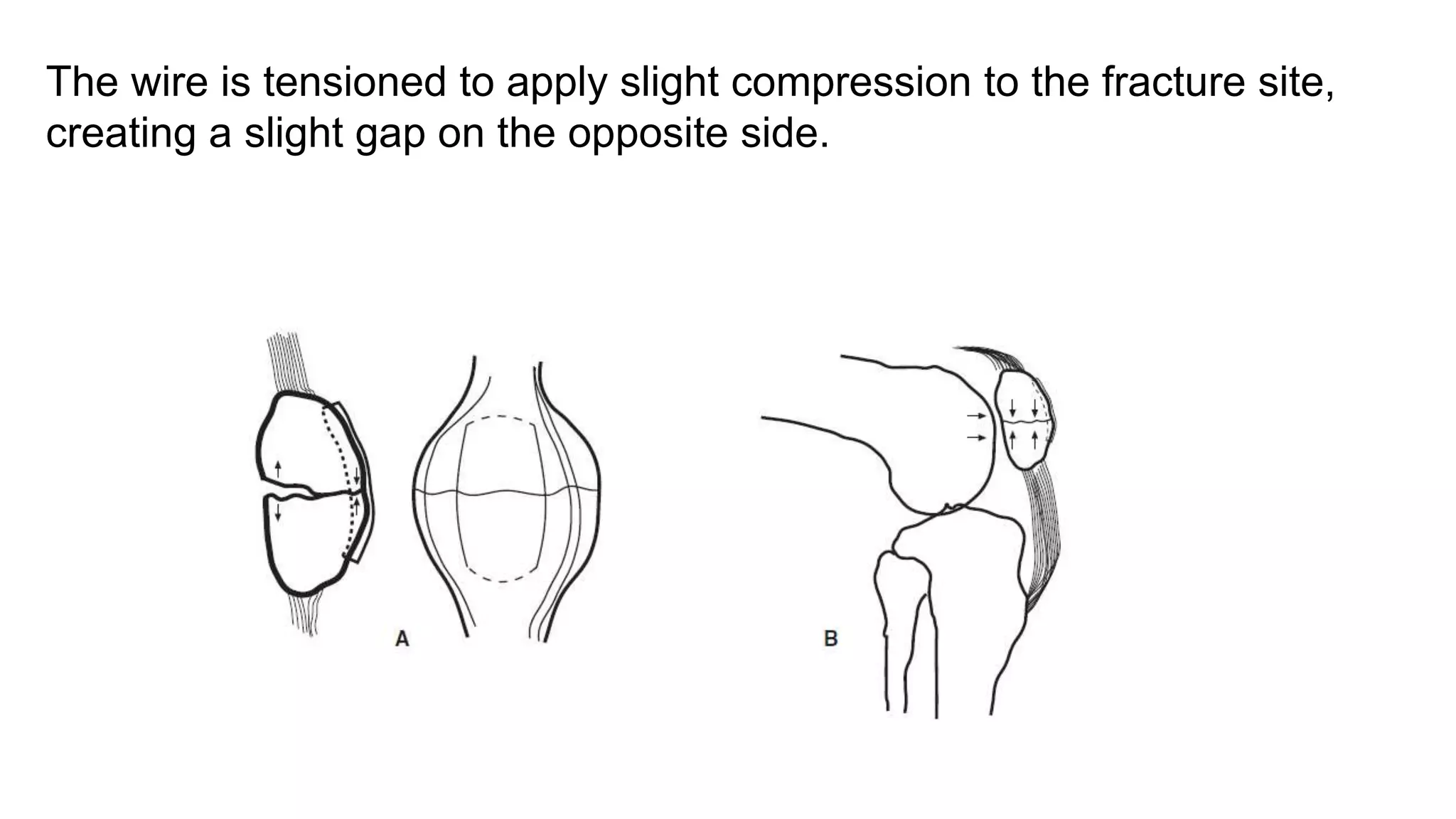
The wire is tensioned to apply slight compression to the fracture site,
creating a slight gap on the opposite side.
When dynamic forces are applied with the contraction
of the antagonistic deforming muscles during normal muscular
activity, the tension band resists the tendency for distraction of
the opposite sides of the fractured bone and, at the same time,
produces uniform compression at the fracture site (dynamic
compression)
•A tension band that produces compression at the time of
application is called a static tension band, as the forces at the
fracture site remain fairly constant during movement.
Tension band application to the medial malleolus is an example of a
static tension band.
•If the compression force increases with motion, the tension band
is a dynamic one.
In the treatment of fractures of patella and olecranon, the application of a
tension band wire achieves dynamic compression during active flexion of the
knee and the elbow respectively.
Material used
A wire, a cable or a non-absorbable suture is used to perform the
function of a tension band. Traditionally, stainless steel wire has been
used for tension band fixation.
The wire should have
 considerable ductility
 high yield point and
 ultimate tensile strength.
Usually wires of diameters ranging from 0.4 to 1.5 mm are used.
Biodegradable implants have been applied with success and
potentially minimize the complication of painful hardware and
decrease the need for implant removal. On the other hand,
biodegradable materials often produce an acute inflammatory
soft-tissue reaction that may resemble an infection
The tension band wire is often applied in a figure-8 fashion
around previously inserted, parallel and longitudinally placed
Kirschner wires, Steinmann pins or cancellous lag screws.
• These implants are used as an adjunctive fixation to prevent
displacement of the fracture fragments through shearing, translation
or rotation.
• The parallel wires also provide anchorage points around which the
tension band wire is placed.
APPLICATIONS
The tension band wiring can be utilized to fix fractures only in a limited
number of locations in the body. The technique can be employed for
 transverse and comminuted patella fracture,
 fracture and osteotomy of the femoral greater trochanter,
 the medial and lateral malleolar fractures,
 fracture of the grater tuberosity of the humerus
 for fracture of the distal end of the clavicle
 of the olecranon process of the ulna.
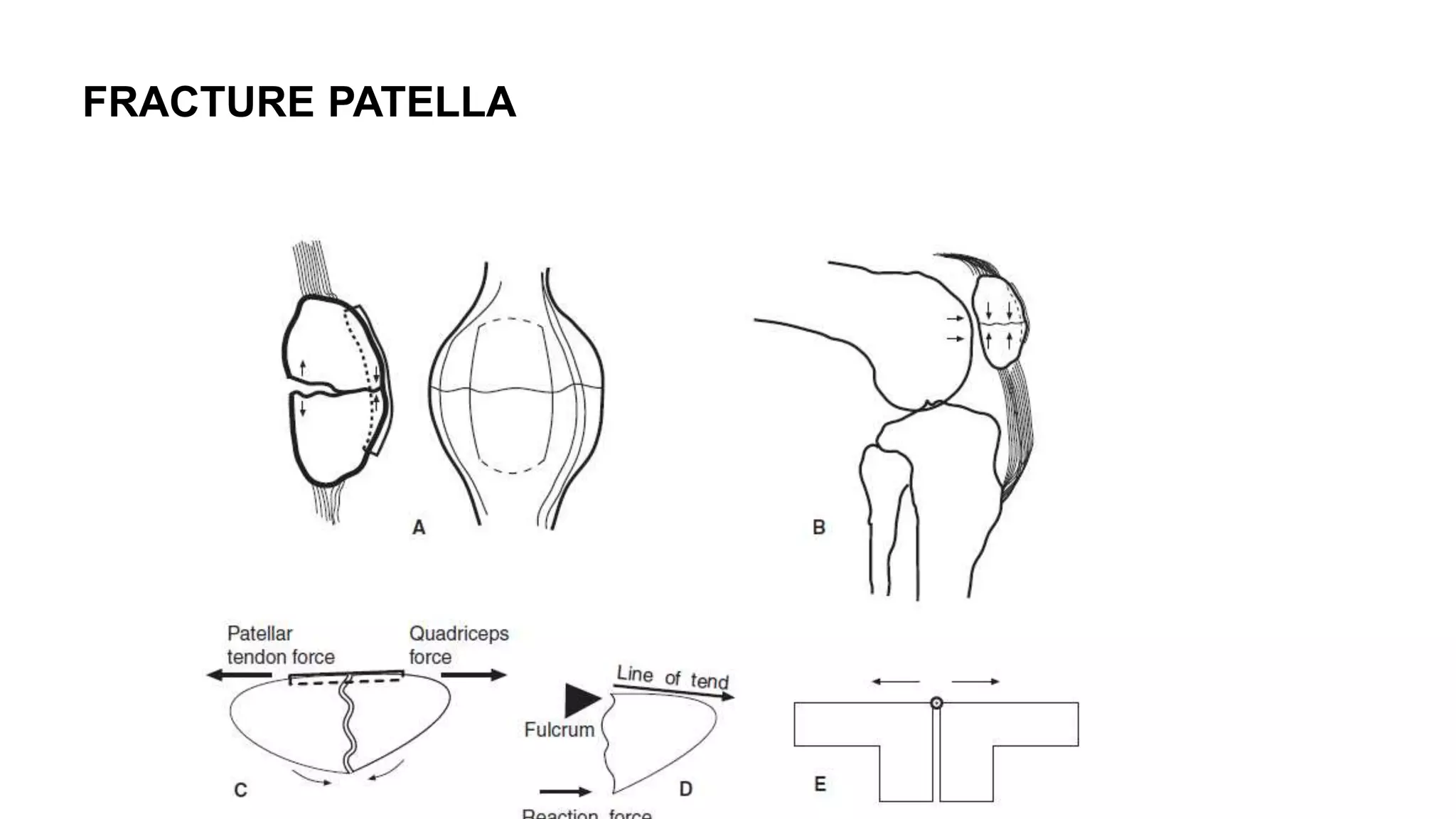
FRACTURE PATELLA
After an accurate reduction, a tension band wire is tightened
(prestressed) and fastened together opposing points on the anterior
cortex at and around the point of contact.
Tightening (prestressing) the wire produces static compression
on the anterior cortex and opens up the posterior cortex.
Knee flexion induces dynamic compression and closes the
posterior gap.
The anterior wire when placed under tension converts the distracting
tendon force to compressive force across the posterior cortex
The tendon force rotates the distal fragment into contact with the
proximal fragment because the wire is holding them together.
olecranon fracture of the ulna
Tension band wiring is selectively suitable for locations where the
extensor muscle usually provides the major deforming force
causing the bending movement at the discontinuity such as olecranon
process of the ulna.
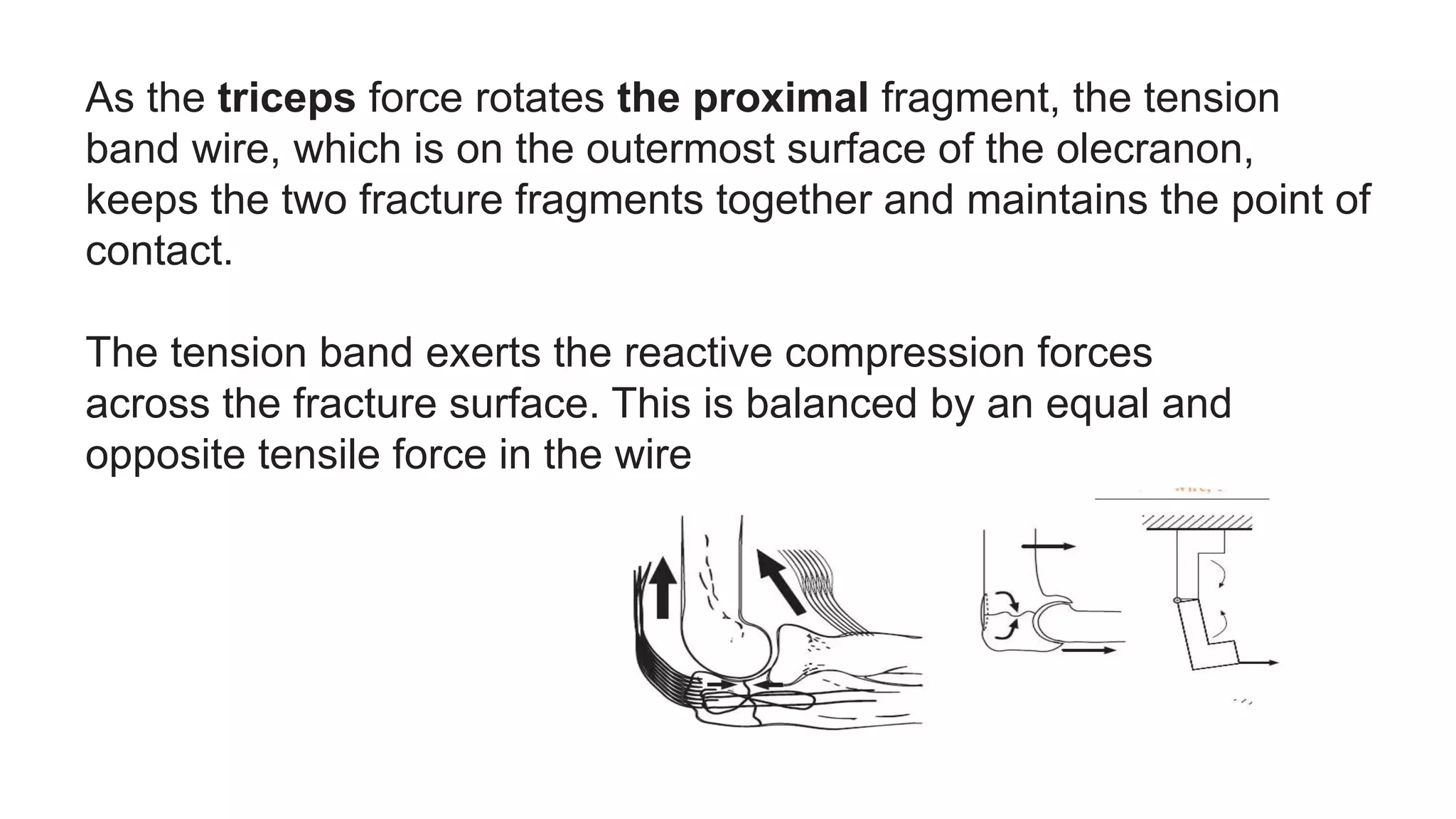
As the triceps force rotates the proximal fragment, the tension
band wire, which is on the outermost surface of the olecranon,
keeps the two fracture fragments together and maintains the point of
contact.
The tension band exerts the reactive compression forces
across the fracture surface. This is balanced by an equal and
opposite tensile force in the wire
The greater trochanter of femur
The antagonistic pull
of the gluteals and the adductors, using
the hip joint as fulcrum,
causes a bending moment at the site of
discontinuity between the
greater trochanter and the femur
This distracting force is converted to a
compression force by the tension band
The antagonistic pulls of the
supraspinatus and pectoralis
Major cause a bending
moment at the site of discontinuity
between the greater tuberosity and
the remaining humerus .
compression is achieved
with this method only during
functional activity that results in
eccentric loading and production of
bending moments.
The greater tuberosity of
humerus
The medial malleolus
Tension band wiring is a suitable
option when the malleolar
fragment is very small or the bone
is porotic, making screw fixation
impossible.
Lateral end of the clavicle
When indicated, this is an effective
method of securing the small
Fragments.
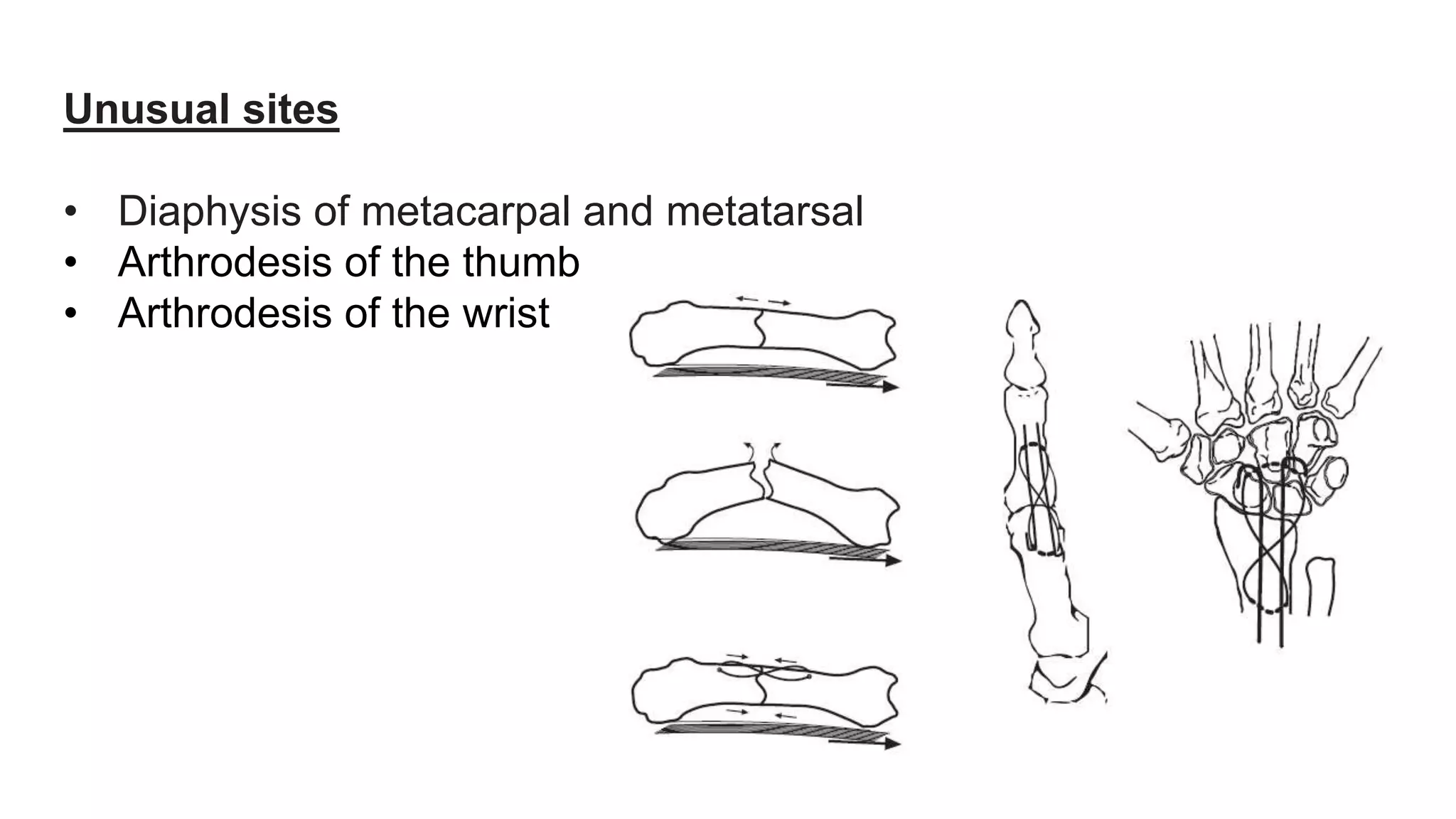
Unusual sites
• Diaphysis of metacarpal and metatarsal
• Arthrodesis of the thumb
• Arthrodesis of the wrist
COMPLICATIONS
The most common complication is implant failure.
A wire put under pure tension is very strong. However, if
bending forces are added, it will break quite rapidly due to
fatigue
Wire prominence is a common complaint associated with
tension band fixation of the olecranon; it may also lead to
skin breakdown and subsequent infection.

Tension Band Wiring principles and applications

  • 1.
    TENSION BAND WIRING PRINCIPALSAND APPLICATIONS DR Gaurav Singh Central institute of orthopaedics VMMC & SJH
  • 2.
  • 3.
    The tension bandprinciple.  An eccentrically loaded bone has a tension and a compression side.  A tension band converts this tension into compression at the opposite cortex.
  • 5.
    A column, whenloaded along its central axis, displays a stress pattern compression, which is evenly distributed over its horizontal cross-section When the load is applied off-centre, the stress pattern changes. In addition to the direct compression, there are elements of compression and tension. This eccentric column loading is common in the skeleton. The more eccentric the loading, the more important the bending component, and the higher the stresses.
  • 7.
    The I-beam isloaded with a weight (Kg) placed over the central axis of the beam; there is uniform compression of both springs at the interruption. When the I-beam is loaded eccentrically by placement of the weight at a distance from the central axis of the beam, the spring on the same side compresses, whereas the spring on the opposite side is placed in tension and stretches. If a tension band is applied prior to the eccentric loading, it resists the tension that would otherwise stretch the opposite spring and thus causes uniform compression of both springs
  • 8.
    The use ofa wire for fixation on the tension surface of a fractured bone converts the distracting tensile force into a compressive force. Such a wire is called a ‘tension band wire’
  • 9.
    Tension band wiring ●Wire must be applied on the tension surface of the bone ● Wire must be prestressed (tightened) ● Wire must be strong to withstand tension load ● Strong opposite bone cortex must be present to withstand dynamic compressive loads ● Joint movement must be encouraged to improve congruity and compression ‘
  • 10.
    The wire istensioned to apply slight compression to the fracture site, creating a slight gap on the opposite side.
  • 11.
    When dynamic forcesare applied with the contraction of the antagonistic deforming muscles during normal muscular activity, the tension band resists the tendency for distraction of the opposite sides of the fractured bone and, at the same time, produces uniform compression at the fracture site (dynamic compression)
  • 12.
    •A tension bandthat produces compression at the time of application is called a static tension band, as the forces at the fracture site remain fairly constant during movement. Tension band application to the medial malleolus is an example of a static tension band. •If the compression force increases with motion, the tension band is a dynamic one. In the treatment of fractures of patella and olecranon, the application of a tension band wire achieves dynamic compression during active flexion of the knee and the elbow respectively.
  • 13.
    Material used A wire,a cable or a non-absorbable suture is used to perform the function of a tension band. Traditionally, stainless steel wire has been used for tension band fixation. The wire should have  considerable ductility  high yield point and  ultimate tensile strength. Usually wires of diameters ranging from 0.4 to 1.5 mm are used.
  • 14.
    Biodegradable implants havebeen applied with success and potentially minimize the complication of painful hardware and decrease the need for implant removal. On the other hand, biodegradable materials often produce an acute inflammatory soft-tissue reaction that may resemble an infection
  • 15.
    The tension bandwire is often applied in a figure-8 fashion around previously inserted, parallel and longitudinally placed Kirschner wires, Steinmann pins or cancellous lag screws. • These implants are used as an adjunctive fixation to prevent displacement of the fracture fragments through shearing, translation or rotation. • The parallel wires also provide anchorage points around which the tension band wire is placed.
  • 16.
  • 17.
    The tension bandwiring can be utilized to fix fractures only in a limited number of locations in the body. The technique can be employed for  transverse and comminuted patella fracture,  fracture and osteotomy of the femoral greater trochanter,  the medial and lateral malleolar fractures,  fracture of the grater tuberosity of the humerus  for fracture of the distal end of the clavicle  of the olecranon process of the ulna.
  • 18.
  • 19.
    After an accuratereduction, a tension band wire is tightened (prestressed) and fastened together opposing points on the anterior cortex at and around the point of contact. Tightening (prestressing) the wire produces static compression on the anterior cortex and opens up the posterior cortex. Knee flexion induces dynamic compression and closes the posterior gap. The anterior wire when placed under tension converts the distracting tendon force to compressive force across the posterior cortex The tendon force rotates the distal fragment into contact with the proximal fragment because the wire is holding them together.
  • 20.
    olecranon fracture ofthe ulna Tension band wiring is selectively suitable for locations where the extensor muscle usually provides the major deforming force causing the bending movement at the discontinuity such as olecranon process of the ulna.
  • 21.
    As the tricepsforce rotates the proximal fragment, the tension band wire, which is on the outermost surface of the olecranon, keeps the two fracture fragments together and maintains the point of contact. The tension band exerts the reactive compression forces across the fracture surface. This is balanced by an equal and opposite tensile force in the wire
  • 22.
    The greater trochanterof femur The antagonistic pull of the gluteals and the adductors, using the hip joint as fulcrum, causes a bending moment at the site of discontinuity between the greater trochanter and the femur This distracting force is converted to a compression force by the tension band
  • 23.
    The antagonistic pullsof the supraspinatus and pectoralis Major cause a bending moment at the site of discontinuity between the greater tuberosity and the remaining humerus . compression is achieved with this method only during functional activity that results in eccentric loading and production of bending moments. The greater tuberosity of humerus
  • 24.
    The medial malleolus Tensionband wiring is a suitable option when the malleolar fragment is very small or the bone is porotic, making screw fixation impossible.
  • 25.
    Lateral end ofthe clavicle When indicated, this is an effective method of securing the small Fragments.
  • 26.
    Unusual sites • Diaphysisof metacarpal and metatarsal • Arthrodesis of the thumb • Arthrodesis of the wrist
  • 27.
    COMPLICATIONS The most commoncomplication is implant failure. A wire put under pure tension is very strong. However, if bending forces are added, it will break quite rapidly due to fatigue Wire prominence is a common complaint associated with tension band fixation of the olecranon; it may also lead to skin breakdown and subsequent infection.