Proximal Femoral
Nail
BY ALEX BERTINO, COREY VAN DE HAY, ANDREW HNAT
ACA ENGINEERING
1
Background
▶ Designed for femur injuries
▶ Largest and strongest bone
▶ Causes of injury
▶ Automobile accidents
▶ Falling
▶ Description of Fracture
▶ Location
▶ Pattern
▶ Skin condition
▶ Treatment based on type of fracture
2
Medical
Need
▶ More than 250,000
patients per year
▶ Cast insufficient in
certain cases
▶ Malunion
▶ Non-union
▶ Necessitates usage of
intramedullary rod
Malunion Non-union
3
Predicate Device
▶ Device Approval Date
▶ January 1997
▶ Product Code: JDS
▶ No recalls for this device in particular
▶ 10 recalls since 1995 for all JDS devices
▶ Standard Length PFN
▶ Synthes offers two options for PFN length
4
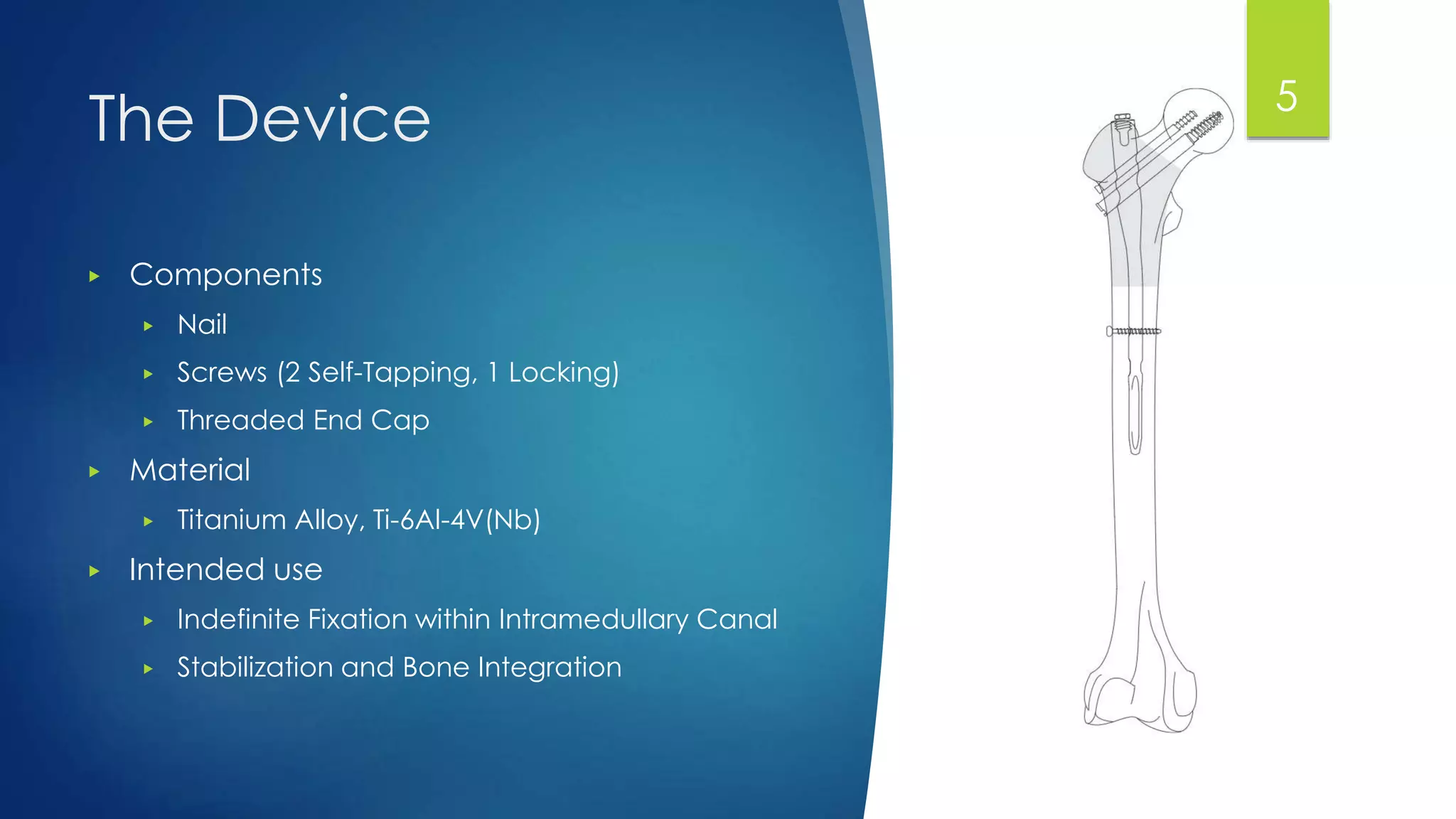
The Device
▶ Components
▶ Nail
▶ Screws (2 Self-Tapping, 1 Locking)
▶ Threaded End Cap
▶ Material
▶ Titanium Alloy, Ti-6Al-4V(Nb)
▶ Intended use
▶ Indefinite Fixation within Intramedullary Canal
▶ Stabilization and Bone Integration
5
Design and
Assumptions
▶ Anatomical geometry
▶ Biocompatible material
▶ Load transfer
▶ Restrict Stress Shielding
6
Finite Element
Analysis
▶ Force: 6267 N
▶ Tripping
▶ Average male over 20 years
▶ Applied to the top of the rod
▶ Fixed at each screw hole
▶ Multiple Simulations
▶ Normal
▶ Bending
▶ Torsion
▶ Buckling/Frequency
7
FEA Analysis:
Normal Force
▶ Order of magnitude lower
than yield stress
▶ Stress singularity at hole
▶ Caused by boundary
condition
▶ Not physically accurate
▶ Stress too low to cause
fatigue damage
8
FEA Analysis:
Bending
▶ Tighter stress distribution
▶ Excessive stress at hole
▶ Singularity
▶ Not physically accurate
▶ Peak Stress half of yield stress
▶ System will not fail under
these conditions
9
FEA Analysis:
Torsion
▶ Tightest stress distribution
▶ Excessive stress at hole
▶ Singularity
▶ Not physically
accurate
▶ Peak Stress slightly lower
than bending
▶ System will not fail under
these conditions
10
FEA Analysis:
Buckling/Frequency
▶ Critical load factor: 183.7
▶ Minimum resonance
frequency: 2071.6 Hz
▶ System will not fail due to
Buckling/Frequency
Buckling Frequency
11
Manufacturing and
Sterilization
▶ Wet (steam) autoclave sterilization
▶ Implanted medium to long-term device
▶ Sterilization level: 10-6 SAL
▶ Titanium casting to account for semi-
complex geometry
▶ Initial barrier costs high, but long-term
production will prove economical
Casting
Steam Autoclave
12
Verification and Validation
▶ 510(k) Submission
▶ Substantial equivalence approach
▶ Predicate device
▶ Synthes PFN (Femur Intramedullary Rod
and Screws) - Std. Length
▶ Device Testing
▶ Static 4-point bending
▶ Static Buckling
▶ Static torsional
▶ Fatigue bending
Static Bending, Buckling, & Torsion Testing
13
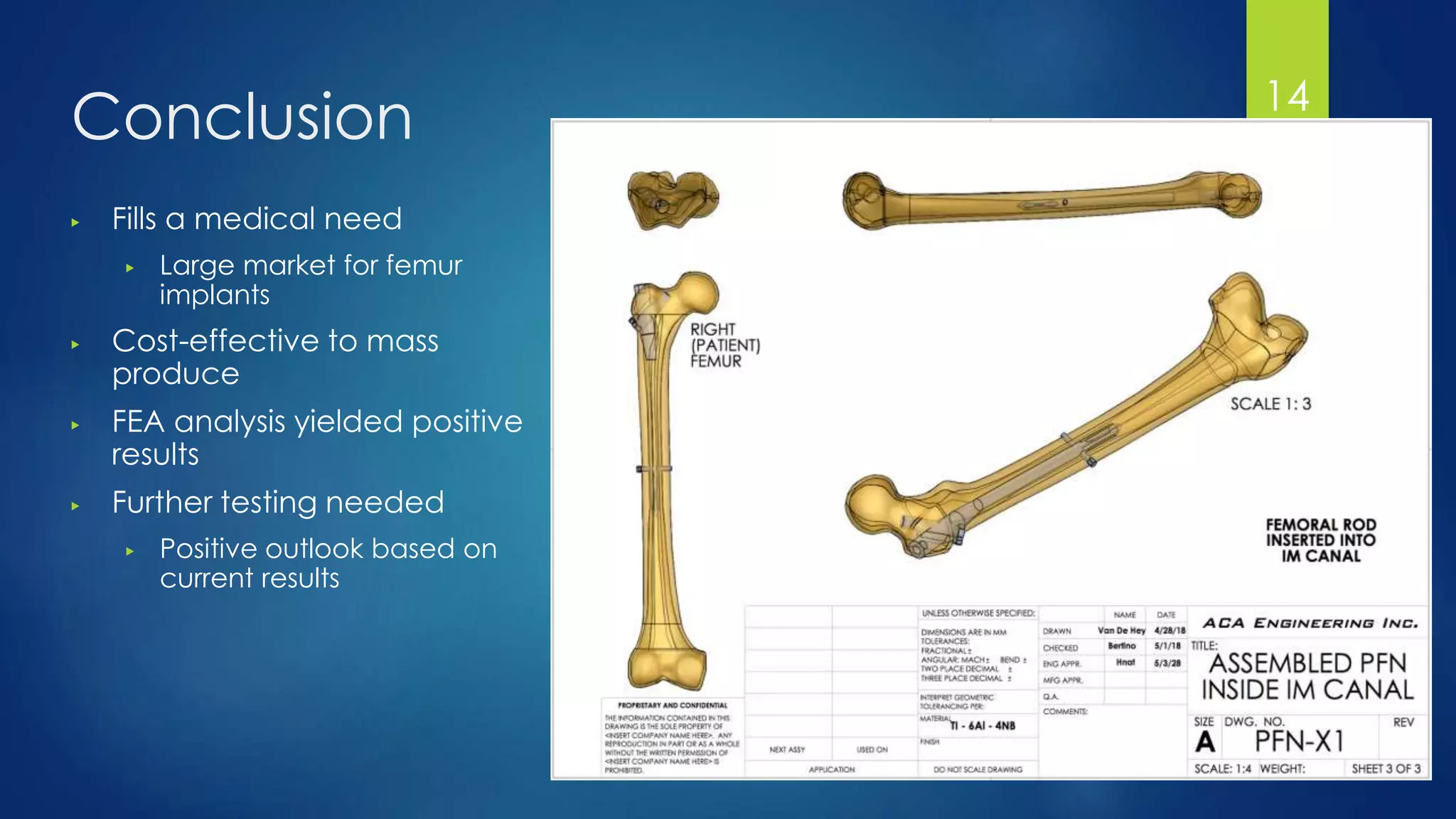
Conclusion
▶ Fills a medical need
▶ Large market for femur
implants
▶ Cost-effective to mass
produce
▶ FEA analysis yielded positive
results
▶ Further testing needed
▶ Positive outlook based on
current results
14
References
▶ https://www.accessdata.fda.gov/scripts/cdrh/cfdocs/cfpmn/pmn.
cfm?ID=K970097
▶ https://www.accessdata.fda.gov/scripts/cdrh/cfdocs/cfPCD/classi
fication.cfm?ID=JDW
▶ https://www.accessdata.fda.gov/cdrh_docs/pdf/K970097.pdf
▶ https://www.accessdata.fda.gov/scripts/cdrh/cfdocs/cfTPLC/tplc.
cfm?ID=4455&min_report_year=1995
▶ https://www.accessdata.fda.gov/scripts/cdrh/cfdocs/cfTPLC/tplc.
cfm?ID=4453&min_report_year=1995
▶ http://synthes.vo.llnwd.net/o16/LLNWMB8/INT%20Mobile/Synthes%2
0International/Product%20Support%20Material/legacy_Synthes_PD
F/DSEM-TRM-0714-0122-1_LR.pdf
▶ https://en.wikipedia.org/wiki/Femur
15
References
▶ http://52.62.202.235/sites/default/files/TDwyer/Tibial%20Hypertrophic%20
Nonunion%20.jpg
▶ http://www.afrjpaedsurg.org/articles/2011/8/1/images/AfrJPaediatrSurg_2
011_8_1_34_78666_f2.jpg
16

Proximal Femoral Nail