Polymerase Chain Reaction “Xeroxing” DNA
Life is not fair! 1983—Kary Mullis, a scientist working for the Cetus Corporation was driving along US Route 101 in northern California when he came up with the idea for the polymerase chain reaction 1985—the polymerase chain reaction was introduced to the scientific community at a conference in October
Still not fair! Cetus rewarded Kary Mullis with a $10,000 bonus for his invention Later, during a corporate reorganization,  Cetus sold the patent for the PCR process to a pharmaceutical company Hoffmann-LaRoche for $300 million Again I say, life is not fair!
Polymerase Chain Reaction PCR for short! A technique for making MANY copies of a particular DNA sequence Allows us to start with VERY SMALL samples We need a large sample to perform electrophoresis and other analyses
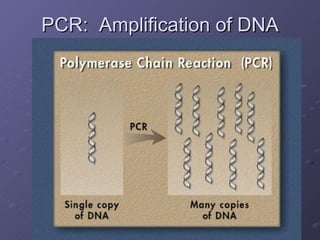
PCR:  Amplification of DNA
PCR:  Amplification of DNA Often, only a small amount of DNA is available A drop of blood A rare cell type Two methods currently exist for amplifying the DNA or making copies Cloning—takes a long time for enough clones to reach maturity PCR—works on even a single molecule quickly
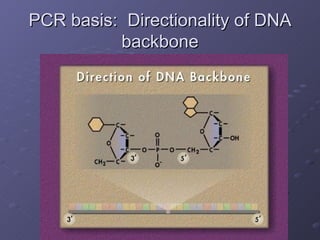
PCR basis:  Directionality of DNA backbone
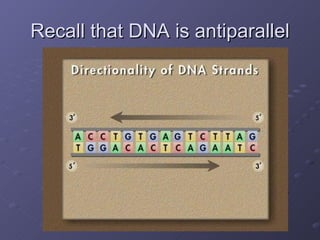
Recall that DNA is antiparallel
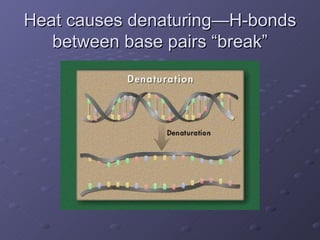
Heat causes denaturing—H-bonds between base pairs “break”
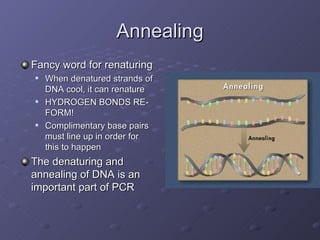
Annealing Fancy word for renaturing When denatured strands of DNA cool, it can renature HYDROGEN BONDS RE-FORM! Complimentary base pairs must line up in order for this to happen The denaturing and annealing of DNA is an important part of PCR
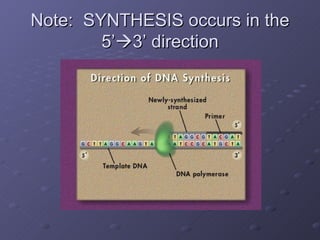
DNA Polymerase moves in a  5’  3’ direction DNA polymerase is the key to “xeroxing” copies of the DNA sample! DNA polymerase is an enzyme that uses an existing  SINGLE  strand of DNA as a template to form a new complementary strand. To get started, DNA polymerase needs a small complementary sequence, called a primer
Note:  SYNTHESIS occurs in the 5’  3’ direction
Where do we get loads of this DNA polymerase enzyme? Most commonly, our good buddy  E. coli Trouble is,  E. coli ’s DNA polymerase is ALSO denatured at the high temperatures needed to denature the DNA! This problem was solved by looking to bacteria that live in hot springs such as Old Faithful The DNA polymerase of these bacterial cells can withstand the high temperatures needed WITHOUT having the enzyme denature!
Old Faithful!
Taq polymerase This is the name of the most common heat-resistant polymerase extracted from these thermophilic bacteria. Thermus aquaticus  is the genus and species name of the bacteria, Taq for short!
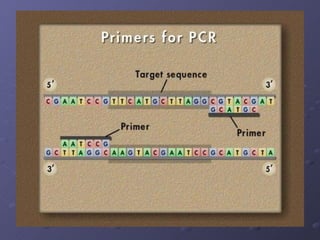
Making PCR twice as fast! The stretch of DNA to be amplified is often referred to as the “target sequence” The template DNA is usually a larger stretch of sample DNA that contains the target sequence The  primers  are short stretches of DNA that flank the target sequence and are complementary to opposite strands of the longer sample DNA The primer attaches to the beginning of the target sequence on one strand and the END of the target sequence on the other strand of DNA Big deal? You bet!  Now both strands of the sample DNA are templates for the polymerase enzymes!!
 
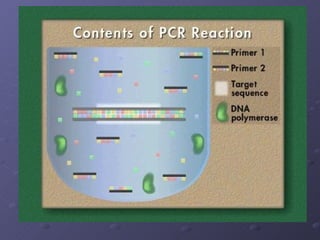
PCR:  Essential Reagents An excess of spare nucleotides An excess of primers We want the primers to bind to the sample DNA once it is denatured to prevent the strands from reannealing PLENTY of DNA polymerase [Taq polymerase in particular] Sample template of DNA
 
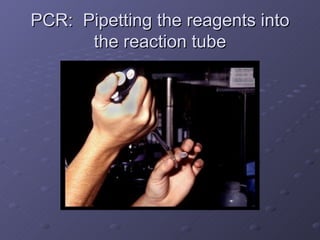
PCR:  Pipetting the reagents into the reaction tube
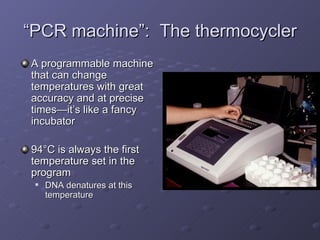
“ PCR machine”:  The thermocycler A programmable machine that can change temperatures with great accuracy and at precise times—it’s like a fancy incubator 94 °C is always the first temperature set in the program DNA denatures at this temperature
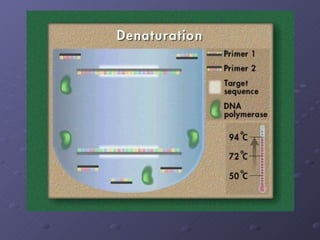
First denaturation As the temperature is raised to 94 °C, the target DNA denatures At these high temperatures, there will be NO BINDING of any sequences The reaction mixture is left at 94°C for 5 minutes to allow the DNA to completely denature
 
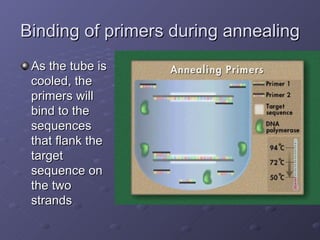
Binding of primers during annealing As the tube is cooled, the primers will bind to the sequences that flank the target sequence on the two strands
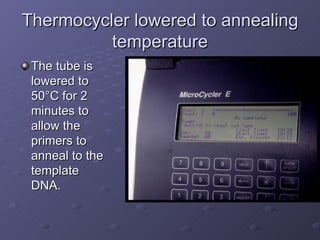
Thermocycler lowered to annealing temperature The tube is lowered to 50 °C for 2 minutes to allow the primers to anneal to the template DNA.
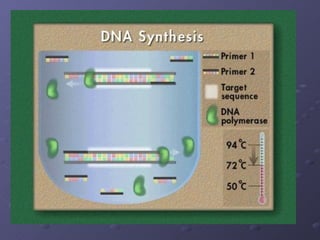
PCR:  Polymerization by High –temperature DNA polymerase After the primers have bound to the flanking sequences, the DNA polymerase will start to synthesize the complementary strand.  The end result will be four copies of the target sequence, doubling the two present at the start.
 
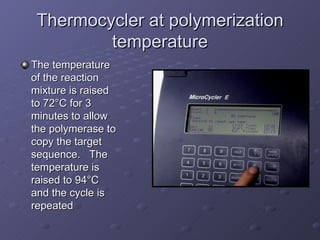
Thermocycler at polymerization temperature The temperature of the reaction mixture is raised to 72 °C for 3 minutes to allow the polymerase to copy the target sequence.  The temperature is raised to 94°C and the cycle is repeated
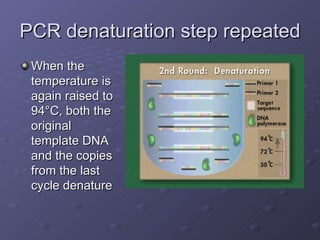
PCR denaturation step repeated When the temperature is again raised to 94 °C, both the original template DNA and the copies from the last cycle denature
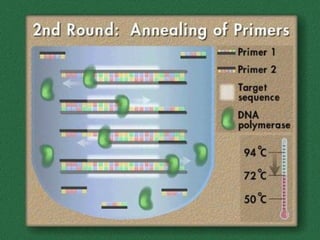
PCR:  Annealing and polymerization repeated Now, both the two original target sequences AND the two copies of the sequence can act as templates.  As the reaction is cooled, primers bind to the templates, and the polymerase makes copies in the opposite directions.  You can see in this next image why primers are needed in both directions.
 
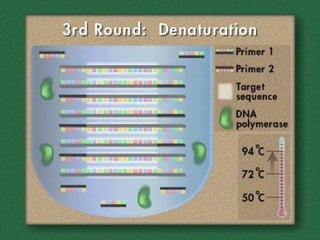
Denaturation repeated a third time The temperature is raised yet again, and the double strands fall apart There are now EIGHT template strands available for making copies
 
Our hero!  The thermocycler! The developers of PCR and the early researchers who used the technique spent long hours transferring tubes between the different hot water baths.  Fortunately, this tedious process is almost entirely automated by the thermocycler.  The times and temperatures described in this tutorial for each step are averages, and different experiments call for different conditions The machine can be programmed for any changes in temperature the experimenter finds useful.
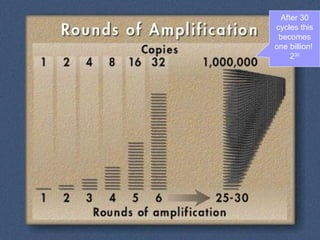
Repeat, repeat, repeat! After this denaturing and synthesizing process is repeated for 30 cycles, the sequence will have been amplified a BILLION times This geometric increase in the amount of target sequence can be achieved in just a few hours rather than the much longer times required by older methods!
After 30 cycles this becomes one billion!  2 30
What next? Now that the most minute sample of DNA has been amplified, there is a large enough PCR product to be electrophoresed.
Applications of PCR The first application dealt with detection of genetic mutations Now the smallest trace evidence from crime scenes can be amplified in order to provide DNA fingerprinting data

Polymerase Chain Reaction

  • 1.
    Polymerase Chain Reaction“Xeroxing” DNA
  • 2.
    Life is notfair! 1983—Kary Mullis, a scientist working for the Cetus Corporation was driving along US Route 101 in northern California when he came up with the idea for the polymerase chain reaction 1985—the polymerase chain reaction was introduced to the scientific community at a conference in October
  • 3.
    Still not fair!Cetus rewarded Kary Mullis with a $10,000 bonus for his invention Later, during a corporate reorganization, Cetus sold the patent for the PCR process to a pharmaceutical company Hoffmann-LaRoche for $300 million Again I say, life is not fair!
  • 4.
    Polymerase Chain ReactionPCR for short! A technique for making MANY copies of a particular DNA sequence Allows us to start with VERY SMALL samples We need a large sample to perform electrophoresis and other analyses
  • 5.
  • 6.
    PCR: Amplificationof DNA Often, only a small amount of DNA is available A drop of blood A rare cell type Two methods currently exist for amplifying the DNA or making copies Cloning—takes a long time for enough clones to reach maturity PCR—works on even a single molecule quickly
  • 7.
    PCR basis: Directionality of DNA backbone
  • 8.
    Recall that DNAis antiparallel
  • 9.
    Heat causes denaturing—H-bondsbetween base pairs “break”
  • 10.
    Annealing Fancy wordfor renaturing When denatured strands of DNA cool, it can renature HYDROGEN BONDS RE-FORM! Complimentary base pairs must line up in order for this to happen The denaturing and annealing of DNA is an important part of PCR
  • 11.
    DNA Polymerase movesin a 5’  3’ direction DNA polymerase is the key to “xeroxing” copies of the DNA sample! DNA polymerase is an enzyme that uses an existing SINGLE strand of DNA as a template to form a new complementary strand. To get started, DNA polymerase needs a small complementary sequence, called a primer
  • 12.
    Note: SYNTHESISoccurs in the 5’  3’ direction
  • 13.
    Where do weget loads of this DNA polymerase enzyme? Most commonly, our good buddy E. coli Trouble is, E. coli ’s DNA polymerase is ALSO denatured at the high temperatures needed to denature the DNA! This problem was solved by looking to bacteria that live in hot springs such as Old Faithful The DNA polymerase of these bacterial cells can withstand the high temperatures needed WITHOUT having the enzyme denature!
  • 14.
  • 15.
    Taq polymerase Thisis the name of the most common heat-resistant polymerase extracted from these thermophilic bacteria. Thermus aquaticus is the genus and species name of the bacteria, Taq for short!
  • 16.
    Making PCR twiceas fast! The stretch of DNA to be amplified is often referred to as the “target sequence” The template DNA is usually a larger stretch of sample DNA that contains the target sequence The primers are short stretches of DNA that flank the target sequence and are complementary to opposite strands of the longer sample DNA The primer attaches to the beginning of the target sequence on one strand and the END of the target sequence on the other strand of DNA Big deal? You bet! Now both strands of the sample DNA are templates for the polymerase enzymes!!
  • 17.
  • 18.
    PCR: EssentialReagents An excess of spare nucleotides An excess of primers We want the primers to bind to the sample DNA once it is denatured to prevent the strands from reannealing PLENTY of DNA polymerase [Taq polymerase in particular] Sample template of DNA
  • 19.
  • 20.
    PCR: Pipettingthe reagents into the reaction tube
  • 21.
    “ PCR machine”: The thermocycler A programmable machine that can change temperatures with great accuracy and at precise times—it’s like a fancy incubator 94 °C is always the first temperature set in the program DNA denatures at this temperature
  • 22.
    First denaturation Asthe temperature is raised to 94 °C, the target DNA denatures At these high temperatures, there will be NO BINDING of any sequences The reaction mixture is left at 94°C for 5 minutes to allow the DNA to completely denature
  • 23.
  • 24.
    Binding of primersduring annealing As the tube is cooled, the primers will bind to the sequences that flank the target sequence on the two strands
  • 25.
    Thermocycler lowered toannealing temperature The tube is lowered to 50 °C for 2 minutes to allow the primers to anneal to the template DNA.
  • 26.
    PCR: Polymerizationby High –temperature DNA polymerase After the primers have bound to the flanking sequences, the DNA polymerase will start to synthesize the complementary strand. The end result will be four copies of the target sequence, doubling the two present at the start.
  • 27.
  • 28.
    Thermocycler at polymerizationtemperature The temperature of the reaction mixture is raised to 72 °C for 3 minutes to allow the polymerase to copy the target sequence. The temperature is raised to 94°C and the cycle is repeated
  • 29.
    PCR denaturation steprepeated When the temperature is again raised to 94 °C, both the original template DNA and the copies from the last cycle denature
  • 30.
    PCR: Annealingand polymerization repeated Now, both the two original target sequences AND the two copies of the sequence can act as templates. As the reaction is cooled, primers bind to the templates, and the polymerase makes copies in the opposite directions. You can see in this next image why primers are needed in both directions.
  • 31.
  • 32.
    Denaturation repeated athird time The temperature is raised yet again, and the double strands fall apart There are now EIGHT template strands available for making copies
  • 33.
  • 34.
    Our hero! The thermocycler! The developers of PCR and the early researchers who used the technique spent long hours transferring tubes between the different hot water baths. Fortunately, this tedious process is almost entirely automated by the thermocycler. The times and temperatures described in this tutorial for each step are averages, and different experiments call for different conditions The machine can be programmed for any changes in temperature the experimenter finds useful.
  • 35.
    Repeat, repeat, repeat!After this denaturing and synthesizing process is repeated for 30 cycles, the sequence will have been amplified a BILLION times This geometric increase in the amount of target sequence can be achieved in just a few hours rather than the much longer times required by older methods!
  • 36.
    After 30 cyclesthis becomes one billion! 2 30
  • 37.
    What next? Nowthat the most minute sample of DNA has been amplified, there is a large enough PCR product to be electrophoresed.
  • 38.
    Applications of PCRThe first application dealt with detection of genetic mutations Now the smallest trace evidence from crime scenes can be amplified in order to provide DNA fingerprinting data