DRUGS AFFECTING
CARDIOVASCULAR SYSTEM
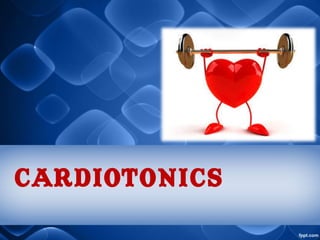
CARDIOTONICS
?
• Cardiotonic agents are drugs used to
increase the contractility and output in a
hypodynamic heart without propotionate
increase in 02 consumption
• Commonly used in the treatment of heart
failure (HF)
• Cardiotonic (inotropic) drugs affect the
intracellular calcium levels in the heart
muscle, leading to increased contractility.
• This increase in contraction strength leads
to increased cardiac output, which causes
increased renal blood flow and increased
urine production
TYPES
1. Cardiac glycosides
2. Phosphodiesterase inhibitors
CARDIAC GLYCOSIDES
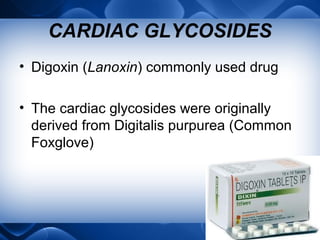
• Digoxin (Lanoxin) commonly used drug
• The cardiac glycosides were originally
derived from Digitalis purpurea (Common
Foxglove)
Foxglove plant
Digitalis lanata
Mechanism of action
• Digoxin increases intracellular calcium and
allows more calcium to enter myocardial
cells during depolarization. That results
1. Increased force of myocardial
contraction (a positive inotropic effect)
2. • Increased cardiac output and renal
perfusion
3. Slowed heart rate, owing to slowing of the
rate of cellular repolarization (a negative
chronotropic effect)
4.Decreased conduction velocity through the
atrioventricular(AV) node
INDICATIONS
• Heart failure (HF)
• Atrial flutter
• Atrial fibrillation
• Paroxysmal atrial tachycardia
Dosage
• Digoxin is available for oral and parenteral
administration.
• Oral- 0.75–1.25 mg PO
• IV-0.125–0.25 mg IV
• Onset of action - 30–120 minutes when
taken orally, 5–30 minutes when given
intravenously
Contraindications
• hypersensitivity to digitalis preparations
• ventricular tachycardia or fibrillation
• heart block or sick sinus syndrome
• idiopathic hypertrophic subaortic stenosis
(IHSS)
• acute MI
• Renal failure
Adverse Effects
• headache, weakness, drowsiness and
vision changes
• Digitalis toxicity ( serious side effect)
Digitalis toxicity
• A serious syndrome that can occur when
digoxin levels are too high
• Normal level- 0.5 -2.0 ng/ml
signs and symptoms – anorexia, nausea,
vomiting, malaise, depression, irregular
heart rhythms including heart block, atrial
arrhythmias, and ventricular tachycardia
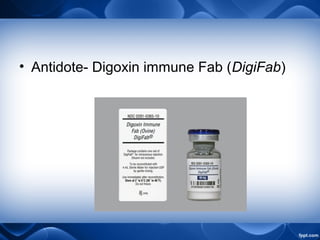
• Antidote- Digoxin immune Fab (DigiFab)
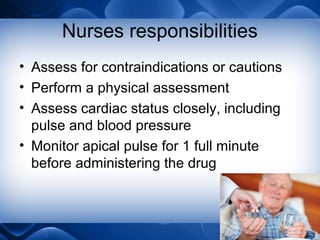
Nurses responsibilities
• Assess for contraindications or cautions
• Perform a physical assessment
• Assess cardiac status closely, including
pulse and blood pressure
• Monitor apical pulse for 1 full minute
before administering the drug
• Hold the dose if the pulse is less than 60
beats/min in an adult or less than 90
beats/min in an infant; retake the pulse in
1 hour. If the pulse remains low, document
it, withhold the drug, and notify the
prescriber
• Monitor the pulse for any change in quality
or rhythm
• Administer intravenous doses very slowly
over at least 5 minutes to avoid cardiac
arrhythmias and adverse effects.
• Avoid administering the oral drug with food
or antacids to avoid delays in absorption
• Obtain digoxin level as ordered; monitor
the patient for therapeutic digoxin level
(0.5–2 ng/mL)
• Maintain emergency equipment on
standby if digoxin toxicity develops
• Provide thorough patient teaching,
including the name of the drug, dosage
prescribed, technique for monitoring pulse
and acceptable pulse parameters, dietary
measures if appropriate, measures to
avoid adverse effects, warning signs of
possible toxicity and need to notify health
care provider
PHOSPHODIESTERASE
INHIBITORS
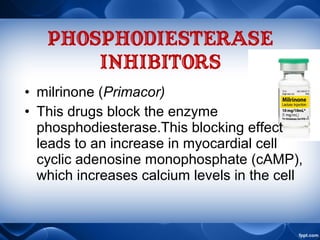
• milrinone (Primacor)
• This drugs block the enzyme
phosphodiesterase.This blocking effect
leads to an increase in myocardial cell
cyclic adenosine monophosphate (cAMP),
which increases calcium levels in the cell
INDICATIONS
• short-term treatment of HF that has not
responded to digoxin or diuretics alone or
that has had a poor response to digoxin,
diuretics, and vasodilators
DOSAGE
• Intravenous
• (PRIMACOR IV 10Mg/ml inj)
dose- 50 microgram/kg iv bolus followed
by 0.4-1.0 microgram/kg/min infusion
Contraindications
• hypersensitivity to phosphodiesterase
inhibitors
• severe aortic or pulmonic valvular disease
• acute MI
Adverse Effects
• ventricular arrhythmias (which can
progress to fatal ventricular fibrillation),
hypotension, and chest pain
• GI effects include nausea, vomiting,
anorexia, and abdominal pain
• Thrombocytopenia occurs frequently with
milrinone
• Precipitates form when these drugs are
given in solution with furosemide
Nurses responsibilities
• Assess for contraindications or cautions:
any known allergies to these drugs or to
avoid hypersensitivity reactions;
• acute aortic or pulmonic valvular disease,
• acute myocardial infarction
• ventricular arrhythmias
• Pregnancy and lactation
• Assess cardiac status closely, including
pulse and blood pressure
• Protect the drug from light to prevent drug
degradation
• Monitor input and output and record daily
weight
• Monitor platelet counts before and
regularly during therapy to ensure that the
dose is appropriate, inspect the skin for
bruising or petechiae to detect early signs
of thrombocytopenia
• Provide life-support equipment on standby
• Provide thorough patient teaching,
including the name of the drug, dosage
prescribed, measures to avoid adverse
effects, warning signs of problems, and
the need for periodic monitoring and
evaluation
ANTIANGINALS
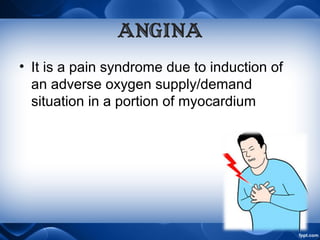
ANGINA
• It is a pain syndrome due to induction of
an adverse oxygen supply/demand
situation in a portion of myocardium
• Antianginal drugs are used to help restore
the appropriate supply-and-demand ratio
in oxygen delivery to the myocardium.
How they act
• These drugs can work to improve blood
delivery to the heart muscle
• (1) by dilating blood vessels
(i.e.,increasing the supply of oxygen)
(2) by decreasing the work of the heart
(i.e.decreasing the demand for oxygen).
Classification
• Nitrates
a. short acting nitrates
Eg: Glyceryl trinitrate (Nitroglycerine)
b.Long acting nitrates
Eg; Isosorbide dinitrate (sorbitrate)
• betA-BLOCKERS
Eg; Atenelol, Propanalol
• Calcium channel blockers
a. phenyl alkamine
Eg: verapamil
b. benzothiazepine
Eg: Diltiazem
c. Dihydropyridines
Eg: Nifidipine, Amlodipine
• Potassium channel openers
Eg: Nicorandil
• OTHers
Eg: Ivabradine
Nitrates
• Nitrates are drugs that act directly on
smooth muscle to cause relaxation and to
depress muscle tone
• isosorbide dinitrate (Isordil)
• isosorbide mononitrate
• nitroglycerin
Mechanism of action
• The nitrates relax and dilate veins,
arteries, and capillaries, allowing
increased blood fl ow through the vessels
and lowering systemic blood pressure
because of a drop in resistance.
• Nitrates decreases the preload and
afterload
INDICATIONS
• LONG ACTING NITRATES
Taken before chest pain begins in situations in
which exertion or stress can be anticipated for
prevention of angina in adults; taken daily for
management of chronic angina
SHORT ACTING NITRATES
• Treatment of acute angina attack; prevention of
anginal attacks
AVAILABLE FORMS
• Nitroglycerin is available as
• sublingual tablet,
• Translingual spray,
• Intravenous solution
• Transdermal patch,
• Topical ointmentor paste,
• Transmucosal agent
DOSAGE
• Isosorbide nitrate- 2.5–5 mg SL
5-mg chewable tablet;
5–20 mg PO;
• Nitroglycerin- 5 mcg/min via IV infusion
pump every 3–5 min;
• 0.4-mg metered dose sublingual, up to
three doses in 15 min for acute attack
Contraindications
• Hypersensitivity
• Severe anemia
• Head trauma or cerebral hemorrhage
• pregnancy or lactation
Adverse effect
• Central nervous system (CNS)
headache, dizziness, and weakness
• Gastrointestinal (GI)
nausea, vomiting, and incontinence.
Cardiovascular
Hypotension
• Integumentary
flushing, pallor, increased perspiration.
Nurses responsibilities
• Assess for contraindications
• Assess cardiopulmonary status closely,
including pulse rate, blood pressure, heart
rate, and rhythm (30min)
• Always check the expiration date on the
bottle and protect the medication from
heat and light
• Instruct the patient that a sublingual dose
may be repeated in 5 minutes if relief is
is not felt, for a total of three doses; if pain
persists, the patient should go to an
emergency room
•Rotate the sites of topical form
•Taper the dose gradually (over 4 to 6
weeks) after long-term therapy
BETA BLOCKERS
• Beta-adrenergic blockers are used to
block the stimulatory effects of the
sympathetic nervous system.
• Eg- Atenelol
Propanalol
Metoprolol
Mechanism of action
• The beta-blockers competitively block
beta-adrenergic receptors in the heart and
decreasing the influence of the SNS on
these tissues. The result is a decrease in
the excitability of the heart, a decrease in
cardiac output, a decrease in cardiac
oxygen consumption, and a lowering
of blood pressure.
INDICATIONS
• Long-term management of angina
pectoris.
• To prevent reinfarction in stable patients 1
to 4 weeks after an MI
CONTRAINDICATIONS
• Bradycardia, heart block, and cardiogenic
shock
• Pregnancy and lactation
• Cautious administration to Asthma,
chronic obstructive pulmonary disease, or
thyrotoxicosis
DOASGE
• ORAL- 50-100 mg
• INTRAVENOUS - 5mg -15mg
NURSES RESPONSIBILITY
• Assess for contraindications or cautions
• Do not stop these drugs abruptly after
chronic therapy, but taper gradually over 2
weeks
• Monitor blood pressure, pulse, rhythm,
and cardiac output regularly
• Continuously monitor any patient receiving
an intravenous form of these drugs
CALCIUM CHANNEL BLOCKERS
• amlodipine (Norvasc),
• diltiazem (Cardizem)
• nicardipine (Cardene)
• nifedipine
• verapamil (Calan, Isoptin).
MECHANISM OF ACTION
• Calcium channel blockers inhibit the
movement of calcium ions across the
membranes of myocardial and arterial
muscle cells, altering the action potential
and blocking muscle cell contraction.
• This will results loss of smooth muscle
tone, vasodilation, and decreased
peripheral resistance occur
• Decreases the preload and afterload
which results in decreases cardiac
workload and oxygen consumption.
INDICATIONS
Treatment of
•Prinzmetal angina
•Chronic angina
•Effort associated angina
•Hypertension.
•Verapamil is also used to treat cardiac
tachyarrhythmias because it slows
conduction more than the other calcium
channel blockers do
Contraindications
• Hypersensitivity
• Pregnancy and lactation
Caution should be used with
• heart block or sick sinus syndrome
• Renal or hepatic dysfunction
• Heart Failure ,
Adverse Effects
• CNS -dizziness, light-headedness,
headache, and fatigue.
• GI- nausea and hepatic injury related to
direct toxic effects on hepatic cells.
Cardiovascular -hypotension, bradycardia,
peripheral edema, and heart block.
• Skin- flushing and rash
NURSES RESPONSIBILITIES
• Assess for contraindications
• Inspect skin for color and integrity
• Monitor blood pressure very carefully
• Provide thorough patient teaching
Potassium channel openers
• Potassium channel openers activates the
ATP sensitive potassium channels thereby
hyperpolarising the vascular smooth
muscles.
• This results in reduction in vascular tone
• That will lead to a decrease in preload and
afterload
• EG- Nicorandil
Dosage
• Oral- 5-20mg
INDICATIONS
• Prevention and long term treatment of
chronic stable angina pectoris
• Reduction in the risk of acute coronary
syndromes in patients with chronic stable
angina
contraindications
• Hypersensitivity
• Cardiogenic shock
• hypotension
Side effects
• Flushing
• Palpitation
• Weakness
• Headache
• Dizziness
• vomiting
Nurses responsibility
• Assess the hypersensitivity and
contraindications
• Regular monitoring of vital signs
• Health education
• asses the oral cavity for oral ulcers
OTHERS- IVABRADINE
• Ivabradine is a newer type of drug
• Mechnism of action- it acts by reducing
the heart rate by specific inhibition of the
funny
channel (cyclic nucleotide-gated)
• It specifically inhibits the cardiac
pacemaker and therby reducing heart
rate
indications
• Chronic stable angina patients with normal
sinus rhythm
• Chronic heart failure
Dosage
• Oral- 2.5-5mg
Contraindications
• Resting heart rate less than 70
• Cardiogenic shock
• Acute M I
• Sick sinus syndrome
• Severe hepatic injury
• Pregnency and lactation
Side effects
• Blurred vision
• Bradycardia
• Syncope
• Headache
• Constipation
• Muscle cramps
Nurses responsibility
• Check for hypersensitivity and
contraindications
• Assess the pulse rate and blood pressure
• Check the liver function test regularly
• Check for visual disturbances
• Health education
ANTIHYPERTENSIV
?
HYPERTENSION
•REGULATORS OF BLOOD
PRESSURE ?
• Antihypertensives are the drugs that used
to treat hypertension
CLASSIFICATIONS
• DIURETICS
LOOP DIURETICS
Eg- furosemide
THIAZIDE DIURETICS
Eg- Hydrochlorothiazide
POTASSIUM SPARING DIURETICS
Eg- Spirinolactone
ADRENERGIC inhibitors
•CENTRALLY ACTING α- ADRENERGIC
ANTAGONISTS
Eg- Clonidine
•PERIPHERALLY ACTING α- ADRENERGIC
ANTAGONISTS
Eg- Reserpine
• α- ADRENERGIC BLOCKERS
Eg-Prazocin
• β- ADRENERGIC BLOCKERS
Eg- Atenelol
• Calcium Channel Blockers
Eg- Amlodipine
Nifidipine
ANGIOTENSIN INHIBITORS
• ANGIOTENSIN-CONVERTING
ENZYME (ACE) INHIBITORS
Eg- Captopril, Enalapril
• Angiotensin II–Receptor
Blockers
Eg- Losartan
Telmisartan
• DIRECT VASODILATORS
Eg- Nitroglycerin
Sodium nitroprusside
DIURETICS
Drugs that increase the production of urine
LOOP DIURETICS
They inhibit the sodium and chloride
reabsorption in the thick segment of the
ascending limb of the loop of Henle as well
as in the proximal convoluted tubule and the
distal diluting site
Eg- furosemide( Lasix)
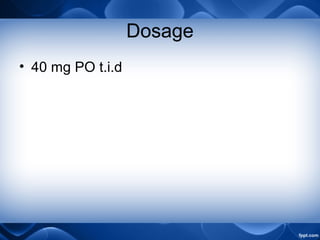
Dosage
• 40 mg PO t.i.d
Thiazide diuretics
Inhibit sodium and chloride reabsorption
in the distal convoluted tubule
•These drugs are the first-line drugs used to
manage essential hypertension when drug
therapy is needed
• Eg- Hydrochlorothiazide
• Dosage- 25–100 mg/d
Potassium Sparing Diuretics
• The potassium-sparing diuretics are not
as powerful as the loop diuretics, but they
retain potassium instead of wasting it
• Eg- spironolactone (Aldactone)
amiloride (Midamor)
Mechanism of action
• Spironolactone acts as an aldosterone
antagonist, blocking the actions of
aldosterone in the distal tubule.
• It decreases the elimination of potassium
Dosage
• 50–100 mg/d PO
CONTRAINDICATIONS
• Hypersensitivity
• Fluid and electrolyte imbalances
• Severe renal failure
cautious administration with
Systemic lupus erythematous( SLE)
Gout
Pregnancy and lactation
SIDE EFFECTS
• Common side effects
GI upset
fluid and electrolyte imbalances
hypotension
electrolyte disturbances
• Side effects ( thiazide and loop diuretics)
1.hypokalemia
weakness, muscle cramps, and
arrhythmia
2. hypercalcemia
3. decreased excretion of uric acid
• Side effects ( potassium sparing diuretics)
1. Hyperkalemia
lethargy, confusion, ataxia, muscle
cramps, and cardiac arrhythmias.
Drugs affecting Cardiovascular system

Drugs affecting Cardiovascular system

  • 1.
  • 2.
  • 3.
    ? • Cardiotonic agentsare drugs used to increase the contractility and output in a hypodynamic heart without propotionate increase in 02 consumption • Commonly used in the treatment of heart failure (HF)
  • 4.
    • Cardiotonic (inotropic)drugs affect the intracellular calcium levels in the heart muscle, leading to increased contractility. • This increase in contraction strength leads to increased cardiac output, which causes increased renal blood flow and increased urine production
  • 5.
    TYPES 1. Cardiac glycosides 2.Phosphodiesterase inhibitors
  • 6.
    CARDIAC GLYCOSIDES • Digoxin(Lanoxin) commonly used drug • The cardiac glycosides were originally derived from Digitalis purpurea (Common Foxglove)
  • 7.
  • 8.
    Mechanism of action •Digoxin increases intracellular calcium and allows more calcium to enter myocardial cells during depolarization. That results 1. Increased force of myocardial contraction (a positive inotropic effect) 2. • Increased cardiac output and renal perfusion
  • 9.
    3. Slowed heartrate, owing to slowing of the rate of cellular repolarization (a negative chronotropic effect) 4.Decreased conduction velocity through the atrioventricular(AV) node
  • 10.
    INDICATIONS • Heart failure(HF) • Atrial flutter • Atrial fibrillation • Paroxysmal atrial tachycardia
  • 11.
    Dosage • Digoxin isavailable for oral and parenteral administration. • Oral- 0.75–1.25 mg PO • IV-0.125–0.25 mg IV • Onset of action - 30–120 minutes when taken orally, 5–30 minutes when given intravenously
  • 12.
    Contraindications • hypersensitivity todigitalis preparations • ventricular tachycardia or fibrillation • heart block or sick sinus syndrome • idiopathic hypertrophic subaortic stenosis (IHSS) • acute MI • Renal failure
  • 13.
    Adverse Effects • headache,weakness, drowsiness and vision changes • Digitalis toxicity ( serious side effect)
  • 14.
    Digitalis toxicity • Aserious syndrome that can occur when digoxin levels are too high • Normal level- 0.5 -2.0 ng/ml signs and symptoms – anorexia, nausea, vomiting, malaise, depression, irregular heart rhythms including heart block, atrial arrhythmias, and ventricular tachycardia
  • 15.
    • Antidote- Digoxinimmune Fab (DigiFab)
  • 16.
    Nurses responsibilities • Assessfor contraindications or cautions • Perform a physical assessment • Assess cardiac status closely, including pulse and blood pressure • Monitor apical pulse for 1 full minute before administering the drug
  • 17.
    • Hold thedose if the pulse is less than 60 beats/min in an adult or less than 90 beats/min in an infant; retake the pulse in 1 hour. If the pulse remains low, document it, withhold the drug, and notify the prescriber • Monitor the pulse for any change in quality or rhythm
  • 18.
    • Administer intravenousdoses very slowly over at least 5 minutes to avoid cardiac arrhythmias and adverse effects. • Avoid administering the oral drug with food or antacids to avoid delays in absorption • Obtain digoxin level as ordered; monitor the patient for therapeutic digoxin level (0.5–2 ng/mL)
  • 19.
    • Maintain emergencyequipment on standby if digoxin toxicity develops • Provide thorough patient teaching, including the name of the drug, dosage prescribed, technique for monitoring pulse and acceptable pulse parameters, dietary measures if appropriate, measures to avoid adverse effects, warning signs of possible toxicity and need to notify health care provider
  • 20.
    PHOSPHODIESTERASE INHIBITORS • milrinone (Primacor) •This drugs block the enzyme phosphodiesterase.This blocking effect leads to an increase in myocardial cell cyclic adenosine monophosphate (cAMP), which increases calcium levels in the cell
  • 21.
    INDICATIONS • short-term treatmentof HF that has not responded to digoxin or diuretics alone or that has had a poor response to digoxin, diuretics, and vasodilators
  • 22.
    DOSAGE • Intravenous • (PRIMACORIV 10Mg/ml inj) dose- 50 microgram/kg iv bolus followed by 0.4-1.0 microgram/kg/min infusion
  • 23.
    Contraindications • hypersensitivity tophosphodiesterase inhibitors • severe aortic or pulmonic valvular disease • acute MI
  • 24.
    Adverse Effects • ventriculararrhythmias (which can progress to fatal ventricular fibrillation), hypotension, and chest pain • GI effects include nausea, vomiting, anorexia, and abdominal pain • Thrombocytopenia occurs frequently with milrinone
  • 25.
    • Precipitates formwhen these drugs are given in solution with furosemide
  • 26.
    Nurses responsibilities • Assessfor contraindications or cautions: any known allergies to these drugs or to avoid hypersensitivity reactions; • acute aortic or pulmonic valvular disease, • acute myocardial infarction • ventricular arrhythmias
  • 27.
    • Pregnancy andlactation • Assess cardiac status closely, including pulse and blood pressure • Protect the drug from light to prevent drug degradation • Monitor input and output and record daily weight
  • 28.
    • Monitor plateletcounts before and regularly during therapy to ensure that the dose is appropriate, inspect the skin for bruising or petechiae to detect early signs of thrombocytopenia • Provide life-support equipment on standby
  • 29.
    • Provide thoroughpatient teaching, including the name of the drug, dosage prescribed, measures to avoid adverse effects, warning signs of problems, and the need for periodic monitoring and evaluation
  • 30.
  • 31.
    ANGINA • It isa pain syndrome due to induction of an adverse oxygen supply/demand situation in a portion of myocardium
  • 32.
    • Antianginal drugsare used to help restore the appropriate supply-and-demand ratio in oxygen delivery to the myocardium.
  • 33.
    How they act •These drugs can work to improve blood delivery to the heart muscle • (1) by dilating blood vessels (i.e.,increasing the supply of oxygen) (2) by decreasing the work of the heart (i.e.decreasing the demand for oxygen).
  • 34.
    Classification • Nitrates a. shortacting nitrates Eg: Glyceryl trinitrate (Nitroglycerine) b.Long acting nitrates Eg; Isosorbide dinitrate (sorbitrate) • betA-BLOCKERS Eg; Atenelol, Propanalol
  • 35.
    • Calcium channelblockers a. phenyl alkamine Eg: verapamil b. benzothiazepine Eg: Diltiazem c. Dihydropyridines Eg: Nifidipine, Amlodipine
  • 36.
    • Potassium channelopeners Eg: Nicorandil • OTHers Eg: Ivabradine
  • 37.
    Nitrates • Nitrates aredrugs that act directly on smooth muscle to cause relaxation and to depress muscle tone • isosorbide dinitrate (Isordil) • isosorbide mononitrate • nitroglycerin
  • 38.
    Mechanism of action •The nitrates relax and dilate veins, arteries, and capillaries, allowing increased blood fl ow through the vessels and lowering systemic blood pressure because of a drop in resistance. • Nitrates decreases the preload and afterload
  • 39.
    INDICATIONS • LONG ACTINGNITRATES Taken before chest pain begins in situations in which exertion or stress can be anticipated for prevention of angina in adults; taken daily for management of chronic angina SHORT ACTING NITRATES • Treatment of acute angina attack; prevention of anginal attacks
  • 40.
    AVAILABLE FORMS • Nitroglycerinis available as • sublingual tablet, • Translingual spray, • Intravenous solution • Transdermal patch, • Topical ointmentor paste, • Transmucosal agent
  • 41.
    DOSAGE • Isosorbide nitrate-2.5–5 mg SL 5-mg chewable tablet; 5–20 mg PO; • Nitroglycerin- 5 mcg/min via IV infusion pump every 3–5 min; • 0.4-mg metered dose sublingual, up to three doses in 15 min for acute attack
  • 42.
    Contraindications • Hypersensitivity • Severeanemia • Head trauma or cerebral hemorrhage • pregnancy or lactation
  • 43.
    Adverse effect • Centralnervous system (CNS) headache, dizziness, and weakness • Gastrointestinal (GI) nausea, vomiting, and incontinence. Cardiovascular Hypotension • Integumentary flushing, pallor, increased perspiration.
  • 44.
    Nurses responsibilities • Assessfor contraindications • Assess cardiopulmonary status closely, including pulse rate, blood pressure, heart rate, and rhythm (30min) • Always check the expiration date on the bottle and protect the medication from heat and light • Instruct the patient that a sublingual dose may be repeated in 5 minutes if relief is
  • 45.
    is not felt,for a total of three doses; if pain persists, the patient should go to an emergency room •Rotate the sites of topical form •Taper the dose gradually (over 4 to 6 weeks) after long-term therapy
  • 46.
    BETA BLOCKERS • Beta-adrenergicblockers are used to block the stimulatory effects of the sympathetic nervous system. • Eg- Atenelol Propanalol Metoprolol
  • 47.
    Mechanism of action •The beta-blockers competitively block beta-adrenergic receptors in the heart and decreasing the influence of the SNS on these tissues. The result is a decrease in the excitability of the heart, a decrease in cardiac output, a decrease in cardiac oxygen consumption, and a lowering of blood pressure.
  • 48.
    INDICATIONS • Long-term managementof angina pectoris. • To prevent reinfarction in stable patients 1 to 4 weeks after an MI
  • 49.
    CONTRAINDICATIONS • Bradycardia, heartblock, and cardiogenic shock • Pregnancy and lactation • Cautious administration to Asthma, chronic obstructive pulmonary disease, or thyrotoxicosis
  • 50.
    DOASGE • ORAL- 50-100mg • INTRAVENOUS - 5mg -15mg
  • 51.
    NURSES RESPONSIBILITY • Assessfor contraindications or cautions • Do not stop these drugs abruptly after chronic therapy, but taper gradually over 2 weeks • Monitor blood pressure, pulse, rhythm, and cardiac output regularly • Continuously monitor any patient receiving an intravenous form of these drugs
  • 52.
    CALCIUM CHANNEL BLOCKERS •amlodipine (Norvasc), • diltiazem (Cardizem) • nicardipine (Cardene) • nifedipine • verapamil (Calan, Isoptin).
  • 53.
    MECHANISM OF ACTION •Calcium channel blockers inhibit the movement of calcium ions across the membranes of myocardial and arterial muscle cells, altering the action potential and blocking muscle cell contraction. • This will results loss of smooth muscle tone, vasodilation, and decreased peripheral resistance occur
  • 54.
    • Decreases thepreload and afterload which results in decreases cardiac workload and oxygen consumption.
  • 55.
    INDICATIONS Treatment of •Prinzmetal angina •Chronicangina •Effort associated angina •Hypertension. •Verapamil is also used to treat cardiac tachyarrhythmias because it slows conduction more than the other calcium channel blockers do
  • 56.
    Contraindications • Hypersensitivity • Pregnancyand lactation Caution should be used with • heart block or sick sinus syndrome • Renal or hepatic dysfunction • Heart Failure ,
  • 57.
    Adverse Effects • CNS-dizziness, light-headedness, headache, and fatigue. • GI- nausea and hepatic injury related to direct toxic effects on hepatic cells. Cardiovascular -hypotension, bradycardia, peripheral edema, and heart block. • Skin- flushing and rash
  • 58.
    NURSES RESPONSIBILITIES • Assessfor contraindications • Inspect skin for color and integrity • Monitor blood pressure very carefully • Provide thorough patient teaching
  • 59.
    Potassium channel openers •Potassium channel openers activates the ATP sensitive potassium channels thereby hyperpolarising the vascular smooth muscles. • This results in reduction in vascular tone • That will lead to a decrease in preload and afterload • EG- Nicorandil
  • 60.
  • 61.
    INDICATIONS • Prevention andlong term treatment of chronic stable angina pectoris • Reduction in the risk of acute coronary syndromes in patients with chronic stable angina

  • 62.
  • 63.
    Side effects • Flushing •Palpitation • Weakness • Headache • Dizziness • vomiting
  • 64.
    Nurses responsibility • Assessthe hypersensitivity and contraindications • Regular monitoring of vital signs • Health education • asses the oral cavity for oral ulcers
  • 65.
    OTHERS- IVABRADINE • Ivabradineis a newer type of drug • Mechnism of action- it acts by reducing the heart rate by specific inhibition of the funny channel (cyclic nucleotide-gated) • It specifically inhibits the cardiac pacemaker and therby reducing heart rate
  • 66.
    indications • Chronic stableangina patients with normal sinus rhythm • Chronic heart failure
  • 67.
  • 68.
    Contraindications • Resting heartrate less than 70 • Cardiogenic shock • Acute M I • Sick sinus syndrome • Severe hepatic injury • Pregnency and lactation
  • 69.
    Side effects • Blurredvision • Bradycardia • Syncope • Headache • Constipation • Muscle cramps
  • 70.
    Nurses responsibility • Checkfor hypersensitivity and contraindications • Assess the pulse rate and blood pressure • Check the liver function test regularly • Check for visual disturbances • Health education
  • 71.
  • 72.
  • 73.
  • 74.
    • Antihypertensives arethe drugs that used to treat hypertension
  • 75.
    CLASSIFICATIONS • DIURETICS LOOP DIURETICS Eg-furosemide THIAZIDE DIURETICS Eg- Hydrochlorothiazide POTASSIUM SPARING DIURETICS Eg- Spirinolactone
  • 76.
    ADRENERGIC inhibitors •CENTRALLY ACTINGα- ADRENERGIC ANTAGONISTS Eg- Clonidine •PERIPHERALLY ACTING α- ADRENERGIC ANTAGONISTS Eg- Reserpine • α- ADRENERGIC BLOCKERS Eg-Prazocin
  • 77.
    • β- ADRENERGICBLOCKERS Eg- Atenelol • Calcium Channel Blockers Eg- Amlodipine Nifidipine
  • 78.
    ANGIOTENSIN INHIBITORS • ANGIOTENSIN-CONVERTING ENZYME(ACE) INHIBITORS Eg- Captopril, Enalapril • Angiotensin II–Receptor Blockers Eg- Losartan Telmisartan
  • 79.
    • DIRECT VASODILATORS Eg-Nitroglycerin Sodium nitroprusside
  • 80.
    DIURETICS Drugs that increasethe production of urine
  • 81.
    LOOP DIURETICS They inhibitthe sodium and chloride reabsorption in the thick segment of the ascending limb of the loop of Henle as well as in the proximal convoluted tubule and the distal diluting site Eg- furosemide( Lasix)
  • 82.
  • 83.
    Thiazide diuretics Inhibit sodiumand chloride reabsorption in the distal convoluted tubule •These drugs are the first-line drugs used to manage essential hypertension when drug therapy is needed
  • 84.
    • Eg- Hydrochlorothiazide •Dosage- 25–100 mg/d
  • 85.
    Potassium Sparing Diuretics •The potassium-sparing diuretics are not as powerful as the loop diuretics, but they retain potassium instead of wasting it • Eg- spironolactone (Aldactone) amiloride (Midamor)
  • 86.
    Mechanism of action •Spironolactone acts as an aldosterone antagonist, blocking the actions of aldosterone in the distal tubule. • It decreases the elimination of potassium
  • 87.
  • 88.
    CONTRAINDICATIONS • Hypersensitivity • Fluidand electrolyte imbalances • Severe renal failure cautious administration with Systemic lupus erythematous( SLE) Gout Pregnancy and lactation
  • 89.
    SIDE EFFECTS • Commonside effects GI upset fluid and electrolyte imbalances hypotension electrolyte disturbances
  • 90.
    • Side effects( thiazide and loop diuretics) 1.hypokalemia weakness, muscle cramps, and arrhythmia 2. hypercalcemia 3. decreased excretion of uric acid
  • 91.
    • Side effects( potassium sparing diuretics) 1. Hyperkalemia lethargy, confusion, ataxia, muscle cramps, and cardiac arrhythmias.