ANTIHYPERTENSIVE 
DRUGS 
Submitted to : 
Dr.M.N.Noolvi 
H.O.D. 
(P’ceutical chemistry) 
 Submitted by: 
Kirti N patel 
M.pharm(IIIrd sem.) 
(P’ceutical chemistry) 
1
Hypertension: 
 Hypertension is defined as either a 
sustained systolic blood pressure (SBP)of 
greater than 140 mm Hg or a sustained 
diastolic blood pressure of greater than 90 
mm of Hg. 
 An agent that reduces high blood 
pressure is called as an 
ANTIHYPERTENSIVE. 2
Prehypertension-systolic between 120 to 
139 mm/Hg and diastolic between 80 to 89 
mm/Hg. 
 Effects of Hypertension 
Increases risk of heart disease , 
heartfailure, kidney disease, blindness, 
and stroke. 
 Primary Hypertension- No known 
reason. 
Secondary Hypertension-due to some 
cause such as kidney disease, 
abnormalities of adrenal glands 
will try nonpharmacological methods first. 3
#Causes: 
It results from: 
Increased arterial resistance 
Reduced capacitance 
Increased peripheral vascular smooth 
muscle tone 
4
Decrease 
in blood 
pressure 
Increased 
blood 
pressure 
Increased 
sympathetic 
activity 
Increased 
activation of 
β1 
adrenoceptor 
s on heart 
Increased 
cardiac 
output 
Increased activation 
of α1 adrenoceptors 
on smooth muscle 
Increased 
peripheral 
resistance 
Decreased 
renal blood 
flow 
Increased 
renin 
Increased 
angiotensin II 
Decreased 
GFR 
Increased 
aldosterone 
Increased 
Na-H2O 
Retention 
Increased 
blood 
volume 5
Miscellaneous 
α2 receptor 
agonist 
α1 receptor 
antagonist 
Beta 
blockers 
Calcium 
Channel 
blocker 
ACE 
Inhibitors 
Diuretics 
ANTI 
HYPERTENSIVE 
DRUGS 
6
CLASSIFICATION OF DRUGS 
1.ACE INHIBITORS 
Captopril,enalapril,lisinopril,perindopril,ramipril. 
2.ANGIOTENSIN ANTAGONISTS 
Losartan,irbesartan,candesartan 
3.CALCIUM CHANNEL BLOCKERS 
Verapamil,diltiazam,nifedipine,felodipine,amlodipine,lacidipine, 
4.DIURETICS 
Thiazide=hydrochlorothiazide,chlorthalidone.indapamide 
High ceiling=furosemide 
K+ sparing=spironolactone.amiloride, 
5.ß - ADRENERGIC BLOCKERS 
Propranolol,metaprolol,atenolol. 
6.+ß ADRENERGIC BLOCKERS 
Labetalol,carvedilol. 
7. - ADRENERGIC BLOCKERS 
prazosin.,terazosin,phentolamine 
8.CENTRAL SYMPATHOLYTIC 
Clonidine,methyldopa 
9.VASODILATORS 
Hydralazine,minoxidil sodium 7
Diuretics 
Thiazide Type: 
Hydrochlorothiazide,Chlorothalidone,Bendroflume-thiazide, 
Trichloromethazide 
Potassium Sparing: 
Spironolactone,Amiloride,Triamterene 
Loop Diuretics: 
Furosemide,Ethacrynic Acid,Bumetanide,Torasemide 
8
THIAZIDE 
DIURETICS 
Sodium,water 
retention 
Blood 
volume 
Cardiac 
output 
Peripheral 
resistance 
Decrease in blood 
pressure 9
Potassium Sparing 
Diuretics: 
Includes: 
Spironolactone (a synthetic steroid that 
antagonizes aldosterone at intracellular 
cytoplasmic receptor site) 
Triamterene & Amiloride (blocks Na 
transport channels resulting in a decrease in Na/K 
exchange) 
10
Loop Diuretics: 
Inhibit the co-transport of Na/K/Cl in the 
luminal membrane in the ascending limb of the 
loop of Henle 
Examples:Furosemide,Bumetanide,Ethacrynic 
acid 
11
Beta Blockers: 
Non-selective(β1/β2):Propranolol,Timolol 
Nadolol,Pindolol 
propranolol structure ; 
12
Selectiveβ1 : Atenolol,Acebutalol 
Atenolol structure; 
13
Beta 
adrenoceptor 
blocker 
Activation of 
β1 receptors 
on the heart 
Renin 
Cardiac 
output 
Peripheral 
resistance 
Angiotensin II 
Aldosterone 
Na/Water 
retention 
Blood 
Volume 
Decrease in 
blood pressure 
14
Examples of ACE Inhibitors: 
Captopril 
Enalpril 
Lisinopril 
Ramipril 
15
ACE Inhibitors: 
ACE Inhibitors blocks the ACE that 
cleaves angiotensin-I to form the 
potent vasoconstrictor angiotensin-II 
by reducing circulating angiotensin-II 
levels , ACE inhibitors also decrease 
secretion of aldosterone, resulting in 
decreased sodium & water retention. 
16
Angiotensin II receptor 
antagonist 
E.g.,losartan,irbesartan,candesartan, 
valsartan. 
Losartan 
Irbesartan 
17
Angiotensin II receptor 
antagonist 
They produce vasodilation and block 
aldosterone secretion, thus lowering 
blood pressure and decreasing salt 
and water retention. 
18
Calcium channel 
blockers: 
Dihydropyridine:Nifedipine,nicardipine 
Phenylalkylamines:Verapamil 
Benzothiazepines:Diltiazem 
19
Calcium channel blockers: 
It inhibits cellular influx of Ca, which is 
responsible for muscle contraction. 
Calcium channel blockers protect 
tissue by inhibiting entrance of Ca 
into cardiac & smooth muscle cells of 
coronary & systemic arterial beds. 
All Ca channel blockers are 
vasodilators that ultimately cause 
dilation of coronary & peripheral 
arteries,reduce heart rate. 20
α-1 adrenergic receptors 
antagonist: 
Decrease the peripheral vascular resistance 
& lower the arterial blood pressure by 
causing relaxation of both arterial & venous 
smooth muscle 
Examples: 
Prazosin 
Doxazosin 
Terazosin 
21
α-2 adrenergic receptor 
agonist: 
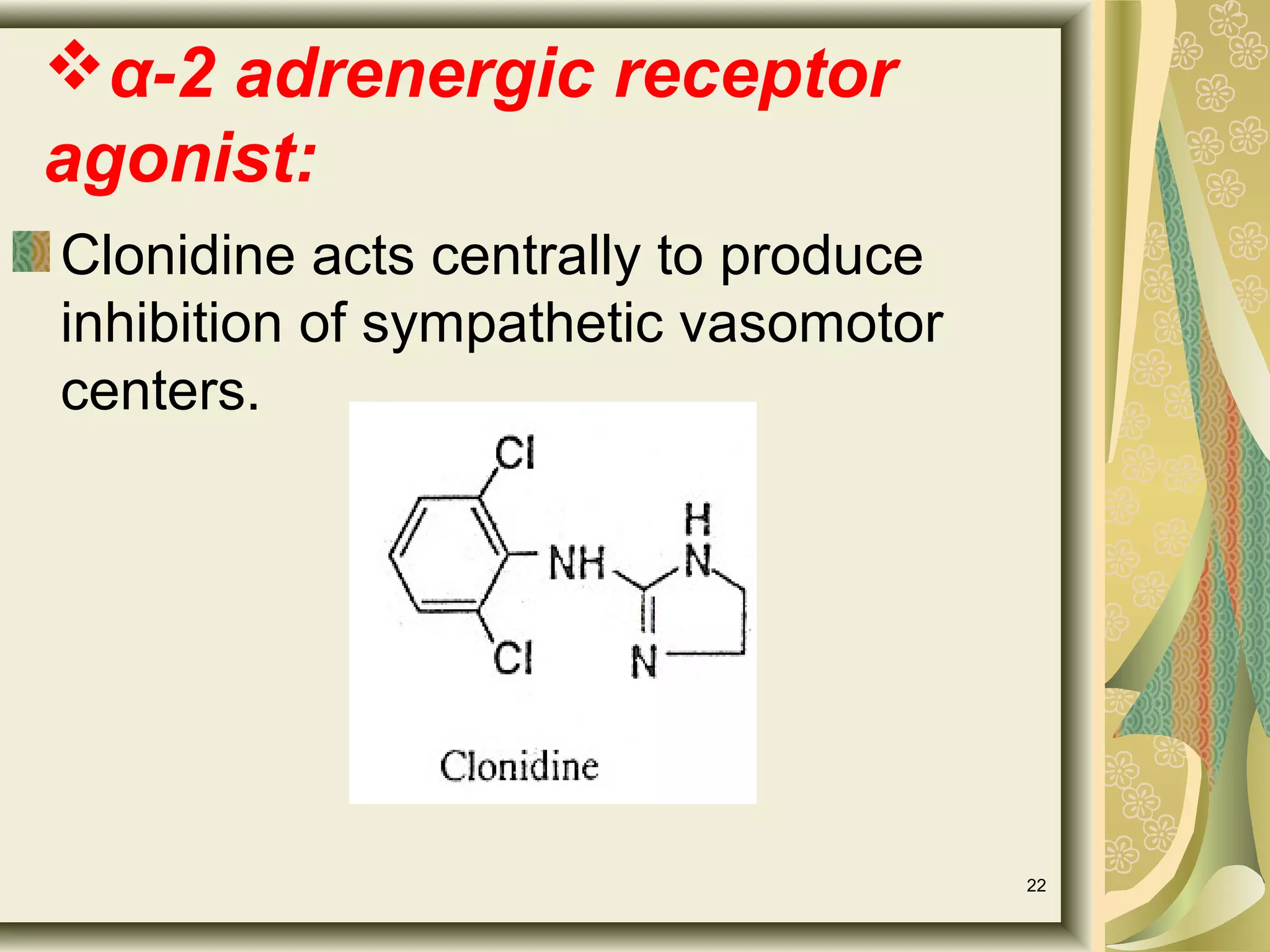
Clonidine acts centrally to produce 
inhibition of sympathetic vasomotor 
centers. 
22
23 
Miscellaneous 
α-methyl dopa 
Neuronal blockers (bretylium, 
guanethidine) 
Bretylium
#Rauwolfia and derivatives 
(reserpine, deserpidine) 
reserpine 
24
#Ganglionic blockers 
(guanadrel, mecamylamine) 
Guanadrel 
25
#Non specific vasodilator 
(hydralazine, minoxidil) 
Hydralazine minoxidil 
26
Recent anti-hypertensive 
drugs 
AT1 ANTAGONIST 
Olmesartan minoxidil 
Azilsartan minoxidil 
27
Serotonin receptor 
antagonist 
Ketanserin: At higher conc. it inhibits 
α-1 adrenergic receptors. 
28
Endothelin receptor 
antagonist 
E.g.,ambrisentan,sitasenten,bosentan, 
darusentan. 
Ambrisentan 
Darusenten 
29
ET-1 is a more potent vasoconstrictor than 
angiotensin II and has high affinity for the ETA 
receptor subtype which mediates the 
vasoconstriction characteristics of the Endothelin. 
30
Protein Kinase C inhibitors 
Staurosporin(antibiotic);it is a natural 
product isolated in 1977 from 
bacterium “streptomyces 
staurosporeus”. 
31
CALCIUM CHANNEL 
BLOCKER 
Cilnidipine 
Azelnidine 
Clevidipine 
32
BUCINDOLOL 
Non-selective β-blocker and weak α- 
blocker. 
Mild vasodilator. 
33
CHYMASE INHIBITORS 
Chymase inhibitors may be useful for 
preventing cardiovascular diseases 
and fibrosis via inhibition of 
angiotensin II formation and 
transforming growth factor-beta 
activation. 
E.g.,SPF-32629A 
34
PROSTACYCLINE ANALOGUE 
M/C:-Direct vasodilation of pulmonary and 
systemic arterial beds;also inhibits platelet 
aggregation. 
E.g.,Treprostinil 
35
CONTRAINDICATIONS 
Antihypertensive drugs are contraindicated 
in patients with known hypersensitivity to 
the individual drug 
ACEIs: Contraindicated in patients with 
impaired renal function, congestive heart 
failure, salt or volume depletion, bilateral 
stenosis, or angioedema, also during 
pregnancy or lactation 
Use of the ACEIs and the angiotensin II 
receptor blockers during the second and 
third trimester of pregnancy is 
contraindicated because use may cause 
fetal and neonatal injury or death 
36
SYNTHESIS OF NIFEDIPINE 
Claisen schmidt condensation 
37
38
39

Antihypertensive drugs

  • 1.
    ANTIHYPERTENSIVE DRUGS Submittedto : Dr.M.N.Noolvi H.O.D. (P’ceutical chemistry)  Submitted by: Kirti N patel M.pharm(IIIrd sem.) (P’ceutical chemistry) 1
  • 2.
    Hypertension:  Hypertensionis defined as either a sustained systolic blood pressure (SBP)of greater than 140 mm Hg or a sustained diastolic blood pressure of greater than 90 mm of Hg.  An agent that reduces high blood pressure is called as an ANTIHYPERTENSIVE. 2
  • 3.
    Prehypertension-systolic between 120to 139 mm/Hg and diastolic between 80 to 89 mm/Hg.  Effects of Hypertension Increases risk of heart disease , heartfailure, kidney disease, blindness, and stroke.  Primary Hypertension- No known reason. Secondary Hypertension-due to some cause such as kidney disease, abnormalities of adrenal glands will try nonpharmacological methods first. 3
  • 4.
    #Causes: It resultsfrom: Increased arterial resistance Reduced capacitance Increased peripheral vascular smooth muscle tone 4
  • 5.
    Decrease in blood pressure Increased blood pressure Increased sympathetic activity Increased activation of β1 adrenoceptor s on heart Increased cardiac output Increased activation of α1 adrenoceptors on smooth muscle Increased peripheral resistance Decreased renal blood flow Increased renin Increased angiotensin II Decreased GFR Increased aldosterone Increased Na-H2O Retention Increased blood volume 5
  • 6.
    Miscellaneous α2 receptor agonist α1 receptor antagonist Beta blockers Calcium Channel blocker ACE Inhibitors Diuretics ANTI HYPERTENSIVE DRUGS 6
  • 7.
    CLASSIFICATION OF DRUGS 1.ACE INHIBITORS Captopril,enalapril,lisinopril,perindopril,ramipril. 2.ANGIOTENSIN ANTAGONISTS Losartan,irbesartan,candesartan 3.CALCIUM CHANNEL BLOCKERS Verapamil,diltiazam,nifedipine,felodipine,amlodipine,lacidipine, 4.DIURETICS Thiazide=hydrochlorothiazide,chlorthalidone.indapamide High ceiling=furosemide K+ sparing=spironolactone.amiloride, 5.ß - ADRENERGIC BLOCKERS Propranolol,metaprolol,atenolol. 6.+ß ADRENERGIC BLOCKERS Labetalol,carvedilol. 7. - ADRENERGIC BLOCKERS prazosin.,terazosin,phentolamine 8.CENTRAL SYMPATHOLYTIC Clonidine,methyldopa 9.VASODILATORS Hydralazine,minoxidil sodium 7
  • 8.
    Diuretics Thiazide Type: Hydrochlorothiazide,Chlorothalidone,Bendroflume-thiazide, Trichloromethazide Potassium Sparing: Spironolactone,Amiloride,Triamterene Loop Diuretics: Furosemide,Ethacrynic Acid,Bumetanide,Torasemide 8
  • 9.
    THIAZIDE DIURETICS Sodium,water retention Blood volume Cardiac output Peripheral resistance Decrease in blood pressure 9
  • 10.
    Potassium Sparing Diuretics: Includes: Spironolactone (a synthetic steroid that antagonizes aldosterone at intracellular cytoplasmic receptor site) Triamterene & Amiloride (blocks Na transport channels resulting in a decrease in Na/K exchange) 10
  • 11.
    Loop Diuretics: Inhibitthe co-transport of Na/K/Cl in the luminal membrane in the ascending limb of the loop of Henle Examples:Furosemide,Bumetanide,Ethacrynic acid 11
  • 12.
    Beta Blockers: Non-selective(β1/β2):Propranolol,Timolol Nadolol,Pindolol propranolol structure ; 12
  • 13.
    Selectiveβ1 : Atenolol,Acebutalol Atenolol structure; 13
  • 14.
    Beta adrenoceptor blocker Activation of β1 receptors on the heart Renin Cardiac output Peripheral resistance Angiotensin II Aldosterone Na/Water retention Blood Volume Decrease in blood pressure 14
  • 15.
    Examples of ACEInhibitors: Captopril Enalpril Lisinopril Ramipril 15
  • 16.
    ACE Inhibitors: ACEInhibitors blocks the ACE that cleaves angiotensin-I to form the potent vasoconstrictor angiotensin-II by reducing circulating angiotensin-II levels , ACE inhibitors also decrease secretion of aldosterone, resulting in decreased sodium & water retention. 16
  • 17.
    Angiotensin II receptor antagonist E.g.,losartan,irbesartan,candesartan, valsartan. Losartan Irbesartan 17
  • 18.
    Angiotensin II receptor antagonist They produce vasodilation and block aldosterone secretion, thus lowering blood pressure and decreasing salt and water retention. 18
  • 19.
    Calcium channel blockers: Dihydropyridine:Nifedipine,nicardipine Phenylalkylamines:Verapamil Benzothiazepines:Diltiazem 19
  • 20.
    Calcium channel blockers: It inhibits cellular influx of Ca, which is responsible for muscle contraction. Calcium channel blockers protect tissue by inhibiting entrance of Ca into cardiac & smooth muscle cells of coronary & systemic arterial beds. All Ca channel blockers are vasodilators that ultimately cause dilation of coronary & peripheral arteries,reduce heart rate. 20
  • 21.
    α-1 adrenergic receptors antagonist: Decrease the peripheral vascular resistance & lower the arterial blood pressure by causing relaxation of both arterial & venous smooth muscle Examples: Prazosin Doxazosin Terazosin 21
  • 22.
    α-2 adrenergic receptor agonist: Clonidine acts centrally to produce inhibition of sympathetic vasomotor centers. 22
  • 23.
    23 Miscellaneous α-methyldopa Neuronal blockers (bretylium, guanethidine) Bretylium
  • 24.
    #Rauwolfia and derivatives (reserpine, deserpidine) reserpine 24
  • 25.
    #Ganglionic blockers (guanadrel,mecamylamine) Guanadrel 25
  • 26.
    #Non specific vasodilator (hydralazine, minoxidil) Hydralazine minoxidil 26
  • 27.
    Recent anti-hypertensive drugs AT1 ANTAGONIST Olmesartan minoxidil Azilsartan minoxidil 27
  • 28.
    Serotonin receptor antagonist Ketanserin: At higher conc. it inhibits α-1 adrenergic receptors. 28
  • 29.
    Endothelin receptor antagonist E.g.,ambrisentan,sitasenten,bosentan, darusentan. Ambrisentan Darusenten 29
  • 30.
    ET-1 is amore potent vasoconstrictor than angiotensin II and has high affinity for the ETA receptor subtype which mediates the vasoconstriction characteristics of the Endothelin. 30
  • 31.
    Protein Kinase Cinhibitors Staurosporin(antibiotic);it is a natural product isolated in 1977 from bacterium “streptomyces staurosporeus”. 31
  • 32.
    CALCIUM CHANNEL BLOCKER Cilnidipine Azelnidine Clevidipine 32
  • 33.
    BUCINDOLOL Non-selective β-blockerand weak α- blocker. Mild vasodilator. 33
  • 34.
    CHYMASE INHIBITORS Chymaseinhibitors may be useful for preventing cardiovascular diseases and fibrosis via inhibition of angiotensin II formation and transforming growth factor-beta activation. E.g.,SPF-32629A 34
  • 35.
    PROSTACYCLINE ANALOGUE M/C:-Directvasodilation of pulmonary and systemic arterial beds;also inhibits platelet aggregation. E.g.,Treprostinil 35
  • 36.
    CONTRAINDICATIONS Antihypertensive drugsare contraindicated in patients with known hypersensitivity to the individual drug ACEIs: Contraindicated in patients with impaired renal function, congestive heart failure, salt or volume depletion, bilateral stenosis, or angioedema, also during pregnancy or lactation Use of the ACEIs and the angiotensin II receptor blockers during the second and third trimester of pregnancy is contraindicated because use may cause fetal and neonatal injury or death 36
  • 37.
    SYNTHESIS OF NIFEDIPINE Claisen schmidt condensation 37
  • 38.
  • 39.