FAST DISSOLUTION
DISINTEGRATION DOSAGE FORM
Submitted by –RAHUL KUL BHUSHAN
Enroll No-2012/1333
B.Pharma 4thyear
Submitted to- MANISH DEV INDORIYA
ASSOCIATE PROF.
(DEPT. OF Pharmaceutics)
INTRODUCTION OF FDDF
NEEDS AND ADVANTAGES OF FDDF
Classification of FDDF
Ingredients to be used for FDDTs
METHODS OF PREPARATION OF FDDT
PATENTED TECHNOLOGIES
Formulations of FDDF’s
CLINICAL STUDIES
COMMERCIAL PRODUCTS OF FDDT’S
CONCLUSION
INTRODUCTION OF FDDF
 The most popular dosage form like Tablets, Capsules, and
Solutions have an important prerequisite that drug should
have an “Optimum solubility” to avoid bioavailability
problems .
 The solid dosage forms that dissolve or disintegrate quickly
in the oral cavity, resulting in solution or suspension
without the need of administration of water are known as
fast dissolving/disintegrating dosage forms (FDDFs).
NEEDS AND ADVANTAGES
OF FDDF
Needs of FDDF:-
 Infants, children and elderly people have difficulty in swallowing
oral solid unit dosage e.g. Tablets and capsules .
 The current needs of the industry are improved
solubility/stability, biological half-life and bioavailability
enhancement of poorly absorbed drugs.
 Fast-dissolving/disintegrating tablet formulations are similar to
many sustained release formulations that are now commonly
available and these are most appropriate dosage forms with ease
Advantages of Mouth dissolving tablets:-
 Ease of administration for patients who are mentally ill,
disabled and uncooperative.
 Requires no water
 Quick disintegration and dissolution of the dosage form.
 Overcomes unacceptable taste of the drugs.
 Can be designed to leave minimal or no residue in the
mouth after administration and also to provide a pleasant
mouth feel.
 Allows high drug loading.
Classification of FDDF :-
 1. Fast dissolving/disintegrating tablets. ( FDT’s)
 2. Fast dissolving wafers (FDW’S)
 3. Fast dissolving films (FDF’S)
Ingredients to be used for FDDTs
 Important ingredients that are used in the formulation of
FDDTs should allow quick release of the drug, resulting in
faster dissolution. This includes both the actives and the
excipients.
 Excipients balance the properties of the actives in FDDTs.
This demands a thorough understanding of the chemistry
of these excipients to prevent interaction with the actives.
 These inactive food-grade ingredients, when incorporated
in the formulation, impart the desired organoleptic
properties and product efficacy.
METHODS OF PREPARATION OF
FDDT
 Direct compression method
 Spray Drying
 Tablet molding
 Freeze-drying
 Sublimation
 Sugar based excipients
 Taste Masking
 Three-dimensional printing technology
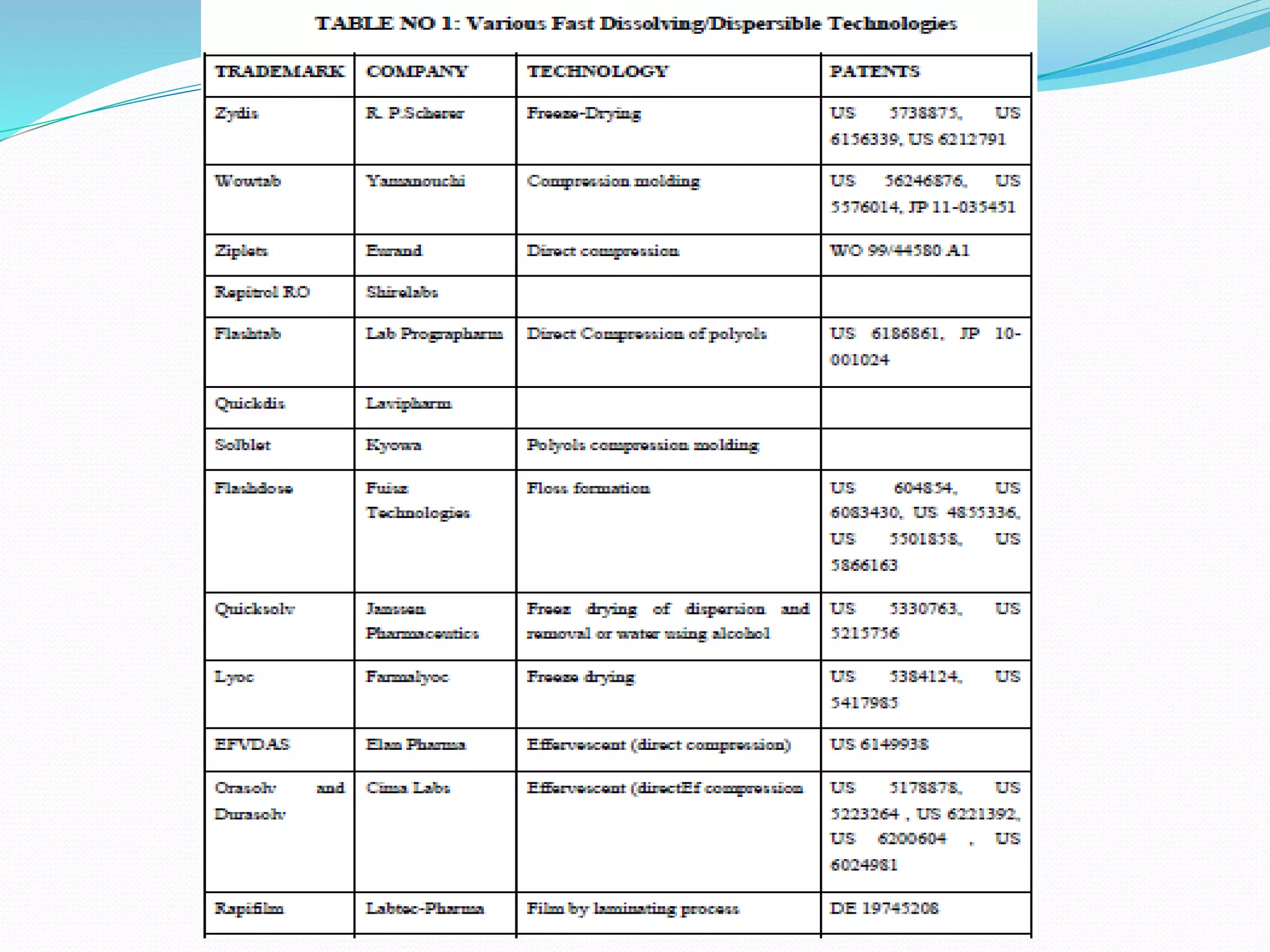
PATENTED TECHNOLOGIES
A. Zydis Technology
B. Durasolv Technology
C. Orasolv Technology
D. Flash Dose Technology
E. Wowtab Technology
F. Flashtab Technology
G. Oraquick Technology
H. Quick –Dis Technology
Formulations of FDDF’s
Formulation 1
In this example, the pharmaceutical substance is
chlorpheniramine maleate and the natural gum
component is a mixture of guar gum and acacia gum.
The formulation for the dosage form is as follows:
Formulation2 :-
 In this example, two batches, were prepared which differed
only in the weight percents of mannitol and water, the
mannitol being 12.5% w/w in the first and 15% w/w in the
second. Each formulation produced wafers that were crisp
and exhibited a good snap and good dissolution time, each
dissolving in water at 37 .degree. C. in less than 10 seconds .
Formulation 3 :-
 In this example, in addition to chlorpheniramine, a second
medication, phenylephrine, is added to the formulation.
The wafers had good body (snap/crispness) and the
disintegration time was less than 10 seconds in water at
37.degree. C.
CLINICAL STUDIES
 Various clinical studies for bioavailability, bioequivalence
and pregastric absorption of drugs have been reported in
the literature. Gamma scientigraphic studies in human
volunteers to compare oesophageal clearance and and
behaviour of freeze dried FDDFs clearly demonstrated no
evidence of oesophageal adhesion (Wilson et al, 1987,
1988).
 Propyphenazone lyophilized tablets (FDDF) were more
advantageous for analgesic antipyretic therapy when
compared with tablets prepared by simple compression.
COMMERCIAL PRODUCTS OF FDDT’S
CONCLUSION
 Besides delivering drug to the body, a drug delivery system
aim to improve patient compliance and convenience, and
fast dissolving tablets are no exception.
 FDDFs dissolve or disintegrate very rapidly in the oral
cavity in close proximity to the taste buds.
 Various technologies fast dissolving tablet technologies,
taste masking, optimization by artificial neuron networks
and fluidized bed technology, and microencapsulation
advances the formulation development and processing
technologies to design more patient friendly and
sophisticated drug delivery systems
THANK YOU

Drug dissolution ppt

  • 1.
    FAST DISSOLUTION DISINTEGRATION DOSAGEFORM Submitted by –RAHUL KUL BHUSHAN Enroll No-2012/1333 B.Pharma 4thyear Submitted to- MANISH DEV INDORIYA ASSOCIATE PROF. (DEPT. OF Pharmaceutics)
  • 2.
    INTRODUCTION OF FDDF NEEDSAND ADVANTAGES OF FDDF Classification of FDDF Ingredients to be used for FDDTs METHODS OF PREPARATION OF FDDT PATENTED TECHNOLOGIES Formulations of FDDF’s CLINICAL STUDIES COMMERCIAL PRODUCTS OF FDDT’S CONCLUSION
  • 3.
    INTRODUCTION OF FDDF The most popular dosage form like Tablets, Capsules, and Solutions have an important prerequisite that drug should have an “Optimum solubility” to avoid bioavailability problems .  The solid dosage forms that dissolve or disintegrate quickly in the oral cavity, resulting in solution or suspension without the need of administration of water are known as fast dissolving/disintegrating dosage forms (FDDFs).
  • 4.
    NEEDS AND ADVANTAGES OFFDDF Needs of FDDF:-  Infants, children and elderly people have difficulty in swallowing oral solid unit dosage e.g. Tablets and capsules .  The current needs of the industry are improved solubility/stability, biological half-life and bioavailability enhancement of poorly absorbed drugs.  Fast-dissolving/disintegrating tablet formulations are similar to many sustained release formulations that are now commonly available and these are most appropriate dosage forms with ease
  • 5.
    Advantages of Mouthdissolving tablets:-  Ease of administration for patients who are mentally ill, disabled and uncooperative.  Requires no water  Quick disintegration and dissolution of the dosage form.  Overcomes unacceptable taste of the drugs.  Can be designed to leave minimal or no residue in the mouth after administration and also to provide a pleasant mouth feel.  Allows high drug loading.
  • 6.
    Classification of FDDF:-  1. Fast dissolving/disintegrating tablets. ( FDT’s)  2. Fast dissolving wafers (FDW’S)  3. Fast dissolving films (FDF’S)
  • 7.
    Ingredients to beused for FDDTs  Important ingredients that are used in the formulation of FDDTs should allow quick release of the drug, resulting in faster dissolution. This includes both the actives and the excipients.  Excipients balance the properties of the actives in FDDTs. This demands a thorough understanding of the chemistry of these excipients to prevent interaction with the actives.  These inactive food-grade ingredients, when incorporated in the formulation, impart the desired organoleptic properties and product efficacy.
  • 8.
    METHODS OF PREPARATIONOF FDDT  Direct compression method  Spray Drying  Tablet molding  Freeze-drying  Sublimation  Sugar based excipients  Taste Masking  Three-dimensional printing technology
  • 9.
    PATENTED TECHNOLOGIES A. ZydisTechnology B. Durasolv Technology C. Orasolv Technology D. Flash Dose Technology E. Wowtab Technology F. Flashtab Technology G. Oraquick Technology H. Quick –Dis Technology
  • 11.
    Formulations of FDDF’s Formulation1 In this example, the pharmaceutical substance is chlorpheniramine maleate and the natural gum component is a mixture of guar gum and acacia gum. The formulation for the dosage form is as follows:
  • 12.
    Formulation2 :-  Inthis example, two batches, were prepared which differed only in the weight percents of mannitol and water, the mannitol being 12.5% w/w in the first and 15% w/w in the second. Each formulation produced wafers that were crisp and exhibited a good snap and good dissolution time, each dissolving in water at 37 .degree. C. in less than 10 seconds .
  • 13.
    Formulation 3 :- In this example, in addition to chlorpheniramine, a second medication, phenylephrine, is added to the formulation. The wafers had good body (snap/crispness) and the disintegration time was less than 10 seconds in water at 37.degree. C.
  • 14.
    CLINICAL STUDIES  Variousclinical studies for bioavailability, bioequivalence and pregastric absorption of drugs have been reported in the literature. Gamma scientigraphic studies in human volunteers to compare oesophageal clearance and and behaviour of freeze dried FDDFs clearly demonstrated no evidence of oesophageal adhesion (Wilson et al, 1987, 1988).  Propyphenazone lyophilized tablets (FDDF) were more advantageous for analgesic antipyretic therapy when compared with tablets prepared by simple compression.
  • 15.
  • 16.
    CONCLUSION  Besides deliveringdrug to the body, a drug delivery system aim to improve patient compliance and convenience, and fast dissolving tablets are no exception.  FDDFs dissolve or disintegrate very rapidly in the oral cavity in close proximity to the taste buds.  Various technologies fast dissolving tablet technologies, taste masking, optimization by artificial neuron networks and fluidized bed technology, and microencapsulation advances the formulation development and processing technologies to design more patient friendly and sophisticated drug delivery systems
  • 17.