DESIGN DEVELOPMENT OF LORNOXICAM FAST
DISSOLVING TABLET BY DIFFERENT TECHNIQUES
A
DISSERTATION
SUBMITTED BY
MR. VIJAY S.SAPKALE
Research Guide
DR. HARUN PATEL
IN
THE FACULTY OF PHARMACY
(PHARMACEUTICS)
TO
NORTH MAHARASTRA UNIVERSITY
R C PATEL COLLEGE OF PHARMACY
SHIRPUR, DIST-DHULE, 425107
NORTH MAHARASHTRA UNIVERSITY, JALGAON- INDIA
CONTENTS
 Introduction
 Objectives
 Review Of Literature
 Drug and Excipients Profile
 Methodology
 Result
 Discussion
 Conclusion
 Summary
 References
Solid dosage forms like tablet and capsule are most popular and preferred drug
delivery system because they have high patient compliance, relatively easy to
produce, easy to market, accurate dosing, and good physical and chemical
stability.
Oral drug delivery has been known for decades as the most widely utilized route
of administration among all the routes that have been explored for the systemic
delivery of drugs via various pharmaceutical products of different dosage forms.
The reason that the oral route achieved such popularity may be in part attributed to
its ease of administration as well as the traditional belief that by oral
administration the drug is as well absorbed as the food stuffs that are ingested
daily.
The development of pharmaceutical products for oral delivery, irrespective of
physical form involves varying extents of optimization of dosage form
characteristics within the inherent constraints of GI physiology. The scientific
frame work required for the successful development of an oral drug delivery
system consists of a basic understanding of the following three aspects:
1. Physicochemical, pharmacokinetic and pharmacodynamic characteristics of
the drug
2. The anatomic and physiologic characteristics of the GIT
3. Physicochemical characteristics and the drug delivery mode of the dosage
form to be designed.
Orally disintegrating tablets are also called as oral disperse,mouth dissolving,
rapidly disintegrating ,fast melt and quick dissolve system.From past decade,there
has been an increased demand for more patient-friendly and compliant dosage
forms.As a result ,the demand for developing new technologies has been
increasing day by day.3 US Food and Drug Administration Center for Drug
Evaluation and Research (CDER) defines, in the ‘Orange Book’ an ODT as “a
solid dosage form containing medicinal substances, which disintegrates rapidly,
usually with a matter of seconds, when placed upon the tongue.
European Pharmacopoeia described orally disintegrating tablets as „uncoated
tablets intended the placed in the mouth where they disperse rapidly before being
swallowed and as tablets which should disintegrate within 3 min.
Scientist have developed innovative drug delivery system known as fast dissolving
“melt in mouth” or mouth dissolve (MD) tablet. These are novel type of tablet
that disintegrate dissolve / disperse in saliva.
Orally disintegrating tablets are also called as orodispersible tablet, quick
disintegrating tablets, mouth dissolving tablets, Fast integrating tablets, fast
dissolving tablets, rapid dissolving tablets, porous tablets.
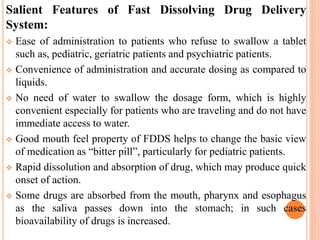
Desired Criteria’s for Fast Disintegrating Drug
Delivery System:
 Not require water to swallow, but it should dissolve or disintegrate
in the mouth in a matter of seconds.
 Have a pleasing mouth feel.
 Should be compatible with taste masking.
 Should be potable without fragility concern.
 Leave minimal or no residue in the mouth after oral administration.
 Exhibit low sensitivity to environmental conditions such as
humidity and temperature.
 Allow the manufacture of tablet using conventional processing and
packaging equipment at low cost.
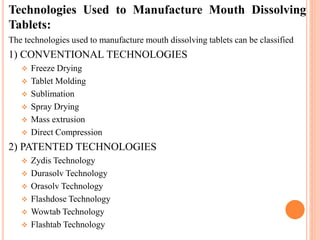
Salient Features of Fast Dissolving Drug Delivery
System:
 Ease of administration to patients who refuse to swallow a tablet
such as, pediatric, geriatric patients and psychiatric patients.
 Convenience of administration and accurate dosing as compared to
liquids.
 No need of water to swallow the dosage form, which is highly
convenient especially for patients who are traveling and do not have
immediate access to water.
 Good mouth feel property of FDDS helps to change the basic view
of medication as “bitter pill”, particularly for pediatric patients.
 Rapid dissolution and absorption of drug, which may produce quick
onset of action.
 Some drugs are absorbed from the mouth, pharynx and esophagus
as the saliva passes down into the stomach; in such cases
bioavailability of drugs is increased.
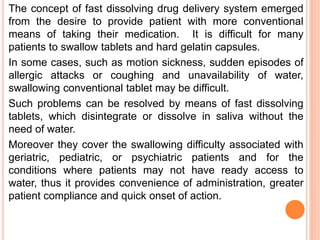
Technologies Used to Manufacture Mouth Dissolving
Tablets:
The technologies used to manufacture mouth dissolving tablets can be classified
1) CONVENTIONAL TECHNOLOGIES
 Freeze Drying
 Tablet Molding
 Sublimation
 Spray Drying
 Mass extrusion
 Direct Compression
2) PATENTED TECHNOLOGIES
 Zydis Technology
 Durasolv Technology
 Orasolv Technology
 Flashdose Technology
 Wowtab Technology
 Flashtab Technology
The concept of fast dissolving drug delivery system emerged
from the desire to provide patient with more conventional
means of taking their medication. It is difficult for many
patients to swallow tablets and hard gelatin capsules.
In some cases, such as motion sickness, sudden episodes of
allergic attacks or coughing and unavailability of water,
swallowing conventional tablet may be difficult.
Such problems can be resolved by means of fast dissolving
tablets, which disintegrate or dissolve in saliva without the
need of water.
Moreover they cover the swallowing difficulty associated with
geriatric, pediatric, or psychiatric patients and for the
conditions where patients may not have ready access to
water, thus it provides convenience of administration, greater
patient compliance and quick onset of action.
Therefore, in the present study an attempt has been made to formulate
fast dissolving tablets of Lornoxicam by different techniques such as
direct compression method, sublimation method, solid dispersion
method and effervescent method.
1) Fast dissolving tablets of lornoxicam were prepared using
superdisintegrants croscarmellose sodium, sodium starch
glycolate, crospovidone, subliming agent such as camphor and
Menthol. Hydrophiliccarrier such as mannitol, PVP, PEG-600.
Effervescent agent such as sodium bicarbonate and citric acid were
used in different ratios.
2) The prepared fast dissolving tablets were evaluated for
micrometric properties (fluff density, tapped density, angle of
repose and carr’s index),Weight variation, hardness , thickness,
friability , wetting time, water absorption ratio, disintegration time,
drug content and in-vitro drug release studies.
3) Prepared formulations were also subjected to Fourier Transform
Infrared (FTIR) Spectroscopy and Differential scanning.
Patel DM et. al., Studied in formulation of orodispersible tablet of Rafecoxib.
The superdisintegrants sodium starch glycolate. Croscarmellose sodium used in
different formulation. Granulation was carried out by deposition method and
prepared granules directly compressed. He concluded that the tablet containing
crospovidone exhibit quick disintegrating time and wetting time followed by
tablet containing croscarmellose sodium and sodium starch glycolate.
Lalla JK et. al., Prepared fast dissolving Rofecoxib tablets by wet granulation
methods using lactose, Avicel PH 102. The inclusion complex of Rofecoxib β-
cyclodextrin using ball milling technique and the evaluation was done with DSC.
Tablet evaluated for weight variation, hardness, friability, disintegration time and
stability studies conducted as per ICH guidlines. Comparison between formulated
fast dissolving tablets of Rofecoxib with a conventional released marketed tablet.
It was observed that combination of three disintegrants gave the desired rapid
disintegration. The dissolution study show that the formulation prepared either by
wet granulation or by direct compression showed complete release of drug within
12 min in both media.
Chaudhari PD et. al., Studied the bitter taste of famotidine was masked using
Eudragit in different ratio. The different superdisintegrants like Ac-di-sol and
polyplasdone with their varying concentration used for disintegration of tablet in
mouth. After dissolution study he concluded that all formulation showed faster
release rate than marketed formulation.
Mishra DN et. al., Formulated rapidly disintegration oral tablet of poor aqueous
soluble valdecoxib by direct compression technique. Using crospovidone, sodium
starch glycolate and cross camellose sodium as disintegrants. He found that
hardness of all prepared tablets was found to be satisfactory. Tablet containing
crosspovidone shows only lesser hardness as compare to other disintegrants. He
concluded that fast disintegrating tablets of voldecoxib can be successfully
prepared using selected superdisintegrants.
Zhao N et. al., Compared disintegration efficiency and to developed a
discriminating model for 3 classes of superdisintegrants represented of AC-Di-Sol,
primoses and polyplasdone X L 10. The study were thus provides a closer look at
the functionality of superdisintegrants in promoting tablet disintegration and
development of model formulation with examinated by videography and
dissolution profile. AC-Di-Sol was found to disintegrate tablet rapidly into
apparently primary particles. 3 disintegrants representing each of the 3 main
classes of superdisintegrants differed in their ability to disintegrate model tablets
into their primary particles.
Sharma S et. al., Formulated promethazine theoclate solid dispersion with PEG
4000 by using optimized amount of superdisintegrant.A phase solubility method
was used to evaluate the effect of various water-soluble polymers on aqueous
solubility of promethazine theoclate.PEG 4000 was selected and solid dispersion
were prepared by method of fusing.
Uddhav S et. al., Described manufacturing technologies for mouth dissolving
tablets showing that incorporation of an existing medicine into a new drug
delivery system can significantly improve its performance in terms of efficacy,
safety and improved patient compliance. In these studies they had described
different types of technologies employed for the formulation of mouth dissolving
tablets i.e. freeze drying, spray drying, sublimation and comparison of sugar based
excipients with their dissolution rate and compressibility.
Chaudhari PD et. al., Formulated and evaluated taste masked orodispersible
dosage form of levocetirizine. An attempt was made to mask the taste, by
complexation technique using ion-exchange resin, tulsion 335 formulate in to a
orodispersible dosage form. The drug loading onto ion exchange resin was
optimized for concentration of resin, swelling time of resin, stirring time, pH of
resin solution, stirring temperature. Shows bitter drug successfully taste masked
using suitable ion exchange resin. The drug resin complex orodispersible tablets
were formulated and the evaluated for drug content, content uniformity, weight
variation, hardness, friability, water absorption ratio, in-vitro and in-vivo drug
release.
Bhardwaj S et al., Formulated and evaluated fast dissolving tablet of aceclofenac
using sodium starch glycolate following by direct compression method.The tablets
were evaluated for hardness, friability, weight variation, disintegration time, water
absorption ratio and wetting time, invitro dissolution studies. All the formulation
showed less disintegration time and rapid dissolution.
DRUG AND EXCIPIENTS PROFILE
Lornoxicam
Chemical formula:
(3E)-6-chloro-3-[hydroxy(pyridin-2-ylamino)methylene]-2-methyl-2,3-dihydro-
4H-thieno[2,3-e][1,2]thiazin-4-one 1,1-dioxide.
Chemical structure :
Empirical Formula : C13H10ClN3O4S2
Molecular weight : 371.8192 g/mol
Solubility:Slightly soluble in chloroform and 0.1mol/L NaOH Liquor and very lightly
soluble in methanol and acetonitrile and hardly soluble in water.
Bioavailability : 90-100%
Protine Binding : 99%
Half-life : 3-4 hour
Melting Point : 239-241 degree dec.
Therapeutic category: Lornoxicam is used for the treatment of various types of
pain, especially resulting from inflammatory diseases of the joints, osteoarthristis
surgery, sciatica, and other inflammations.
Indication: Lornoxicam is used for the treatment of various types of pain,
especially resulting from inflammatory diseases of the joints, osteoarthritis,
surgery, sciatica, and other inflammations.
Adverse effect: Lornoxicam has side effects similar to other NSAIDs, most
commonly mild ones like gastrointestinal disorders (nausea and diarrhea) and
headache. Severe but seldom side effects include bleeding, bronchospasms and
the extremely rare Stevens–Johnson syndrome.
Mechanism of action: Like other NSAIDs, lornoxicam inhibits prostaglandin
biosynthesis by blocking the enzyme cyclooxygenase.Lornoxicam inhibits both
isoforms in the same concentration range, that is, the ratio of COX-1 inhibition to
COX-2 inhibition is 1:1. It readily penetrates into the synovial fluid. The AUC
ratio of synovial fluid to blood plasma is 0.5 after administration of 4 mg twice
daily.
Dose:
1) Adult Dose: Postoperative pain/acute lumbo-sciatia, recommended daily dose,
8mg to 16mg taken before meals (daily doses above 8mg should be divided into
two or more doses). Maximum single dose, 8mg; maximum daily dose, 16mg.
Osteoarthritis/Rheumatoid arthritis, recommended daily dose, 12 mg taken before
meals (4mg three times daily or 8mg in the morning and 4mg at night); maximum
recommended daily dose for long-term treatment, 12mg.
2) Child Dose : Under 18 years, not recommended
3) Elderly Dose : Monitoring of renal and hepatic function is recommended.
Brand Name:
 Lorniflex
 Lorsaid
 Lornoxi
 Lorex
 Lornox
Excipients
 Crospovidone:
Synonyms : Crosslinked povidone, polyvinyl
Chemical name :1-Ethenyl-2-pyrrolidinone homopolymer
Empirical formula and molecular weight: (C6H9NO)n ( >1000000)
Functional category : Superdisintegrant.
Description:Crospovidone is a white to creamy-white, finely divided, free-
flowing, practically tasteless, odorless or nearly odorless, hygroscopic powder.
 Croscarmellose sodium:
Synonyms : Ac-Di-sol; cross-linked carboxy methylcellulose Sodium;
Primellose
Chemical name : Cellulose, carboxymethyl ether, sodium salt, cross- linked
Functional category :Tablet and capsule disintegrants
Description: Croscarmellose sodium occurs as an odourless, white-coloured
powder.
 Sodium starch glycolate:
Synonyms: Explotab, Primogel.
Chemical names: Sodium carboxymethyl starch
Functional category: Tablet and capsule disintegrant.
Description: Sodium starch glycolate is a white to off-white, odourless, tasteless,
free flowing powder.
 Eudragit E100:
Chemical Name : Poly(butyl methacrylate-co-(2-demethylamino ethyl)
methacrylate-co-methyl methacrylate).
Physical Description: Colourse to yellow tinged granules with amine like order.
 Microcrystalline cellulose
Synonyms: Cellulose gel: Crystalline cellulose: Avicel PH101, 102.
Functional category: Tablet and capsule diluents, tablet disintegrant, suspending
and/or viscosity increasing agent.
Empirical formula:(C6H10O5)n
Molecular weight: 36,000(approx).
 Magnesium stearate:
Synonyms: Metallic stearic, Magnesium salt.
Functional category: Tablet and capsule lubricant.
Chemical names: Octadecanoic acid; Magnesium salt; Magnesium stearate
Empirical formula: C36H70MgO4
Molecular weight: 591.3
 Camphor
Synonyms: Gum Camphor
Chemical names: Bicycle [2.2, 1] heptane-2-one, 1, 7, 7-trimethyl camphor
Empirical formula: C10H16O
Molecular weight: 152.23
 Talc:
Synonym: Powdered talc.
Empirical formula: Mg 6(Si2O5)4(OH)4.
Functional category: Anticaking agent, glidant, tablet and capsule diluent, tablet
and capsule lubricant
 ß-Cyclodextrin
Synonyms: Beta-cycloamylose, betadex, beta-dextrin, cycloheptaamylose
Functional Category: Solubilizing agent and stabilizing agent.
Empirical Formula: C42H70O35
Molecular Weight: 1135
Description: White, practically odorless, amorphous powder, having a slightly
sweet taste.
Preparation of Fast Dissolving Tablets of Lornoxicam
The fast dissolving tablets of Lornoxicam were prepared by following four
methods.
 Direct compression method.
 Sublimation method.
 Solid dispersion method.
 Effervescent method.
 Direct compression method:
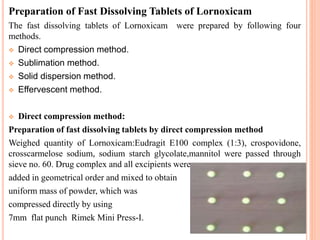
Preparation of fast dissolving tablets by direct compression method
Weighed quantity of Lornoxicam:Eudragit E100 complex (1:3), crospovidone,
crosscarmelose sodium, sodium starch glycolate,mannitol were passed through
sieve no. 60. Drug complex and all excipients were
added in geometrical order and mixed to obtain
uniform mass of powder, which was
compressed directly by using
7mm flat punch Rimek Mini Press-I.
Sublimation Method:
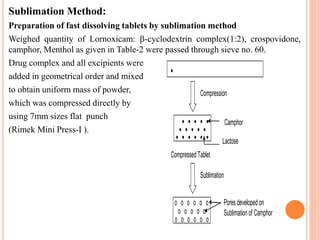
Preparation of fast dissolving tablets by sublimation method
Weighed quantity of Lornoxicam: -cyclodextrin complex(1:2), crospovidone,
camphor, Menthol as given in Table-2 were passed through sieve no. 60.
Drug complex and all excipients were
added in geometrical order and mixed
to obtain uniform mass of powder,
which was compressed directly by
using 7mm sizes flat punch
(Rimek Mini Press-I ).

Compression
    
    
     
Sublimation
CompressedTablet
Camphor
Lactose
o o o o o o
o o o o o
o o o o o o
Pores developed on
Sublimation of Camphor
Solid dispersion Method:
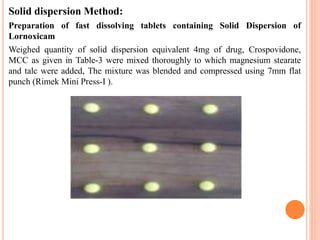
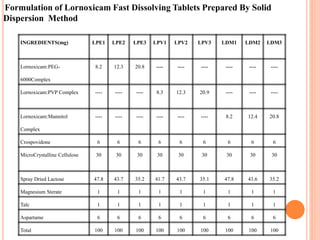
Preparation of fast dissolving tablets containing Solid Dispersion of
Lornoxicam
Weighed quantity of solid dispersion equivalent 4mg of drug, Crospovidone,
MCC as given in Table-3 were mixed thoroughly to which magnesium stearate
and talc were added, The mixture was blended and compressed using 7mm flat
punch (Rimek Mini Press-I ).
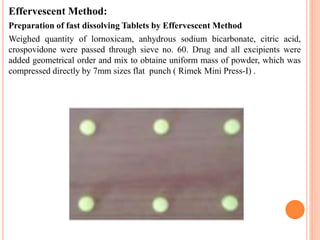
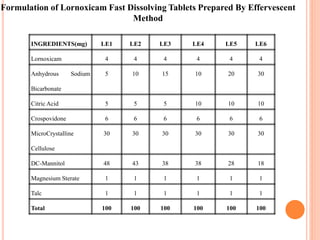
Effervescent Method:
Preparation of fast dissolving Tablets by Effervescent Method
Weighed quantity of lornoxicam, anhydrous sodium bicarbonate, citric acid,
crospovidone were passed through sieve no. 60. Drug and all excipients were
added geometrical order and mix to obtaine uniform mass of powder, which was
compressed directly by 7mm sizes flat punch ( Rimek Mini Press-I) .
Evaluation of Lornoxicam Fast Dissolving Tablets:
Micromeritic properties:
 Angle of repose ()
 Tapped density
 Fluff density
 Carr’s compressibility index
Post-compression parameters
 Hardness.
 Friability.
 Weight variation.
 Uniformity of thickness.
 Drug content uniformity.
 Wetting time.
 Water absorption ratio.
 In vitro disintegration time.
 In vitro dissolution studies.
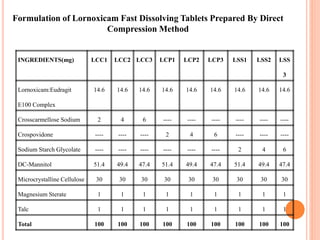
INGREDIENTS(mg) LCC1 LCC2 LCC3 LCP1 LCP2 LCP3 LSS1 LSS2 LSS
3
Lornoxicam:Eudragit
E100 Complex
14.6 14.6 14.6 14.6 14.6 14.6 14.6 14.6 14.6
Crosscarmellose Sodium 2 4 6 ---- ---- ---- ---- ---- ----
Crospovidone ---- ---- ---- 2 4 6 ---- ---- ----
Sodium Starch Glycolate ---- ---- ---- ---- ---- ---- 2 4 6
DC-Mannitol 51.4 49.4 47.4 51.4 49.4 47.4 51.4 49.4 47.4
Microcrystalline Cellulose 30 30 30 30 30 30 30 30 30
Magnesium Sterate 1 1 1 1 1 1 1 1 1
Talc 1 1 1 1 1 1 1 1 1
Total 100 100 100 100 100 100 100 100 100
Formulation of Lornoxicam Fast Dissolving Tablets Prepared By Direct
Compression Method
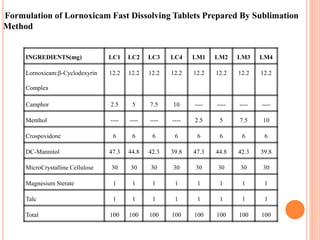
INGREDIENTS(mg) LC1 LC2 LC3 LC4 LM1 LM2 LM3 LM4
Lornoxicam:-Cyclodexyrin
Complex
12.2 12.2 12.2 12.2 12.2 12.2 12.2 12.2
Camphor 2.5 5 7.5 10 ---- ---- ---- ----
Menthol ---- ---- ---- ---- 2.5 5 7.5 10
Crospovidone 6 6 6 6 6 6 6 6
DC-Mannitol 47.3 44.8 42.3 39.8 47.3 44.8 42.3 39.8
MicroCrystalline Cellulose 30 30 30 30 30 30 30 30
Magnesium Sterate 1 1 1 1 1 1 1 1
Talc 1 1 1 1 1 1 1 1
Total 100 100 100 100 100 100 100 100
Formulation of Lornoxicam Fast Dissolving Tablets Prepared By Sublimation
Method
INGREDIENTS(mg) LPE1 LPE2 LPE3 LPV1 LPV2 LPV3 LDM1 LDM2 LDM3
Lornoxicam:PEG-
6000Complex
8.2 12.3 20.8 ---- ---- ---- ---- ---- ----
Lornoxicam:PVP Complex ---- ---- ---- 8.3 12.3 20.9 ---- ---- ----
Lornoxicam:Mannitol
Complex
---- ---- ---- ---- ---- ---- 8.2 12.4 20.8
Crospovidone 6 6 6 6 6 6 6 6 6
MicroCrystalline Cellulose 30 30 30 30 30 30 30 30 30
Spray Dried Lactose 47.8 43.7 35.2 41.7 43.7 35.1 47.8 43.6 35.2
Magnesium Sterate 1 1 1 1 1 1 1 1 1
Talc 1 1 1 1 1 1 1 1 1
Aspartame 6 6 6 6 6 6 6 6 6
Total 100 100 100 100 100 100 100 100 100
Formulation of Lornoxicam Fast Dissolving Tablets Prepared By Solid
Dispersion Method
INGREDIENTS(mg) LE1 LE2 LE3 LE4 LE5 LE6
Lornoxicam 4 4 4 4 4 4
Anhydrous Sodium
Bicarbonate
5 10 15 10 20 30
Citric Acid 5 5 5 10 10 10
Crospovidone 6 6 6 6 6 6
MicroCrystalline
Cellulose
30 30 30 30 30 30
DC-Mannitol 48 43 38 38 28 18
Magnesium Sterate 1 1 1 1 1 1
Talc 1 1 1 1 1 1
Total 100 100 100 100 100 100
Formulation of Lornoxicam Fast Dissolving Tablets Prepared By Effervescent
Method
RESULTS
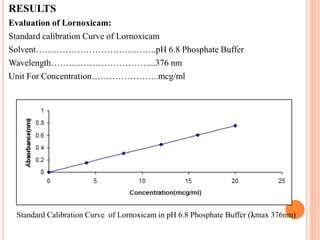
Evaluation of Lornoxicam:
Standard calibration Curve of Lornoxicam
Solvent…………………………………..pH 6.8 Phosphate Buffer
Wavelength……………………………...376 nm
Unit For Concentration…………………..mcg/ml
Standard Calibration Curve of Lornoxicam in pH 6.8 Phosphate Buffer (max 376nm)
Standard calibration Curve 0f Lornoxicam
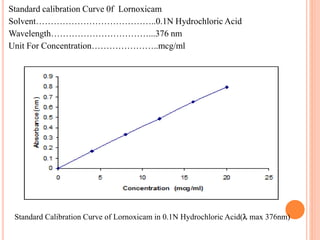
Solvent…………………………………..0.1N Hydrochloric Acid
Wavelength……………………………...376 nm
Unit For Concentration…………………..mcg/ml
Standard Calibration Curve of Lornoxicam in 0.1N Hydrochloric Acid( max 376nm)
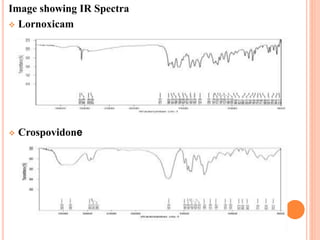
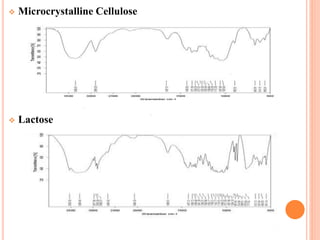
Image showing IR Spectra
 Lornoxicam
 Crospovidone
 Microcrystalline Cellulose
 Lactose
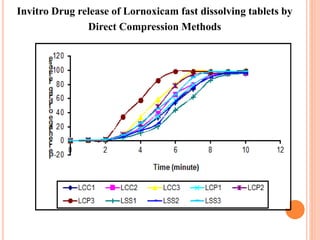
Invitro Drug release of Lornoxicam fast dissolving tablets by
Direct Compression Methods
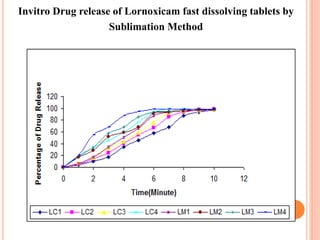
Invitro Drug release of Lornoxicam fast dissolving tablets by
Sublimation Method
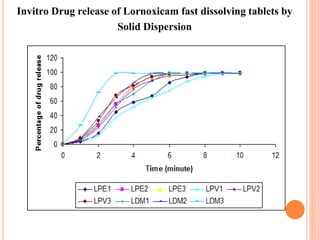
Invitro Drug release of Lornoxicam fast dissolving tablets by
Solid Dispersion
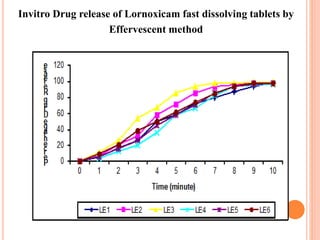
Invitro Drug release of Lornoxicam fast dissolving tablets by
Effervescent method
CONCLUSION
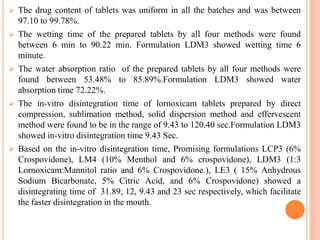
The data obtained from the study of “Design and development of lornoxicam fast
dissolving tablets by different techniques” reveals following conclusion:
 Fast dissolving tablets of lornoxicam can were successfully prepared by direct
compression, sublimation methods, solid dispersion method and effervescent
method.
 The flow properties and uniformity of all the prepared tablets were good as
indicated by good fluff density, tapped density, low angle of repose ( <30 ) ,
low compressibility index (I<35).
 The Percentage deviation of average weight of the prepared tablets showed
between 0.03 to 1.22 which indicated weight uniformity within the batches
prepared.
 The hardness of the prepared tablets by direct compression, sublimation, solid
dispersion and effervescent method was found to be in the range of 2.7 to 4.4
Kg/cm².
 The Thickness of the prepared tablets by all four methods were found between
2.12mm to 3.33 mm.
 The friability values of the prepared tablets by all four methods were found to
be less than 1%.
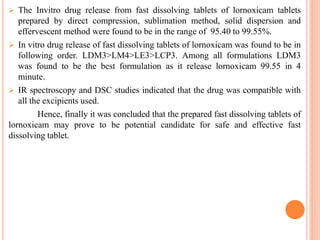
 The drug content of tablets was uniform in all the batches and was between
97.10 to 99.78%.
 The wetting time of the prepared tablets by all four methods were found
between 6 min to 90.22 min. Formulation LDM3 showed wetting time 6
minute.
 The water absorption ratio of the prepared tablets by all four methods were
found between 53.48% to 85.89%.Formulation LDM3 showed water
absorption time 72.22%.
 The in-vitro disintegration time of lornoxicam tablets prepared by direct
compression, sublimation method, solid dispersion method and effervescent
method were found to be in the range of 9.43 to 120.40 sec.Formulation LDM3
showed in-vitro disintegration time 9.43 Sec.
 Based on the in-vitro disintegration time, Promising formulations LCP3 (6%
Crospovidone), LM4 (10% Menthol and 6% crospovidone), LDM3 (1:3
Lornoxicam:Mannitol ratio and 6% Crospovidone.), LE3 ( 15% Anhydrous
Sodium Bicarbonate, 5% Citric Acid, and 6% Crospovidone) showed a
disintegrating time of 31.89, 12, 9.43 and 23 sec respectively, which facilitate
the faster disintegration in the mouth.
 The Invitro drug release from fast dissolving tablets of lornoxicam tablets
prepared by direct compression, sublimation method, solid dispersion and
effervescent method were found to be in the range of 95.40 to 99.55%.
 In vitro drug release of fast dissolving tablets of lornoxicam was found to be in
following order. LDM3>LM4>LE3>LCP3. Among all formulations LDM3
was found to be the best formulation as it release lornoxicam 99.55 in 4
minute.
 IR spectroscopy and DSC studies indicated that the drug was compatible with
all the excipients used.
Hence, finally it was concluded that the prepared fast dissolving tablets of
lornoxicam may prove to be potential candidate for safe and effective fast
dissolving tablet.
REFERENCE
 Sameer G, Late, Yi-Ying Yu, Ajay K. Effect of disintegration- promoting agent,
lubricants and moisture treatment on optimized fast disintegrating agent. Int J
Pharm. 2008 Aug 8;365: 4-11.
 Bhushan SY, Sambhaji SP, Anant RP, Mandik KR. New drug delivery system
for elderly. Indian drugs. 2003 ; 37 :312-8.
 United states food and drug administration. CDER Data standards
manual.2003
 Chang R, Guo X, Burnside B. A review of fast dissolving tablets. Pharm Tech.
2000; 24(6): 52-4.
 Gohel M, Patel M, Amin A, Nehal BA. Formulation design and optimization of
mouth dissolving tablets of nimesulide using vacuum drying technique. AAPS
Pharm Sci-Tech. 2004 Apr 26; 5(3): 1-6.
 Bandari S, Mittapalli RK, Gannu R, Rao MY. Orodispersible tablets: An
overview. Asian J Pharm. 2008;1(2): 2-11.
 Pebley WS, Jager NE, Thompson SJ.Rapidly disintegrating tablets. US patent
No. 5,298,261,1994.
 Debjit B, Chiranjib .B, Krishnakanth, Pankraj. Fast dissolving tablet:an
overview.J Che. Pha. Res.2009;1(1):163-7.
 Nangude TD, Chatap VK, Bhise KS, Sharma DK. Mouth dissolving tablets:
Geriatrics and pediatrics friendly drug delivery system. Indian Drugs. 2007;
44(6): 471-3.
 Koizumi K, Watanabe Y, Morita K, Utoguchi N. New method of preparing
high porosity rapid saliva soluble compressed tablet using mannitol with
camphor a subliming material. Ind. J. pharm. 1997:127-1.
 Allen LV, Wang B, Davies JD. Method for producing a rapidly dissolving
dosage form, US Patent 2000,6,066,337.
 Biradar SS, Bhagavati SS. Fast Dissolving Drug Delivery Systems: A Brief
Overview.Internet J. Pharmacology. 2006; 4(2):1-11.
 Amin AF, Shah TJ. Bhadani MN, Patel MM, Emerging trends in orally
disintegrating tablets, www.pharminfo.net, 2005.
 Patel DM, Patel NM, Shah RR, Jogani PD , Balapatel A. Studies in formulation
of Orodispersible tablets of rofecoxib. Indian J Pharm Sci. 2004 Jan 16; 66(5):
621-5.
 Chaudhari PD, Chaudhari SP, Kolhes R, Dave KV ,More DM. Formulation
and evaluation fast dissolving tablets of famotidine. Indian Drugs. 2005 Oct
10; 42(10): 641-9.
 37. Udhav S, Bagul .Manufacturing Technologies for Mouth Dissolving
Tablets.Phrmainfo. net.2006:1-7.
LORNOXICAM

LORNOXICAM

  • 1.
    DESIGN DEVELOPMENT OFLORNOXICAM FAST DISSOLVING TABLET BY DIFFERENT TECHNIQUES A DISSERTATION SUBMITTED BY MR. VIJAY S.SAPKALE Research Guide DR. HARUN PATEL IN THE FACULTY OF PHARMACY (PHARMACEUTICS) TO NORTH MAHARASTRA UNIVERSITY R C PATEL COLLEGE OF PHARMACY SHIRPUR, DIST-DHULE, 425107 NORTH MAHARASHTRA UNIVERSITY, JALGAON- INDIA
  • 2.
    CONTENTS  Introduction  Objectives Review Of Literature  Drug and Excipients Profile  Methodology  Result  Discussion  Conclusion  Summary  References
  • 4.
    Solid dosage formslike tablet and capsule are most popular and preferred drug delivery system because they have high patient compliance, relatively easy to produce, easy to market, accurate dosing, and good physical and chemical stability. Oral drug delivery has been known for decades as the most widely utilized route of administration among all the routes that have been explored for the systemic delivery of drugs via various pharmaceutical products of different dosage forms. The reason that the oral route achieved such popularity may be in part attributed to its ease of administration as well as the traditional belief that by oral administration the drug is as well absorbed as the food stuffs that are ingested daily. The development of pharmaceutical products for oral delivery, irrespective of physical form involves varying extents of optimization of dosage form characteristics within the inherent constraints of GI physiology. The scientific frame work required for the successful development of an oral drug delivery system consists of a basic understanding of the following three aspects: 1. Physicochemical, pharmacokinetic and pharmacodynamic characteristics of the drug 2. The anatomic and physiologic characteristics of the GIT 3. Physicochemical characteristics and the drug delivery mode of the dosage form to be designed.
  • 5.
    Orally disintegrating tabletsare also called as oral disperse,mouth dissolving, rapidly disintegrating ,fast melt and quick dissolve system.From past decade,there has been an increased demand for more patient-friendly and compliant dosage forms.As a result ,the demand for developing new technologies has been increasing day by day.3 US Food and Drug Administration Center for Drug Evaluation and Research (CDER) defines, in the ‘Orange Book’ an ODT as “a solid dosage form containing medicinal substances, which disintegrates rapidly, usually with a matter of seconds, when placed upon the tongue. European Pharmacopoeia described orally disintegrating tablets as „uncoated tablets intended the placed in the mouth where they disperse rapidly before being swallowed and as tablets which should disintegrate within 3 min. Scientist have developed innovative drug delivery system known as fast dissolving “melt in mouth” or mouth dissolve (MD) tablet. These are novel type of tablet that disintegrate dissolve / disperse in saliva. Orally disintegrating tablets are also called as orodispersible tablet, quick disintegrating tablets, mouth dissolving tablets, Fast integrating tablets, fast dissolving tablets, rapid dissolving tablets, porous tablets.
  • 6.
    Desired Criteria’s forFast Disintegrating Drug Delivery System:  Not require water to swallow, but it should dissolve or disintegrate in the mouth in a matter of seconds.  Have a pleasing mouth feel.  Should be compatible with taste masking.  Should be potable without fragility concern.  Leave minimal or no residue in the mouth after oral administration.  Exhibit low sensitivity to environmental conditions such as humidity and temperature.  Allow the manufacture of tablet using conventional processing and packaging equipment at low cost.
  • 7.
    Salient Features ofFast Dissolving Drug Delivery System:  Ease of administration to patients who refuse to swallow a tablet such as, pediatric, geriatric patients and psychiatric patients.  Convenience of administration and accurate dosing as compared to liquids.  No need of water to swallow the dosage form, which is highly convenient especially for patients who are traveling and do not have immediate access to water.  Good mouth feel property of FDDS helps to change the basic view of medication as “bitter pill”, particularly for pediatric patients.  Rapid dissolution and absorption of drug, which may produce quick onset of action.  Some drugs are absorbed from the mouth, pharynx and esophagus as the saliva passes down into the stomach; in such cases bioavailability of drugs is increased.
  • 8.
    Technologies Used toManufacture Mouth Dissolving Tablets: The technologies used to manufacture mouth dissolving tablets can be classified 1) CONVENTIONAL TECHNOLOGIES  Freeze Drying  Tablet Molding  Sublimation  Spray Drying  Mass extrusion  Direct Compression 2) PATENTED TECHNOLOGIES  Zydis Technology  Durasolv Technology  Orasolv Technology  Flashdose Technology  Wowtab Technology  Flashtab Technology
  • 10.
    The concept offast dissolving drug delivery system emerged from the desire to provide patient with more conventional means of taking their medication. It is difficult for many patients to swallow tablets and hard gelatin capsules. In some cases, such as motion sickness, sudden episodes of allergic attacks or coughing and unavailability of water, swallowing conventional tablet may be difficult. Such problems can be resolved by means of fast dissolving tablets, which disintegrate or dissolve in saliva without the need of water. Moreover they cover the swallowing difficulty associated with geriatric, pediatric, or psychiatric patients and for the conditions where patients may not have ready access to water, thus it provides convenience of administration, greater patient compliance and quick onset of action.
  • 11.
    Therefore, in thepresent study an attempt has been made to formulate fast dissolving tablets of Lornoxicam by different techniques such as direct compression method, sublimation method, solid dispersion method and effervescent method. 1) Fast dissolving tablets of lornoxicam were prepared using superdisintegrants croscarmellose sodium, sodium starch glycolate, crospovidone, subliming agent such as camphor and Menthol. Hydrophiliccarrier such as mannitol, PVP, PEG-600. Effervescent agent such as sodium bicarbonate and citric acid were used in different ratios. 2) The prepared fast dissolving tablets were evaluated for micrometric properties (fluff density, tapped density, angle of repose and carr’s index),Weight variation, hardness , thickness, friability , wetting time, water absorption ratio, disintegration time, drug content and in-vitro drug release studies. 3) Prepared formulations were also subjected to Fourier Transform Infrared (FTIR) Spectroscopy and Differential scanning.
  • 13.
    Patel DM et.al., Studied in formulation of orodispersible tablet of Rafecoxib. The superdisintegrants sodium starch glycolate. Croscarmellose sodium used in different formulation. Granulation was carried out by deposition method and prepared granules directly compressed. He concluded that the tablet containing crospovidone exhibit quick disintegrating time and wetting time followed by tablet containing croscarmellose sodium and sodium starch glycolate. Lalla JK et. al., Prepared fast dissolving Rofecoxib tablets by wet granulation methods using lactose, Avicel PH 102. The inclusion complex of Rofecoxib β- cyclodextrin using ball milling technique and the evaluation was done with DSC. Tablet evaluated for weight variation, hardness, friability, disintegration time and stability studies conducted as per ICH guidlines. Comparison between formulated fast dissolving tablets of Rofecoxib with a conventional released marketed tablet. It was observed that combination of three disintegrants gave the desired rapid disintegration. The dissolution study show that the formulation prepared either by wet granulation or by direct compression showed complete release of drug within 12 min in both media. Chaudhari PD et. al., Studied the bitter taste of famotidine was masked using Eudragit in different ratio. The different superdisintegrants like Ac-di-sol and polyplasdone with their varying concentration used for disintegration of tablet in mouth. After dissolution study he concluded that all formulation showed faster release rate than marketed formulation.
  • 14.
    Mishra DN et.al., Formulated rapidly disintegration oral tablet of poor aqueous soluble valdecoxib by direct compression technique. Using crospovidone, sodium starch glycolate and cross camellose sodium as disintegrants. He found that hardness of all prepared tablets was found to be satisfactory. Tablet containing crosspovidone shows only lesser hardness as compare to other disintegrants. He concluded that fast disintegrating tablets of voldecoxib can be successfully prepared using selected superdisintegrants. Zhao N et. al., Compared disintegration efficiency and to developed a discriminating model for 3 classes of superdisintegrants represented of AC-Di-Sol, primoses and polyplasdone X L 10. The study were thus provides a closer look at the functionality of superdisintegrants in promoting tablet disintegration and development of model formulation with examinated by videography and dissolution profile. AC-Di-Sol was found to disintegrate tablet rapidly into apparently primary particles. 3 disintegrants representing each of the 3 main classes of superdisintegrants differed in their ability to disintegrate model tablets into their primary particles. Sharma S et. al., Formulated promethazine theoclate solid dispersion with PEG 4000 by using optimized amount of superdisintegrant.A phase solubility method was used to evaluate the effect of various water-soluble polymers on aqueous solubility of promethazine theoclate.PEG 4000 was selected and solid dispersion were prepared by method of fusing.
  • 15.
    Uddhav S et.al., Described manufacturing technologies for mouth dissolving tablets showing that incorporation of an existing medicine into a new drug delivery system can significantly improve its performance in terms of efficacy, safety and improved patient compliance. In these studies they had described different types of technologies employed for the formulation of mouth dissolving tablets i.e. freeze drying, spray drying, sublimation and comparison of sugar based excipients with their dissolution rate and compressibility. Chaudhari PD et. al., Formulated and evaluated taste masked orodispersible dosage form of levocetirizine. An attempt was made to mask the taste, by complexation technique using ion-exchange resin, tulsion 335 formulate in to a orodispersible dosage form. The drug loading onto ion exchange resin was optimized for concentration of resin, swelling time of resin, stirring time, pH of resin solution, stirring temperature. Shows bitter drug successfully taste masked using suitable ion exchange resin. The drug resin complex orodispersible tablets were formulated and the evaluated for drug content, content uniformity, weight variation, hardness, friability, water absorption ratio, in-vitro and in-vivo drug release. Bhardwaj S et al., Formulated and evaluated fast dissolving tablet of aceclofenac using sodium starch glycolate following by direct compression method.The tablets were evaluated for hardness, friability, weight variation, disintegration time, water absorption ratio and wetting time, invitro dissolution studies. All the formulation showed less disintegration time and rapid dissolution.
  • 16.
    DRUG AND EXCIPIENTSPROFILE Lornoxicam Chemical formula: (3E)-6-chloro-3-[hydroxy(pyridin-2-ylamino)methylene]-2-methyl-2,3-dihydro- 4H-thieno[2,3-e][1,2]thiazin-4-one 1,1-dioxide. Chemical structure : Empirical Formula : C13H10ClN3O4S2 Molecular weight : 371.8192 g/mol Solubility:Slightly soluble in chloroform and 0.1mol/L NaOH Liquor and very lightly soluble in methanol and acetonitrile and hardly soluble in water.
  • 17.
    Bioavailability : 90-100% ProtineBinding : 99% Half-life : 3-4 hour Melting Point : 239-241 degree dec. Therapeutic category: Lornoxicam is used for the treatment of various types of pain, especially resulting from inflammatory diseases of the joints, osteoarthristis surgery, sciatica, and other inflammations. Indication: Lornoxicam is used for the treatment of various types of pain, especially resulting from inflammatory diseases of the joints, osteoarthritis, surgery, sciatica, and other inflammations. Adverse effect: Lornoxicam has side effects similar to other NSAIDs, most commonly mild ones like gastrointestinal disorders (nausea and diarrhea) and headache. Severe but seldom side effects include bleeding, bronchospasms and the extremely rare Stevens–Johnson syndrome. Mechanism of action: Like other NSAIDs, lornoxicam inhibits prostaglandin biosynthesis by blocking the enzyme cyclooxygenase.Lornoxicam inhibits both isoforms in the same concentration range, that is, the ratio of COX-1 inhibition to COX-2 inhibition is 1:1. It readily penetrates into the synovial fluid. The AUC ratio of synovial fluid to blood plasma is 0.5 after administration of 4 mg twice daily.
  • 18.
    Dose: 1) Adult Dose:Postoperative pain/acute lumbo-sciatia, recommended daily dose, 8mg to 16mg taken before meals (daily doses above 8mg should be divided into two or more doses). Maximum single dose, 8mg; maximum daily dose, 16mg. Osteoarthritis/Rheumatoid arthritis, recommended daily dose, 12 mg taken before meals (4mg three times daily or 8mg in the morning and 4mg at night); maximum recommended daily dose for long-term treatment, 12mg. 2) Child Dose : Under 18 years, not recommended 3) Elderly Dose : Monitoring of renal and hepatic function is recommended. Brand Name:  Lorniflex  Lorsaid  Lornoxi  Lorex  Lornox
  • 19.
    Excipients  Crospovidone: Synonyms :Crosslinked povidone, polyvinyl Chemical name :1-Ethenyl-2-pyrrolidinone homopolymer Empirical formula and molecular weight: (C6H9NO)n ( >1000000) Functional category : Superdisintegrant. Description:Crospovidone is a white to creamy-white, finely divided, free- flowing, practically tasteless, odorless or nearly odorless, hygroscopic powder.  Croscarmellose sodium: Synonyms : Ac-Di-sol; cross-linked carboxy methylcellulose Sodium; Primellose Chemical name : Cellulose, carboxymethyl ether, sodium salt, cross- linked Functional category :Tablet and capsule disintegrants Description: Croscarmellose sodium occurs as an odourless, white-coloured powder.
  • 20.
     Sodium starchglycolate: Synonyms: Explotab, Primogel. Chemical names: Sodium carboxymethyl starch Functional category: Tablet and capsule disintegrant. Description: Sodium starch glycolate is a white to off-white, odourless, tasteless, free flowing powder.  Eudragit E100: Chemical Name : Poly(butyl methacrylate-co-(2-demethylamino ethyl) methacrylate-co-methyl methacrylate). Physical Description: Colourse to yellow tinged granules with amine like order.  Microcrystalline cellulose Synonyms: Cellulose gel: Crystalline cellulose: Avicel PH101, 102. Functional category: Tablet and capsule diluents, tablet disintegrant, suspending and/or viscosity increasing agent. Empirical formula:(C6H10O5)n Molecular weight: 36,000(approx).
  • 21.
     Magnesium stearate: Synonyms:Metallic stearic, Magnesium salt. Functional category: Tablet and capsule lubricant. Chemical names: Octadecanoic acid; Magnesium salt; Magnesium stearate Empirical formula: C36H70MgO4 Molecular weight: 591.3  Camphor Synonyms: Gum Camphor Chemical names: Bicycle [2.2, 1] heptane-2-one, 1, 7, 7-trimethyl camphor Empirical formula: C10H16O Molecular weight: 152.23  Talc: Synonym: Powdered talc. Empirical formula: Mg 6(Si2O5)4(OH)4. Functional category: Anticaking agent, glidant, tablet and capsule diluent, tablet and capsule lubricant
  • 22.
     ß-Cyclodextrin Synonyms: Beta-cycloamylose,betadex, beta-dextrin, cycloheptaamylose Functional Category: Solubilizing agent and stabilizing agent. Empirical Formula: C42H70O35 Molecular Weight: 1135 Description: White, practically odorless, amorphous powder, having a slightly sweet taste.
  • 24.
    Preparation of FastDissolving Tablets of Lornoxicam The fast dissolving tablets of Lornoxicam were prepared by following four methods.  Direct compression method.  Sublimation method.  Solid dispersion method.  Effervescent method.  Direct compression method: Preparation of fast dissolving tablets by direct compression method Weighed quantity of Lornoxicam:Eudragit E100 complex (1:3), crospovidone, crosscarmelose sodium, sodium starch glycolate,mannitol were passed through sieve no. 60. Drug complex and all excipients were added in geometrical order and mixed to obtain uniform mass of powder, which was compressed directly by using 7mm flat punch Rimek Mini Press-I.
  • 25.
    Sublimation Method: Preparation offast dissolving tablets by sublimation method Weighed quantity of Lornoxicam: -cyclodextrin complex(1:2), crospovidone, camphor, Menthol as given in Table-2 were passed through sieve no. 60. Drug complex and all excipients were added in geometrical order and mixed to obtain uniform mass of powder, which was compressed directly by using 7mm sizes flat punch (Rimek Mini Press-I ).  Compression                 Sublimation CompressedTablet Camphor Lactose o o o o o o o o o o o o o o o o o Pores developed on Sublimation of Camphor
  • 26.
    Solid dispersion Method: Preparationof fast dissolving tablets containing Solid Dispersion of Lornoxicam Weighed quantity of solid dispersion equivalent 4mg of drug, Crospovidone, MCC as given in Table-3 were mixed thoroughly to which magnesium stearate and talc were added, The mixture was blended and compressed using 7mm flat punch (Rimek Mini Press-I ).
  • 27.
    Effervescent Method: Preparation offast dissolving Tablets by Effervescent Method Weighed quantity of lornoxicam, anhydrous sodium bicarbonate, citric acid, crospovidone were passed through sieve no. 60. Drug and all excipients were added geometrical order and mix to obtaine uniform mass of powder, which was compressed directly by 7mm sizes flat punch ( Rimek Mini Press-I) .
  • 28.
    Evaluation of LornoxicamFast Dissolving Tablets: Micromeritic properties:  Angle of repose ()  Tapped density  Fluff density  Carr’s compressibility index Post-compression parameters  Hardness.  Friability.  Weight variation.  Uniformity of thickness.  Drug content uniformity.  Wetting time.  Water absorption ratio.  In vitro disintegration time.  In vitro dissolution studies.
  • 29.
    INGREDIENTS(mg) LCC1 LCC2LCC3 LCP1 LCP2 LCP3 LSS1 LSS2 LSS 3 Lornoxicam:Eudragit E100 Complex 14.6 14.6 14.6 14.6 14.6 14.6 14.6 14.6 14.6 Crosscarmellose Sodium 2 4 6 ---- ---- ---- ---- ---- ---- Crospovidone ---- ---- ---- 2 4 6 ---- ---- ---- Sodium Starch Glycolate ---- ---- ---- ---- ---- ---- 2 4 6 DC-Mannitol 51.4 49.4 47.4 51.4 49.4 47.4 51.4 49.4 47.4 Microcrystalline Cellulose 30 30 30 30 30 30 30 30 30 Magnesium Sterate 1 1 1 1 1 1 1 1 1 Talc 1 1 1 1 1 1 1 1 1 Total 100 100 100 100 100 100 100 100 100 Formulation of Lornoxicam Fast Dissolving Tablets Prepared By Direct Compression Method
  • 30.
    INGREDIENTS(mg) LC1 LC2LC3 LC4 LM1 LM2 LM3 LM4 Lornoxicam:-Cyclodexyrin Complex 12.2 12.2 12.2 12.2 12.2 12.2 12.2 12.2 Camphor 2.5 5 7.5 10 ---- ---- ---- ---- Menthol ---- ---- ---- ---- 2.5 5 7.5 10 Crospovidone 6 6 6 6 6 6 6 6 DC-Mannitol 47.3 44.8 42.3 39.8 47.3 44.8 42.3 39.8 MicroCrystalline Cellulose 30 30 30 30 30 30 30 30 Magnesium Sterate 1 1 1 1 1 1 1 1 Talc 1 1 1 1 1 1 1 1 Total 100 100 100 100 100 100 100 100 Formulation of Lornoxicam Fast Dissolving Tablets Prepared By Sublimation Method
  • 31.
    INGREDIENTS(mg) LPE1 LPE2LPE3 LPV1 LPV2 LPV3 LDM1 LDM2 LDM3 Lornoxicam:PEG- 6000Complex 8.2 12.3 20.8 ---- ---- ---- ---- ---- ---- Lornoxicam:PVP Complex ---- ---- ---- 8.3 12.3 20.9 ---- ---- ---- Lornoxicam:Mannitol Complex ---- ---- ---- ---- ---- ---- 8.2 12.4 20.8 Crospovidone 6 6 6 6 6 6 6 6 6 MicroCrystalline Cellulose 30 30 30 30 30 30 30 30 30 Spray Dried Lactose 47.8 43.7 35.2 41.7 43.7 35.1 47.8 43.6 35.2 Magnesium Sterate 1 1 1 1 1 1 1 1 1 Talc 1 1 1 1 1 1 1 1 1 Aspartame 6 6 6 6 6 6 6 6 6 Total 100 100 100 100 100 100 100 100 100 Formulation of Lornoxicam Fast Dissolving Tablets Prepared By Solid Dispersion Method
  • 32.
    INGREDIENTS(mg) LE1 LE2LE3 LE4 LE5 LE6 Lornoxicam 4 4 4 4 4 4 Anhydrous Sodium Bicarbonate 5 10 15 10 20 30 Citric Acid 5 5 5 10 10 10 Crospovidone 6 6 6 6 6 6 MicroCrystalline Cellulose 30 30 30 30 30 30 DC-Mannitol 48 43 38 38 28 18 Magnesium Sterate 1 1 1 1 1 1 Talc 1 1 1 1 1 1 Total 100 100 100 100 100 100 Formulation of Lornoxicam Fast Dissolving Tablets Prepared By Effervescent Method
  • 34.
    RESULTS Evaluation of Lornoxicam: Standardcalibration Curve of Lornoxicam Solvent…………………………………..pH 6.8 Phosphate Buffer Wavelength……………………………...376 nm Unit For Concentration…………………..mcg/ml Standard Calibration Curve of Lornoxicam in pH 6.8 Phosphate Buffer (max 376nm)
  • 35.
    Standard calibration Curve0f Lornoxicam Solvent…………………………………..0.1N Hydrochloric Acid Wavelength……………………………...376 nm Unit For Concentration…………………..mcg/ml Standard Calibration Curve of Lornoxicam in 0.1N Hydrochloric Acid( max 376nm)
  • 36.
    Image showing IRSpectra  Lornoxicam  Crospovidone
  • 37.
  • 38.
    Invitro Drug releaseof Lornoxicam fast dissolving tablets by Direct Compression Methods
  • 39.
    Invitro Drug releaseof Lornoxicam fast dissolving tablets by Sublimation Method
  • 40.
    Invitro Drug releaseof Lornoxicam fast dissolving tablets by Solid Dispersion
  • 41.
    Invitro Drug releaseof Lornoxicam fast dissolving tablets by Effervescent method
  • 43.
    CONCLUSION The data obtainedfrom the study of “Design and development of lornoxicam fast dissolving tablets by different techniques” reveals following conclusion:  Fast dissolving tablets of lornoxicam can were successfully prepared by direct compression, sublimation methods, solid dispersion method and effervescent method.  The flow properties and uniformity of all the prepared tablets were good as indicated by good fluff density, tapped density, low angle of repose ( <30 ) , low compressibility index (I<35).  The Percentage deviation of average weight of the prepared tablets showed between 0.03 to 1.22 which indicated weight uniformity within the batches prepared.  The hardness of the prepared tablets by direct compression, sublimation, solid dispersion and effervescent method was found to be in the range of 2.7 to 4.4 Kg/cm².  The Thickness of the prepared tablets by all four methods were found between 2.12mm to 3.33 mm.  The friability values of the prepared tablets by all four methods were found to be less than 1%.
  • 44.
     The drugcontent of tablets was uniform in all the batches and was between 97.10 to 99.78%.  The wetting time of the prepared tablets by all four methods were found between 6 min to 90.22 min. Formulation LDM3 showed wetting time 6 minute.  The water absorption ratio of the prepared tablets by all four methods were found between 53.48% to 85.89%.Formulation LDM3 showed water absorption time 72.22%.  The in-vitro disintegration time of lornoxicam tablets prepared by direct compression, sublimation method, solid dispersion method and effervescent method were found to be in the range of 9.43 to 120.40 sec.Formulation LDM3 showed in-vitro disintegration time 9.43 Sec.  Based on the in-vitro disintegration time, Promising formulations LCP3 (6% Crospovidone), LM4 (10% Menthol and 6% crospovidone), LDM3 (1:3 Lornoxicam:Mannitol ratio and 6% Crospovidone.), LE3 ( 15% Anhydrous Sodium Bicarbonate, 5% Citric Acid, and 6% Crospovidone) showed a disintegrating time of 31.89, 12, 9.43 and 23 sec respectively, which facilitate the faster disintegration in the mouth.
  • 45.
     The Invitrodrug release from fast dissolving tablets of lornoxicam tablets prepared by direct compression, sublimation method, solid dispersion and effervescent method were found to be in the range of 95.40 to 99.55%.  In vitro drug release of fast dissolving tablets of lornoxicam was found to be in following order. LDM3>LM4>LE3>LCP3. Among all formulations LDM3 was found to be the best formulation as it release lornoxicam 99.55 in 4 minute.  IR spectroscopy and DSC studies indicated that the drug was compatible with all the excipients used. Hence, finally it was concluded that the prepared fast dissolving tablets of lornoxicam may prove to be potential candidate for safe and effective fast dissolving tablet.
  • 47.
    REFERENCE  Sameer G,Late, Yi-Ying Yu, Ajay K. Effect of disintegration- promoting agent, lubricants and moisture treatment on optimized fast disintegrating agent. Int J Pharm. 2008 Aug 8;365: 4-11.  Bhushan SY, Sambhaji SP, Anant RP, Mandik KR. New drug delivery system for elderly. Indian drugs. 2003 ; 37 :312-8.  United states food and drug administration. CDER Data standards manual.2003  Chang R, Guo X, Burnside B. A review of fast dissolving tablets. Pharm Tech. 2000; 24(6): 52-4.  Gohel M, Patel M, Amin A, Nehal BA. Formulation design and optimization of mouth dissolving tablets of nimesulide using vacuum drying technique. AAPS Pharm Sci-Tech. 2004 Apr 26; 5(3): 1-6.  Bandari S, Mittapalli RK, Gannu R, Rao MY. Orodispersible tablets: An overview. Asian J Pharm. 2008;1(2): 2-11.  Pebley WS, Jager NE, Thompson SJ.Rapidly disintegrating tablets. US patent No. 5,298,261,1994.  Debjit B, Chiranjib .B, Krishnakanth, Pankraj. Fast dissolving tablet:an overview.J Che. Pha. Res.2009;1(1):163-7.
  • 48.
     Nangude TD,Chatap VK, Bhise KS, Sharma DK. Mouth dissolving tablets: Geriatrics and pediatrics friendly drug delivery system. Indian Drugs. 2007; 44(6): 471-3.  Koizumi K, Watanabe Y, Morita K, Utoguchi N. New method of preparing high porosity rapid saliva soluble compressed tablet using mannitol with camphor a subliming material. Ind. J. pharm. 1997:127-1.  Allen LV, Wang B, Davies JD. Method for producing a rapidly dissolving dosage form, US Patent 2000,6,066,337.  Biradar SS, Bhagavati SS. Fast Dissolving Drug Delivery Systems: A Brief Overview.Internet J. Pharmacology. 2006; 4(2):1-11.  Amin AF, Shah TJ. Bhadani MN, Patel MM, Emerging trends in orally disintegrating tablets, www.pharminfo.net, 2005.  Patel DM, Patel NM, Shah RR, Jogani PD , Balapatel A. Studies in formulation of Orodispersible tablets of rofecoxib. Indian J Pharm Sci. 2004 Jan 16; 66(5): 621-5.  Chaudhari PD, Chaudhari SP, Kolhes R, Dave KV ,More DM. Formulation and evaluation fast dissolving tablets of famotidine. Indian Drugs. 2005 Oct 10; 42(10): 641-9.  37. Udhav S, Bagul .Manufacturing Technologies for Mouth Dissolving Tablets.Phrmainfo. net.2006:1-7.