Bioavailability and  Bioequivalence Assessment José A. Guimarães Morais Faculdade de Farmácia, Universidade de Lisboa  INFARMED (Portugal) CPMP Efficacy Working Party Therapeutics Subgroup on Pharmacokinetics Pharmacon 2007 Congress,  Dubrovnik May, 22-27, 2007
SUMMARY Regulatory and Scientific background Contents  of the NfG on BA/BE Design and conduct of studies Subjects; heterogeneity Standardisation of study; sampling PK and BA characteristics and acceptance range Data analysis Questions & Answers document Examples
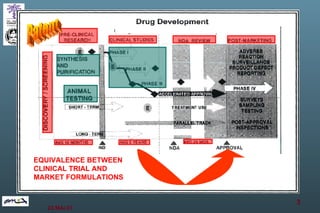
Patent EQUIVALENCE BETWEEN CLINICAL TRIAL AND MARKET FORMULATIONS
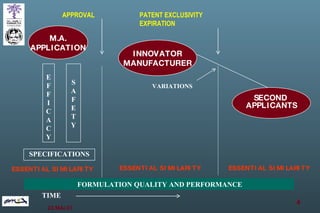
  APPROVAL  PATENT EXCLUSIVITY     EXPIRATION M.A. APPLICATION INNOVATOR MANUFACTURER EF FICACY SAFETY SPECIFICATIONS FORMULATION QUALITY AND PERFORMANCE ESSENTIAL SIMILARITY TIME SECOND  APPLICANTS VARIATIONS ESSENTIAL SIMILARITY ESSENTIAL SIMILARITY
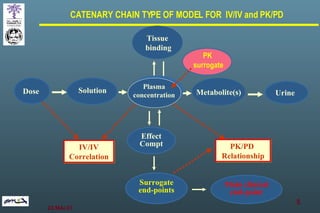
CATENARY CHAIN TYPE OF MODEL FOR  IV/IV and PK/PD Effect Compt Dose  IV/IV Correlation PK/PD  Relationship Metabolite(s) Tissue binding Solution Plasma concentration Urine Surrogate end-points Main clinical end-point PK  surrogate
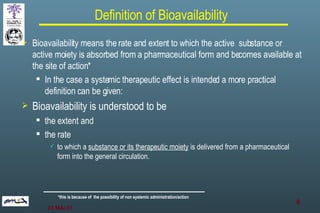
Definition of Bioavailability Bioavailability means the rate and extent to which the active  substance or active moiety is absorbed from a pharmaceutical form and becomes available at the site of action * In the case a systemic therapeutic effect is intended a more practical definition can be given: Bioavailability is understood to be  the extent and the rate  to which a  substance or its therapeutic moiety  is delivered from a pharmaceutical form into the general circulation. * this is because of  the possibility of non systemic administration/action
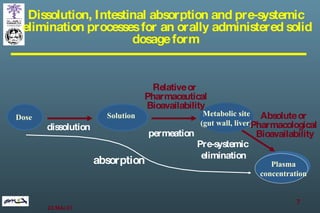
Dissolution, Intestinal absorption and pre-systemic elimination processes for an orally administered solid dosage form Dose  Metabolic site (gut wall, liver ) Solution dissolution Pre-systemic  elimination Absolute or  Pharmacological  Bioavailability Relative or  Pharmaceutical Bioavailability absorption permeation Plasma concentration
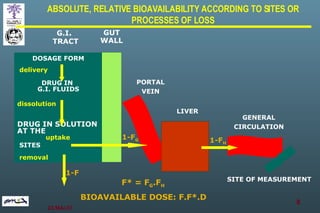
ABSOLUTE, RELATIVE BIOAVAILABILITY ACCORDING TO SITES OR PROCESSES OF LOSS BIOAVAILABLE DOSE: F.F*.D DOSAGE FORM delivery   DRUG IN  G.I. FLUIDS dissolution DRUG IN SOLUTION AT THE   uptake SITES removal G.I . TRACT GUT WALL PORTAL VEIN LIVER GENERAL CIRCULATION SITE OF MEASUREMENT 1-F G 1-F H 1-F F* = F G .F H
Definition of bioequivalence Two medicinal product are bioequivalent if  they are pharmaceutically equivalent or pharmaceutical alternatives  and if their bioavailabilities (rate and extent) after administration in the same molar dose are similar to such degree  that their effects,  with respect to both efficacy and safety , will be essentially the same.
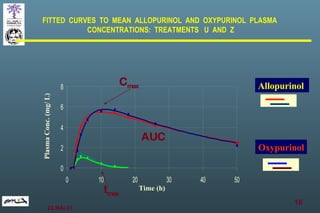
FITTED  CURVES  TO  MEAN  ALLOPURINOL  AND  OXYPURINOL  PLASMA  CONCENTRATIONS:  TREATMENTS  U  AND  Z Allopurinol   Oxypurinol Time (h) Plasma Conc. (mg/ L) t max C max AUC
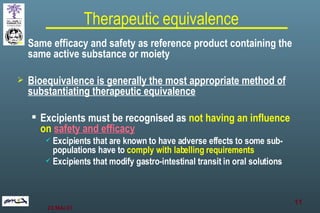
Same efficacy and safety as reference product containing the same active substance or moiety Bioequivalence is generally the most appropriate method of substantiating therapeutic equivalence Excipients must be recognised as  not having an influence on  safety and efficacy Excipients that are known to have adverse effects to some sub-populations have to  comply with labelling requirements Excipients that modify gastro-intestinal transit in oral solutions Therapeutic   equivalence
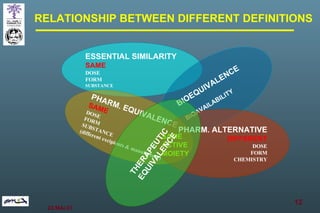
RELATIONSHIP BETWEEN DIFFERENT DEFINITIONS  ESSENTIAL SIMILARITY SAME DOSE FORM SUBSTANCE BIOEQUIVALENCE BIOAVAILABILITY SAME ACTIVE MOIETY THERAPEUTIC  EQUIVALENCE PHARM. EQUIVALENCE SAME DOSE FORM SUBSTANCE (different excipients & manufacture) PHARM. ALTERNATIVE DIFFERENT DOSE FORM CHEMISTRY
Extension of the essential similarity definition The matter of the definition of essential similarity has plagued the European Regulatory System   A definition has been given in two instances, none of them with enough legislative power the minutes of the Council meeting that approved Directive 87/21 and  the ruling of the European Court of Justice on Generics Case. Both state that essentially similar products have to be  pharmaceutically equivalent  (same active substance – not active moiety )   and same form; and bioequivalent,  leaving out pharmaceutical alternatives . Now the concept has been extended to active moiety
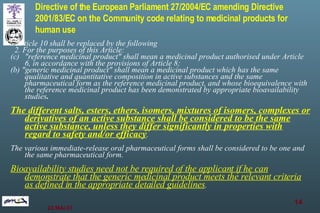
Directive of the European Parliament  27/2004/EC   amending Directive 2001/83/EC on the Community code relating to medicinal products for human use       Article 10 shall be replaced by the following     2. For the purposes of this Article: "reference medicinal product" shall mean a medicinal product authorised under Article 6, in accordance with the provisions of Article 8; (b) "generic medicinal product" shall mean a medicinal product which has the same qualitative and quantitative composition in active substances and the same pharmaceutical form as the reference medicinal product, and whose bioequivalence with the reference medicinal product has been demonstrated by appropriate bioavailability studies . The different salts, esters, ethers, isomers, mixtures of isomers, complexes or derivatives of an active substance shall be considered to be the same active substance, unless they differ significantly in properties with regard to safety and/or efficacy .  The various immediate-release oral pharmaceutical forms shall be considered to be one and the same pharmaceutical form.  Bioavailability studies need not be required of the applicant if he can demonstrate that the generic medicinal product meets the relevant criteria as defined in the appropriate detailed guidelines .
Extension of the essential similarity definition The extension of the essential similarity definition to other chemical forms, including isomers, and to all oral immediate release pharmaceutical forms entails a sizeable risk, even if bioequivalence is demonstrated according to the relevant guidelines and the safety of the counter ion in the case of salts is ensured.
Extension of the essential similarity definition There are too many uncontrolled events in the way the body handles these substances that cannot be pinned down by just a human pharmacokinetic or a safety animal study. In the absence of hard scientific evidence this definition entails unknown risks.
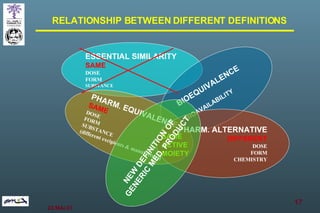
RELATIONSHIP BETWEEN DIFFERENT DEFINITIONS  ESSENTIAL SIMILARITY SAME DOSE FORM SUBSTANCE BIOEQUIVALENCE BIOAVAILABILITY PHARM. EQUIVALENCE SAME DOSE FORM SUBSTANCE (different excipients & manufacture) PHARM. ALTERNATIVE DIFFERENT DOSE FORM CHEMISTRY SAME ACTIVE MOIETY NEW DEFINITION OF  GENERIC MED. PRODUCT
Note for Guidance on the Investigation of Bioavailability and Bioequivalence CPMP/EWP/QWP/1401/98 –  26 July de 2001 Immediate Release Medicinal Products
Note for Guidance on the Investigation of Bioavailability and Bioequivalence (NfG on BA/BE) INTRODUCTION DEFINITIONS Pharmaceutical equivalents Pharmaceutical alternatives Bioavailability Bioequivalents Essentially similar products Therapeutic equivalents
Note for Guidance on the Investigation of Bioavailability and Bioequivalence (NfG on BA/BE) DESIGN AND CONDUCT OF STUDIES Design Subjects Selection of subjects Standardisation of the study Inclusion of patients Genetic phenotyping Characteristics to be investigated Metabolites Urine data Parameters Chemical analysis Reference and test product Data analysis 'In vitro' dissolution complementary to a bioequivalence study Reporting of results
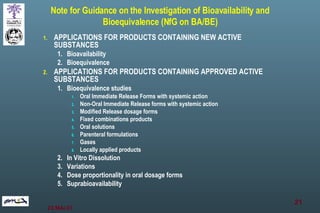
Note for Guidance on the Investigation of Bioavailability and Bioequivalence (NfG on BA/BE) APPLICATIONS FOR PRODUCTS CONTAINING NEW ACTIVE SUBSTANCES Bioavailability Bioequivalence APPLICATIONS FOR PRODUCTS CONTAINING APPROVED ACTIVE SUBSTANCES Bioequivalence studies Oral Immediate Release Forms with systemic action Non-Oral Immediate Release forms with systemic action Modified Release dosage forms Fixed combinations products Oral solutions Parenteral formulations Gases Locally applied products In Vitro Dissolution Variations Dose proportionality in oral dosage forms Suprabioavailability
Sections under revision Bioavailability vs Bioequivalence Biopharmaceutics Classification System and waivers Acceptance Criteria (80 – 125 etc.) Use of metabolites (when, how) Urine data Outliers (parametric vs. non-parametric) Food effect Reference product (new directive defines it) Proportionality/non-linearity Highly Variable Drugs
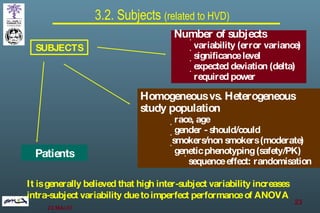
3.2. Subjects  (related to HVD) SUBJECTS Number of subjects variability (error variance) significance level expected deviation (delta) required power Homogeneous vs. Heterogeneous study population race, age gender - should/could smokers/non smokers (moderate) genetic phenotyping (safety/PK) sequence effect: randomisation Patients It is generally believed that high inter-subject variability increases intra-subject variability due to imperfect performance of ANOVA
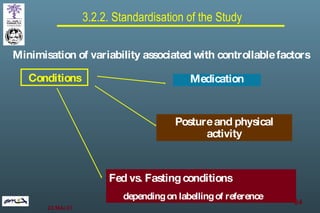
3.2.2. Standardisation of the Study Fed vs. Fasting conditions depending on labelling of reference Minimisation of variability associated with controllable factors  Conditions Medication Posture and physical activity
Section 3.2.2 of the Guideline states: “ If the Summary of Product Characteristics (SPC) of the reference product contains specific recommendations in relation to food intake related to food interaction the study should be designed accordingly .” Standardisation of bioequivalence studies with regard to food intake. How strictly should the Guideline be interpreted? Q &A document
Summary: Fed or fasting conditions depend on SPC recommendations Fasting is preferable because more sensitive to differences If in doubt, do both fed and fasting even for IR Both fed and fasting obligatory for MR Composition of meal must be specified Standardisation of bioequivalence studies with regard to food intake. How strictly should the Guideline be interpreted? Q &A document
Standardisation with regard to food intake. The r ecommendations  concerning food intake in the SPC  are not sufficient  for regulatory decisions on the adequacy of bioequivalence studies.  If the recommendation of food intake in the SPC is based on pharmacokinetic properties such as higher bioavailability, then a bioequivalence study under fed conditions is generally required.  Fed BE studies for immediate-release products Based on our data, an IR drug product that meet BE criteria under fasting conditions will not necessarily pass under fed conditions So it appears to be safer to generally require studies under both fasted and fed conditions
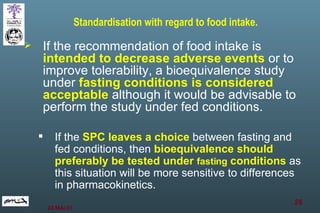
If the recommendation of food intake is  intended to decrease adverse events  or to improve tolerability, a bioequivalence study under  fasting conditions is considered acceptable  although it would be advisable to perform the study under fed conditions. If the  SPC leaves a choice  between fasting and fed conditions, then  bioequivalence should preferably be tested under  fasting  conditions  as this situation will be more sensitive to differences in pharmacokinetics. Standardisation with regard to food intake.
Standardisation with regard to food intake. The composition of the meal should be described and taken into account, since a light meal might sometimes be preferable to mimic clinical conditions, especially when the fed state is expected to be less sensitive to differences in pharmacokinetics. For products with  release characteristics differing from conventional  immediate release (e.g. improved release, dissolution or absorption), even if they cannot be classified as modified release products with prolonged or delayed release,  bioequivalence studies may be necessary in both the fasted and fed states .
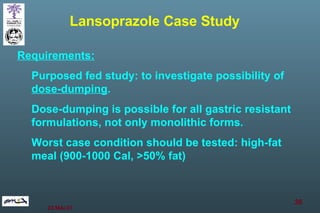
Requirements: Purposed fed study: to investigate possibility of  dose-dumping .  Dose-dumping is possible for all gastric resistant formulations, not only monolithic forms. Worst case condition should be tested: high-fat meal (900-1000 Cal, >50% fat) Lansoprazole Case Study
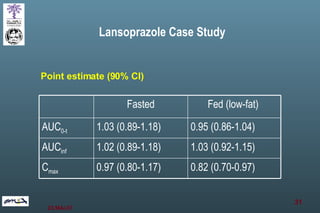
Lansoprazole Case Study Point estimate (90% CI) 0.82 (0.70-0.97) 0.97 (0.80-1.17) C max 1.03 (0.92-1.15) 1.02 (0.89-1.18) AUC inf 0.95 (0.86-1.04) 1.03 (0.89-1.18) AUC 0-t Fed (low-fat)  Fasted
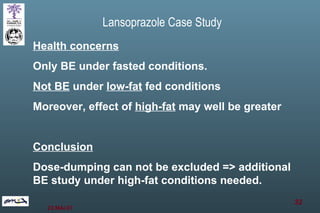
Health concerns Only BE under fasted conditions. Not BE  under  low-fat  fed conditions Moreover, effect of  high-fat  may well be greater Conclusion Dose-dumping can not be excluded => additional BE study under high-fat conditions needed. Lansoprazole Case Study
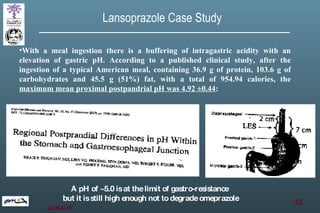
With a meal ingestion there is a buffering of intragastric acidity with an elevation of gastric pH. According to a published clinical study, after the ingestion of a typical American meal, containing 36.9 g of protein, 103.6 g of carbohydrates and 45.5 g (51%) fat, with a total of 954.94 calories, the  maximum mean proximal postpandrial pH was 4.92 ±0.44 : Lansoprazole Case Study A pH of ~5.0 is at the limit of gastro-resistance  but it is still high enough not to degrade omeprazole
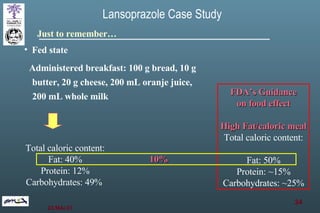
Just to remember… Fed state Administered breakfast: 100 g bread, 10 g butter, 20 g cheese, 200 mL oranje juice, 200 mL whole milk Total caloric content: Fat: 40% Protein: 12% Carbohydrates: 49%  FDA’s Guidance on food effect High Fat/caloric meal Total caloric content: Fat: 50% Protein:  ~ 15% Carbohydrates: ~25% Lansoprazole Case Study 10%
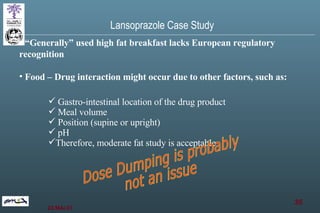
“ Generally” used high fat breakfast lacks European regulatory recognition Food – Drug interaction might occur due to other factors, such as:  Gastro-intestinal location of the drug product Meal volume Position (supine or upright) pH Therefore, moderate fat study is acceptable Dose Dumping is probably not an issue Lansoprazole Case Study
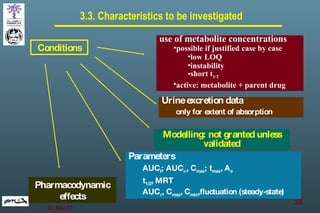
3.3. Characteristics to be investigated Conditions use of metabolite concentrations possible if justified case by case low LOQ instability short t 1/2 active: metabolite + parent drug   Urine excretion data only for extent of absorption Modelling: not granted unless validated Parameters AUC t ; AUC  , C max ; t max , A e t 1/2 , MRT AUC  ,   C max , C min ,fluctuation (steady-state) Pharmacodynamic effects
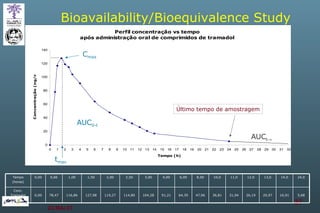
Bioavailability/Bioequivalence Study  Último tempo de amostragem AUC 0-t AUC t-  t max C max 16,91 14,0 5,68 20,97 26,19 31,94 36,81 47,96 64,39 91,21 104,28 114,80 119,27 127,98 116,86 78,47 0,00 Conc. Tramadol (ng/mL) 24,0 13,0 12,0 11,0 10,0 8,00 6,00 4,00 3,00 2,50 2,00 1,50 1,00 0,66 0,00 Tempo (horas)
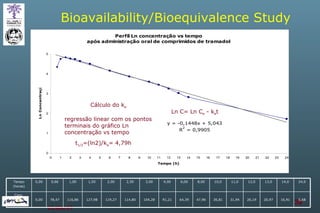
Ln C= Ln C e  - k e t Cálculo do k e regressão linear com os pontos terminais do gráfico Ln concentração vs tempo t 1/2 =(ln2)/k e = 4,79h Bioavailability/Bioequivalence Study  16,91 14,0 5,68 20,97 26,19 31,94 36,81 47,96 64,39 91,21 104,28 114,80 119,27 127,98 116,86 78,47 0,00 Conc. Tramadol (ng/mL) 24,0 13,0 12,0 11,0 10,0 8,00 6,00 4,00 3,00 2,50 2,00 1,50 1,00 0,66 0,00 Tempo (horas)
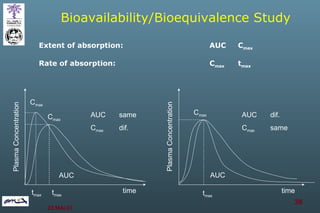
Bioavailability/Bioequivalence Study  Extent of absorption: AUC C max time Plasma Concentration t max C max AUC Rate of absorption: C max   t max AUC  dif. C max   same time Plasma Concentration t max C max AUC AUC  same C max   dif. C max t max
When should metabolite data be used to establish bioequivalence? According to the guideline, the only 2 situations where metabolite data  can be used  to establish bioequivalence are: 1.  “ If the concentration of the active substance is too low to be accurately measured in the biological matrix, thus giving rise to significant variability ”.  Q &A document
Metabolite data can only be used if the Applicant presents  convincing, state-of-the-art arguments that measurements of the parent compound are unreliable . Cmax of the metabolite is less sensitive to differences in the rate of absorption than Cmax of the parent drug. Therefore,  bioequivalence should, if possible, be determined for Cmax of the parent compound , if necessary at a higher dose.   New bioanalytical methodology improved LoQ Use of metabolites in BE studies: Metabolites are generally less sensitive to detect differences in formulation A study that meets BE requirements on parent rarely fails on the metabolite When should metabolite data be used  to establish bioequivalence?
2 .  “ If metabolites significantly contribute to the net activity of an active substance  and  the pharmacokinetic system is non-linear ”. To evaluate the significance of the  contribution of metabolites ,  relative AUCs and non-clinical or clinical pharmacodynamic activities   should be compared with those of the parent drug. PK/PD modelling may be useful. If criteria for significant contribution to activity and pharmacokinetic non-linearity are met, then “ it is necessary to measure both parent drug and active metabolite plasma concentrations and evaluate them separately ”.   Any discrepancy  between the results obtained with the parent compound and the metabolites should be discussed based on relative activities and AUCs. If the discrepancy lies in  Cmax  ,  the results of the parent compound should usually prevail.  Pooling  of the plasma concentrations or pharmacokinetic parameters of the parent drug and its metabolite for calculation of bioequivalence  is not acceptable.  When should metabolite data be used  to establish bioequivalence?
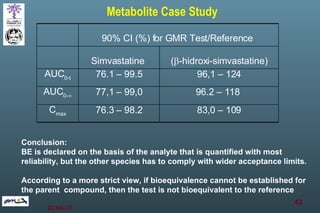
Metabolite Case Study Conclusion:  BE is declared on the basis of the analyte that is quantified with most  reliability, but the other species has to comply with wider acceptance limits. According to a more strict view, if bioequivalence cannot be established for  the parent  compound, then the test is not bioequivalent to the reference 83,0 – 109 76.3 – 98.2 C max 96.2 – 118  77,1 – 99,0 AUC 0-  96,1 – 124 76.1 – 99.5 AUC 0-t (  -hidroxi-simvastatine) Simvastatine  90% CI (%) for GMR Test/Reference
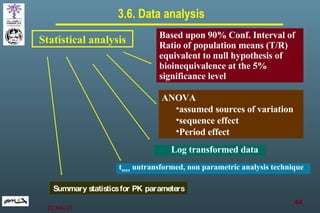
3.6. Data analysis Statistical analysis Based upon 90% Conf. Interval of Ratio of population means (T/R) equivalent to null hypothesis of bioinequivalence at the 5% significance level ANOVA assumed sources of variation sequence effect Period effect Log transformed data t max  untransformed, non parametric analysis technique Summary statistics for PK parameters
 
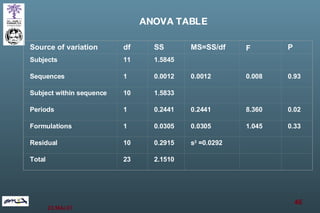
ANOVA TABLE Source of variation df SS MS=SS/df F P Subjects 11 1.5845       Sequences 1 0.0012 0.0012 0.008 0.93 Subject within sequence 10 1.5833       Periods 1 0.2441 0.2441 8.360 0.02 Formulations 1 0.0305 0.0305 1.045 0.33 Residual 10 0.2915 s 2  =0.0292     Total 23 2.1510      
Statistical analysis example -hydrochlorothiazide [84,5 – 106]% 94,7% AUC 0-inf   [87,6 – 106]% 96,8% AUC 0-t   [85,3 – 101]% 93,0% C max 90% CI  T  /   R   Parameter
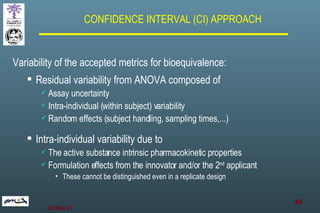
Variability of the accepted metrics for bioequivalence: Residual variability from ANOVA composed of Assay uncertainty Intra-individual (within subject) variability Random effects (subject handling, sampling times,...) Intra-individual variability due to The active substance intrinsic pharmacokinetic properties Formulation effects from the innovator and/or the 2 nd  applicant These cannot be distinguished even in a replicate design CONFIDENCE INTERVAL (CI) APPROACH
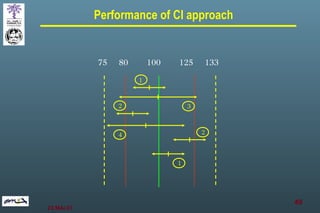
Performance of CI approach 75  80  100  125  133  1 1 2 2 3 4
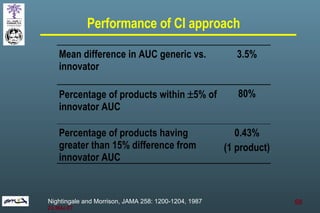
Performance of CI approach Nightingale and Morrison, JAMA 258: 1200-1204, 1987
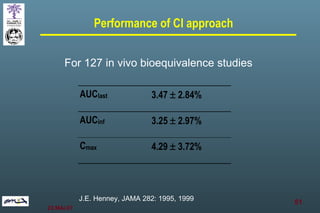
Performance of CI approach J.E. Henney, JAMA 282: 1995, 1999 For 127 in vivo bioequivalence studies
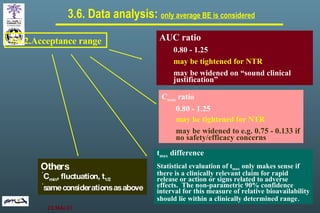
3.6. Data analysis:  only average BE is considered 3.6.2.Acceptance range AUC ratio 0.80 - 1.25 may be tightened for NTR may be widened on “sound clinical justification” C max  ratio 0.80 - 1.25 may be tightened for NTR may be widened to e.g. 0.75 - 0.133 if no safety/efficacy concerns t max  difference Statistical evaluation of t max  only makes sense if there is a clinically relevant claim for rapid release or action or signs related to adverse effects.  The non-parametric 90% confidence interval for this measure of relative bioavailability should lie within a clinically determined range . Others  C min , fluctuation, t 1/2 same considerations as above
Assessment of Cmax in bioequivalence studies. In which cases is it allowed to use a wider acceptance range for the ratio of Cmax? Q &A document
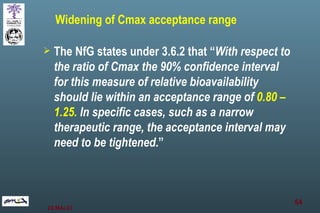
Widening of Cmax acceptance range The NfG states under 3.6.2 that “ With respect to the ratio of Cmax the 90% confidence interval for this measure of relative bioavailability should lie within an acceptance range of  0.80 – 1.25.  In specific cases, such as a narrow therapeutic range, the acceptance interval may need to be tightened .”
Widening of Cmax acceptance range The NfG also states that “ In certain cases a  wider interval may be acceptable . The interval must be  prospectively defined , e.g. 0.75 – 1.33,  and justified  addressing in particular any safety or efficacy concerns for patients switched between formulations ”.
The possibility offered here by the guideline  to widen the acceptance  range of 0.80 – 1.25 for the ratio of Cmax (not for AUC)  should be considered  exceptional  and limited to a small widening, i.e. in most cases to 0.75 − 1.33.  PK/PD should be documented Post-hoc widening not accepted Widening of Cmax acceptance range
Summary:  never, unless protocol violations such as like vomiting, diarrhoea, analytical failure In very exceptional circumstances  post-hoc data exclusion can be justified. The condition stated to cause the deviation is present in the outlier (s) only and  absence of this condition has been investigated using the same criteria for all other subjects.  Q &A document  Outliers. When can subjects classified as outliers be excluded from the analysis in bioequivalence studies?
Under 3.6.3 the NfG states that “ Post-hoc exclusion of outliers is  generally not accepted ”  but at the same time acknowledges that  “the protocol should also specify methods for identifying biologically implausible outliers ”. Q &A document Exclusion of outliers
Pharmacokinetic data can only be excluded based on non-statistical reasons that have been either defined previously in the protocol or, at the very least, established before reviewing the data.  Exclusion of data can never be accepted on the basis of statistical analysis or for pharmacokinetic reasons alone , because it is impossible to distinguish between formulation effects and pharmacokinetic effects. Exclusion of outliers
Acceptable explanations to exclude pharmacokinetic data or to exclude a subject would be  protocol violations like vomiting, diarrhoea, analytical failure , etc. Exceptional  reasons may justify post-hoc data exclusion but this should be considered with utmost care. In such a case, the applicant must demonstrate that the condition stated to cause the deviation is present in the outlier (s) only and  absence of this condition has been investigated using the same criteria for all other subjects.  Results of statistical analyses with and without the group of excluded subjects should be provided. Exclusion of outliers
The NfG states under 3.6.1–Statistical analysis: “ AUC and Cmax should be analysed using ANOVA after log transformation. ”  The reasons for this request are the following:  a) the AUC and C max  values as biological parameters are usually not normally distributed;  b) a multiplicative model may be plausible;  c) after log transformation the distribution may allow a parametric analysis.  Q &A document In which cases may a non-parametric  statistical model be used?
However, the true distribution in a pharmacokinetic data set usually cannot be characterised due to the small sample size, so it is  not recommended  to have the analysis strategy depend on a pre-test for normality.  Parametric testing using ANOVA on log-transformed data should be the rule for AUC and C max .  For t max , the use of non-parametric methods on the original data set is recommended. Use of non-parametric statistical model
Variability of the accepted metrics for bioequivalence Residual variability from ANOVA composed of Assay uncertainty Intra-individual (within subject) variability Random effects (subject handling, sampling times,...) Intra-individual variability due to The active substance intrinsic pharmacokinetic properties Formulation effects from the innovator and/or the 2 nd  applicant These cannot be distinguished even in a replicate design HIGHLY VARIABLE DRUGS (HVD)
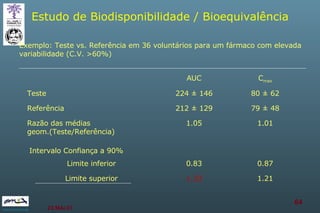
Highly Variable Example Exemplo: Teste vs. Referência em 36 voluntários para um fármaco com elevada variabilidade (C.V. >60%) 1.21 1.33 Limite superior 0.87 0.83 Limite inferior Intervalo Confiança a 90% 1.01 1.05 Razão das médias geom.(Teste/Referência) 79  ±  48 212  ±  129 Referência 80  ±  62 224  ±  146 Teste C max AUC Estudo de Biodisponibilidade / Bioequivalência
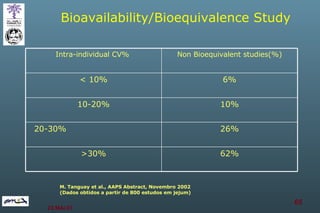
M. Tanguay et al., AAPS Abstract, Novembro 2002 (Dados obtidos a partir de 800 estudos em jejum) Bioavailability/Bioequivalence Study  62% >30% 26% 20-30%  10% 10-20% 6% < 10% Non Bioequivalent studies(%) Intra-individual CV%
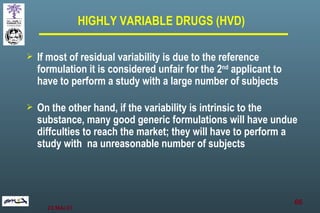
If most of residual variability is due to the reference formulation it is considered unfair for the 2 nd  applicant to have to perform a study with a large number of subjects On the other hand, if the variability is intrinsic to the substance, many good generic formulations will have undue diffculties to reach the market; they will have to perform a study with  na unreasonable number of subjects HIGHLY VARIABLE DRUGS (HVD)
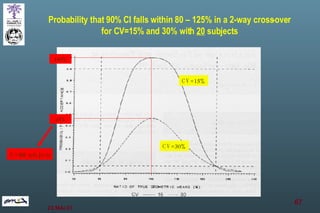
Probability that 90% CI falls within 80 – 125% in a 2-way cross-over for CV=15% and 30% with  20  subjects 100% 45% CV=15% CV=30% N=88 subjects
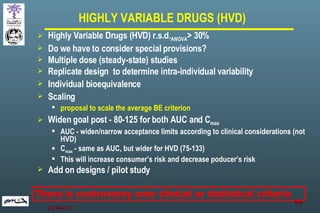
Highly Variable Drugs (HVD) r.s.d. ANOVA > 30% Do we have to consider special provisions? Multiple dose (steady-state) studies Replicate design  to determine intra-individual variability Individual bioequivalence Scaling  proposal to scale the average BE criterion   Widen goal post - 80-125 for both AUC and C max   AUC - widen/narrow acceptance limits according to clinical considerations (not HVD) C max  - same as AUC, but wider for HVD (75-133) This will increase consumer’s risk and decrease poducer’s risk Add on designs / pilot study HIGHLY VARIABLE DRUGS (HVD) There is controversy over clinical or statistical criteria
Steady State Studies May be required in the case of dose- or time-dependent pharmacokinetics; modified release products (in addition to single dose studies).  Or can be considered if problems of sensitivity preclude sufficiently precise plasma concentration measurement after single dose; if the intra-individual variability in the plasma concentrations or disposition rate is inherently large; In the case of delayed release the guideline is not clear: required if justified
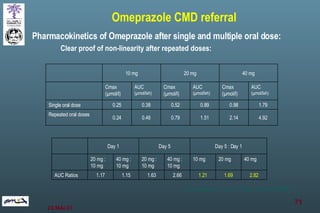
Omeprazole : delayed release formulation Omeprazole submission Steady-state study required because multiple dosing of omeprazole leads to an increase in AUC
Pharmacokinetics of Omeprazole after single and multiple oral dose: Clear proof of non-linearity after repeated doses: Omeprazole CMD referral (Andersson T et al: Drug Invest 1991) 4.92 2.14 1.51 0.79 0.46 0.24 Repeated oral doses 1.79 0.98 0.89 0.52 0.38 0.25 Single oral dose AUC  (µmol/lxh) Cmax (µmol/l) AUC  (µmol/lxh) Cmax (µmol/l) AUC  (µmol/lxh) Cmax (µmol/l) 40 mg 20 mg 10 mg 2.82 1.69 1.21 2.66 1.63 1.15 1.17 AUC Ratios 40 mg 20 mg 10 mg 40 mg : 10 mg 20 mg : 10 mg 40 mg : 10 mg 20 mg : 10 mg Day 5 : Day 1 Day 5 Day 1
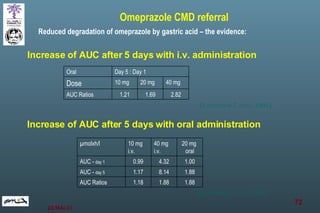
Reduced degradation of omeprazole by gastric acid – the evidence: Omeprazole CMD referral Increase of AUC after 5 days with i.v. administration Increase of AUC after 5 days with oral administration (Andersson T et al: 1991) (Cederberg C et al: 1992) 2.82 1.69 1.21 AUC Ratios 40 mg 20 mg 10 mg Dose Day 5 : Day 1 Oral 1.88 1.88 1.18 AUC Ratios 1.88 8.14 1.17 AUC -  day 5 1.00 4.32 0.99 AUC -  day 1 20 mg  oral 40 mg  i.v. 10 mg  i.v. µmolxh/l
Omeprazole CMD referral Conclusions: ▪ There is a significant increase of C max  and AUC in omeprazole kinetics over time which is not only caused by inhibition of drug metabolising enzymes but also by reduced acid degradation. ▪ Therefore, the acid resistant properties of a formulation need to be tested not only in single-dose studies, but also in multiple-dose studies mimicking the pH environment of a prolonged administration of the drug
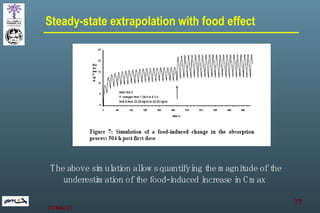
Steady-state extrapolation example Food study for a slow release tablet was performed after steady state has been achieved (objection) Applicant uses M&S trying to prove that underestimation of food effect on test product was negligible
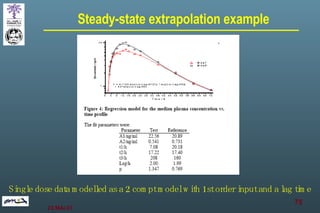
Steady-state extrapolation example Single dose data modelled as a 2 compt model with 1st order input and a lag time
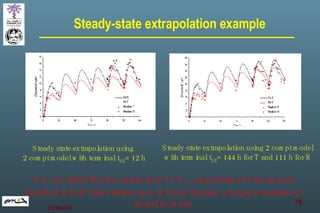
Steady-state extrapolation example Steady state extrapolation using  2 compt model with terminal t 1/2 = 12 h Steady state extrapolation using 2 compt model with terminal t 1/2 = 144 h for T and 111 h for R It is concluded that the single-dose AUC 0-∞  underestimates the amount absorbed in both formulations and, in future studies, a longer measurement should be made.
Steady-state extrapolation with food effect The above simulation allows quantifying the magnitude of the underestimation of the food-induced increase in Cmax
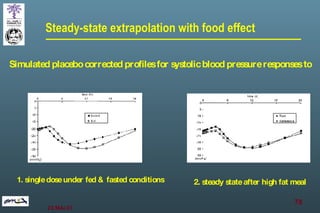
Steady-state extrapolation with food effect Simulated placebo corrected profiles for systolic blood pressure responses to 1. single dose under fed & fasted conditions 2. steady state after high fat meal
It is acceptable to divert from the guideline in designing the food interaction study, because the applicant provided sufficient justifications proving the validity of their chosen approach. It should be remarked, though, that modelling results never can be considered acceptable as proof of bioequivalence.  As the modelling used here included a considerable number of assumptions and used median data instead of individual data, the value as supporting evidence is very limited.  Steady-state extrapolation with food effect
5.4. Dose proportionality in immediate release  oral dosage forms  If a new application concerns several strengths of the active substance a bioequivalence study investigating only one strength may be acceptable. However the choice of the strength used should be justified on analytical, pharmacokinetic and safety grounds.  If a new strength (within the approved dose range) is applied for on the basis of an already approved medicinal product and all of the stated conditions hold ,  then a bioequivalence study is not necessary.
Furthermore   all  of the following conditions should be fulfilled:   the pharmaceutical products are manufactured by the same manufacturer and process; the qualitative composition of the different strengths is the same; the ratio between amounts of active substance and excipients is the same, or, in the case of preparations containing a low concentration of the active substance (less than 5%), the ratio between the amounts of excipients is similar; A not too strict approach has to be in place. 5.4. Dose proportionality in immediate release  oral dosage forms
the drug input has   been  shown to be linear over the therapeutic dose range  (if this is not the case the strengths where the sensitivity is largest to identify differences in the two products should be used);   the dissolution profile should be similar under identical conditions for the additional strengths and the strength of the batch used in the bioequivalence study. 5.4. Dose proportionality in immediate release  oral dosage forms
Dose proportionality Question   If there is a lack of published evidence of linear absorption kinetics for a proprietary medicinal product, are Applicants of generic products required to produce their own proof of linearity over the full therapeutic range (or alternatively establish bioequivalence at the dose level where the sensitivity is highest to identify differences in the bioavailability of the two products)? General recommendation: If proof of linear absorption kinetics is lacking, or if evidence of non-linearity is available, bioequivalence between test and reference formulations should be established both with the lowest and highest dose unless adequately justified by the Applicant.
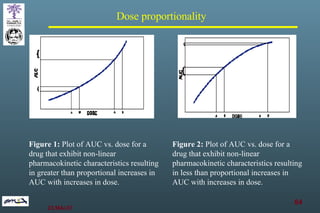
Figure 1:  Plot of AUC vs. dose for a drug that exhibit non-linear pharmacokinetic characteristics resulting in greater than proportional increases in AUC with increases in dose.  Figure 2:  Plot of AUC vs. dose for a drug that exhibit non-linear pharmacokinetic characteristics resulting in less than proportional increases in AUC with increases in dose. Dose proportionality
Muito obrigado

Bioavailability and bioequivalence – problems and pitfalls

  • 1.
    Bioavailability and Bioequivalence Assessment José A. Guimarães Morais Faculdade de Farmácia, Universidade de Lisboa INFARMED (Portugal) CPMP Efficacy Working Party Therapeutics Subgroup on Pharmacokinetics Pharmacon 2007 Congress, Dubrovnik May, 22-27, 2007
  • 2.
    SUMMARY Regulatory andScientific background Contents of the NfG on BA/BE Design and conduct of studies Subjects; heterogeneity Standardisation of study; sampling PK and BA characteristics and acceptance range Data analysis Questions & Answers document Examples
  • 3.
    Patent EQUIVALENCE BETWEENCLINICAL TRIAL AND MARKET FORMULATIONS
  • 4.
    APPROVAL PATENT EXCLUSIVITY EXPIRATION M.A. APPLICATION INNOVATOR MANUFACTURER EF FICACY SAFETY SPECIFICATIONS FORMULATION QUALITY AND PERFORMANCE ESSENTIAL SIMILARITY TIME SECOND APPLICANTS VARIATIONS ESSENTIAL SIMILARITY ESSENTIAL SIMILARITY
  • 5.
    CATENARY CHAIN TYPEOF MODEL FOR IV/IV and PK/PD Effect Compt Dose IV/IV Correlation PK/PD Relationship Metabolite(s) Tissue binding Solution Plasma concentration Urine Surrogate end-points Main clinical end-point PK surrogate
  • 6.
    Definition of BioavailabilityBioavailability means the rate and extent to which the active substance or active moiety is absorbed from a pharmaceutical form and becomes available at the site of action * In the case a systemic therapeutic effect is intended a more practical definition can be given: Bioavailability is understood to be the extent and the rate to which a substance or its therapeutic moiety is delivered from a pharmaceutical form into the general circulation. * this is because of the possibility of non systemic administration/action
  • 7.
    Dissolution, Intestinal absorptionand pre-systemic elimination processes for an orally administered solid dosage form Dose Metabolic site (gut wall, liver ) Solution dissolution Pre-systemic elimination Absolute or Pharmacological Bioavailability Relative or Pharmaceutical Bioavailability absorption permeation Plasma concentration
  • 8.
    ABSOLUTE, RELATIVE BIOAVAILABILITYACCORDING TO SITES OR PROCESSES OF LOSS BIOAVAILABLE DOSE: F.F*.D DOSAGE FORM delivery DRUG IN G.I. FLUIDS dissolution DRUG IN SOLUTION AT THE uptake SITES removal G.I . TRACT GUT WALL PORTAL VEIN LIVER GENERAL CIRCULATION SITE OF MEASUREMENT 1-F G 1-F H 1-F F* = F G .F H
  • 9.
    Definition of bioequivalenceTwo medicinal product are bioequivalent if they are pharmaceutically equivalent or pharmaceutical alternatives and if their bioavailabilities (rate and extent) after administration in the same molar dose are similar to such degree that their effects, with respect to both efficacy and safety , will be essentially the same.
  • 10.
    FITTED CURVES TO MEAN ALLOPURINOL AND OXYPURINOL PLASMA CONCENTRATIONS: TREATMENTS U AND Z Allopurinol Oxypurinol Time (h) Plasma Conc. (mg/ L) t max C max AUC
  • 11.
    Same efficacy andsafety as reference product containing the same active substance or moiety Bioequivalence is generally the most appropriate method of substantiating therapeutic equivalence Excipients must be recognised as not having an influence on safety and efficacy Excipients that are known to have adverse effects to some sub-populations have to comply with labelling requirements Excipients that modify gastro-intestinal transit in oral solutions Therapeutic equivalence
  • 12.
    RELATIONSHIP BETWEEN DIFFERENTDEFINITIONS ESSENTIAL SIMILARITY SAME DOSE FORM SUBSTANCE BIOEQUIVALENCE BIOAVAILABILITY SAME ACTIVE MOIETY THERAPEUTIC EQUIVALENCE PHARM. EQUIVALENCE SAME DOSE FORM SUBSTANCE (different excipients & manufacture) PHARM. ALTERNATIVE DIFFERENT DOSE FORM CHEMISTRY
  • 13.
    Extension of theessential similarity definition The matter of the definition of essential similarity has plagued the European Regulatory System A definition has been given in two instances, none of them with enough legislative power the minutes of the Council meeting that approved Directive 87/21 and the ruling of the European Court of Justice on Generics Case. Both state that essentially similar products have to be pharmaceutically equivalent (same active substance – not active moiety ) and same form; and bioequivalent, leaving out pharmaceutical alternatives . Now the concept has been extended to active moiety
  • 14.
    Directive of theEuropean Parliament 27/2004/EC amending Directive 2001/83/EC on the Community code relating to medicinal products for human use     Article 10 shall be replaced by the following     2. For the purposes of this Article: &quot;reference medicinal product&quot; shall mean a medicinal product authorised under Article 6, in accordance with the provisions of Article 8; (b) &quot;generic medicinal product&quot; shall mean a medicinal product which has the same qualitative and quantitative composition in active substances and the same pharmaceutical form as the reference medicinal product, and whose bioequivalence with the reference medicinal product has been demonstrated by appropriate bioavailability studies . The different salts, esters, ethers, isomers, mixtures of isomers, complexes or derivatives of an active substance shall be considered to be the same active substance, unless they differ significantly in properties with regard to safety and/or efficacy . The various immediate-release oral pharmaceutical forms shall be considered to be one and the same pharmaceutical form. Bioavailability studies need not be required of the applicant if he can demonstrate that the generic medicinal product meets the relevant criteria as defined in the appropriate detailed guidelines .
  • 15.
    Extension of theessential similarity definition The extension of the essential similarity definition to other chemical forms, including isomers, and to all oral immediate release pharmaceutical forms entails a sizeable risk, even if bioequivalence is demonstrated according to the relevant guidelines and the safety of the counter ion in the case of salts is ensured.
  • 16.
    Extension of theessential similarity definition There are too many uncontrolled events in the way the body handles these substances that cannot be pinned down by just a human pharmacokinetic or a safety animal study. In the absence of hard scientific evidence this definition entails unknown risks.
  • 17.
    RELATIONSHIP BETWEEN DIFFERENTDEFINITIONS ESSENTIAL SIMILARITY SAME DOSE FORM SUBSTANCE BIOEQUIVALENCE BIOAVAILABILITY PHARM. EQUIVALENCE SAME DOSE FORM SUBSTANCE (different excipients & manufacture) PHARM. ALTERNATIVE DIFFERENT DOSE FORM CHEMISTRY SAME ACTIVE MOIETY NEW DEFINITION OF GENERIC MED. PRODUCT
  • 18.
    Note for Guidanceon the Investigation of Bioavailability and Bioequivalence CPMP/EWP/QWP/1401/98 – 26 July de 2001 Immediate Release Medicinal Products
  • 19.
    Note for Guidanceon the Investigation of Bioavailability and Bioequivalence (NfG on BA/BE) INTRODUCTION DEFINITIONS Pharmaceutical equivalents Pharmaceutical alternatives Bioavailability Bioequivalents Essentially similar products Therapeutic equivalents
  • 20.
    Note for Guidanceon the Investigation of Bioavailability and Bioequivalence (NfG on BA/BE) DESIGN AND CONDUCT OF STUDIES Design Subjects Selection of subjects Standardisation of the study Inclusion of patients Genetic phenotyping Characteristics to be investigated Metabolites Urine data Parameters Chemical analysis Reference and test product Data analysis 'In vitro' dissolution complementary to a bioequivalence study Reporting of results
  • 21.
    Note for Guidanceon the Investigation of Bioavailability and Bioequivalence (NfG on BA/BE) APPLICATIONS FOR PRODUCTS CONTAINING NEW ACTIVE SUBSTANCES Bioavailability Bioequivalence APPLICATIONS FOR PRODUCTS CONTAINING APPROVED ACTIVE SUBSTANCES Bioequivalence studies Oral Immediate Release Forms with systemic action Non-Oral Immediate Release forms with systemic action Modified Release dosage forms Fixed combinations products Oral solutions Parenteral formulations Gases Locally applied products In Vitro Dissolution Variations Dose proportionality in oral dosage forms Suprabioavailability
  • 22.
    Sections under revisionBioavailability vs Bioequivalence Biopharmaceutics Classification System and waivers Acceptance Criteria (80 – 125 etc.) Use of metabolites (when, how) Urine data Outliers (parametric vs. non-parametric) Food effect Reference product (new directive defines it) Proportionality/non-linearity Highly Variable Drugs
  • 23.
    3.2. Subjects (related to HVD) SUBJECTS Number of subjects variability (error variance) significance level expected deviation (delta) required power Homogeneous vs. Heterogeneous study population race, age gender - should/could smokers/non smokers (moderate) genetic phenotyping (safety/PK) sequence effect: randomisation Patients It is generally believed that high inter-subject variability increases intra-subject variability due to imperfect performance of ANOVA
  • 24.
    3.2.2. Standardisation ofthe Study Fed vs. Fasting conditions depending on labelling of reference Minimisation of variability associated with controllable factors Conditions Medication Posture and physical activity
  • 25.
    Section 3.2.2 ofthe Guideline states: “ If the Summary of Product Characteristics (SPC) of the reference product contains specific recommendations in relation to food intake related to food interaction the study should be designed accordingly .” Standardisation of bioequivalence studies with regard to food intake. How strictly should the Guideline be interpreted? Q &A document
  • 26.
    Summary: Fed orfasting conditions depend on SPC recommendations Fasting is preferable because more sensitive to differences If in doubt, do both fed and fasting even for IR Both fed and fasting obligatory for MR Composition of meal must be specified Standardisation of bioequivalence studies with regard to food intake. How strictly should the Guideline be interpreted? Q &A document
  • 27.
    Standardisation with regardto food intake. The r ecommendations concerning food intake in the SPC are not sufficient for regulatory decisions on the adequacy of bioequivalence studies. If the recommendation of food intake in the SPC is based on pharmacokinetic properties such as higher bioavailability, then a bioequivalence study under fed conditions is generally required. Fed BE studies for immediate-release products Based on our data, an IR drug product that meet BE criteria under fasting conditions will not necessarily pass under fed conditions So it appears to be safer to generally require studies under both fasted and fed conditions
  • 28.
    If the recommendationof food intake is intended to decrease adverse events or to improve tolerability, a bioequivalence study under fasting conditions is considered acceptable although it would be advisable to perform the study under fed conditions. If the SPC leaves a choice between fasting and fed conditions, then bioequivalence should preferably be tested under fasting conditions as this situation will be more sensitive to differences in pharmacokinetics. Standardisation with regard to food intake.
  • 29.
    Standardisation with regardto food intake. The composition of the meal should be described and taken into account, since a light meal might sometimes be preferable to mimic clinical conditions, especially when the fed state is expected to be less sensitive to differences in pharmacokinetics. For products with release characteristics differing from conventional immediate release (e.g. improved release, dissolution or absorption), even if they cannot be classified as modified release products with prolonged or delayed release, bioequivalence studies may be necessary in both the fasted and fed states .
  • 30.
    Requirements: Purposed fedstudy: to investigate possibility of dose-dumping . Dose-dumping is possible for all gastric resistant formulations, not only monolithic forms. Worst case condition should be tested: high-fat meal (900-1000 Cal, >50% fat) Lansoprazole Case Study
  • 31.
    Lansoprazole Case StudyPoint estimate (90% CI) 0.82 (0.70-0.97) 0.97 (0.80-1.17) C max 1.03 (0.92-1.15) 1.02 (0.89-1.18) AUC inf 0.95 (0.86-1.04) 1.03 (0.89-1.18) AUC 0-t Fed (low-fat) Fasted
  • 32.
    Health concerns OnlyBE under fasted conditions. Not BE under low-fat fed conditions Moreover, effect of high-fat may well be greater Conclusion Dose-dumping can not be excluded => additional BE study under high-fat conditions needed. Lansoprazole Case Study
  • 33.
    With a mealingestion there is a buffering of intragastric acidity with an elevation of gastric pH. According to a published clinical study, after the ingestion of a typical American meal, containing 36.9 g of protein, 103.6 g of carbohydrates and 45.5 g (51%) fat, with a total of 954.94 calories, the maximum mean proximal postpandrial pH was 4.92 ±0.44 : Lansoprazole Case Study A pH of ~5.0 is at the limit of gastro-resistance but it is still high enough not to degrade omeprazole
  • 34.
    Just to remember…Fed state Administered breakfast: 100 g bread, 10 g butter, 20 g cheese, 200 mL oranje juice, 200 mL whole milk Total caloric content: Fat: 40% Protein: 12% Carbohydrates: 49% FDA’s Guidance on food effect High Fat/caloric meal Total caloric content: Fat: 50% Protein: ~ 15% Carbohydrates: ~25% Lansoprazole Case Study 10%
  • 35.
    “ Generally” usedhigh fat breakfast lacks European regulatory recognition Food – Drug interaction might occur due to other factors, such as: Gastro-intestinal location of the drug product Meal volume Position (supine or upright) pH Therefore, moderate fat study is acceptable Dose Dumping is probably not an issue Lansoprazole Case Study
  • 36.
    3.3. Characteristics tobe investigated Conditions use of metabolite concentrations possible if justified case by case low LOQ instability short t 1/2 active: metabolite + parent drug Urine excretion data only for extent of absorption Modelling: not granted unless validated Parameters AUC t ; AUC  , C max ; t max , A e t 1/2 , MRT AUC  , C max , C min ,fluctuation (steady-state) Pharmacodynamic effects
  • 37.
    Bioavailability/Bioequivalence Study Último tempo de amostragem AUC 0-t AUC t-  t max C max 16,91 14,0 5,68 20,97 26,19 31,94 36,81 47,96 64,39 91,21 104,28 114,80 119,27 127,98 116,86 78,47 0,00 Conc. Tramadol (ng/mL) 24,0 13,0 12,0 11,0 10,0 8,00 6,00 4,00 3,00 2,50 2,00 1,50 1,00 0,66 0,00 Tempo (horas)
  • 38.
    Ln C= LnC e - k e t Cálculo do k e regressão linear com os pontos terminais do gráfico Ln concentração vs tempo t 1/2 =(ln2)/k e = 4,79h Bioavailability/Bioequivalence Study 16,91 14,0 5,68 20,97 26,19 31,94 36,81 47,96 64,39 91,21 104,28 114,80 119,27 127,98 116,86 78,47 0,00 Conc. Tramadol (ng/mL) 24,0 13,0 12,0 11,0 10,0 8,00 6,00 4,00 3,00 2,50 2,00 1,50 1,00 0,66 0,00 Tempo (horas)
  • 39.
    Bioavailability/Bioequivalence Study Extent of absorption: AUC C max time Plasma Concentration t max C max AUC Rate of absorption: C max t max AUC dif. C max same time Plasma Concentration t max C max AUC AUC same C max dif. C max t max
  • 40.
    When should metabolitedata be used to establish bioequivalence? According to the guideline, the only 2 situations where metabolite data can be used to establish bioequivalence are: 1. “ If the concentration of the active substance is too low to be accurately measured in the biological matrix, thus giving rise to significant variability ”. Q &A document
  • 41.
    Metabolite data canonly be used if the Applicant presents convincing, state-of-the-art arguments that measurements of the parent compound are unreliable . Cmax of the metabolite is less sensitive to differences in the rate of absorption than Cmax of the parent drug. Therefore, bioequivalence should, if possible, be determined for Cmax of the parent compound , if necessary at a higher dose. New bioanalytical methodology improved LoQ Use of metabolites in BE studies: Metabolites are generally less sensitive to detect differences in formulation A study that meets BE requirements on parent rarely fails on the metabolite When should metabolite data be used to establish bioequivalence?
  • 42.
    2 . “ If metabolites significantly contribute to the net activity of an active substance and the pharmacokinetic system is non-linear ”. To evaluate the significance of the contribution of metabolites , relative AUCs and non-clinical or clinical pharmacodynamic activities should be compared with those of the parent drug. PK/PD modelling may be useful. If criteria for significant contribution to activity and pharmacokinetic non-linearity are met, then “ it is necessary to measure both parent drug and active metabolite plasma concentrations and evaluate them separately ”. Any discrepancy between the results obtained with the parent compound and the metabolites should be discussed based on relative activities and AUCs. If the discrepancy lies in Cmax , the results of the parent compound should usually prevail. Pooling of the plasma concentrations or pharmacokinetic parameters of the parent drug and its metabolite for calculation of bioequivalence is not acceptable. When should metabolite data be used to establish bioequivalence?
  • 43.
    Metabolite Case StudyConclusion: BE is declared on the basis of the analyte that is quantified with most reliability, but the other species has to comply with wider acceptance limits. According to a more strict view, if bioequivalence cannot be established for the parent compound, then the test is not bioequivalent to the reference 83,0 – 109 76.3 – 98.2 C max 96.2 – 118 77,1 – 99,0 AUC 0-  96,1 – 124 76.1 – 99.5 AUC 0-t (  -hidroxi-simvastatine) Simvastatine 90% CI (%) for GMR Test/Reference
  • 44.
    3.6. Data analysisStatistical analysis Based upon 90% Conf. Interval of Ratio of population means (T/R) equivalent to null hypothesis of bioinequivalence at the 5% significance level ANOVA assumed sources of variation sequence effect Period effect Log transformed data t max untransformed, non parametric analysis technique Summary statistics for PK parameters
  • 45.
  • 46.
    ANOVA TABLE Sourceof variation df SS MS=SS/df F P Subjects 11 1.5845       Sequences 1 0.0012 0.0012 0.008 0.93 Subject within sequence 10 1.5833       Periods 1 0.2441 0.2441 8.360 0.02 Formulations 1 0.0305 0.0305 1.045 0.33 Residual 10 0.2915 s 2 =0.0292     Total 23 2.1510      
  • 47.
    Statistical analysis example-hydrochlorothiazide [84,5 – 106]% 94,7% AUC 0-inf [87,6 – 106]% 96,8% AUC 0-t [85,3 – 101]% 93,0% C max 90% CI  T /  R Parameter
  • 48.
    Variability of theaccepted metrics for bioequivalence: Residual variability from ANOVA composed of Assay uncertainty Intra-individual (within subject) variability Random effects (subject handling, sampling times,...) Intra-individual variability due to The active substance intrinsic pharmacokinetic properties Formulation effects from the innovator and/or the 2 nd applicant These cannot be distinguished even in a replicate design CONFIDENCE INTERVAL (CI) APPROACH
  • 49.
    Performance of CIapproach 75 80 100 125 133 1 1 2 2 3 4
  • 50.
    Performance of CIapproach Nightingale and Morrison, JAMA 258: 1200-1204, 1987
  • 51.
    Performance of CIapproach J.E. Henney, JAMA 282: 1995, 1999 For 127 in vivo bioequivalence studies
  • 52.
    3.6. Data analysis: only average BE is considered 3.6.2.Acceptance range AUC ratio 0.80 - 1.25 may be tightened for NTR may be widened on “sound clinical justification” C max ratio 0.80 - 1.25 may be tightened for NTR may be widened to e.g. 0.75 - 0.133 if no safety/efficacy concerns t max difference Statistical evaluation of t max only makes sense if there is a clinically relevant claim for rapid release or action or signs related to adverse effects. The non-parametric 90% confidence interval for this measure of relative bioavailability should lie within a clinically determined range . Others C min , fluctuation, t 1/2 same considerations as above
  • 53.
    Assessment of Cmaxin bioequivalence studies. In which cases is it allowed to use a wider acceptance range for the ratio of Cmax? Q &A document
  • 54.
    Widening of Cmaxacceptance range The NfG states under 3.6.2 that “ With respect to the ratio of Cmax the 90% confidence interval for this measure of relative bioavailability should lie within an acceptance range of 0.80 – 1.25. In specific cases, such as a narrow therapeutic range, the acceptance interval may need to be tightened .”
  • 55.
    Widening of Cmaxacceptance range The NfG also states that “ In certain cases a wider interval may be acceptable . The interval must be prospectively defined , e.g. 0.75 – 1.33, and justified addressing in particular any safety or efficacy concerns for patients switched between formulations ”.
  • 56.
    The possibility offeredhere by the guideline to widen the acceptance range of 0.80 – 1.25 for the ratio of Cmax (not for AUC) should be considered exceptional and limited to a small widening, i.e. in most cases to 0.75 − 1.33. PK/PD should be documented Post-hoc widening not accepted Widening of Cmax acceptance range
  • 57.
    Summary: never,unless protocol violations such as like vomiting, diarrhoea, analytical failure In very exceptional circumstances post-hoc data exclusion can be justified. The condition stated to cause the deviation is present in the outlier (s) only and absence of this condition has been investigated using the same criteria for all other subjects. Q &A document Outliers. When can subjects classified as outliers be excluded from the analysis in bioequivalence studies?
  • 58.
    Under 3.6.3 theNfG states that “ Post-hoc exclusion of outliers is generally not accepted ” but at the same time acknowledges that “the protocol should also specify methods for identifying biologically implausible outliers ”. Q &A document Exclusion of outliers
  • 59.
    Pharmacokinetic data canonly be excluded based on non-statistical reasons that have been either defined previously in the protocol or, at the very least, established before reviewing the data. Exclusion of data can never be accepted on the basis of statistical analysis or for pharmacokinetic reasons alone , because it is impossible to distinguish between formulation effects and pharmacokinetic effects. Exclusion of outliers
  • 60.
    Acceptable explanations toexclude pharmacokinetic data or to exclude a subject would be protocol violations like vomiting, diarrhoea, analytical failure , etc. Exceptional reasons may justify post-hoc data exclusion but this should be considered with utmost care. In such a case, the applicant must demonstrate that the condition stated to cause the deviation is present in the outlier (s) only and absence of this condition has been investigated using the same criteria for all other subjects. Results of statistical analyses with and without the group of excluded subjects should be provided. Exclusion of outliers
  • 61.
    The NfG statesunder 3.6.1–Statistical analysis: “ AUC and Cmax should be analysed using ANOVA after log transformation. ”  The reasons for this request are the following: a) the AUC and C max values as biological parameters are usually not normally distributed; b) a multiplicative model may be plausible; c) after log transformation the distribution may allow a parametric analysis. Q &A document In which cases may a non-parametric statistical model be used?
  • 62.
    However, the truedistribution in a pharmacokinetic data set usually cannot be characterised due to the small sample size, so it is not recommended to have the analysis strategy depend on a pre-test for normality. Parametric testing using ANOVA on log-transformed data should be the rule for AUC and C max . For t max , the use of non-parametric methods on the original data set is recommended. Use of non-parametric statistical model
  • 63.
    Variability of theaccepted metrics for bioequivalence Residual variability from ANOVA composed of Assay uncertainty Intra-individual (within subject) variability Random effects (subject handling, sampling times,...) Intra-individual variability due to The active substance intrinsic pharmacokinetic properties Formulation effects from the innovator and/or the 2 nd applicant These cannot be distinguished even in a replicate design HIGHLY VARIABLE DRUGS (HVD)
  • 64.
    Highly Variable ExampleExemplo: Teste vs. Referência em 36 voluntários para um fármaco com elevada variabilidade (C.V. >60%) 1.21 1.33 Limite superior 0.87 0.83 Limite inferior Intervalo Confiança a 90% 1.01 1.05 Razão das médias geom.(Teste/Referência) 79 ± 48 212 ± 129 Referência 80 ± 62 224 ± 146 Teste C max AUC Estudo de Biodisponibilidade / Bioequivalência
  • 65.
    M. Tanguay etal., AAPS Abstract, Novembro 2002 (Dados obtidos a partir de 800 estudos em jejum) Bioavailability/Bioequivalence Study 62% >30% 26% 20-30% 10% 10-20% 6% < 10% Non Bioequivalent studies(%) Intra-individual CV%
  • 66.
    If most ofresidual variability is due to the reference formulation it is considered unfair for the 2 nd applicant to have to perform a study with a large number of subjects On the other hand, if the variability is intrinsic to the substance, many good generic formulations will have undue diffculties to reach the market; they will have to perform a study with na unreasonable number of subjects HIGHLY VARIABLE DRUGS (HVD)
  • 67.
    Probability that 90%CI falls within 80 – 125% in a 2-way cross-over for CV=15% and 30% with 20 subjects 100% 45% CV=15% CV=30% N=88 subjects
  • 68.
    Highly Variable Drugs(HVD) r.s.d. ANOVA > 30% Do we have to consider special provisions? Multiple dose (steady-state) studies Replicate design to determine intra-individual variability Individual bioequivalence Scaling proposal to scale the average BE criterion Widen goal post - 80-125 for both AUC and C max AUC - widen/narrow acceptance limits according to clinical considerations (not HVD) C max - same as AUC, but wider for HVD (75-133) This will increase consumer’s risk and decrease poducer’s risk Add on designs / pilot study HIGHLY VARIABLE DRUGS (HVD) There is controversy over clinical or statistical criteria
  • 69.
    Steady State StudiesMay be required in the case of dose- or time-dependent pharmacokinetics; modified release products (in addition to single dose studies). Or can be considered if problems of sensitivity preclude sufficiently precise plasma concentration measurement after single dose; if the intra-individual variability in the plasma concentrations or disposition rate is inherently large; In the case of delayed release the guideline is not clear: required if justified
  • 70.
    Omeprazole : delayedrelease formulation Omeprazole submission Steady-state study required because multiple dosing of omeprazole leads to an increase in AUC
  • 71.
    Pharmacokinetics of Omeprazoleafter single and multiple oral dose: Clear proof of non-linearity after repeated doses: Omeprazole CMD referral (Andersson T et al: Drug Invest 1991) 4.92 2.14 1.51 0.79 0.46 0.24 Repeated oral doses 1.79 0.98 0.89 0.52 0.38 0.25 Single oral dose AUC (µmol/lxh) Cmax (µmol/l) AUC (µmol/lxh) Cmax (µmol/l) AUC (µmol/lxh) Cmax (µmol/l) 40 mg 20 mg 10 mg 2.82 1.69 1.21 2.66 1.63 1.15 1.17 AUC Ratios 40 mg 20 mg 10 mg 40 mg : 10 mg 20 mg : 10 mg 40 mg : 10 mg 20 mg : 10 mg Day 5 : Day 1 Day 5 Day 1
  • 72.
    Reduced degradation ofomeprazole by gastric acid – the evidence: Omeprazole CMD referral Increase of AUC after 5 days with i.v. administration Increase of AUC after 5 days with oral administration (Andersson T et al: 1991) (Cederberg C et al: 1992) 2.82 1.69 1.21 AUC Ratios 40 mg 20 mg 10 mg Dose Day 5 : Day 1 Oral 1.88 1.88 1.18 AUC Ratios 1.88 8.14 1.17 AUC - day 5 1.00 4.32 0.99 AUC - day 1 20 mg oral 40 mg i.v. 10 mg i.v. µmolxh/l
  • 73.
    Omeprazole CMD referralConclusions: ▪ There is a significant increase of C max and AUC in omeprazole kinetics over time which is not only caused by inhibition of drug metabolising enzymes but also by reduced acid degradation. ▪ Therefore, the acid resistant properties of a formulation need to be tested not only in single-dose studies, but also in multiple-dose studies mimicking the pH environment of a prolonged administration of the drug
  • 74.
    Steady-state extrapolation exampleFood study for a slow release tablet was performed after steady state has been achieved (objection) Applicant uses M&S trying to prove that underestimation of food effect on test product was negligible
  • 75.
    Steady-state extrapolation exampleSingle dose data modelled as a 2 compt model with 1st order input and a lag time
  • 76.
    Steady-state extrapolation exampleSteady state extrapolation using 2 compt model with terminal t 1/2 = 12 h Steady state extrapolation using 2 compt model with terminal t 1/2 = 144 h for T and 111 h for R It is concluded that the single-dose AUC 0-∞ underestimates the amount absorbed in both formulations and, in future studies, a longer measurement should be made.
  • 77.
    Steady-state extrapolation withfood effect The above simulation allows quantifying the magnitude of the underestimation of the food-induced increase in Cmax
  • 78.
    Steady-state extrapolation withfood effect Simulated placebo corrected profiles for systolic blood pressure responses to 1. single dose under fed & fasted conditions 2. steady state after high fat meal
  • 79.
    It is acceptableto divert from the guideline in designing the food interaction study, because the applicant provided sufficient justifications proving the validity of their chosen approach. It should be remarked, though, that modelling results never can be considered acceptable as proof of bioequivalence. As the modelling used here included a considerable number of assumptions and used median data instead of individual data, the value as supporting evidence is very limited. Steady-state extrapolation with food effect
  • 80.
    5.4. Dose proportionalityin immediate release oral dosage forms If a new application concerns several strengths of the active substance a bioequivalence study investigating only one strength may be acceptable. However the choice of the strength used should be justified on analytical, pharmacokinetic and safety grounds. If a new strength (within the approved dose range) is applied for on the basis of an already approved medicinal product and all of the stated conditions hold , then a bioequivalence study is not necessary.
  • 81.
    Furthermore all of the following conditions should be fulfilled: the pharmaceutical products are manufactured by the same manufacturer and process; the qualitative composition of the different strengths is the same; the ratio between amounts of active substance and excipients is the same, or, in the case of preparations containing a low concentration of the active substance (less than 5%), the ratio between the amounts of excipients is similar; A not too strict approach has to be in place. 5.4. Dose proportionality in immediate release oral dosage forms
  • 82.
    the drug inputhas been shown to be linear over the therapeutic dose range (if this is not the case the strengths where the sensitivity is largest to identify differences in the two products should be used); the dissolution profile should be similar under identical conditions for the additional strengths and the strength of the batch used in the bioequivalence study. 5.4. Dose proportionality in immediate release oral dosage forms
  • 83.
    Dose proportionality Question If there is a lack of published evidence of linear absorption kinetics for a proprietary medicinal product, are Applicants of generic products required to produce their own proof of linearity over the full therapeutic range (or alternatively establish bioequivalence at the dose level where the sensitivity is highest to identify differences in the bioavailability of the two products)? General recommendation: If proof of linear absorption kinetics is lacking, or if evidence of non-linearity is available, bioequivalence between test and reference formulations should be established both with the lowest and highest dose unless adequately justified by the Applicant.
  • 84.
    Figure 1: Plot of AUC vs. dose for a drug that exhibit non-linear pharmacokinetic characteristics resulting in greater than proportional increases in AUC with increases in dose. Figure 2: Plot of AUC vs. dose for a drug that exhibit non-linear pharmacokinetic characteristics resulting in less than proportional increases in AUC with increases in dose. Dose proportionality
  • 85.