
Funded by: U.S. Department of Education, Rehabilitation Services Administration Award # H235J050020
Orthotics Overview
Dr TAREK M NASRALLAH MD
AL AZHAR
Funded by: U.S. Department of Education, Rehabilitation Services Administration Award # H235J050020
Objectives
Upon completion of this educational material, the participant will
• Be able to define orthosis
• Demonstrate an understanding of basic and common orthotic
terminology
• Demonstrate an understanding of basic orthotic goals
• Differentiate between general types of orthoses
• Be able to select an appropriate type of orthosis given a simple case
scenario
Funded by: U.S. Department of Education, Rehabilitation Services Administration Award # H235J050020
Orthotist
• Specializes in the
– design
– fabrication,
– fitting,
– alignment
– adjustment
• of orthoses.
• An orthosis is any device added to the body to
stabilize or immobilize a body part, prevent
deformity, protect against injury, or assist with
function. (Taber’s Cyclopedic Medical
Dictionary. ©2001, FA Davis)
Funded by: U.S. Department of Education, Rehabilitation Services Administration Award # H235J050020
Some Basic Goals of Orthoses
• Maintenance or correction of body segment alignment
• Assistance or resistance to joint motion
• Axial loading of the orthosis & therefore relief of distal
weight bearing forces
• Protection against physical insult
Funded by: U.S. Department of Education, Rehabilitation Services Administration Award # H235J050020
Lower Extremity Orthoses:
• FO foot orthosis
• AFO ankle foot orthosis
• KO knee orthosis
• KAFO knee ankle foot orthosis
• HKAFO hip knee ankle foot orthosis
• HO hip orthosis
Funded by: U.S. Department of Education, Rehabilitation Services Administration Award # H235J050020
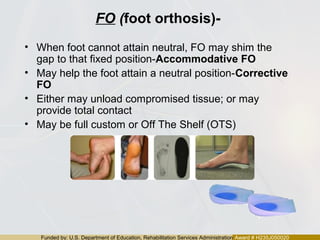
FO (foot orthosis)-
• When foot cannot attain neutral, FO may shim the
gap to that fixed position-Accommodative FO
• May help the foot attain a neutral position-Corrective
FO
• Either may unload compromised tissue; or may
provide total contact
• May be full custom or Off The Shelf (OTS)
Funded by: U.S. Department of Education, Rehabilitation Services Administration Award # H235J050020
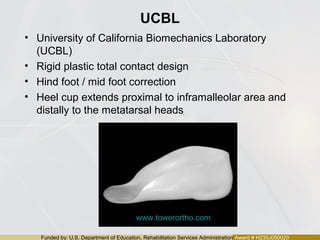
UCBL
• University of California Biomechanics Laboratory
(UCBL)
• Rigid plastic total contact design
• Hind foot / mid foot correction
• Heel cup extends proximal to inframalleolar area and
distally to the metatarsal heads
www.towerortho.com
Funded by: U.S. Department of Education, Rehabilitation Services Administration Award # H235J050020
AFO (ankle foot orthosis)
Most common orthosis
1. Metal bars
2. Total Contact
3. Floor reaction
4. Unweighting
5. Immobilizing
– Most AFO’s can be articulating or non-articulating
Funded by: U.S. Department of Education, Rehabilitation Services Administration Award # H235J050020
SMO
• Supra Maleolar Orthosis
• Low profile design that crosses the ankle
• Less invasive trim lines than a standard AFO
www.towerortho.comwww.dafo.com/ www.pelsupply.com
Funded by: U.S. Department of Education, Rehabilitation Services Administration Award # H235J050020
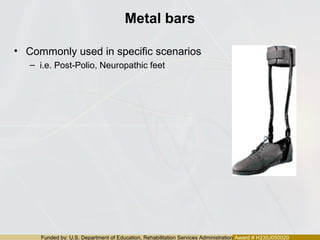
Metal bars
• Commonly used in specific scenarios
– i.e. Post-Polio, Neuropathic feet
Funded by: U.S. Department of Education, Rehabilitation Services Administration Award # H235J050020
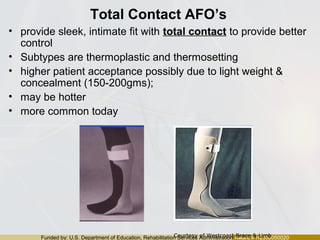
Total Contact AFO’s
• provide sleek, intimate fit with total contact to provide better
control
• Subtypes are thermoplastic and thermosetting
• higher patient acceptance possibly due to light weight &
concealment (150-200gms);
• may be hotter
• more common today
Courtesy of Westcoast Brace & Limb
Funded by: U.S. Department of Education, Rehabilitation Services Administration Award # H235J050020
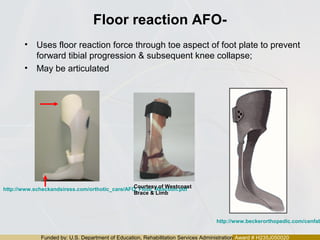
Floor reaction AFO-
• Uses floor reaction force through toe aspect of foot plate to prevent
forward tibial progression & subsequent knee collapse;
• May be articulated
http://www.beckerorthopedic.com/cenfab
http://www.scheckandsiress.com/orthotic_care/AFO_Floor_Reaction.pdf
Courtesy of Westcoast
Brace & Limb
Funded by: U.S. Department of Education, Rehabilitation Services Administration Award # H235J050020
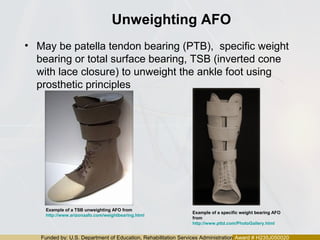
Unweighting AFO
• May be patella tendon bearing (PTB), specific weight
bearing or total surface bearing, TSB (inverted cone
with lace closure) to unweight the ankle foot using
prosthetic principles
Example of a specific weight bearing AFO
from
http://www.pttd.com/PhotoGallery.html
Example of a TSB unweighting AFO from
http://www.arizonaafo.com/weightbearing.html
Funded by: U.S. Department of Education, Rehabilitation Services Administration Award # H235J050020
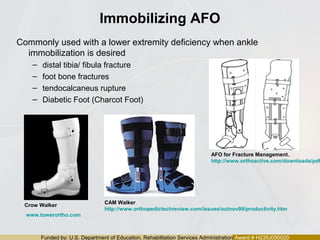
Immobilizing AFO
Commonly used with a lower extremity deficiency when ankle
immobilization is desired
– distal tibia/ fibula fracture
– foot bone fractures
– tendocalcaneus rupture
– Diabetic Foot (Charcot Foot)
CAM Walker
http://www.orthopedictechreview.com/issues/octnov99/productivity.htm
Crow Walker
www.towerortho.com
AFO for Fracture Management.
http://www.orthoactive.com/downloads/pdf
Funded by: U.S. Department of Education, Rehabilitation Services Administration Award # H235J050020
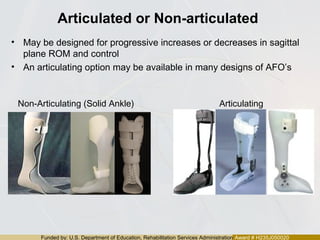
Articulated or Non-articulated
• May be designed for progressive increases or decreases in sagittal
plane ROM and control
• An articulating option may be available in many designs of AFO’s
Non-Articulating (Solid Ankle) Articulating
Funded by: U.S. Department of Education, Rehabilitation Services Administration Award # H235J050020
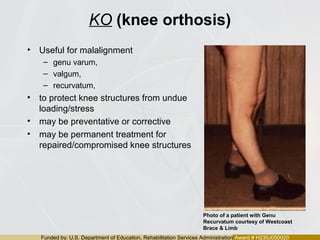
KO (knee orthosis)
• Useful for malalignment
– genu varum,
– valgum,
– recurvatum,
• to protect knee structures from undue
loading/stress
• may be preventative or corrective
• may be permanent treatment for
repaired/compromised knee structures
Photo of a patient with Genu
Recurvatum courtesy of Westcoast
Brace & Limb
Funded by: U.S. Department of Education, Rehabilitation Services Administration Award # H235J050020
Several Types of KO’s:
• Athletic KO-
• Non-articulated KO-
• Custom or OTS KO-
Funded by: U.S. Department of Education, Rehabilitation Services Administration Award # H235J050020
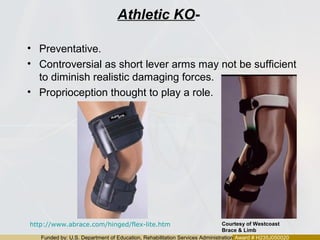
Athletic KO-
• Preventative.
• Controversial as short lever arms may not be sufficient
to diminish realistic damaging forces.
• Proprioception thought to play a role.
http://www.abrace.com/hinged/flex-lite.htm Courtesy of Westcoast
Brace & Limb
Funded by: U.S. Department of Education, Rehabilitation Services Administration Award # H235J050020
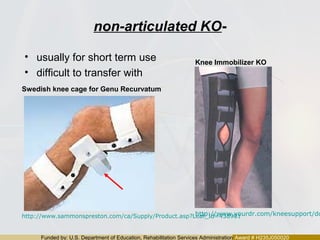
non-articulated KO-
• usually for short term use
• difficult to transfer with
http://www.yourdr.com/kneesupport/dohttp://www.sammonspreston.com/ca/Supply/Product.asp?Leaf_Id=438901
Swedish knee cage for Genu Recurvatum
Knee Immobilizer KO
Funded by: U.S. Department of Education, Rehabilitation Services Administration Award # H235J050020
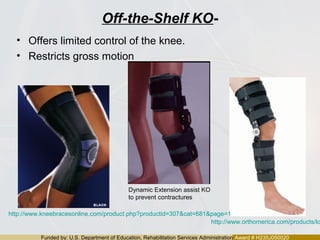
Off-the-Shelf KO-
• Offers limited control of the knee.
• Restricts gross motion
http://www.orthomerica.com/products/lo
http://www.kneebracesonline.com/product.php?productid=307&cat=681&page=1
Dynamic Extension assist KO
to prevent contractures
Funded by: U.S. Department of Education, Rehabilitation Services Administration Award # H235J050020
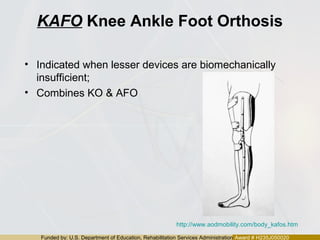
KAFO Knee Ankle Foot Orthosis
• Indicated when lesser devices are biomechanically
insufficient;
• Combines KO & AFO
http://www.aodmobility.com/body_kafos.htm
Funded by: U.S. Department of Education, Rehabilitation Services Administration Award # H235J050020
Subtypes:
– Single/Double bar (upright) KAFO-
– Total contact KAFO-
– Ischial Weight Bearing (unweighting) KAFO-
Funded by: U.S. Department of Education, Rehabilitation Services Administration Award # H235J050020
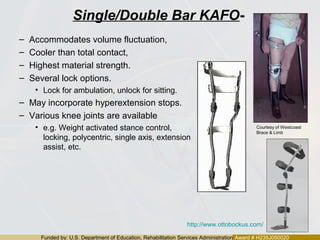
Single/Double Bar KAFO-
– Accommodates volume fluctuation,
– Cooler than total contact,
– Highest material strength.
– Several lock options.
• Lock for ambulation, unlock for sitting.
– May incorporate hyperextension stops.
– Various knee joints are available
• e.g. Weight activated stance control,
locking, polycentric, single axis, extension
assist, etc.
http://www.ottobockus.com/
Courtesy of Westcoast
Brace & Limb
Funded by: U.S. Department of Education, Rehabilitation Services Administration Award # H235J050020
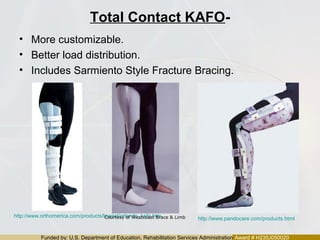
Total Contact KAFO-
• More customizable.
• Better load distribution.
• Includes Sarmiento Style Fracture Bracing.
http://www.orthomerica.com/products/lowext/orlando_kafo.htm
http://www.pandocare.com/products.htmlCourtesy of Westcoast Brace & Limb
Funded by: U.S. Department of Education, Rehabilitation Services Administration Award # H235J050020
Ischial Weight Bearing (unweighting) KAFO-
• Ischial containment or Quadrilateral style
brims with high trimlines.
• Generally used with paralytic limbs.
• Not as effective with larger or obese
individuals.
http://www.beckerorthopedic.com/cenfab/cfp.htm
http://leedergroup.com/bulletins/limited-
Funded by: U.S. Department of Education, Rehabilitation Services Administration Award # H235J050020
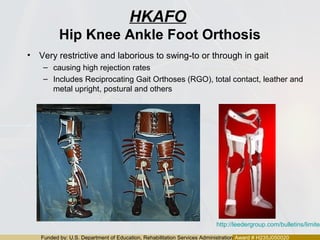
HKAFO
Hip Knee Ankle Foot Orthosis
• Very restrictive and laborious to swing-to or through in gait
– causing high rejection rates
– Includes Reciprocating Gait Orthoses (RGO), total contact, leather and
metal upright, postural and others
http://leedergroup.com/bulletins/limited
Funded by: U.S. Department of Education, Rehabilitation Services Administration Award # H235J050020
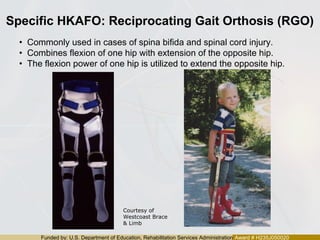
Specific HKAFO: Reciprocating Gait Orthosis (RGO)
• Commonly used in cases of spina bifida and spinal cord injury.
• Combines flexion of one hip with extension of the opposite hip.
• The flexion power of one hip is utilized to extend the opposite hip.
Courtesy of
Westcoast Brace
& Limb
Funded by: U.S. Department of Education, Rehabilitation Services Administration Award # H235J050020
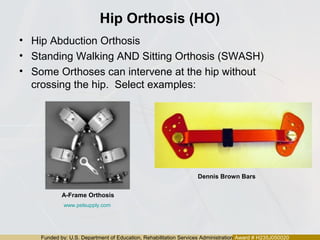
Hip Orthosis (HO)
• Hip Abduction Orthosis
• Standing Walking AND Sitting Orthosis (SWASH)
• Some Orthoses can intervene at the hip without
crossing the hip. Select examples:
A-Frame Orthosis
Dennis Brown Bars
www.pelsupply.com
Funded by: U.S. Department of Education, Rehabilitation Services Administration Award # H235J050020
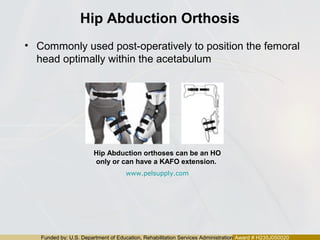
Hip Abduction Orthosis
• Commonly used post-operatively to position the femoral
head optimally within the acetabulum
Hip Abduction orthoses can be an HO
only or can have a KAFO extension.
www.pelsupply.com
Funded by: U.S. Department of Education, Rehabilitation Services Administration Award # H235J050020
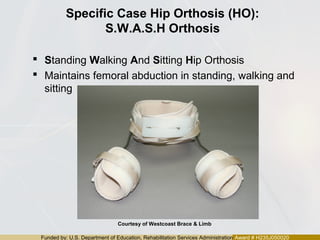
Specific Case Hip Orthosis (HO):
S.W.A.S.H Orthosis
 Standing Walking And Sitting Hip Orthosis
 Maintains femoral abduction in standing, walking and
sitting
Courtesy of Westcoast Brace & Limb
Funded by: U.S. Department of Education, Rehabilitation Services Administration Award # H235J050020
Golden Temple (Amritsar)
Funded by: U.S. Department of Education, Rehabilitation Services Administration Award # H235J050020
Upper Extremity Orthoses:
• HO hand orthosis
• WHO wrist hand orthosis
• EO elbow orthosis
• EWHO elbow wrist hand orthosis
• SO shoulder orthosis
Funded by: U.S. Department of Education, Rehabilitation Services Administration Award # H235J050020
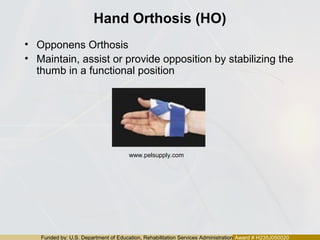
Hand Orthosis (HO)
• Opponens Orthosis
• Maintain, assist or provide opposition by stabilizing the
thumb in a functional position
www.pelsupply.com
Funded by: U.S. Department of Education, Rehabilitation Services Administration Award # H235J050020
Wrist Hand Orthosis (WHO)
• Commonly referred to as a “resting hand splint”
• Commonly used to prevent contractures
• Maintains neutral/static wrist, hand, and finger
Courtesy of Westcoast Brace & Limb
Funded by: U.S. Department of Education, Rehabilitation Services Administration Award # H235J050020
Wrist Hand Orthosis (WHO)
• Commonly referred to as a “cock-up splint”
• Commonly used in cases of carpal tunnel syndrome
• Maintains wrist in slight extension
Courtesy of Westcoast Brace & Limb
Funded by: U.S. Department of Education, Rehabilitation Services Administration Award # H235J050020
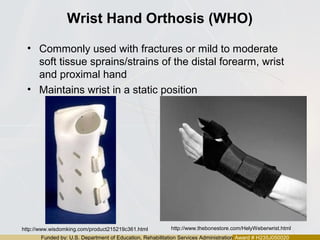
Wrist Hand Orthosis (WHO)
• Commonly used with fractures or mild to moderate
soft tissue sprains/strains of the distal forearm, wrist
and proximal hand
• Maintains wrist in a static position
http://www.wisdomking.com/product215219c361.html http://www.thebonestore.com/HelyWeberwrist.html
Funded by: U.S. Department of Education, Rehabilitation Services Administration Award # H235J050020
Wrist Hand Orthosis (WHO)
• Commonly referred to as a “tenodesis orthosis”
• Commonly used in cases of cervical spinal cord injury that
result in paralysis of prehension
• Creates approximation of the 2nd
and 3rd
digits and the
thumb with active extension of the wrist
Courtesy of Westcoast Brace & Limb
Funded by: U.S. Department of Education, Rehabilitation Services Administration Award # H235J050020
OTS Orthoses around the elbow
• Lateral Epicondylitis Brace-
• Elbow Sleeve- commonly used for minor soft tissue
injuries, compression, sprains and strains
www.pelsupply.com
Funded by: U.S. Department of Education, Rehabilitation Services Administration Award # H235J050020
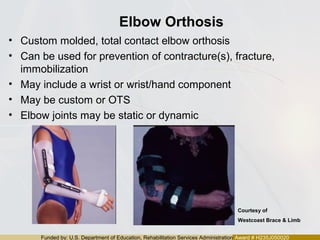
Elbow Orthosis
• Custom molded, total contact elbow orthosis
• Can be used for prevention of contracture(s), fracture,
immobilization
• May include a wrist or wrist/hand component
• May be custom or OTS
• Elbow joints may be static or dynamic
Courtesy of
Westcoast Brace & Limb
Funded by: U.S. Department of Education, Rehabilitation Services Administration Award # H235J050020
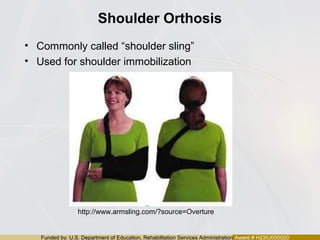
Shoulder Orthosis
• Commonly called “shoulder sling”
• Used for shoulder immobilization
http://www.armsling.com/?source=Overture
Funded by: U.S. Department of Education, Rehabilitation Services Administration Award # H235J050020
Shoulder Orthosis
• Commonly called a shoulder abduction orthosis
– Sometimes referred to as an “airplane splint”
• Maintains abduction at the glenohumeral joint
www.pelsupply.com
Funded by: U.S. Department of Education, Rehabilitation Services Administration Award # H235J050020
LOTUS Temple (DELHI)
Funded by: U.S. Department of Education, Rehabilitation Services Administration Award # H235J050020
Spinal Orthoses
• CO cervical orthosis
• CTLSO cervical, thoracic, lumbosacral orthosis
• TLSO thoracic, lumbosacral orthosis
• LSO lumbosacral orthosis
Funded by: U.S. Department of Education, Rehabilitation Services Administration Award # H235J050020
Cervical Orthosis (CO)
• Soft Cervical Collar
• Commonly used for mild
soft tissue strains and
sprains
• Kinesthetic reminder to limit
motion
Courtesy of Westcoast Brace & Limb
Funded by: U.S. Department of Education, Rehabilitation Services Administration Award # H235J050020
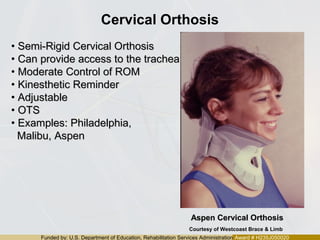
Cervical Orthosis
• Semi-Rigid Cervical OrthosisSemi-Rigid Cervical Orthosis
• Can provide access to the tracheaCan provide access to the trachea
• Moderate Control of ROMModerate Control of ROM
• Kinesthetic ReminderKinesthetic Reminder
• AdjustableAdjustable
• OTSOTS
• Examples: Philadelphia,Examples: Philadelphia,
Malibu, AspenMalibu, Aspen
Aspen Cervical OrthosisAspen Cervical Orthosis
Courtesy of Westcoast Brace & Limb
Funded by: U.S. Department of Education, Rehabilitation Services Administration Award # H235J050020
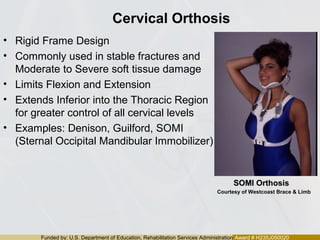
Cervical Orthosis
• Rigid Frame Design
• Commonly used in stable fractures and
Moderate to Severe soft tissue damage
• Limits Flexion and Extension
• Extends Inferior into the Thoracic Region
for greater control of all cervical levels
• Examples: Denison, Guilford, SOMI
(Sternal Occipital Mandibular Immobilizer)
SOMI OrthosisSOMI Orthosis
Courtesy of Westcoast Brace & Limb
Funded by: U.S. Department of Education, Rehabilitation Services Administration Award # H235J050020
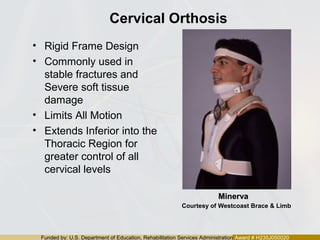
Cervical Orthosis
• Rigid Frame Design
• Commonly used in
stable fractures and
Severe soft tissue
damage
• Limits All Motion
• Extends Inferior into the
Thoracic Region for
greater control of all
cervical levels
MinervaMinerva
Courtesy of Westcoast Brace & Limb
Funded by: U.S. Department of Education, Rehabilitation Services Administration Award # H235J050020
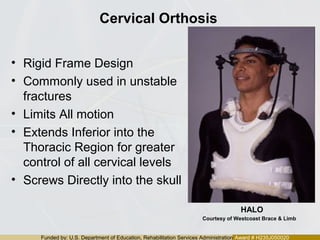
Cervical Orthosis
• Rigid Frame Design
• Commonly used in unstable
fractures
• Limits All motion
• Extends Inferior into the
Thoracic Region for greater
control of all cervical levels
• Screws Directly into the skull
HALO
Courtesy of Westcoast Brace & Limb
Funded by: U.S. Department of Education, Rehabilitation Services Administration Award # H235J050020
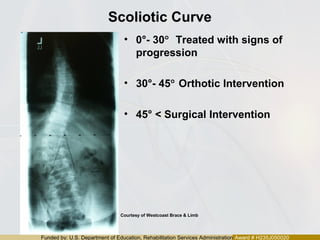
Scoliotic Curve
• 0°- 30° Treated with signs of
progression
• 30°- 45° Orthotic Intervention
• 45° < Surgical Intervention
Courtesy of Westcoast Brace & Limb
Funded by: U.S. Department of Education, Rehabilitation Services Administration Award # H235J050020
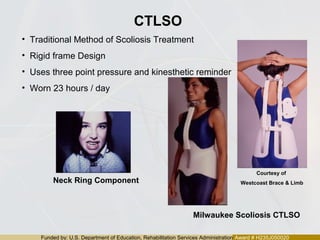
CTLSO
Milwaukee Scoliosis CTLSO
• Traditional Method of Scoliosis Treatment
• Rigid frame Design
• Uses three point pressure and kinesthetic reminder
• Worn 23 hours / day
Neck Ring Component
Courtesy of
Westcoast Brace & Limb
Funded by: U.S. Department of Education, Rehabilitation Services Administration Award # H235J050020
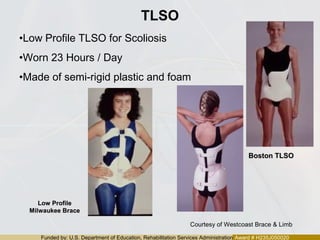
TLSO
Low ProfileLow Profile
Milwaukee BraceMilwaukee Brace
Boston TLSOBoston TLSO
•Low Profile TLSO for Scoliosis
•Worn 23 Hours / Day
•Made of semi-rigid plastic and foam
Courtesy of Westcoast Brace & Limb
Funded by: U.S. Department of Education, Rehabilitation Services Administration Award # H235J050020
TLSO
Charleston Bending OrthosisCharleston Bending Orthosis
ProvidenceOrthosisProvidenceOrthosis
• Low Profile TLSO for Scoliosis
• Worn when sleeping only
• Made of semi-rigid plastic and foam
Courtesy of Westcoast Brace & Limb
Funded by: U.S. Department of Education, Rehabilitation Services Administration Award # H235J050020
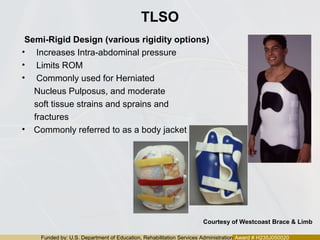
TLSO
Semi-Rigid Design (various rigidity options)
• Increases Intra-abdominal pressure
• Limits ROM
• Commonly used for Herniated
Nucleus Pulposus, and moderate
soft tissue strains and sprains and
fractures
• Commonly referred to as a body jacket
Courtesy of Westcoast Brace & Limb
Funded by: U.S. Department of Education, Rehabilitation Services Administration Award # H235J050020
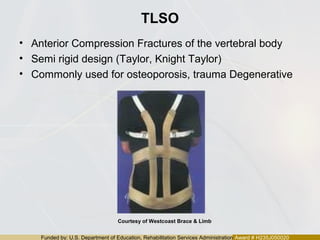
TLSO
• Anterior Compression Fractures of the vertebral body
• Semi rigid design (Taylor, Knight Taylor)
• Commonly used for osteoporosis, trauma Degenerative
Courtesy of Westcoast Brace & Limb
Funded by: U.S. Department of Education, Rehabilitation Services Administration Award # H235J050020
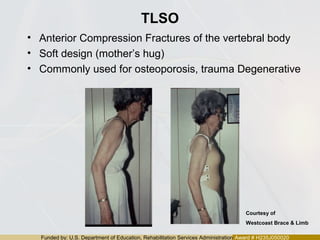
TLSO
• Anterior Compression Fractures of the vertebral body
• Soft design (mother’s hug)
• Commonly used for osteoporosis, trauma Degenerative
Courtesy of
Westcoast Brace & Limb
Funded by: U.S. Department of Education, Rehabilitation Services Administration Award # H235J050020
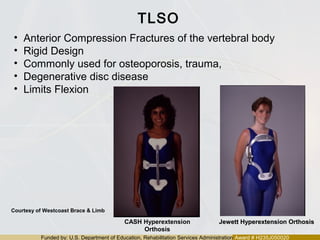
TLSO
• Anterior Compression Fractures of the vertebral body
• Rigid Design
• Commonly used for osteoporosis, trauma,
• Degenerative disc disease
• Limits Flexion
Jewett Hyperextension OrthosisJewett Hyperextension OrthosisCASH Hyperextension
Orthosis
Courtesy of Westcoast Brace & Limb
Funded by: U.S. Department of Education, Rehabilitation Services Administration Award # H235J050020
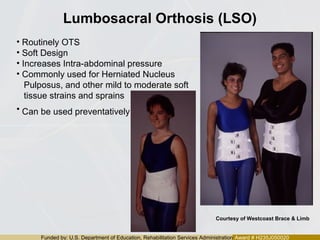
Lumbosacral Orthosis (LSO)
• Routinely OTS
• Soft Design
• Increases Intra-abdominal pressure
• Commonly used for Herniated Nucleus
Pulposus, and other mild to moderate soft
tissue strains and sprains
• Can be used preventatively
Courtesy of Westcoast Brace & Limb
Funded by: U.S. Department of Education, Rehabilitation Services Administration Award # H235J050020
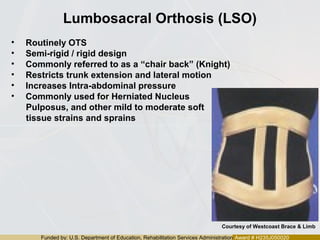
Lumbosacral Orthosis (LSO)
• Routinely OTS
• Semi-rigid / rigid design
• Commonly referred to as a “chair back” (Knight)
• Restricts trunk extension and lateral motion
• Increases Intra-abdominal pressure
• Commonly used for Herniated Nucleus
Pulposus, and other mild to moderate soft
tissue strains and sprains
Courtesy of Westcoast Brace & Limb
Funded by: U.S. Department of Education, Rehabilitation Services Administration Award # H235J050020
Boston Overlap Orthosis
Semi-Rigid Design (various rigidity options)
• Increases Intra-abdominal pressure
• Limits ROM
• Commonly used for Herniated Nucleus
Pulposus, and moderate soft tissue strains
and sprains
Courtesy of Westcoast Brace & Limb

Dr tarek orthotic overview

  • 1.
    Funded by: U.S.Department of Education, Rehabilitation Services Administration Award # H235J050020 Orthotics Overview Dr TAREK M NASRALLAH MD AL AZHAR
  • 2.
    Funded by: U.S.Department of Education, Rehabilitation Services Administration Award # H235J050020 Objectives Upon completion of this educational material, the participant will • Be able to define orthosis • Demonstrate an understanding of basic and common orthotic terminology • Demonstrate an understanding of basic orthotic goals • Differentiate between general types of orthoses • Be able to select an appropriate type of orthosis given a simple case scenario
  • 3.
    Funded by: U.S.Department of Education, Rehabilitation Services Administration Award # H235J050020 Orthotist • Specializes in the – design – fabrication, – fitting, – alignment – adjustment • of orthoses. • An orthosis is any device added to the body to stabilize or immobilize a body part, prevent deformity, protect against injury, or assist with function. (Taber’s Cyclopedic Medical Dictionary. ©2001, FA Davis)
  • 4.
    Funded by: U.S.Department of Education, Rehabilitation Services Administration Award # H235J050020 Some Basic Goals of Orthoses • Maintenance or correction of body segment alignment • Assistance or resistance to joint motion • Axial loading of the orthosis & therefore relief of distal weight bearing forces • Protection against physical insult
  • 5.
    Funded by: U.S.Department of Education, Rehabilitation Services Administration Award # H235J050020 Lower Extremity Orthoses: • FO foot orthosis • AFO ankle foot orthosis • KO knee orthosis • KAFO knee ankle foot orthosis • HKAFO hip knee ankle foot orthosis • HO hip orthosis
  • 6.
    Funded by: U.S.Department of Education, Rehabilitation Services Administration Award # H235J050020 FO (foot orthosis)- • When foot cannot attain neutral, FO may shim the gap to that fixed position-Accommodative FO • May help the foot attain a neutral position-Corrective FO • Either may unload compromised tissue; or may provide total contact • May be full custom or Off The Shelf (OTS)
  • 7.
    Funded by: U.S.Department of Education, Rehabilitation Services Administration Award # H235J050020 UCBL • University of California Biomechanics Laboratory (UCBL) • Rigid plastic total contact design • Hind foot / mid foot correction • Heel cup extends proximal to inframalleolar area and distally to the metatarsal heads www.towerortho.com
  • 8.
    Funded by: U.S.Department of Education, Rehabilitation Services Administration Award # H235J050020 AFO (ankle foot orthosis) Most common orthosis 1. Metal bars 2. Total Contact 3. Floor reaction 4. Unweighting 5. Immobilizing – Most AFO’s can be articulating or non-articulating
  • 9.
    Funded by: U.S.Department of Education, Rehabilitation Services Administration Award # H235J050020 SMO • Supra Maleolar Orthosis • Low profile design that crosses the ankle • Less invasive trim lines than a standard AFO www.towerortho.comwww.dafo.com/ www.pelsupply.com
  • 10.
    Funded by: U.S.Department of Education, Rehabilitation Services Administration Award # H235J050020 Metal bars • Commonly used in specific scenarios – i.e. Post-Polio, Neuropathic feet
  • 11.
    Funded by: U.S.Department of Education, Rehabilitation Services Administration Award # H235J050020 Total Contact AFO’s • provide sleek, intimate fit with total contact to provide better control • Subtypes are thermoplastic and thermosetting • higher patient acceptance possibly due to light weight & concealment (150-200gms); • may be hotter • more common today Courtesy of Westcoast Brace & Limb
  • 12.
    Funded by: U.S.Department of Education, Rehabilitation Services Administration Award # H235J050020 Floor reaction AFO- • Uses floor reaction force through toe aspect of foot plate to prevent forward tibial progression & subsequent knee collapse; • May be articulated http://www.beckerorthopedic.com/cenfab http://www.scheckandsiress.com/orthotic_care/AFO_Floor_Reaction.pdf Courtesy of Westcoast Brace & Limb
  • 13.
    Funded by: U.S.Department of Education, Rehabilitation Services Administration Award # H235J050020 Unweighting AFO • May be patella tendon bearing (PTB), specific weight bearing or total surface bearing, TSB (inverted cone with lace closure) to unweight the ankle foot using prosthetic principles Example of a specific weight bearing AFO from http://www.pttd.com/PhotoGallery.html Example of a TSB unweighting AFO from http://www.arizonaafo.com/weightbearing.html
  • 14.
    Funded by: U.S.Department of Education, Rehabilitation Services Administration Award # H235J050020 Immobilizing AFO Commonly used with a lower extremity deficiency when ankle immobilization is desired – distal tibia/ fibula fracture – foot bone fractures – tendocalcaneus rupture – Diabetic Foot (Charcot Foot) CAM Walker http://www.orthopedictechreview.com/issues/octnov99/productivity.htm Crow Walker www.towerortho.com AFO for Fracture Management. http://www.orthoactive.com/downloads/pdf
  • 15.
    Funded by: U.S.Department of Education, Rehabilitation Services Administration Award # H235J050020 Articulated or Non-articulated • May be designed for progressive increases or decreases in sagittal plane ROM and control • An articulating option may be available in many designs of AFO’s Non-Articulating (Solid Ankle) Articulating
  • 16.
    Funded by: U.S.Department of Education, Rehabilitation Services Administration Award # H235J050020 KO (knee orthosis) • Useful for malalignment – genu varum, – valgum, – recurvatum, • to protect knee structures from undue loading/stress • may be preventative or corrective • may be permanent treatment for repaired/compromised knee structures Photo of a patient with Genu Recurvatum courtesy of Westcoast Brace & Limb
  • 17.
    Funded by: U.S.Department of Education, Rehabilitation Services Administration Award # H235J050020 Several Types of KO’s: • Athletic KO- • Non-articulated KO- • Custom or OTS KO-
  • 18.
    Funded by: U.S.Department of Education, Rehabilitation Services Administration Award # H235J050020 Athletic KO- • Preventative. • Controversial as short lever arms may not be sufficient to diminish realistic damaging forces. • Proprioception thought to play a role. http://www.abrace.com/hinged/flex-lite.htm Courtesy of Westcoast Brace & Limb
  • 19.
    Funded by: U.S.Department of Education, Rehabilitation Services Administration Award # H235J050020 non-articulated KO- • usually for short term use • difficult to transfer with http://www.yourdr.com/kneesupport/dohttp://www.sammonspreston.com/ca/Supply/Product.asp?Leaf_Id=438901 Swedish knee cage for Genu Recurvatum Knee Immobilizer KO
  • 20.
    Funded by: U.S.Department of Education, Rehabilitation Services Administration Award # H235J050020 Off-the-Shelf KO- • Offers limited control of the knee. • Restricts gross motion http://www.orthomerica.com/products/lo http://www.kneebracesonline.com/product.php?productid=307&cat=681&page=1 Dynamic Extension assist KO to prevent contractures
  • 21.
    Funded by: U.S.Department of Education, Rehabilitation Services Administration Award # H235J050020 KAFO Knee Ankle Foot Orthosis • Indicated when lesser devices are biomechanically insufficient; • Combines KO & AFO http://www.aodmobility.com/body_kafos.htm
  • 22.
    Funded by: U.S.Department of Education, Rehabilitation Services Administration Award # H235J050020 Subtypes: – Single/Double bar (upright) KAFO- – Total contact KAFO- – Ischial Weight Bearing (unweighting) KAFO-
  • 23.
    Funded by: U.S.Department of Education, Rehabilitation Services Administration Award # H235J050020 Single/Double Bar KAFO- – Accommodates volume fluctuation, – Cooler than total contact, – Highest material strength. – Several lock options. • Lock for ambulation, unlock for sitting. – May incorporate hyperextension stops. – Various knee joints are available • e.g. Weight activated stance control, locking, polycentric, single axis, extension assist, etc. http://www.ottobockus.com/ Courtesy of Westcoast Brace & Limb
  • 24.
    Funded by: U.S.Department of Education, Rehabilitation Services Administration Award # H235J050020 Total Contact KAFO- • More customizable. • Better load distribution. • Includes Sarmiento Style Fracture Bracing. http://www.orthomerica.com/products/lowext/orlando_kafo.htm http://www.pandocare.com/products.htmlCourtesy of Westcoast Brace & Limb
  • 25.
    Funded by: U.S.Department of Education, Rehabilitation Services Administration Award # H235J050020 Ischial Weight Bearing (unweighting) KAFO- • Ischial containment or Quadrilateral style brims with high trimlines. • Generally used with paralytic limbs. • Not as effective with larger or obese individuals. http://www.beckerorthopedic.com/cenfab/cfp.htm http://leedergroup.com/bulletins/limited-
  • 26.
    Funded by: U.S.Department of Education, Rehabilitation Services Administration Award # H235J050020 HKAFO Hip Knee Ankle Foot Orthosis • Very restrictive and laborious to swing-to or through in gait – causing high rejection rates – Includes Reciprocating Gait Orthoses (RGO), total contact, leather and metal upright, postural and others http://leedergroup.com/bulletins/limited
  • 27.
    Funded by: U.S.Department of Education, Rehabilitation Services Administration Award # H235J050020 Specific HKAFO: Reciprocating Gait Orthosis (RGO) • Commonly used in cases of spina bifida and spinal cord injury. • Combines flexion of one hip with extension of the opposite hip. • The flexion power of one hip is utilized to extend the opposite hip. Courtesy of Westcoast Brace & Limb
  • 28.
    Funded by: U.S.Department of Education, Rehabilitation Services Administration Award # H235J050020 Hip Orthosis (HO) • Hip Abduction Orthosis • Standing Walking AND Sitting Orthosis (SWASH) • Some Orthoses can intervene at the hip without crossing the hip. Select examples: A-Frame Orthosis Dennis Brown Bars www.pelsupply.com
  • 29.
    Funded by: U.S.Department of Education, Rehabilitation Services Administration Award # H235J050020 Hip Abduction Orthosis • Commonly used post-operatively to position the femoral head optimally within the acetabulum Hip Abduction orthoses can be an HO only or can have a KAFO extension. www.pelsupply.com
  • 30.
    Funded by: U.S.Department of Education, Rehabilitation Services Administration Award # H235J050020 Specific Case Hip Orthosis (HO): S.W.A.S.H Orthosis  Standing Walking And Sitting Hip Orthosis  Maintains femoral abduction in standing, walking and sitting Courtesy of Westcoast Brace & Limb
  • 31.
    Funded by: U.S.Department of Education, Rehabilitation Services Administration Award # H235J050020 Golden Temple (Amritsar)
  • 32.
    Funded by: U.S.Department of Education, Rehabilitation Services Administration Award # H235J050020 Upper Extremity Orthoses: • HO hand orthosis • WHO wrist hand orthosis • EO elbow orthosis • EWHO elbow wrist hand orthosis • SO shoulder orthosis
  • 33.
    Funded by: U.S.Department of Education, Rehabilitation Services Administration Award # H235J050020 Hand Orthosis (HO) • Opponens Orthosis • Maintain, assist or provide opposition by stabilizing the thumb in a functional position www.pelsupply.com
  • 34.
    Funded by: U.S.Department of Education, Rehabilitation Services Administration Award # H235J050020 Wrist Hand Orthosis (WHO) • Commonly referred to as a “resting hand splint” • Commonly used to prevent contractures • Maintains neutral/static wrist, hand, and finger Courtesy of Westcoast Brace & Limb
  • 35.
    Funded by: U.S.Department of Education, Rehabilitation Services Administration Award # H235J050020 Wrist Hand Orthosis (WHO) • Commonly referred to as a “cock-up splint” • Commonly used in cases of carpal tunnel syndrome • Maintains wrist in slight extension Courtesy of Westcoast Brace & Limb
  • 36.
    Funded by: U.S.Department of Education, Rehabilitation Services Administration Award # H235J050020 Wrist Hand Orthosis (WHO) • Commonly used with fractures or mild to moderate soft tissue sprains/strains of the distal forearm, wrist and proximal hand • Maintains wrist in a static position http://www.wisdomking.com/product215219c361.html http://www.thebonestore.com/HelyWeberwrist.html
  • 37.
    Funded by: U.S.Department of Education, Rehabilitation Services Administration Award # H235J050020 Wrist Hand Orthosis (WHO) • Commonly referred to as a “tenodesis orthosis” • Commonly used in cases of cervical spinal cord injury that result in paralysis of prehension • Creates approximation of the 2nd and 3rd digits and the thumb with active extension of the wrist Courtesy of Westcoast Brace & Limb
  • 38.
    Funded by: U.S.Department of Education, Rehabilitation Services Administration Award # H235J050020 OTS Orthoses around the elbow • Lateral Epicondylitis Brace- • Elbow Sleeve- commonly used for minor soft tissue injuries, compression, sprains and strains www.pelsupply.com
  • 39.
    Funded by: U.S.Department of Education, Rehabilitation Services Administration Award # H235J050020 Elbow Orthosis • Custom molded, total contact elbow orthosis • Can be used for prevention of contracture(s), fracture, immobilization • May include a wrist or wrist/hand component • May be custom or OTS • Elbow joints may be static or dynamic Courtesy of Westcoast Brace & Limb
  • 40.
    Funded by: U.S.Department of Education, Rehabilitation Services Administration Award # H235J050020 Shoulder Orthosis • Commonly called “shoulder sling” • Used for shoulder immobilization http://www.armsling.com/?source=Overture
  • 41.
    Funded by: U.S.Department of Education, Rehabilitation Services Administration Award # H235J050020 Shoulder Orthosis • Commonly called a shoulder abduction orthosis – Sometimes referred to as an “airplane splint” • Maintains abduction at the glenohumeral joint www.pelsupply.com
  • 42.
    Funded by: U.S.Department of Education, Rehabilitation Services Administration Award # H235J050020 LOTUS Temple (DELHI)
  • 43.
    Funded by: U.S.Department of Education, Rehabilitation Services Administration Award # H235J050020 Spinal Orthoses • CO cervical orthosis • CTLSO cervical, thoracic, lumbosacral orthosis • TLSO thoracic, lumbosacral orthosis • LSO lumbosacral orthosis
  • 44.
    Funded by: U.S.Department of Education, Rehabilitation Services Administration Award # H235J050020 Cervical Orthosis (CO) • Soft Cervical Collar • Commonly used for mild soft tissue strains and sprains • Kinesthetic reminder to limit motion Courtesy of Westcoast Brace & Limb
  • 45.
    Funded by: U.S.Department of Education, Rehabilitation Services Administration Award # H235J050020 Cervical Orthosis • Semi-Rigid Cervical OrthosisSemi-Rigid Cervical Orthosis • Can provide access to the tracheaCan provide access to the trachea • Moderate Control of ROMModerate Control of ROM • Kinesthetic ReminderKinesthetic Reminder • AdjustableAdjustable • OTSOTS • Examples: Philadelphia,Examples: Philadelphia, Malibu, AspenMalibu, Aspen Aspen Cervical OrthosisAspen Cervical Orthosis Courtesy of Westcoast Brace & Limb
  • 46.
    Funded by: U.S.Department of Education, Rehabilitation Services Administration Award # H235J050020 Cervical Orthosis • Rigid Frame Design • Commonly used in stable fractures and Moderate to Severe soft tissue damage • Limits Flexion and Extension • Extends Inferior into the Thoracic Region for greater control of all cervical levels • Examples: Denison, Guilford, SOMI (Sternal Occipital Mandibular Immobilizer) SOMI OrthosisSOMI Orthosis Courtesy of Westcoast Brace & Limb
  • 47.
    Funded by: U.S.Department of Education, Rehabilitation Services Administration Award # H235J050020 Cervical Orthosis • Rigid Frame Design • Commonly used in stable fractures and Severe soft tissue damage • Limits All Motion • Extends Inferior into the Thoracic Region for greater control of all cervical levels MinervaMinerva Courtesy of Westcoast Brace & Limb
  • 48.
    Funded by: U.S.Department of Education, Rehabilitation Services Administration Award # H235J050020 Cervical Orthosis • Rigid Frame Design • Commonly used in unstable fractures • Limits All motion • Extends Inferior into the Thoracic Region for greater control of all cervical levels • Screws Directly into the skull HALO Courtesy of Westcoast Brace & Limb
  • 49.
    Funded by: U.S.Department of Education, Rehabilitation Services Administration Award # H235J050020 Scoliotic Curve • 0°- 30° Treated with signs of progression • 30°- 45° Orthotic Intervention • 45° < Surgical Intervention Courtesy of Westcoast Brace & Limb
  • 50.
    Funded by: U.S.Department of Education, Rehabilitation Services Administration Award # H235J050020 CTLSO Milwaukee Scoliosis CTLSO • Traditional Method of Scoliosis Treatment • Rigid frame Design • Uses three point pressure and kinesthetic reminder • Worn 23 hours / day Neck Ring Component Courtesy of Westcoast Brace & Limb
  • 51.
    Funded by: U.S.Department of Education, Rehabilitation Services Administration Award # H235J050020 TLSO Low ProfileLow Profile Milwaukee BraceMilwaukee Brace Boston TLSOBoston TLSO •Low Profile TLSO for Scoliosis •Worn 23 Hours / Day •Made of semi-rigid plastic and foam Courtesy of Westcoast Brace & Limb
  • 52.
    Funded by: U.S.Department of Education, Rehabilitation Services Administration Award # H235J050020 TLSO Charleston Bending OrthosisCharleston Bending Orthosis ProvidenceOrthosisProvidenceOrthosis • Low Profile TLSO for Scoliosis • Worn when sleeping only • Made of semi-rigid plastic and foam Courtesy of Westcoast Brace & Limb
  • 53.
    Funded by: U.S.Department of Education, Rehabilitation Services Administration Award # H235J050020 TLSO Semi-Rigid Design (various rigidity options) • Increases Intra-abdominal pressure • Limits ROM • Commonly used for Herniated Nucleus Pulposus, and moderate soft tissue strains and sprains and fractures • Commonly referred to as a body jacket Courtesy of Westcoast Brace & Limb
  • 54.
    Funded by: U.S.Department of Education, Rehabilitation Services Administration Award # H235J050020 TLSO • Anterior Compression Fractures of the vertebral body • Semi rigid design (Taylor, Knight Taylor) • Commonly used for osteoporosis, trauma Degenerative Courtesy of Westcoast Brace & Limb
  • 55.
    Funded by: U.S.Department of Education, Rehabilitation Services Administration Award # H235J050020 TLSO • Anterior Compression Fractures of the vertebral body • Soft design (mother’s hug) • Commonly used for osteoporosis, trauma Degenerative Courtesy of Westcoast Brace & Limb
  • 56.
    Funded by: U.S.Department of Education, Rehabilitation Services Administration Award # H235J050020 TLSO • Anterior Compression Fractures of the vertebral body • Rigid Design • Commonly used for osteoporosis, trauma, • Degenerative disc disease • Limits Flexion Jewett Hyperextension OrthosisJewett Hyperextension OrthosisCASH Hyperextension Orthosis Courtesy of Westcoast Brace & Limb
  • 57.
    Funded by: U.S.Department of Education, Rehabilitation Services Administration Award # H235J050020 Lumbosacral Orthosis (LSO) • Routinely OTS • Soft Design • Increases Intra-abdominal pressure • Commonly used for Herniated Nucleus Pulposus, and other mild to moderate soft tissue strains and sprains • Can be used preventatively Courtesy of Westcoast Brace & Limb
  • 58.
    Funded by: U.S.Department of Education, Rehabilitation Services Administration Award # H235J050020 Lumbosacral Orthosis (LSO) • Routinely OTS • Semi-rigid / rigid design • Commonly referred to as a “chair back” (Knight) • Restricts trunk extension and lateral motion • Increases Intra-abdominal pressure • Commonly used for Herniated Nucleus Pulposus, and other mild to moderate soft tissue strains and sprains Courtesy of Westcoast Brace & Limb
  • 59.
    Funded by: U.S.Department of Education, Rehabilitation Services Administration Award # H235J050020 Boston Overlap Orthosis Semi-Rigid Design (various rigidity options) • Increases Intra-abdominal pressure • Limits ROM • Commonly used for Herniated Nucleus Pulposus, and moderate soft tissue strains and sprains Courtesy of Westcoast Brace & Limb