Lower limb orthotics


Jeff Ericksen, MD
VCU/MCV Dept. of PM&R
Goals
Gait review
  Key muscles, joint mechanics
Common conditions for orthotics
Lower limb orthotic approach
Examples
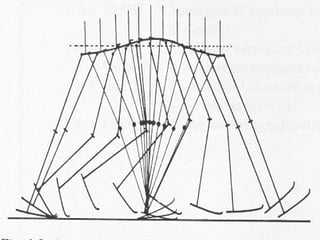
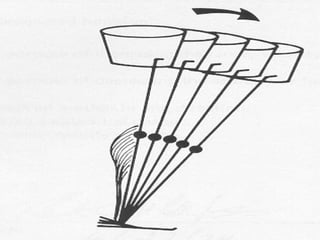
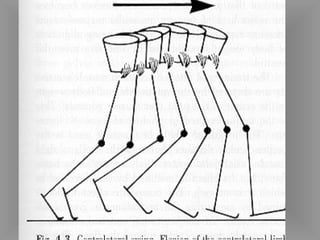
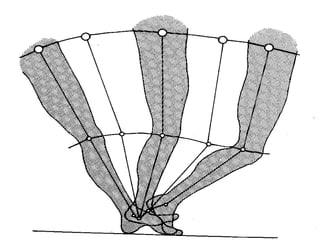
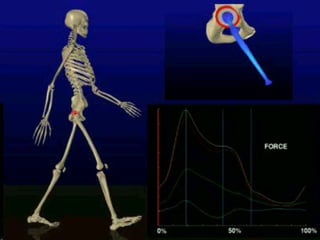
Normal gait = progression of
  passenger unit through
  space with stability and
  minimal energy output.*
 Keep center of gravity in tightest spiral
   Most efficient CG path = line, only with wheels
     Perry, J Atlas of Orthotics
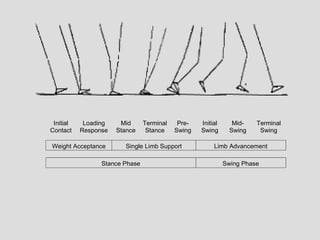
Initial    Loading    Mid      Terminal    Pre-   Initial      Mid-   Terminal
Contact    Response   Stance     Stance    Swing   Swing       Swing    Swing

Weight Acceptance       Single Limb Support             Limb Advancement

                 Stance Phase                                Swing Phase
Terminology
Gait Cycle: Sequence of events from
initial contact of one extremity to
the subsequent initial contact on the
same side
Gait terminology
Stride length: Distance from initial contact
of one extremity to the subsequent initial
contact on the same side (x= 1.41 m)

Step length: Distance from initial contact
of one extremity to the initial contact on
the opposite side (x= 0.7 m)
Terminology
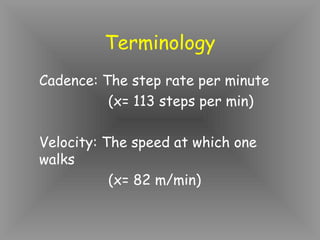
Cadence: The step rate per minute
          (x= 113 steps per min)

Velocity: The speed at which one
walks
           (x= 82 m/min)
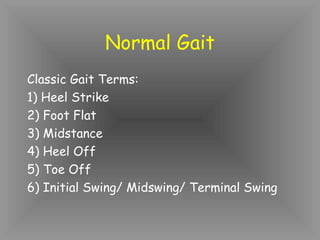
Normal Gait
Classic Gait Terms:
1) Heel Strike
2) Foot Flat
3) Midstance
4) Heel Off
5) Toe Off
6) Initial Swing/ Midswing/ Terminal Swing
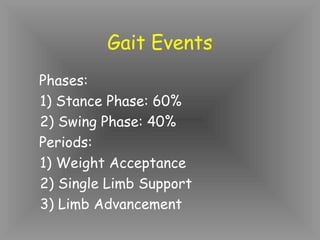
Gait Events
Phases:
1) Stance Phase: 60%
2) Swing Phase: 40%
Periods:
1) Weight Acceptance
2) Single Limb Support
3) Limb Advancement
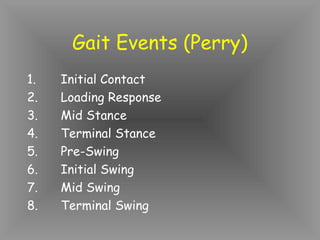
Gait Events (Perry)
1.   Initial Contact
2.   Loading Response
3.   Mid Stance
4.   Terminal Stance
5.   Pre-Swing
6.   Initial Swing
7.   Mid Swing
8.   Terminal Swing
Progression
Mostly from forward fall of body
mass as it progresses in front of
loaded foot, ankle moves into DF with
rapid acceleration as heel rises
Swing limb generates second
progressional force as stance limb
goes into single support phase, must
occur to prepare for forward fall
Energy consumption
Acceleration & deceleration needs
Swinging mass of leg must be
decelerated by eccentric contraction
of extensors and counterforce
(acceleration) of body
Forward falling body must be
decelerated by shock absorption at
initial contact = heel strike
Eccentric energy
    consumption is high
Pretibial and quadriceps contraction
at initial contact with eccentric
control of tibial shank in loading
phase on stance leg.
Results in 8:5 ratio for energy in
deceleration or control activity vs.
propulsion activity
Determinants of gait
Foot, ankle, knee and pelvis
contributions to smoothing center of
gravity motion to preserve energy
  Inman APMR 67
Determinants
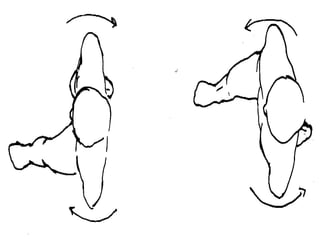
1) Pelvic Rotation
2) Pelvic Tilt
3) Lateral pelvic motion
4) Knee flexion in midstance
5) Knee motion throughout gait cycle
6) Foot and ankle motion
Determinants
                            Foot & ankle motion
Pelvic rotation 4 degrees     Smooths out abrupt
saves 6/16 vertical drop      changes in accel/decel
Pelvic tilt 5 degrees,        & direction of body
saves 3/16 vertical           motion
excursion                        Knee contributes also
Knee flexion 15 degrees       Converts CG curve into
lowers CG 7/16                smooth sine wave < 2
                              inch amplitude
   total savings = 1 inch   CG horizontal translation
   per leg                  reduced by leg alignment
                              reduces side to side
                              sway for stability by >
                              4 inches
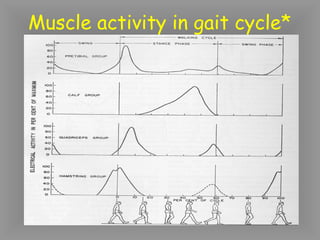
Muscle activity in gait cycle*
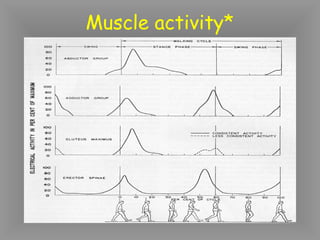
Muscle activity*
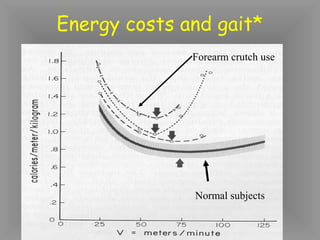
Energy costs and gait*
              Forearm crutch use


              Normal subjects
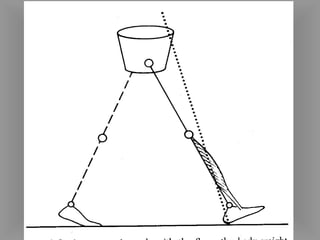
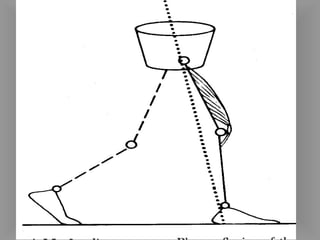
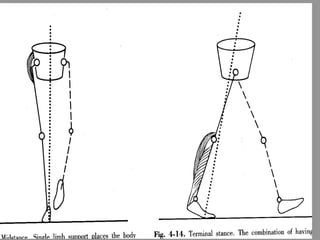
Joint stability in gait
Determined by relationship between
muscle support, capsule & ligamentous
support, articular relationships and
lines of force
Gait deviations
Structural bony issues
Joint/soft tissue changes
Neuromuscular functional changes
Leg length difference
 < 1.5 in, see long side shoulder
elevation with dipping on short leg
side
  Compensation with dropping pelvis on
  short side
  Exaggerated hip, knee, ankle flexion on
  long side
 > 1.5 in, different compensation such
as vaulting on short leg, trunk lean to
short side, circumduct long leg
ROM loss or ankylosis will
show proximal compensation
  with or without velocity
          changes.
Other orthopedic problems
        affect gait*
Foot equinus gives steppage gait to clear
the relatively longer leg
Calcaneal deformity changes push off and
initial contact
Gait changes from
     orthopedic issues
Joint instability gives unstable motion
and fear, reduced stance phase
Pain reduces stance typically
  Spine pain may reduce gait speed to
  reduce impact
Hemiplegia gaits
Extensor synergy allows ambulation
  Hip & knee extension, hip IR, foot & toe
  PF and foot inversion
Difficulty in loading phase or clearing
the “longer” plegic limb gives step-to
gait.
Hemiplegia
1) Asymmetric Gait
2) Step length shortened on the plegic side
3) Decreased knee and hip flexion on swing
   phase
4) Shortened stance phase
5) Upper extremity held in flexion and
    adduction
Lower motor neuron gaits
Hip extensor weakness gait
  Trunk & pelvis posterior after heel
  strike
Glut medius limp
  pelvis drops if uncompensated
  trunk shift if compensated
Hip flexor weakness
  Leg swung by trunk rotation pulling leg
  on hip ligaments
Lower motor neuron gaits
Quadricep weakness: forcible extension
using hip flexors, heavy heel strike and
forward lean over heel to keep force
anterior to knee joint.
Gastroc/soleus weakness: poor control of
loading phase DF >> compensation is delay
with resulting knee bending moment and
more quad extensor needs. Reduced
forward progression of limb with push off
into swing*
Lower motor neuron gaits
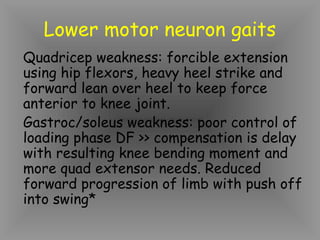
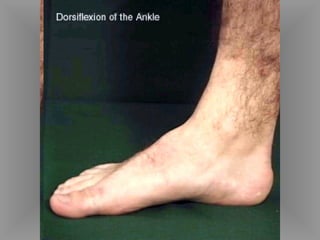
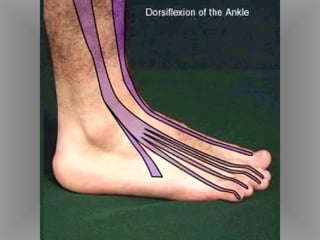
Dorsiflexor weakness gives steppage
gait
  Foot slap in fast walk with mild weakness
  and if some strength, may be noticable
  with fatigue as eccentric TA activity
  fails
  Forefoot = initial contact point if no
  strength for DF present
LE Orthotics
Weakness
Skeletal & joint insufficiency
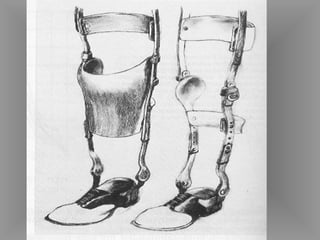
Leg joint alignment orthoses
Use with & without weight bearing
features
Most common in knee support for RA
induced ligamentous loss
Form fitting shells better than bands
Alignment of knee joint is key
  Typically use single axis knee joints for
  these orthoses
LE weakness orthoses
AFO’s                   HKAFO’s
  Double metal          Reciprocating Gait
  upright               Orthosis
  Plastic               Functional
    Molded
                        Electrical
    off shelf
                        Stimulation (FES)
  VAPC
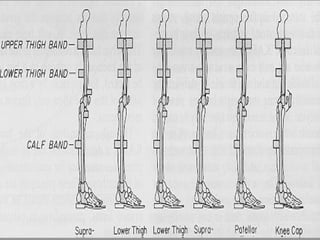
KAFO’s
  Many designs for
  band configurations
  Metal vs. plastic
AFO’s
Most common orthotic
Stabilizes ankle in stance
Helps clear toe in swing
Gives some push off in late stance to
save energy
Remember effects on knee!!
AFO’s
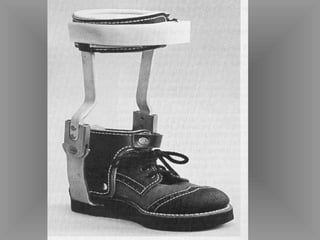
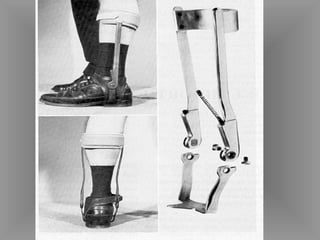
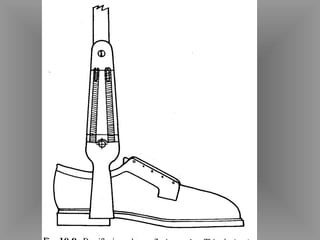
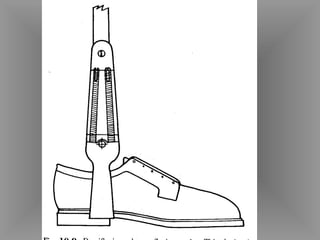
Double metal upright allows for
anterior and posterior stops and
spring assist for DF & PF force
generation.
  Hinged molded AFO can be similar
Mediolateral stability is good but can
be enhanced with T-straps
Knee effects of PF stops
PF stop helps weak DF & swing
clearance but stops PF of foot at heel
strike, force line behind knee
destabilizes.
  Minimal PF stop or just spring assist to
  pick toe up in swing should be used for
  flaccid paralysis and only few degrees of
  DF position for PF stop in spastic
  paralysis.
Posterior PF stop should
allow adequate toe clearance
 in swing but not excessive
DF to increase knee bending
    moment at heel strike.
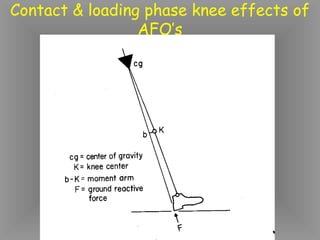
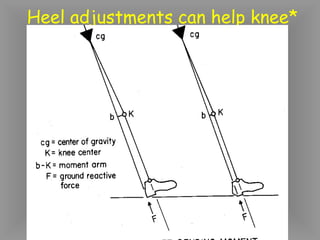
Contact & loading phase knee effects of
                 AFO’s
Heel adjustments can help knee*
Effects of DF stops
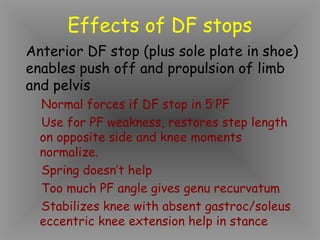
Anterior DF stop (plus sole plate in shoe)
enables push off and propulsion of limb
and pelvis
  Normal forces if DF stop in 5o PF
  Use for PF weakness, restores step length
  on opposite side and knee moments
  normalize.
  Spring doesn’t help
  Too much PF angle gives genu recurvatum
  Stabilizes knee with absent gastroc/soleus
  eccentric knee extension help in stance
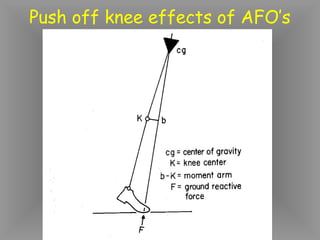
Push off knee effects of AFO’s
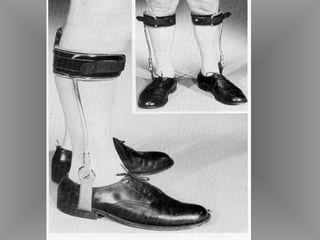
Single upright orthoses
Reduces interference with
contralateral orthoses or medial
malleolus
Not useful for mediolateral stability
problems
Plastic AFO’s
Similar biomechanical analysis
Trim lines of posterior vertical
component influence ankle rigidity
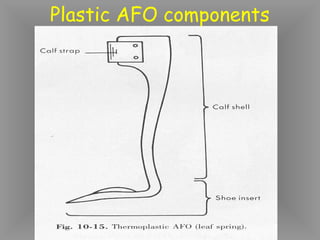
Plastic AFO components
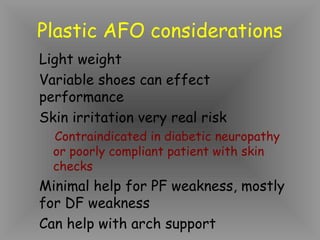
Plastic AFO considerations
Light weight
Variable shoes can effect
performance
Skin irritation very real risk
  Contraindicated in diabetic neuropathy
  or poorly compliant patient with skin
  checks
Minimal help for PF weakness, mostly
for DF weakness
Can help with arch support
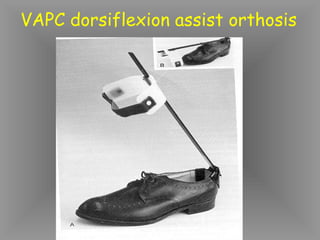
VAPC dorsiflexion assist orthosis
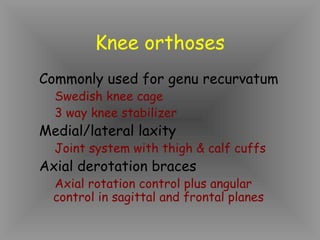
Knee orthoses
Commonly used for genu recurvatum
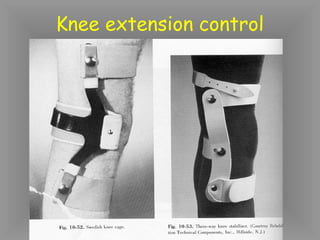
  Swedish knee cage
  3 way knee stabilizer
Medial/lateral laxity
  Joint system with thigh & calf cuffs
Axial derotation braces
  Axial rotation control plus angular
  control in sagittal and frontal planes
Knee extension control
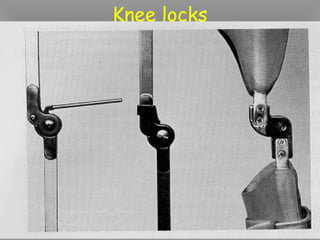
Knee locks
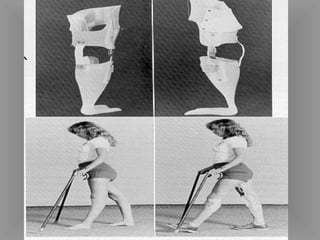
KAFO’s used in SCI, conus or
   cauda equina injuries
 T10 is often cutoff level, use swing to
 gait with locked knees, considerable
 energy expenditure
Knee stability added when
AFO not able to control knee
 Continue to utilize rigid foot plate
 and DF stop to help push off and PF
 stop to clear toe in swing
Knee stability via 3 force
       application
Anterior force to stop knee buckling
2 posterior counterforces at thigh &
1 at calf
Shoe level counterforce keeps lower
leg from posterior motion in closed
chain loading
HKAFO’s
Rarely used, indicated for hip
extensor weakness
Pelvic band often necessary for
stabilization and suspension
Hip orthotics for dislocation
            risks
 Adults
 Pediatrics
   Scottish Rite
   Pavlik Harness
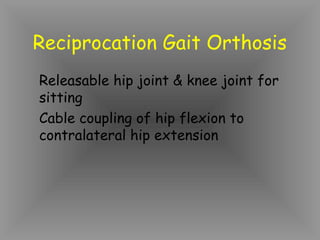
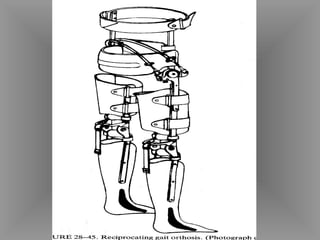
Reciprocation Gait Orthosis
Releasable hip joint & knee joint for
sitting
Cable coupling of hip flexion to
contralateral hip extension
Questions

Gaitortho

  • 1.
    Lower limb orthotics JeffEricksen, MD VCU/MCV Dept. of PM&R
  • 2.
    Goals Gait review Key muscles, joint mechanics Common conditions for orthotics Lower limb orthotic approach Examples
  • 3.
    Normal gait =progression of passenger unit through space with stability and minimal energy output.* Keep center of gravity in tightest spiral Most efficient CG path = line, only with wheels Perry, J Atlas of Orthotics
  • 5.
    Initial Loading Mid Terminal Pre- Initial Mid- Terminal Contact Response Stance Stance Swing Swing Swing Swing Weight Acceptance Single Limb Support Limb Advancement Stance Phase Swing Phase
  • 6.
    Terminology Gait Cycle: Sequenceof events from initial contact of one extremity to the subsequent initial contact on the same side
  • 7.
    Gait terminology Stride length:Distance from initial contact of one extremity to the subsequent initial contact on the same side (x= 1.41 m) Step length: Distance from initial contact of one extremity to the initial contact on the opposite side (x= 0.7 m)
  • 8.
    Terminology Cadence: The steprate per minute (x= 113 steps per min) Velocity: The speed at which one walks (x= 82 m/min)
  • 9.
    Normal Gait Classic GaitTerms: 1) Heel Strike 2) Foot Flat 3) Midstance 4) Heel Off 5) Toe Off 6) Initial Swing/ Midswing/ Terminal Swing
  • 10.
    Gait Events Phases: 1) StancePhase: 60% 2) Swing Phase: 40% Periods: 1) Weight Acceptance 2) Single Limb Support 3) Limb Advancement
  • 11.
    Gait Events (Perry) 1. Initial Contact 2. Loading Response 3. Mid Stance 4. Terminal Stance 5. Pre-Swing 6. Initial Swing 7. Mid Swing 8. Terminal Swing
  • 15.
    Progression Mostly from forwardfall of body mass as it progresses in front of loaded foot, ankle moves into DF with rapid acceleration as heel rises Swing limb generates second progressional force as stance limb goes into single support phase, must occur to prepare for forward fall
  • 18.
    Energy consumption Acceleration &deceleration needs Swinging mass of leg must be decelerated by eccentric contraction of extensors and counterforce (acceleration) of body Forward falling body must be decelerated by shock absorption at initial contact = heel strike
  • 19.
    Eccentric energy consumption is high Pretibial and quadriceps contraction at initial contact with eccentric control of tibial shank in loading phase on stance leg. Results in 8:5 ratio for energy in deceleration or control activity vs. propulsion activity
  • 20.
    Determinants of gait Foot,ankle, knee and pelvis contributions to smoothing center of gravity motion to preserve energy Inman APMR 67
  • 21.
    Determinants 1) Pelvic Rotation 2)Pelvic Tilt 3) Lateral pelvic motion 4) Knee flexion in midstance 5) Knee motion throughout gait cycle 6) Foot and ankle motion
  • 22.
    Determinants Foot & ankle motion Pelvic rotation 4 degrees Smooths out abrupt saves 6/16 vertical drop changes in accel/decel Pelvic tilt 5 degrees, & direction of body saves 3/16 vertical motion excursion Knee contributes also Knee flexion 15 degrees Converts CG curve into lowers CG 7/16 smooth sine wave < 2 inch amplitude total savings = 1 inch CG horizontal translation per leg reduced by leg alignment reduces side to side sway for stability by > 4 inches
  • 25.
    Muscle activity ingait cycle*
  • 26.
  • 27.
    Energy costs andgait* Forearm crutch use Normal subjects
  • 28.
    Joint stability ingait Determined by relationship between muscle support, capsule & ligamentous support, articular relationships and lines of force
  • 34.
    Gait deviations Structural bonyissues Joint/soft tissue changes Neuromuscular functional changes
  • 35.
    Leg length difference < 1.5 in, see long side shoulder elevation with dipping on short leg side Compensation with dropping pelvis on short side Exaggerated hip, knee, ankle flexion on long side > 1.5 in, different compensation such as vaulting on short leg, trunk lean to short side, circumduct long leg
  • 36.
    ROM loss orankylosis will show proximal compensation with or without velocity changes.
  • 37.
    Other orthopedic problems affect gait* Foot equinus gives steppage gait to clear the relatively longer leg Calcaneal deformity changes push off and initial contact
  • 38.
    Gait changes from orthopedic issues Joint instability gives unstable motion and fear, reduced stance phase Pain reduces stance typically Spine pain may reduce gait speed to reduce impact
  • 39.
    Hemiplegia gaits Extensor synergyallows ambulation Hip & knee extension, hip IR, foot & toe PF and foot inversion Difficulty in loading phase or clearing the “longer” plegic limb gives step-to gait.
  • 40.
    Hemiplegia 1) Asymmetric Gait 2)Step length shortened on the plegic side 3) Decreased knee and hip flexion on swing phase 4) Shortened stance phase 5) Upper extremity held in flexion and adduction
  • 41.
    Lower motor neurongaits Hip extensor weakness gait Trunk & pelvis posterior after heel strike Glut medius limp pelvis drops if uncompensated trunk shift if compensated Hip flexor weakness Leg swung by trunk rotation pulling leg on hip ligaments
  • 42.
    Lower motor neurongaits Quadricep weakness: forcible extension using hip flexors, heavy heel strike and forward lean over heel to keep force anterior to knee joint. Gastroc/soleus weakness: poor control of loading phase DF >> compensation is delay with resulting knee bending moment and more quad extensor needs. Reduced forward progression of limb with push off into swing*
  • 43.
    Lower motor neurongaits Dorsiflexor weakness gives steppage gait Foot slap in fast walk with mild weakness and if some strength, may be noticable with fatigue as eccentric TA activity fails Forefoot = initial contact point if no strength for DF present
  • 46.
  • 47.
    Leg joint alignmentorthoses Use with & without weight bearing features Most common in knee support for RA induced ligamentous loss Form fitting shells better than bands Alignment of knee joint is key Typically use single axis knee joints for these orthoses
  • 49.
    LE weakness orthoses AFO’s HKAFO’s Double metal Reciprocating Gait upright Orthosis Plastic Functional Molded Electrical off shelf Stimulation (FES) VAPC KAFO’s Many designs for band configurations Metal vs. plastic
  • 50.
    AFO’s Most common orthotic Stabilizesankle in stance Helps clear toe in swing Gives some push off in late stance to save energy Remember effects on knee!!
  • 51.
    AFO’s Double metal uprightallows for anterior and posterior stops and spring assist for DF & PF force generation. Hinged molded AFO can be similar Mediolateral stability is good but can be enhanced with T-straps
  • 55.
    Knee effects ofPF stops PF stop helps weak DF & swing clearance but stops PF of foot at heel strike, force line behind knee destabilizes. Minimal PF stop or just spring assist to pick toe up in swing should be used for flaccid paralysis and only few degrees of DF position for PF stop in spastic paralysis.
  • 56.
    Posterior PF stopshould allow adequate toe clearance in swing but not excessive DF to increase knee bending moment at heel strike.
  • 57.
    Contact & loadingphase knee effects of AFO’s
  • 58.
  • 59.
    Effects of DFstops Anterior DF stop (plus sole plate in shoe) enables push off and propulsion of limb and pelvis Normal forces if DF stop in 5o PF Use for PF weakness, restores step length on opposite side and knee moments normalize. Spring doesn’t help Too much PF angle gives genu recurvatum Stabilizes knee with absent gastroc/soleus eccentric knee extension help in stance
  • 61.
    Push off kneeeffects of AFO’s
  • 62.
    Single upright orthoses Reducesinterference with contralateral orthoses or medial malleolus Not useful for mediolateral stability problems
  • 64.
    Plastic AFO’s Similar biomechanicalanalysis Trim lines of posterior vertical component influence ankle rigidity
  • 65.
  • 66.
    Plastic AFO considerations Lightweight Variable shoes can effect performance Skin irritation very real risk Contraindicated in diabetic neuropathy or poorly compliant patient with skin checks Minimal help for PF weakness, mostly for DF weakness Can help with arch support
  • 67.
  • 68.
    Knee orthoses Commonly usedfor genu recurvatum Swedish knee cage 3 way knee stabilizer Medial/lateral laxity Joint system with thigh & calf cuffs Axial derotation braces Axial rotation control plus angular control in sagittal and frontal planes
  • 69.
  • 70.
  • 71.
    KAFO’s used inSCI, conus or cauda equina injuries T10 is often cutoff level, use swing to gait with locked knees, considerable energy expenditure
  • 72.
    Knee stability addedwhen AFO not able to control knee Continue to utilize rigid foot plate and DF stop to help push off and PF stop to clear toe in swing
  • 74.
    Knee stability via3 force application Anterior force to stop knee buckling 2 posterior counterforces at thigh & 1 at calf Shoe level counterforce keeps lower leg from posterior motion in closed chain loading
  • 76.
    HKAFO’s Rarely used, indicatedfor hip extensor weakness Pelvic band often necessary for stabilization and suspension
  • 77.
    Hip orthotics fordislocation risks Adults Pediatrics Scottish Rite Pavlik Harness
  • 78.
    Reciprocation Gait Orthosis Releasablehip joint & knee joint for sitting Cable coupling of hip flexion to contralateral hip extension
  • 80.

Editor's Notes

  • #4 Double stance occurs in initial and terminal 10% of stance, thus middle 40% of stance is single limb support
  • #26 Pre-tibial muscles eccentrically slow plantarflexion after heel strike, some action in stance for sub-talar influence and some activity in swing for toe clearance. Gastroc/soleus with peak in push off for CG propulsion but also eccentrically controls shank progression over ankle. Quads peak after heal strike to absorb knee flexion. RF active in late stance with flexed hip and knee to reduce heel rise. Quads also active in early swing to keep lower leg swinging on femur. Hamstrings with 2 peaks around heel strike. Firstin terminal swing to slow forward swing with hip extension and knee flexion action in open chain role. Second is closed chain role with foot contact to extend knee and hip for stability. Variable late peak helps with extension in push off.
  • #27 Glut medius and minimus give abduction support in initial contact&amp; early stance to reduce pelvic tilt. Adductors peak at initial contact, possibly from hamstring portion of adductor magnus slowing hip flexion &amp; possibly to help with femur internal rotation in closed chain role. Second adductor peak at end of stance may help accelerate the limb forward into swing with muscles aiding hip flexion. Glut max absorbs heel strike shock eccentrically, keeps hip and knee extended. Second peak with push off may help hip and knee extension to propel body on fully extended stance leg. Show gluts as knee extensor in closed chain model Spine erector mass active on heel strike each side to prevent trunk flexion over pelvis and provide medial/lateral stability.
  • #28 Lowest = normal +/- 1 SD next = amputee with suction socket prosthetic next = amputee with pylon next = forearm crutch use
  • #38 May see hip OA patients lean over stance leg to reduce glut medius contraction, shoulder dip. May see external rotation of affected leg due to hip effusion.
  • #43 Keeps line of force behind knee when compensate for gastroc/soleus weakness.
  • #59 Heel cutting or cushioned heel wedge moves point of ground reaction force contact forward and brings force line closer to knee axis of rotation.
  • #76 Considerable forces are measured with variable strap configurations which can cause tissue damage in insensate skin. Cyclic ambulation reduces this effect, but must avoid bony prominences and use adequate straps to distribute forces. Shear forces at knee also vary with strap design.