Orthosis
Orthosis
 Definition: Orthosis is an orthopedic
appliance or apparatus used to support,
align, prevent, or correct deformities or
to improve function of movable parts of
the body.
 Purpose:
1. To lend stability to a weak joint.
2. Correct or maintain alignment.
3. Correct skeletal deformities, etc.
Principles in designing orthosis
 Three point pressure.
 Total contact.
 Partial weight relieving.
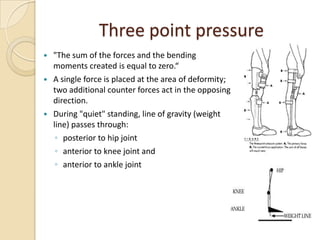
Three point pressure
 "The sum of the forces and the bending
moments created is equal to zero.“
 A single force is placed at the area of deformity;
two additional counter forces act in the opposing
direction.
 During "quiet" standing, line of gravity (weight
line) passes through:
◦ posterior to hip joint
◦ anterior to knee joint and
◦ anterior to ankle joint
Total contact
 “Pressure is equal to the total force per unit area. “
 The greater the area of a pad of an orthosis, the less
force will be placed on the skin.
 P = force
Area of application
Partial weight relieving
 “The farther the point of force from the
joint, the greater the moment arm and
the smaller the magnitude of force
required to produce a given torque at
the joint.”
 The greater the length of the supporting
orthotic structure, the greater the
moment or torque that can be placed on
the joint or unstable segment.
Types of orthosis
 Upper limb orthosis.
 Lower limb orthosis.
Lower limb orthosis
 Purpose: For supporting lower limbs.
 Materials used:
◦ Plastic (recently in demand). e.g. polypropylene,
polyethylene.
◦ Metal: aluminum-light weight, stainless steel, etc.
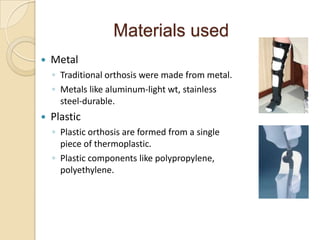
Materials used
 Metal
◦ Traditional orthosis were made from metal.
◦ Metals like aluminum-light wt, stainless
steel-durable.
 Plastic
◦ Plastic orthosis are formed from a single
piece of thermoplastic.
◦ Plastic components like polypropylene,
polyethylene.
Types of lower limb orthosis
 Ankle foot orthosis (AFO)
 Knee ankle foot orthosis (KAFO)
 Knee orthosis (KO)
 Hip knee ankle foot orthosis (HKAFO)
 Hip orthosis (HO)
AFO
 Ankle-foot orthosis is a brace, usually
plastic, worn on the lower leg and foot
to support the ankle, hold the foot and
ankle in the correct position, and
correct foot drop.
 Purpose:
◦ To control alignment and motion of the
joints of foot and ankle.
◦ For patients affected with muscular
dystrophy, cerebral palsy, etc.
 Construction:
◦ Consists of a shoe attachment, ankle
control, uprights and a proximal leg
band.
 Parts:
◦ Calf bands
◦ Metal uprights
◦ Ankle joint
◦ Shoe attachments
◦ Stirrup
Calf band
Metal upright
Ankle joint
Shoe
attachments
Stirrup
Types of AFO
 Dorsiflexion assist AFO:
◦ In case of moderate foot drop.
 Plantar flexion assist AFO:
 Posterior leaf spring AFO:
 Patellar tendon bearing AFO:
 Spiral AFO:
 Solid AFO:
◦ In case of severe foot drop.
Knee Ankle Foot Orthosis (KAFO)
 A KAFO is a long-leg orthosis that spans
the knee, the ankle, and the foot in an
effort to stabilize the joints and assist
the muscles of the leg.
 Material for fabrication: metals, plastics,
fabrics, and leather.
Parts
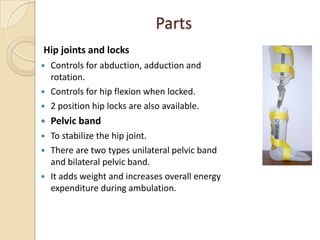
Hip joints and locks
 Controls for abduction, adduction and
rotation.
 Controls for hip flexion when locked.
 2 position hip locks are also available.
 Pelvic band
 To stabilize the hip joint.
 There are two types unilateral pelvic band
and bilateral pelvic band.
 It adds weight and increases overall energy
expenditure during ambulation.
Types of KAFO
 Supracondylar plastic orthosis.
 Scott-Craig orthosis.
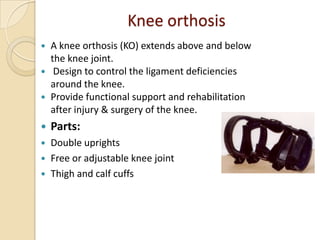
Knee orthosis
 A knee orthosis (KO) extends above and below
the knee joint.
 Design to control the ligament deficiencies
around the knee.
 Provide functional support and rehabilitation
after injury & surgery of the knee.
 Parts:
 Double uprights
 Free or adjustable knee joint
 Thigh and calf cuffs
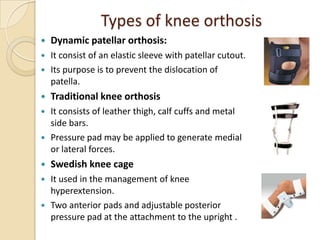
Types of knee orthosis
 Dynamic patellar orthosis:
 It consist of an elastic sleeve with patellar cutout.
 Its purpose is to prevent the dislocation of
patella.
 Traditional knee orthosis
 It consists of leather thigh, calf cuffs and metal
side bars.
 Pressure pad may be applied to generate medial
or lateral forces.
 Swedish knee cage
 It used in the management of knee
hyperextension.
 Two anterior pads and adjustable posterior
pressure pad at the attachment to the upright .
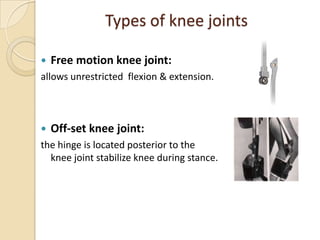
Types of knee joints
 Free motion knee joint:
allows unrestricted flexion & extension.
 Off-set knee joint:
the hinge is located posterior to the
knee joint stabilize knee during stance.
Hip Knee Ankle Foot Orthosis (HKAFO)
 Hip joint and pelvic band attached to the lateral
upright of a KAFO converts it to a HKAFO.
 Purpose:
◦ Hip flexion/extension instability
◦ Hip adduction/abduction weakness
◦ Hip internal rotation/external rotation
instability
 Parts:
◦ Sole plate extending to the metatarsal
heads with a crossbar added to the
metatarsal heads area for mediolateral
stabilization.
◦ Ankle joint set at 10° of dorsiflexion
◦ Anterior rigid tibial band (patellar tendon
strap)
◦ Offset knee joint with bail lock
◦ Proximal posterior thigh band
Types of HKAFO
 Reciprocal Gait Orthosis (RGO)
 It is used for upper lumbar paralysis in
which active hip flexion is preserved.
 RGO consists of bilateral HKAFO with
offset knee joints, knee drop locks,
posterior plastic AFO, thigh pieces,
custom molded pelvic girdle, hip joints,
and a thoracic extension with Velcro®
straps, in addition to the control
mechanism
Hip orthosis
 Purpose:
◦ To resist femoral adduction.
◦ Mostly in elderly patients who have had total
hip joint replacement.
 Parts:
◦ Two position lock which permits full extension
and 95 degree of hip flexion and adjustable
adduction stop.

orthosis-130814094004-phpapp02.pdf

  • 1.
  • 2.
    Orthosis  Definition: Orthosisis an orthopedic appliance or apparatus used to support, align, prevent, or correct deformities or to improve function of movable parts of the body.  Purpose: 1. To lend stability to a weak joint. 2. Correct or maintain alignment. 3. Correct skeletal deformities, etc.
  • 3.
    Principles in designingorthosis  Three point pressure.  Total contact.  Partial weight relieving.
  • 4.
    Three point pressure "The sum of the forces and the bending moments created is equal to zero.“  A single force is placed at the area of deformity; two additional counter forces act in the opposing direction.  During "quiet" standing, line of gravity (weight line) passes through: ◦ posterior to hip joint ◦ anterior to knee joint and ◦ anterior to ankle joint
  • 5.
    Total contact  “Pressureis equal to the total force per unit area. “  The greater the area of a pad of an orthosis, the less force will be placed on the skin.  P = force Area of application
  • 6.
    Partial weight relieving “The farther the point of force from the joint, the greater the moment arm and the smaller the magnitude of force required to produce a given torque at the joint.”  The greater the length of the supporting orthotic structure, the greater the moment or torque that can be placed on the joint or unstable segment.
  • 7.
    Types of orthosis Upper limb orthosis.  Lower limb orthosis.
  • 8.
    Lower limb orthosis Purpose: For supporting lower limbs.  Materials used: ◦ Plastic (recently in demand). e.g. polypropylene, polyethylene. ◦ Metal: aluminum-light weight, stainless steel, etc.
  • 9.
    Materials used  Metal ◦Traditional orthosis were made from metal. ◦ Metals like aluminum-light wt, stainless steel-durable.  Plastic ◦ Plastic orthosis are formed from a single piece of thermoplastic. ◦ Plastic components like polypropylene, polyethylene.
  • 10.
    Types of lowerlimb orthosis  Ankle foot orthosis (AFO)  Knee ankle foot orthosis (KAFO)  Knee orthosis (KO)  Hip knee ankle foot orthosis (HKAFO)  Hip orthosis (HO)
  • 11.
    AFO  Ankle-foot orthosisis a brace, usually plastic, worn on the lower leg and foot to support the ankle, hold the foot and ankle in the correct position, and correct foot drop.  Purpose: ◦ To control alignment and motion of the joints of foot and ankle. ◦ For patients affected with muscular dystrophy, cerebral palsy, etc.  Construction: ◦ Consists of a shoe attachment, ankle control, uprights and a proximal leg band.
  • 12.
     Parts: ◦ Calfbands ◦ Metal uprights ◦ Ankle joint ◦ Shoe attachments ◦ Stirrup Calf band Metal upright Ankle joint Shoe attachments Stirrup
  • 13.
    Types of AFO Dorsiflexion assist AFO: ◦ In case of moderate foot drop.  Plantar flexion assist AFO:  Posterior leaf spring AFO:  Patellar tendon bearing AFO:  Spiral AFO:  Solid AFO: ◦ In case of severe foot drop.
  • 14.
    Knee Ankle FootOrthosis (KAFO)  A KAFO is a long-leg orthosis that spans the knee, the ankle, and the foot in an effort to stabilize the joints and assist the muscles of the leg.  Material for fabrication: metals, plastics, fabrics, and leather.
  • 15.
    Parts Hip joints andlocks  Controls for abduction, adduction and rotation.  Controls for hip flexion when locked.  2 position hip locks are also available.  Pelvic band  To stabilize the hip joint.  There are two types unilateral pelvic band and bilateral pelvic band.  It adds weight and increases overall energy expenditure during ambulation.
  • 16.
    Types of KAFO Supracondylar plastic orthosis.  Scott-Craig orthosis.
  • 17.
    Knee orthosis  Aknee orthosis (KO) extends above and below the knee joint.  Design to control the ligament deficiencies around the knee.  Provide functional support and rehabilitation after injury & surgery of the knee.  Parts:  Double uprights  Free or adjustable knee joint  Thigh and calf cuffs
  • 18.
    Types of kneeorthosis  Dynamic patellar orthosis:  It consist of an elastic sleeve with patellar cutout.  Its purpose is to prevent the dislocation of patella.  Traditional knee orthosis  It consists of leather thigh, calf cuffs and metal side bars.  Pressure pad may be applied to generate medial or lateral forces.  Swedish knee cage  It used in the management of knee hyperextension.  Two anterior pads and adjustable posterior pressure pad at the attachment to the upright .
  • 19.
    Types of kneejoints  Free motion knee joint: allows unrestricted flexion & extension.  Off-set knee joint: the hinge is located posterior to the knee joint stabilize knee during stance.
  • 20.
    Hip Knee AnkleFoot Orthosis (HKAFO)  Hip joint and pelvic band attached to the lateral upright of a KAFO converts it to a HKAFO.  Purpose: ◦ Hip flexion/extension instability ◦ Hip adduction/abduction weakness ◦ Hip internal rotation/external rotation instability
  • 21.
     Parts: ◦ Soleplate extending to the metatarsal heads with a crossbar added to the metatarsal heads area for mediolateral stabilization. ◦ Ankle joint set at 10° of dorsiflexion ◦ Anterior rigid tibial band (patellar tendon strap) ◦ Offset knee joint with bail lock ◦ Proximal posterior thigh band
  • 22.
    Types of HKAFO Reciprocal Gait Orthosis (RGO)  It is used for upper lumbar paralysis in which active hip flexion is preserved.  RGO consists of bilateral HKAFO with offset knee joints, knee drop locks, posterior plastic AFO, thigh pieces, custom molded pelvic girdle, hip joints, and a thoracic extension with Velcro® straps, in addition to the control mechanism
  • 23.
    Hip orthosis  Purpose: ◦To resist femoral adduction. ◦ Mostly in elderly patients who have had total hip joint replacement.  Parts: ◦ Two position lock which permits full extension and 95 degree of hip flexion and adjustable adduction stop.