Hip knee ankle foot
orthosis(HKAFO) & Hip Orthosis
DR. EHTISHAM UL HAQ
Indications
Assist gait
Decrease weight bearing
Control Movement
Minimize progression of a deformity
Principle of Equilibrium
This system applies corrective and assertive forces which
are implemented at surface of orthosis through skin and
transmitted to underlying soft tissue and bones
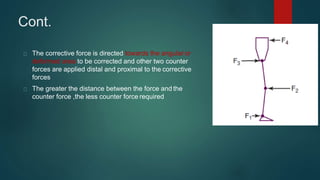
To remain stable ,the body has to have one point of pressure
opposed by two equal points of counter pressure
Hip joint: F3 =F2+F4
Knee joint: F2=F1+F3
Forces F1, F2, and F3 control knee flexion, while forces F2,
F3, and F4 control hip flexion
Cont.
The corrective force is directed towards the angular or
deformed area to be corrected and other two counter
forces are applied distal and proximal to the corrective
forces
The greater the distance between the force and the
counter force ,the less counter force required
Hip knee ankle foot orthosis
A hip–knee–ankle–foot orthosis (HKAFO) is an orthosis whose components
stabilize or lock the hip, knee and ankle
The typical HKAFO is a pair of KAFOs linked above the hip with either a
pelvic band, lumbosacral orthosis
The hip section provides significant stability in the transverse plane and, if
the hip joints are locked, also provides sagittal plane stability
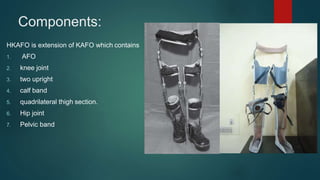
Components:
HKAFO is extension of KAFO which contains
1. AFO
2. knee joint
3. two upright
4. calf band
5. quadrilateral thigh section.
6. Hip joint
7. Pelvic band
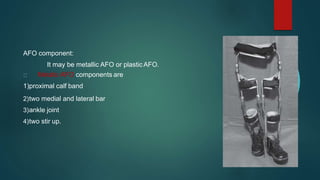
AFO component:
It may be metallic AFO or plasticAFO.
Metalic AFO components are
1)proximal calf band
2)two medial and lateral bar
3)ankle joint
4)two stir up.
Fabrication process of plastic AFO
Step 1:
Creating a negative plaster mould of
patient's lower leg and foot
Step 2:
Cutting and removing plaster mold from
patient
Step 3:
Pouring liquid plaster into the negative
plaster mold
Step 4:
Modifing the positive plaster cast
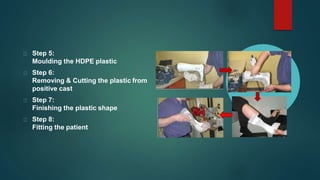
Step 5:
Moulding the HDPE plastic
Step 6:
Removing & Cutting the plastic from
positive cast
Step 7:
Finishing the plastic shape
Step 8:
Fitting the patient
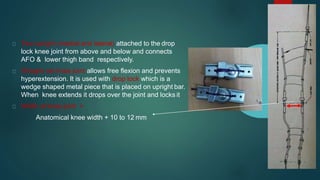
Two upright (medial and lateral) attached to the drop
lock knee joint from above and below and connects
AFO & lower thigh band respectively.
Straight set knee joint allows free flexion and prevents
hyperextension. It is used with drop lock which is a
wedge shaped metal piece that is placed on upright bar.
When knee extends it drops over the joint and locks it
Width at knee joint =
Anatomical knee width + 10 to 12 mm
Quadrilateral thigh sections
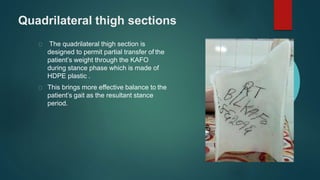
The quadrilateral thigh section is
designed to permit partial transfer of the
patient’s weight through the KAFO
during stance phase which is made of
HDPE plastic .
This brings more effective balance to the
patient’s gait as the resultant stance
period.
Hip joint
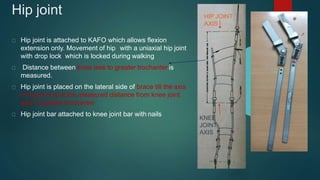
Hip joint is attached to KAFO which allows flexion
extension only. Movement of hip with a uniaxial hip joint
with drop lock which is locked during walking
Distance between knee axis to greater trochanter is
measured.
Hip joint is placed on the lateral side of brace till the axis
of hip joint is at the measured distance from knee joint
axis to greater trochanter
Hip joint bar attached to knee joint bar with nails
HIP JOINT
AXIS
KNEE
JOINT
AXIS
Pelvic band
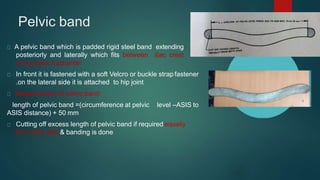
A pelvic band which is padded rigid steel band extending
posteriorly and laterally which fits between iliac crest
and greater trochanter
In front it is fastened with a soft Velcro or buckle strap fastener
.on the lateral side it is attached to hip joint
Measurement of pelvic band:
length of pelvic band =(circumference at pelvic level –ASIS to
ASIS distance) + 50 mm
Cutting off excess length of pelvic band if required equally
from both side & banding is done
Indication:
Bilateral HKAFOs designed for standing and ambulation in adults with
paraplegia. It provides the paraplegic patient who has a complete
neurological level at L1 or lower with a more functional and comfortable gait
Reciprocal Gait Orthosis (RGO)
A reciprocating gait orthosis (RGO) is
an HKAFO that uses a mechanical
system that connects the two sides of
the brace by
1. Isocentric bar (IRGO)
2. Double cable (LSU RGO from
Louisiana State University)
3. Single push/pull cable system
(advanced RGO [ARGO] )
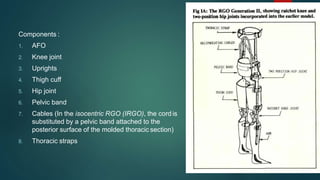
Components :
1. AFO
2. Knee joint
3. Uprights
4. Thigh cuff
5. Hip joint
6. Pelvic band
7. Cables (In the isocentric RGO (IRGO), the cord is
substituted by a pelvic band attached to the
posterior surface of the molded thoracic section)
8. Thoracic straps
In all RGOs, the hip joints are coupled together with cables(pelvic band in the IRGO) which
provides mechanical assistance to hip extension while preventing simultaneous bilateral hip
flexion
As a step is initiated and hip flexion takes place on one side, the cable coupling induces
hip extension on the opposite side, producing a reciprocal walking pattern
Forward stepping is achieved by active hip flexion, lower abdominal muscle
Using 2 crutches and an RGO, paraplegics can ambulate with a 4-point gait. A walker may
also be used
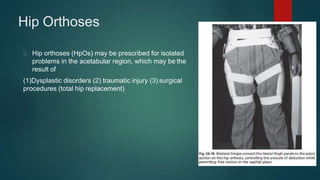
Hip Orthoses
Hip orthoses (HpOs) may be prescribed for isolated
problems in the acetabular region, which may be the
result of
(1)Dysplastic disorders (2) traumatic injury (3) surgical
procedures (total hip replacement)
Orthosis in dislocation of hip joint
Once reduced, a total hip can be stabilized with an orthosis until the
compromised soft tissue heals and creates scarring around the jointThis
usually prevents further dislocations if the femoral and acetabular
components are well positioned
In the past, hip spica casts have been shown to be useful for this purpose.
Currently, orthoses offer several advantages over casts. Orthoses weigh
less, which makes them easier totolerate during ambulation
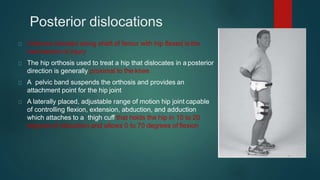
Posterior dislocations
Violence directed along shaft of femur with hip flexed is the
mechanism of injury
The hip orthosis used to treat a hip that dislocates in a posterior
direction is generally proximal to the knee
A pelvic band suspends the orthosis and provides an
attachment point for the hip joint
A laterally placed, adjustable range of motion hip joint capable
of controlling flexion, extension, abduction, and adduction
which attaches to a thigh cuff that holds the hip in 10 to 20
degrees of abduction and allows 0 to 70 degrees of flexion
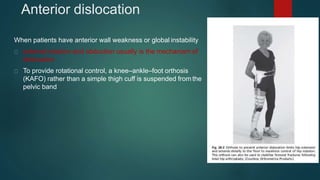
Anterior dislocation
When patients have anterior wall weakness or global instability
external rotation and abduction usually is the mechanism of
dislocation
To provide rotational control, a knee–ankle–foot orthosis
(KAFO) rather than a simple thigh cuff is suspended from the
pelvic band
Pediatric hip orthosis
Conditions that fall within this category include
Developmental dysplasia of the hip (DDH)
Legg-Calve´-Perthes disease (LCP)
cerebral palsy (CP)
lower limb weakness or paralysis associated with neuromuscular disorders,
myelodysplasia, and spinal cord injury
Developmental dysplasia of the hip (DDH) Orthosis
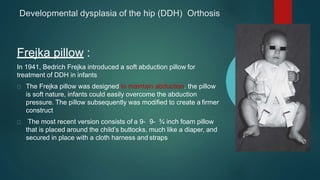
Frejka pillow :
In 1941, Bedrich Frejka introduced a soft abduction pillow for
treatment of DDH in infants
The Frejka pillow was designed to maintain abduction. the pillow
is soft nature, infants could easily overcome the abduction
pressure. The pillow subsequently was modified to create a firmer
construct
The most recent version consists of a 9- 9- ¾ inch foam pillow
that is placed around the child’s buttocks, much like a diaper, and
secured in place with a cloth harness and straps
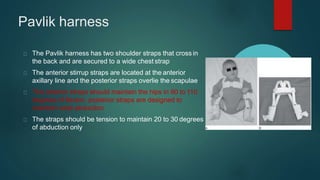
Pavlik harness
The Pavlik harness has two shoulder straps that cross in
the back and are secured to a wide chest strap
The anterior stirrup straps are located at the anterior
axillary line and the posterior straps overlie the scapulae
The anterior straps should maintain the hips in 90 to 110
degrees of flexion. posterior straps are designed to
maintain wide abduction
The straps should be tension to maintain 20 to 30 degrees
of abduction only
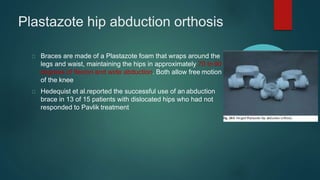
Plastazote hip abduction orthosis
Braces are made of a Plastazote foam that wraps around the
legs and waist, maintaining the hips in approximately 70 to 90
degrees of flexion and wide abduction. Both allow free motion
of the knee
Hedequist et al.reported the successful use of an abduction
brace in 13 of 15 patients with dislocated hips who had not
responded to Pavlik treatment
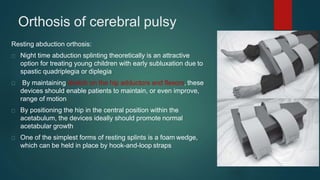
Orthosis of cerebral pulsy
Resting abduction orthosis:
Night time abduction splinting theoretically is an attractive
option for treating young children with early subluxation due to
spastic quadriplegia or diplegia
By maintaining stretch on the hip adductors and flexors, these
devices should enable patients to maintain, or even improve,
range of motion
By positioning the hip in the central position within the
acetabulum, the devices ideally should promote normal
acetabular growth
One of the simplest forms of resting splints is a foam wedge,
which can be held in place by hook-and-loop straps
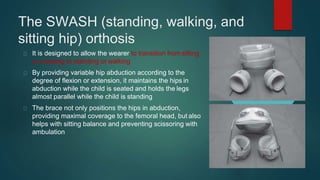
The SWASH (standing, walking, and
sitting hip) orthosis
It is designed to allow the wearer to transition from sitting
or crawling to standing or walking
By providing variable hip abduction according to the
degree of flexion or extension, it maintains the hips in
abduction while the child is seated and holds the legs
almost parallel while the child is standing
The brace not only positions the hips in abduction,
providing maximal coverage to the femoral head, but also
helps with sitting balance and preventing scissoring with
ambulation
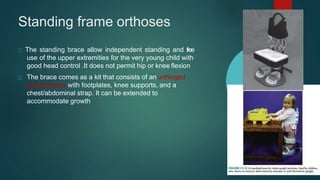
Standing frame orthoses
The standing brace allow independent standing and free
use of the upper extremities for the very young child with
good head control .It does not permit hip or knee flexion
The brace comes as a kit that consists of an unhinged
upright frame with footplates, knee supports, and a
chest/abdominal strap. It can be extended to
accommodate growth
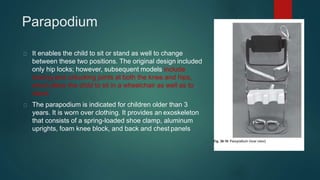
Parapodium
It enables the child to sit or stand as well to change
between these two positions. The original design included
only hip locks; however, subsequent models include
locking and unlocking joints at both the knee and hips,
which allow the child to sit in a wheelchair as well as to
stand
The parapodium is indicated for children older than 3
years. It is worn over clothing. It provides an exoskeleton
that consists of a spring-loaded shoe clamp, aluminum
uprights, foam knee block, and back and chest panels
References:
Atlas of orthosis by AAOS
Physical medicine and rehabilitation by Braddom
Physical medicine and rehabilitation by Board review
THANK YOU

hip orthosis.pptx

  • 1.
    Hip knee anklefoot orthosis(HKAFO) & Hip Orthosis DR. EHTISHAM UL HAQ
  • 2.
    Indications Assist gait Decrease weightbearing Control Movement Minimize progression of a deformity
  • 3.
    Principle of Equilibrium Thissystem applies corrective and assertive forces which are implemented at surface of orthosis through skin and transmitted to underlying soft tissue and bones To remain stable ,the body has to have one point of pressure opposed by two equal points of counter pressure Hip joint: F3 =F2+F4 Knee joint: F2=F1+F3 Forces F1, F2, and F3 control knee flexion, while forces F2, F3, and F4 control hip flexion
  • 4.
    Cont. The corrective forceis directed towards the angular or deformed area to be corrected and other two counter forces are applied distal and proximal to the corrective forces The greater the distance between the force and the counter force ,the less counter force required
  • 5.
    Hip knee anklefoot orthosis A hip–knee–ankle–foot orthosis (HKAFO) is an orthosis whose components stabilize or lock the hip, knee and ankle The typical HKAFO is a pair of KAFOs linked above the hip with either a pelvic band, lumbosacral orthosis The hip section provides significant stability in the transverse plane and, if the hip joints are locked, also provides sagittal plane stability
  • 6.
    Components: HKAFO is extensionof KAFO which contains 1. AFO 2. knee joint 3. two upright 4. calf band 5. quadrilateral thigh section. 6. Hip joint 7. Pelvic band
  • 7.
    AFO component: It maybe metallic AFO or plasticAFO. Metalic AFO components are 1)proximal calf band 2)two medial and lateral bar 3)ankle joint 4)two stir up.
  • 8.
    Fabrication process ofplastic AFO Step 1: Creating a negative plaster mould of patient's lower leg and foot Step 2: Cutting and removing plaster mold from patient Step 3: Pouring liquid plaster into the negative plaster mold Step 4: Modifing the positive plaster cast
  • 9.
    Step 5: Moulding theHDPE plastic Step 6: Removing & Cutting the plastic from positive cast Step 7: Finishing the plastic shape Step 8: Fitting the patient
  • 10.
    Two upright (medialand lateral) attached to the drop lock knee joint from above and below and connects AFO & lower thigh band respectively. Straight set knee joint allows free flexion and prevents hyperextension. It is used with drop lock which is a wedge shaped metal piece that is placed on upright bar. When knee extends it drops over the joint and locks it Width at knee joint = Anatomical knee width + 10 to 12 mm
  • 11.
    Quadrilateral thigh sections Thequadrilateral thigh section is designed to permit partial transfer of the patient’s weight through the KAFO during stance phase which is made of HDPE plastic . This brings more effective balance to the patient’s gait as the resultant stance period.
  • 12.
    Hip joint Hip jointis attached to KAFO which allows flexion extension only. Movement of hip with a uniaxial hip joint with drop lock which is locked during walking Distance between knee axis to greater trochanter is measured. Hip joint is placed on the lateral side of brace till the axis of hip joint is at the measured distance from knee joint axis to greater trochanter Hip joint bar attached to knee joint bar with nails HIP JOINT AXIS KNEE JOINT AXIS
  • 13.
    Pelvic band A pelvicband which is padded rigid steel band extending posteriorly and laterally which fits between iliac crest and greater trochanter In front it is fastened with a soft Velcro or buckle strap fastener .on the lateral side it is attached to hip joint Measurement of pelvic band: length of pelvic band =(circumference at pelvic level –ASIS to ASIS distance) + 50 mm Cutting off excess length of pelvic band if required equally from both side & banding is done
  • 14.
    Indication: Bilateral HKAFOs designedfor standing and ambulation in adults with paraplegia. It provides the paraplegic patient who has a complete neurological level at L1 or lower with a more functional and comfortable gait
  • 15.
    Reciprocal Gait Orthosis(RGO) A reciprocating gait orthosis (RGO) is an HKAFO that uses a mechanical system that connects the two sides of the brace by 1. Isocentric bar (IRGO) 2. Double cable (LSU RGO from Louisiana State University) 3. Single push/pull cable system (advanced RGO [ARGO] )
  • 16.
    Components : 1. AFO 2.Knee joint 3. Uprights 4. Thigh cuff 5. Hip joint 6. Pelvic band 7. Cables (In the isocentric RGO (IRGO), the cord is substituted by a pelvic band attached to the posterior surface of the molded thoracic section) 8. Thoracic straps
  • 17.
    In all RGOs,the hip joints are coupled together with cables(pelvic band in the IRGO) which provides mechanical assistance to hip extension while preventing simultaneous bilateral hip flexion As a step is initiated and hip flexion takes place on one side, the cable coupling induces hip extension on the opposite side, producing a reciprocal walking pattern Forward stepping is achieved by active hip flexion, lower abdominal muscle Using 2 crutches and an RGO, paraplegics can ambulate with a 4-point gait. A walker may also be used
  • 18.
    Hip Orthoses Hip orthoses(HpOs) may be prescribed for isolated problems in the acetabular region, which may be the result of (1)Dysplastic disorders (2) traumatic injury (3) surgical procedures (total hip replacement)
  • 19.
    Orthosis in dislocationof hip joint Once reduced, a total hip can be stabilized with an orthosis until the compromised soft tissue heals and creates scarring around the jointThis usually prevents further dislocations if the femoral and acetabular components are well positioned In the past, hip spica casts have been shown to be useful for this purpose. Currently, orthoses offer several advantages over casts. Orthoses weigh less, which makes them easier totolerate during ambulation
  • 20.
    Posterior dislocations Violence directedalong shaft of femur with hip flexed is the mechanism of injury The hip orthosis used to treat a hip that dislocates in a posterior direction is generally proximal to the knee A pelvic band suspends the orthosis and provides an attachment point for the hip joint A laterally placed, adjustable range of motion hip joint capable of controlling flexion, extension, abduction, and adduction which attaches to a thigh cuff that holds the hip in 10 to 20 degrees of abduction and allows 0 to 70 degrees of flexion
  • 21.
    Anterior dislocation When patientshave anterior wall weakness or global instability external rotation and abduction usually is the mechanism of dislocation To provide rotational control, a knee–ankle–foot orthosis (KAFO) rather than a simple thigh cuff is suspended from the pelvic band
  • 22.
    Pediatric hip orthosis Conditionsthat fall within this category include Developmental dysplasia of the hip (DDH) Legg-Calve´-Perthes disease (LCP) cerebral palsy (CP) lower limb weakness or paralysis associated with neuromuscular disorders, myelodysplasia, and spinal cord injury
  • 23.
    Developmental dysplasia ofthe hip (DDH) Orthosis Frejka pillow : In 1941, Bedrich Frejka introduced a soft abduction pillow for treatment of DDH in infants The Frejka pillow was designed to maintain abduction. the pillow is soft nature, infants could easily overcome the abduction pressure. The pillow subsequently was modified to create a firmer construct The most recent version consists of a 9- 9- ¾ inch foam pillow that is placed around the child’s buttocks, much like a diaper, and secured in place with a cloth harness and straps
  • 24.
    Pavlik harness The Pavlikharness has two shoulder straps that cross in the back and are secured to a wide chest strap The anterior stirrup straps are located at the anterior axillary line and the posterior straps overlie the scapulae The anterior straps should maintain the hips in 90 to 110 degrees of flexion. posterior straps are designed to maintain wide abduction The straps should be tension to maintain 20 to 30 degrees of abduction only
  • 25.
    Plastazote hip abductionorthosis Braces are made of a Plastazote foam that wraps around the legs and waist, maintaining the hips in approximately 70 to 90 degrees of flexion and wide abduction. Both allow free motion of the knee Hedequist et al.reported the successful use of an abduction brace in 13 of 15 patients with dislocated hips who had not responded to Pavlik treatment
  • 26.
    Orthosis of cerebralpulsy Resting abduction orthosis: Night time abduction splinting theoretically is an attractive option for treating young children with early subluxation due to spastic quadriplegia or diplegia By maintaining stretch on the hip adductors and flexors, these devices should enable patients to maintain, or even improve, range of motion By positioning the hip in the central position within the acetabulum, the devices ideally should promote normal acetabular growth One of the simplest forms of resting splints is a foam wedge, which can be held in place by hook-and-loop straps
  • 27.
    The SWASH (standing,walking, and sitting hip) orthosis It is designed to allow the wearer to transition from sitting or crawling to standing or walking By providing variable hip abduction according to the degree of flexion or extension, it maintains the hips in abduction while the child is seated and holds the legs almost parallel while the child is standing The brace not only positions the hips in abduction, providing maximal coverage to the femoral head, but also helps with sitting balance and preventing scissoring with ambulation
  • 28.
    Standing frame orthoses Thestanding brace allow independent standing and free use of the upper extremities for the very young child with good head control .It does not permit hip or knee flexion The brace comes as a kit that consists of an unhinged upright frame with footplates, knee supports, and a chest/abdominal strap. It can be extended to accommodate growth
  • 29.
    Parapodium It enables thechild to sit or stand as well to change between these two positions. The original design included only hip locks; however, subsequent models include locking and unlocking joints at both the knee and hips, which allow the child to sit in a wheelchair as well as to stand The parapodium is indicated for children older than 3 years. It is worn over clothing. It provides an exoskeleton that consists of a spring-loaded shoe clamp, aluminum uprights, foam knee block, and back and chest panels
  • 30.
    References: Atlas of orthosisby AAOS Physical medicine and rehabilitation by Braddom Physical medicine and rehabilitation by Board review
  • 31.